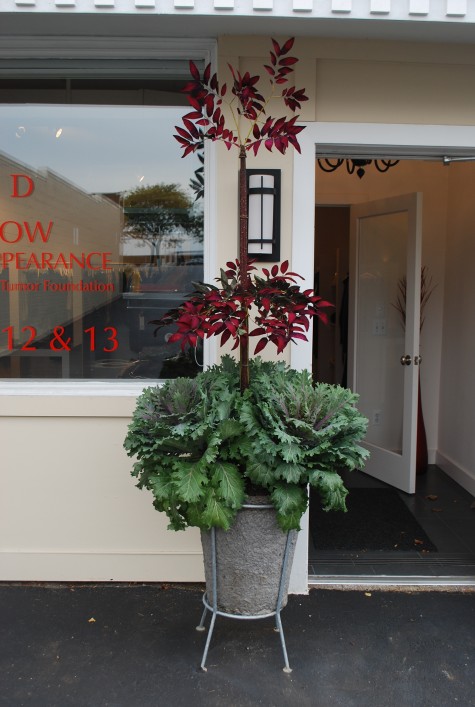
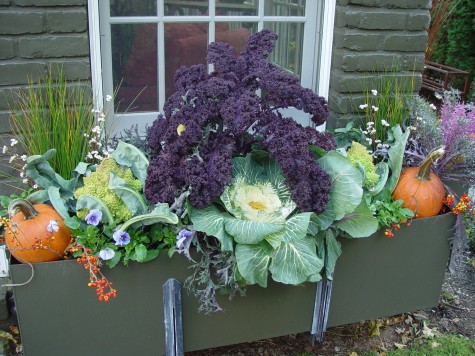
The better part of fall is the harvest from the garden. The pumpkins, the brussel sprouts and cabbage, the Romanesco broccoli, and the squashes are as delightful to look at as eat. The gourds in irresistible shapes and intense colors make you want to decorate something. I am glad to have something celebratory for the season. As I mentioned before, the cabbages and kales top my list of great fall plants. The centerpiece in the above pictured pot is unabashedly fake-just a little fall fun. This client owns a business set back quite some distance from the road. These tall and brightly colored picks, wired into a post of natural cedar whips, get some attention. The store looks dressed for fall.
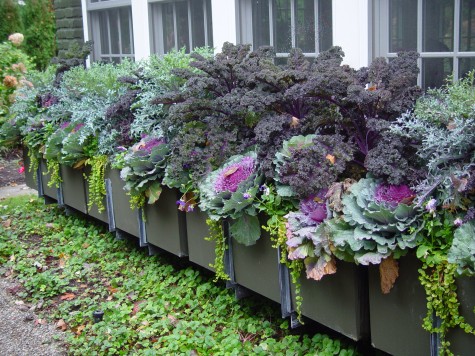 Window boxes of size permit expression of size. These boxes are viewed primarily from a garden room indoors, so big and striking, and not too tall, is the order of the day. As they face the south, and are somewhat protected from freezing winds and cold temperatures, these boxes prosper late into the fall season and through Thanksgiving.
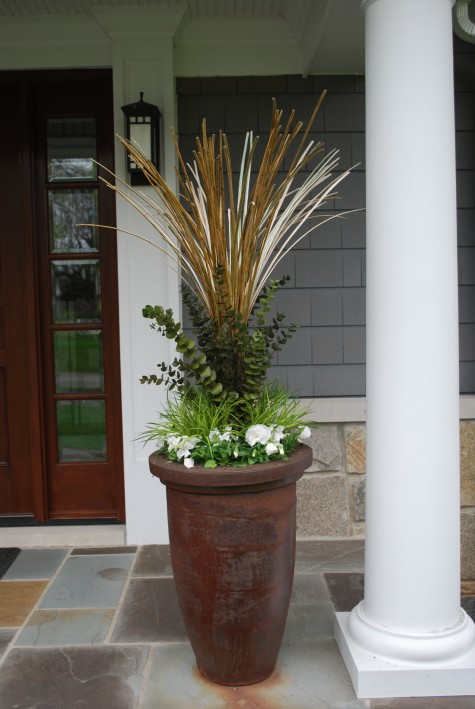 Whomever it was who invented stick stacks, I thank them. These 6 foot stacks comprised of wood cut into quarter inch by quarter inch squares are uniformly vertical when they go in a pot. A piece of steel rebar is driven deep into the pots, and the stack wired to it. This keeps the centerpiece from tilting. Funny how an element askew has that air of neglect about it. I like to see people keeping up the appearance of their homes from the street. Stick stacks change in appearance with exposure to weather. As the wood absorbs moisture from the air, they curve away from the center in a very graceful way. The preserved green eucalyptus weathers just about anything.
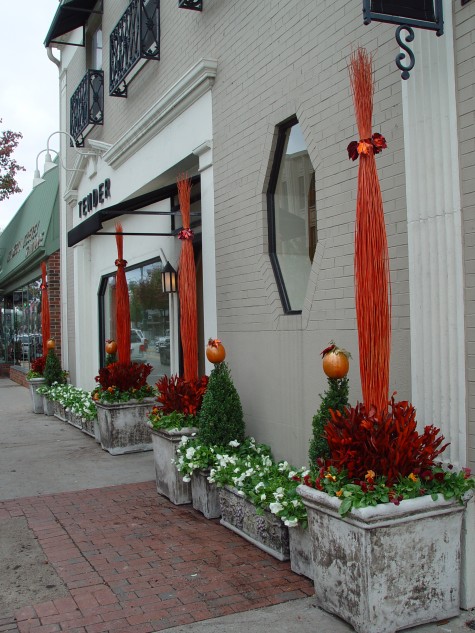 Tender is a fabulous dress shop that is known for its cutting edge fashion. Their fall pots are dressy. Maple leaves coated in copper shine, as do the pumpkins with a dusting of gold. Integrifolia dyed an intense shade of fall orange compliment the dyed pencil thin willow sticks. Orange and white pansies complete the ensemble.
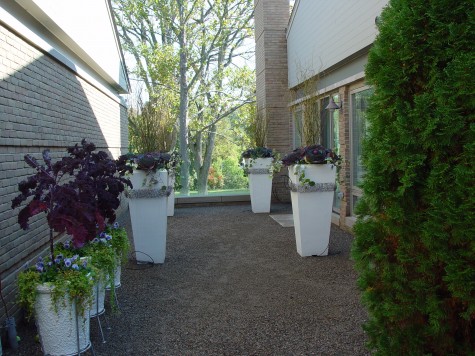 This narrow courtyard, part of a condominium, is organized around four very large white concrete pots inlaid with bands of curved stainless steel wire. Fiber pots painted white in galvanized steel stands are home to my client’s tomato plants in the summer; the tall kale, pansies, and creeping jenny compliment the cabbages and ivy in the concrete pots in both form and feeling.
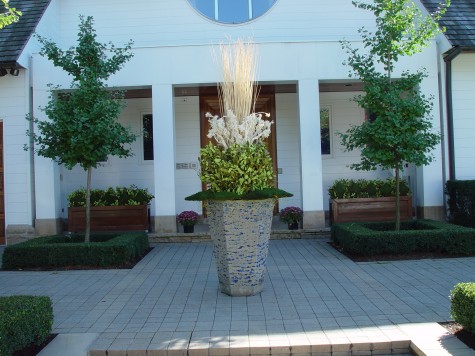 Lime integrifolia and diamond shaped moss pillows help create a clean and more modern look; not every client is enamoured of pumpkins and the like. Bleached sticks and pods complete the look.
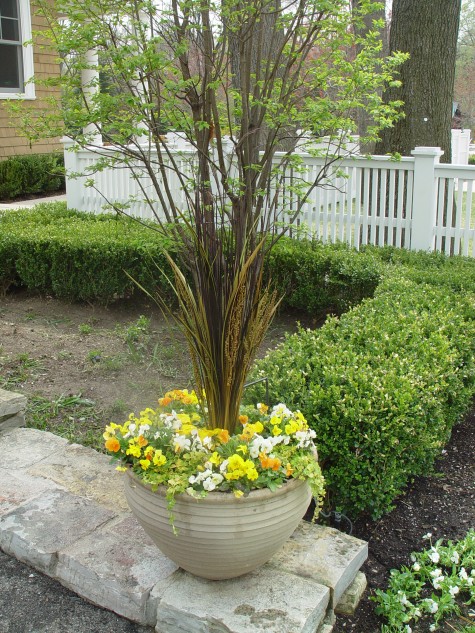
Seed pods from tropical countries have an exotic look that adds a lot of interest to a planting of pansies. These stems are ruggedly weather resistant. I am not really sure from what plant they come, but the stringy leaf stalks cannot be torn-they must be cut.
There are lots of materials available to spice up a fall planting. Any farmer’s market is a great place to find something that might suit you. Bittersweet, rose hips, dried hydrangea, money plants, thistles and cattails from the roadside-nature provides plenty of bounty at harvest time.
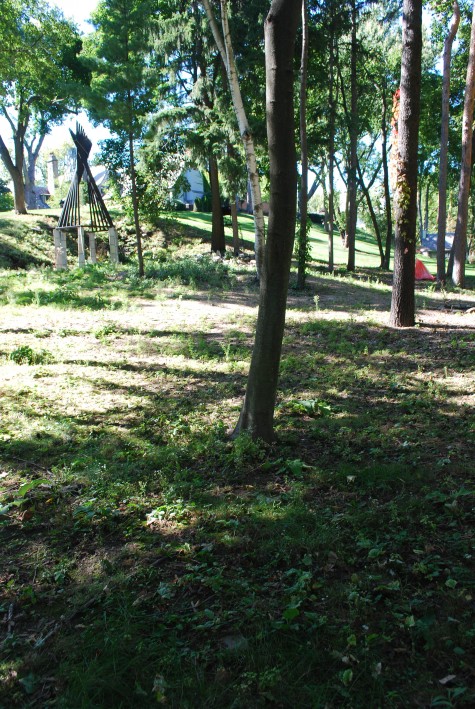 For years my client and I had been looking at a certain giant blob of a thicket on her property. Lanky buckthorn, lilac and other unkempt and untended shrubs had made the space impenetrable. The fact that the area was on a steep slope made investigating what was there all the more difficult.Not knowing what was in there made it easy to just mow around it, and act like it was part of a landscape. Every so often she would talk about what might be in there; this went on for some years.
 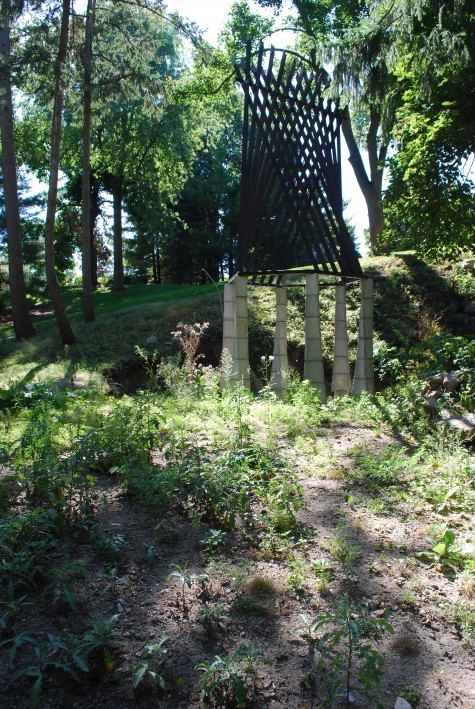 One day she called to say she had clear cut the entire spot, and discovered an old rock waterfall and pool. No doubt it dated back to the 1920’s. The precipitous drop, lined with giant rocks, was entirely stable. There was a lot of discussion about restoring the watefall and pool, which led to some discussion of a new fountain; more years went by. One day she called to say she wanted me to look at the space again-I thought as the thicket was threatening to grow back-we were being chased for a plan. How like her to install an enormous concrete and wood sculpture in the center of the old pool. This is so distinctively her way of working things out. Making a move like that was forcing everyone’s hand. I told her I thought a sculpture of this size and proportion needed its own park.
 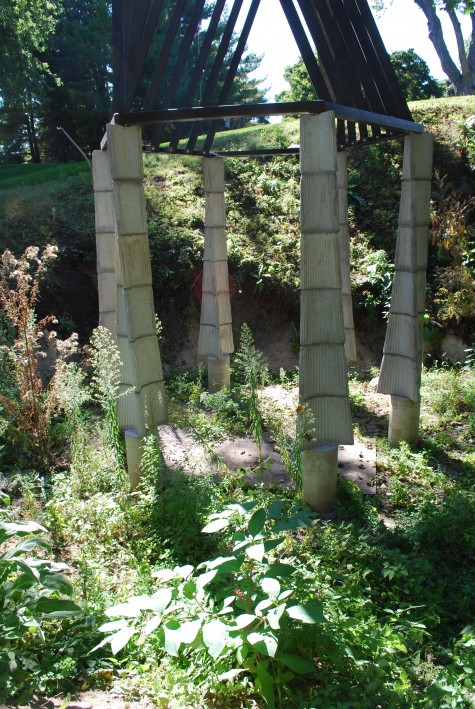 The sculptor had sunk concrete pilings in giant sonatubes. Still visible in the above picture, it was apparent no small amount of grading was needed. My client was concerned that the pool would hold water. The rim of outside soil needed to be taken down. A giant pile of rocks collected from the first clear cutting went into the hole first. Trapping water near the sculpture would not be a good idea.
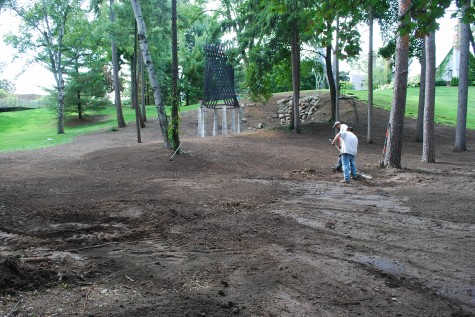 A skid steer made quick work of removing the weedy growth that had begun to take hold. I have watched the history channel television series called “Life After People” with great interest. It is astonishing how little time it takes for untended ground to go to rack and ruin. Nature abhors a vacuum; any bare dirt will have something going on in short order. Ignore a space, and nature will take over in your absence.
 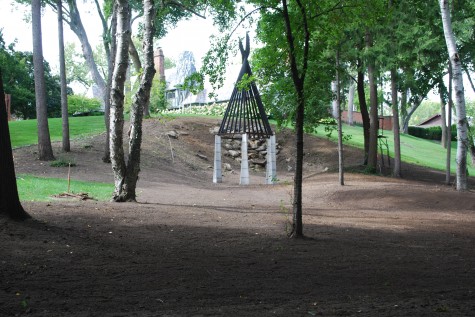 The front edge of the old pool was lowered to permit water to escape. I so love this point in a landscape project; bare sculpted dirt is incredibly beautiful. A landscape of evergreens planted in sculpted, cultivated soil-a landscape of my dreams. Barked areas in a garden leave me cold-I like to cover the ground with plants, or see dirt. I mulch strictly to conserve moisture in the soil. The pattern of light and dark on the ground here is telling. The old waterfall and pool were situated in a patch of sun. The sculpture benefits from this.
 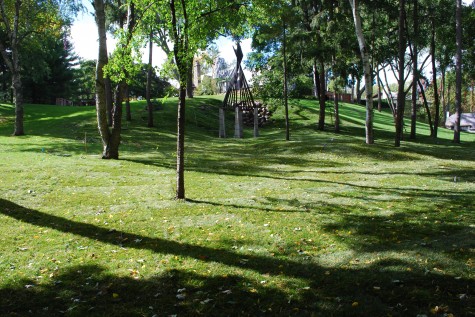 New lawn softens all the hard edges. The rolling, swelling and dipping of the ground makes for a big fluid situation for the starkly vertical sculpture on its big legs. They look good together.
 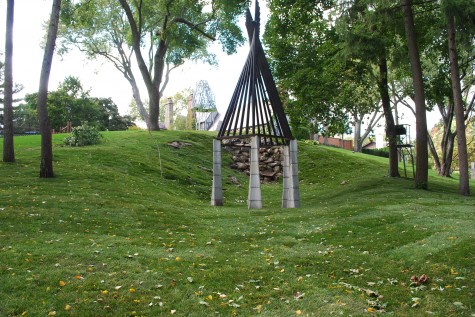 The fountain rockwork we left exposed. It is a part of the history of the property. Practically speaking, I would never have removed those giant stones; they have stabilized soil existing at a very steep angle. In the spring, my client will be able to pick and choose what she mows, and what she chooses to let be. There is a sculptural element yet to come-the decision about how and where to cut the lawn.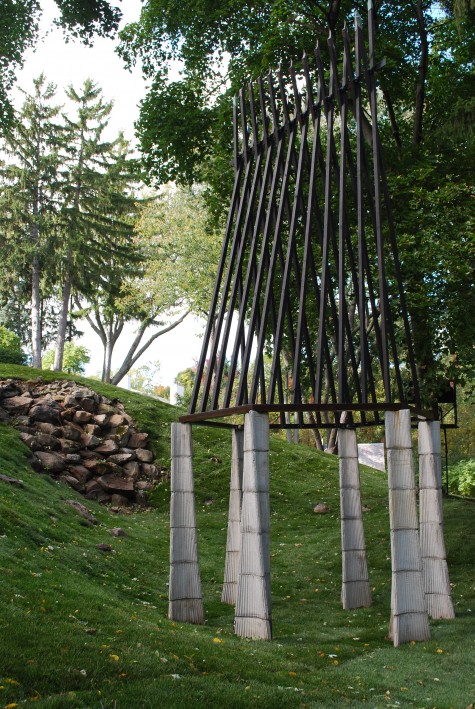
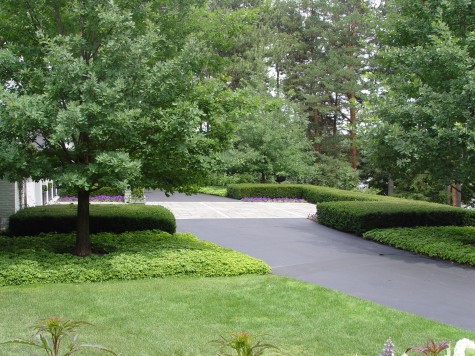 My idea of sheetcake has nothing to do with cooking batter in a pan. It has everything to do with the idea of planting shrubs in masses. There are those times and places where planting out in rows has its place. Field rows of corn, asparagus, peonies or cutting flowers can be an astonishing sight. Many years ago I designed just such a garden for a client who tithed the use of the land surrounding his house to his church. This, the intersection of agriculture and landscape. Some years later I dicovered the work of the Spanish landscape architect, Fernando Caruncho. His gardens explore the idea of agrarian based landscape design on a grand scale. His landscape, Mas De Les Voltes, I admire as much as any landscape I have ever seen. But my intent with the above pictured landscape was to suggest that a drivecourt had been carved out of a mass of taxus. Though most of the mass is actually drivecourt, the suggestion of great mass remains. Shrubs planted formally en mass-I call this a sheetcake.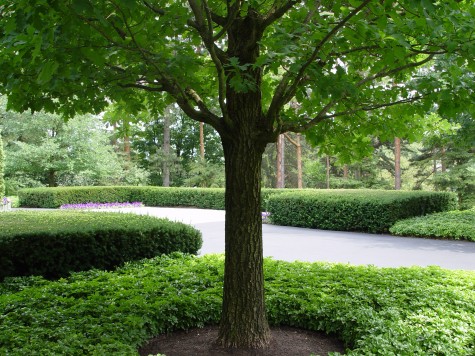
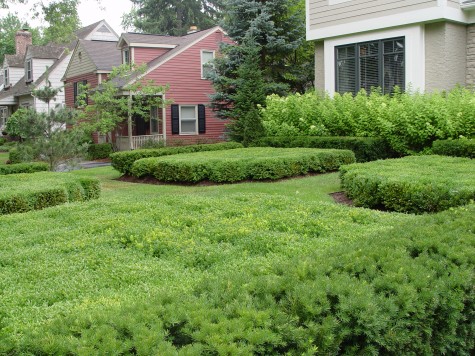 Very small urban properties can be sheetcaked to good success. One has to choose as few gestures from many possibilities, given a small space. Too much going on in a small space dilutes the impact of the landscape. In this case saying less truly is more.
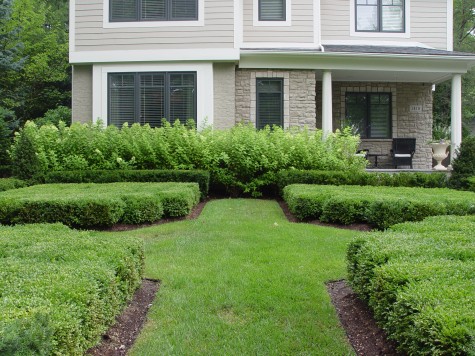 A very flat piece of land achieves a change of level with the interaction of two plant materials of different heights.
 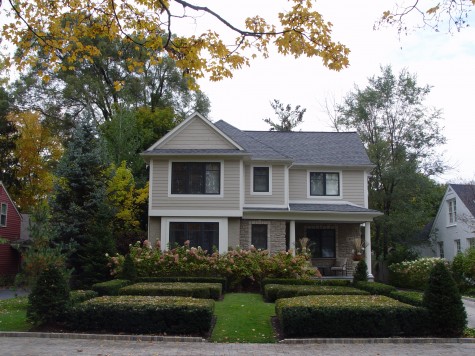 The dusting of fall leaves provides another dimension as the limelights are fading.
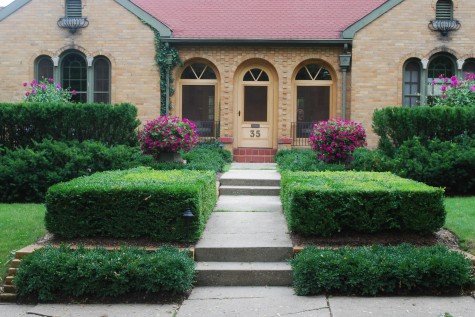 A sheetcake garden is an effective way to showcase abrupt changes in grade. I am all for celebrating any unusual characteristic of the land. One client had a low lying front yard, and an active artesian spring. I dug the ground deeper, and created a pond. The sidewalk to the front door was actually a boardwalk over the pond; you get the idea. The artesian spring was treated as an asset, rather than a nuisance. Accommodating nature helps produce a successful project.
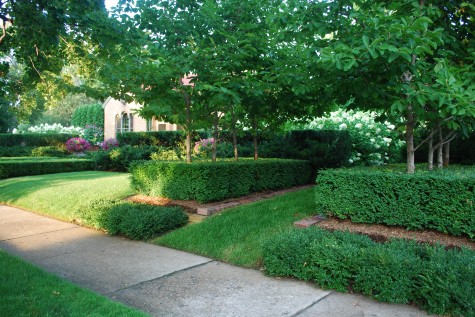 A tree inset into a sheetcake provides another layer of interest. I have talked about the spent magnolia petals on these boxwood in the spring-it is a sight for my gardening eyes.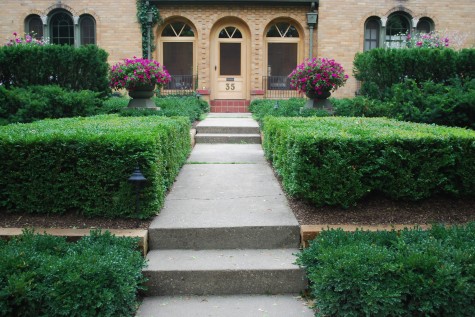
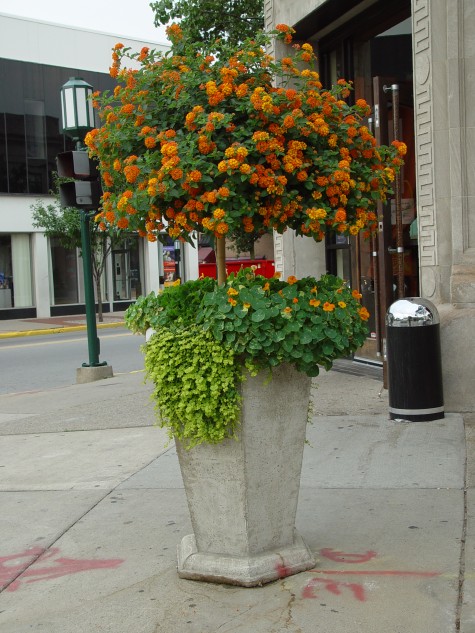 Topiary is the art of pruning, and training a plant to grow in whatever shape you might fancy. Plenty of plant species lend themselves to this kind of treatment. The above pictured lantana is seven years old. It began as a small plant, whose side branches were removed until the primary trunk was about four feet tall. A devoted grower then pinched back the main leader-the first step in the formation of the top. As I like slightly flattened spherical shapes in topiary, we keep the top pruned, and grow the side shoots wide. Lantana flowers profusely in hot weather, it makes a strikingly statuesque topiary plant. In the fall, I cut the head of the plant back by two-thirds,, strip all the remaining leaves off, and stash it in the greenhouse. I strip the leaves off, as lantana is a magnet for whitefly-and they multiply like lightening in a green house environment. What they require is plenty of trouble, but it is glorious in form and flower.
 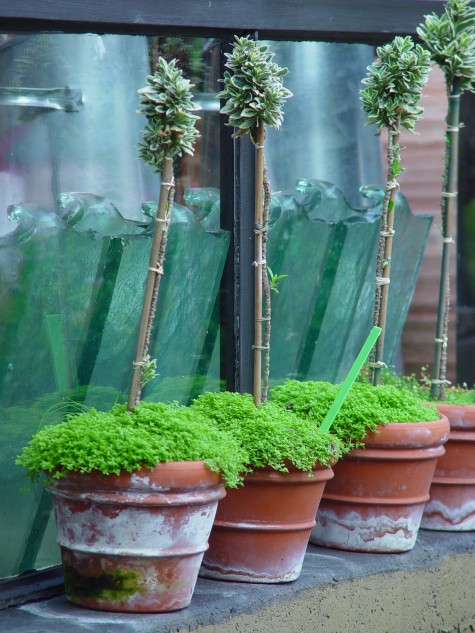 Well grown large topiary plants are expensive. It takes a lot of time to grow them on-sometimes years go by before a plant can be sold. This dwarf variegated euonymus with a batch of leaves atop a stem tells the story. In ten years, this plant will not be much taller-just much stockier, with a full head of leafy branches. As euonymus is a hardy shrub, they like to be wintered in a cool light place.
 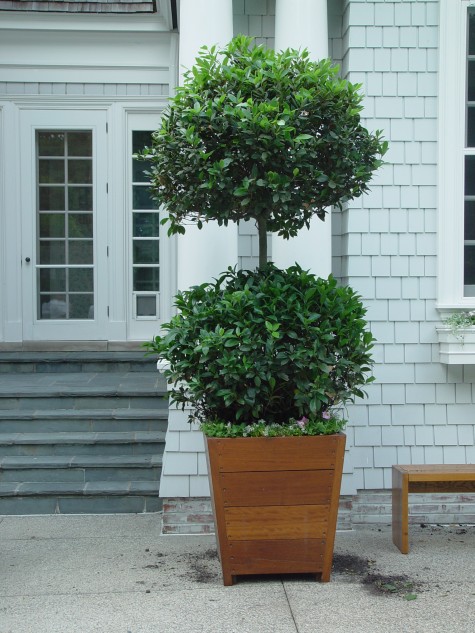 Bay Laurel is not hardy here, unfortunately-so a greenhouse is a necessity in the winter. This plant is 14 years old. This single ball topiary suckered at the base so persistently, I finally just let it grow. The formal shape is easy to keep up; you can see it needs a little haircut right now. There are many kinds of topiary shears available-I like short bladed snips, so I can cut branches without slicing into the leaves. Any leaf that is cut will show that telltale browing on that cut edge within days. �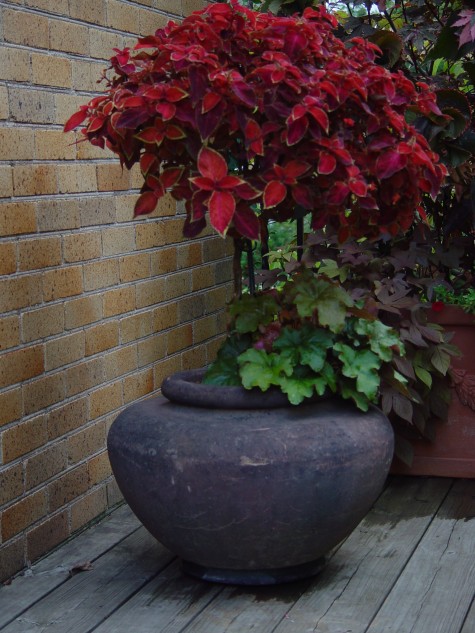
 Ivy can be readily be trained over a wire form. This makes it an ideal subject for fast growing. The vines are tied to the form to provide completely coverage, and the vines are clipped as needed. Hedera algeriensis ” Gloire de Marengo”, or variegated Algerian ivy, has large glossy leaves, and a prominent white variegation; old topiaries grown from this plant are striking. A bonus-it is possible to winter ivy topiaries over in the house.
 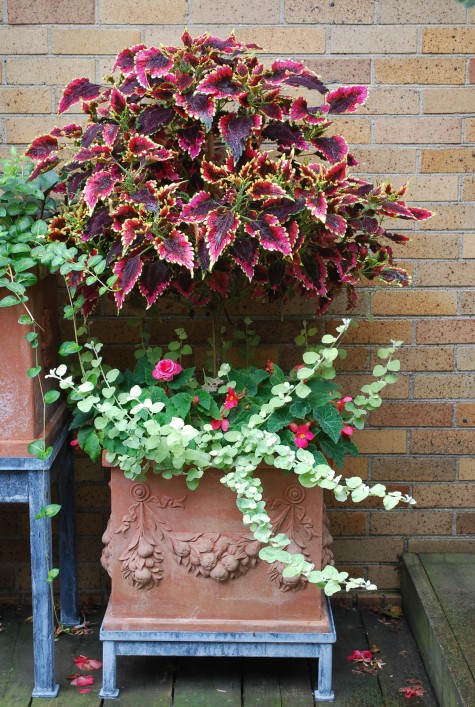 The coleus topiary I let go after two seasons-they seem to loose vigor. The minute you decide to grow a plant in any form which is not its natural form, there will be maintenance problems down the road. Plants tolerate being fooled with by people-they rarely love it. Plants that naturally lend themselves to this treatment are easier to look after.