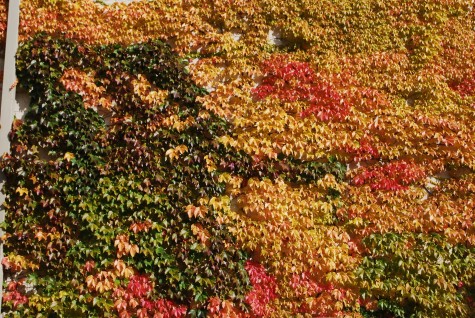
 I have never forgotten my ninth grade science teacher, Dr. Watson. He concluded every lecture or discussion with the statement, “And that is the beauty of science”. Though at the time I thought he was a crackpot, I now know he was absolutely right. Today I am thinking about Parthenocissus Tricuspidata; Boston Ivy is an ordinary plant with a fancy scientific name whose primary claim to fame is its ability to grip to and cover walls with dense sheets of leaves. Why today? The fall color of Boston Ivy is one of nature’s most spectacularly glowing moments, ranking right up there with the aurora borealis.
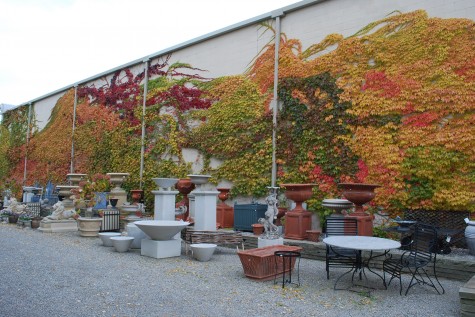 One wall of the building next door to me sits right on my property line; that would be just about two thousand square feet of beige concrete block. Needless to say, I was not too crazy about the look. Five Boston Ivy plants have just about transformed that wall in four years time; today it is looking exceptionally good. The science behind all this color-the formation of the abcission layer. Don’t black out; I’m talking about the beauty of science here. As soon as the nights get long enough in the fall, the cells that connect the leaves to the stems begin to rapidly divide-but they do not expand. This produces a brittle callus, which slows, and finally prevents the flow of nutrients from the stem to the leaves. The plant is going dormant, and putting any expenditure of energy on hold. This is a survival mechanism, the instinct to preserve life, and the beauty of science.
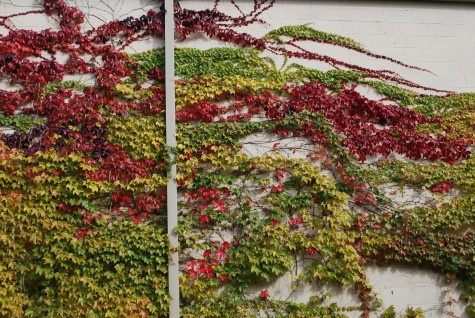 At the same time, the leaves slow down and eventually quit producing chlorophyll-that chemical that makes leaves green. If chlorophyll is not constantly manufactured in a leaf, the leaf will fade in sunlight. Chlorophyll masks the other pigments existing in leaves; the yellows, oranges and reds that were there all along are revealed when the production of chlorophyll ceases.
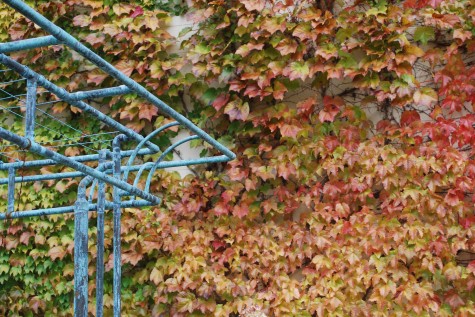 Though day length triggers this process, the temperatures, the moisture in the soil, and sunlight influence the overall show. A dry growing season can encourage leaves to drop early before they reveal any color. High winds can sever the dry corky abscission layer with the same result. At any rate, the variation and intensity of color on this wall is different every year given weather conditions. I can see that light, water, wind, sun and overnight temperatures affect the leaves on wall at different rates.
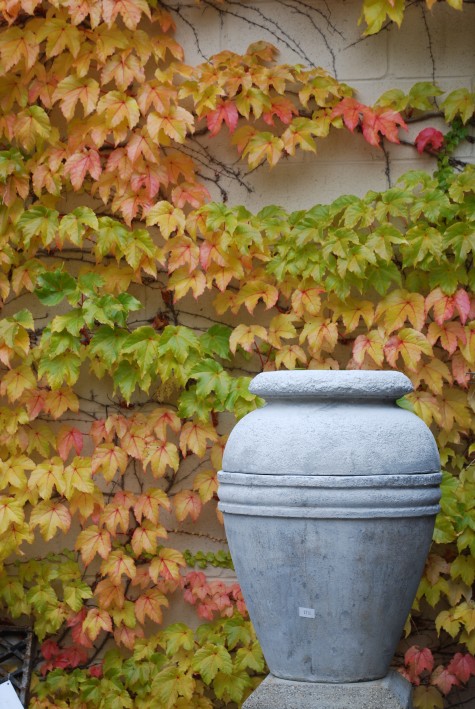 It is easy to see the chlorophyll fading at different rates in different leaves-the color variation within each individual leaf is beautiful.
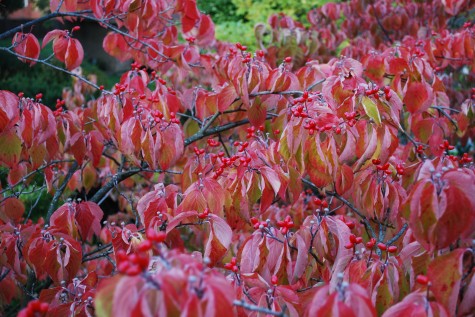 Anthocyanins are responsible for the red and purple pigments in leaves. They are manufactured from sugars that are trapped in the leaf. Oddly enough, these pigments are not present in leaves during the growing season. The role of these pigments is not so well understood. If you are interested in reading more about it, The United States National Arboretum has an excellent article on line about the science of color in autumn leaves.
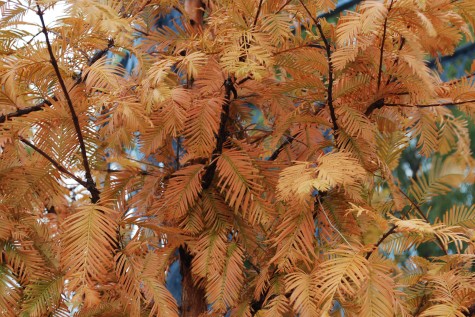 Metasequoia Glyptostroboides-I wish this were my name. The Dawn Redwood is an ancient evergreen tree with a twist; it drops its needles in the fall, after turning this glorious peachy orange. This deciduous evergreen is an anomaly amongst evergreens, which ordinarily hold their foliage all winter.
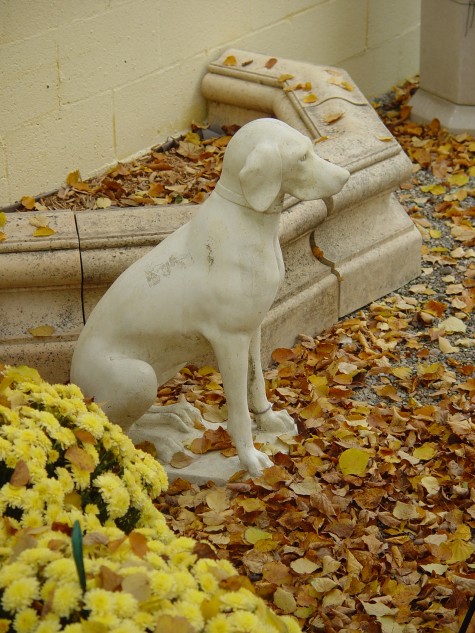
The brilliant colors of fall leaves holds but a very short time. These pigments break down when exposed to light, or heavy frost. The brown color you see in these leaves is a result of the only pigment left-the tannins. The story of parthenocissus is not only about the beauty of science. It is just as much the story of the miracle that is nature.
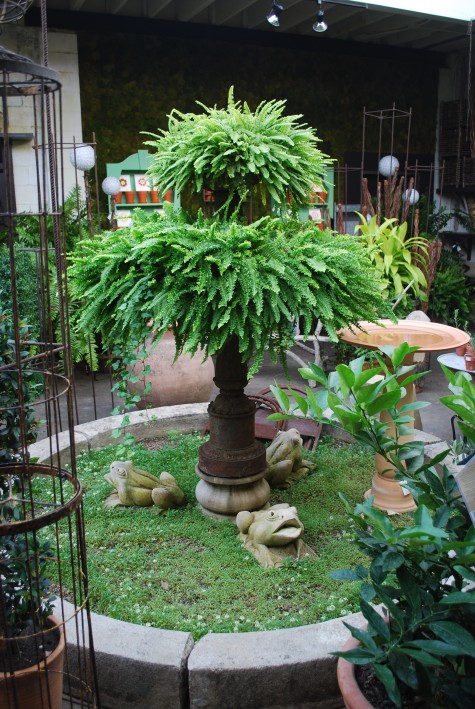 As fond as I am of ferns for shady spots in a perennial garden, there are plenty of tropical species too handsome to pass up. I have a client whose pair of Australian tree ferns flank her front door every summer; they have spent the winter in the greenhouse for the past six years. On a smaller scale, Victorian parlor ferns and Boston ferns prosper in a shady spot outdoors over the summer, and make a decent show in a cool light place indoors over the winter. Every fall we fall heir to a number of plants clients have no place for, but can’t bear to compost. Won’t we take them? Try as I can, I can’t say no to a plant in need of a home. Added to these were a number of ferns Rob grew in pots at home this year. As the dwarf crested ferns we planted 2 years ago in this antique French fountain are clearly very happy, Rob decided a fernery was in order.
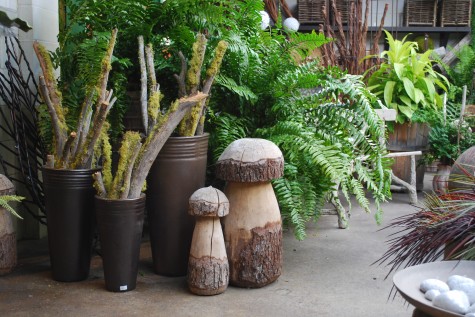 Once Rob gets a theme going, he has a sure hand putting a vignette together. The fern collection is kept company with lichen encrusted sticks from Oregon and carved wood mushrooms from Belgium. The giant fronds of what we call Macho ferns from his yard arch out some 30 inches, and cascade gracefully to the floor. We have turned on our heat, but an industrial building from the 1940’s heated with old Modine greenhouse furnaces stays decidedly cool.
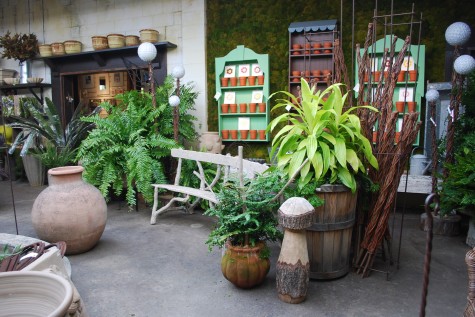 A chartreuse dracaena named “Janet Craig” that grew vigorously over the summer in an oak barrel is brought inside. Its fountain like habit of growth is fern like, but the texture much more simple and dramatic. I find shade loving tropicals are indispensible for growing shade containers that are fresh and lively-different than the usual. This plant will winter well here; it will make a fine centerpiece for a shade pot next summer.
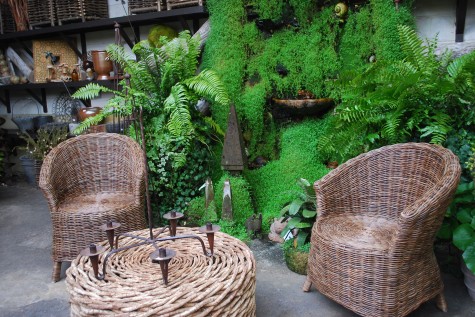 A pair of woven wood chairs and a table are drawn up to the fountain wall covered in baby tears. The elements of water and moss add to the woodsy look of a fern room. I cut a hole in the ceiling here large enough to handle the roof of an old Lord and Burham greenhouse. A shop devoted to all things garden would seem lacking without water, and a space to grow plants.
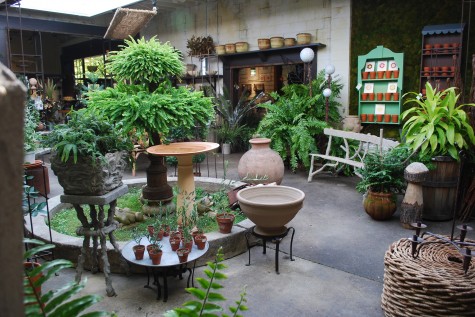 As the room starts to fill up with plants, the space begins to feel like a conservatory. It is no wonder people go to great trouble and expense to have glass houses, or grow lights in the basement. I perfectly understand that feeling of being shut in, once I am shut out of the garden. These ferns make me think about having plants at home over the winter.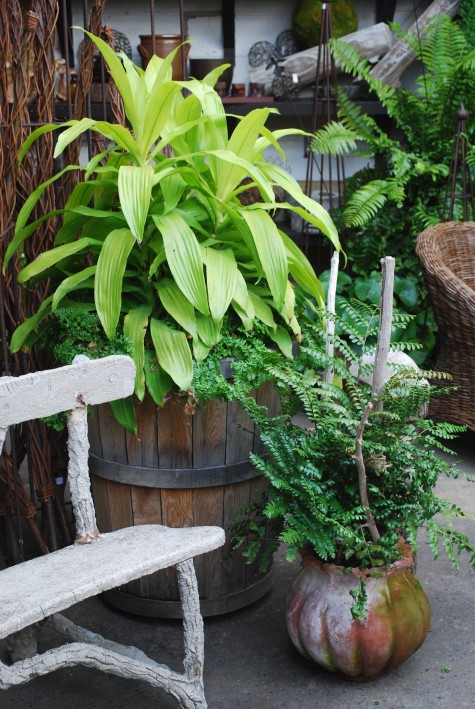
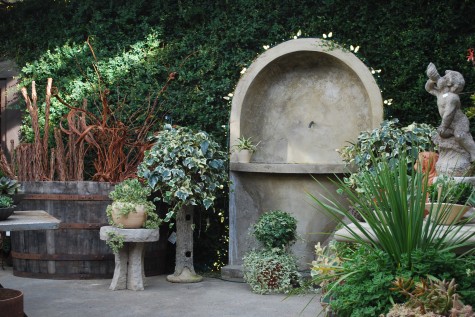 We find a home for the other bits as well. A pair of variegated Algerian ivies are so striking in a pair of old faux bois planters. A spike encircled with Cuban oregano organizes a collection of small agaves and echeverias; Rob is calling this the arid zone. An old varigated ivy single ball topiary in need of a haircut will get a winter home somewhere in this room. The climbing fig that covers the walls completes the green picture.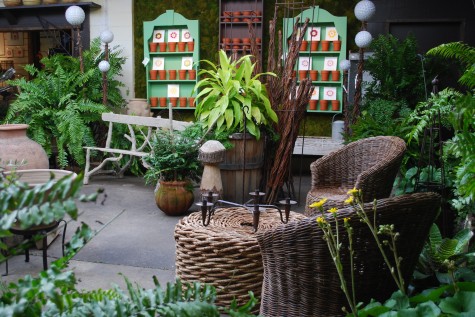
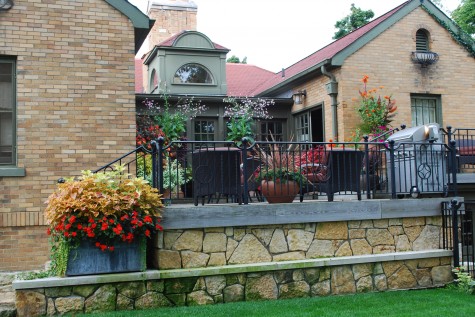 Given that I took this picture September 24, why wouldn’t I be unprepared for the weather here this past week? Just three weeks ago, I still had my summer. Though describing any Michigan weather as “ordinary” is glossing over the truth, our weather ordinarily cools off at a slow enough pace to make keeping up with the job of putting the garden to sleep relatively easy. My fall cleanup and shovelling out is based on the distinction I draw between gardening, and housekeeping.
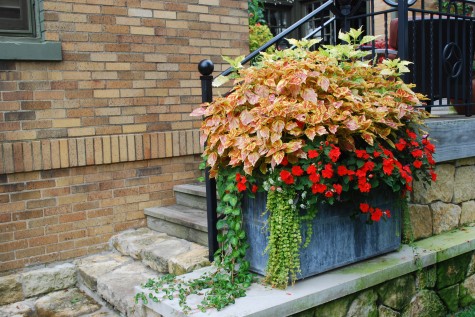 I have seen those properties that look as though every shred of organic debris has been blown, vacuumed up and disposed of weekly; anyone who has inadvertently turned a blower on themselves realize what an invasion they are. Every green leaf looks dusted; every surface has been swept, every shred or organic debris is bagged and removed. The stone is scrubbed clean, and the cushions are only on the furniture when company is in attendance. I like the look of cultivated soil as well as the next person, but all of the above is housekeeping, not gardening. Years ago a gardener whom I greatly respect, Marge Alpern, told me she disturbed her plants as little as possible. She maintained that plants can be worried such that they refuse to prosper. I think this is a point well taken. I will not take on the perennial gardens until much later in the fall.
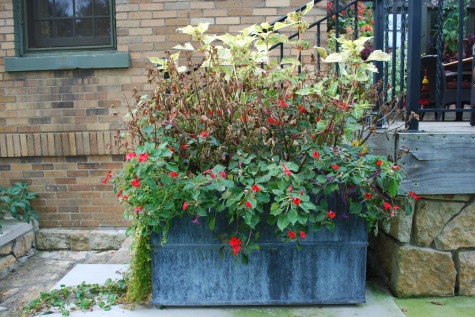 A series of nights with temperatures hovering in the mid thirties left my pots looking like this-devastated. It does not matter one bit that I know this day is coming, I am never ready for it, nor do I like it. I do not like to let go. On a much more dramatic scale than the time changing to daylight savings, I adjust slowly, and poorly.
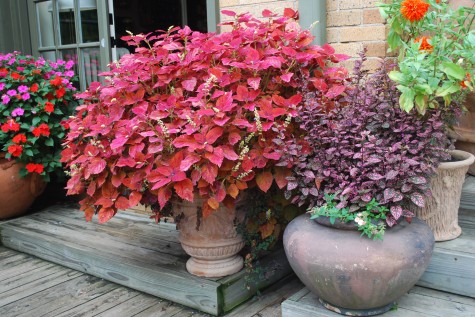 Coleus are astonishingly intolerant of cold weather. Anyone who does poorly with them is probably planting them out too early; every plant thrives in some conditions, and sulks in all else. This five foot diameter fiery orange ball was glorious all season; in late August the corgis were breaking off the branches encroaching on the doorway. They keep the extreme understory clear of any obstructions.
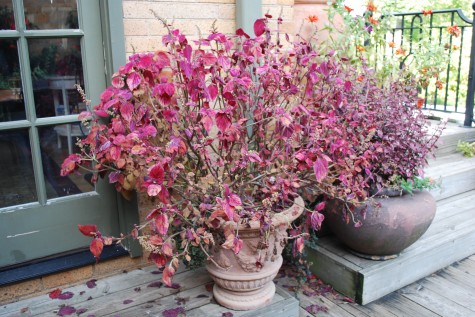 In what seemed like the blink of an eye my fireball shed almost every leaf. Unlike the gingko tree which sheds every leaf on that certain perfect fall day, leaving a beautiful pool of yellow on the ground, the coleus leaves dessicate, drop, and disappear before you can even mourn properly.
 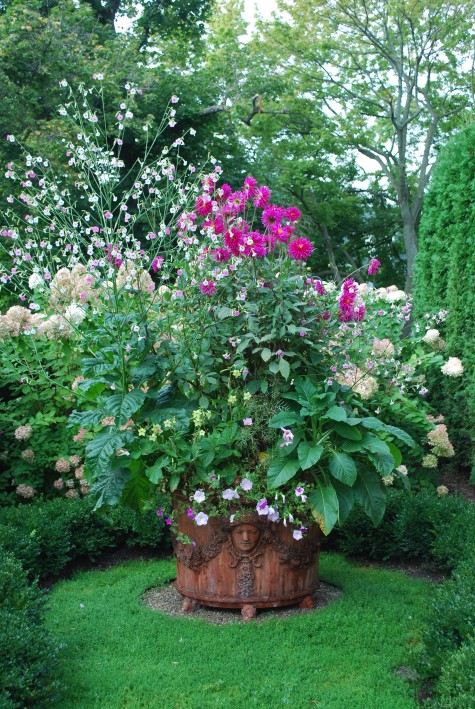 My English-made Italian style pots were home to the biggest bouquet I have ever grown. The nicotiana mutabilis got busy throwing spikes in September, and the dahlias were blooming profusely. I like that extravagant and exuberant look. No matter how the day had gone, I could go home and congratulate myself on having grown one of the annual wonders of the western world. You may be laughing, but how the look of it pleased and cheered me.
 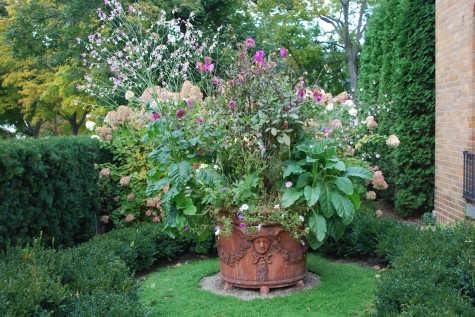 Though the nicotiana mutabilis is yet bravely defending its home, the cold pierced the heart of the whole. Buck is always amazed and amused and the depth and breadth of the despair which attends the beginning of the end of my gardening year. I alternately rage and whine-he murmurs, and pours the wine.
 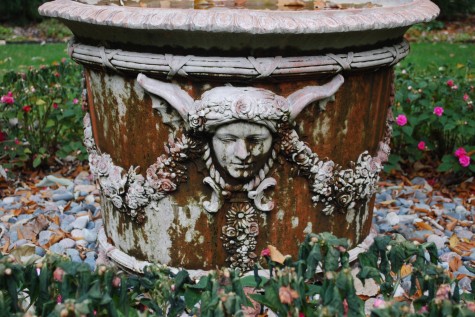 This sister to my pots, adapted for use as a fountain, bears all the signs of a season’s worth of mineral laden water, weather,heat and growth. Does that gorgeous Italianate face not seem completely grief stricken?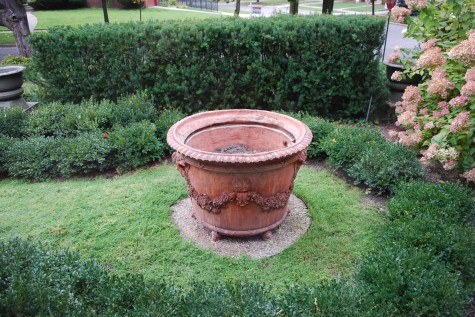
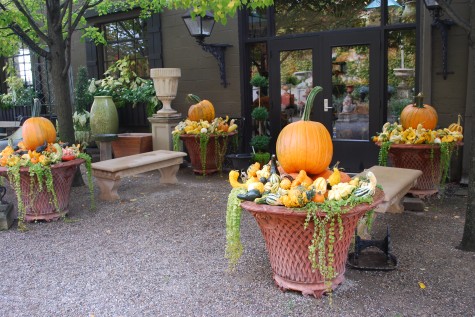
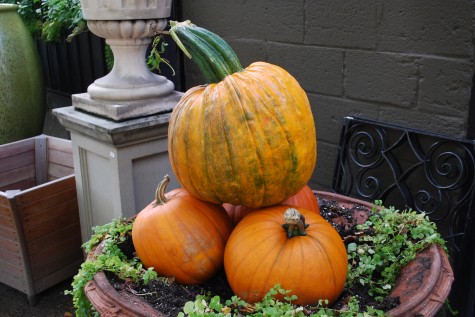 Whether I am drawing a plan, arranging some flowers, building a topiary sculpture, or staging a display, my first move is to determine the order of events. The big gesture comes first. In a landscape plan, I determine the center of interest, or organizing element, and place it. If it is a pool, that pool is assigned a size and a location; any other design is keyed to and in support of that initial decision. If the pool is centered in a space, I work from the middle to the edges of my paper. If that pool is located on a wall at the far end of my space, I would work from back to front, in tandem with establishing the views. As the topiaries that had spent the summer in these pots needed the shelter of a greenhouse, I had four empty pots in search of a reason to be. The idea of these pots overflowing with pumpkins squashes and gourds in some sculptural way had appeal. As these pots are large, a center of interest at a height pleasingly proportional to their width needed to be set first. I used a trio of medium sized pumpkins to get my big pumpkin with its giant stem at the right finished height.
 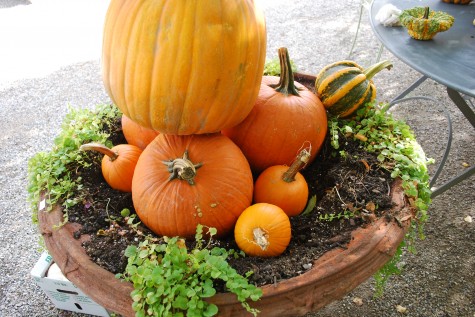 When working with rounded forms, it rarely works to use a filler material for height. Someplace your filler will show, and give the impression your slip is showing. Trying to cover up a not for viewing interior structure invariably looks like a cover up. Whatever portion of these support pumpkins might show in the finished piece, that portion will look like part of the arrangement. I would not have the faintest idea about how to turn pie pumpkins into pie, but I do know how to use them to provide crooks and crannies to set my prized specimen gourds. I set these beginning pumpkins at an angle which makes their swooping stems part of the action of the sculpture. This helps to make the sculpture look graceful. Every stem set straight up risks that soldierly, grocery store display look.
 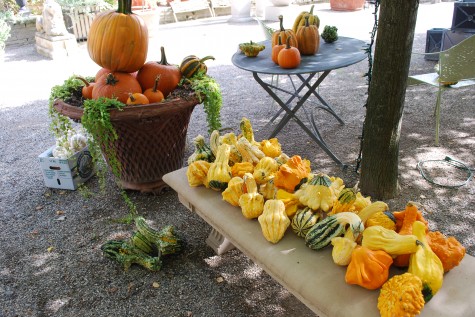 As I am interested in placing the largest gourds next, and then, arranging with color in mind, I need to look at averything I have available all at once. This can be quite a nuisance when building a stone wall, but I would not know how to construct it otherwise. In designing a landscape, a lot of shapes, textures and volumes need to be available to your mind’s eye, all at once. I am only good for a random thought that might be pertinent when I am tired; it takes energy to concentrate enough to turn off the daily noise and design. This is easy-get the gourds out, and spread them around.
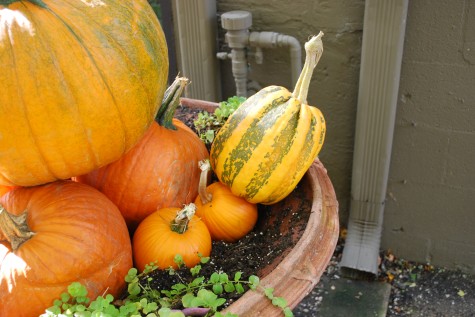 My big beautiful squashes get placed next. When I look at the four pots from the drive, I see that the pots furthest from my eye will need more emphasis than the pots close to my eye; bigger material is a good way to get what is far away to read better. A small pie pumpkin enables me to tilt the squash out over the edge of the pot, and feature the stem.
 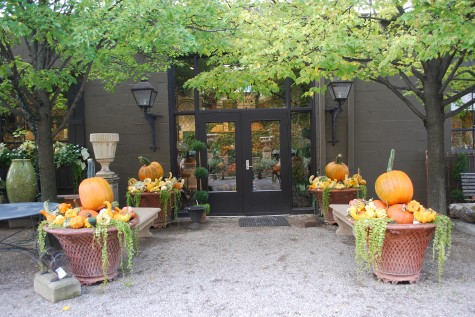 I finish placing all the large gourds, and stand back for a look. Though not so readily apparent in this picture, I have placed more of the pale or light colored gourds in the rear pots, and the darker colored gourds in the front pots. Dark colors do not read well at a distance, so placing them up front makes the detail of their shape and color read better. Pale colors read fine at a distance, and highlight dark colors placed in front of them. The pots are ready for the little bits-the smallest gourds finish and refine the shape of the overall arrangement. In a landscape, I might be planting roses at this stage, or groundcover as part of the finishing touches.
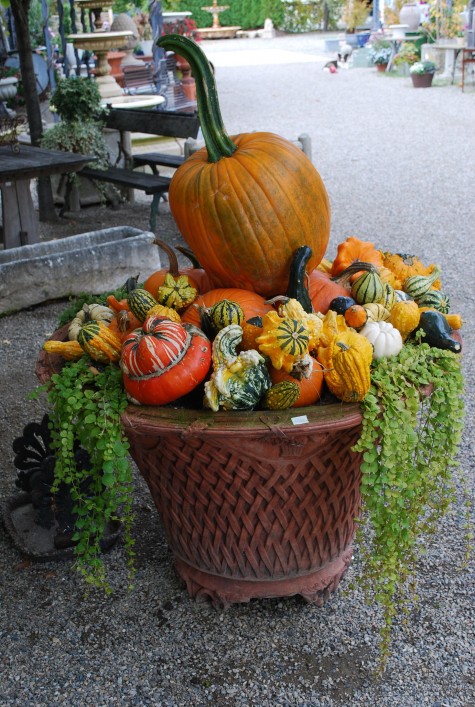 The idea is suggest a casual and not too fussy an arrangement. In fact, ordering the placement of sizes permits an arrangement where all the pieces are built sensibly from a large base supporting the fine detail-both visually, and physically. In a large flower arrangement, the interlocking big stems under water provide a framework that will hold the smaller stems where you want them. In a landscape, a long walk indicates how a garden is meant to be experienced-but it also provides weight and organization to the smaller elements you otherwise might not notice. All the elements of any composition need to interlock for a strong presentation of the whole. This front pot features dark and intense colors, with dashes of pale colors here and there.
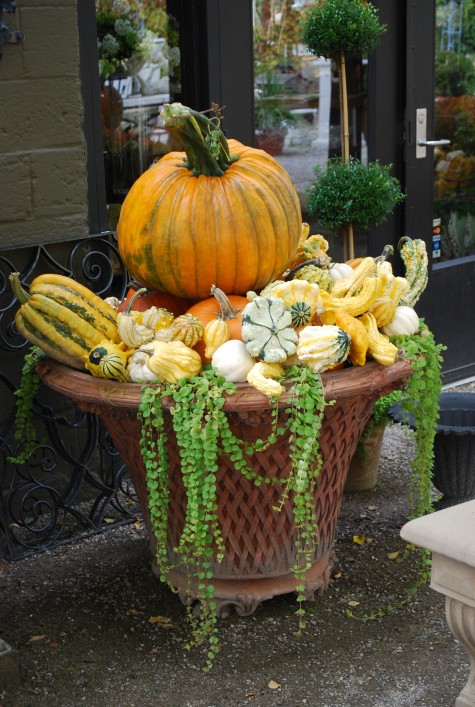 This rear pot set in a much darker environment relies on the interaction of pale colored shapes for good visibility. The varying shapes and colors of all the little noisy gourds emphasize the mass and grace of the shape of my starring pumpkin.