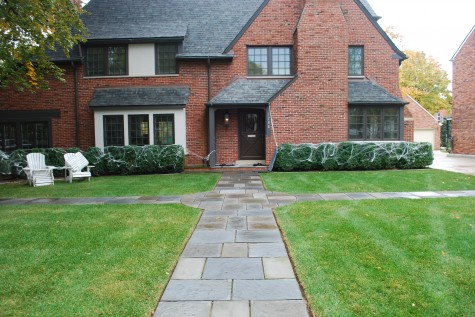
The idea of balance in design is intimately related to our physical understanding of balance. At the conclusion of an event some years ago, I stupidly decided to avoid the long route to my car via the lighted sidewalk, and cut through an intervening landscape bed. In the dark, I stepped directly into an unexpected drainage ditch set 18 inches below grade. Loosing my balance, I went down hard and sideways-my unfortunately high heeled foot hit the steel drainhole cover at an impossible angle, and I crashed to the ground. The stress of the bad landing left me with a broken leg. Every day for the ensuing ten weeks I had every reason to think about the importance of balance. I never did master the art of dragging the hose weighty with water up the two steps to my upper deck-while on crutches. I could not balance my cup full of coffee in my hand, and still hold the crutch-I did not have enough fingers. I had to move my coffee pot from the kitchen to my desk. As my house sits up high, negotiating the stairs while on crutches proved particularly nerve wracking; no doubt I was unstable on my feet, and fearful of falling. It was not until I was able to ditch the crutches that I regained my sense of equilibrium; my bilateral symmetry was restored. This is a fancy way of saying I had back a functional leg on each side of me, and my center of gravity. The day that I was again securely balanced was a very good day. I still loose my balance on occasion; I cannot focus on anything up close without my reading glasses. When I forget I am wearing them, and start to walk somewhere, my inner sense of balance vanishes; this is not a pleasant sensation.
The idea of balance in design falls into two broad categories. Symmetrical design, in which every element left of center is matched equally with identical and corresponding elements right of center, is visually very stable. Of course landscape is a sculpture one views in the round, so the symmetry always applies to a particular view. Choosing which view will be the dominant view should come early in the design process. It is just as important to identify the center of any given view. The degree to which a design is symmetrical, and therefore completely stable, determines its formality. A composition symmetrical from every view is very formal. Very formal landscapes laid out on visual axis have an equilibrium such that your eye moves around the composition, and eventually comes to rest. Those clients for whom an atmosphere that is serene is important usually gravitate towards formally balanced landscapes.
As people are visually completely familiar with the appearances of the human figure and face, a symmetrical arrangement that is out of square, or balance, can be spotted instantly. I have installed formal landscapes where I have had a surveyor lay out a swimming pool, or landscape beds in an effort to be sure every line perpendicular to a residence is as perfectly perpendicular as possible, and likewise every horizontal line is as closely horizontal as one could manage. The science of generating these lines involves checking and rechecking one’s measurements. A tree planted out of vertical is instantly apparent as such. If it is not the deliberate intent of the design to introduce a skewed line, then the appearance of that tree will always be irritating. A swimming pool installed out of square is a problem not easy to solve.
Landscapes can just as easily be asymetrically balanced, but this is more complicated, and requires more skill. Asymmetrical compositions are not at rest; angled lines are very active visually. The excitement of it all asks for a keen sense of balance. As Vita de Sackville West is reputed to have said, “It isn’t that I don’t like sweet disorder,. but it has to be judiciously arranged.” The relationship of a massive evergreen to the shape and size of the groundcover bed underneath it speaks to establishing a sense of visual balance. The placement of one large element can be balanced by a number of smaller elements placed elsewhere in such a way that a pleasing relationship is made. A diagonally planted mass of light colored foliage plants in the horizontal plane can be balanced by a single tall dark vertical plant. Asymmetrically curving beds relate to each other via the shape of the lawn, walk, or path between them. A driveway approaching a house on an angle needs a balancing counterpart to provide the eye with the directions about where to go next, or that eye will fall off the edge of the composition. Some visually compelling element placed to direct the eye from one place to the next provides an active view with a stable rhythm. I like a good beat. A driveway with a giant landscape bed on one side, and lawn on the other appears lopsided. A house placed asymetrically on a piece of land asks for a landscape to balance all that visual weight concentrated off kilter; properly done, the relationship of house to landscape can be as pleasing as it is exciting.
An informal landscape is not a justification for a landscape lacking design. Once while installing a landscape, I had a chance to observe an identical activity taking place across the street. Trucks arrived with plants, the plants were placed in order as they came off the truck, and planted. At the last, beds were cut around the plants. Some curving lines had glaringly flat spots. Some beds curved inward too close to the trunk of a tree, and then curved outward where no plants were planted-resulting in big barked areas. I saw no one checking any views; I did see trees placed dead center on windows. I have seen other very informal landscapes perfectly balanced in its color, texture, proportion and mass; it was clear a very skilled person was driving the design process.
The choice one makes as to the formality and symmetry of a landscape design is just that-a choice. I like them both, equally. My landscape at home is very formal and bilaterally symmetrical, as that is what gives me what I need, and what pleases me. This does not prevent me from admiring other differently designed spaces, or designing informally for a client whose love of line is anything but horizontal and vertical. I just like to see that moves in a landscape get made deliberately and thoughtfully. By design.
However, I am also exposed to plenty of landscapes where I cannot sense the design idea behind it, but the plants are lovingly cared for. Some might lack for plants, but the lawn is mowed and the yard neat. There are others in which the gardens are weeded, the trash is picked up, the garbage cans, lawnmowers, rowboats, children’s toys and bikes are not part of the public view. There are flowers at the door-though that door might be painted lavender to match a set of lavender shutters. Neat, clean, and well-tended, on purpose. These landscapes balance me; they help keep me from tripping, and falling over from my own design obsessed foolishness.
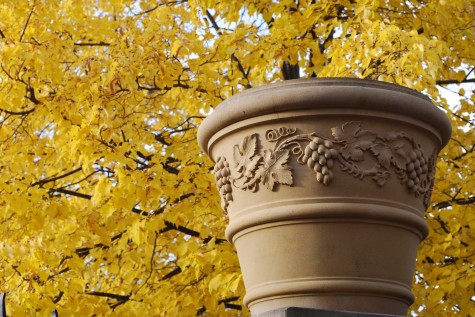 The fall is the perfect time to talk about light as an element of design in the landscape. How, when and where the sun shines, dramatically influences the visual impact of any landscape or garden. October light in Michigan is cold and low in the sky. Uneven or carved surfaces are cast in sharp relief. Any shadows cast will be dramatically elongated. A client choosing a smooth surfaced ornament for their garden should be happy for a subtle light rendering; if not, choosing ornament with some more graphic surface variation might be in order.
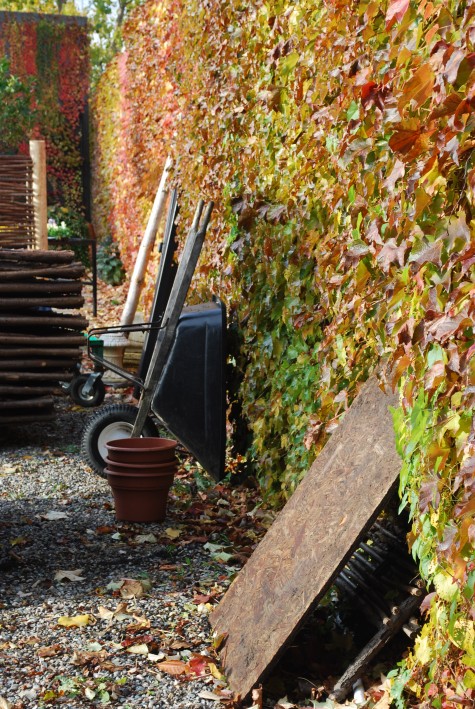 I could write on into the next decade about how light is the engine that gets any outdoor space moving. One of my favorite parts of my Michigan gardening life is how the light can make the appearance of everything change, from hour to hour, and day to day, and season to season. The contrast of light and dark in a garden is its heartbeat. In October, the trees coloring up are all the more dramatic for the ignition supplied by that intensely pale light. Its worth thinking about the degree of shade a tree or shrub will cast in a landscape. A densely shady area is all the more dramatic with a pocket pool of light behind it. Plan for dark spaces close to your view, with light spaces in the distance.
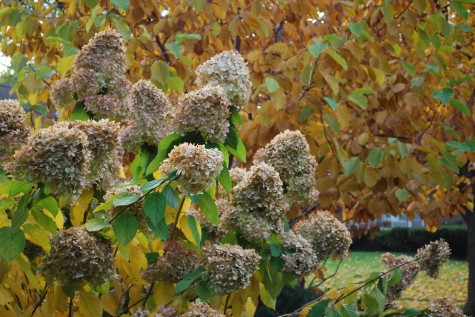
 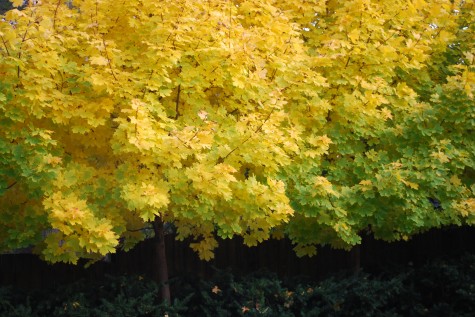 The spring leaves emerging on my Princeton gold maples cannot hold a candle to their yellow fall fire. I am a photographer whose lack of understanding about the mechanics of photography is considerable. So I watch the light. When it suffuses every element in a garden such that the color in my pictures, or the feeling of my pictures, will be saturated-that is the time I photograph. I record; I do not have the skills to generate. It is hard to believe this collection of these maple yellow leaves produces such dense shade underneath; the grey cedar fence appears black by way of contrast, and almost disappears.
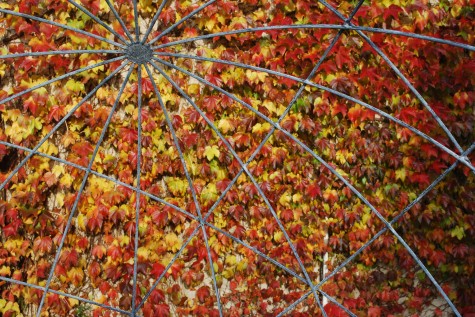 Our thin rod steel spheres permit the view of your choice through to the landscape. How they interact with a garden is the best part about them. Imagine this view in the winter, the early spring, the early summer, the high summer, the fall; you get the idea. Add light to the mix, and your possible visual combinations increase considerably. Garden ornament interests me greatly, given how it offers me a sense of solidity, and steadfast longevity, against the ever changing landscape.
 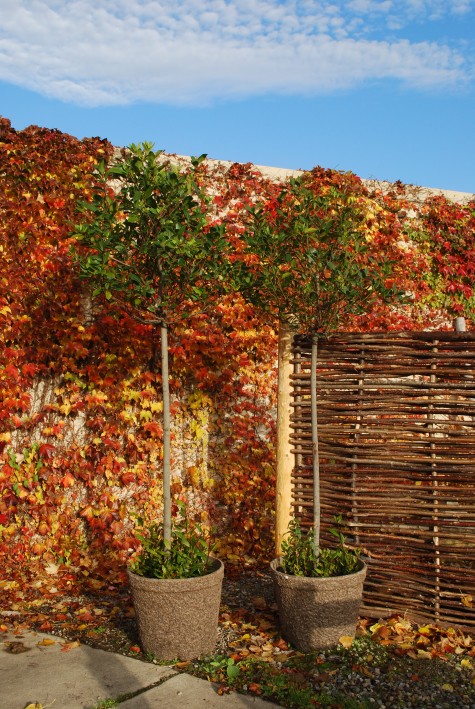 The bright flat October sun sets all it touches on fire. The greens are all that much more electrically green; the reds glow red. If you are looking to see the rhythm established by the masses of light and dark in your landscape, look quick now before the leaves fall. There is instruction coming from the natural world every day, should you care to tune in.
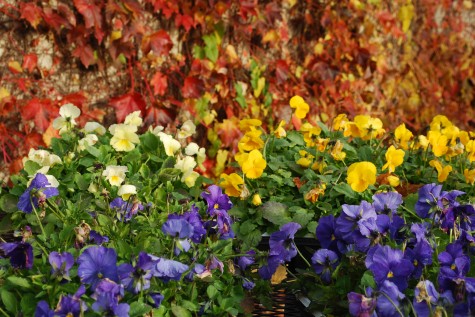 The color of these pansies speaks softly in the spring. The fall light intensifies and electrifies the appearance of their color. On my best days, I think about how the light will fall on a landscape in every season, as this should influence how I place every plant or object.
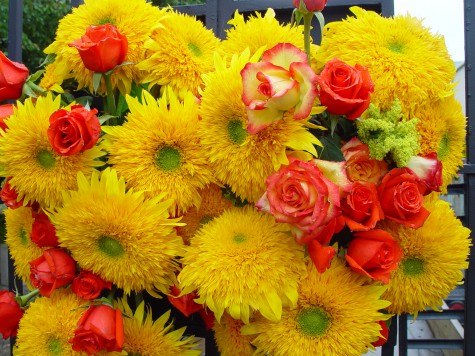 As my clients were bound and determined that Allie, Snoopy and Vladdy would be members of their wedding party, their choices for a wedding venue were slim to none. I was happy for them to get married at the shop, and equally happy to welcome the canine members of their family. Since the decision was made some six months prior to the ceremony, I had the chance to plan a garden that would look great on their late, late summer date.
 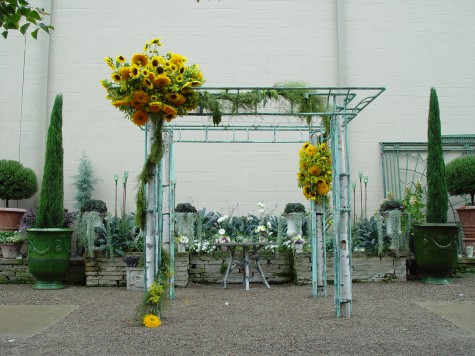 A copper pergola would provide the chuppah necessary for the ceremony. We infilled the poles at each corner with birch bark tubes. This blue and white scheme dictated the selection of plants as much as the season would. A collection of Italian cypress, giant rosemary topiaries, kales and cabbages would look swell come wedding time. Luckily a local grower has a very late batch of sunflowers, including the ultra double “teddy bear”. That intense yellow would warm up the arbor in a happy and sunny way. A goldenrod garland casually draped over the chuppah provided the roof necessary for the ceremony.
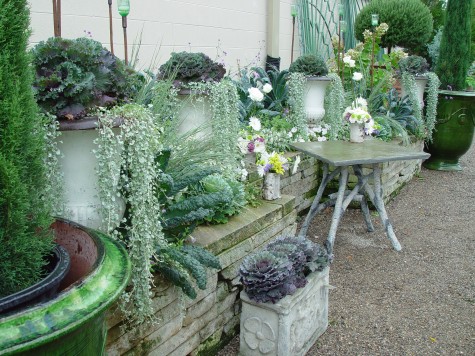 Silver dichondra has a distinctly blue cast; its diminuitive felted leaves were a great contrast to the giant blistered kale, “Nero di Toscano”. Short blue foliaged fescues, white million bells and showy oregano made good companions for the massive cabbages. White iron urns showed off the long tails of dichondra to good advantage.
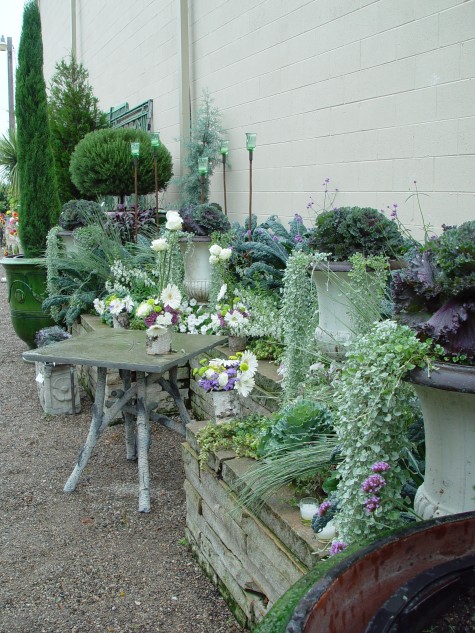 As the ceremony required a table be available for the Rabbi, my clients chose a carved concrete faux bois piece whose legs were carved and acid stained to look like birch. The wedding party flowers in lime green, white, and lavender repeated the color scheme of the garden. Is that old rosemary topiary not a dream come true?
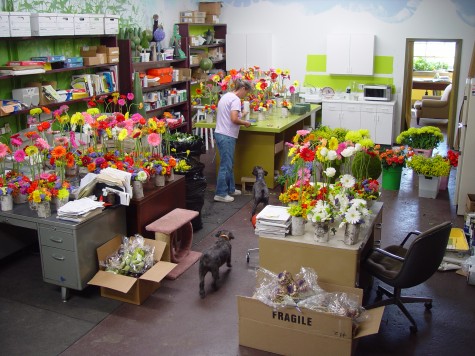 The plan for the reception involved nine 8′ long tables set end to end in the drive. Small glass vases covered in short birch bark tubes held late summer garden flowers available from the growers at my local farmer’s market. These 45 small arrangements centered on the tables would run for the entire 72 foot long reception dinner table.
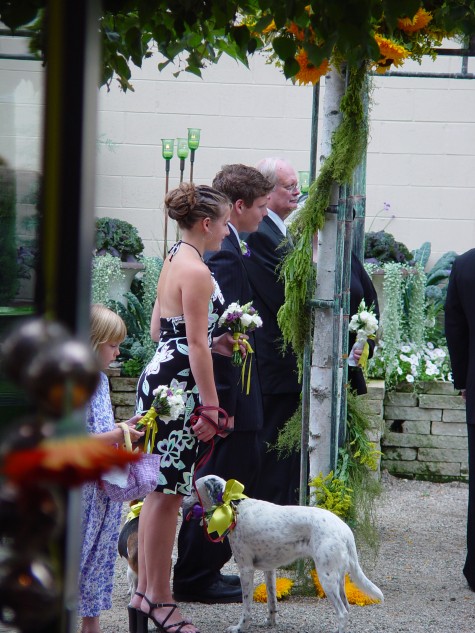 Allie and Snoopy were nervous, but they did take their big lime green satin bow and flower collars in stride. They did mill around-but just a little bit. All in all they were very well behaved.
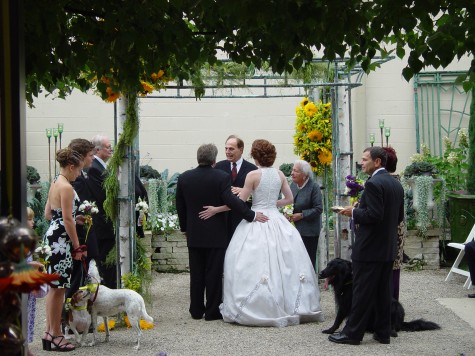 Vladdy was ordinarily fairly dignified and unflappable; he sat calmly through the entire ceremony.
 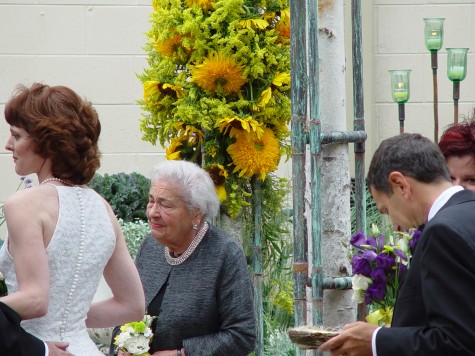 It was a beautiful wedding, and I was happy to have a part in it. There is something so satisfying about a small ceremony for everyone involved. When there are but a few details, every detail can be very personal and thoughtful. I think they were so pleased to be able to have their dog family there that day.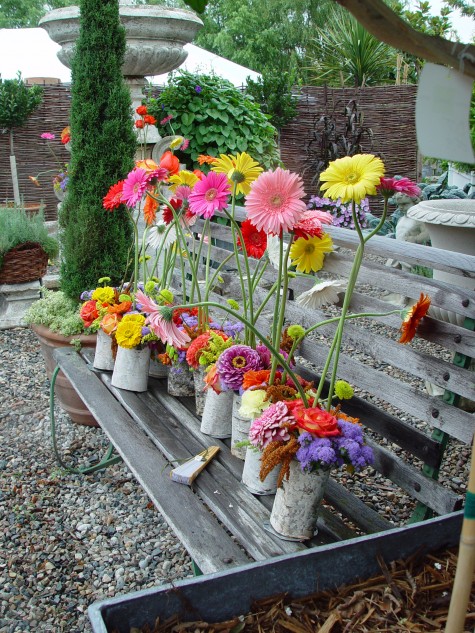
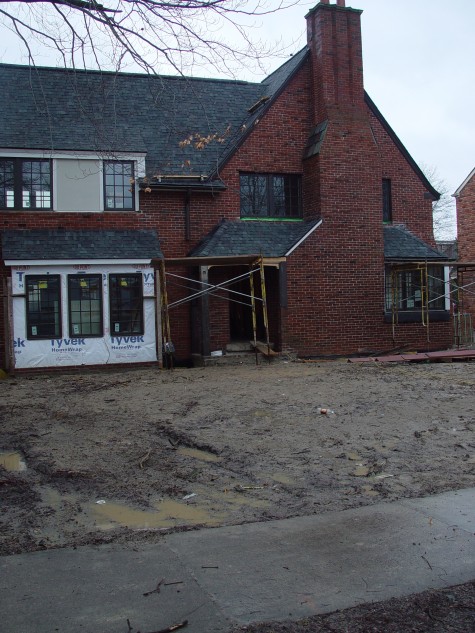 This lovely home in a local neighborhood was in sore need of updating, and needed additional space to house a young family with children. The addition was in progress the first time I saw the house. On this miserably wet and cold March day, the prospects for the outdoors did not look promising. Contractors had driven machines over every inch of land they owned. Water was sitting on the surface of the soil everywhere. It seemed like every move my clients made uncovered a new problem requiring attention. When a house is under major renovation, the landscape is last in line-as it needs to be.
 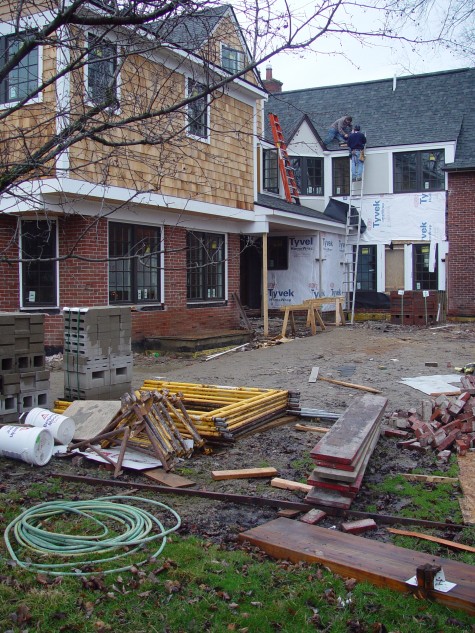 It wouldn’t be possible to install a landscape at this point. Some years ago the New York Times ran a feature about landscape costs-the thrust of which was that it can, and frequently does take as much money to build and furnish a landscape as a house. I don’t know that I would go that far, but a landscape is a considerable investment. Though property values have been under siege in our area of late, it is still true that for most people, their home will be the biggest investment they ever make-for better, or for worse. Thus I have no problem recommending to a young family that they invest such that fifteen years later, should they decide to move, a landscape that is in place will make that home they want to sell look settled, finished- irresistible.
 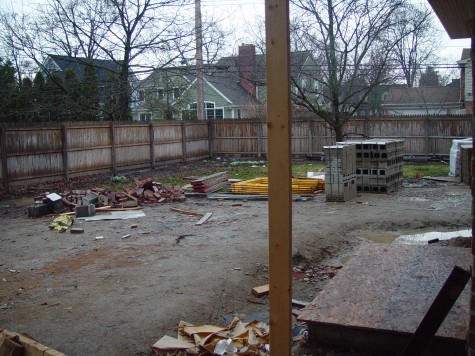 Some very important investments in a landscape are not fun. This property was the lowest property in the neighborhood, and water would stand and not drain for weeks after a heavy rain. The regrading and drainage work necessary to correct this problem was very expensive, and not so satisfying. It was about as much fun as buying a new hot water heater. I have seen many landscapes, installed both by home owners, and professional landscape contractors, where drainage issues were not addressed. The plant material is struggling, dying or dead from the lack of an investment in the drainage. For the sake of the future, some things cannot be skipped over.
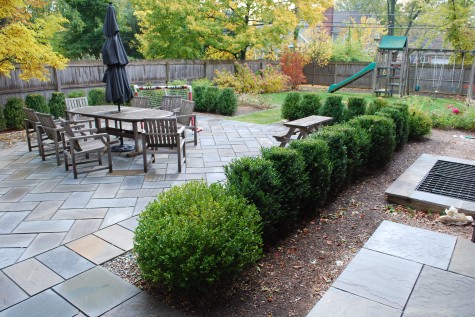 These clients knew they wanted stone for their terrace and walkways. Bluestone is a gorgeous natural stone that gives a space a solid and serious look. They also wanted their stone wet set in mortar. Mortaring stone to a concrete substrate insures a level surface that presumably does not move, or require maintenance. I say this with one caveat; the winters in Michigan will heave up just about anything. I made sure the installation was expert.
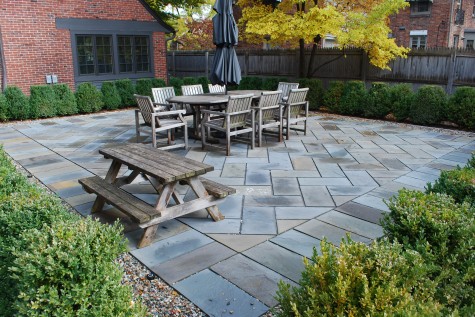 Their decision was to stage the installation of the landscape such that they could have their mortared stone. The first year, their yard consisted of stone, and lawn. Year two saw the boxwood installed in the rear, and the yews in the front. This year, some of the garden. Next year, the yews designed to back up the boxwood here, and maybe an arbor. I do admire their willingness to wait, in order to have the landscape they wanted. Get a plan, pick a part to install you can handle, do it, and proceed again when time and money permits. This seems like such a logical and good way to proceed.
 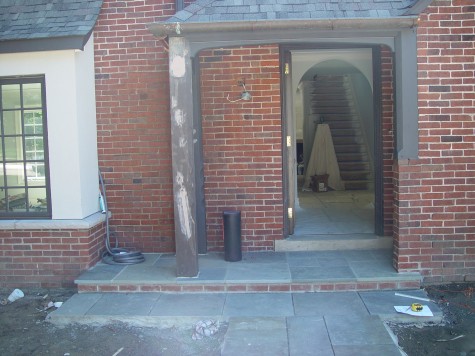 The front porch, originally only inches wider than the front door, was redone. The new porch absorbed an awkward space between the original stoop, and the adjacent bay window. Four years later, with the exception of one stone that is shaling probably from salt damage, the stonework is beautifully intact.
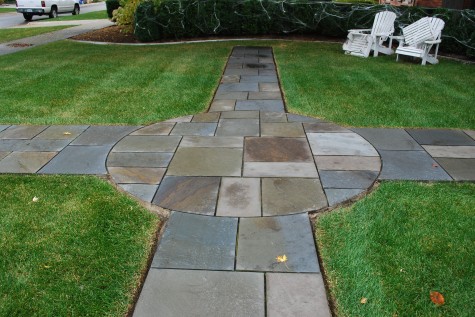 The front walkways from the drive and streetside meet in a circular stone landing midway to the door. Perhaps there will be a sundial someday, or a sculpture, or a high school graduation picture being taken.