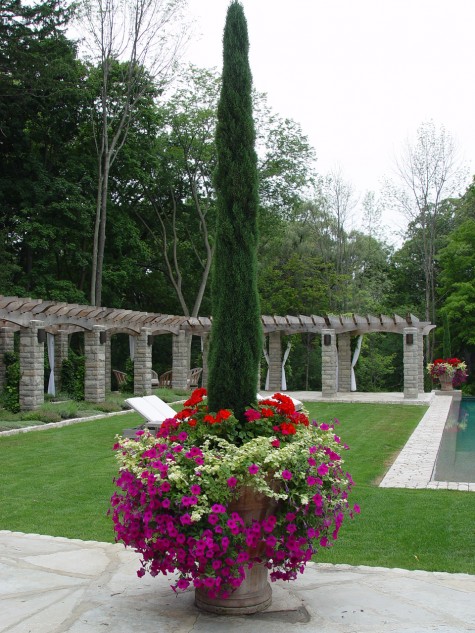
 On my top ten list of frequently asked questions, the culture of evergreens in pots ranks right up there. In theory it sounds great. You invest in an evergreen which will provide you with a center of interest that looks great no matter the season. Perhaps there will be room on the edges for a few seasonal annuals. The work and expense up front is considerably more than planting smaller and less expensive plants, but then you are done. Redoing one’s pots with new plants every new season no doubt is a lot of work and expense. But as with everything connected to growing a garden, one is rarely “done”. The Italian cypress in the pot pictured above is not hardy in Michigan, nor can one leave a terra cotta pot such as this one outdoors during the winter. The cypress has to be wintered in a greenhouse cold storage area, and replanted every spring. The pot is put away. There is time and trouble hauling it back to the greenhouse in late fall.
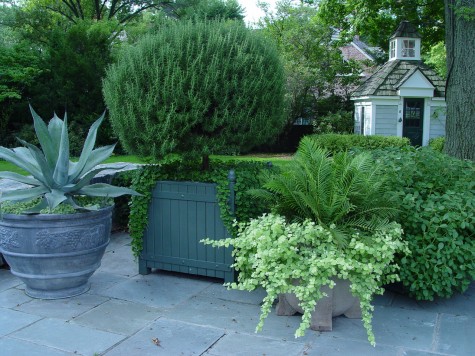 This 25 year old rosemary has spent 25 winters in a glass house. It is an evergreen-should you live in Greece or Italy, or California. Michigan winters are fiercely cold. However unfair it seems, rosemary is just not hardy here. In return for the extraordinary pleasure of owning an old rosemary such as this one, my client is willing to weather what it takes to keep it alive and healthy.
 Junipers on the other hand are ruggedly hardy. But key to the successful culture of evergreens in pots is to understand that at best, they tolerate this treatment. Growing a plant in a pot is actually about growing a plant with its roots above ground. No plant likes this-they may or may not put up with it. Siting is the first crucial issue. Evergreens must survive the winter and stay green without being able to take up water. A windy location can dessicate the needles-thus the term, winter burn. A winter burned plant is still alive, but it’s not a good look. It will take time to grow out of the scorched needle phase.
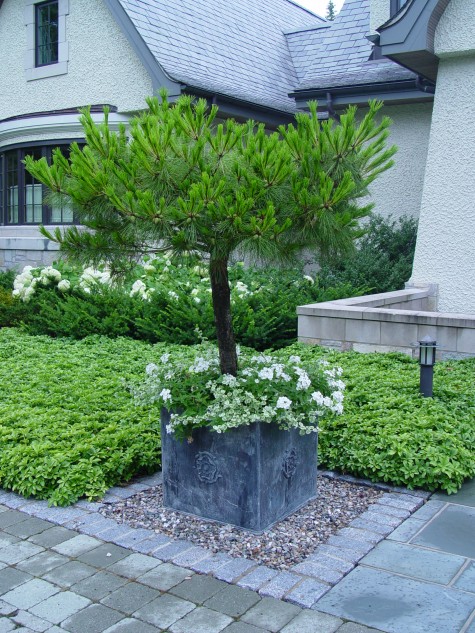 Mugho pines, both the shrubby and the topiary forms, have the reputation of good survivability in pots. Critical to that survival is proper watering. Should you quit watering this evergreen when your geraniums go down from frost, you are almost certain to loose it. Judicious watering right up until the soil ball is frozen solid is a must. If this evergreen were to unfreeze in a January thaw, a watering might be in order. When the soil thaws in the spring, the watering should be resumed-even if this is long before you plant your other pots. What evergreens in containers require is not for the faint of heart.
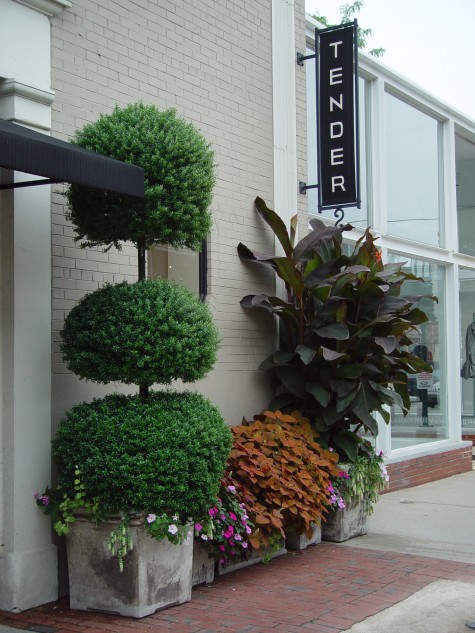 This grand old myrtle topiary was beautifully maintained, for 11 summers. The 12th winter in the greenhouse, a furnace went out, and it froze. It has been in the greenhouse for the past two years; we are trying to coax it back to health. Owning plants like this is a big committment with little in the way of any guarantee. Just because you have provided next to perfect care for a long time does not mean you cannot loose it. Evergreens in containers are for gardeners who relish risk.
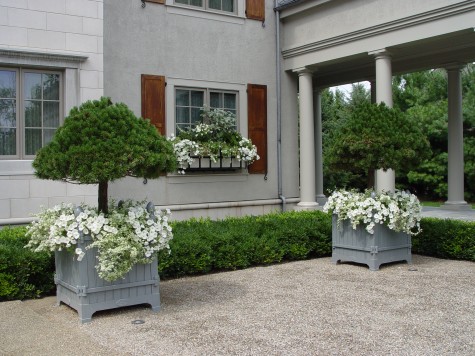 These mugho pines on standard have lived in these orangery boxes for 6 years. At some point, they should be taken out, root pruned, and reset in fresh soil. They will most certainly decline without this maintenance. No plant stays the same, just because its container stays the same. Plants will prosper and grow, or sulk and decline-one or the other.
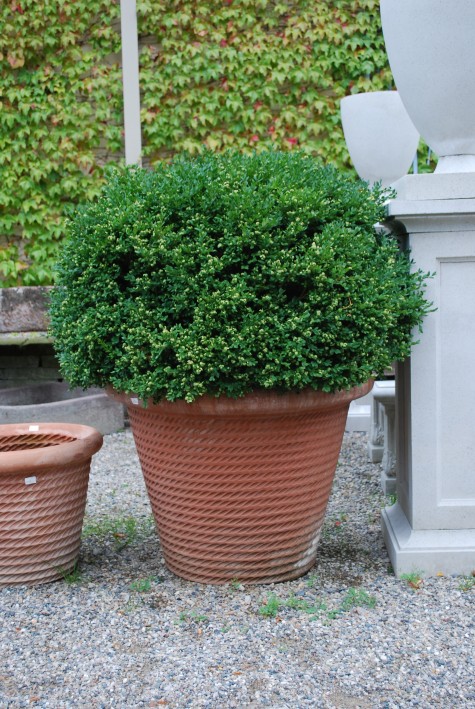 Boxwood is a good choice for a container. As this French terra cotta pot cannot be left out, I wheel this entire assembly into the garage for the winter. This species, Buxus Microphylla, is very tough; my hedge on the southside of my building never winter burns. In the same spirit, it tolerates a mostly dark and unheated garage from November until March. At the first sign of moderating temperatures, I take it back outside. A garage can get too warm for holding plants dormant long before the outside temperatures moderate.
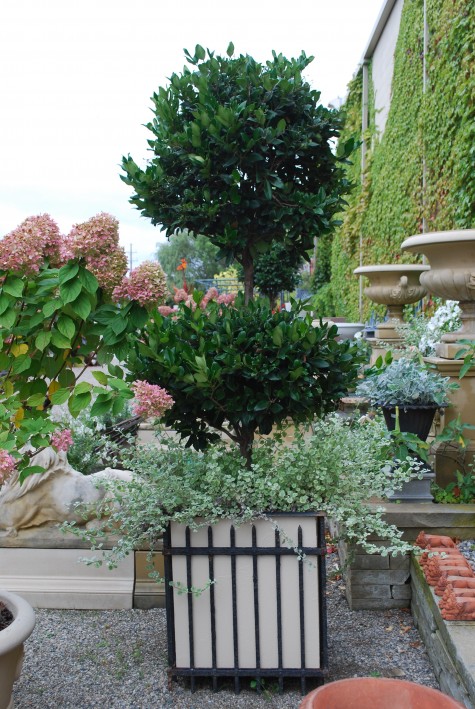 Waxleaf privets are an aristocratic cousin of our hardy privet. The large leaves are lustrous and juicy looking. They are hardy in zone 7, so they can be wintered in an indoor spot without much in the way of heat. They grow slowly, and are available in big sizes; there is demand for the topiary forms from gardeners in more temperate regions. They take well to pruning and shaping.
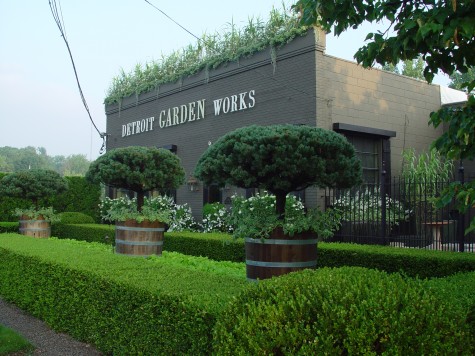
These giant scotch pine on standard are breathtakingly beautiful. I kept them in equally giant wood barrels for the better part of two years, before I sold them. Evergreens need big rootballs to insure successful transplanting-so pots for evergreens need to be large. Boxwood balls are usually larger than their foliage diameter. A well-grown evergreen in a gorgeous container is hard to beat; most likely I will keep on trying to grow them.

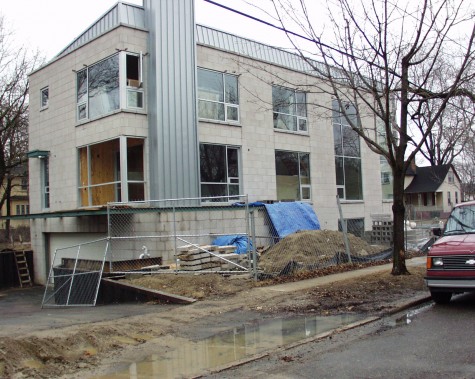 Luckily glass reflects light during the day. Her life would not be on visual review from all the neighboring properties-except at night. Given the very small size of the lot, the architect had designed a basement garage accessible from a sharply pitched drive. I did admire how he managed to exclude the garage from the visual presentation of the of the house. The garage is rarely the most beautiful feature of a home. It was necessary to retain the soil surrounding the house in order to permit a drive surface below grade. This was accomplished cleanly with corrugated steel capped in corten.
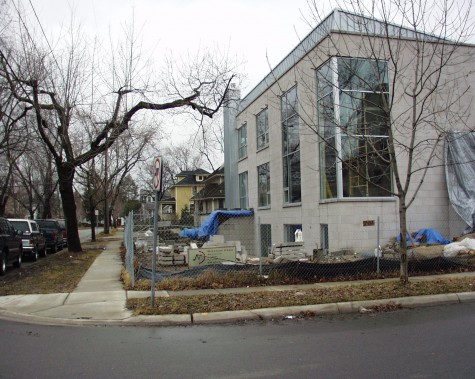 The house is very tall, and the stone and glass edifice is starkly contemporary. The land unoccupied by the house amounted to an L-shaped strip barely wider than the right of way between the street and the sidewalk. Some homes are architecturally demanding buildings. By this I mean their sculptural element dominates the space. My client has a big love for contemporary art and architecture-such that the prospect of living in a sculpture appealed to her. It was my job to design a landscape that would in no way interfere with the one thought-the sculpture that would also provide a home to her. This landscape would in no way be about plants; it needed to be about sculpture too.
 The slanted steel roof presented its own problem-how to handle rain water. A drainage system was designed, and approved by the city. It was very expensive, but it prevented water from flooding the neighboring property. The front porch under construction here would necessitate a big flight of steps, as the bottom of the glass panels matched the grade of the first floor living space.
 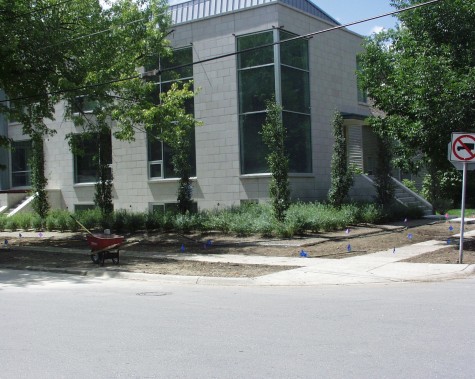 As with any contemporary landscape, a restricted palette of materials makes for a clean and strong statement. I planted a slew of Salix purpurea nana-commonly known as dwarf actic willow. Its gracefully meadow-like appearance sharply contrasted to the hard surfaces of the house, and softened them. The blocks of willows would be mulched in granite gravel. The columnar poplars would not obstruct the views of the house, but would slightly break up the stone and glass surface. The placement was dictated in part to provide good views from the inside of the trees outdoors.
 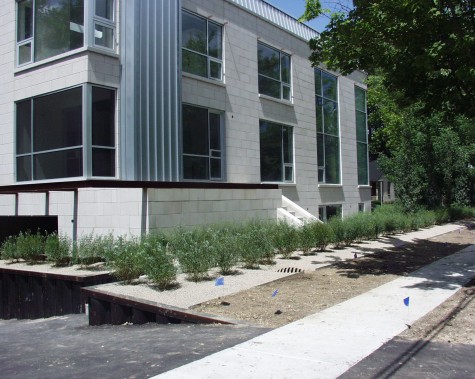 The transition from the willows to the walk would be handled by lawn. It was important for a house this size to visually include the right of way landscape, so more lawn was in order.
 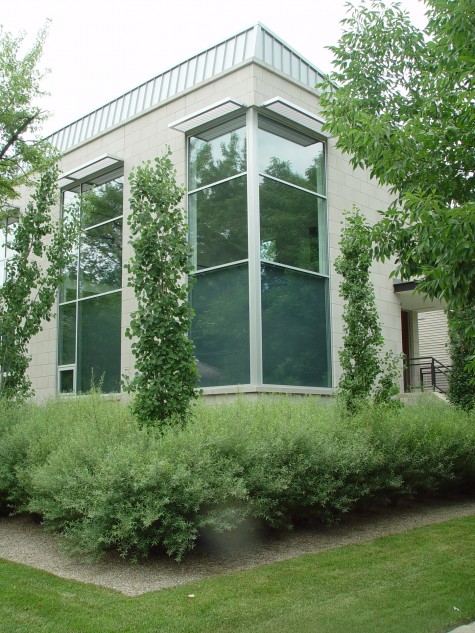 Given some time, the willows took hold. Their dense billowing appearance is simple and handsome. These densely twiggy shrubs are solid and graceful. Their mature height barely sweeps the bottom of the glass panels. Their slightly bluish cast repeated the blue-green color of the poplar leaves.
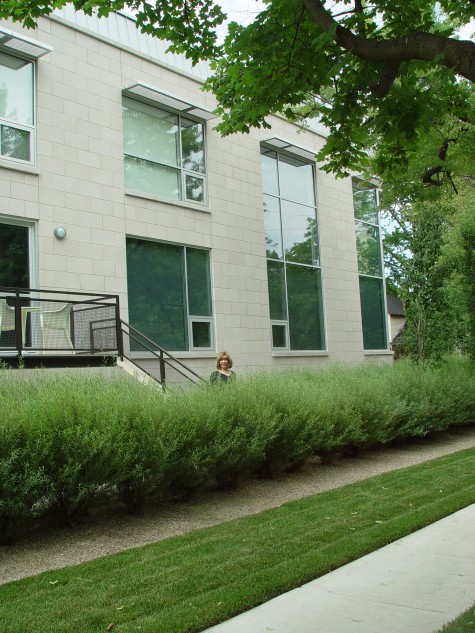 The walkway to the side door is embedded in this meadow as well. A retaining wall which permitted windows to be installed at the basement level is no longer visible-as the wall is strictly utilitarian, we screened it from view. The look of a shrubby willow reminds me of an ornamental grass. Ornamental grasses are difficult in the winter season. Leave them tall over the winter-heavy snow will knock them over, and spring winds will scatter their broken branches everywhere. Trimmed to the ground in the fall-that look is not so appealing either. Some prominent places in a landscape wanting grasses might benefit from being shrubbed up with dwarf willows.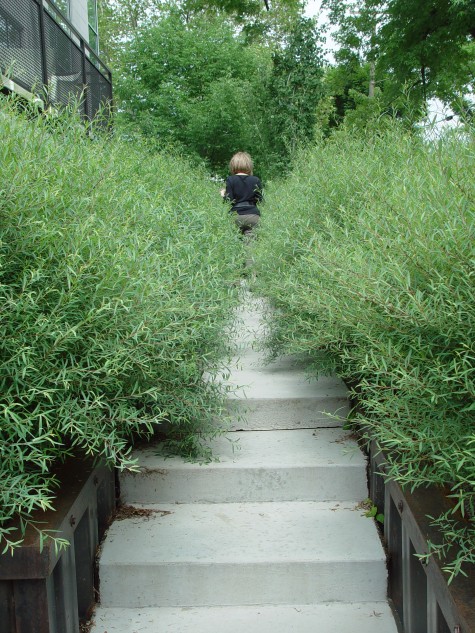

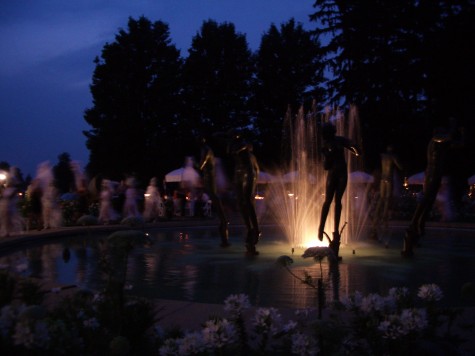 The benefactor tables surrounding the upper level Orpheus fountain glowed with the soft light from hundreds of votive candles set on their surfaces. The white tablecloths, umbrellas, garden flowers,the costumes of the dance troup and water reflected light in every direction. This kind of romance makes people feel good.
 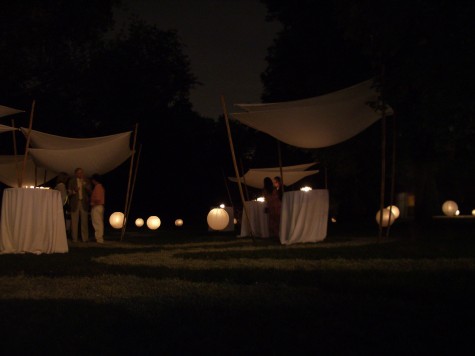 The votive-lit lanterns skimming the surface of the Triton pools were repeated ingound, lighting the path from the entrance to the event, to its center. Designing and creating a walk to the event gave every guest the chance to shift their visual gears from their every day landscape to this specially made and momentary landscape. This transition helps to build anticipation for the event; when I have the idea I am going to enjoy something, I usually do.
 I had not thought about the fact that the level of glow the one votive candle tucked into each sphere would vary greatly given the size of that sphere. That variation in light level proved especially beautiful – courtesy of a little physics via the umbrella we call nature.
 As the evening wore on, the intensity of light emitted from the spheres, and the diminishing ability to gauge the water level gave the impression that all the spheres were floating on, or hovering over the water.
 The reflection of the spheres in the still water made it seem like the spheres were multiplying. The water, the weather, and the light acting on those spheres made this event. How weather acts on a landscape is a critical factor in its success. I do my best work when I am paying attention to that.
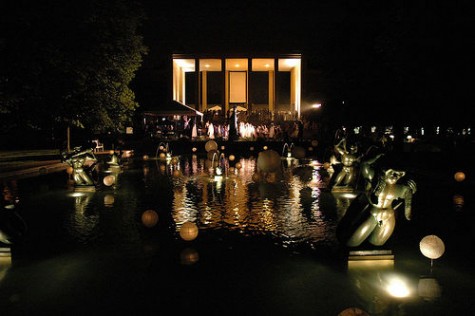 Of course there would be music, dining and dancing. The bidding on the art at auction was brisk; people were enjoying themselves. It was such a pleasure seeing the Triton pools, and their sculptures at night.
 The perfect moment that night? The coming of the frogs. Late in the evening, the spheres were host to many hundreds, maybe thousands, of frogs. They gravitated to the spheres, and took up residence. Everyone could hear them singing, before anyone spotted where they were perched. Some said the rhythm of that singing matched the rhythm of the music; I choose to believe that was so.