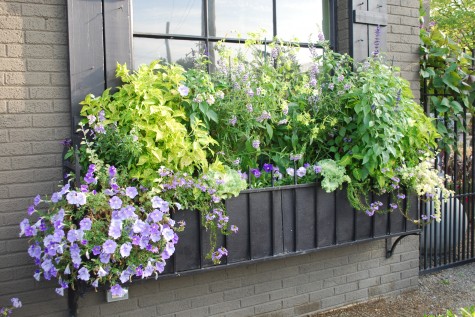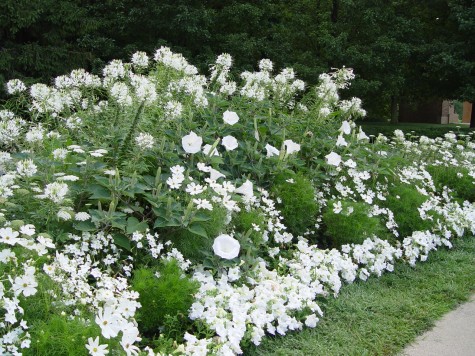
I have been a supporter of the Cranbrook Academy of Art for some years. They produce several events a year to raise money to support their programs. It is a unique institution among graduate art schools in the US, and a considerable asset to our community. I like being involved. We planted the annual garden surrounding the Orpheus fountain in May, in anticipation of their event to come in July. I took my cue for design and decor from the title of the event.
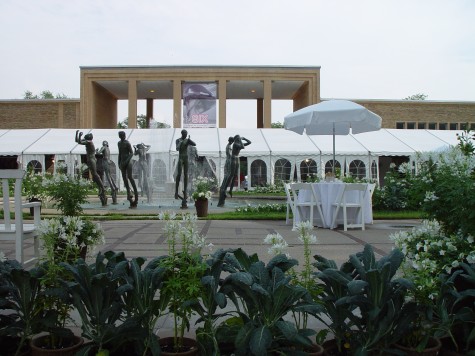 A large tent would be a temporary home to a collection of art destined for auction that evening. Each work was donated by a previous graduate of the academy; this part of the event generated considerable interest and participation. Tables reserved for groups representing the major benefactors for this event were placed in the fountain garden.
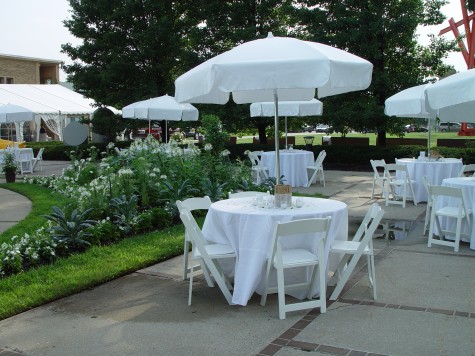 The remnants of puddles you see on the ground in the above picture bring back memories for me; it rained fiercely the afternoon of the event. What I had thought I would have the entire day to accomplish would have to be done in less time. The threat of bad weather makes any garden party all the more exciting to plan and produce-in this case, it was more excitement than I really wanted.
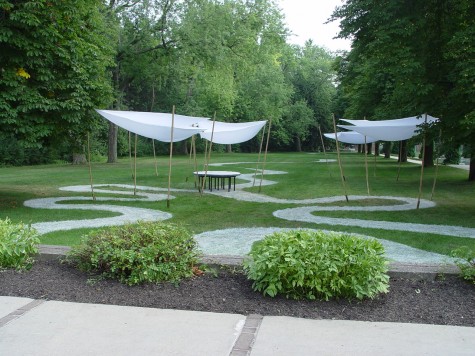 A cocktail reception would be held in a grassy area immediately adjacent to the showpiece of the Cranbrook landscape-the Triton pools. We fashioned simple tents for the hordoerves tables from double layers of white fabric attached to bamboo poles. Steel shoes for the poles were sunk in the ground at an outward angle, stretching the fabric tight and smooth. Nature had another idea in store; the intense downpour changed that flat profile to a graceful swoop. This unexpected contribution from the sky was a good one; I liked the swooping fabric against the curving path. We had painted a rambling path for guests arriving at the Lone Pine entrance to the garden to the reception area, with athletic paint.
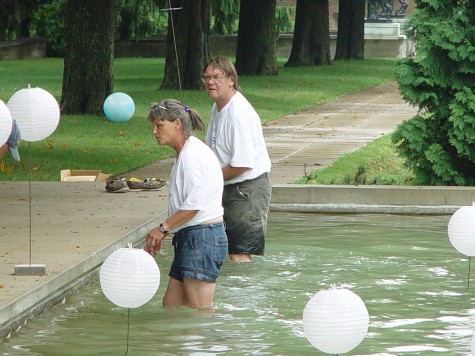 The big gesture? I had the idea to affix paper lanterns to slender steel rods anchored with bricks which would sit on the on the pool bottom. Advance measurements of the water depth enabled us to create the impression that the lanterns were floating on the surface of the water. What fun it was to get in these fountains; I never expected this opportunity to come along. A crew of four of us spent the better part of the afternoon wading in the water.
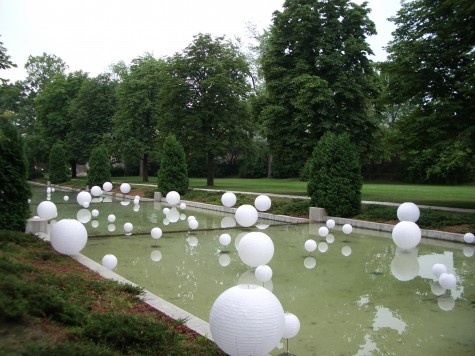 We set up hundred of lanterns of different diameters. Each steel rod had a platform at the top holding a votive candle. As we set the lanterns, we lit the votives rated to burn for ten hours, and hoped no more rain or wind would come our way. I was equally concerned that no water from the pools wick its way onto the paper. I was interested in creating a little moonlight magic, not a wet paper mess.
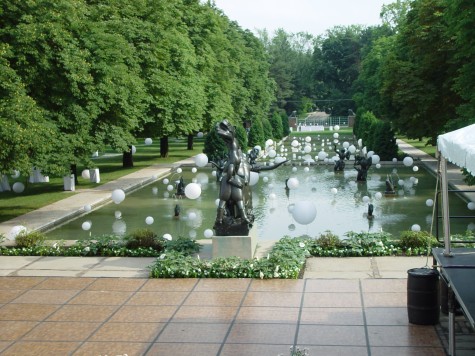 It seemed the rain had cleared off, and we did finish with an hour to spare before guests were due to arrive. The reception would begin at the very far end of the pools, and guests would wind their way uphill.
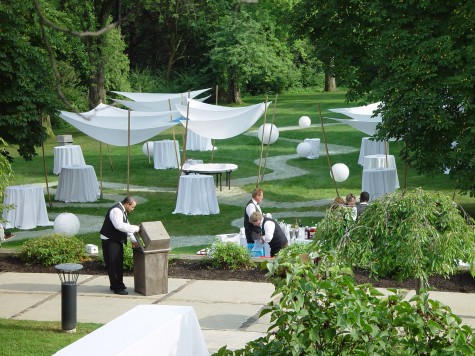 I was happy to have finished my part as the catering staff was setting up. I was on my way home to get dressed; I did not want to miss how all of this would look at night.
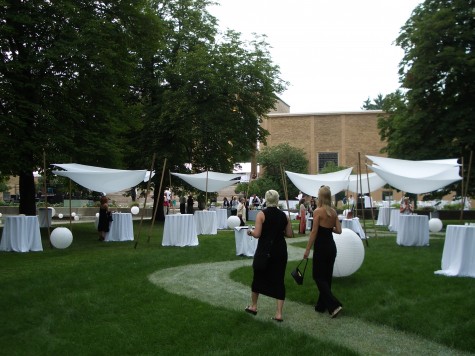 Attending an event gives you the chance to experience it as other people do. There is plenty to be learned from this-what proves awkward, what is not visually strong enough when a space is full of people, what proves to be good that you never gave a moment’s thought to. Any party in a garden will surprise you.
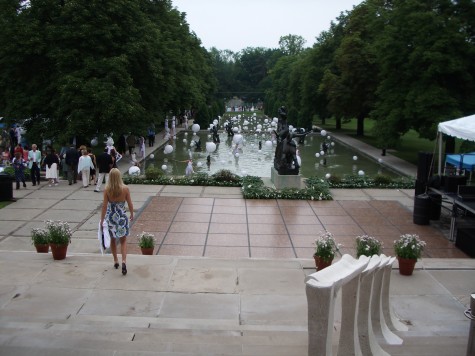
I made it back just in time to see the garden begin to fill with people. Little did I realize what the night would add to this party-more on that tomorrow.
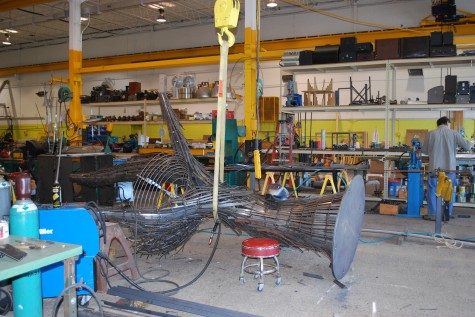 The upper peninsula of Michigan, and the Sault in particular, is home to a substantial population of American bald eagles. They are proud of the fact that the eagle which symbolizes our entire nation thrives here, as well they should be. The bald eagle is as much a local treasure, as it is a national one. As any fountain placed on City property would be subject of discussion, design and review by committee, it seemed those firecely wild and independent birds would make a fitting subject for a sculpture, and appeal to a broad audience. We chose a subject matter we knew would strike a chord with a number of people. Given some drawings and dimensions of this object, a CAD drawing was produced enabling the project to be quoted. Nothing with cities proceeds quickly, but it does proceed; we were cleared to build.
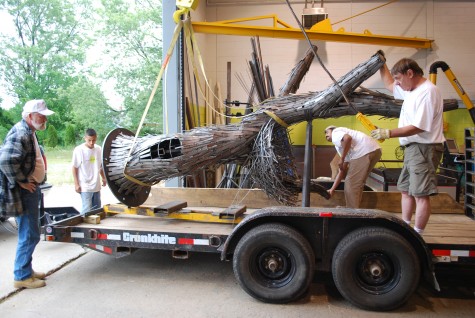 This fourteen foot tall steel sculpture interpretive of a tree would cover a plumbing system designed to propel water out the topmost branch. Attached to that tree would be a network of steel twigs representing an eagle aerie. The galvanizing tank in which we hot dip galvanize all of our steel is only 5.5 feet wide; one branch of the tree would have to be mechanically installed after the contruction process was complete. The fountain was designed in the round for viewing, not designed to fit a tank.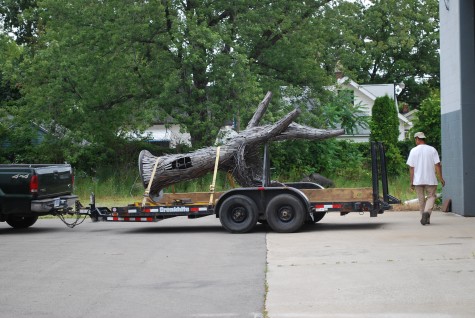
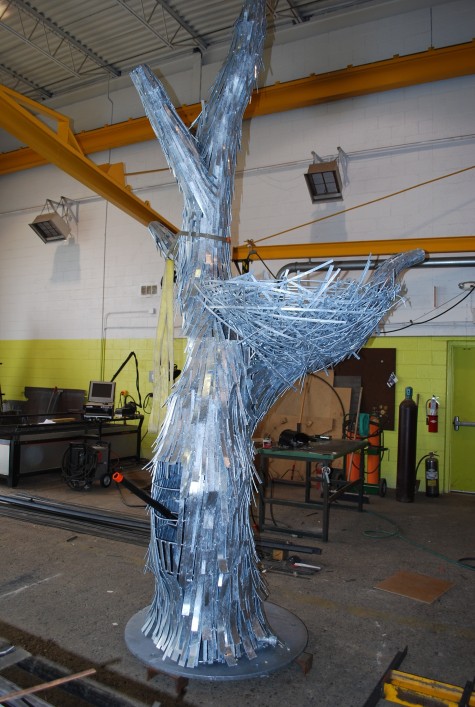
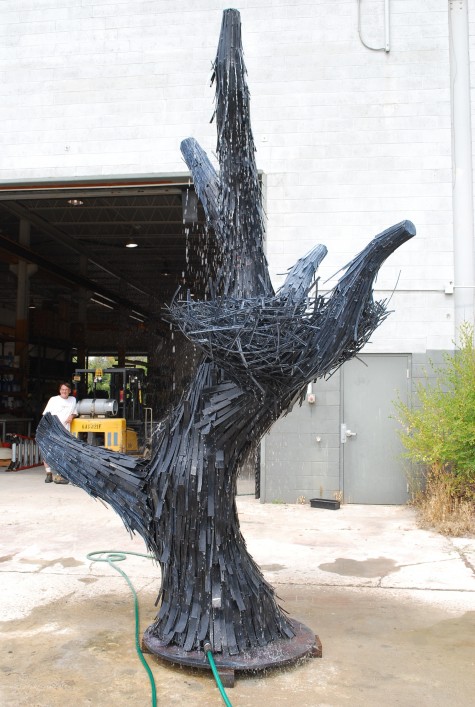
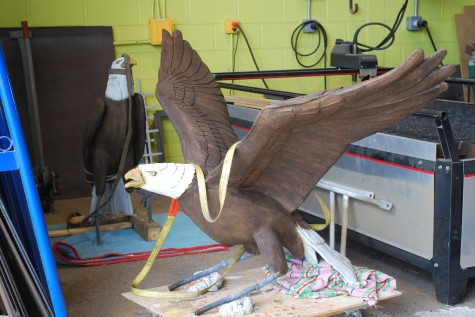 Life-size bald eagles hand sculpted from a steel rod and mesh galvanized armature, and acid stained mortar, would be attached to the sculpture via steel sleeves made to match the size and angle of the legs.
 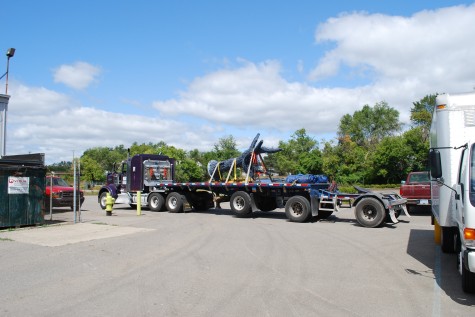 Buck followed this semitruck on whose whose flatbed that sculpture was securely tied down-for 340 miles. The next day, he supervised the installation, driving home late in the day. The sculpture had been installed.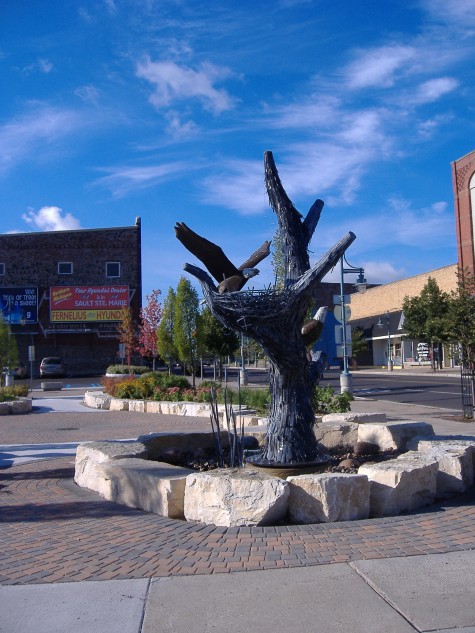
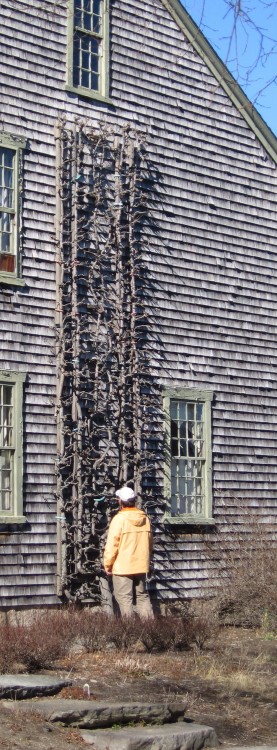 Would not the silhouette of this tree, trained and grown parallel to a wall, get your attention? Even out of leaf, it is striking. You are looking at an espalier- a tree trained to grow in only two dimensions. In the late 1600’s, Fr. Legendre, a monk living in Hanonville France was in charge of his monastery’s garden. His fruit trees were bedevilled by late frosts that killed the fruiting buds. Noticing that the fruit trees planted closest to the monastery walls sustained the least damage, he began planting his fruit trees as close to the walls as possible. As wall space was limited, he began shearing his trees, so as to provide room for all the varieties he wanted to grow. Amazingly, the drastically sheared trees produced heavier yields than unpruned trees in the field. His book, Palmette Legendre, was published shortly before his death in 1684. This book is the earliest known text regarding the science of growing espaliers. These trees, pruned flat, spare, and parallel to a wall, had fewer cultural problems, took up little space, and were beautiful to boot.
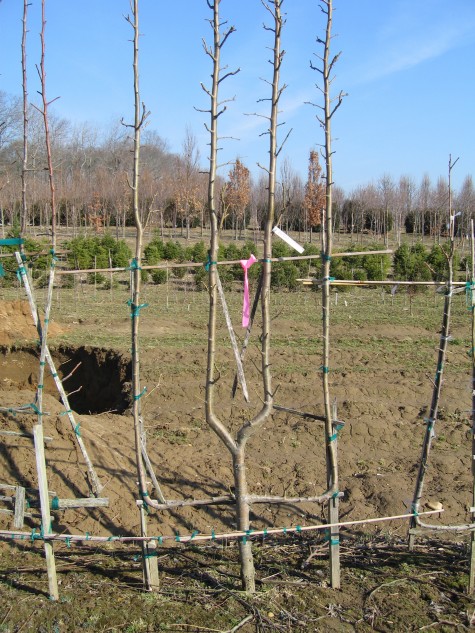 Espaliered fruit trees look like no naturally growing tree . Though no tree expert would advise this kind of planting, pruning and shaping, Father Legendre’s ideas practices enabled ample fruit for everyone living at his monastery. Sometimes the hand of man comes to good end in the environment. This very early spring picture shows an espaliered tree, grown in the candelabra shape. It would be beautiful, grown on a blank wall-never mind the fruit. Training trees to grow in two dimensions became a gardening art form-even for those who had no need to feed many from a very small plot of land.
 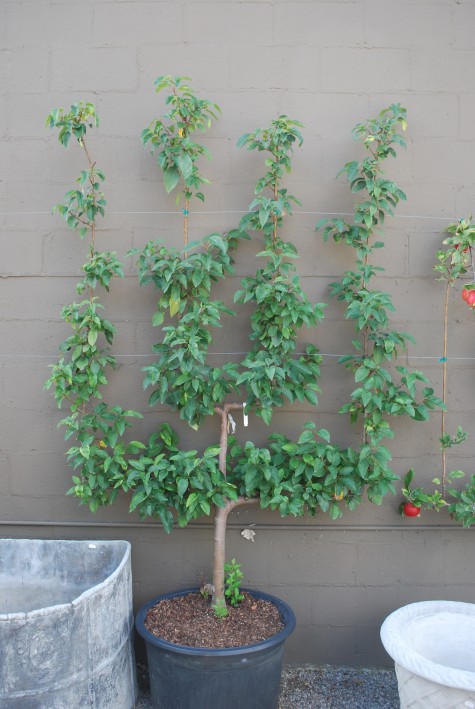 I make a special effort to offer exceptional espaliered trees to my clients. My grower of choice is of French descent, and his espaliers take my breath away. I drive a day’s length to see and review his espaliers. He grows in the traditional way, and only has a few trees to offer for sale every year. He sells no trees that are not at least seven years old; his big trees are much older. He pots his trees, and then sinks the pots in the ground. Note that the trunk of this tree is positioned to the back of its pots-his trees are easy to plant close to a wall.
 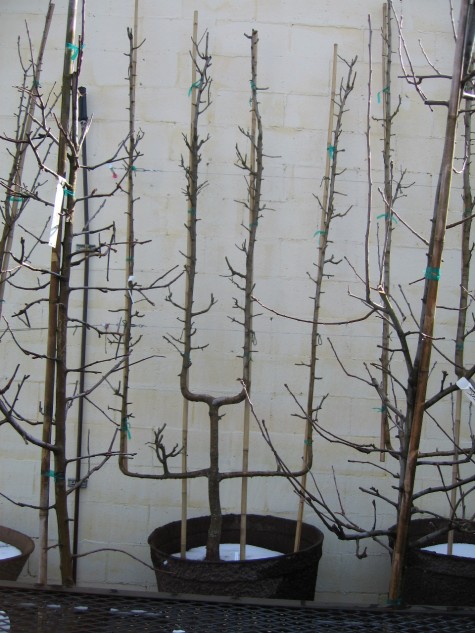 Their winter appearance is architectural. The American landscape is fundamentally based on big spaces; we have eight lane highways and driveways 22 feet wide. This makes this particular dose of French editing all the more refreshing. People who come to my store are invariably interested in their history and forms.
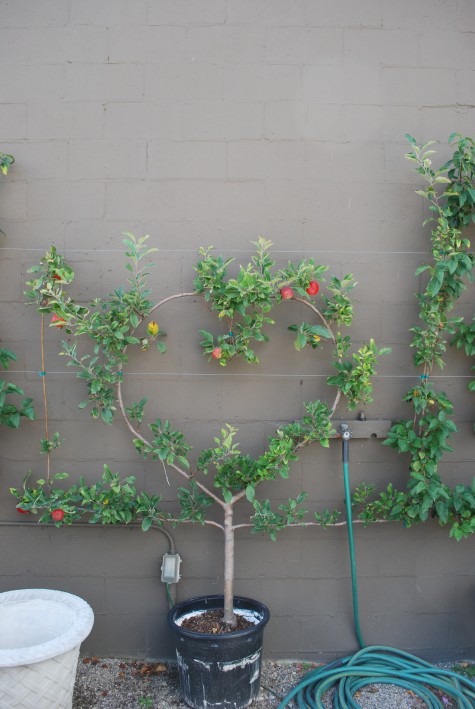 My grower trains some of his espaliers in a form not existing in the classical literature. This framed heart is entirely his invention; how I love this. It has a distinctly American feeling; he has taken his classical training, and gone beyond.
 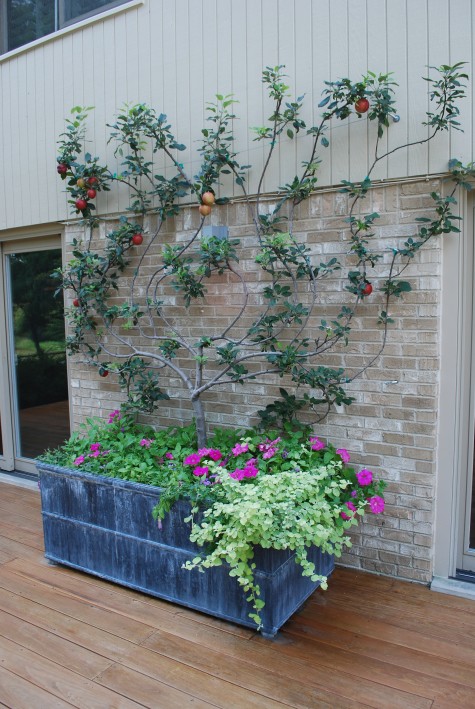 This informal heart espalier enchanted one of my clients. I call it the wild at heart espalier. As she had no room in the ground, we built her a box for her deck, insulated to slow the freeze, and delay the spring thaw; this apple tree is thriving. We heap up the compost after the ground freezes, and we uncover it in the spring; so far, so good.
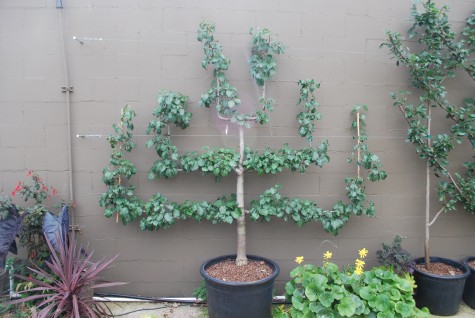 Not all espaliers are fruit trees. The art of training espaliered trees has extended to many trees tolerant of this treatment. This Bradford pear makes a big statement as an espalier. Any lonely wall would be all the happier for this tree planted on it.
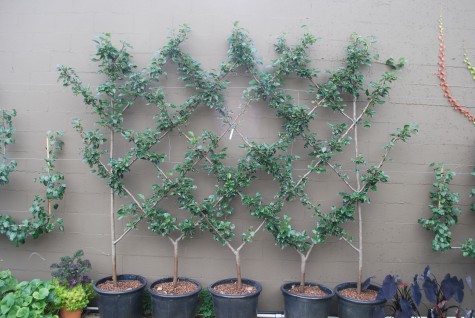 This series of trees is known as a Belgian Fence. You can see that individual trees were topped low to the ground as whips, encouraging branching in both directions. The branches of these trees are trained in a diamond pattern; what a beautiful living ornament for a long wall, or a free standing fence.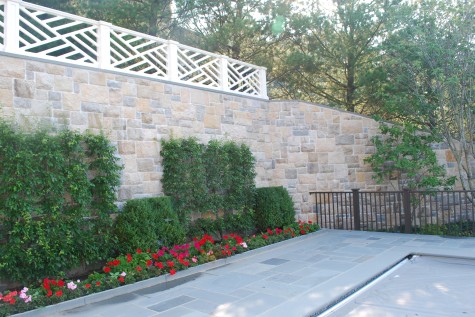
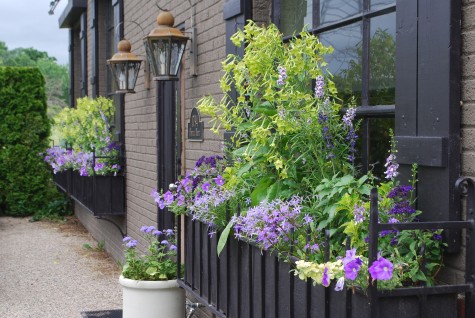
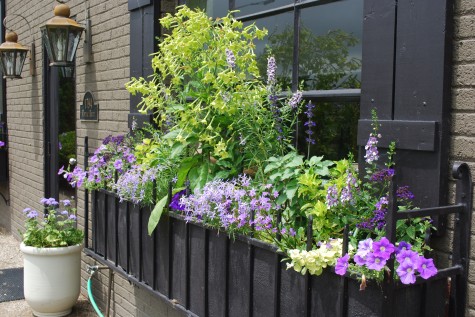 No matter what you fancy in your garden, nothing in it ever stands still. A garden actively grows, or actively sulks, or goes down. Some days I wish I could shift into neutral and coast, but I know better. I also know that as much as I would want to devote a chunk of time to nurturing all my plants, every day, that rarely happens. I have a demanding work life; moving that along every day takes priority. I hedge my bets some with plants that seem to handle the hit and miss nature of my care. Petunias thrive on this treatment; this is one plant that the more I fuss with them, the more they resent it. A trim once in a while is enough. Angelonia does not like cold weather, but it’s not a prima donna either. Once the hot weather comes, they come on strong.
 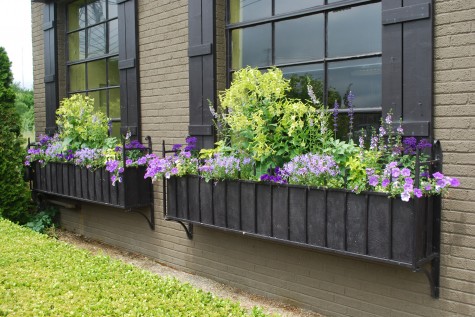 Blue salvia is puny early on; it is a late season annual. In a good year, they handle cooling fall temperatures with aplomb. I knew I would have these late. Planting the blue star-flowered laurentia was risky. Not only am I not so familiar with its habit, it has that look of an early season annual destined to peter out. This I cannot really explain, except to say some plants just look like they won’t do. The heliotrope was stuck in first gear; this plant likes hot weather. But for the moment, the lime nicotiana alata has my attention; the weather was instrumental in making it look perfectly happy. Every year, the weather is perfect for something; I thus follow the National Weather Service three month predictions with a lot of interest in late winter. Occasionally that helps.
 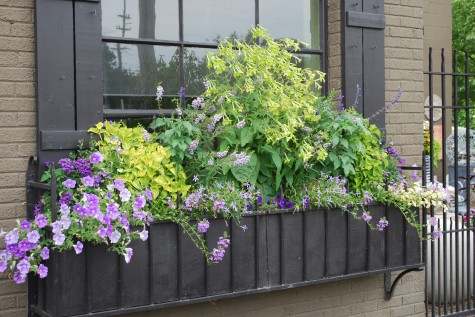 By August first, we were getting an 80 degree day once in a while. You can see the effect on the licorice and heliotrope; too little heat, too late. The flowering on the laurentia is slowing down, as I thought it would. Though the flowering is so- so, the plants are growing fine. The overall shape and the interaction of the group is the success of the box. Cool and dry made for unusually few bugs and no disease .
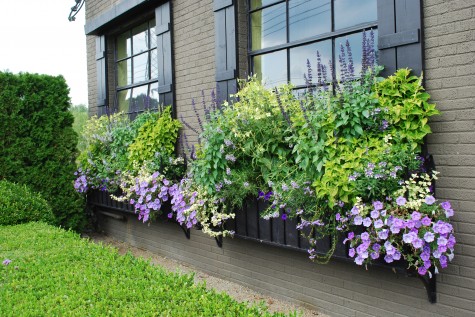 By early September, my balanced box has gone too tall-bad maintenance on my part. Trimming plants back keeps them stocky, and encourages them to reflower. However, this height is a great look from the street; the flowers are visible over the boxwood.
 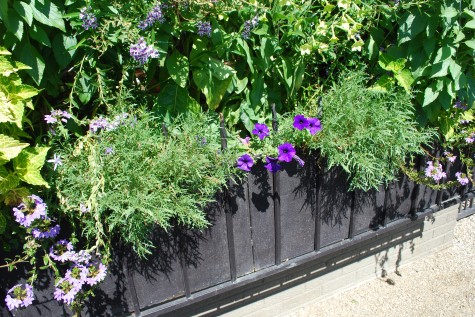 As I predicted, the laurentia bloomed out, and needs replacing. By September 15, our weather is in transition. I expect night temperatures in the high forties this week yet. However, I am not willing to rip the boxes yet; I hold on to my summer season as long as I can. We are having our warmest daytime temperatures of the season. As there are plenty of plants that thrive in cool night temperatures, I will replace as needed.
 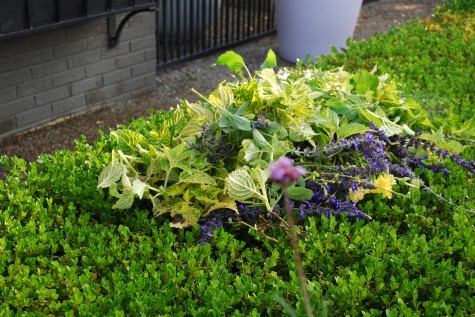 A good haircut and deadheading came first; late is better than never. As long as the warm weather holds, the coleus will respond quickly to the trim. There is no reason to give up what you have looked after all season. There is every good reason to keep what is good, and replace what isn’t.