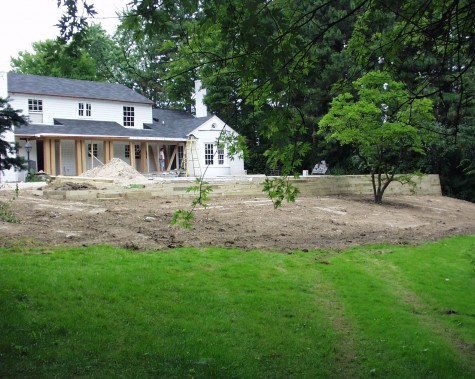
The idea of a house on a hill has a grand and romantic ring to it-especially considering I have spent my entire life standing on ground no higher than sea level. The terraced gardens of the villas of the Italian Lakes-heavenly. Meaning, heavenly to look at, and the devil to visit and maintain. The crest of this fairly steep slope was home to a narrow driveway. Driving uncomfortably close to a steep slope can be nervewracking; I would not have wanted to drive it at night, after a few cocktails. A beautiful drivecourt would provide room to drive and park. The requirement for flat space would be provided by a retaining wall of pressure treated lumber. As I planned to grow climbing hydrangea on the face, I chose the most reasonable and serviceable material.
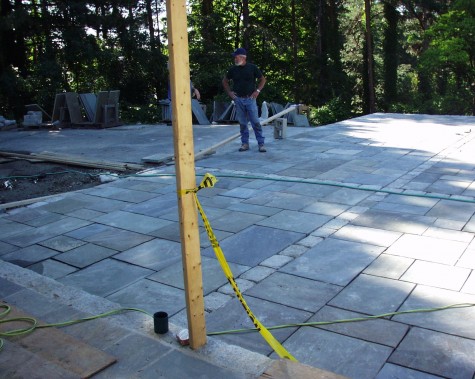 The driveway was equally close to the front door, and ran past the house to the garage. This made for little opportunity for a presentation of the house, and its fourteen foot width did not permit much parking. It seemed appropriate to splurge here. Two inch thick bluestone laid in a classic aschlar pattern, and bordered in granite setts announced the entrance in an elegant and spacious way.
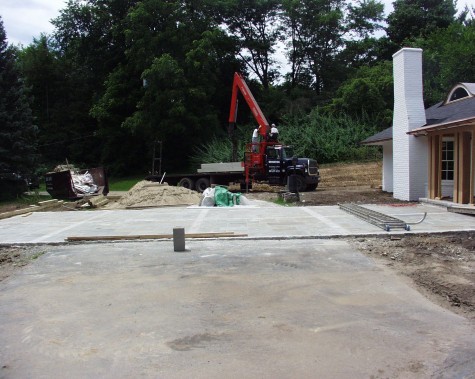 When not in use as a driveway, or for parking, this areafunctioned as a terrace. I have known my clients to host a pre-dinner hour here on a nice night. The asphalt would remain in place on either side. A stone driveway demands expert installation, a service which is well worth the expense.
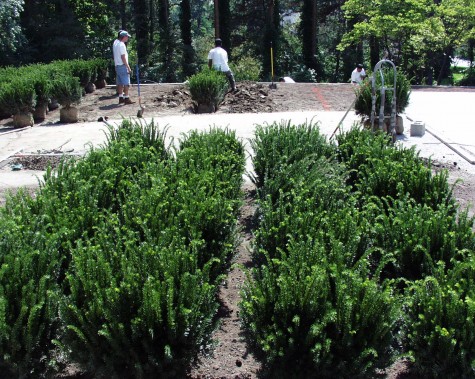 The landscape is simple. Rectangles planted solidly with yews abut four rectangles of pachysandra and matching English Oaks. The triple wide hedge of yews adjacent to the retaining wall provide security for people and vehicles. These masses of yews did have that polka-dot pattern for a few years until they grew in; proper spacing at planting helps to avoid cultural problems later.
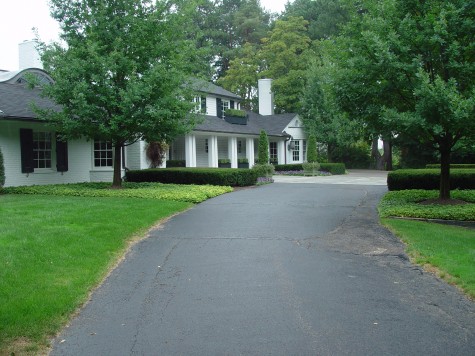 A driveway that runs parallel to the front door needs a landscape statement that signals an imminent entrance. This drivecourt landscape creates the impression that the garden came first, and the drive through second. The English oaks enclose the space, without obstructing the view of the house.
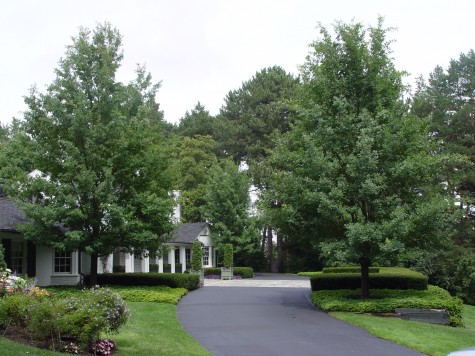 It has been a number of years since this garden was installed. This photograph clearly illustrates what a graceful space has been created from the simple idea of flat ground. Sloped spaces are not particularly sociable or functional spaces. Deciding how you need a space to function, should organize the design to come.
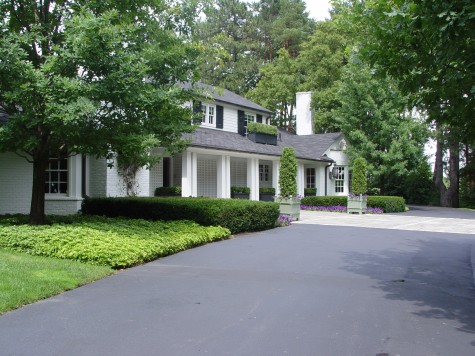 A pair of French orangery boxes from Les Jardin du Roi Soleil define the transition from driveway to walkway. These boxes have been manufactured in this shape, design, and color since ythe 17th century. The legs, corners and hinges are cast iron. Originally, the slatted oak boards and hinged iron permitted the boxes to be opened from the side. A lemon tree that had summered outdoors could be slid out of its box, and stored in the orangery for the winter. How’s that for a little romance?
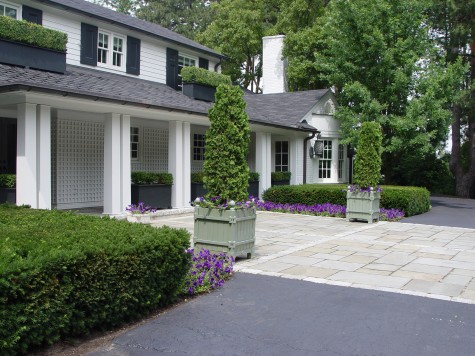
Simple rectangles of painted wood contain boxwood hedges that sit between the columns of the porch, and on the roof. The modification of the roof to hold those boxes-the work of a very thoughtful interior designer.
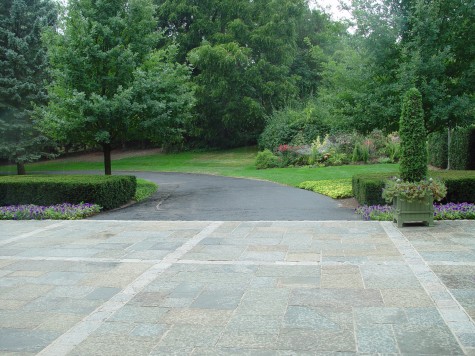
There is a fine view from the inside looking out as well. Flat spaces are great places to meet and to be.
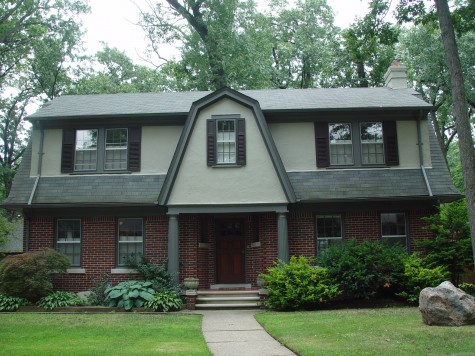 Though my client lives in this lovely old Dutch colonial house, she loves all things modern and minimal. She was interested in a landscape design which would reflect her point of view, yet work with the house. In a book entitled “Minimum” -a gift from her-author John Pawson states that “The minimum could be defined as the perfection that an artefact achieves when it is no longer possible to improve it by subtraction.”
 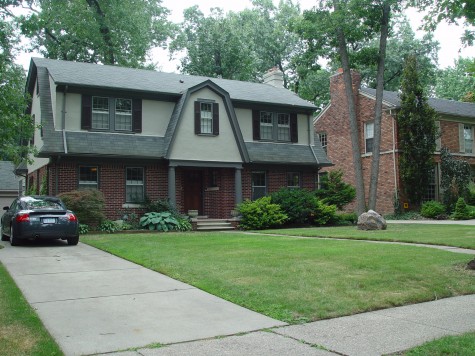 As a landscape is a living thing, and most definitely not an artefact, I told her the best way to achieve the sort of simplicity she was looking for would require a very simple palette of materials. I concentrated on volumes, and values. If you wish to see shapes simply, squint; all the detail will disappear. The house has very definite light and dark shapes. The relative lightness or darkness of a color is known in design lingo as its “value”. I could see a white and dark landscape looking just fine with her home.
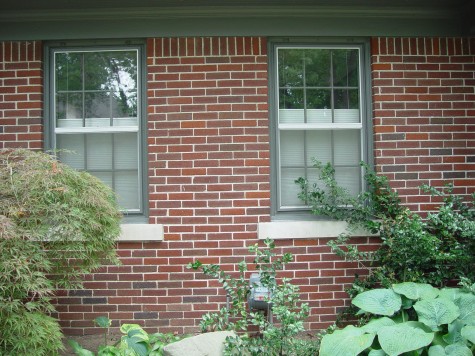 Though the house was built in the 1920’s, its architecture has a very modern feeling. The windows are plain; the shapes of the house and gable are simple and massive. A traditional mix of plant species planted along the foundation, though well grown, had nothing to add. As she planned to do her own work, I did a quick conceptual sketch.
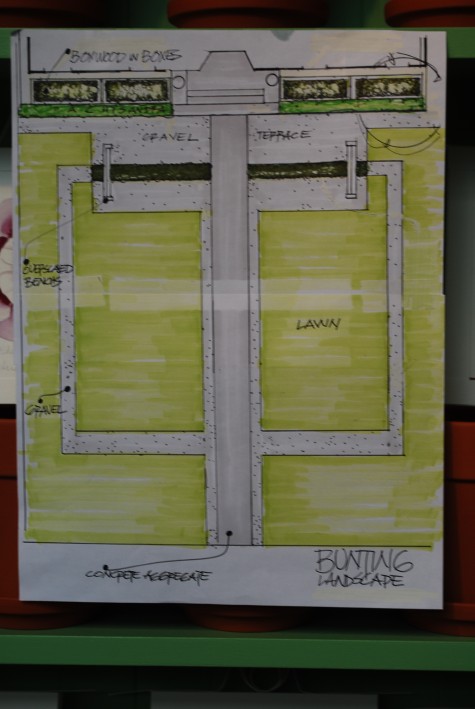 I suggested that she remove all the plants in the front of the house, build four sheet metal boxes, paint them a dark color, and plant them with boxwood. The only in-ground plant along the foundation would be pachysandra. Lawn and gravel panels in simple geometric shapes would be connected by a large square frame of gravel. The frame shape running through the terrace, and under the benches would be planted with some dark foliaged plant material.
 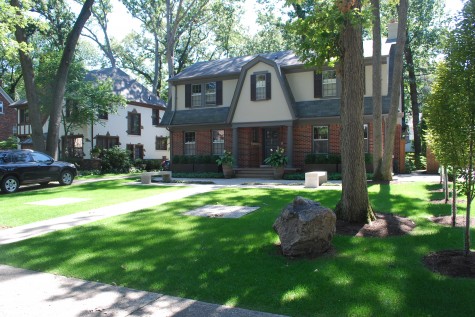 Some of my clients like to do their own work-she is one of them. She would come up on occasion for a quick consult on this or that. She made changes to the plan for both practical and aesthetic reasons. She added a row of columnar carpinus on the lot line; the screening was important. Rather than the big picture frame, she installed two limestone gravel squares in the lawn. The installation was very well done.
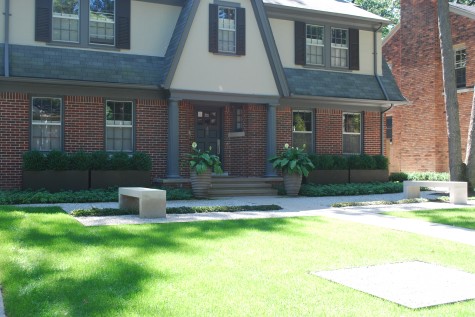 The dark green boxwood in the dark boxes repeat the dark horizontal line of the roof. They seem even darker, as they are always in shade. Squint as you look-they almost disappear. The boxes sit quietly behind the modern Italian beehive pots by Francesca del Re. These pots are the only highly textural element in the landscape. I am sure my client would say that one textural element was enough. She is a very good editor.
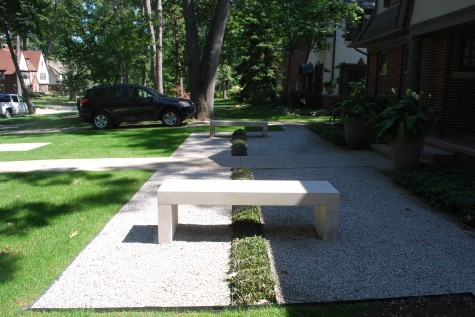 The dark run of ajuga is much more about sculpture, and sculptural relationships than it is about the plant. She did however reseach carefully for a small growing, fine textured plant that would tolerate both dry shade, and some sun. Her care in selection has paid off. Though the light conditions change from one place to another, the run is growing and thriving uniformly.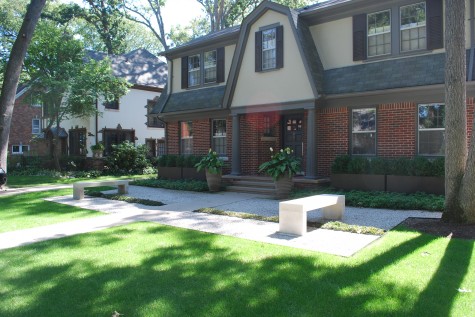
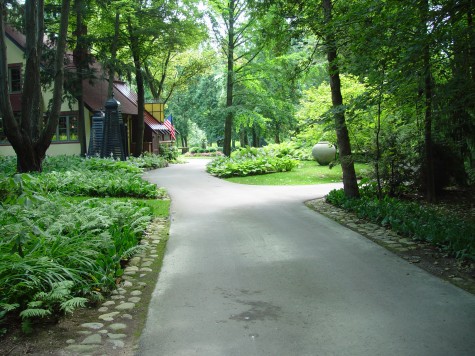 I started to work on this lovely property in 1998. Set in a forest of old trees, the house and landscape had that quiet woodland up-north feeling. Everything I designed for this client I kept in keeping with that feeling; few properties come with an aura as strong as this one did. A case in point; this driveway was laid out with the house in the 1920’s-and was no longer wide enough for modern vehicles. My solution? Edge the drive in small round native to Michigan granite rocks, and let the moss go to work on them. Anyone over the edge with their SUV-no harm. Do no harm-this was my organizing metaphor.
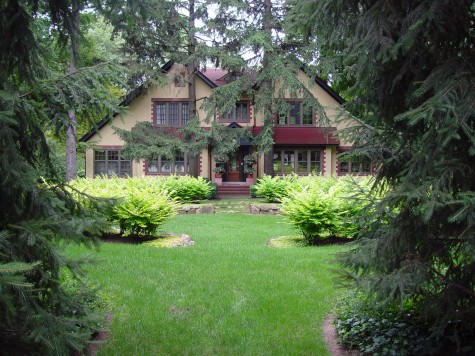 I like formal spaces in front yards, as I like a public presentation that looks good every day. All of us are very busy people-I like a landscape that can wait. But boxwood or taxus hedging seemed alien to the feel of this space. The golden vacary privet-an old plant not much in fashion since its hey day in the 50’s, seemed perfect. The chartreuse color would light up the shade. This very informal material used in a formal way, was a nod to the period and feeling of the vintage house, and its landscape.
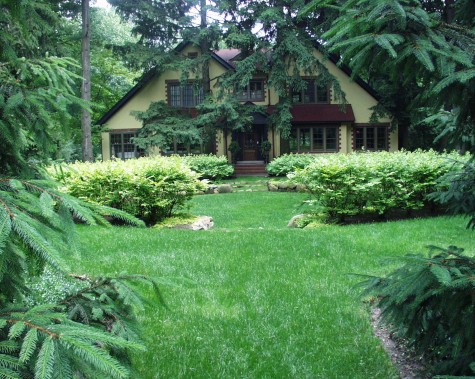 This picture is taken from the road. Old weeping Norway spruce were planted very close and gracefully to the foundation of the house. I repeated this woodland feeling at the road-with a break, a view. A brief view.
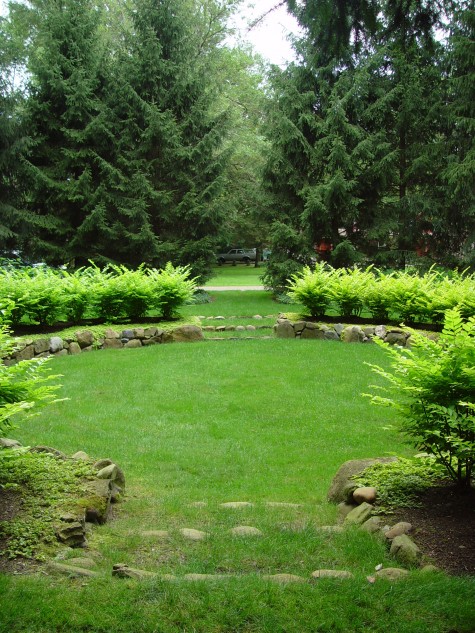 The gold vicary described the shape of a circular sunken garden. What I love the most about the native Michigan woods are how quiet they are; no noise which is technological in origin. No radio, no cars, no jet skis, no boats-just quiet. The sound of birds, wind, footsteps-these sounds are native, natural, and good. Sinking a garden even a little intensifies the quiet. Two simple steps of grass with round rock risers-a casual, northern Michigan detail.
 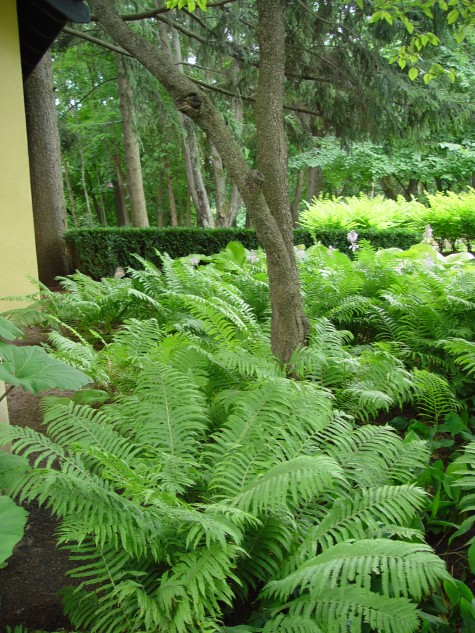 And the ferns? Everywhere. Ostrich ferns as a groundcover-this is a beautiful look. The texture, scale and informality is easy on the eyes, and pleasing. Drifts of ferns really interest me as a designer. They are bold and sculptural in big masses. But they speak directly to the primeval forest; the look of a stand of ferns wrings all the tension out of me.
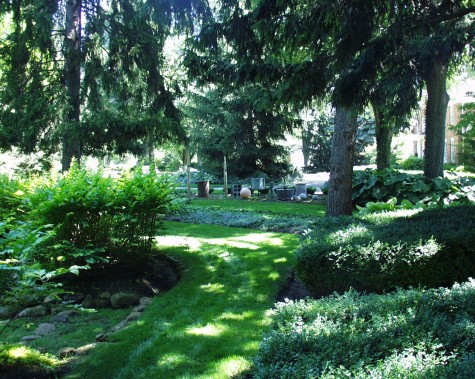 No doubt this was a shady, mossy, quiet, not perfect, natural, woodland landscape. A grouping of funky containers and sculptures, set in groundcover on the far east perimeter, was a nod to the point of view of the client. I love a collection of objects that band together to make a sculpture.
 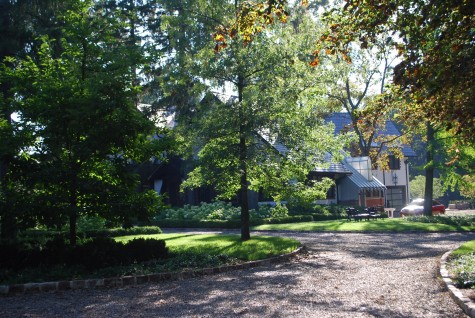 I wrote last Sunday in my weekly opinion post that a ride by this treasured project of mine revealed that the client has ripped most everything out, and installed a new landscape. I felt the shock that anyone feels when they come face to face with something so totally unexpected that blacking out seems an appropriate response. It took me two days to recover, but recover I did.
 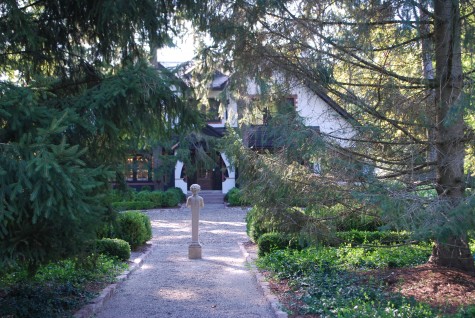 My clients have their own lives, and their own idea of beauty. They hire me-I am not a favorite aunt, or a Mom, or a daughter. Their lives change-I am not privy to most of that. I may be close beyond close for the duration of the project, but I am usually their fifth business. At my age, I know who I am. I appreciate that the lives of my clients are not subject to my review. I furthermore understand that my ownership of a project is while I am making it. What happens after-I am not responsible, nor am I honored. This is as it should be.
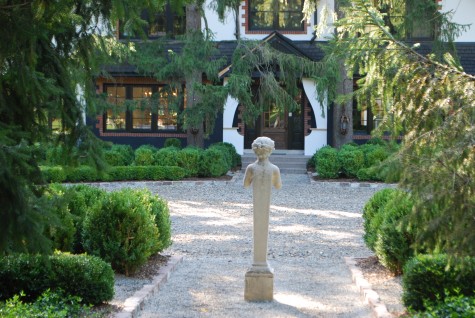 It is not my idea to critique the new landscape-that is not the point of this post. I am not interested in being a critic. I am interested in writing about my life as a designer. It is very tough to see years of work erased-no one cozies up to this. Least of all me. I am interested in history, and continuity. But I do not always get my way.
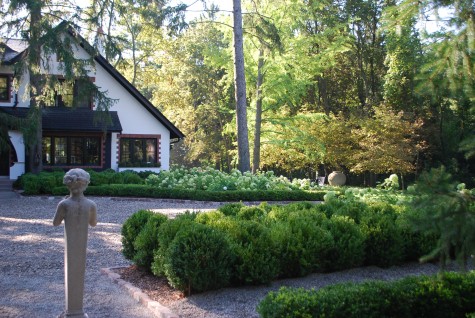 No matter how this landscape looks now, I am not unhappy about how I approached it. I have no second thoughts. I will sleep sound tonight.
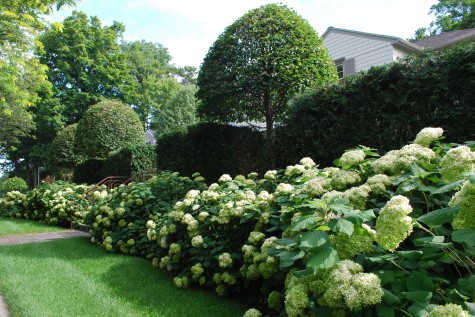
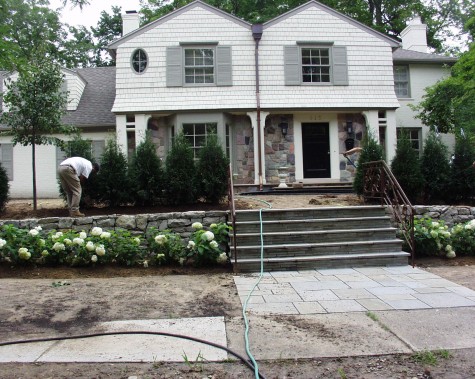
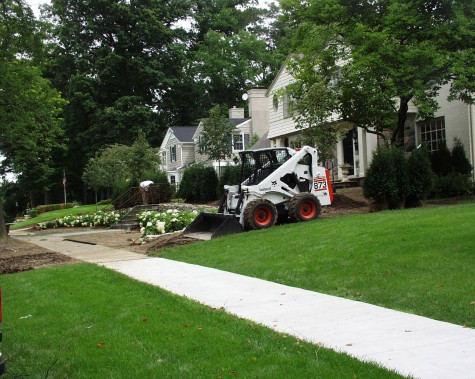 Yesterday I discussed all the grading and stonework that was necessary for this project; what a relief it was to finally be putting plants in the ground! The neighborhood association belatedly decided this wall needed to be screened by plants. They apparently did not permit walls in front yards. So I planted a slew of Annabelle hydrangeas; my clients have a great view of the wall in the winter.
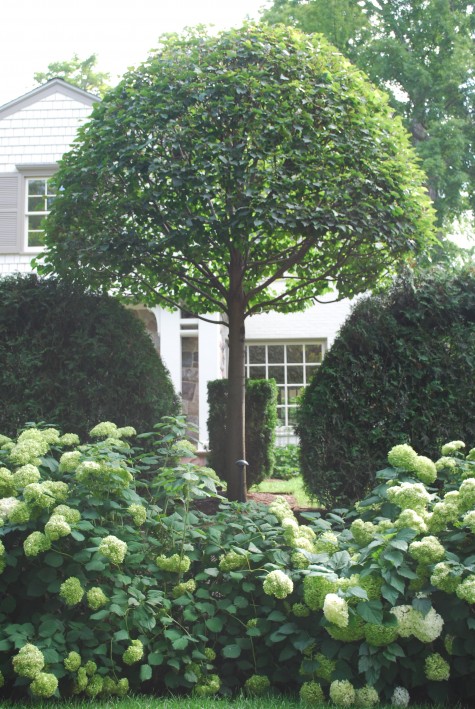
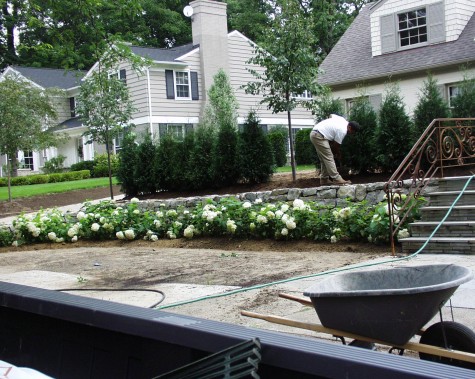 The upper level we did screen from the street. Houses that sit high afford little in the way of privacy. I interspersed five little leaf lindens in a hedgerow of techny arborvitae. The techny’s are dense, and slow growing. They also tolerate some shade, although the plan was to keep the lindens pruned.
 Lindens belong to that group of trees that do not mind shaping. I have seen old ones not much taller than 15 feet, with densely foliated heads. My lindens at my store are boxed; they have been pruned into rectangular shapes. They are a hedge high above ground. They greatly soften the appearance of the building-originally a machine shop built in the 1940’s. These lindens I wanted to keep in scale with the house.
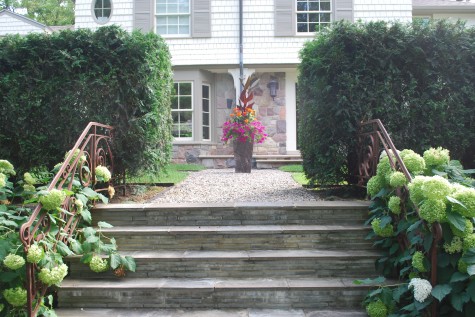
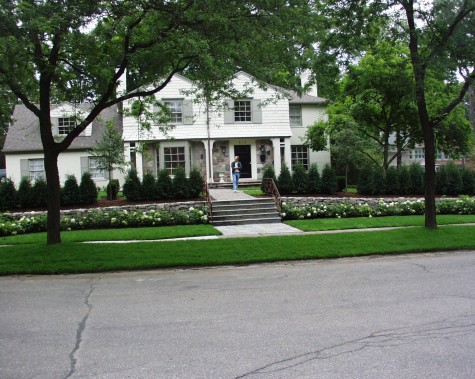 The house seems to sit lower than it once did. Though the front door of the house is off center, the landscape balances the space. The granite walled portion of the facade reads as a centerpiece, of which the front door is a part. The landscape making much of the bluestone staircase centers the view.
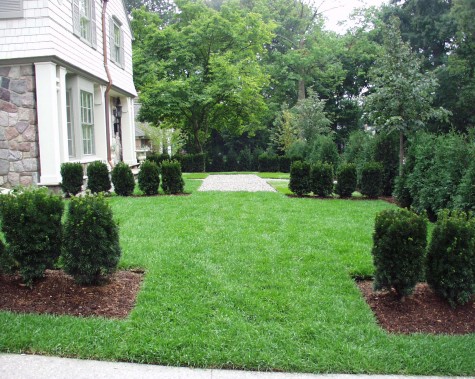 There were two issues driving the design of the upper level. How could the sidewalk gracefully turn towards the front door? The walk from the street now empties into a large rectangle of gravel; its color and size makes it read as the dominant element. The taxus viridis, naturally a very columnar yew, is planted in rows perpendicular to the house. This distracts the eye from the fact that the property in the background is dropping downhill. The techny arborvitae at the end are actually much taller than the yews-but everything reads about the same height. In time, the yews could be topped level with the horizon, thus minimizing the slope down to the west.
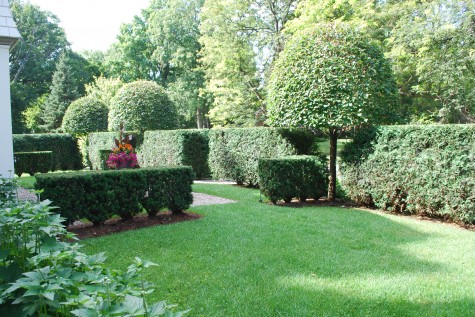 Eight years later, the landscape has begun to grow in. This front courtyard is private, and simple.