For Adults Only

Some trees delight gardening adults, and gardening adults only.  They do not burst forth dramatically with a blizzard of white blooms in the spring-like a Snowdrift crabapple. There is not a frothy pink blooming ballerina of a crabapple tree in the bunch.  They have no orange and green tulip like flowers on trees closing in on 100 feet tall-as in Liriodendron. 
They have none of the drama of Chamaecyparis Nootkatensis pendula-the weeping Alaskan cedar. None of them are the robustly strong and stately shade trees that ought to be thriving in the tree lawn of every community-the lindens, the sugar and red maples, the zelkovas, the oaks, and sycamores.  They are not a member of the corps of the tree elites-the beeches in all their forms hog most of the room in this category. The Japanese maples consume every spot not taken by the beech. European weeping beech, tri-color beech, Rohani Beech, fernleaf beech-the list is long. The dirt under a mature beech-fit for mulch. No beech suffers any close company in the absence of a feverishly devoted ground-gardener. Acer Palmatum, available in countless permutations-too precious for words. I see them much more than I should.
These architecturally interesting and subtly beautiful trees are not touchy-like the white cercis-and the dogwoods. Any summer day I can see an American dogwood in decline, a Kousa dogwood with wilted foliage and fungus, a birch struggling with borer or ice storm damage, a pin oak with foliage a stark and unpleasant bright yellow from chlorosis.
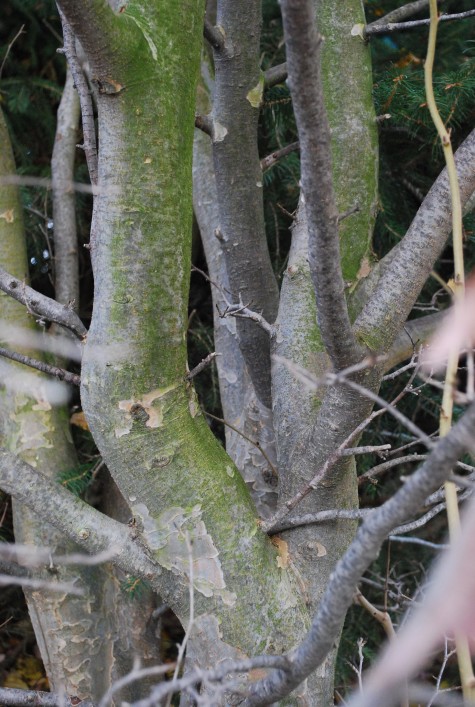
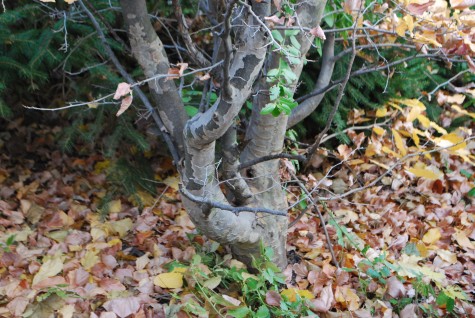
The adults only trees are never weepers. Weeping trees are hard to respect-admit it. Their tears are relentless. The weeping cherries with their gall-like grafts, the weeping larch, the Camperdown elms-I do not want to come home from work and look at drooping trees-just my preference. So what trees make my adults only list? First and foremost, Parrotia Persica. The Persian Ironwood tree. It grows 20-30 feet tall. It is intimately related taxonomically to the witch hazels. What’s to love here? This small growing multi-branched tree sports subtle witch-hazel like flowers in the spring.   The bark exfoliates as the tree ages. An old Parrotia is a living sculpture with great dignity, and quiet presence. In my garden, it is utterly maintenance-free. Its leaves are disease and insect resistant-my grove of 5 looks great all season long. The fall color varies-but I can count on my Parrotias to hold their leaves really late, and last; most of the leaves hold throughout the winter. Should you be a gardener like me, you tour your garden regularly, and get up close. You give time to seeing it. My parrotias are incredibly beautiful.
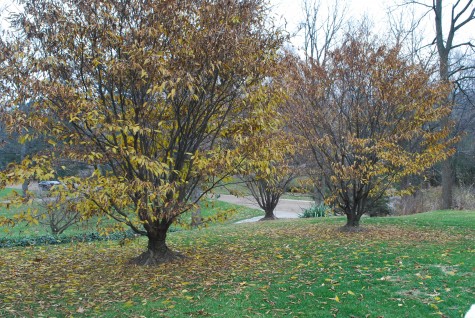
On my short list of trees for gardening adults, I have the following criteria. Sculptural branch structure. Great bark. An overall gorgeous shape. Sturdily persistent. Beautiful spring and fall color-this means leaves that make my heart pound. This means the parrotias, the magnolias, the katsuras-and pictured here, the musclewood tree-carpinus caroliniana.  Any tree that makes me think sculpture gets my grown-up attention. 
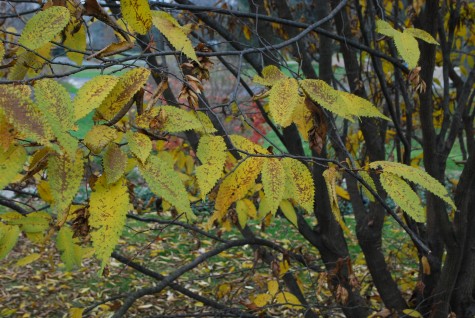

The leaves are subtly serrated and highly textured; the greenish-yellow fall color persists late into the fall. They branch very low to the ground. They are not showy or dramatic-they are handsome.    
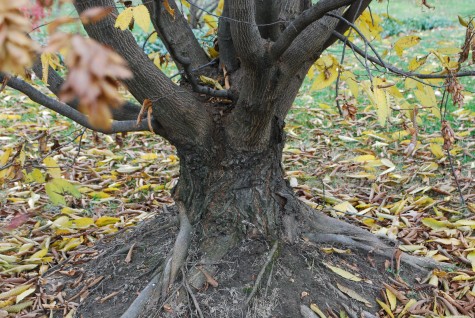

The trunks are indeed muscular. Their winter aspect is every bit as satisfying as the summer.  I have other trees on this short list.  The yellow wood, Cladrastis lutea probably grows the largest.  Maackia Amurensis has glowing green bark, subtle summer flowers, and a beautiful mature shape-very stout, low, and very wide.   
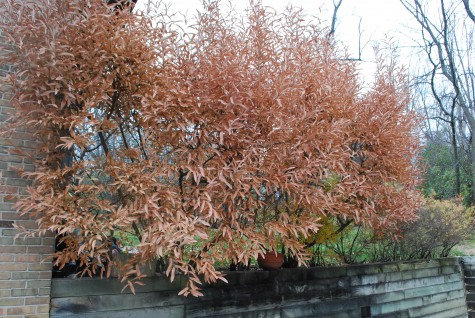
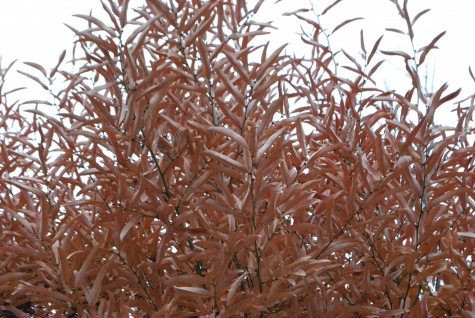
I planted these Lindera glauca var salicifolia quite a few years ago for a client.  Lindera benzoin-the spicebush-is perhaps a better known species. The linderas are shrubs-but they grow large with a minimum of attention.  This species in particular has blue-green willow like leaves.  The texture of the foliage is quite striking.  But it is the fall color- a pale peach-that is a showstopper.  This color persists very long into the fall.  �
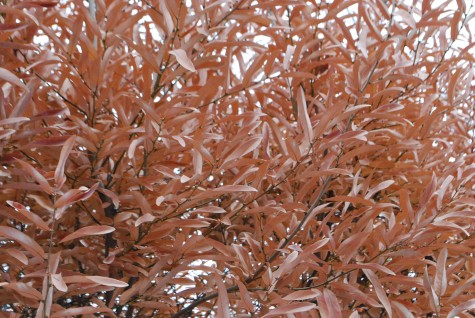
The peach will fade to a pale khaki color; the leaves will persist all winter. I took this picture this morning-still peachy November 21. 

I have those days when I am more than willing to be seduced by anything that grows.  In truth, there are probably few trees that I would turn away from my door.  But today, when I tromped around and photographed the parrotias-what fun I had.  Buck asked me what I was doing out there-he could see me from the window.  I told him I was checking out how much my garden, and my gardening, had grown up.
Winter Pots

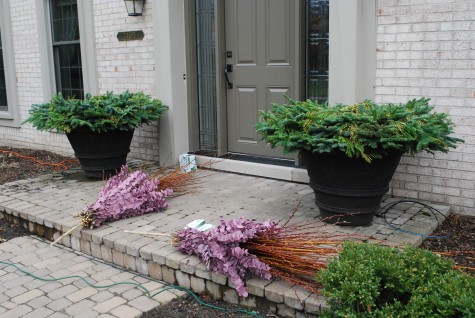
Our winter greens finally arrived yesterday-today we began “planting” winter pots.  I have clients that cannot bear to have their pots sit empty over the winter-I do not blame them.  In some ways, a winter pot is more difficult to design and plant than a summer one.  Of course the materials are more limited, but the toughest part is determining a proper scale and proportion.  The winter pots do not grow; they cannot be trimmed or groomed into a finished shape.  The shape and scale they have the day they go in will be the shape and scale they have throughout the season. I need to hold that thought from start to finish.    

Most of the construction of what goes in my client’s pots goes on in the garage at the shop.  A warm space makes the construction go faster.  It is tough to clean up and hose down on site now.  In Michigan, the water gets turned off to the outside spigots in anticipation of freezing weather.  I like to leave the mess at home.  I know the diameter of the pots I need to fill-I make a decision about the scale from my notes, photographs, measurements, and memory of the containers, and the space.  This gets me close.    

Proportions that are generous, and of proper scale are pleasing to the eye.  Odd this-I almost never see anything outside that is overscaled to the point of asking for a redo.  I routinely see landscape gestures that are too small.  Plantings that are too small for the containers, pots too small for for the front porch, a single hydrangea when 5 are called for, 1 tree trying to hold down a space meant for a grove.  The proper scale for a winter display-not so easy.    

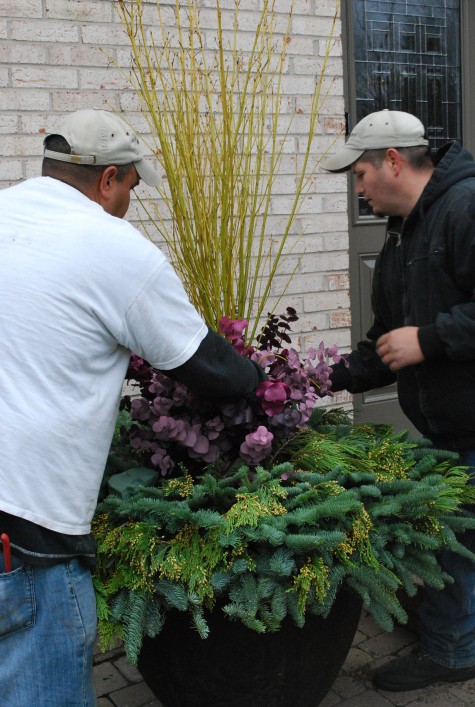
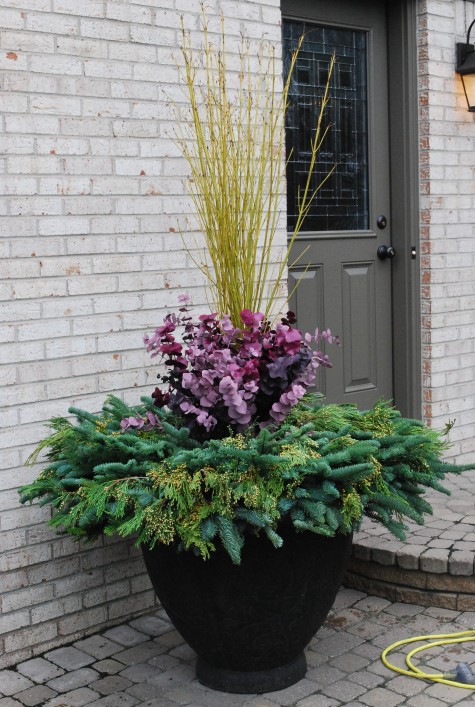
The construction of winter pots involves several issues.  Design-this comes first. Color, texture, materials, scale-this comes second.  The actual construction is all about a natural look that is invisibly sturdy enough to withstand a Michigan winter-start to finish.  All of the elements of a winter pot designed and constructed in the studio go on to the installation phase on site.  Tall heavy twigs need thorough anchoring. Though you cannot see it, the centerpiece in this pot has bamboo, steel and concrete wire-we like a stand up straight construction that endures.  Every evergreen stem is sharpened at the base-a tight fit means a persistently long lasting fit. We have four to six winter months ahead.  What I do today needs to last.

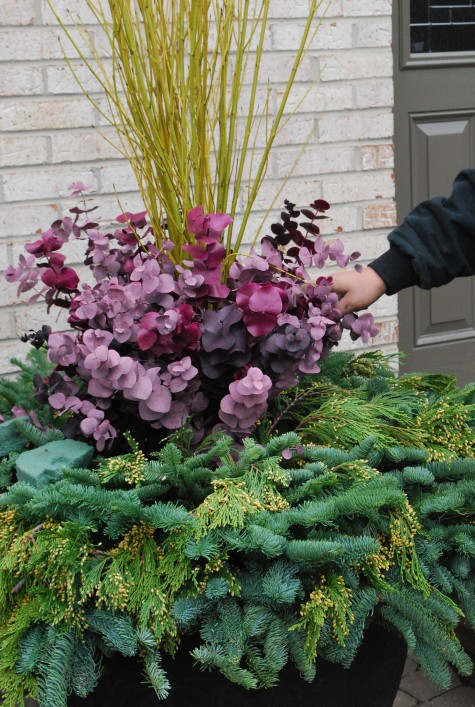
I really want to talk about the color and the texture here, but the real news-a scale assessment.  Invariably I have to go back, and adjust; almost always, I have a need to add.  The process is simple.  Plan, aim and construct as best you can. Then step back, and look.  I would advise that you look a second time.  Then step back and see. Fill in. The gaps, the underscaled elements-it is all there for the seeing.  The fill in stage-necessary. 

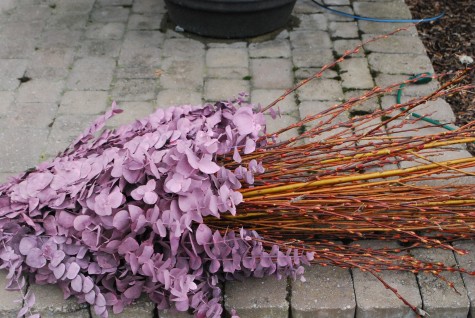
This giant pot needs 2 more bunches of yellow twig dogwood, and two more bunches of preserved eucalyptus-to get the proportions right. I wish I could get everything perfect the first go around, but frankly-I rarely deserve the spot on award.  I usually need to go back.  The big idea here?  Any project worth doing deserves an energy at the end equal to the energy at the start.  Start strong-finish stronger.

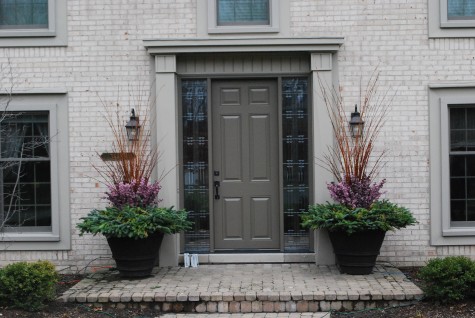
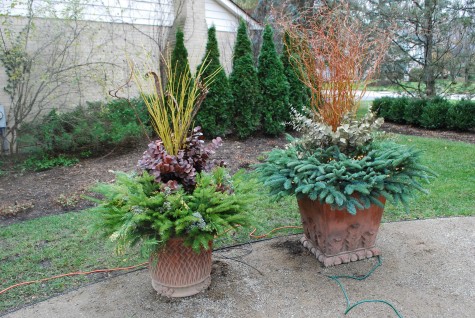
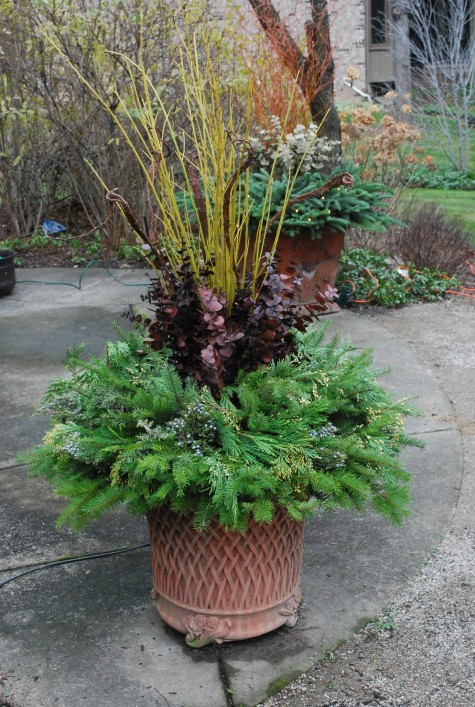
The summer pots dressed in their winter outfits-they look good.  Every one of these pots have lights.  For the dark hours.  We hook up, we bury the extension cords-day and night-we have plans.   

I am enchanted by the blue berries of the cut juniper against the brown eucalyptus in this pot.  I so like the effort of a mix of greens.  Douglas fir branches-graceful.  Everything seems to be working here-the basket weave pot, the draping greens way wide-this winter pot has everything going for it.  


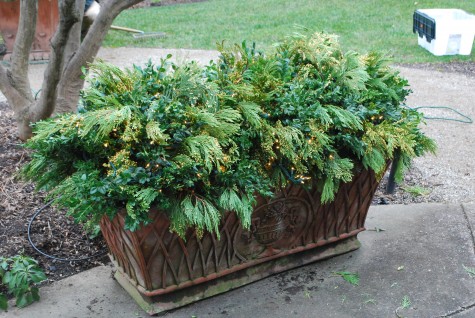
The long rectangle in view from the kitchen-the mixed greens include incense cedar, German boxwood, and southern boxwood.  The effect is soft and swooping. drapy. The garland lights buried in these evergreens will make for some night life. The winter approaching-we are in the process of getting ready.

Staying Late

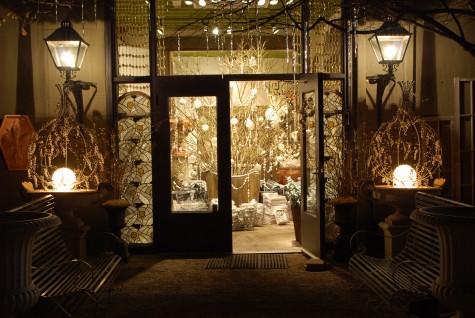
My come early- stay late routine came to a close beautifully.  The shop garden needed some dressing up for our evening event; we wanted the outside to say welcome, and encourage a festive mood for anyone walking to the door.  

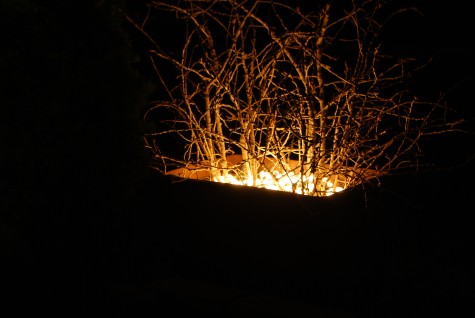
Out at the street, an old iron cistern is stuffed with poplar branches, and finished with a groundcover of various sizes of white lights. Holiday light strings in groundcover, or in containers is an easy, portable and inexpensive way to light your winter landscape. This pot-our greeting. 

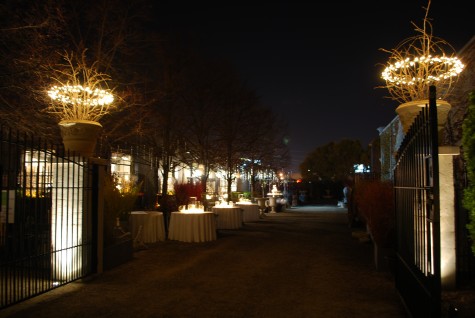
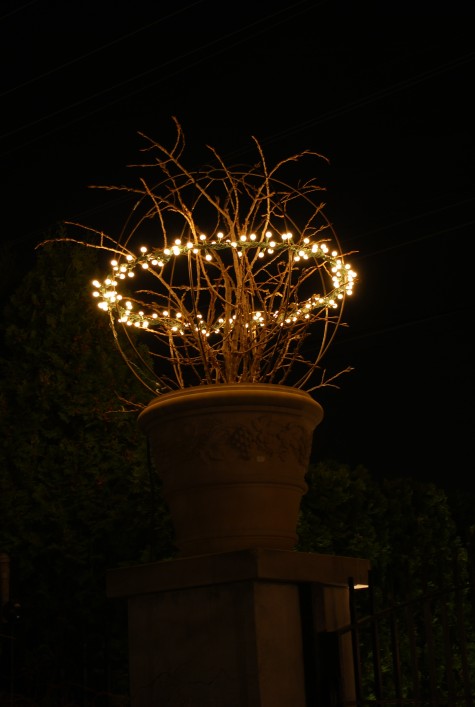
A pair of cast stone pots atop the gate piers feature steel spheres wrapped in a single ring of pearl lights.  Poplar branches were sunk in the soil, through the openings in the sphere.  The Saturn pots, as I call them, take the every day in ground landscape lighting at the base of the piers skyward.  


Wrapping the lights on the form can be accomplished quickly; we use the smallest zip tie available. This makes the removal of the lights much faster, when you need the sphere to support a vine, or provide a sculptural element in a container. The light ring reads clearly from below.

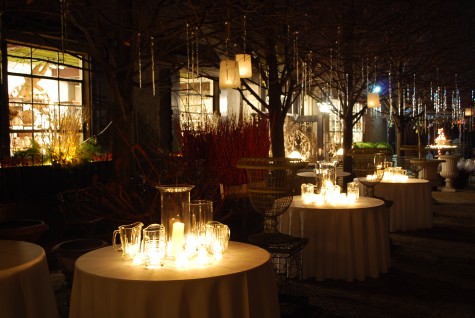
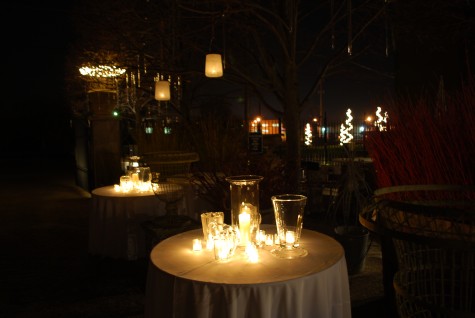
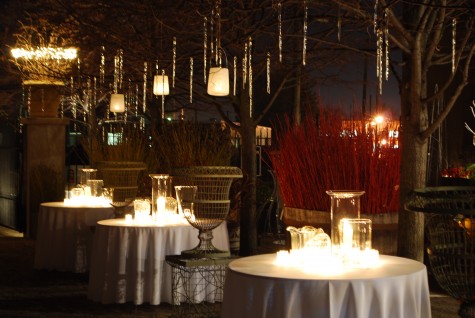
Lining the driveway with tables dressed in white linens in mid November has the element of surprise going for it.  This very traditonal symbol of a party to come gets a big boost from being placed outdoors.

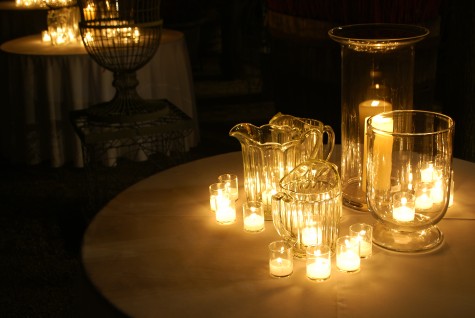
Candlelight endows any event or gathering with a little romance.  However many candles you set out, a few more would probably be good.  Votive candles are much like the mini light strings-readily available and inexpensive, they can ornament a party indoors or out like nothing else. 

Straight sided votive holders are just as inexpensive, and reuseable-our trick is to put a teaspoon of water into each glass before we light the candles.  This makes popping the used candles out for cleaning easy.  Adding the votives to larger glass containers, pitchers and vases greatly magnifies the light; we did a collection of glass on each table.

The candlelight did much to illuminate the glass icicles in the lindens.  A few white laser cut plastic lanterns with a votive inside contrast with the icicles.  The walk to the door was warmly and invitingly lit.

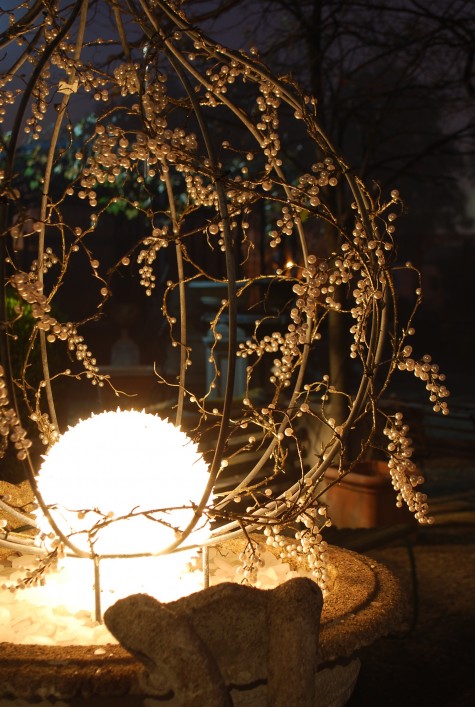
A pair of garlic shaped steel tuteurs covered in pearl garland are illuminated courtesy of a light sphere at the bottom.  The surface of the pot is mulched in white recycled and tumbled bottle glass. Very dressy. It was a good day to stay late.

Holiday Lighting

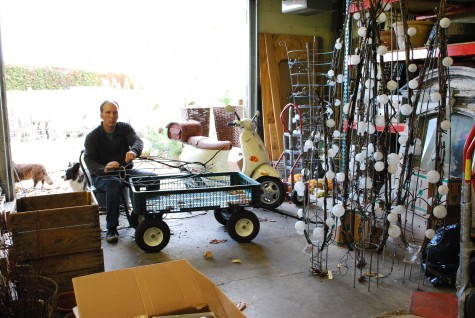
There are those qualities that Rob is known for; his dry sense of humor, his razor sharp eye, his formidable knowledge of garden ornament, his patience. Any garden, anything related to the garden gets his interest.  He rarely shifts out of first gear, but he is ready and able to run his first gear up to better than 10,000 rpms-he can furthermore sustain that level an amazingly long time.  Though he spent countless hours engineering this holiday, I can count on him to disappear for a few days while the store is being outfitted for the holidays.  I know where to find him.  He’ll be parked in the garage, surrounded by lights, forms and natural materials.  It just looks like mayhem.  He stuffs his space with materials, tries lots of various combinations. He finally makes peace;  the materials and his creative process make for something you do not want to miss. He not only has ideas about how to light the garden for the winter, he has a mind to translate those ideas into sculpture.

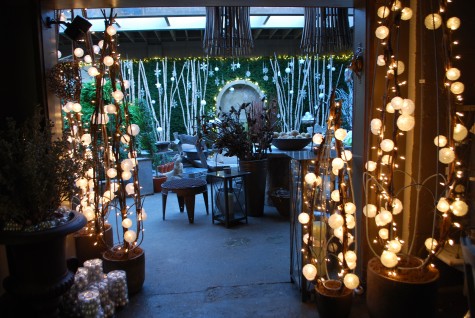
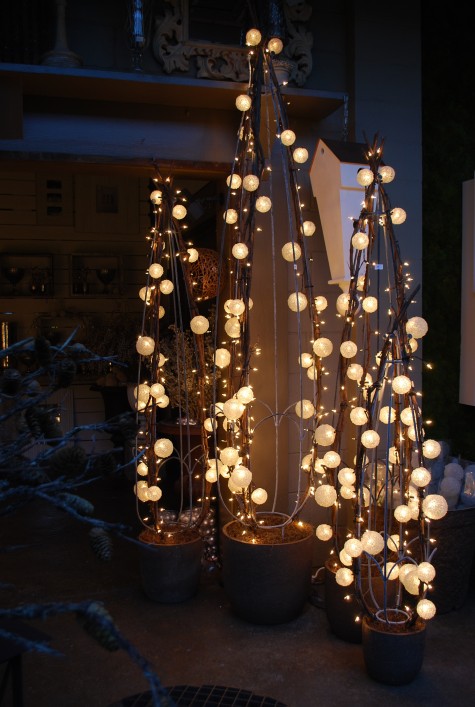
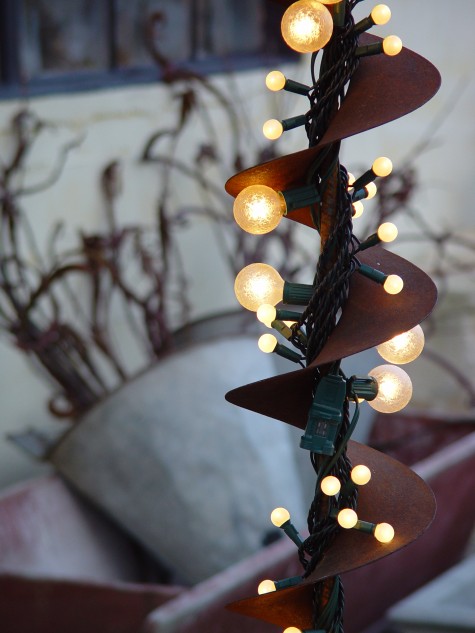
This year, the plant climber, tuteur or topiary form that supported a mandevillea over the summer will have a second life at the holidays as lighted sculptures. The tuteurs-we design, and manufacture them.  He is happy for you to load one up in the trunk of your car so you can take it home, find a great spot in the garden or container, and plug it in. But he also makes sure to have the materials available for anyone who wants to make their own.  This means light strands with brown cords, light strands with bulbs in varying sizes and colors.  Red berry LED lights.  Strands of clear C-9’s. C-7’s in interesting colors. Garland lights-these strands have the lights close toether on the wire-perfect for lighting a tuteur. Pearl lights, snowball lights-LED battery operated flower lights.  Blanket lights and intermittently twinking lights. I am sure there are lights I have forgooten to list.  Light covers, and lots of weatherproof decorative garlands help make for a great daytime look for the lighting.

What he imagines and creates from a simple strands of lights is truly original; no where else do I see anything like it.  Part of the best of what Detroit Garden Works has to offer at the holidays are his light sculptures.  He is doing his best to have plenty on hand for our holiday open house, this coming weekend.  As much as I wish he was in a display-making mode, lighting is a critical element in the holiday and winter garden-so I am patient about the time he puts to it.

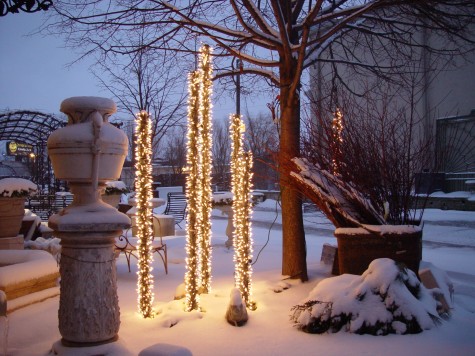
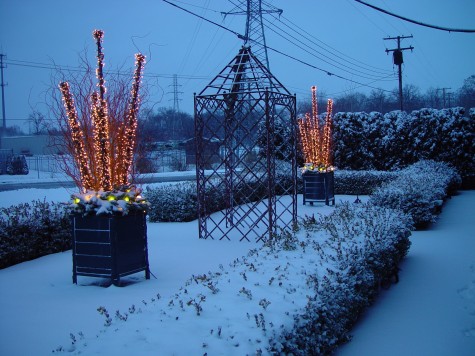
Light strings are readily available almost everywhere now.  My interest in holiday lighting was fast forwarded at least 15 years ago-by a breathtaking display in Washington DC.  Rob and I were there to look at doing flowers and props for an event.  A series of trees on the water were densely and completely wound with mini lights; every trunk, and most every branch was ablaze with light. The terrace in the center had no snow whatsoever; there were so many lights, the heat melted the snow.  Hanging from the branches, light spheres. At the end of the long drive back from Washington, we stopped and bought a truckload of mini-lights.  We spent the following 2 days doing up one old apple tree in my orchard in similar fashion. That tree was a lighthouse-it directed my course all winter long. Unlike the tree wrapping, these light bars of Rob’s are simple and fast to make.  A galvanized pipe from the hardware is wound round with lights, and slipped over a piece of steel rebar sunk in the ground. Simple, and beautiful.

Another year, Rob would wrap farm augurs with varying sizes of round lights, and hang them from the big branches in the lindens on the drive.  A steel hook was welded to one end of the augur, and wrapped with foam to prevent injury to the bark of the trees. Overscaled light ornaments read well from a distance, and most of the work of it can be done indoors.  The late fall weather has everything to do with how many people light their gardens.  No one wants to stand outside when it is 20 degrees, trying to put up lights.  If November is mild, I know there will be plenty to see in the neighborhood come December.

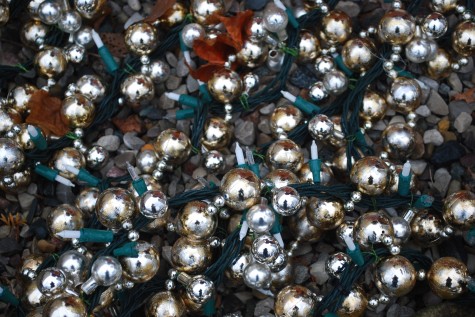
Gold and platinum plastic ball garlands were zip-tied to a light garland of clear and white mini lights.  This looked festive draped over the shop gate.  It can be tough and forbidding to navigate the winter dark-holiday lighting can make it easier for guests to find the door.  Even just a small but concentrated amount of lighting can make an entrance walk and garden look inviting.

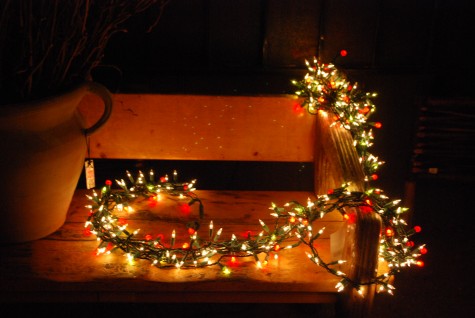
This wood bench stands out at night, thanks to the light garland.  Red berry LED lights look great paired with chartreuse and opaque white mini lights. I have had excellent luck finding mini lights in every color and size imaginable-including chartreuse- at English Gardens. Their holiday lighting and ornament shop at the Royal Oak location on Coolidge is great.  When I have a last minute or unexpected holiday decorating job, I can count on them to help me out with materials.

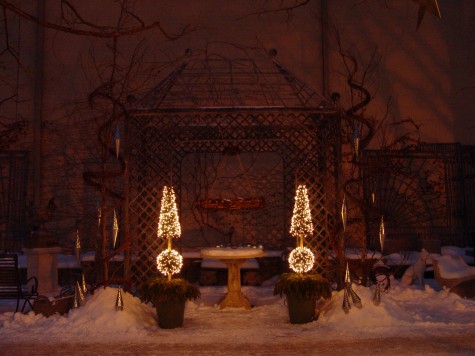
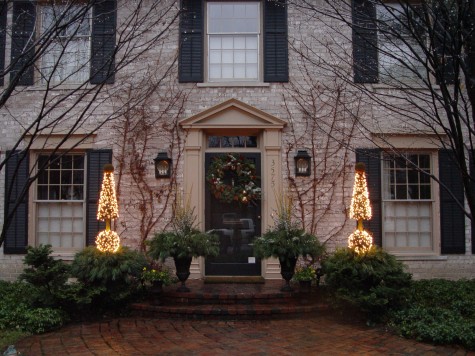
One year Rob wrapped styrofoam topiary forms with lights-they are easy to secure with fern pins from a florist supply. This pair went home with a client; their front porch, door, and entry gardens glowed all winter.  When I came in March to put them in storage for the summer, they were not really ready to let them go.  Funny, that.

Light garlands and bars in containers means you will enjoy them long after the winter daylight fades. This sounds like an excellent idea to me.  Should you live in my area and have the chance, stop by over our holiday open house weekend-November 13 and 14 and see what Detroit Garden Works has to offer for the holidays.  This includes what Rob has put together in the way of lighting.  Stop by; I think you will be delighted.