The Dirt

Anyone who gardens has ideas about dirt; I am no exception.  I like friable soil that drains readily, and is heavily weighted with compost for good soil retention.  Though these two characteristics may seem to oppose one another, they in fact speak to a need for balance. Most plants need a regular source of water, but not swimmingly so.   Heavy clay soil stays wet.  Clay also makes a great material from which to make pots; when clay soil dries out, it is is so densely hard it repels water. In any case, if you are a root hair, either clay state sounds less than optimal.  Liberal amounts of compost can help leaven that soil, but choosing plants that like heavy soil is a very good idea if clay is what you have.  
It is is easy to establish plants in a sandy porous soil-provided you are planting grapes, succulents, lavender or rosa rugosa.  You will have a very tough time getting peonies or delphiniums to prosper, though it is easy to get them to root.  Determining your soil type is important.  Loads of compost can improve the texture of any soil, but you would be hard pressed to completely change its character.  I do have clients that cook up soil as if it were their most favorite thing to do-and their gardens reflect that.  But after you have improved clay soil, you have improved clay soil-not sandy loam.   
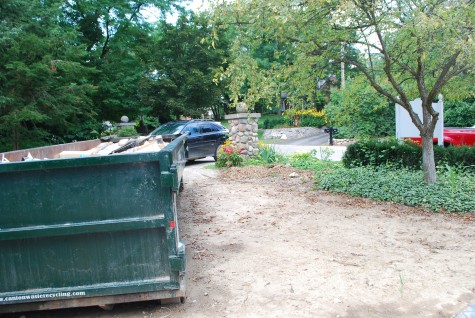
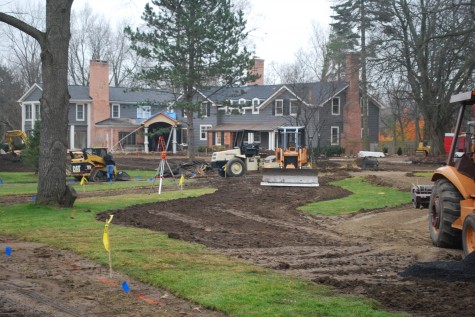
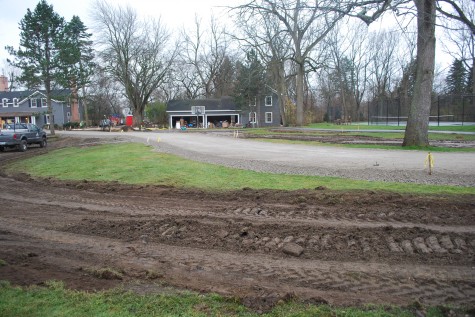
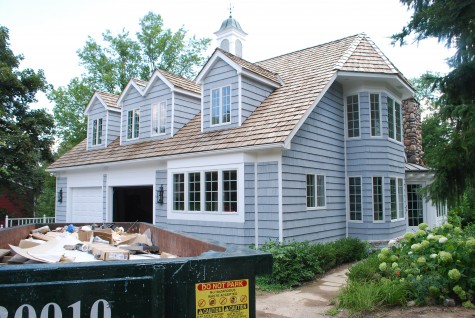
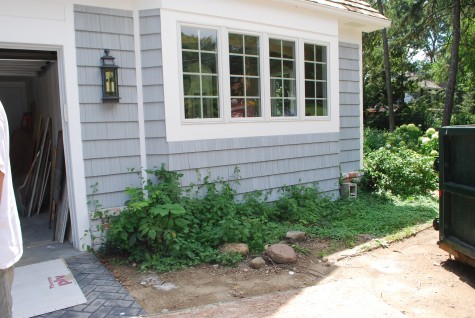
This older home had been completely redone on the inside.  The work was not kind to the soil. Pickup trucks, dumpsters and various equipment drove over and parked on that soil for months. Who knows what got dumped on it. Redoing a landscape from scratch requires at least as much time devoted to restoring the health of the soil as planting.   
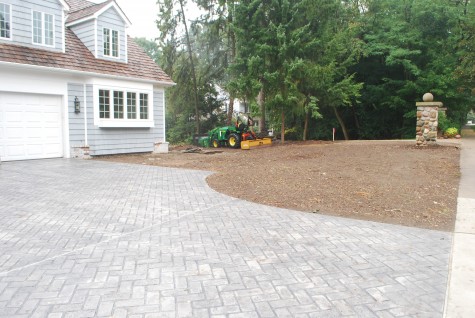
Shoveling out the weeds and lifting and storing plants that will be saved is the first move. This phase alone is a whomping lot of work.  We are not ready for plants yet.  The front door of the home is not in front-is is actually located on the east side.  The design of the walkway will need to address the 90 degree change of direction, and the relatively long trip to the door.      
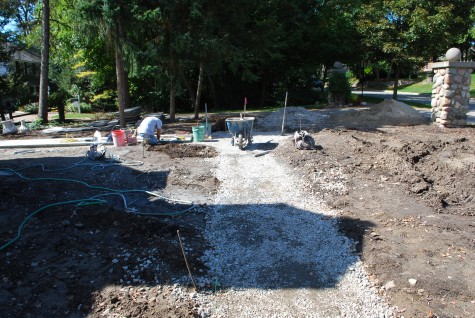
The process of installing the stone makes another kind of mess.  This phase always pains me, given all the clean up and out that has already been done.  But the process of creating a landscape is always quicker and more efficient if if all the hard structure comes first.  Working around existing plant material is difficult; inevitably something precious gets damaged.
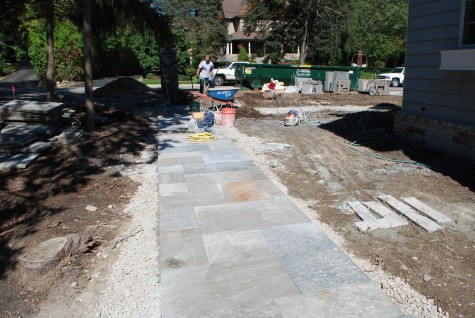
The mess proved to be well worth enduring; the walk is beautiful.  At the juncture of the north leg and the west leg is a terrace. Though the views out the windows to the rear yard are beautiful, the property drops off precipitously.  As very little of the rear yard space is useable, this landscape will feature a terrace in the front yard. 
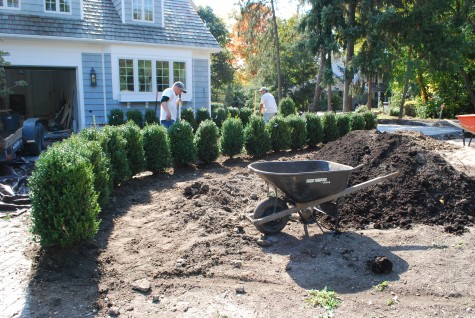
I do not often plant buxus Green Mountain.  Its 4′ by 3′ eventual size makes it a tall and narrow growing plant.  I wanted this small space to afford my client some privacy. So the plan is to plant tall.  Taller plants will screen the view of the drive from the garden, and make the terrace feel more secluded.
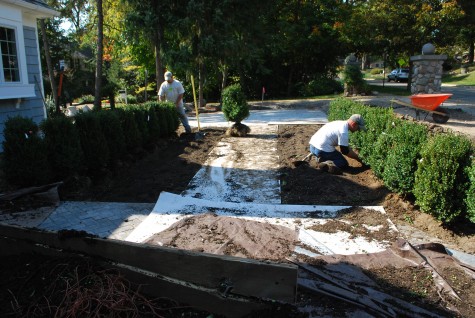
The beds on either side of the walk that will contain smaller plants.  The soil in these beds was excavated down some 10 inches; a our own plant mix that contains our own compost.  Steve’s long tenure as superintendent of grounds at Grand Hotel made him a compost expert.  Mackinac Island has very little topsoil, and bringing soil to the island was very expensive.  So we have a considerable pile of great compost available for projects. We mix in some sand, and some worm castings for good measure. 
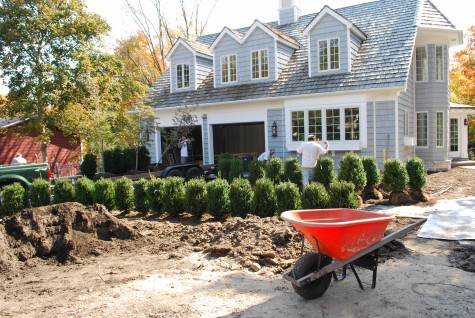

The soil here is actually quite good.  I suspect the years the garden had been neglected and the leaves unraked contributed a lot of compost by default. Once dug, the soil had a good hand, and was crumbly. Our main issue was to try to restore some air to the soil.  I am encouraged by this-all of the new plants should thrive.
Sky Blue

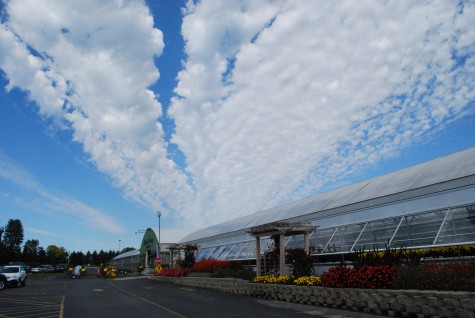
I may have been playing hookey from my writing the past few days, but I have been slammed with work.  I have been out shopping for a variety of projects the past few days-but what is really capturing my attention is the show going on overhead.  October skies in Michigan can be so vibrantly blue, and the clouds are always such fabulous shapes.  I am treasuring these moments, as Michigan winters mean an unvarying shade of lead grey overhead-most every day.

Blue skies in the fall are that fresh blue that reminds me of lobelia in the spring, cornflowers and belladonna or bellamosum delphinium.  So striking and so lively. The clouds overhead yesterday against the blue skies were dramatically directional and three dimensional.   

 The atmosphere refers to that mass of air surrounding the earth.  Clouds like this describe that air in a visually spectacular fashion. I have been seeing the stars the past few mornings-this tells me the blue of the daytime sky will be clear sky blue.     


No matter what I might design, engineer, organize or dream up, what nature effortlessly puts on display every day is remarkably beautiful.  My efforts to make something beautiful take lots of behind the scenes work.  The beauty of nature-out there every day,  for everyone to enjoy. We are having a spell of unusually beautiful weather right now. On the ground, 72 degrees.        

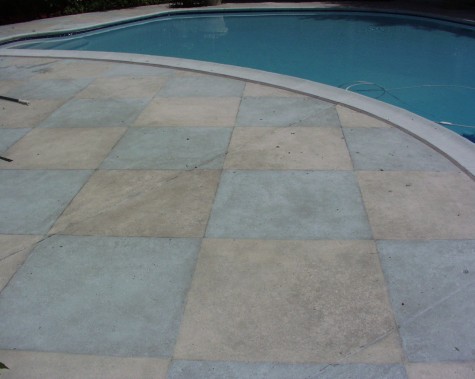
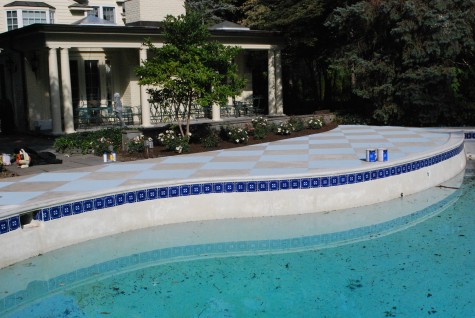
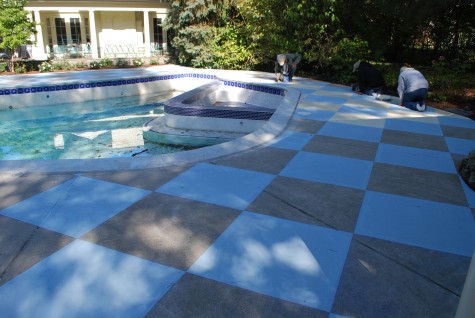
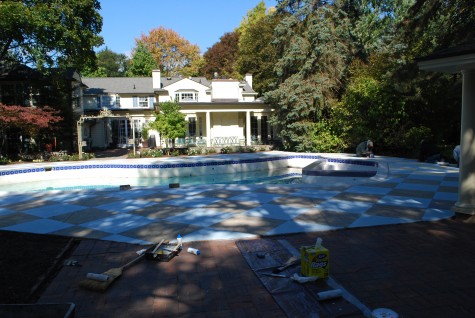
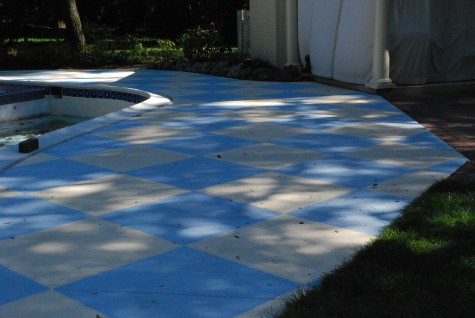
Beautiful weather is enabling us to express a sky blue and white idea of our own. Some 15 years ago I stained a concrete pool deck for a client with a checkerboard of blue and cream squares.  My client called a month ago-that pool deck, and the landscape, needed an update.    

Concrete stain can do an old piece of concrete a world of good.  A vintage concrete sidewalk or terrace still in great shape is a great look with a vintage home.  Concrete is a common material for pool decking.  It can be poured in any shape, it has a slip-resistant texture, and the light color keeps the surface temperature reasonable on a hot summer day. This pool deck was in fine condition, but the old stain looked tired and faded.  My client was interested in a fresh look.

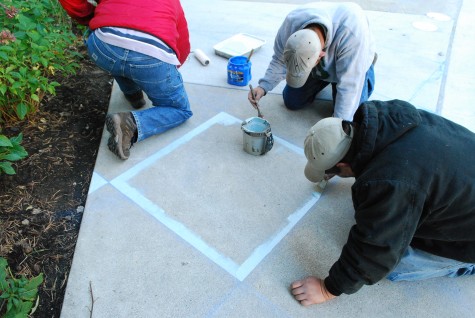
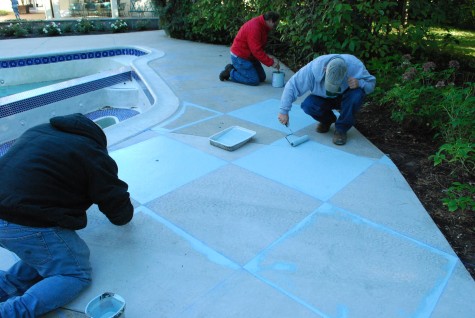
Steve snapped the 3′ by 3′ checkerboard pattern onto the surface with a chalk line.  He painted the blue squares first; the blue chalk became part of the edge of those blue squares. Should you want to stain concrete in a pattern, choose a chalk color that won’t adversely affect the color you intend.   

We carefully edged each square by hand; Trevor rolled on the body of the stain from there. The water based stain soaked into the old concrete; years of rain and wear had made the surface open and porous.  The rough texture of the concrete has not changed at all-just the color. There is no mistaking the concrete for some other material; this ordinary concrete has a new look that is anything but humdrum.

Cloud white would have been too glaringly white for the alternate squares.  A soft yellow-cream would contrast with the blue, but not blindingly so. 

 Even at this stage, I could tell the staining of the concrete would make a big visual statement from a utilitarian surface.  The comment from my client’s pre-teenage grandson?  This makes it look like young people live here. I rather like this description.

Telegraph Road


Some landscape projects invove a lot of tearing up and moving around.  This 19th century home is situated a long way from the street.  The original gravel driveway was in a deteriorated state, in large measure due to the fact that it followed the existing contours of the land.  This put parts of the drive under water in a hard rain. A road needs a proper base, and grading such that rain water runs off.    

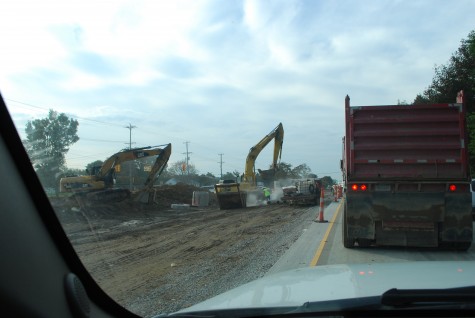
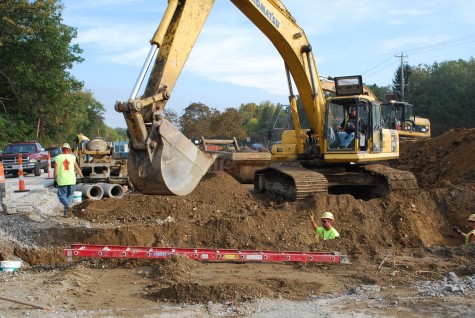
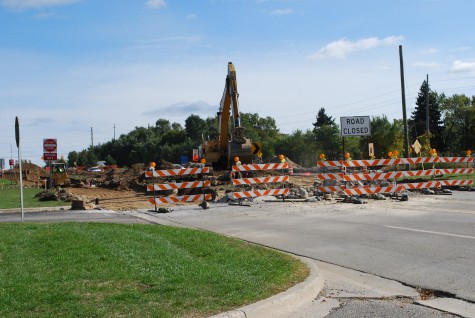
If you live anywhere near me, I am sure you have been privy to a landscape construction site of staggering proportion.  The demolition and rebuilding of miles worth of Telegraph Road has been going on for months.  Telegraph is a major north-south thoroughfare; I may travel on it 6 times on a busy day.  I am not alone in this-thousands of trucks, cars and buses use it to swiftly get from one place to another.  The heavy volume of traffic and the Michigan winters have taken their toll; no one denies there was a need to rebuild.    

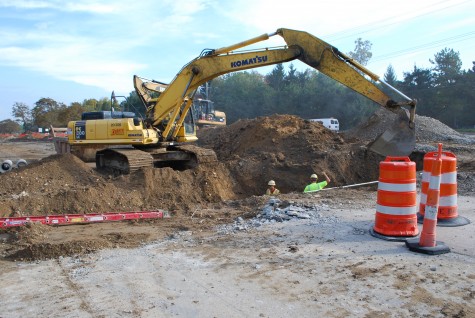
The volume of trucks hauling away old road and hauling in new materials is equally staggering.  Construction vehicles, excavators, bulldozers are cordoned off from from the two lanes still open to traffic by thousands of orange cones.  Crossovers are open one day, and closed the next. It is a massive project, producing a massive disruption to the people who work and shop in the area, and the businesses who rely on the road to provide simple access.  This is a go for broke project that can make a quick trip north  seem like an off-road rally.   


My client’s project seems so benign and modest by comparison, but the concepts are the same.  A road needs engineering.  It needs to be easily maneuverable.  It needs to drain.  It needs compacting to withstand the weight of vehicles in all kinds of weather.  In this case, some 10 inches of base was required to get the drive to drain.  Many hundred of yards of soil were required to bring the ground up around the new drive. 

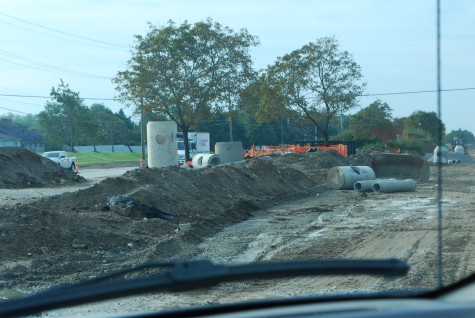
I have tried to be good natured about being brought to a dead stop time and time again.  I have had more than enough time to put my truck in park, and take photographs. I cannot deny that it has been an interesting process to watch.  The concrete of the old road being pulverized by a massive machine equipped with a battering ram that makes the ground shake.  The numerous giant trucks whose only job all day long is to haul away debris.  The giant concrete drain tiles littering the dirtscape.  The hundreds of people running machines-how does such a huge project get coordinated?  I have tried to view mile after mile of the most God awful mess imaginable as landscape theatre.  It really does seem like what usually zips by me in a few minutes has become a full length feature. This particular day I was stuck at a crossover for at least 4 lights, while some machinery and trucks got moved around. 

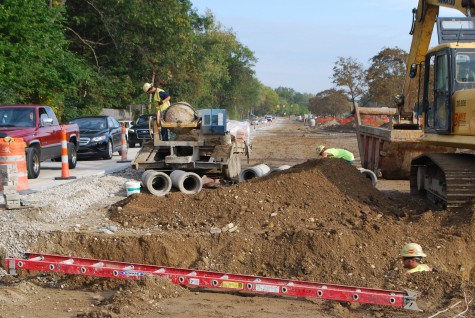
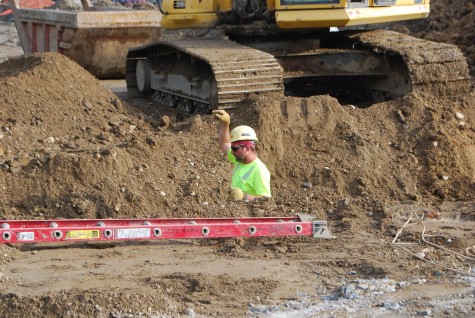
The man shoulder deep in a giant trench is communicating with the excavator operator via hand signals-the deafening noise precluded any talk.  The stoppage of traffic behind me starts to stretch out.  Once the truck in front of me backs into his slot, I make my escape at the Quarton Road cross over.   

This man in the pit has nerve if nothing else.  I would not be so comfortable, downhill from a machine of this size.  I love pushing dirt around as much as the next gardener, but is earthwork on an astonishing scale.  The following day, the Quarton Road crossover is closed.  This puts me miles out of my way; I hate having to go south to go north.  Just as I think I am home free, A tree trimming crew has eastbound Quarton closed.  To the north, Lone Pine is closed all the way to Cranbrook Road-a new road, drainage system and bridge is in progress.  I am forced further south.  I am 25 minutes later getting to the job than I planned for.  


I will confess I have traded in my fascination for the project for a fascination with how to avoid it.  Woodward Avenue runs parallel to Telegraph; I have clear sailing all the way north to Orchard Lake Road.  Once I drive under the Phoenix Center in Pontiac, I am but a short distance from the shop. Middlebelt Road runs north and south on the west side of Telegraph.  It is a smaller road, but traffic moves along briskly.  I feel bad for all of the businesses located along Telegraph; the contruction is so extensive and visually confusing. 


The very last straw??  MDOT  closed the exit ramp  from Telegraph onto Orchard Lake to any driver coming north three weeks ago. The detours that would permit my clients to get to me are poorly marked.  The best bet; continue north on Telegraph and go under the Orchard Lake Bridge.  The very next crossover will take you to the southbound exit off Telegraph.  In three weeks, I am just seeing the first moves made to rebuild it.  Can you hear me sigh?   We can help you navigate if you need it; I think we are worth a little travel trouble.

Unfinished Sculptures

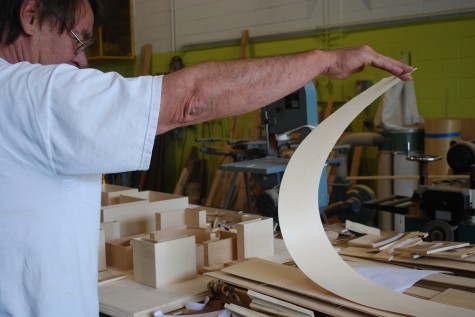
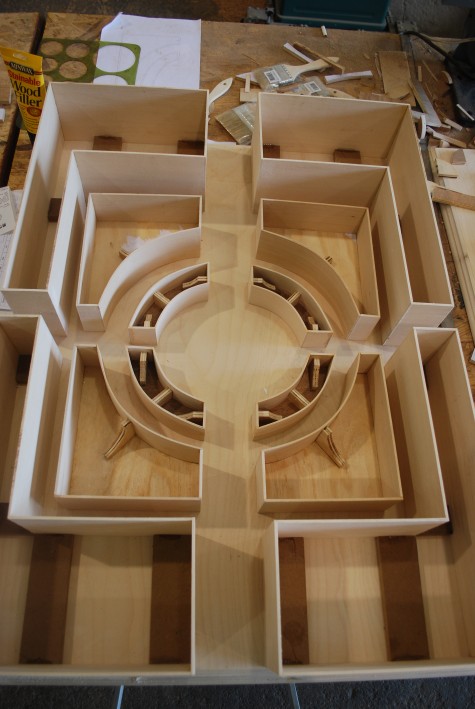
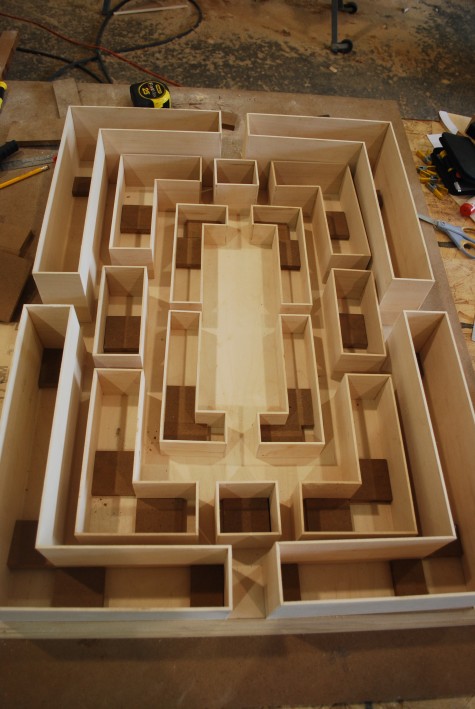
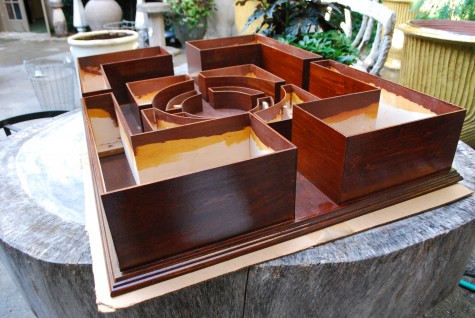
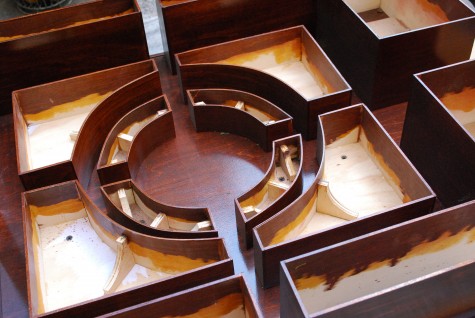
My last Sunday opinion post I entirely owe to Nanne-she made me think long and hard about the relationship of imagination to precision.  Unbeknownst to her, she waded headlong into one of my stuck spots.  I had this idea to make models of gardens I doubted anyone would ask me to build.  Who knows where that idea came from, but when I have an idea, I try to play along. Fine so far.  After clumsily trying to build them out of foam core, Buck waved my story off, and  asked for drawings.  Pretty soon, basswood in thicknesses between 1/16th and 1/32nd of an inch and in varying widths, began arriving via UPS. 

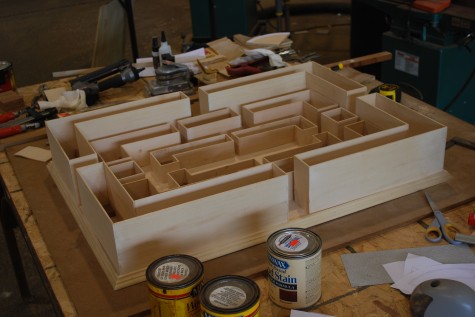
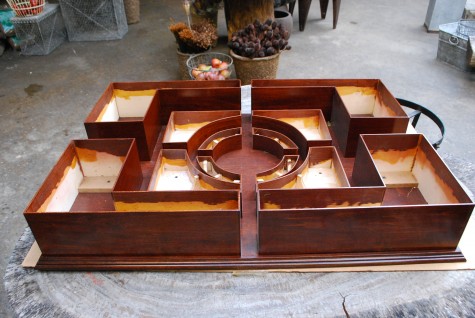
He wanted to build the models on a birch plywood base, finished on its four edges with molding.  They could be set flat on a table, or floor-or hung on a wall.  This construction reminded him of the slide wire potentiometers he collects.  As you are probably a gardener, and not a collector of old scientific instruments, I will elaborate.  Buck collects vintage instruments which were used to measure voltage; he thinks they are beautiful objects.  Many of them were finely finished and presented in mohogany cabinets or cases; his office wall is covered with them. Some instruments were part of university laboratories.  Some were commissioned for industry.  To the last, they are very finely calibrated scientific instruments which were extremely expensive to purchase in their day.  He buys those the looks of which interest him, takes them apart, cleans and restores them.    

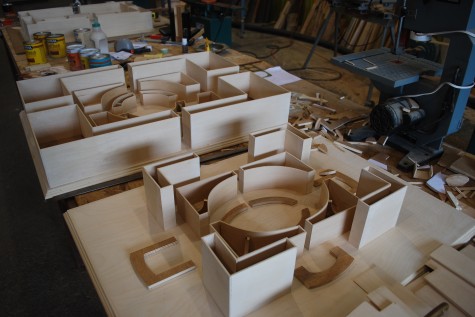
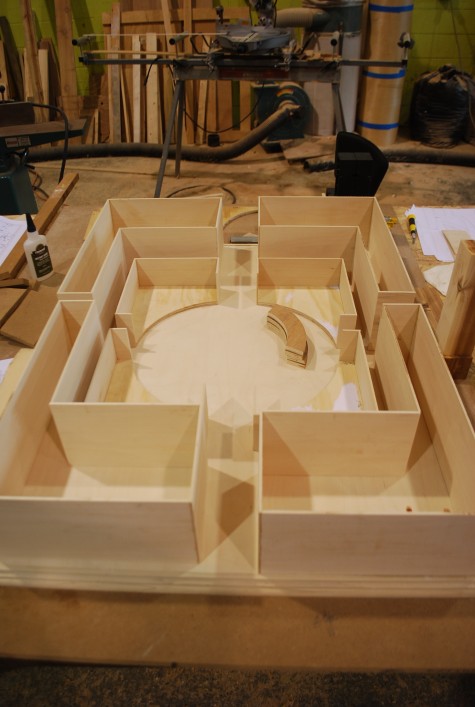
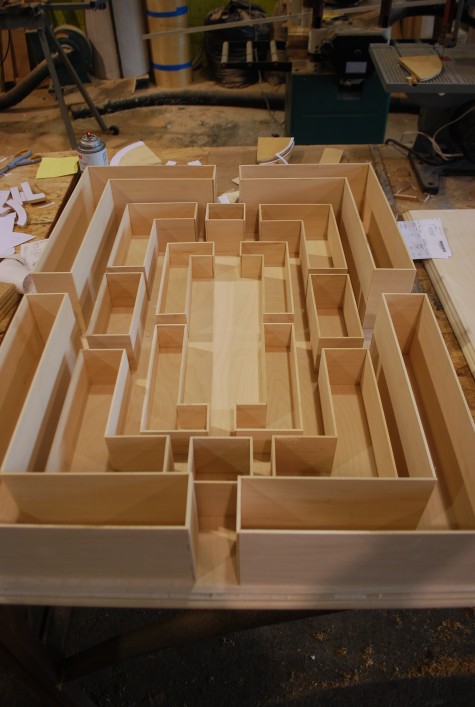
These instruments interested me when I saw them, but they did not enchant.  Years later, I understand and appreciate his enchantment.  There was some astonishingly imaginative person who designed and made a beautiful object which would in addition precisely measure volts.  Very precisely.  My garden models, and his love for old scientific instruments-an interesting mix.  My drawings were about to be transformed from lines into shapes.   Each model he painstakingly reproduced in basswood, from my drawings. His bench-littered with pieces of wood light enough and thin enough to float.  They are clearly not landscapes-they are sculptures.   There are four unfinished sculptures to date, each 24″ by 36″. 

He fussed and fretted about the construction-much like I do, when I have a landscape project underway.  When I am at home gardening, and have a problem or a full blown impasse, I back up, and fix myself a lemonade.  When I am working, I fuss and fret, and fret a little more.  It does not help to fix a lemonade, or go home. I have to stick with it. It could be a video about how Buck constructed these models is of vastly more interest than the sculptures themselves.  Why? I am having trouble trying to figure out where to take his work next.  

I imagine a landscape as a three dimensional sculpture.  Everything about that sculpture occupies me like an army.  Buck’s questions about the models-the eventual heights, distances and spaces-much like what I think about every day. But his precise questions regarding the length, width, depth, and height of elements in these sculptures forced me to think less about landscape and more about my intentions.      

A property needing landscape can be forgiving of what you have not accounted for in a drawing. A big idea may leave out that space or this corner.  This might make a landscape renovation more difficult than a landscape starting from scratch.  Buck’s wood sculptures I would not need to keep alive. They need to be brought to a visual life.  

While Buck is absorbed constructing these sculptures, I have time to panic.  What will I do to finish them, once he is done? What will go in all those spaces?   

Two of the four sculptures have been done for 5 months.  I have been scheming to provide an imaginative  finish worthy of his precise effort.  As much as I would like to have an answer, nothing is coming-yet. I had originally planned to fill my hedges with reindeer moss in different colors.  Now I am not so sure.  I could fill them with various sized wood spheres, stained the same mahogany color as the geometric shapes.  I could stain the interiors of the spaces, and do nothing more.  I could fill the shapes with seeds or dyed wool roving .     


 If you have ever made a change in a garden only to see that choice go on to change how you see everything around it, you will see my dilemma.  Gardeners have to go on, and live with their choices. This tree over that tree.  This perennial over a world of other perennials.  This groundcover instead of that. There are so many plants from which to choose-all of them different, many with merit.  All of this leads me to think about those treasured moments in my own garden which were much more about accident than by design.  That chance nicotiana seeding and growing up in the gravel walk.   

I got involved with these models by design. It is looking like I may finish them by accident.