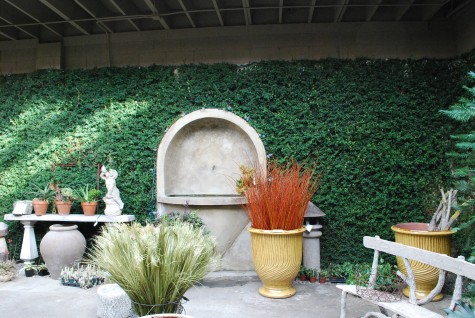
Holiday Diorama


I have one room in the shop from which I removed the solid roof, and installed the roof of an abandoned glass house.  Many years later, 15 creeping fig plants have completely covered the walls. In early spring this space provides protection for tender plants.  The summer sun shining down and through the glass roof endows this space with heat.  This hot space encourages the fig, tender begonias, tropical ferns-not to mention all of the gardeners that appreciate this growing space.  A concrete fountain built from an old French design sits on top of the one place we could not remove the concrete floor next to the wall for the fig; an old concrete waste oil tank sits below the surface.  So we built over it; the sound of the water in the space is great. I have water, light and plants in this room, year round.      

When the growing season closes, Rob makes the moves it takes to move on. How can this green wall be transformed?  He invariably has a big idea I do not see coming.  Hundreds of white birch sticks have been stashed in the garage for better than a month-waiting to be transformed into a birch forest holiday diorama.  If you are wondering if we really talk this way-holiday diorama-the answer is yes.  What you give a name to helps to endow an idea with an identity.  Brooklyn Botanical Garden is a name that says science; La Foce speaks to romance and magic.  
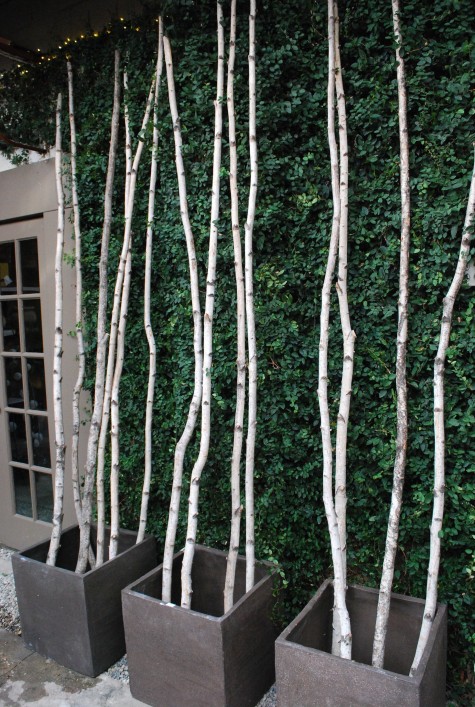
Chocolate terra cotta squares-they are Rob’s idea for a home for the birch.  How can we get those heavy branches to sit up straight?   My landscape superintendent Steve Bernard suggested Rob might sink those birch branches in washed sand.  This worked perfectly.  Every birch stick is standing tall; anyone wanting a birch stick for there own holiday will have no problem lifting out the sticks of their choice.  Steve made his contribution to the display early on. 
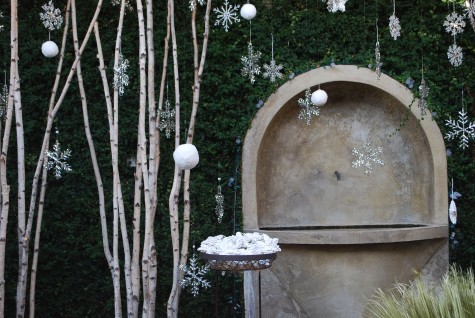

Rob knew to buy stout white birch poles, silver snowflakes in various materials and sizes, and snowballs.  Putting them together in this particular way involves introuducing the materials to each other, and to a space.  This is a romantic description of what is really about persistence.  He hauls materials all over the place until he sees something that he likes.  So much of successful design involves persistence and patience. 
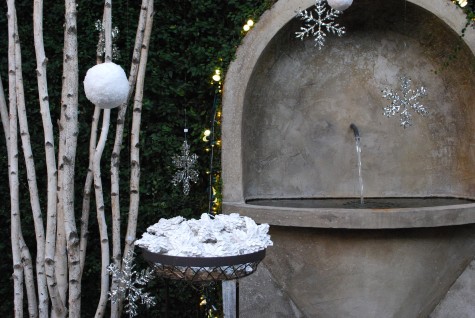

The relationship of the materials is easy to believe; where there are snowflakes, snow balls cannot be far behind.  A visually successful arrangement is believable.  I do have a neighbor down the street with a life size lighted palm tree in her front yard-this would not be for me.  The contrast of texture, shape, and mass is pleasing. The white against the dark green of the fig wall looks good.
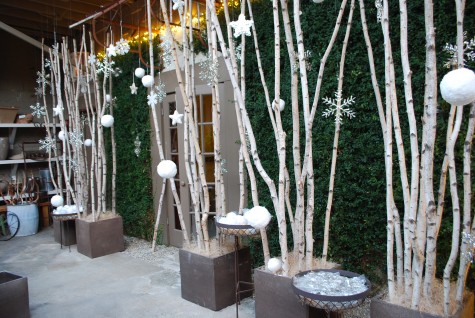
At the last minute, Rob had Catherine add stars to the mix. How this wall looks now could not be more unlike its summer appearance.  The dramatic change is enchanting.  Every person who sees it takes something away from it that is all their own. I had a lengthy discussion with one person about the cultural requirements of Himalayan white barked birch.  Another person planned to use a birch stick as a rod over her kitchen window, and hang ornaments from it like a valance.  Yet another planned to mass snowballs and snowflakes in a white washed vintage box on her front porch.  Our discussion was primarily about how she would light it.   
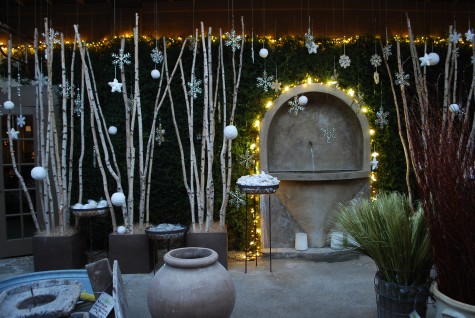
Of course we needed some lighting; daylight savings time means the dark comes early now.  White and chartreuse light garlands warm up the space on a cold and gloomy afternoon.  A midwestern summer garden can be sunny from dawn to very late in the day.  A winter garden is divided between day and night, and always about not so many sunny days.  A great holiday display takes lighting into consideration. 
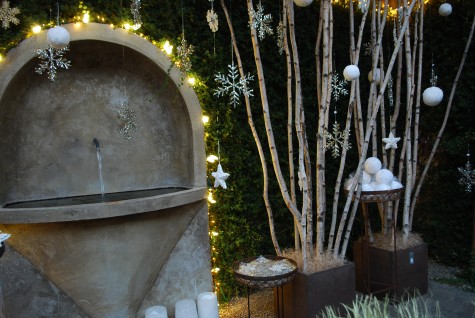

Anyone can garden in the winter.  There are plenty of materials that can be arranged in those pots that held tree ferns over the summer. A favorite bench can be lit from the front with a spot light, or from below with strings of lights strewn on the ground.  Decorating a garden with holiday or winter lighting is an alternative type of gardening, but gardening none the less.  There are those gardeners that are relieved when a hard freeze puts an end to the season.  There is something attractive about putting the spade and pruners away for a while, but I like to keep on gardening.
More On The Warm-Up

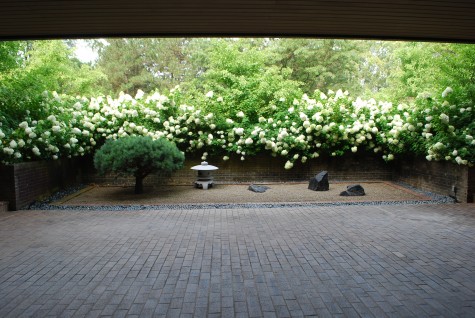
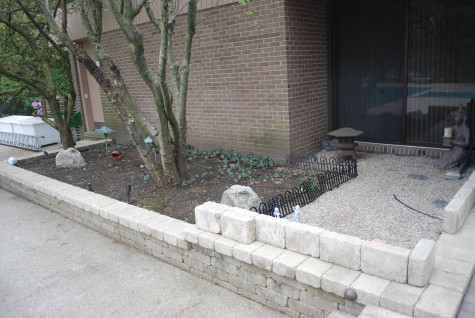
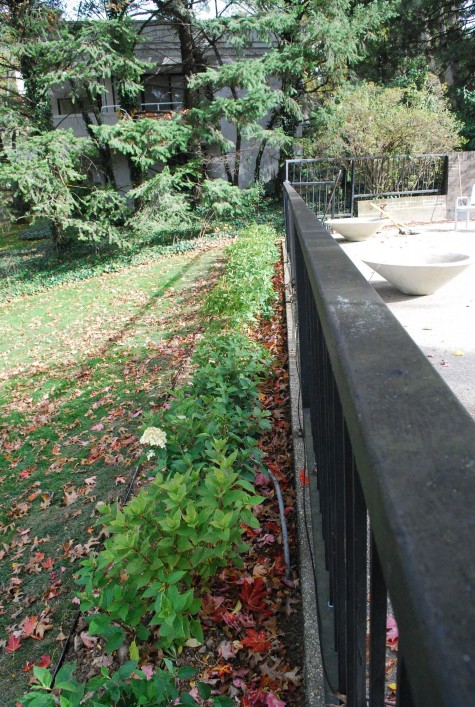
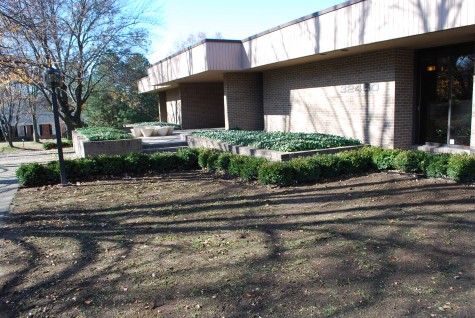
Forty years after the fact, some of the landscape attending this fabulous home designed by Irv Tobocman is perilously overgrown.  Every gardener knows this-no garden, no landscape pays any mind to the pause button. Everything in the landscape is either moving forward, or declining.  A lower level terrace opens up a garden below grade-the natural slope of the property is retained by yet another brick wall. The brick wall is barely visible any more.  Most of the material here-I relocated.      I restored the view of the ground plane, and a view of the brick retaining wall. The Limelight hydrangeas, and the columnar gingko trees were planted above the wall-on the street side.  This brick wall is set invisibly into a natural slope; the view out the lower level of the house-beautiful. 

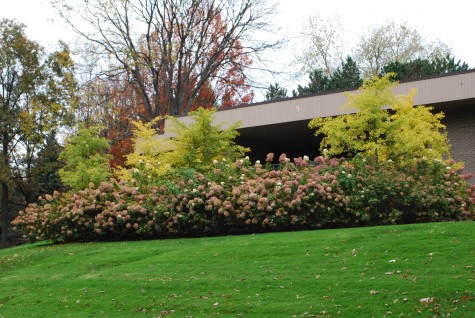
The gingkos trees underplanted with Limelight hydrangeas make for a substantial statement from the street.  The brick and gravel garden outside the lower level of the house-a completely private garden.   

A mini dog run for a mini dog named Pookie, and two mature crabapples are viewed prominently from the grilling terrace.  This space needed some tending to.  Areas like this I call a can opener.  Everyone has owned a can opener that works poorly-but for some reason, it doesn’t get replaced until it is about to fall apart.  Only then you realize what an aggravation it was to wrestle with, and how much better it is to have a tool that works.  The landscape here-not working so well.  Making this space look better- a breeze.  

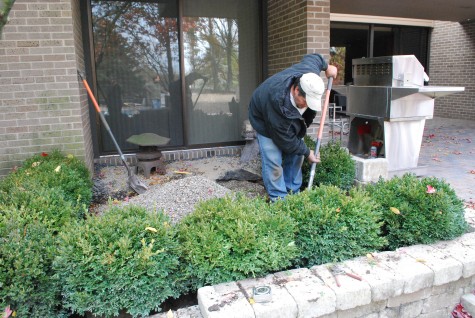
Boxwood would enclose and remove most of the the dog run from view.  A thicket of hosta sieboldiana elegans will completely carpet the ground below the crabapples-this update aims for lush. 

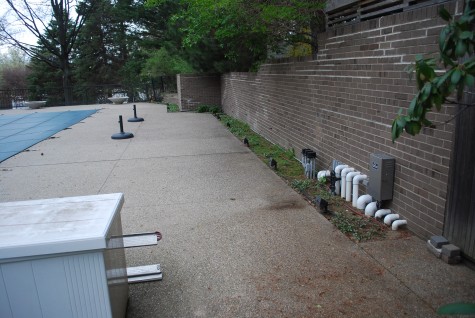
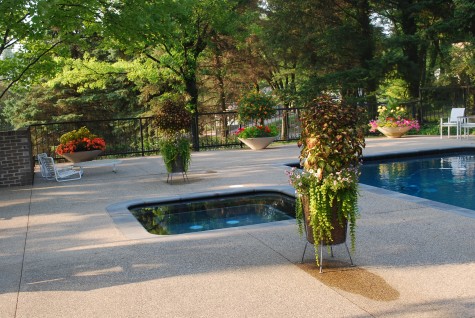
The small space between the pool deck and the tall brick wall asks for a green and year round softening.  I am looking at an embarrassment of riches in hard surfaces here.  Modern can mean austere-but I like my austere a little more elegant than this.  My clients have no need to view the pool filtration pipes.  The intersection of concrete aggregate pool deck and brick wall will benefit from something living. 

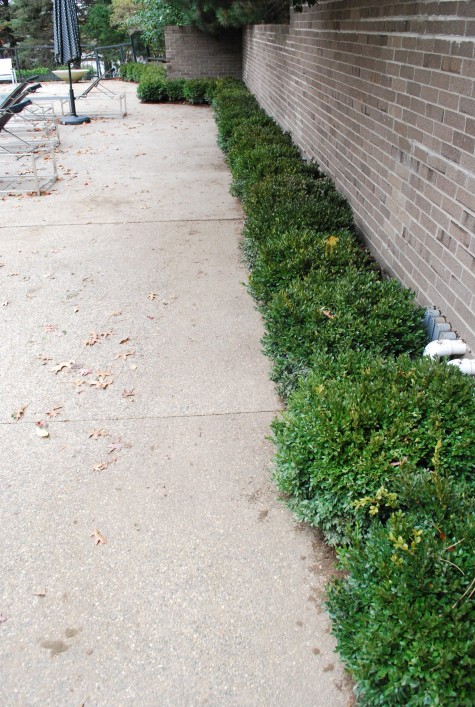
I stuffed that small space with boxwood, and planted Boston Ivy on the wall.  It will make for a vibrantly green enclosure for the pool in no time. Pools generally have giant paved spaces around them-for obvious reasons.  But this does not mean they have to be cold.    

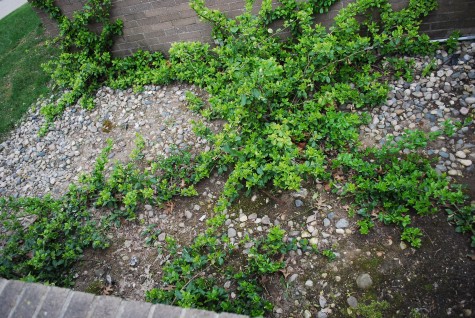
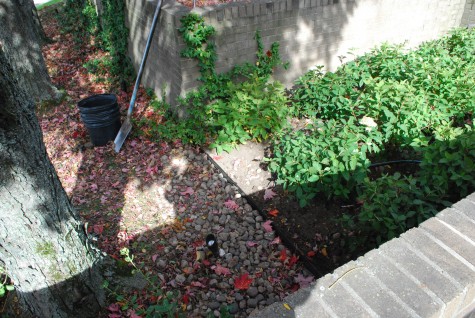
This bare gravelly space at the base of a U-shaped arrangement of very tall brick walls-stony, barky-neglected.  Though not in immediate view from the pool terrace, the look on the other side of the wall is not a good one.  An out of sight-out of mind spot.       


I planted Limelight hydrangeas here-with the idea that they would form a tall groundcover. Come summer, the flower heads will pop up above this pool wall, and bloom. The wall was necessary; it enabled a flat space large enough to build a pool.  The hydrangeas will obscure the indented portion of the wall from view, and strengthen the view of the flat portion of the wall.  

The far end of the pool deck is home to a sternly utilitarian black iron fence.  This row of hydrangeas will mitigate that jail-like look, and provide the landscape from the street with its third planting of hydrangeas.  The large block, the small block, and the single row will visually describe this large property from one end the other from the outside.  On the inside, they punctuate and soften all the hard surfaces.     


By next summer, there will be much more of a landscape to enjoy.

Chilly

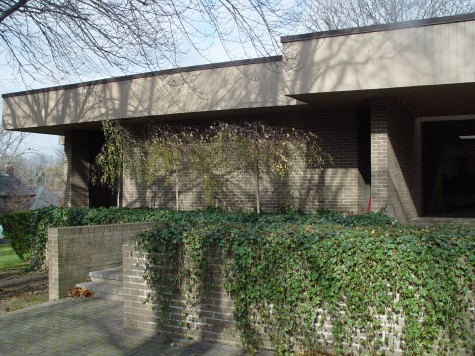
It was 28 degrees when I drove to work this morning-chilly.  The frost was unmistakable.  Chilly and frosty can apply to other things besides the weather.  Modern architecture can be a testament to everything nature is not-spare to the point of bare, intellectual, rigorously geometric-sometimes chilly.  One client with a modern house observed that it takes a certain kind of person to be able cheerfully set up camp in a sculpture. Thw landscape attending this modern house had gotten a little out of control; the repeating weeping birch were depressingly uneventful.  The untrimmed ivy diluted the impact of the multiple walls and changes of level that intended to make the landscape a compelling extension of the house.

Trimming the ivy made a huge improvement.  This property has little flat ground; Irving Tobocman designed a house for this site that occupies most of the existing level ground.  Those of you who live in my area know the work of Irving Tobocman.  His passion and gift for architecture is a legend well deserved.  My first contact with him was almost 25 years ago-I witnessed him mopping the floor with a fellow landscape designer who dared to insert his own landscape ideas between Irv and his final realization of a project. Suffice it to say it still remember the encounter. But this day that this ivy got pruned up-a happy day for me.  Those massive retaining walls were visually representing what he intended-an interesting conversation about natural and man made spaces .

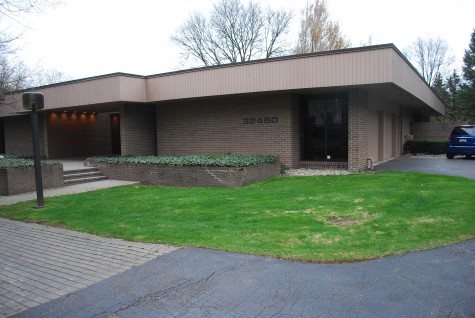
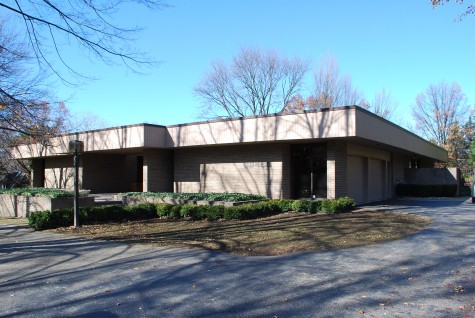
My clients own a home designed by Irv in the 70’s-it is breathtaking.  Forgive my lame description, but the structure is low, very large and imposing, spot on simple, and modern.  The exterior hard surfaces fan out from the house; they are visually influential in size and scope.  The interior spaces soar and speak-they inspire awe.  I am sure he had a hand in every material and move from the brick cladding to the kitchen layout to the light switch covers. My observation?  Those clients who take on and choose to live in a house drenched in this kind of passionate creativity-they are game, and confident people.

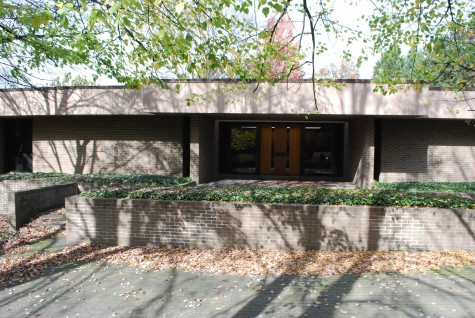
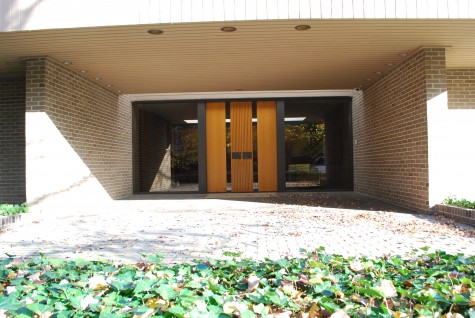
My clients engaged Mr. Tobocman to consult and update when they bought the house-knowing they were asking for a cyclone, a firestorm, and a substantial outpouring of opinion.  They obviously weathered all of this with him-to good end.  But almost every outdoor surface is paved over; the massive front doors are inset, and part of a porch which is really a terrace.  Nothing green intrudes on this view.

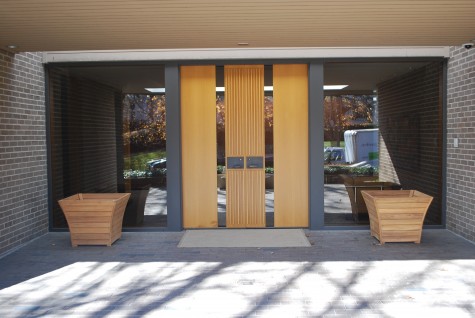
I thought this space would benefit from a warm-up; we are trying out a pair of contemporary Belgian teak boxes.  The wood is a good look with the doors, and warmly contrasts with all of the brick.  Planters low enough not to obstruct those astonishingly large windows, but large enough to permit a personal expression-a great mix. The skylight in the roof washed the front door area with light; there will be no problem getting something to grow here.

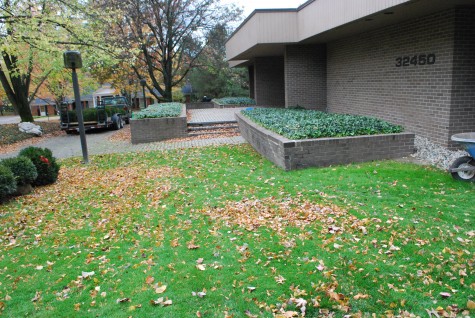
The three large brick boxes topped in baltic ivy are very stark.  What could be done here that would better enhance the impact of the architecture?

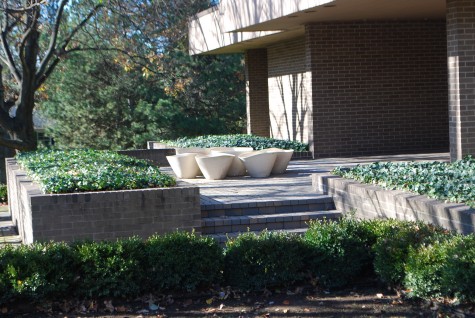
The vertical faces of the walls had aged in a not so attractive way, but the top surfaces of all of these walls are perfect. Facing two of the brick boxes down with boxwood changes the relationship of the mass of the house to the property in a good way. The house seems a little more gracefully integrated into the landscape.

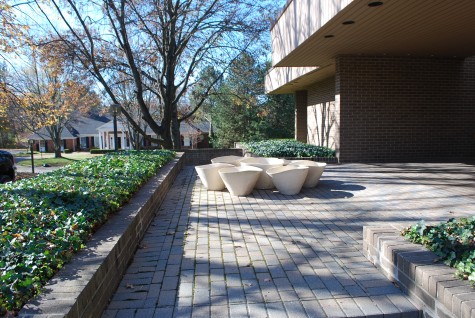
The front door terrace can be accessed by staircases from both the east and west side of the brick box that abuts the driveway.  A collection of contemporary stoneware planters can be arranged in a number of different ways.  My circular arrangement strongly contrasts with the dominant rectilinear shapes.

These pots could be planted, or not.  They could be planted such that the top soil surface would be well below the rim of the pots.  The planting would only be visible at close range. They could be planted all the same, or all different.  The pots could be rearranged to suit a season or occasion.

We scraped off all of the weedy grass in this small space, in preparation for quietly sculpting the lawn plane.  The soil was low; the ground usually soggy. A carefully graded green plane would set off this beautiful view of the house.


I think once the boxwood grows enough to be pruned level,  the landscape will have a deliberately tailored, but warmer look.

A Pedestrian Bridge

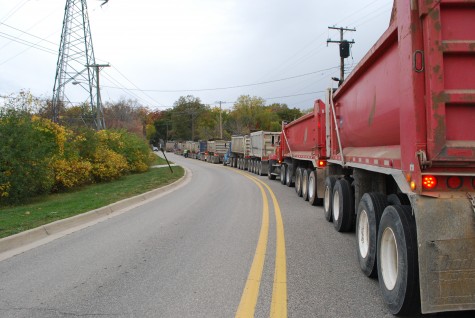
This was the scene on Pontiac Drive at 7am yesterday. Tractor trailer after tractor trailer-every one filled with dirt.  Down the street from us, a bridge is under construction. The bridge will cross over 6 lanes of Telegraph road.  2 spans, totalling 315 feet.  The Clinton River trail system, built primarily over a section of railroad which was closed in 1998, is a pedestrian path friendly to bike riders, runners and walking folk, stretching from from South Lyon to Rochester.  Current users of the trail have to detour around Telegraph some 5 miles before they are able to hook up to it again on the other side. The bridge will link the Sylvan Lake portion of the trail to the Pontiac portion.  


Building the bridge will cost something over 2 million dollars; quite a project.  We have been privy to the pounding and trucking for weeks now. Needless to say, traffic on this sleepy street has been congested. I was mesmerized by the sight of all of those trucks. There s something about earth work that fascinates me.   

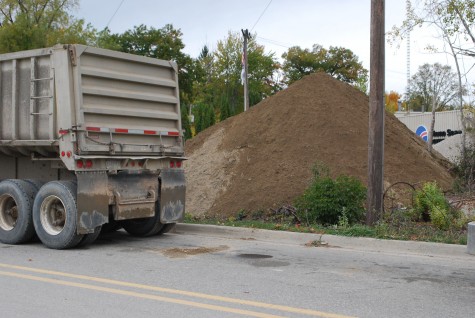
The project is at a stage where they need soil-and lots of it. I had to ask, and was told-each truck hauled in 44 yards of dirt.  By my estimation, close to 900 yards of soil arrived in a two hour period yesterday morning.  You can tell from the photo above the dirt was very sandy. I have no idea how it is being used-the bridge approach is off limits. 

It took about 10 minutes for each trucker to dump one load, detach the trailer, dump the next, and hook the trailer back up.  All the while, another 10 trucks were waiting in line.  One of the drivers told me that once he fires his diesel powered truck up in the morning, it stays running all day.  Apparently it is very hard on the engine to turn them on and off.  

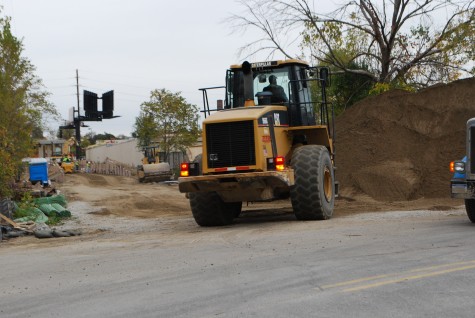
The wheels on this bull dozer are taller than I am. The operator ran loads of dirt from the street down to the Telegraph side of the trail all day long.  When I left work at 6pm, the dozer was still running back and forth.    

I like everything assciated with the landscape, and that includes the trucks that makes the work possible.  They brought my espaliers to me, under refrigeration, from the west coast. They haul soil, plants people and machines for me.  They deliver the many pallets of soil mix that we have formulated for our container plantings.  Every container that comes from Europe is trucked to the shop for unloading.    

Each one of these trucks has 44 tires.  I cannot imagine the maintenance associated with a vehicle of this size.  No doubt this company has a full time mechanic on staff.  I have gardened in places where vehicles were not permitted.  Even the most simple job took a lot of time.  This in no small part accounts for my great admiration for people who do their own landscaping-and their own trucking.   


I have no idea how long it will be before bikers and walkers can take the bridge over Telegraph, but it seems like it will be a while yet.  I doubt I will ever ride a bike over Telegraph, but it has been an interesting experience to observe a bridge being built.