



Deborah Silver is an accomplished and experienced landscape and garden designer whose firm first opened its doors in 1986.
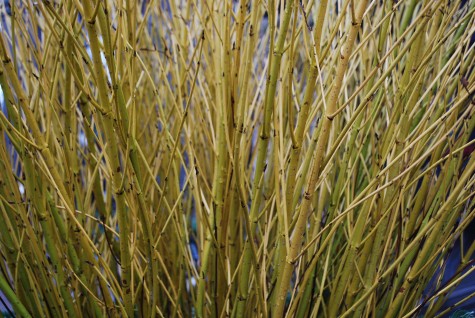 As much the week between Christmas and New Year’s seems mostly about the pause button, it has gone by quickly. The shop has been very busy. I also try to use this time to plan and construct for the holiday to come. My holiday shopping for 2011 comes up mid month. Am I weary of the holidays? Au contraire, I am just getting warmed up. Having spent the better part of 2 months working with holiday materials, I have only just now hitting my stride. Working steadily endows the hand with a certain confidence some call rhythm.
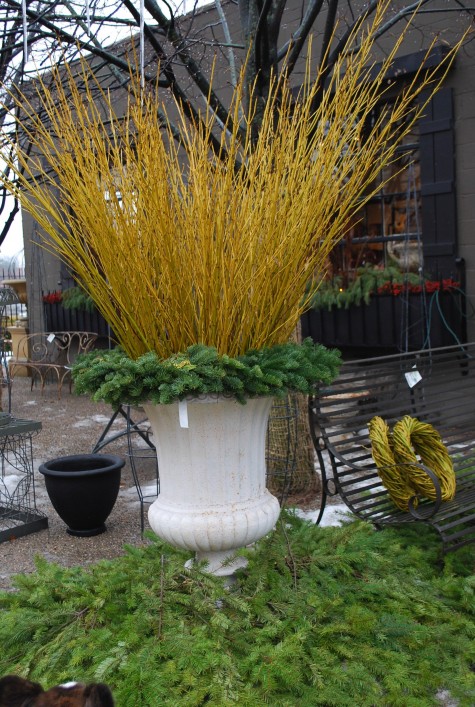
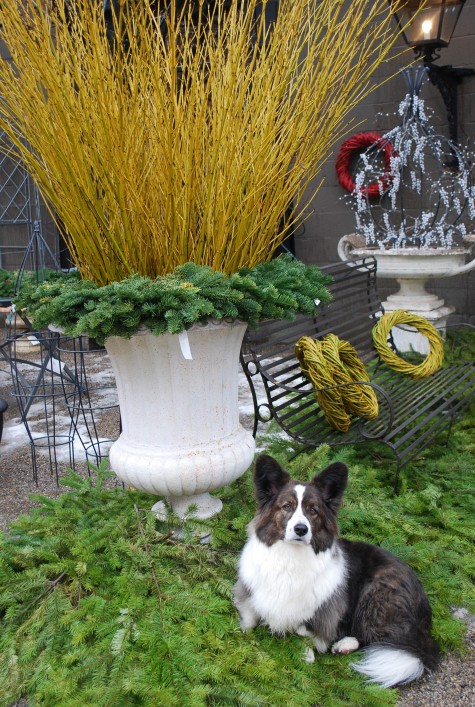
Some materials we still have are being put to use in sculptures we are making now-for 2011. The raw materials that made for a beautiful 2010 holiday season can now be turned over or inside out. They can be cut up, moved over, or rotated in space-reconfigured. I like nothing better than a project with a list of must haves, a list of cannot do’s, and the feeling that I am about to be cornered. That kind of challenge sounds good to me. This is much about what I really enjoy about landscape design. Rob redid the front door to the shop. Two left over evergreen wreaths sit perfectly on the rim of a pair of iron pots. What is left of our yellow twig fills those pots. A few bales of douglas fir boughs carpet the ground.
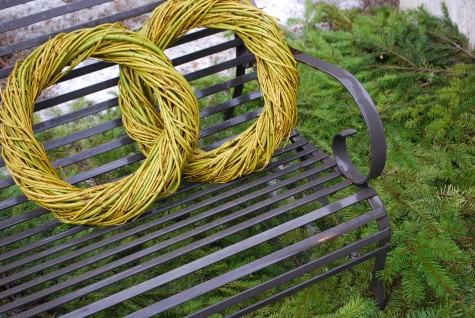
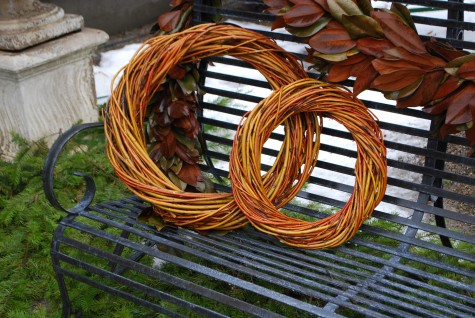
Some of that yellow twig got woven into wreaths. Willow twigs are incredibly flexible. There is no form inside, just layer after layer of branches wound round each other and tucked in. The greens carpeting ground-why not? I’ve seen them swagged over doorways and banisters, in pots and wreaths-but I like this carpet idea. They were left over materials in search of a reason to be. Lots of ideas come to mind if you deal with a material long enough. Flooring from greens-new to me.
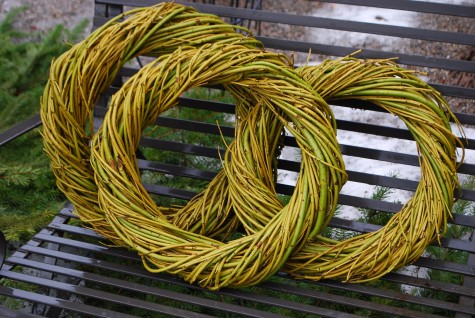
Years and years ago I made wreaths from the rosa multiflora rose canes that grew wild on my property. The new canes made gorgeous wreaths-but steering clear of those thorns was not so easy. I do not own that property now; that material is no longer available. An old idea in a new material; the dogwood is easy to work with with. Every holiday season is a new season. No need to trot out the old moves. Natural materials are just waiting for a new idea to emerge. I hate to throw away any material for lack of an interesting idea-I have been looking at the twig remains.
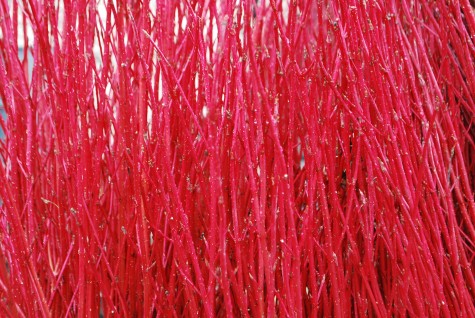
No matter how many times the yearly twig truck arrives, I always feel a sense of anticipation. I have another chance to interpret them. The same applies to my garden. Though it is a relatively small space, there will always be room for a big idea. My plans for the new year? More roses. Less grass. The corgi grass-inviolate. I know when to leave well enough alone. But I have other grass that could instead be a home for really cool plants. Planning-the winter is perfect for this. Not one creature, not one plant stirs when the ground is frozen solid. I have time to think, look at the existing materials, and plan.

These ideas are not really resolutions for the New Year. Expecting a garden to provide rersolution seems like a contradiction in terms. Resolving to tackle this project or that spot that isn’t working, adding something that will improve the overall look-a good idea. Resolving is a verb, suggesting some thought, and definitely implying some action. It is a paradox-how all of the resolving of a gardening lifetime won’t result in a resolution. A garden is a living thing-always moving in one direction or another.
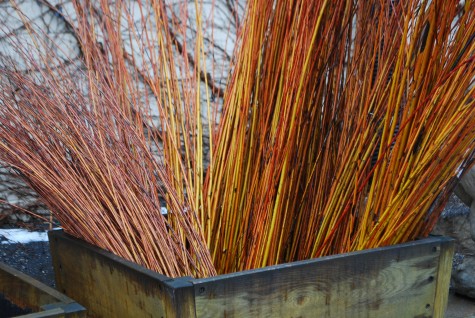 Some leftovers need to be taken out to the trash. Some obsolete ideas need to be trashed. But I cannot help but think there might be a future in store for these materials. I so like making something of what is left to the last.
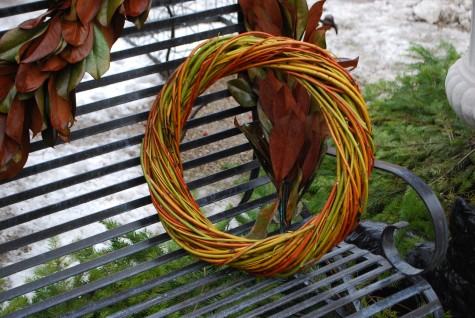 Already these round forms are suggesting other forms. Maybe a twig mix could be interesting. The yellow and copper colors look very companionable here-where can I go with this idea?
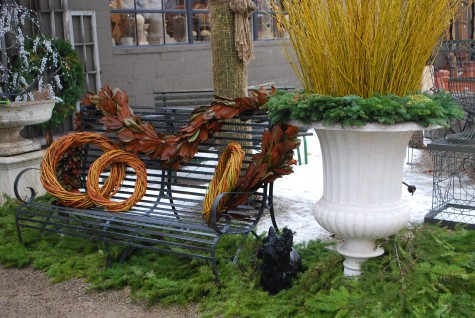 A year, a gardening season, every season comes to an end, like it or not. I do much better facing the winter with resolve. If all goes well, I’ll be cleaning out, and cooking up.
 In simple terms, I would so resolve to try new things. New plants. Unfamiliar arrangements. The toughest part of design is to look at any given arrangement, and realize that it can be different. It just takes a willingness to entertain new ideas-no matter from whence they come. This almost makes the idea of winter sound good.
Happy New Year-that’s what we plan to call it.
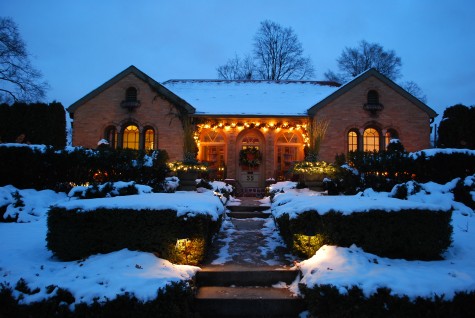 The only thing warm about my garden this late December afternoon are the lights. Some years I think to skip putting them up; I am invariably glad that I don’t give in to that idea. I cannot imagine what it must have felt like, seeing a city street or home lit with electric lights for the first time. Though in 1882 the first commercial power station ever built supplied light and electric power to 59 customers on Pearl St. in lower Manhattan, the widespread availability of electricity is a 20th century phenomenon. The landscape lighting permits me some interaction with my garden, at a time when there are more dark hours than light.
 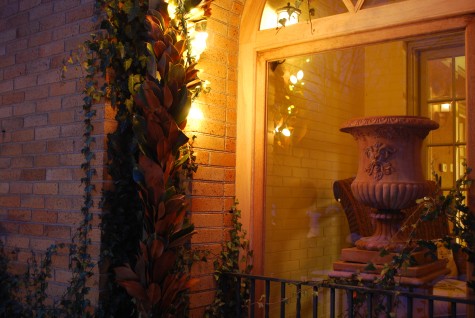 The magnolia garland does a good job of concealing the substantial light cords. My glassed in front porch is a winter home to a pair of Italian terra cotta urns on plinths. Just having them where I can see them , and lighting them, helps drive away the winter blues. Though hand made terra cotta is vastly stronger than machine made, I would not leave these pots out over the winter. Our winter weather is predictably vicious. Luckily, this pot is beautiful in its empty state.
 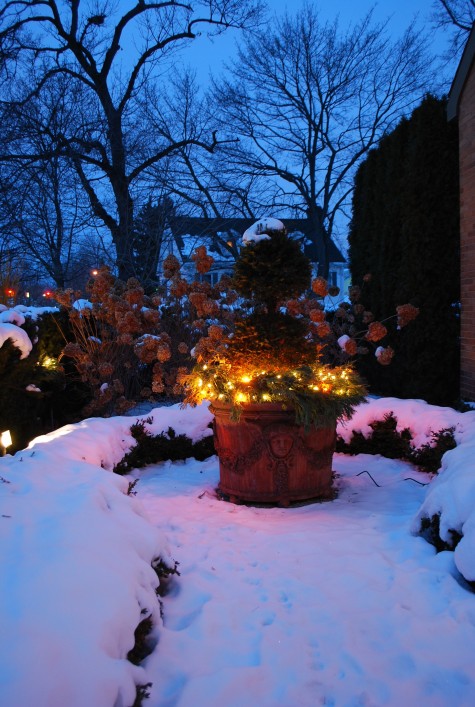 Though these pots appear to be terra cotta, they are actually fiber reinforced concrete. I like the look; I like even better that I can leave them out all winter. I left a double ball taxus topiary in the pot; I am hoping it will successfully survive the winter. The volume of soil in this pot is huge, compared to the rootball in question. I think that gives me better than decent odds of survival. I watered right up until the ground froze. Adequate water both late into the fall, and early in the spring, helps improve your chances of wintering evergreens in pots. I wound lighted mixed evergreen garland on top of the soil.
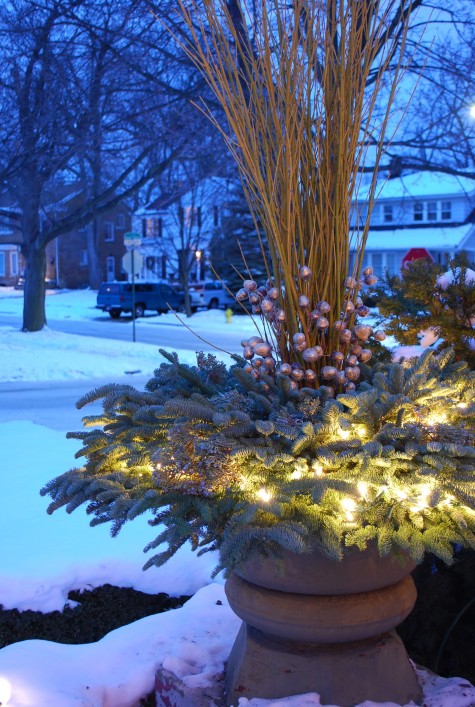 The yellow twig in the pots is a pale color, but it does not read well at night. The lights in the evergreens helps light them considerably. But once it is completely dark, a well placed andscape spotlight does a better job of rescuing them from the gloom. The yellow twig does stand out against the dominant blue grey of the winter.
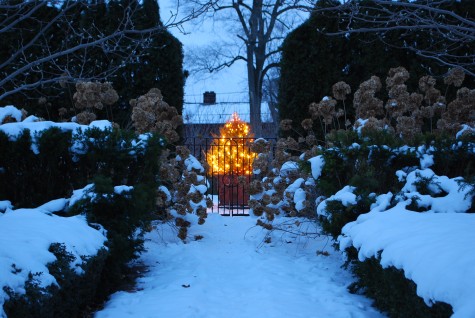 The view into my side yard from the street would be bleak indeed without my lit evergreen tree. This large Italian style square concrete pot looks good planted for the winter. A short statured cut Christmas tree is vastly less expensive than a live dwarf or topiary evergreen. I really don’t mind being free of the responsibility to keep plants alive for a few months. I have no plants inside my house-for exactly this reason. Having 2 live topiaries in pots to worry through the winter was enough. Though I think my untrimmed Limelight flower heads look great over the winter, they are not much to look at in the dark.
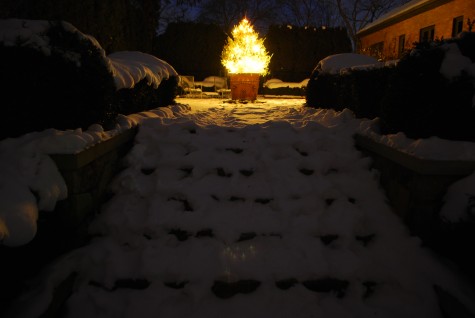 From inside the garden, the side yard gets to be tough to navigate, unless you are a corgi. My lit tree not only lights up the entire side yard, it provides me with something bright to look at out of all of the south side windows. I have no thought to pull the plug after New Years. It is my plan to let the light shine until March first. Though March is a winter month, but it is vastly better than January and February. By that time, the days will be much longer than they are now; I will be ready to do without the lights.
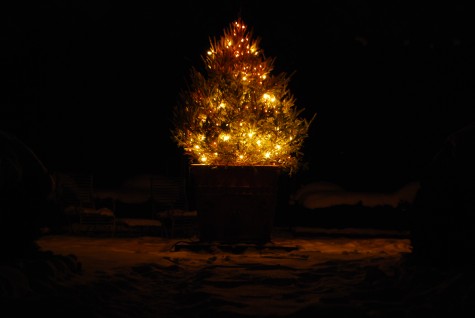
I only have landscape lighting in the front of my house. In the summer, it is light so late, I do not feel the need. I am thinking it might be a good idea to plan for some lighting here for next winter, but in any event, I do not have any plans to give up this lighted tree.
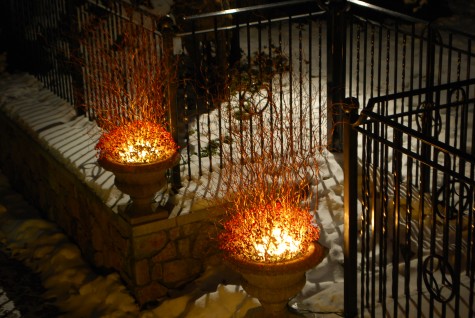 Rob put these pots together for me. I see them first thing when I come home at night, and when I leave for work in the morning. He cut a disk of floral foam that fit each urn, and frosted them with strings of C-7 white lights. Then he stuck umpteen dozen stems of dried rose hips, and several bunches of copper curly willow into each disk, taking care not to puncture a cord. This pair of pots are giant night lights; they glow. This construction would be great for those places in the garden that could stand to have the lights switched on.
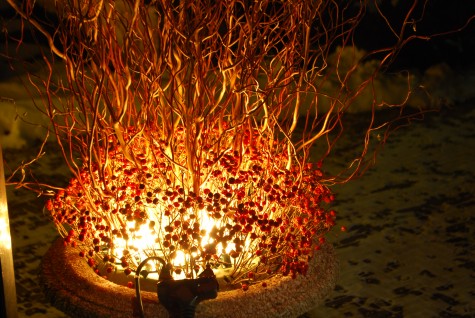 This cheers me as much as a fire in the fireplace-maybe more. I like that this winter pot uses no evergreens whatsoever-just sticks, and lights. The rose hips dried and are stuck fast on the stems, making them an ideal material for a winter pot. All you need is the patience to collect lots of sticks, and stick them. I like the big old fashioned C-7 lights.
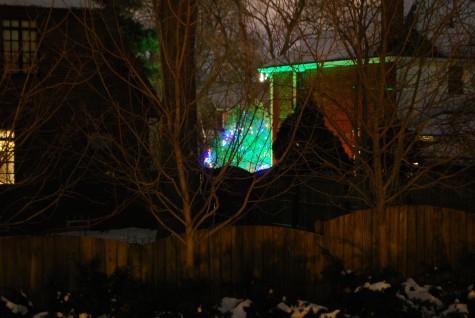
A neighbor behind and several doors down from me stuffed a giant yew in his front yard with lights for the holiday. This is one of the better parts of living in an urban community; the good lighting works of others make my winter better.
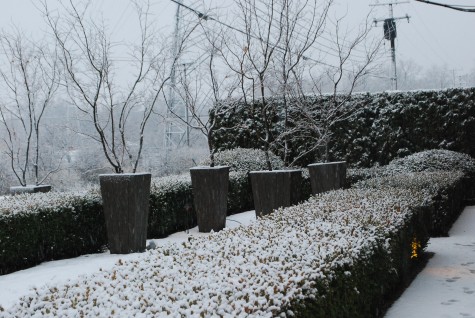
There is nothing like a snowfall to make patterns and textures in the landscape stand out. Boxwood provides a small and fine texture and a uniform pattern; this picture makes that very clear. The branching on trees stands out dramatically when those branches are coated with snow. These brown concrete pots have very smooth surfaces; only the rims catch the snow. The pots read as a homogeneous shape. Given the somber colors of a winter landscape, the interest here is all about line, pattern, texture, and mass. Winter greatly restricts the color palette in the landscape-that change is not all bad. It makes the other elements of design easier to see.
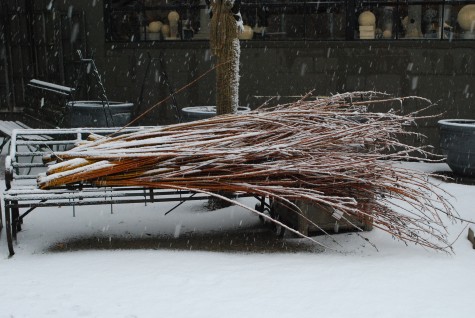 A dusting of snow has collected on the exposed surfaces of these bundles of copper willow. The bunches provide quite a hairdo for this bench. Individually, the sticks are quite linear. The mass of sticks have a curved pattern. The snow makes clear that anything in a mass reads quite diferently than it does as an individual. A single plant might be distinguished in its flower or leaf, or stature; a mass of that plant is more about an overall shape, sweep, or drift.
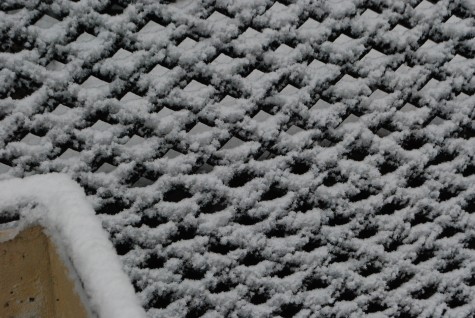 This cast iron grate has a distinctive pattern and a densely complex texture. Snow makes all the more of that. How snow softens the outlines of hard structures and surfaces is one of the pleasures of the winter landscape. A snowfall can make the most ordinary landscape look spectacularly beautiful. It would be more accurate to say that most natural phenomena are spectacularly beautiful-even if I neglect to see it. The snow turns on the lights.
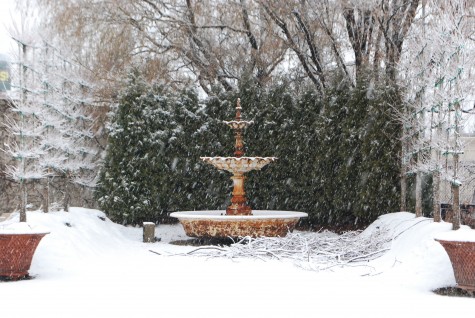 We are not buried in snow like other parts of the country, but we did get 6-8 inches. The snow fell fast, and stuck to everything. Why does it sometime snow when the temperature is above freezing? It was 35 degrees here at one point yesterday and snowing like mad; it was 7 degrees when I got to work this morning. All the wet snow is now frozen in place, so I have had plenty of time to look around. The pruning pattern on the katsura espaliers can be readily seen; branches that were cut back hard responded by sprouting a number of stick straight branches from a single cut. The pattern I see on these trees is a very clear explanation of how a branch responds to pruning. A pruning cut issues an invitation to grow.
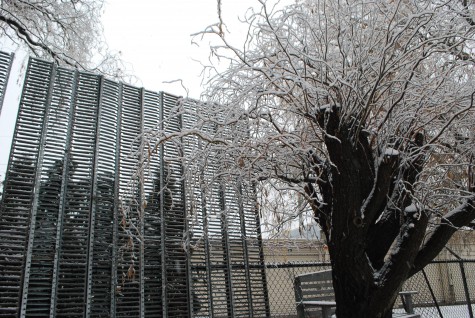 These vintage trench drains have a repetitive and very geometric pattern. They are most clearly a human-generated form. The wildly curving branches of the pollarded willow are anything human. This idea shocks me some, and interests me a lot. The snow outlines the massive main trunks of the tree. I will loose this pollarded tree sooner rather than later. A high wind several years ago uprooted it. My efforts to replant it were in vain; the bark is shedding in giant strips, and bracket fungus fruiting bodies have appeared.
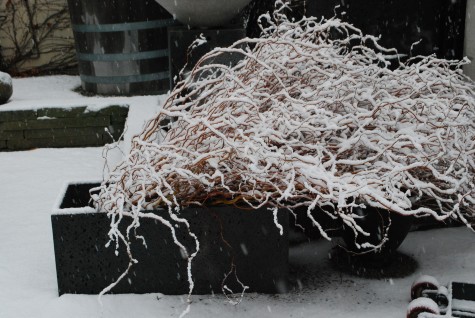 The copper curly willow is very curly. This branching is obscured in the summer by leaves. I have to admit that this tree looks better in the winter than the summer, and that the pattern is outstanding in the snow. The most difficult thing about choosing plants for their winter interest is that when that idea strikes home, as in today, nothing can be done about it. I keep files of photographs of my own garden organized by the month. I photograph certain key spots from the same angle 12 times a year. I wish I had started doing this 14 years ago, instead of four. Nonetheless, these pictures tell me a lot about whether the design and planting is working as well as it could.
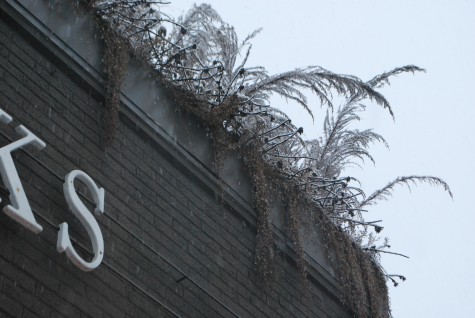 I did not clean out the boxes on the roof this year-the first time ever for that. The fall and very late fall was a beautiful season for the boxes. I am not surprised that the elegant feather persisted in its skeletal state, but I am surprised to see so much of the dichondra and plectranthus still holding on. The pattern and texture provides something moody and textural to see. The empty box alternative seems much less interesting.
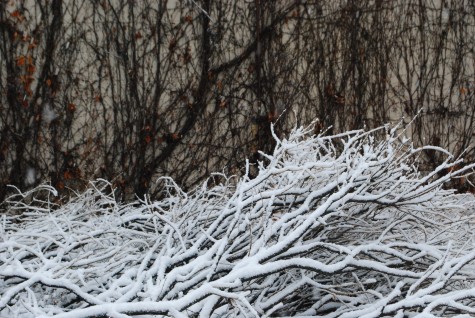 This pile of cut burning bush branches is dramatic covered with snow. They are all the more dramatic for their accidental placement in front of a concrete wall, covered in the dark stems of boston ivy. This wall faces the west; I have no idea why there is not one bit of snow on it anywhere-unless the snow was born on wind out of the west. So much pattern and texture-all ruled by a study in light and dark.
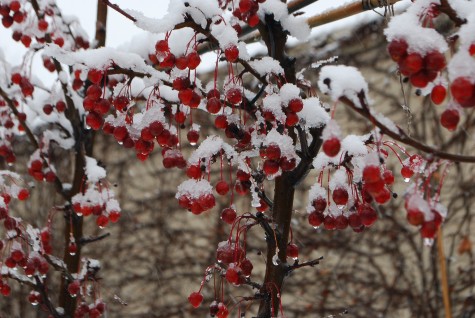
A pair of espaliered crabapples need to come into the garage for the winter. As soon as the bulk of our winter containers are done, space will open up for them. This is the only plant with color on the entire shop property. The pattern of the snow on the berries-I am glad I got a chance to see this.