The Border

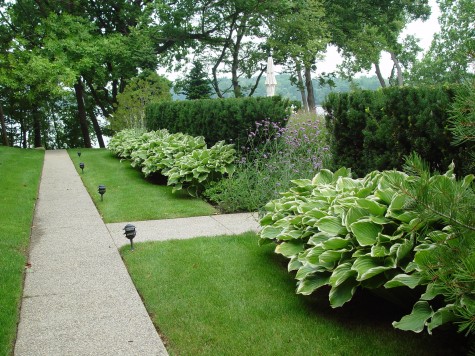
I have been painting the border of painted concrete floor in the shop the past few days; the word “border” is on my mind. The language of the garden-a special language that crosses over national boundaries and may span centuries.  To whit-a verge refers to an edge in the garden, deeply cut with an edging spade.  A verge also refers to the shoulder of a road.  This is primarily a British term.  I greatly admire British gardens and gardeners; I equally like their use of language.  When I am edging a bed, the idea that I am creating a verge lends great dignity and creates excitement about what amounts to plain hard work.  I know how to amuse myself, when I am working.  A well cut verge is not so unlike a precipice that you could fall into, and break an ankle.  A passionately cut and serious edge on a bed.  Sharp clean edges make for a beautiful presentation. I fancy the grass border pictured above on this walk qualifies as a shoulder of a modest road-a grass verge.  The grass also forms a border for a luxuriant bed of variegated Krossa Regal hosta.  This plant is so textural and lyrical in appearance, a quiet setting would seem to display it to best advantage.  In this case, a border of grass.
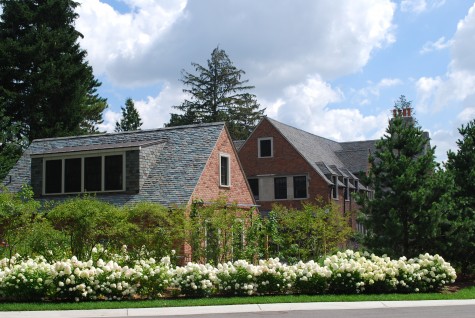
This hedge of limelight hydrangea, bordering a hedge of lilac, itself bordered by grass, borders a road.  A border? A border is a line or a mass that visually indicates a boundary.  This border of three plants in three heights forms a boundary.  It screens a private garden from a public thoroughfare. This landscape border is on the verge of spilling over onto the roadway.  OK, I have a very active imagination.   
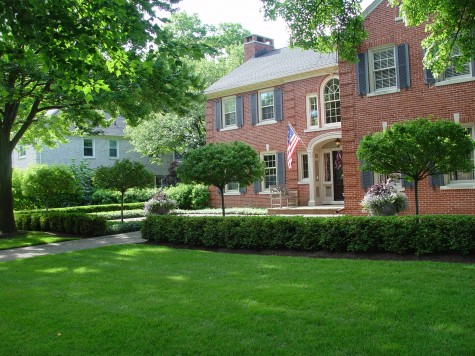
This boxwood, punctuated by crabapple standards creates a border which separates the public presentation of the landscape from private garden.  There is no reason why the landscape which faces the street need be an entirely public landscape.  This border creates a boundary.  Should you drive by, you are visually privy to what exists planted on the streetside of the boxwood.  Should you be an invited guest, you are also privy to what is planted on the house side of the border.  I like the idea of making friends especially welcome with a landscape experience all their own.    
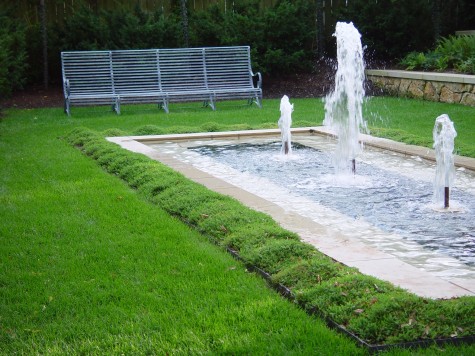
My fountain brings me great pleasure.  A concrete affair faced in Valders stone, it needs a border that separates it from the grass.  Grass clippings in the pool-not good.  A border of herniaria replicates the look of the grass, but needs no mowing.  The Valders stone is a border which protects the herniaria from the chlorine in the fountain.  Some borders are about visual definition; some borders are about protection. 
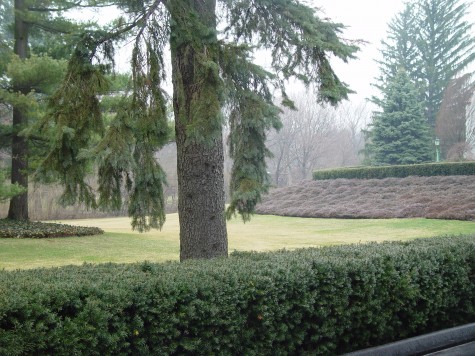
This formally clipped yew hedge is a border clearly delineating this driveway. This is a dicey move in our zone; road salt can severely damage yews.  Should you be thinking of bordering your drive with an evergreen, look at your salt habit.  The junipers planted on this slope, so beautiful in their winter color, a spectacularly generous border bewtwen the lawn plane, and the driveway plane.  This simple border tells you everything you need to know about the elevation of the house. 
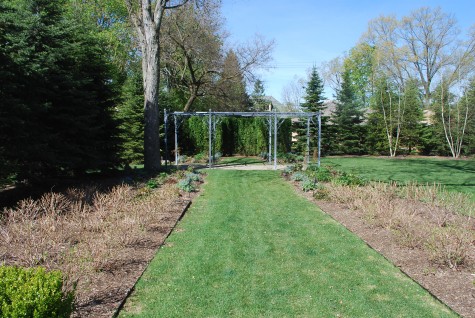
Perennial borders-no one does them better than the Brits.  My zone 4to5 makes me reluctant to invest too much in a perennial border.  I had lots of space here-so half of it went to a hydrangea border.  The hydrangeas, rugged and dependable.   Given the design of the border, the lawn reads as a road, a generous path to somewhere.  In this case, a pergola.  Yet to come, a focal point at the end of this grass verge which would encourage travel.  I think one of the most important elements of landscape design involves how to encourage people to travel through, and experience that landscape.  
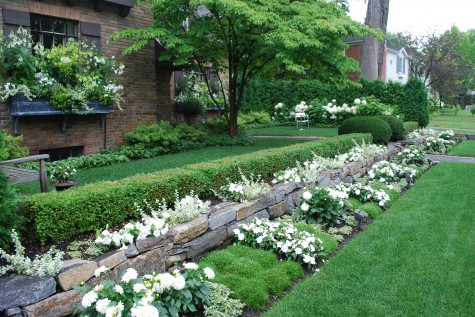

This low and so beautifully constructed wall is a border, a retaining wall, between one level and the next.  A change of grade asks for a boundary.  A change of grade requires steps.  I like to signal that one level is ending, and another level is to come.  I like moves in a landscape that are clear and easy to read.  Clear and confident moves are beautiful to my eye.    A crisp verge-how I love this.
A Signature


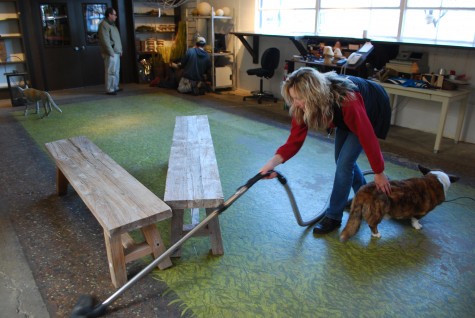
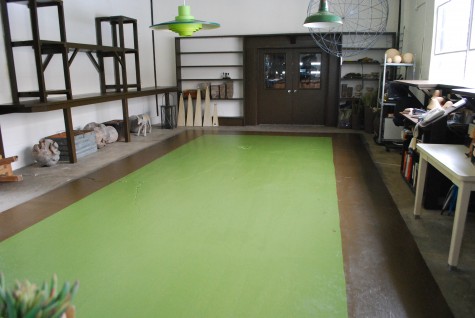
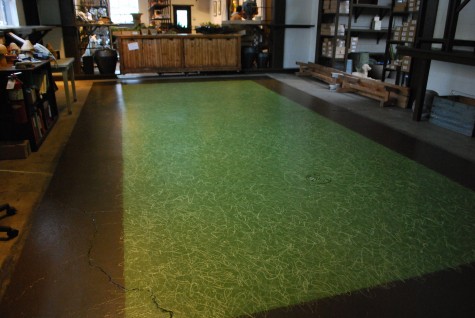
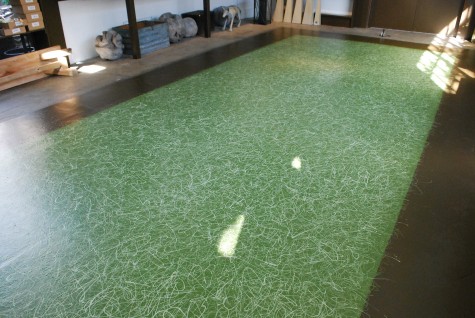
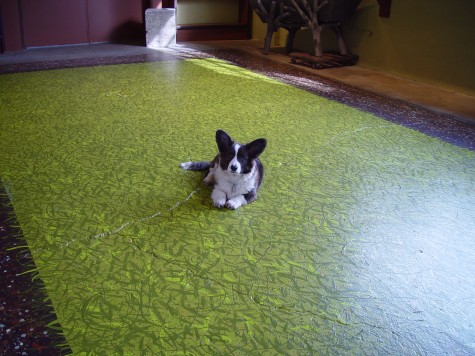
We are into the maelstrom phase of the spring redo of the shop.  It seems like everything has been moved, washed, and otherwise made ready to make friends with what what is on its way here.  Ourt first container from Europe-in customs in Romulus as I write.  Some months ago I wrote about a concrete floor that I had painted to resemble a “tapis vert”.  Lierally translated from the French, a tapis vert is a green carpet.  It is to my mind the most elemental version of a garden.  Every garden bears the signature of the garden maker.  A group of plants are arranged, have a form, that comes from human hands.  Though a wild meadow studded with poplars may not seem to have a signature, it does.  Certain and specific species thrive there.  The placement of the trees has everything to do with how seed is dispersed.  The most natural wild place has a signature, no matter how subtle.  Milo was a baby when I painted the floor with my representation of a lawn edged in gravel; he could not wait for the barricades to come down so he could go lie on it.   

Five years has taken its toll.  Lots of traffic from both people and objects had dulled the colors.  There were places where the paint had simply worn away.  Since spring is all about fresh, a fresh take on the floor seemed in order.  Moving everything to the sidelines was a big job, as was a thorough cleaning.  The paint needs every chance it can get to stick.  Howard decided to pitch in and help Pam with this. 

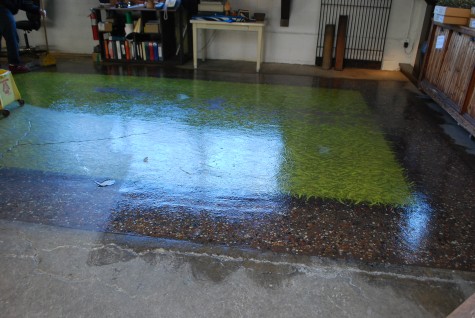
The floor got washed twice, and hand dried, in an effort to remove as much grime as possible.  The cleaning of this building is a full time job.  Dirt, plants and water get tracked all over.  Last time, I painted with floor with Benjamin Moore exterior 100% acrylic paint in a satin finish.  Acrylic paint is much harder than latex; the paint finish is washable, but not too shiny.  This time, I decided to use the acrylic version manufactured by Porter Paint.  We use this brand on all our painted furniture that goes outdoors, and on the extira board panels in the Jackie boxes we make.  Porter paint is a paint of choice for sign painters.  It is extremely durable outdoors.  This floor gets plenty of abuse-every muddy or wet day in every season, someone is bringing what’s on the ground across this floor.  Durability is important. 

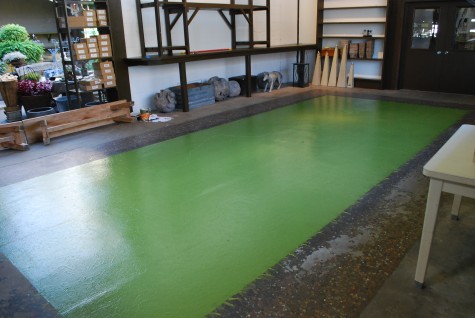
What particular green to use as a base coat-I spent plenty of time stewing over that.  As the previous painting featured a green leaning towards yellow, I decided to change to a grass green.  Fern green.  A green not yellow, not blue.  Just green.  You cannot tell the temperature from this picture; the building is cold this time of year.  Big and drafty and a fortune to heat, we keep the temp down and out coats on-usually somewhere between 50 and 55.  This means the paint dries slowly, but I cannot imagine taking on a project like this any other time of year.   

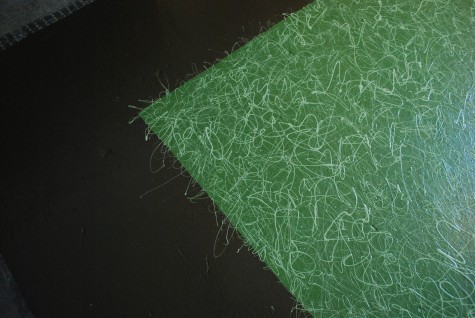
The chocolate border is a paint color called “afternoon tea”.  How appropriate to the time of year.  Have you ever picked a paint color that had a name you did not like?  I haven’t either.  The person whose job it is to name paint colors-they must be bursting at the seams with ingenuity, and endowed with a stellar vocabulary.  Two base coats were applied-this part took 3 days.  Letting the paint dry enough is essential.  I do like to apply a second coat as the first coat is just barely shy of being dry.  I believe this makes the top layer stick better.   

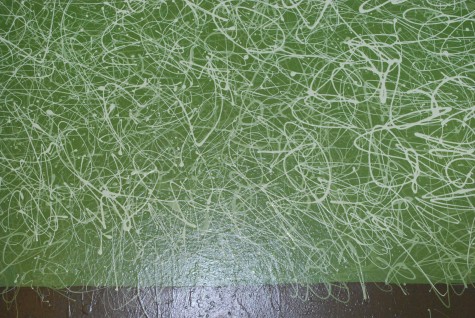
The texture of the green ground the first time around came from a series of stokes meant to have a grassy feel.  I am sure I applied 3 additional colors over the ground.  Ths time I had something different in mind.  I wanted to apply the paint as if it were being written rather than painted.  This meant thinning the paint down until it ran a bit.  All of the paint was applied with a paint stir stick, not a brush. 

My paint stick was just inches above the surface while I was writing-this was a tough position to maintain for long.  But it was great fun.  That paint stick was a cross between a baton, a light stick and a pen.  Sometimes I would draw, sometimes I would sign.  I shook the stick on occasion like Milo shakes off the snow.

What did I write?  Whose names did I sign?  You will have to decide for yourself, come March.

The border-tomorrow.

Stuff

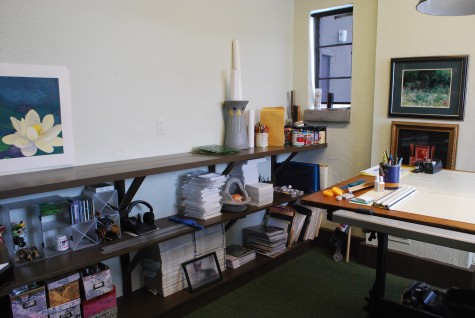
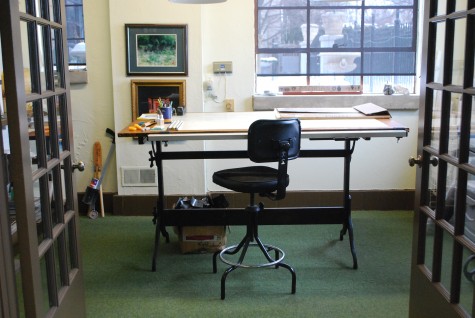
In lieu of writing, I spent the weekend going through my work stuff.  Desk stuff, drawing studio stuff, catalogue stuff.  Letter stuff, note stuff, picture stuff, closet stuff, blueprint stuff. My drafting studio was a wreck.  The table itself-piled so high with stuff that MCat had moved in, and was using it as a penthouse floor catbed.  I am one of those people who require a clean space in order to work.  Visual anarchy makes it next to impossible for me to concentrate.  All I can think about is where does this belong, or what could I do with that.  Mounds of stuff, and not a flat space anywhere to draw, paint, construct, dream or doodle.  I needed a shovel and a soil sifter, and plenty of garbage bags.  There are those times that I go too far, pitching this or that.  A phone number I need the second I have thrown it away.  One time I found my checkbook in the trash.  After I had turned the rest of my space up side down in search, I casually looked in the trash. 


A collection of stuff is made up of lots of individual things.  Some things make my world go round.  My keys, my computer, my books, my Suburban, my socks and shoes. Dog treats, my coffee pot, tools, paper, books-these things I could not do without. Other things litter the landscape.  An out of date driver’s license, a pile of change, Milo’s puppy collar, a dead pen, a left over piece of water color paper, a few granite bricks, magazines from 2008.  Broken things-I have an impressive collection.  My entire office had evolved into the equivalent of my kitchen junk drawer.  Rather than dump the lot, all the stuff needed going through.  Some stuff matters. 

I have a file folder for every year dating back to 1998.  They are home to letters from friends and clients.  Articles.  Photographs.  Stuff that means something to me. I am more careful about the stuff I collect now than I was 20 years ago.  In any given year, that file has no more than 30 entries.  I edit-as best I can.  It ought to be 10 entries or less every year, but I am an American.  We have a big country, with lots of open spaces.  This means I collect, dissect, am pathetically sentimental, go on and hold on too long. 

    Looking for a rocking discussion of what constitutes stuff?  Fire up your computer, and go to UTube; bleep up George Carlin stuff.  You’ll find it.  The first time I saw his comedy routine about how we organize our lives around our stuff, and how our stuff gets spread out wherever we go- I could not stop laughing, nor could I stop thinking. A house provides refuge, but it also is a giant box that holds all our stuff.  What about all of my stuff?  My costume for a party in 1994-is it time to let that go?  Last winter was completely absorbed with the process and rehabilitation from a knee replacement.  That titanium thing organized my entire winter.  The stuff enabling me to walk-a prosthesis, a pain pump, a walker, a cane, a portable exercise bikea good stuff.  The usual winter cull of the fluff stuff  never happened. No old plans got filed.  Nothing found its way to the trash.

January of 2011; my 2010 work got done.  I went shopping for 2011.  I am home, and taking a second breath-that second breath involves a bad cold that seems to be hanging on.  February 1, 2011-I am looking at the stuff that has accumulated since January of  2009.  Several years worth of stuff. My stuff is not the sort of thing that anyone would want.  It’s just litter, clutter, Roly poly bugs long since deceased.  It took every bit of two days, and I kicked up a lot of dust.  But today I am ready for something new.  Where are you, Something New?


I am ready to make your acquaintance.

Structure


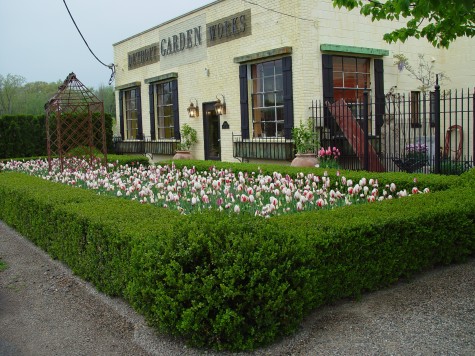
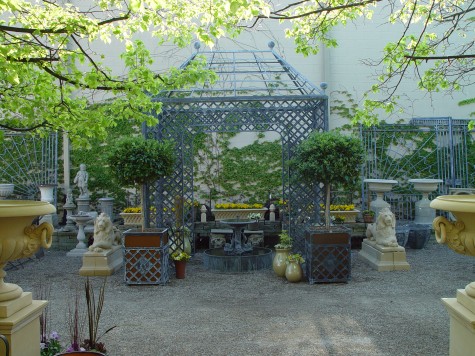
Structure in a garden, whether formal or informal, symmetrical, or asymmetrical, visually subtle or strong, is a very important element of garden-making.  A structure implies some element that is enduring.  The most elaborate sand castle will wash away with high tide.  Concrete that is not steel reinforced can crack.  A house of cards can be blown over.  Regularly, certain elements in my garden are blown over.  The annuals last but one season.  The hyssop peters out.  Roses and lilacs without regular maintenance age, and fade.  But those plants that provide structure-the evergreens, and the trees, endure, and grow to a great age.  This boxwood rectangle with its boxwood balls at the corners was planted in 1997.  It will be but 14 years old this year, but it has endured many changes of season, fungus, leaf miners, and heavy pruning.  It provides structure to this garden-the rest of which changes every season.  Tulips in the spring, annuals in the summer-the fall and winter have a still different look.  The boxwood is a living architectural, structural, element.  It provides the garden with a framework that makes a home for every other element.  In 2005, a steel gloriette arrived from France; you see it pictured here.  Still stuck in the roof, the gnarled remains of a giant wisteria. Like the wisteria and its gloriette, the spring tulips have a structural picture frame of boxwood that celebrate them.             


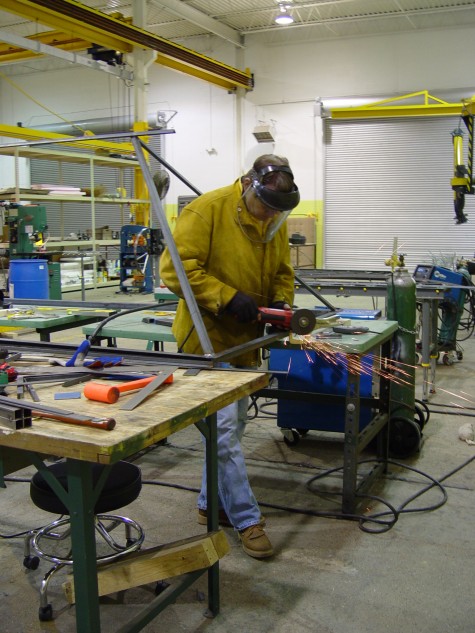
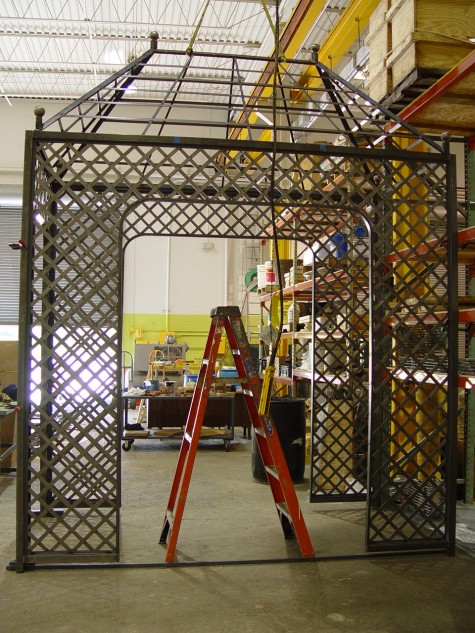
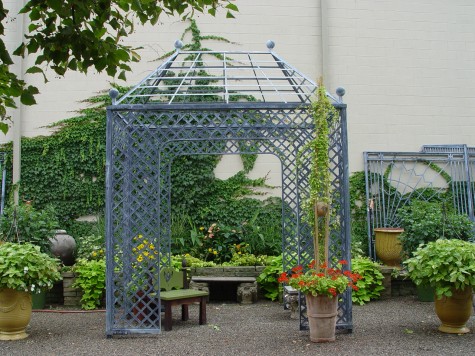
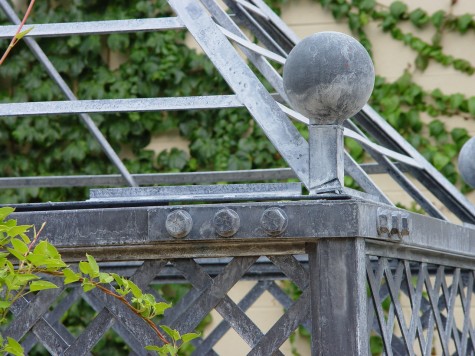
A gloriette provides shelter-as does a house for a family, a library for a reader, a road for a traveller, or a grocery store for a cook.  I decided to build a gloriette, in an expanded dimension, for the shop.  Buck obligingly drew one up in a retangular shape, and set immediately to making the roof.  The angle iron pictured here is a stock steel shape.  What he does with that angle iron is create a structure that will endure.  Structural elements in gardens stand in stark contrast to what is ephemeral.  Seasons come and go.  Perennials thrive, and fade.  As much as a garden is about change, and constant effort, more permanent elements provide comfort.  The hedges I planted 15 years ago make me feel like my life as a gardener has meant something; what I did in my garden when I was 45 persists.   

The gardens of my twenties and thirties do not exist anymore, but for the trees, and the evergreens.  They have persisted in spite of an ownership without a gardener.  The structure they provide still organize a property that is not much looked after.  I regret that I gave that property up.  The structure still in place-a comfort.   

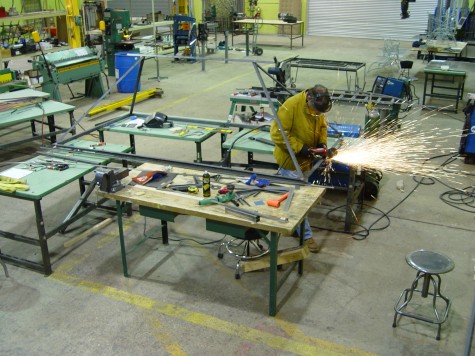
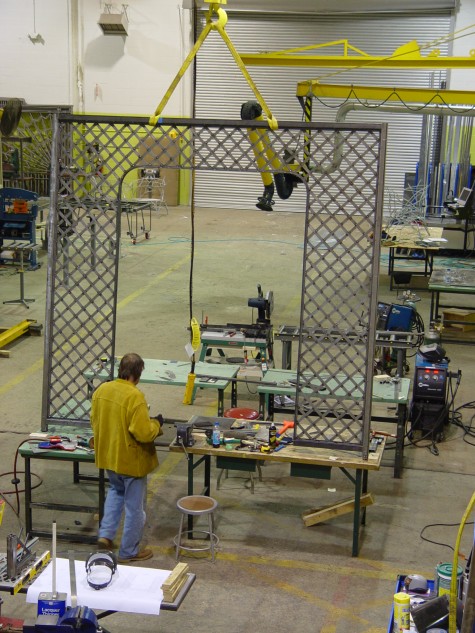
Buck builds giant structures, with the help of a bridge crane.  This single panel of the gloriette under construction dwarfs him.   Plenty of structures both man-made and natural, make me feel the same way.  The Grand Canyon, Yosemite, the Taj Mahal, the Washington Monument, the Lake Michigan dunes, the redwood forests-you get the picture.  My house has been standing in the spot I now occupy- uninterrupted- since 1930.  I like this.  I very much like an idea bigger than me, a world view that makes me just a member of a big group-what gardener doesn’t?           

This modern version of my square French gloriette is long, and very tall.  I imagined that anyone who might place it in their garden would want a home for climbing plants that would get them skyward where they want to be.  I imagined they would want to walk underneath, and perhaps sit with a solid roof over their head.  The Branch Studio has close to 30 foot tall ceilings-room enough to build a structure within a structure.  

The first season I had the gloriette at the shop, we dressed it very formally, with associated tall lattice boxes, and an English lead fountain. Looking good, Buck.  I so like how the lower branches of the shop lindens frame the roof of the gloriette.  The woody structure and the steel structure overlap in a graceful way. 

The second summer, we dressed the gloriette in a far less formal way.  Rob’s Italian pot with a bamboo pole plant climber curved out with a wedged wood sphere-this is a great look.  This treatment spoke up; we sold the gloriette.

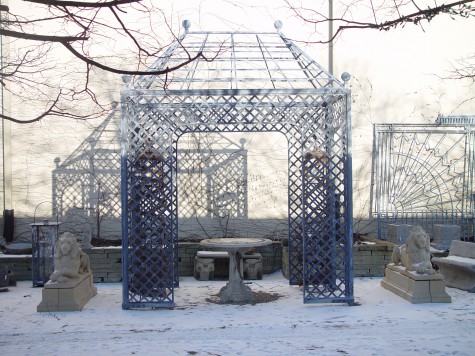
My garden is actually quite handsome in the winter, for its green structure.  I know there will be something there, once the snow melts.  The gloriette likewise had considerable impact in the winter.  The shadow on the wall behind it-so beautiful.  Creating structure in a garden asks for everything.  All of your thought.  All of your effort.  All of your history.  All of your resources.  This spring, gardeners everywhere will be buying beech trees.  Trenching for hedges.  Setting walkways.  Installing fountains.  Building gates, pergolas, and benches.  Planning to provide structure. Are you ready?  


Every year I think about a cottage.  Were I ever able to afford one, I would have no garden.  I would move in, and do nothing outdoors except go there and look.  In the woods, I would encourage the existing trees right up to and onto the foundation.  Were I on the water, I would slog through the sand, and appreciate the reeds.  Were I in the Smoky Mountains, I would put the smallest structure possible in a trillium field.  If I ever had a cottage, what nature had in store for me would be more than enought to make me happy.  Lacking a cottage on a wildly beautiful piece of property,  my home landscape asks for structure.  Steel and green.  Sounds good to me.