Speaking Of A Garden

I speak to groups on occasion.  As I believe that exchange between gardeners is a form of gardening, I am happy to do so.  I have met lots of interesting people this way.  Today I hosted a local chapter of the PEO.  I don’t know much about their organization, except that they make a point of encouraging and funding women who seek higher education, and need help getting that.  A group with a mission such as this-I felt a story about an experience which served to educate me seemed appropriate.  In the early eighties I worked for the landscape designer, Al Goldner.  My brief tenure with him before he retired proved to be an experience that greatly influenced my design life.
He had that bel’occhio gene-the beautiful eye- so aptly described by Thomas Hobbs. I discussed this last week;  gardeners are optimistic, and  appreciate and require beauty in their lives.  Al  loved all manner of plants.  He was a landscape designer with as much heart as skill, and great instincts.  When I first went to work for him in 1983, he had already struck a deal with Grand Hotel. 
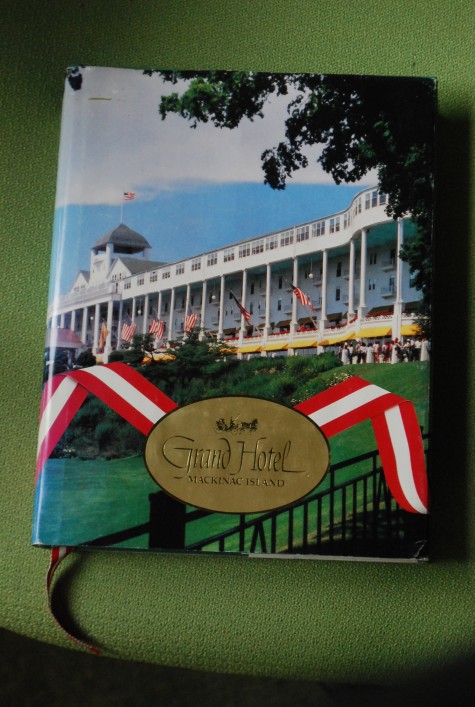
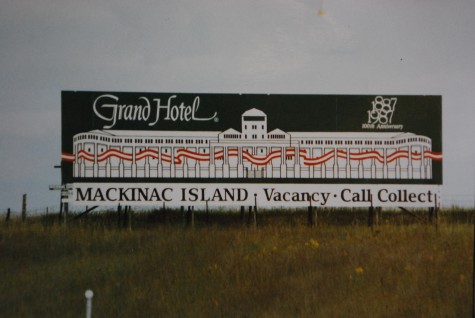
Anyone reading who lives in Michigan knows that the Grand Hotel on Mackinac Island has been in business since 1887-this would be 124 years.  A resort hotel dating from the Victorian era still hosts countless guests and groups beautifully every year.  A stay there-lovely, luxurious, relaxing, and gorgeous.  Dan and Amelia Musser-they too have the bel’occio gene.  Once they met Al, they decided more beautiful gardens were in order.   I am making short written work of what proved to be a long and important relationship.
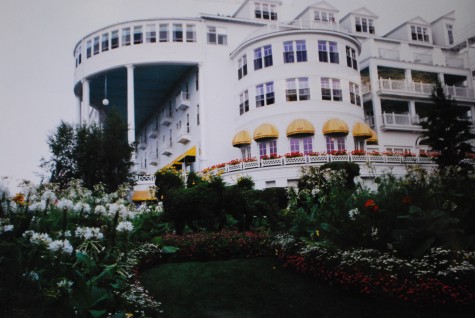
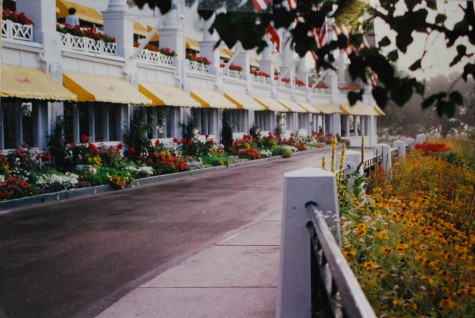
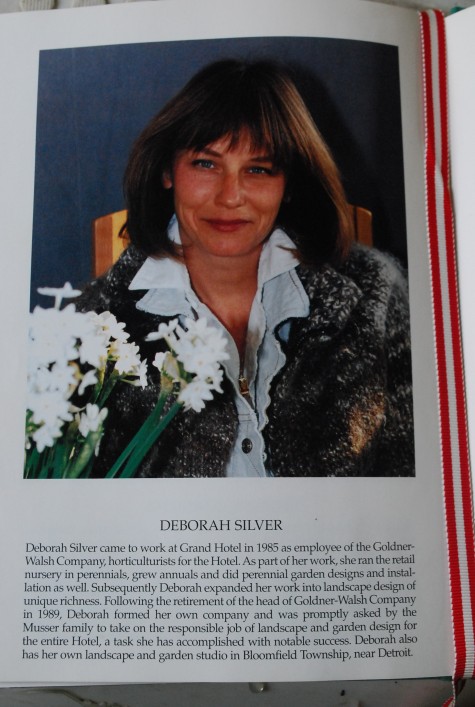
By the time I came to work for Al Goldner, Grand Hotel had already invested much time, money, and people to the development of their landscape and gardens.  I would be sent there on occasion to plant.  Later, I would be sent there to design, and then plant. The property is enormous.  The hotel has an identity which is crystal clear, and an equal committment to providing everything that makes for a great experience. When Al retired, they asked me to take on the design of the gardens.  Why would I not?  They were clients with a bel’occio gene; I designed and supervised their gardens for ten great years.
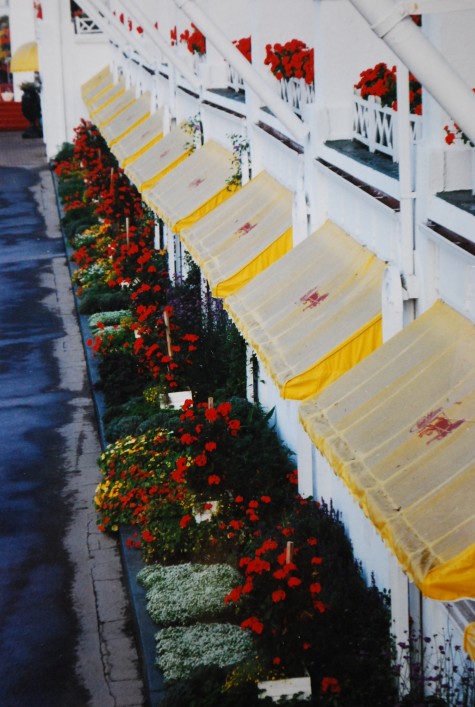
My point to my group this morning is as follows.  No other hotels on Mackinac Island had gardens or container plantings when I first went there to work.  Today, the gardens and plantings all over the island attract countless visitors. Three people with a vision transformed the landscape of an entire community.
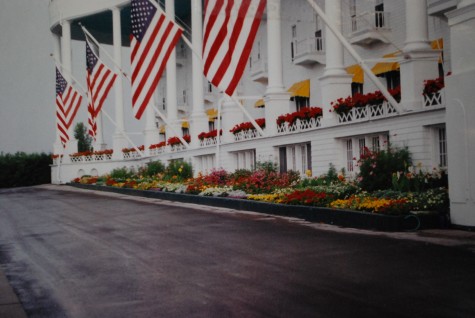

The time I spent working there was an incredible experience.  It was a winter’s work to design and order the plant material for all of the gardens.  They took every bit of 6 weeks to plant.  I have never since seen so many flowers in one place.  Though I have not been there for a very long time, I hear the gardens are still beautiful.   
Susanne’s Roses


My post earlier today featured the best that there is going on outside here-that best is not so great.  It is still winter where I live.   So I went back into that stack of old pictures and projects looking for something a little less chilly and off-putting.  This landscape and garden I worked on intensively between 1986 and 1994.  A client with a beautiful house on a small piece of land-I cannot remember how we met.  But I do remember that she decided that a garden, and a great garden at that, was just what she wanted.  Though she was always clear about what she liked, she had not so much knowledge.  I not only designed and planted for her-I taught.  She wanted to know everything I knew about wildflowers, perennials, meadows-and most of all, roses.  I had a history with roses, fostered by Al Goldner.  A highly regarded landscape designer with a degree in floriculture-he put up with a young employee (that would be me) who insisted to him in 1985 that tea roses were overbred, disease prone, and marginally hardy prima donnas.  He had the confidence to allow me to order roses of my own choosing for Goldner-Walsh.  I knew he was giving me just enough rope to hang myself.

I placed an order for roses with Hortico in Canada.  I bought antique roses. Climbers.  Rugosas.  Species roses.  And a line of English roses-the David Austin roses. Everything and anything that was not a tea rose.  I vividly remember the day I pulled a company pickup truck full of bareroot roses up to the Canadian/American customs booth-of course they pulled me over.  Who knew I needed a phytosanitary certificate?  I spent hours on a bench next to a man in handcuffs-it was terrifying.  Eventually they let me go.  This was some years before Wayside Gardens began offering David Austin roses.  I potted up just short of a thousand roses, and brought them on.  I learned plenty about them, just taking care of them.  Though I was by no means a rosarian, I had a client who wanted any and all of them.  Susanne.    

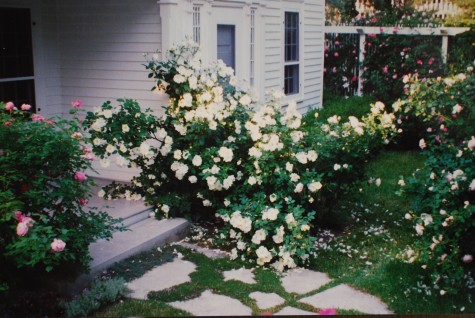
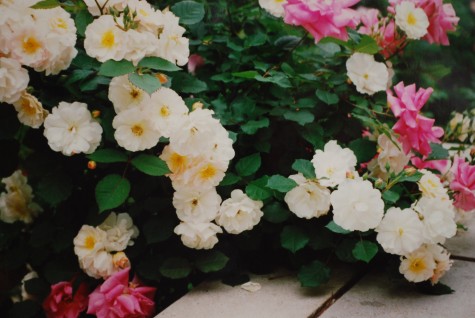
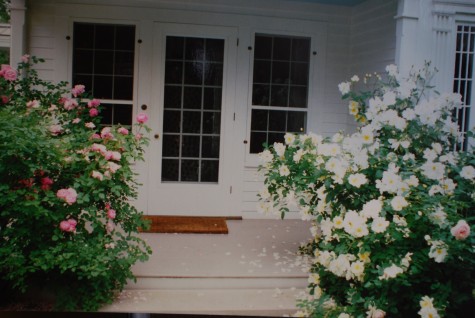
There are those people you meet.  In the course of business.  In the neighborhood.  In the grocery check out line.  They encourage you to be better than you ever thought you could be.  This perfectly describes Susanne.  She lit a fire under me the likes of which happens only rarely.  Some days I would come to plant, armed with hellebore species I had stood on my head to obtain-and she would still be in bed.  I would march right upstairs (I had the run of the house by then) and roust her out.  Years later, her front porch was dwarfed by mature David Austin roses-Mary Rose to the left here, and Heritage, on the right. 

Her rear yard had about 15 feet of flat ground, before the earth dropped precipitously to the Rouge River.  That 15 feet of space-stuffed with roses.  They were lush.  She was lush.  My gardening life had an operatic quality to it, thanks to her.  Her entire property smelled of roses.  We grew roses with perennials.  We grew roses with asparagus, and grasses. We grew roses wherever we could. The we part was important there-the two of us gardened as if we only had 10 minutes to live.

Every walkway, every staircase-redolent with the blossoms, the smell, and the habit of roses.  Not one of them was a tea rose.  I could go over the names and the classifications, but that is not my idea here.  Though we also planted no end of unusual perennials, wildflowers, grasses, trees, espaliers and shrubs, the organizing metaphor of this landscape-for the love of the rose.    

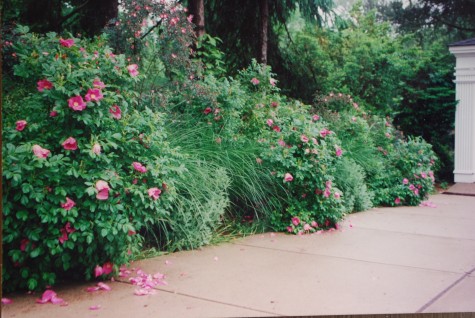
The driveway garden-a mix of Rosa Rugosa Scabrosa, rosa glauca (formerly rosa rubrifolia) miscanthus gracillimus, and artemesia.  Petals on the drive-how I loved this. 

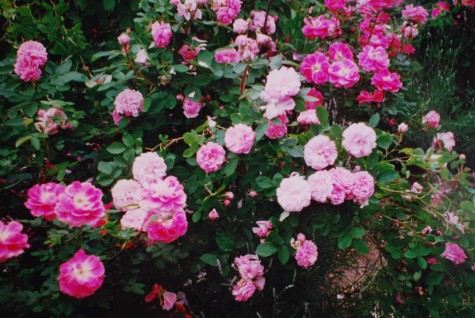
It has been so long ago that I designed and planted this garden, I cannot perfectly recall specific varieties from these old 35mm pictures.  But I do know my knowledge of roses burgeoned.  Susanne wanted to know everything she could about them-from me.  We both learned.

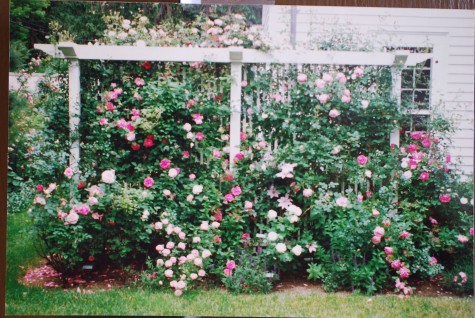
Her architect in Chicago built this rose arbor for her-I planted it.  This picture does little justice to that day some years later when I took this photograph.  Her passion-that’s what I see here.  I forget everything routinely-but I remember this day as if it were yesterday.   


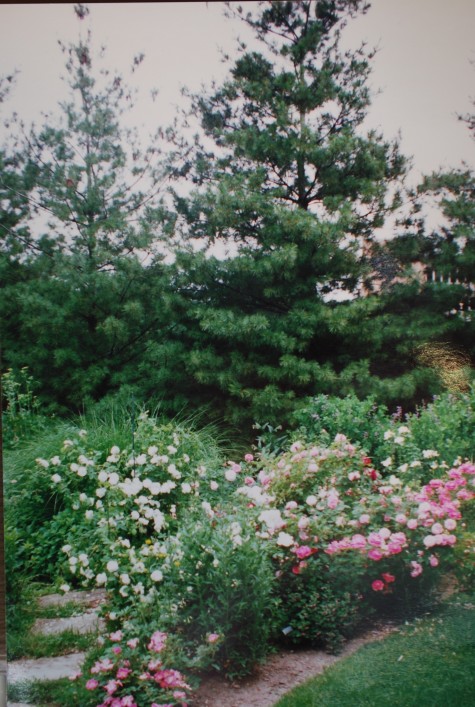
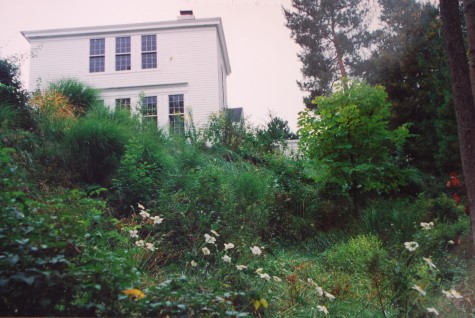
Her home sat on a very small piece of level ground.  The back yard dropped off precipitously to the Rouge River.  I gardened this entire steep slope-species and wild roses, grasses.  Perennials.  Weeds.  The anchoring trees-yellow woods-Cledrastis. This garden on a steep slope about did me in-but it was wildly beautiful.  
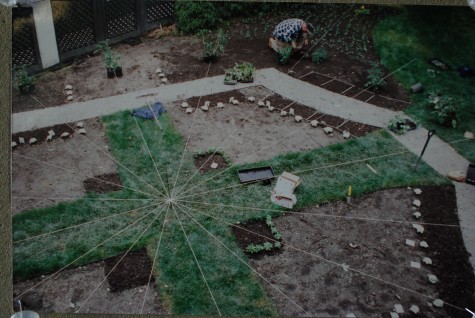

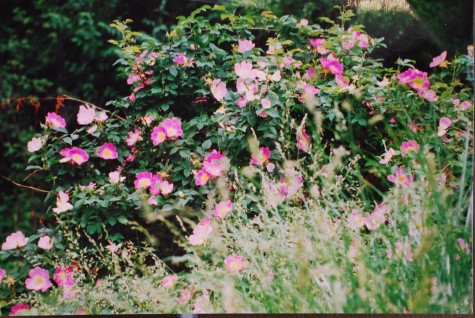
All over that slope-Rosa Complicata. How lucky I was to have met Susanne.  This garden changed my my life.

A Fence Of A Different Sort


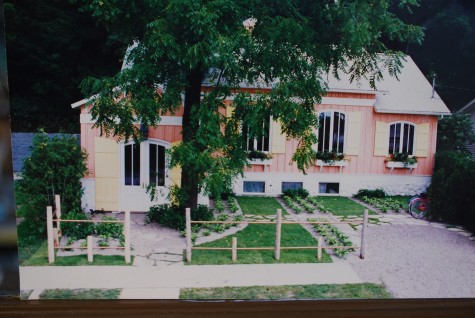
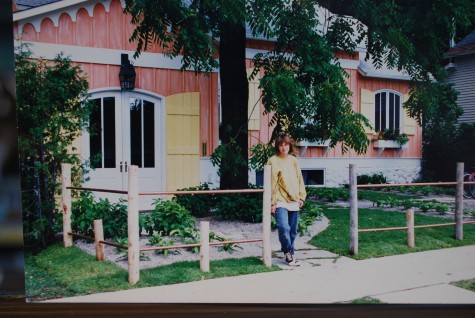
What am I up to here?  Many years ago I installed a fence which was more sculpture than fence for a young client who owned a  second home in Harbor Springs.  Second homes, vacation cottages-they have landscape requirements all their own.  People go to the cottage to have fun, and relax-not work.  The landscape needs to survive and thrive with intermittent care.  I would hate driving up to a landscape that looks neglected.  Lake and woods properties can be easy-whatever nature has seen fit to put there is generally quite beautiful.  But this second home was in a neighborhood in a northern community right on Lake Michigan. Lacking a woodland, or sand, beach grass and water, some kind of landscape was in order. 
      

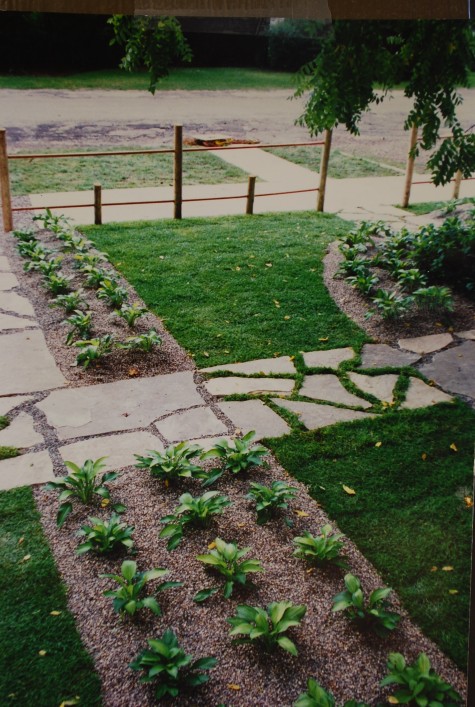
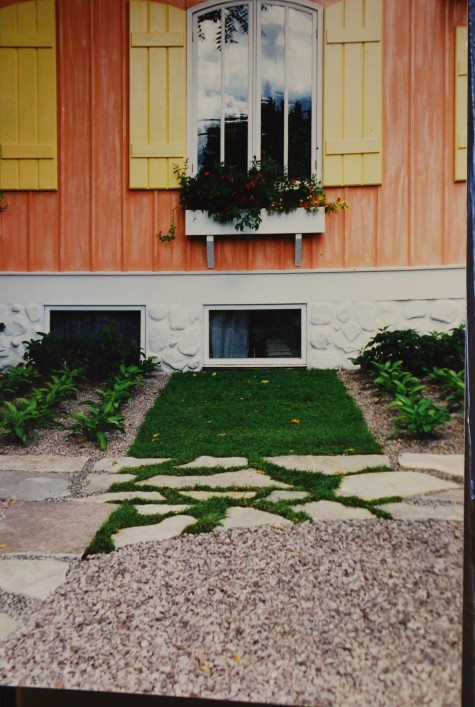
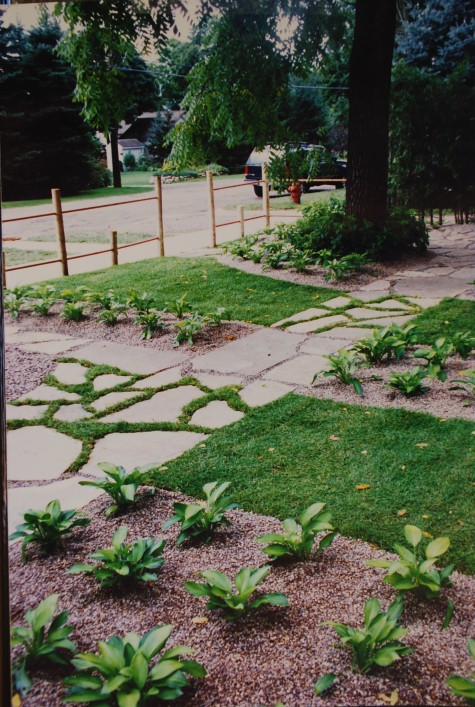
The house was small, and the property very small.   A gravelled car park, and a stone walk across the yard to the front door were the first order of business.  The gravel, grass, and rows Sum and Substance hosta would cover the ground plane with stripes.  My young client happened to be an artist; she was interested in a design with a strongly graphic and whimsical quality. A few Annabelle hydrangea would provide some height and interest during the summer months. 


The large shuttered windows seemed to ask for window boxes.  Both the width and the location of the windows and boxes would dictate the placement and the width of the lawn stripes.  As the boxes were fairly high off the ground, easy access to them with a stepladder would make caring for them all that much easier.  The grass stripes would lead your eye right to the boxes. It is a fairly simple matter to automatically irrigate a window box, if you already have in ground irrigation.  This is not foolproof, but it can buy you some time. 

   
The dry laid flagstone walk which traversed the yard perpendicular to the stripes was set with large joints.  Where the walk crossed over a grass stripe, we put grass between the stones.  Where it crossed a gravel mulched stripe of hostas, we put gravel between the stones.  The size of the joints between stones depends on what kind of traffic you expect to have.  Guests in sneakers would do just fine with such a walk-guests in high heels would need to pay careful attention.    

The property featured a giant walnut; I knew the hostas would tolerate that.  But something seemed missing.  Some element that would strongly reflect the point of view of the owner-something fun. And most of all, something that would not require regular maintenance. So I designed and built a fence- not to screen, nor to keep anything in or out.  A sculpture of a fence, if you will.   

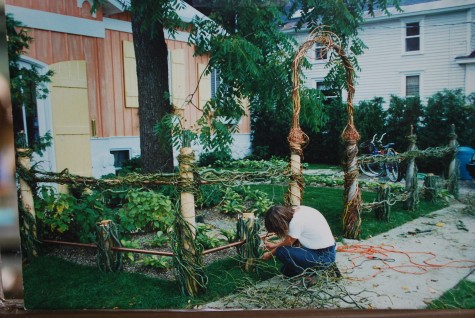
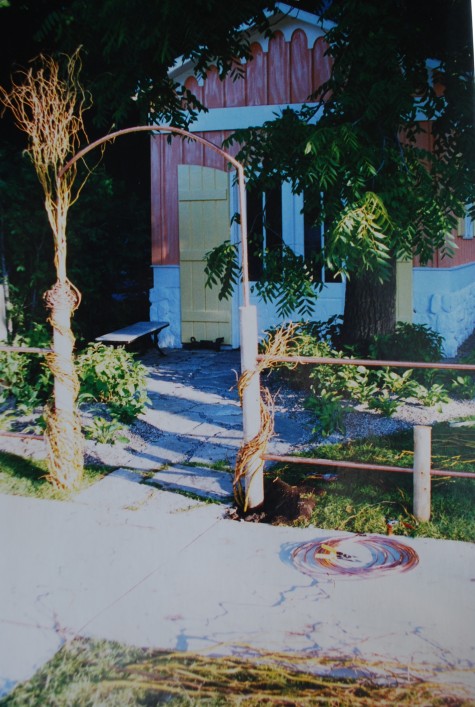
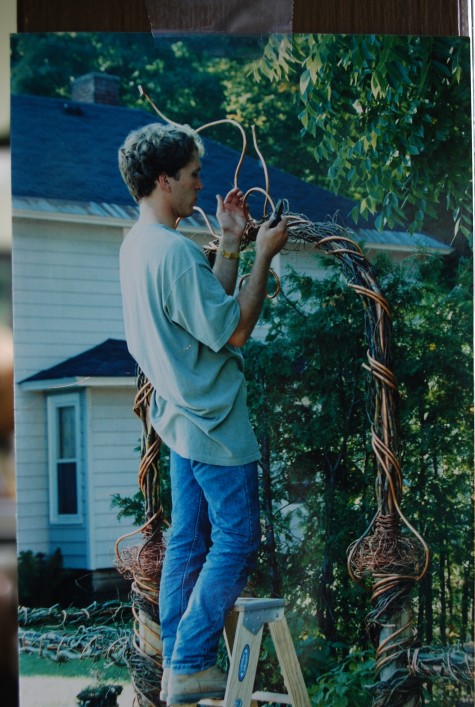
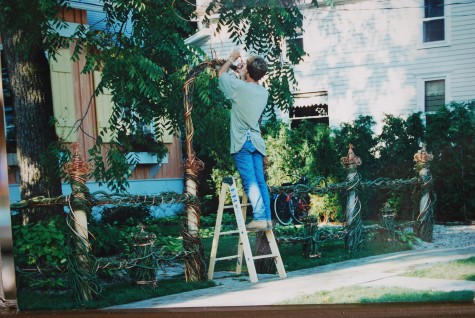
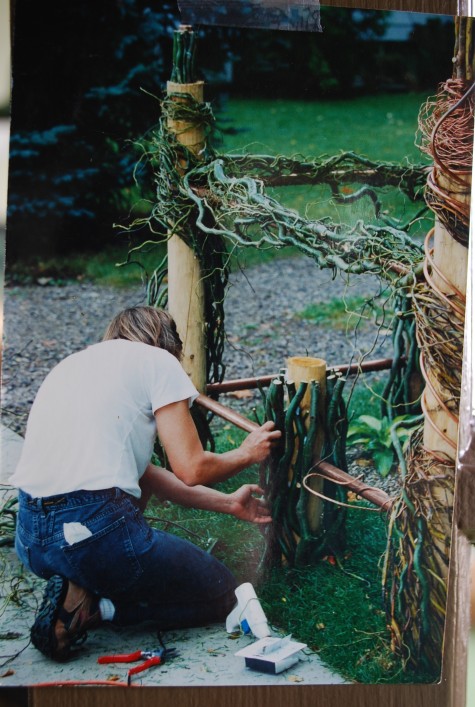
We built the fence with three materials.  Peeled cedar fence poles, available locally, would form the uprights.  Tall posts alternating with short ones would provide interest on several levels.  We drilled through the cedar poles, and used copper plumbing pipe for the horizontals elements, and an arbor that would go over the walk.  Fresh cut curly willow would informally spiral around the posts.  The willow would be held in place with 1/4 inch copper tubing.  The fence post finials-a nest/hairdo of copper wire. 

Rob handled the contruction of the arch.  10 foot long willow pieces were inserted in the ground next to the cedar post, and wound up and aroung that post.  Smaller willow braches were added to the top of the post, and secured with copper tubing.  The flexible tubing repeated the shape of the wire finials, and went on to wrap and secure the willow to the rigid pipe.  As I gave all of the pictures of the finished fence to my client, the shape of the top of the arbor is from memory-I think Rob made an informal fleur de lis to finish.

All of the rigid pipe was covered in curly willow, and secured with copper tubing.  This was not a particularly orderly or repetitive process-we did what we thought looked interesting.  The relationship of the metal to the willow proved to be great visual fun. 

I did hot melt glue the short willow pieces on the low posts, more as a method to hold them in place while the water pipe was wound round, rather than a securing mechanism.  I remember coming by long after finishing the fence-some of the willow stuck in the ground had rooted.  What unexpected fun.  There would be other construction projects featuring willow, but this one was especially satisfying.

Once the fence bones were built, I was ready to go.  Is the fence still there?  It would be about 17 years old now.  I have no plans to go back and look.

The Brush Fence


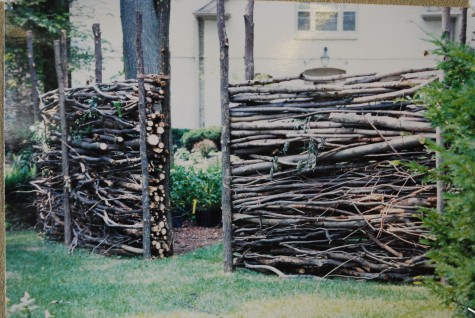
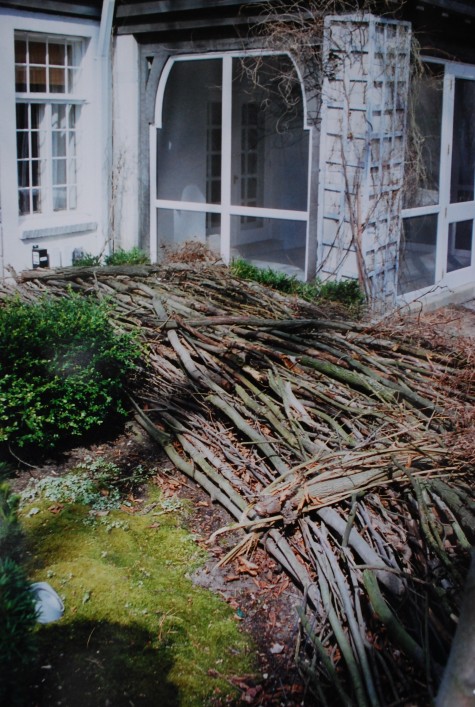
You would laugh if you could see all of the boxes of 35mm pictures that are littering my drawing studio right now.  No matter whatever possessed me to get them down off the shelf, and go through them, I am in that sore tooth phase-I cannot leave them alone.  Thus the posts about my first garden.  Apparently more is to come from those pictures; some projects I still like.  I have a little time to write about them-this March is shaping up to be a winter month, not a transition from winter to spring month. This picture of a brush fence I built many years ago strikes a current chord.  I have had a container of English terra cotta and antiques stuck in England for 6 weeks-over a round of chestnut fencing that US customs does not like.  Chestnut fencing is very common in England-chestnut slats and wire make for a rough and cottage ready, simple fencing that comes in  rolls.  There are panels, and gates, to go with. Chestnut fencing may be a fixture in England, but customs is not happy that I wish to import it to the US.  Why is this?  Standard fumigation techniques have been outlawed, with no substitute put in place.  Suffice it to say that this has been very difficult.  They are worried the fencing has bugs and I want to make available gardening materials from England.  We finally got the fencing heat treated; the container should be in my hands by April 4.   
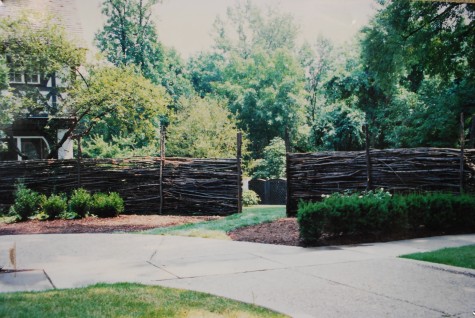
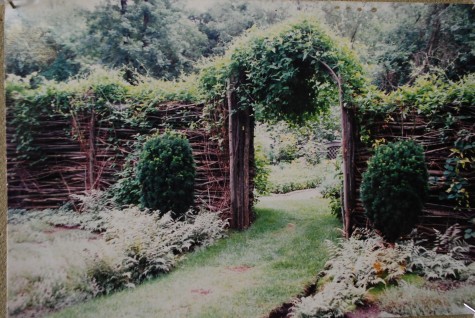
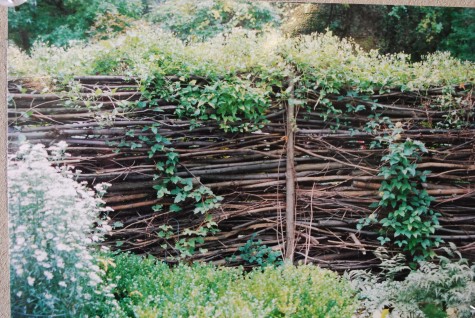
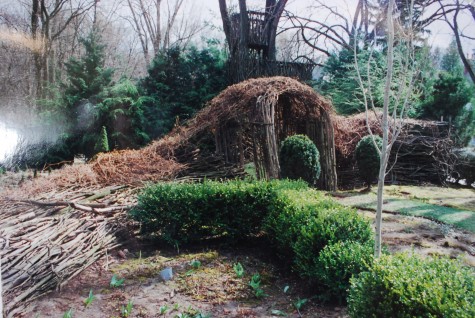
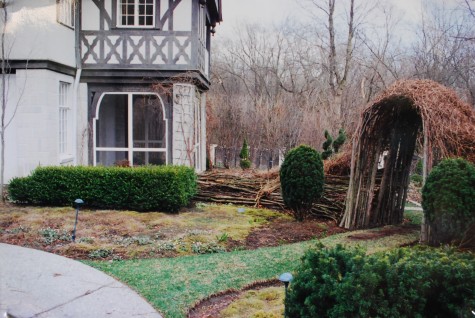
This client lived on a corner. Corner properties have no back yard.  This means no clearly defined front and public space, and back, or private space.  This 1920’s tudor style house made its own architectural demands. My idea-a rough brush fence would define the front landscape, separate from the side and rear.  I still love this fence, though it is long gone.  Thick maple branch posts set at intervals capture good size and very long branches-laid in between; all of the branches were courtesy of Westside Forestry.  The big idea here-a fence can be built from what is due to be discarded.  The bottom branches were laid in between parallel sets of maple poles.  The poles were then wired together with concrete wire to keep them parallel, and the next layer of brush would be laid.  Very low tech.    

 Once the fence was in place, of course I planted sweet autumn clematis.  What better plant to grow over, and soften this structure.  The front gardens got laid out and planted.  Yews trimmed in oval shapes were set square in generous swoops of Japanese painted ferns marked the arbor entrance to the side garden.   

Large flowered clematis hybrids were planted at the base of the brush fence, which eventually was frosted with a single plant of sweet autumn clematis. Trained to grow sideways on the top of the fence, it added considerable height to the fence.   One late winter night, a straight line wind took the fence down.  Looking at this picture today, I remember my shock.   The maple posts snapped.  They were not one bit rotted-that same wind took half of the roof off my building and deposited it in the street.    


Always in a garden-there is trouble.  Plants that do not survive the winter.  Plants that do not survive terrible storms.  Too much water; not enough water.  Plants that do not survive with no reasonable explanation.   Trouble-every garden sees plenty of this. This trouble-terrible.  The timing could not have been better though-it was very early spring.  Nothing else in the garden was damaged.         

 The broken brush fence exposed what I had thought to keep private for my clients.  This turn of events-not much to my liking.  As it turned out, it was a fairly simple matter to repair.    

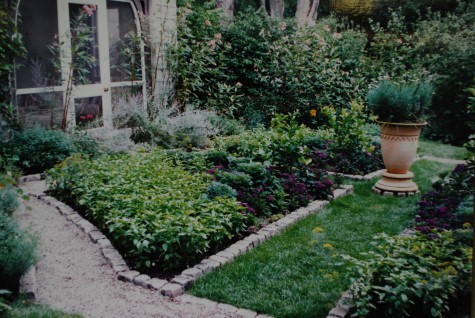
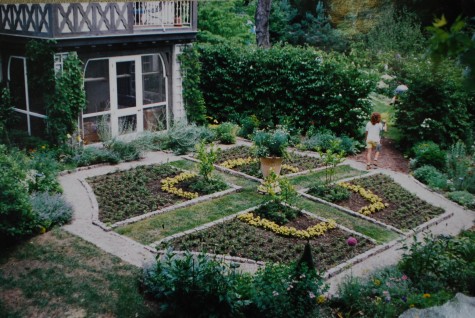
In the side yard, off the sun porch,  a formal herb garden had been under construction.  We were able to go ahead and plant, once spring came.   

A very small formal garden sited off a side porch-this is how it looked, only seconds after it was first planted.  The brush fence that made this space private-we put that fence back up, better than ever.  This sheltered garden was devoted primarily to herbs. The tall hedge you see on the right of this picture-Cornus Kousa.  It was planted in a curve opposite to the curve of brush fence. These features made the side garden very private.  


The herbs, notably basil, had good company.  Heliotrope.  Perovskia.  Marguerite daisies. Granite cobbles, and decomposed granite.  The entrance from the street-a recently rebuilt brush fence.  This garden exists only in these pictures now-the client went on to reconfigure the entire landscape.  Every garden I work in is different than it was 20 years ago-nothing in a garden stands still.