Sunday Opinion: Collecting Plants

Buck and I were out to dinner the other night with friends.  The rather spirited and hotly debated topic of discussion-collecting.  From the dictionary, a collection is a group of objects to be seen, studied, or kept together.  That group could be as little as 2; anyone who owns more than one sports car, garbage disposal or vintage fountain pen is a collector in my book.  Could one not get by with just one of each of these things? If you own one or none of something, you aren’t collecting, you’re just living.  Some collections are entirely utilitarian.  Dress shirts and sports coats, juice glasses, socks, garden books and steak knives-these objects in numbers serve a purpose. A clothes closet, a cutlery drawer, a bookshelf-these are means by which a collection is kept together for ease of use.  Seeds harvested by a grower ia a collection that will be studied; the tomato seeds will be kept with other tomato seeds-maybe they will be tested for viability.  Once the seeds of a given variety are packaged for sale, they may be displayed in a garden center next to packages of other varieties of tomato seeds.  This kind of collection gets studied by the individual gardener.  The gardener that buys seed for twenty different types of tomatoes-that person we might call an afficianado, or connoisseur, chef de cuisine, farmer, or a gardener that particularly values fresh and homegrown food.

Buck is a collector.  He has a collection of vintage accordions-maybe 38, maybe 52.  Many of them he has taken apart, cleaned, and restored.  I am not sure how many he has, as all but 2 are packed away, stored in their cases.  This is a group of objects meant to be seen.  What about displaying 4 of them in every room of the house?  This does not sound good.  They should be kept together-but how?  Displaying a collection is an art in itself. He also collects vintage movie projectors, slide wire potentiometers and other antique instruments used to precisely measure voltage.  Every square inch of the walls of his den are lined with them.  A pair of movie projectors from the 1940’s taller than I, sit on the floor face to face, and occupy one entire wall.  Though not the usual room decor, this loosely related series of machines all from a particular period make a very strong visual statement.  My interests could not be further from this, but I like collections created by an individual, rather than by committee or consensus.

A few years ago, I got him going collecting vintage composition dolls, doll heads, and doll parts.  I always bring a little something back to him if I am travelling-a trip shopping to the Roundtop Antique show in Texas would be no different.  Booth after booth stocked with every imaginable collectible object were set up in giant fields.  An elderly lady had a booth that was entirely devoted to vintage dolls.  She had countless glass jars full of doll parts. Many of these dolls had seen what Buck would call 1000 miles of bad road-dragged through the dirt, left outdoors, an arm missing.   One doll head-a composition head with bleached straw like hair, half of which was gone,  and alarmingly blue and fixed glass eyes – this would be perfect for Buck.  Compelling, and a little scary-he likes this.  But I walked away, thinking I might find something better.  Of course I didn’t-nor could I find my way back to her booth.  I thought about that head on and off all the way home; all I could do was tell him about it. A month or so later, a box of doll heads arrived.  Soon they were arriving every day. He did an installation of quite a few of his collection on a wall-they look great.

Our dinner companions-they are good friends, and avid plant collectors.  He was interested to know what Buck had to say about displaying collections.  He waded right in where I would be reluctant to tread.  When I go out to dinner with friends, I act like a friend.  But Buck doesn’t design gardens-his involvement is strictly on the looking end.  His take- a collection gains visual strength when it is arranged, grouped in a way that makes visual sense. As he is not a horticulturist, he sees overall shapes, colors and arrangements, not rare cultivars, or unusual specimens.  It is one thing to garden with such ability that all of your plants perform and thrive.  It is another thing all together to make them read visually.  I have few clients who garden with such a range of plants even close to theirs.  Conifers of all kinds, rare shrubs and trees,  wildflowers, perennials of every description, tropical plants, roses, bulbs, dahlias-you get the idea .  Their passion is for plants.  I have no problem spotting a small start of a rare jack in the pulpit, or an unusually variegated Japanese maple-but Buck can’t see that.

Making sense of a collection visually means that you enjoy it just as much from a distance as you do up close.  Once my collection of peonies got to 25 cultivars, I knew I had to arrange them in some way.  I could have spread them out, planting a few in each of many perennial areas.  I instead chose to line them out in rows, like crops.  From a distance, the green rows were orderly, and made a big statement.  This arrangement made caring for them easier.  When they were in bloom, the mass of flowers was beautiful.  When I collect one type of plant in depth, I like to keep them together.  I like hedges of peonies, better than individual bursts of peonies.  In my little south side rose garden, I did not plant one climbing rose.  I planted the entire wall with a collection of climbing roses.  I planted a collection of roses of only 3 varieties, that I thought would make a pleasing mass and interesting color contrast.

 When I collect plants that are related by some organizing characteristic-such as dwarf conifers, meadow perennials, rock garden plants, bog plants-a collection such as this is broad, rather than deep.  I would tend to arrange these related plants together, such that the overall shape of the collection makes as big an impact as a mass of one plant.  Naming gardens and spaces helps to make clear what goes in that broadly concieved garden, and what would be lost, or just doesn’t belong there.  I like plant collections that are arranged such that I see what made the garden maker collect them to begin with.  If you are unable to edit your collecting, I am sympathetic. I do not do a very good job of this either.  But I have a very small garden-my limits are clearly defined.  A large piece of property-I would be out of control.   One of the reasons I enjoy gardening for a living is the access I have to garden and plant collections other than my own.
Naming Names


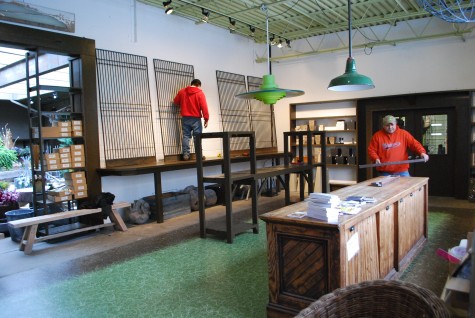
The very best part of the beginning of March?  It is 12 months until it will be the end of February again.  This I like.  Though I have been cooped up inside like lots of other gardeners, I have an interior landscape project of my own invention to occupy some of my jail time.  I truly do enjoy dismantling the entire shop, and putting it back together in some completely different form.  There are many givens, and few variables in my landscape at home.  The shop landscape has lots of new and some old elements.  I can rearrange everything.  The first order of business?  Clean, and repaint.  A change of color in any room can fuel a fresh start.    

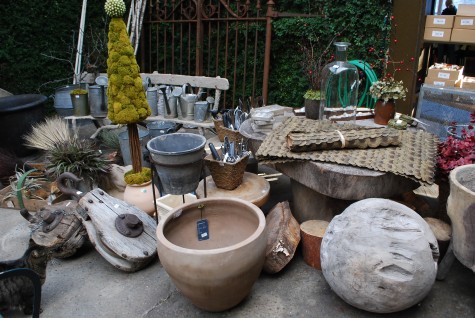
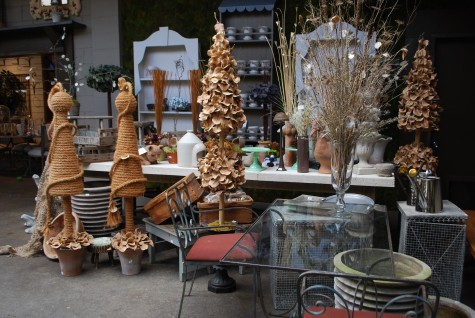
Of course this means moving everything you own out of the way.  This picture is ample evidence of what happens when an organizing idea is not in place.  A random collection of objects is visually disquieting.  Clash was a great band, but clash is not such a great concept for a space.  How do I pick and choose, move, add and rebuild?  First up,  I name my spaces.  In much the same way as the garden of my dreams will have a nuttery, a pond, a wildflower garden, a kitchen garden, a knot garden, the meadow walk, a corgi run, hellebore heaven, and a dining terrace-I name names.  In my house, I have a reliquary (for my cherished relics) a corgi lounge (featuring a giant couch that holds the four of us) and a dressing room.  The names fuel the arrangements.    

Our greenhouse space has had lots of names over the years.  But this spring season, bootcamp for gardeners.  Back to basics simple handmade Italian terra cotta.  Good tools.  Materials as in moss, pot feet, vintage trugs and galvanized steel sinks.  Plainly functional objects and vintage materials have a beauty all their own-how can I arrange them to make this naming  visual?  Once a space gets a name, it is easier to see what belongs-and what needs to be moved somewhere else.      

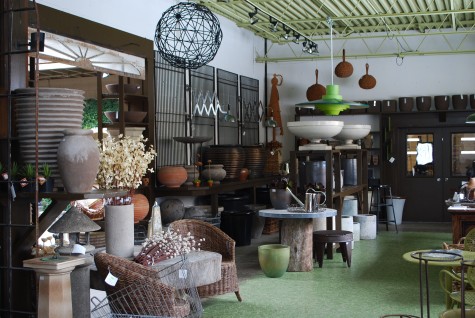
Our front room got a newly painted floor-decidedly more modern than traditional.  A pair of light fixtures-one vintage industrial, and one mid century modern.  The ceiling, painted steel,  is much like the carport my parents had in the fifties;  this part of the building was built in 1947.   What name for the space comes to mind?  The modern garden?  Whatever words I might choose, the naming is a decision that can energize a design. 

This room was easy to furnish.  Every object I looked at either seemed right for the space, or seemed wrong.  I paid no attention to the provenance, or history of an object.  I pay attention to their visual aura.  The three vintage dock bumpers hung in the airspace at the rear of this room-no one would ever characterize them as modern, or contemporary.  But their simple shape and texture, their relationship to the steel sphere in the foreground makes them appropriate for this space. 

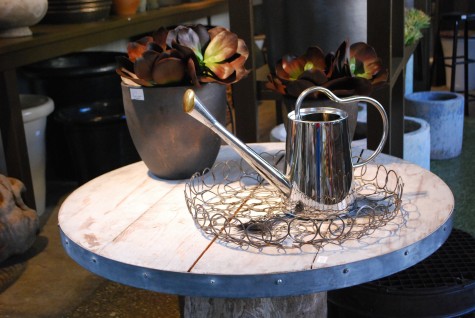
A stump based table with a plank top captured in galvanized metal-I could see this in a modern garden.  A stainless steel watering can-harmonic.  A tray of welded metal  circles echoes and repeats the bronzy glaze and rounded form of a simple pot.  This arrangement of objects makes a cohesive visual statement.   

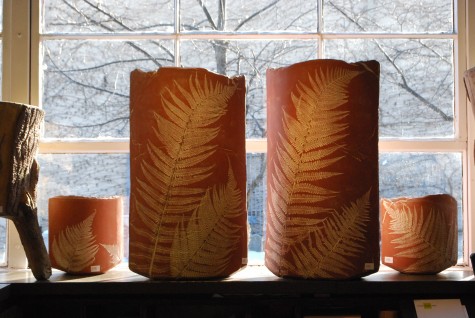
What could be more traditional, or more historic than the footprint of a fern? These contemporary English garden pots are of a shape and detail that describes a fern in a decidedly contemporary language.  The shape and the top edges of these pots-edgy.  How would I plant these?  I need more time with them.  Though they would seem out of place in my garden, I greatly admire them.  They will find a name and a place, I have no doubt.  A spot in the all things modern room-perfect. 

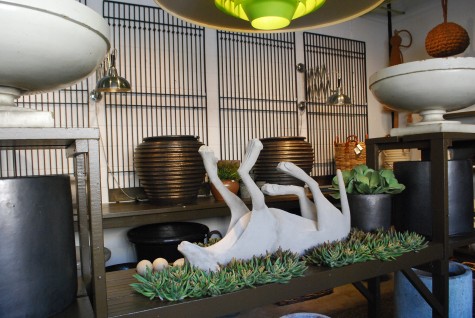
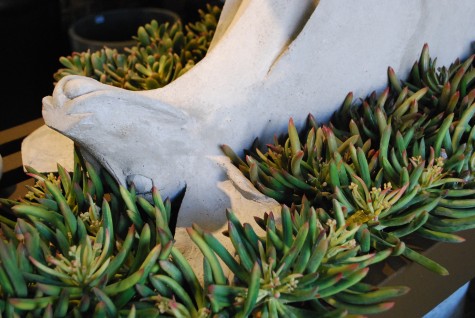
I have a new pack of dogs on the way. Troy, who sculpts these for me, is an old school grower and naturalist.  But his vision of the energy and beauty of a dog is so simple and spare, his sculptures warrant a place in this room. 


Her name is Annie.  Give names to places, spaces, and gardens.  You will know what to do next.

The Sylvan Lake Effect

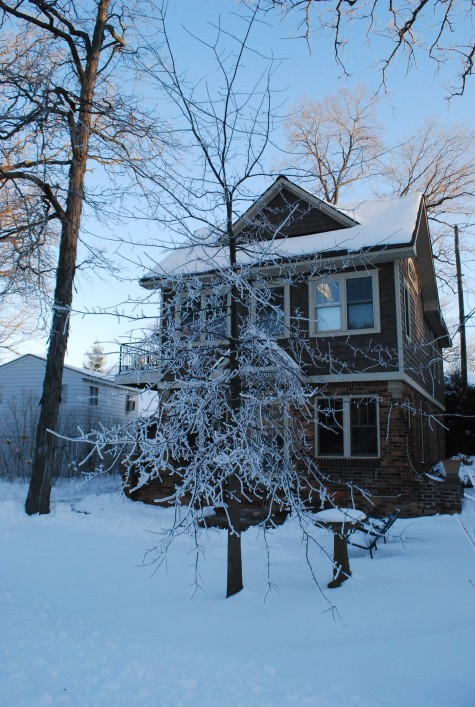
 Rob called me at home early this morning with a weather alert.  A spectacular hoarfrost had built up at his house overnight; in minutes I was on my way.  As a result, I have a much better understanding of why people so prize lake living.  I have had lots of clients with lake properties.  They are an amazingly homogeneous group.  Nothing in the landscape must obstruct even a fraction of the view.  Every element in the landscape must be subordinate to, and in celebration of that view.  Some lake communities have specific ordinances that restrict any obstruction of the view.  Rob has no lake front, but he does have a beautiful lake view.  Lake properties are highly prized and expensive.  Today reminds me why that is.  This morning, the fog hovering over the water and the frost on the lake front trees-spectacular.  I am also seeing why a lake environment demands a very specialized design discussion.   

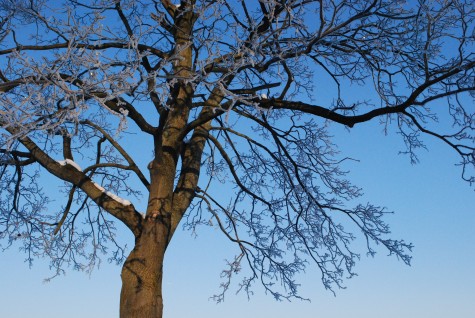
The temperature at 7 am-1 degree. The pin oak in his front yard was clothed in spicules of ice.  I know this sounds creepy, but it was incredibly beautiful.  The bark of the tree was even colder than the air, as it was loosing heat like crazy.  The warmer wet air around those branches condensed on every surface.  A large and lacy coating of ice was a first time in person hoarfrost weather event for me.  

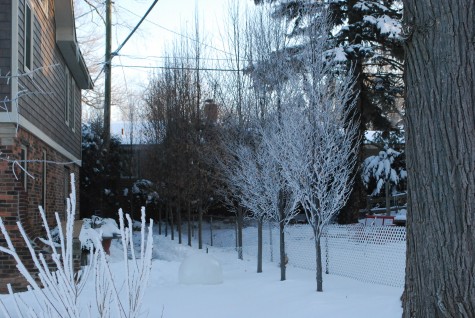
Even the chain link fence was coated in frost. Chain link fence ordinarily reads dark in a landscape, much like a window screen.  Even though most screens are bright galvanized metal, they appear dark, and permit a view through. The pattern of this fence is graphically rendered in white-visually graphic, and new.  How rare to see the dark and delicate branches of trees thickly rendered in white. 

The lake effect-I have a picture.  This hedge of carpinus tells the story.  Those trees open to the lake are covered with frost.  Those trees sheltered by the house have none.  Anyone who designs formally in long runs has lots of issues to consider.  Do the soil, light, or exposure conditions exist equally start to finish?  Maybe not.  The patience to grow hedges level with the horizon, the skill to cultivate them for a uniform effect-a job for a committed gardener.  The variation I see here-I have seen it in countless other forms.  This hedge-challenged by nature.  I would expect to see a different pattern of growth based on the level of exposure to the lake. 

These lilacs in Rob’s yard screen him from his lake front neighbor.  I would be hard pressed to decide if these lilacs in bloom are better looking than this winter rendition.  As much as I dislike the winter, these branches coated with frost were incredibly beautiful.  Beyond the beauty, the wind and weather that comes off a lake can be very tough on plants.    

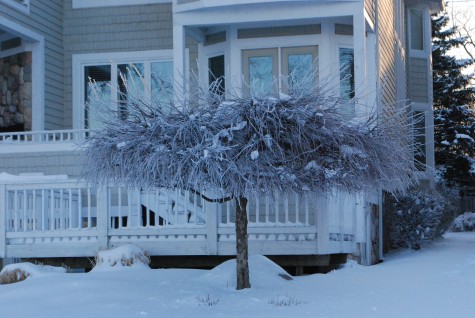
This horizontal and wild thatch of stems on an ornamental tree-enchanting.  Identifying the tree would add nothing to the discussion.  What would add?  In my zone 4-5, the winter appearance of the landscape is equally as important as the summer.  Bare branches and ice have their day-as they did today.  If this tree belonged to me, on this day, I would be delighted.


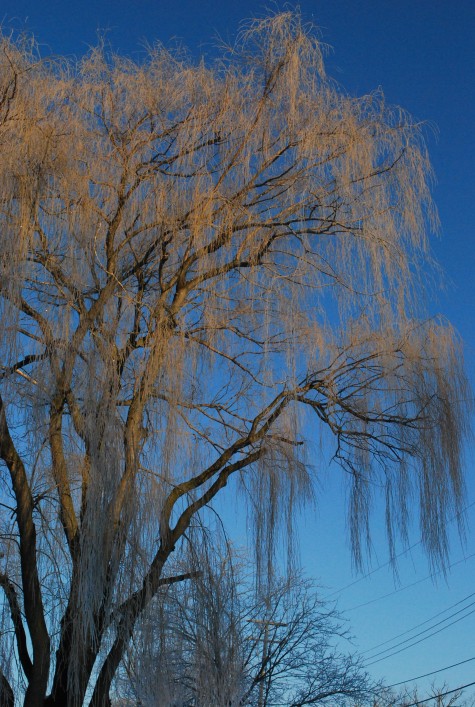
The old willows on Sylvan Lake were much more astonishing than this photograph suggests.  I am sure the stub ends of these giant branches were created in a strong storm. The thin branches were so coated in frost, they just about described the meaning of vertical.  The larger Sylvan Lake view this morning-I understand what it means to have a long and wide view of a natural phenomenon.  The lake effect-substantial.  From my kitchen window, I have an excellent winter urban view of M-59. I have a pair of dogwoods planted just outside these windows for good reason.   

Everywhere and anywhere the sun struck the willows, the frost melted.  These upper branches are yellow, and yellowing up more and more as spring approaches.  The lower branches, frost laden. As much weather as I have been exposed to, a view like this was a first.  


Almost every day of all of the years that I have been a gardener, and a landscape designer, I see something new.  I regularly experience something I neither planned for or anticipated.  How great is this?

Watering Cans

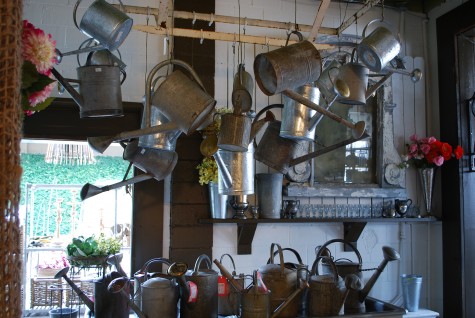
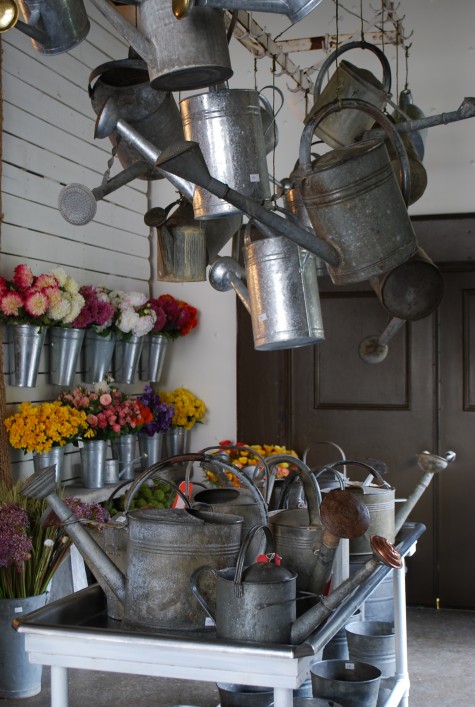
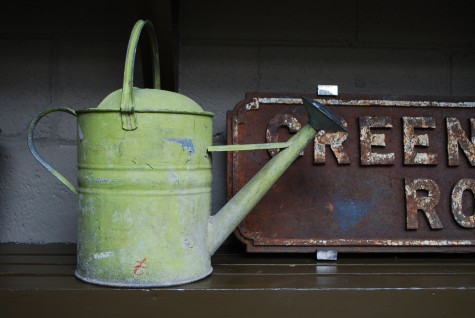
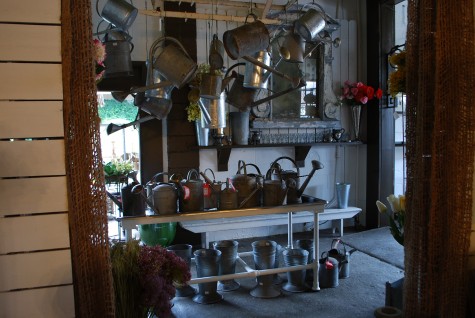
The word icon has broad and diverse meanings. I will not be discussing most of them, as I would be instantly over my head.  But Rob’s collection of vintage watering cans which came off our container first up has me thinking about garden icons.  The transport of water, via a vessel, from a source to a plant in need, defines the first watering cans. Known as watering pots, documentation exists from the 17th century.     

All manner of designs shapes and sizes of watering cans came to be manufactured.  I imagine very early vessels were made of sewn and waterproofed skins-I have no knowledge of the history-this is just my imagination talking. But later versions involved a holding tank, a spout, a handle, and a rose-forged in metal.   

I have no love for watering with a watering cans.  Any metal can that holds and transports enough water to do some good weighs a goodly amount empty.  Should you not know, 2 gallons of water weighs 16.5 pounds.  So add to the weight of the can to the weight of the water.  Five gallons of water weighs somewhere in the neighborhood of 41.5 pounds.  41.5 pounds-this is how much Howard weighs.  Would I want to carry him from the spigot across the deck and down the stairs to my planter box-no.  No. What watering with a can  involves in sheer weight-daunting.   I vastly prefer a great and long hose.  But the cans are a gardening icon-I would not think of doing without some.   

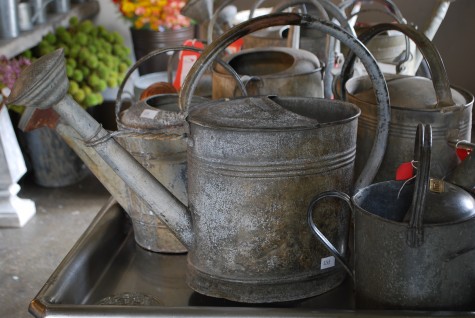
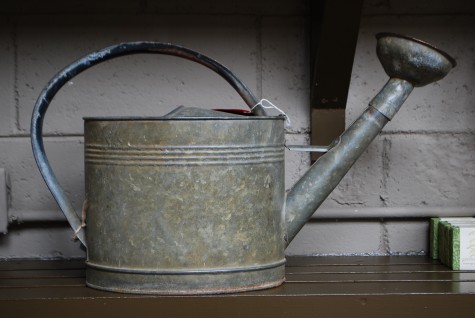
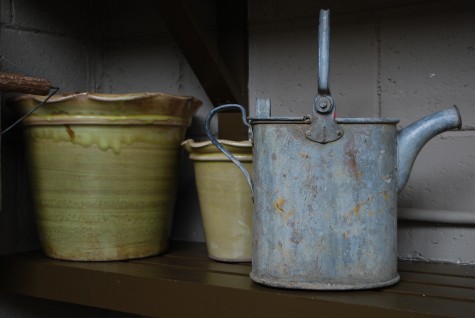
This vintage can sports a handle at the top.  If you have to carry a heavy load, the hnadle in this spot makes good sense.  The handle at the back-a necessity once the work evolved from the carrying phase, to the pouring phase.  This can needs a hand to carry, and a hand to defy gravity, and tip the spout down. Two hands on a tool brings a much greater level of precision to bear. When I try to handle a watering can with one hand, I either miss the mark entirely, or blast the plants out of the soil.  But as much as I hate to carry water, I would have this can.  It is a gardening icon.  What better symbol for a gardener exists, as an invention designed to fit  human hands that permits watering in a time of need.   

There are plenty and varied definitions of gardeners.  Some fancy, some laborious, some silly-some miss the mark entirely.  I cannot pass by a plant in need of water.  This makes me a gardener.  Do I water with a gardening can-not usually.  But I do indeed have one-it is a symbol of my committment.  I like my can, more for its iconography, more than its use.


In the nineteenth century, the Haws watering cans moved the handles from the top, to the back.  Thbis makes one-handed watering a distinct possibility, should you be really strong and able.  That swooping handle may be eminently functional-but take a look -it looks beautifully graceful.  A Haws can-this shape and volume implies moving a lot of water efficiently.

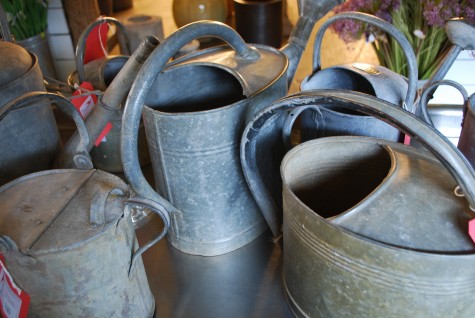
These English vintage cans-each one has the dings and dents and out of round detail that documents their history.  But they still hold water perfectly.  The handle is an invitation to take hold.  Put your hand confidently anywhere on this handle, and water away.     


Some cans-who knows what fluids they meant to disperse.  This very beautiful can holds plenty; the short spout without a rose implies a delivery which is a torrent.  Watering cans are usually outfitted with a rose.  That rose converts a torrent to a sprinkle.  No doubt, I would sprinkle my plants-not blast them out of the soil, given a choice.  I will admit I have a collection of watering cans, none of which I use to carry water.  If I fill one with water, the chances are good I will put cut flowers in it, and think about the garden.