Stuck

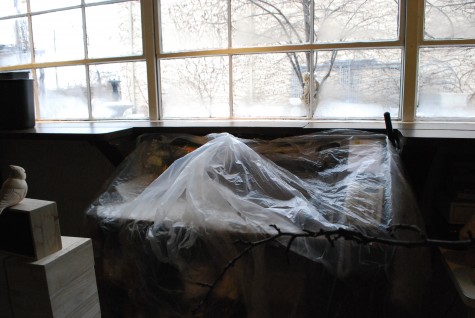
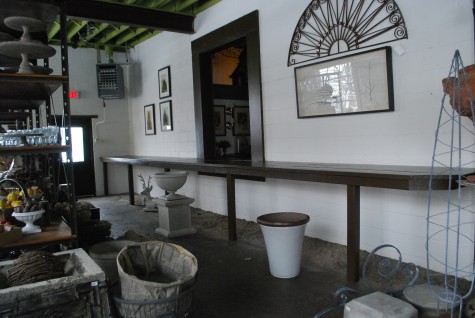
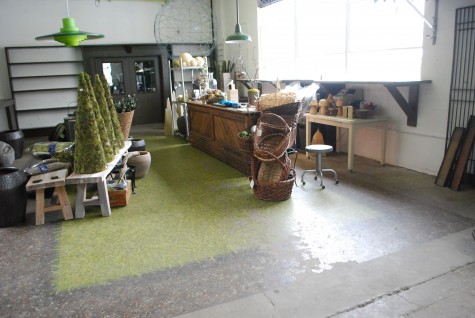
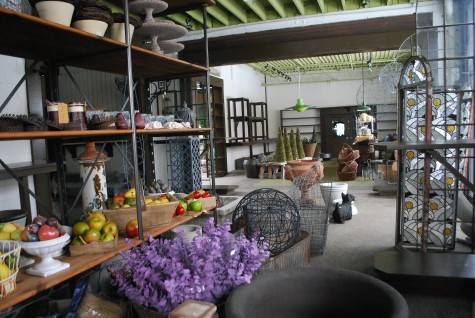
Stuck inside, that is.  The inside story-we are repainting parts of Detroit Garden Works for the spring. Every square inch is torn up, everything is stacked up, on hold, or in storage.  Then what we have has to be introduced to what is on the way for spring. The visit to the Atlanta Mart gave rise to plenty of ideas about display spaces.  I walked through my shop rooms this past week, and tried to imagine what new spaces might look like.  Not one idea surfaces.  A bad cold didn’t help things.  The January weather adds to the inertia that best describes winter; there is a sopping wet and partially frozen dingy grey wool blanket everywhere I look.  Every square foot of our 10,000 square feet will be home to our the spring gardening congress.  I know I need to be ready, but there needs to be a plan first.  All the possibilities and sheer the size of this place means I have less time that I think to get it thought out.  It is just hard to shake off that longing for another time and another place-like my garden in the spring or summer or fall- and get going.  This makes for a design headache. 
We have 2 containers coming from the Europe, the first of which is scheduled to make Montreal February 4.  What happens next is anyone’s guess. Should that part of Canada see a snow storm the likes of which invaded New York City a few days ago, the railway will be shut down, or keep traffic moving at a crawl.  A 2 day trip from Montreal might take 10 days.  We have a customs broker who attends to the process of our container being cleared for entrance into the US.  That process is a good deal more stringent and time consuming today than 10 years ago.  I have no earthly idea what day that semi will pull in with that container on board.  It could be days-it could be more time than I bargained for.
 

If you are a gardener, you get design headaches too, particular to the winter months.  The process of deciding what trees, shrubs, perennials, groundcovers, annuals, tropicals, vegetables, herbs you are crazy for-easy.  What we all  have a mind to grow next season-easy. Every tomato under the sun looks good right about now.  What we plan to change, renovate, turn around and rethink-easy.  Putting all of this together in a coherent scheme-a design headache. Beautiful meadows-there are many that are nature driven and naturally maintained.  They tend to be really big spaces-much bigger than my yard.  When nature has an idea, she expresses it on a really big scale.    A mini meadow requires such thoughtful design-there’s simply no room for mucking about with obviously unresolved areas.  Full scheme ahead.
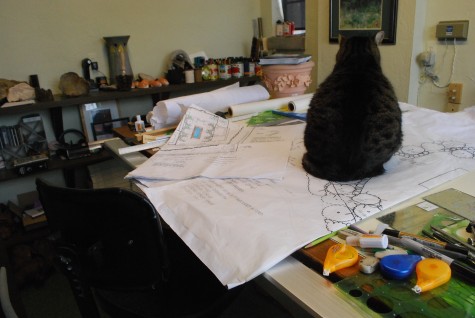
On my small property, in my small business, I do not have unlimited space and time.  I need to pick and choose which statements I wish to make, and then decide how to make them.  This means my gardening broadcasts need a lot of distillation, and fast.  The Mart in Atlanta-so many things in one place.  Making sense of it all-big work that is still going on.  One finite space, one small voice-looking to organize and energize a collection.  Seed catalogues, tools, nursery stock availability lists, annuals, pots and benches for spring-there is plenty to to see, read and absorb.  There is also the matter of the stack of site plans on my drafting table-projects which need design time before spring. 
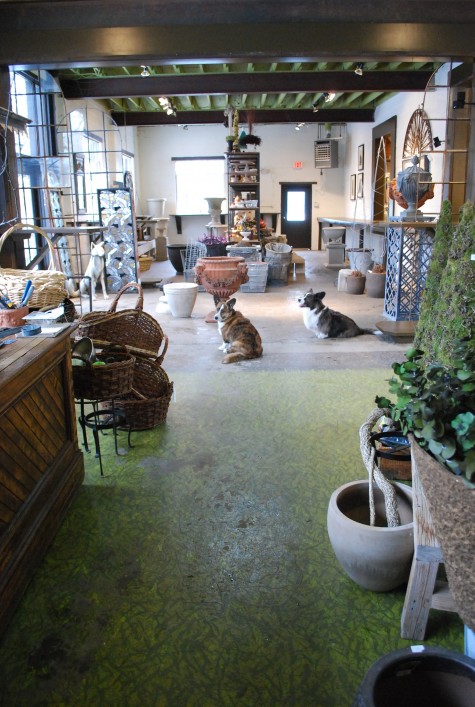
  

   Customers straggle to my door-we are happy to let the garden-starved in, but we do not provide that much comfort. The shop is just about 55 degrees. The most lively thing going on is the dogs barking.  The January doldrums have set in.  The shop is in so many fragments, waiting for an organizing metaphor.  In spite of my headache,  I like these days when every room is taken down to its bare bones, and the thought of putting it all back together scares me.  It means I have work to do that I like.
  Sorry to say this, but we northern gardeners have the entire month of February, and perhaps into March to go before there is any hint of spring.  Not so good for you-not so great for me either.  I so miss my garden.  But for the shop, the deconstruction is good.  It means our spring will be a fresh.     If there ever was a time for a big idea, this is it.  I feel sure that if I look long enough, I’ll spot one.
Madame Nature, I’ll be ready when you are.

A Hot Spot For Cool Plants

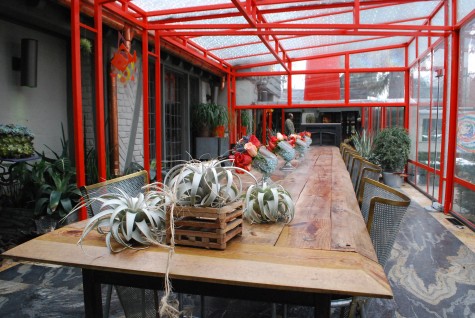
I have a client with a vision that defies description.  Her vision well may be, is no doubt, visionary.  I have a history with her that spans quite a few years, but I am never ready for what might come next with her.  I have seen her collect the most amazing and esoteric objects-for both inside and out-and gone on to see her put it all together in a way that never crossed my mind.   A few years ago she had the idea to roof a rear terrace.  I was not prepared for a steel structure painted orange, and a dichroic glass roof.  As I have since learned, dichroic glass is layered with metal oxides.  Thus the sparkles that make for a little shade.  Dichroic glass-very reflective.  The roof, in no way symmetrical, in no way expected. 

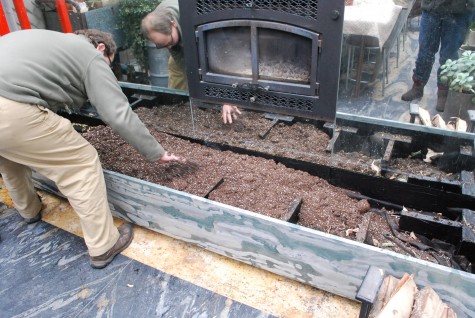
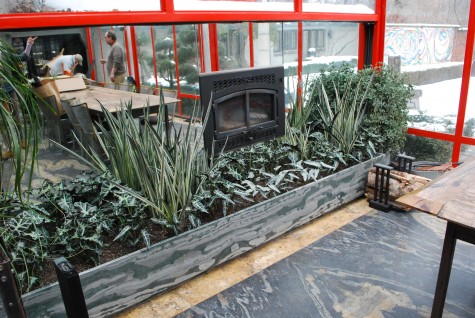
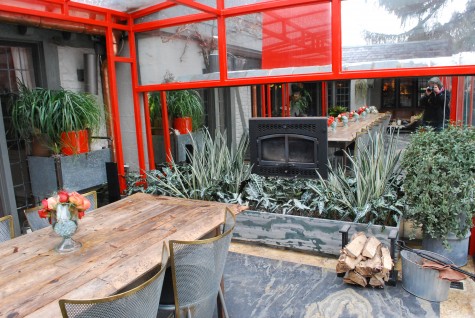
It did not take long for her to have the idea to enclose the terrace with a roof space with glass walls. A conservatory, if you please. The upshot-a conservatory of the most un-conservatory sort you can imagine. New this winter-integral planter boxes made of marble.  A very visually active and sassy marble.  I went shopping for the plants.  Whenever anyone says home greenhouse to me, I cringe.  A working greenhouse is just that-lots and lots of work.  Professionals manage this with a steely dedication.  Most home greenhouses I have seen are neglected affairs.  The remains of holiday pointsettias stashed under the bench.  Struggling tropical plants.  I would not recommend them to a home enthusiast, unless they promise to live in that space.  Places you live in have a whole different feeling than places you visit.  My basement is a good example. This conservatory space-a space in which to live.  

The orange steel structure, and the marble floor-what plants would I choose? The dichroic glass makes for more shade than you would think.  A collection of black and silver alocasias-Black Velvet, Silver Arrow, and the very rare Alocasia Tigrina Superba seemed like a good idea.  They are a supporting cast to a particularly beautiful sanseveria-Bantel’s Sensation.  Sensational, indeed.  Grey, green and black-much like the marble, and the cast iron fireplace. 

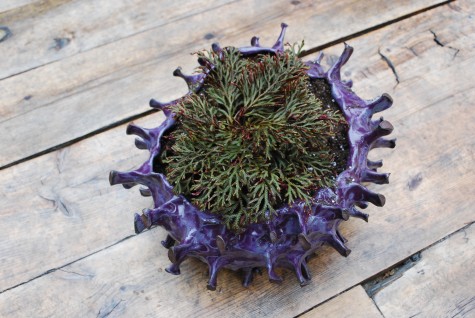
A fabulous purple glazed sea urchin shaped pot from my client looks all the better for a planting of Selaginella “Ruby Red”.  Please note, It was not so easy to choose a plant for this partcular container. I have planted no end of green and lime selaginellas in pots-this variety is new to me.  I am falling for it-hard.  Little pots demand little growing plants.  Some horticultural relationships are about the idea of an equality of contributon.   As growing things never are at rest, a sensible start-little for little- makes for a reasonable approximation of equilibrium.  This is a fancy way of saying, match your plants to their environment, and watch what will come of it.       

My clients lives in the space-any chance they get. This entirely accounts for how compelling and lively a living space it is.  She has created an environment that is warm, provocative, and compelling.  I have been here to dinner on occasion-the room, the food, the music, and the conversation-magical.  Even with the winter light, there is a sense of life that makes for liftoff.  Some of the most interesting conversations I have ever had happened in this room.  Make of this what you will.  

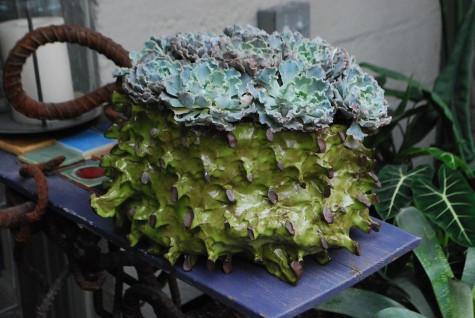
A second, and larger glazed sea urchin pot-I planted it solid with Escheveria Shaviana. Is this not a a happy relationship?  The color relationships and similar textures-very happy.  How do gardeners shop for plants?  For the flowers?  For the habit of the plant?  For the hardiness?  The designer in me shops for the visual relationships.  My background in the science of horticulture saves me from foolish choices most of the time-but not all of the time.  

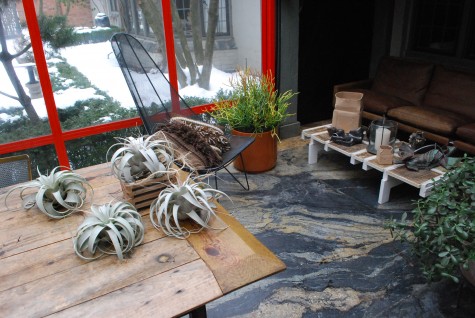
Tillandsia Xerographica is a plant I had never seen before. They are strikingly silver grey.   Before trying to plant this extraordinary space, I would not have given them a moment’s notice.  This space-they belong.  Tillandsias are bromeliads.  They are commonly referred to as air plants.  A plant you can lay on the table, which will thrive with a generous misting twice a week-astonishing.  

This space is incredibly beautiful-my pictures do it no justice.  It is unlike how I think.  It is unlike what I usually see.  My client- she is a visionary girl.

Unexpected Company

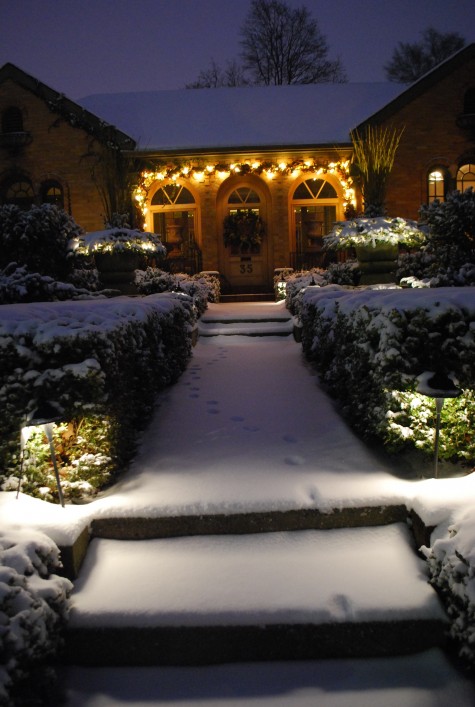
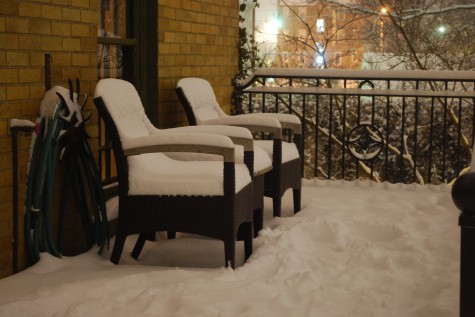
Some winter weather-not so much worth talking about.  Michigan can be grey and unchanged, day after day, week after week.  This winter we are seeing plenty of activity.  Not the snow sort that has the east coast barely operating in first gear, or the unexpected snow, ice and cold that has the south in its grip-but active winter weather nonetheless.  I have lost count how many snow storms we have had, but yesterday’s was significant.  Significantly beautiful.  Driving by the front walk last night, I could see the prints from an unexpected visitor.  

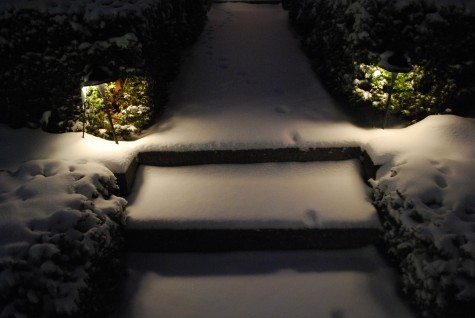
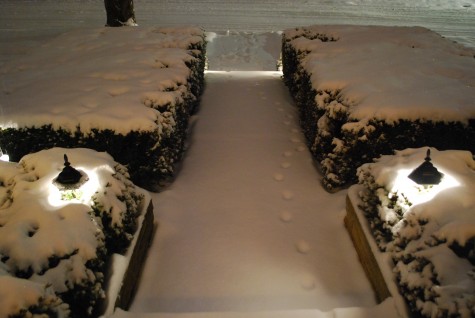
I could see those prints, as I have lights in the landscape.  Path lights are a must; there are stairs to climb to my front door.  An older friend fell into the boxwood a few years ago, taking her husband with her.  Though I was horrified, they laid over the boxwood, laughing.  Needless to say, I saw to getting that walkway lit.  Tonight,here are big spaces between these two tiny snowprints-who came calling?

My holiday lighting-I can not bear to turn it off. By the time I get home now, it is dark.  I like seeing the lights on inside, and the lights on outside.  The night lighted is a comfort to me.  This snowfall was particularly beautiful; I came up the back stairs with the idea to take some pictures.  I persuaded Buck to haul my tripod to the car, and drive me around the block to the front door.  It took a little time to explain that I did not want to ruin my snow with my bootprints, and fix him a vodka on the rocks. He agreed to go along. This is my idea of a night out, camera and tripod in tow, I photographed the footprints of my unexpected company. 

Once I was done outside, Buck obligingly drove me home. Around the corner to the driveway, that is.  You would think I had documented an event of great importance. He rolled his eyes.  Apparently the garden has lots of visitors; only in the winter are there prints.  Buck tells me the yard is a way station for all sorts of creatures.  One neighborhood cat traverses the top of our fence almost every day. I ventured out the front door,careful to keep the legs of the tripod out of view.  Unmistakeable, signs of a visitor meandering up the walk.    

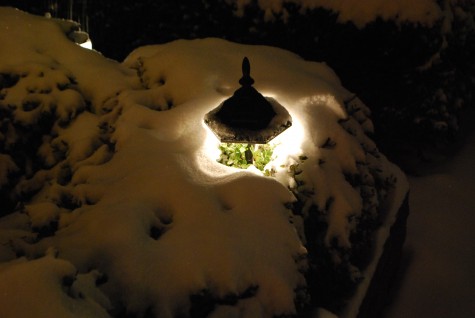
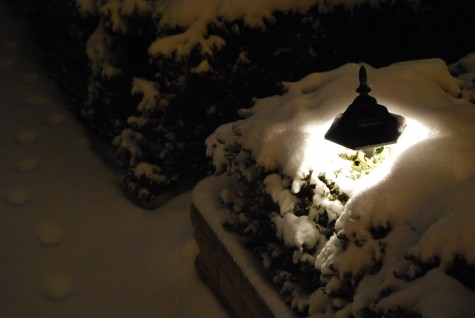
I was easily able to track the prints in the snow, courtesy of the landscape lighting. Make no mistake, my outdoor lighting would win no awards.  I know not so much about it, and the catalogues of fixtures exhaust me.  I refer my clients to a lighting designer and contractor whose work I like. Kevin came and lit my front walk, and my driveway at my request. On my mind last night was an idea to get much more involved in lighting-especially for winter.   My path lights need something in the way of a riser; the boxwood have grown.  Nonetheless, the now too short fixture made for a pool of bright light that dramatically changed the night view of my garden in winter.


The path lights in the background of this picture illuminate the first flight of steps up to my front door with an intense and focused light. The city street light illuminates the dark softly; this light is high off the ground.  My four footed visitor had little problem coming up the stairs. This picture has me thinking about how complicated a lighting scheme can be-in the absence of the sun.

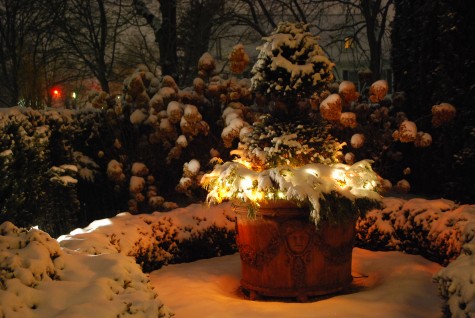
The lighting in this container has never looked better than it did last night.  This snowfall-incredibly beautiful.  The snow collecting on the hydrangeas and boxwood-I would have never seen this, but for the lights in the landscape. 


I do not so much love the winter.  But there are those times that what I see makes me grateful I have it.  I have a little yard in a city.  No views to an ocean.  No mountains. No property to speak of. But last night, courtesy of the light, it was truly enchanting.

Objet Trouve

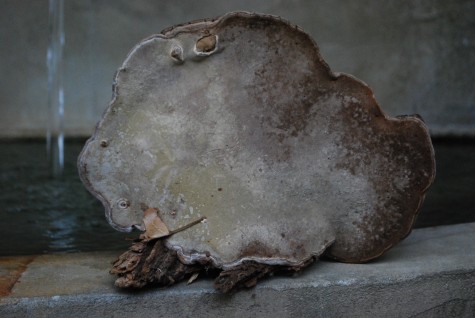
Correct me if I am wrong Delphine, but I believe the French phrase “objet trouve” translates literally as found art.  Any ordinary object, prized in some way for its aesthetic qualities, qualifies.  as art, that is.  I have questions.  Are there are rules about what constitutes art?  I am instantly over my head here.  Question 2-if there is art that is found, who does the finding?  Is part of the art in the finding?  These questions I can warm up to.  I go to a museum, expecting to find art.  A museum provides a home for art treasured by the greater community, yes?  Generations of museum directors, curators, artists, art historians and museum boards presumably recognize art and fund acquisitions.  In this instance, I am a viewer, not a finder.  I will admit I see some works in museums or galleries that I would not identify as art, except for their address.  This might be ignorance, or it might be that the eye of the beholder counts for something. This particular bracket fungus has been with me at least 30 years.  It means something to my eye.  The shape, the mass, the line, the color-everything about it engages me.  It is beautiful.  It is also the fruiting body of a deadly fungus.  I am a gardener-I think about life, death, and second chances every day.  This bracket fungus is by no means a Degas sculpture; it is an objet trouve.  I am the finder. 


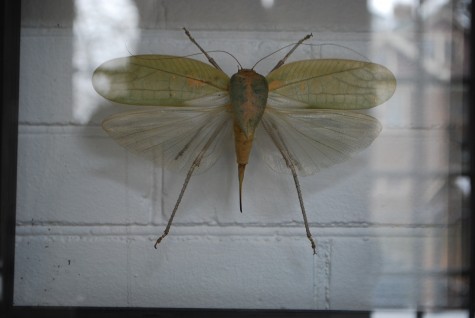
I do collect bugs. Big bugs from Indonesia, Malaysia, wherever-suffice it to say any jewel of a bug will catch my eye.  My bugs-I buy them mounted and framed. Someone else was a finder.  This bug-its size is astonishing. Not the kind of thing I would want to run across in my garden or closet, but behind glass, I can appreciate it.  The substantial body sustains four wings, and a pair of really long legs.  The artist of record here-nature.  There are those of us who would frame mounts of what objet trouve nature has to offer; I am one of those.  

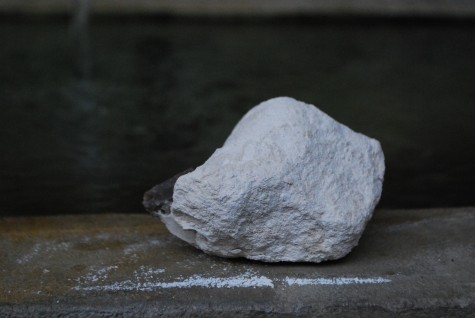
This rock, take my word for it-an objet trouve. This is not just any ordinary white rock; the history is as follows.  This is a chalk rock, from the white cliffs of Dover.  Dover, England.  So many years ago, on an early shopping trip for Detroit Garden Works, Rob found himself on those cliffs.  He pocketed this rock for me, and brought it home.  An English chalk rock with a flint toe that he collected on my behalf-an objet trouve.  It is an object from a place I have never been.  It smells like the ocean.  It was meant for me; I had a part in this trip, but not a presence.  I will admit I chalked the concrete surface it sits on before I photographed it.       


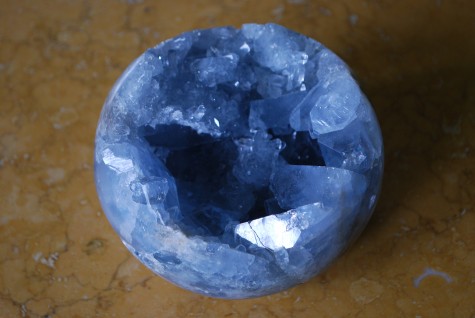
The minerals of the world are can be very flashy and exotic looking, once they are cut and or polished.  Someone had the idea to treat this rock as something very special.  It has been cut in a spherical shape, and the interior surfaces are exposed and polished.  It is gallery ready-the gallery at my house, that is.    

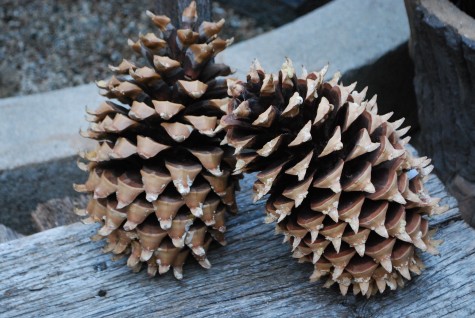
The coulter pine produces some of the largest pinecones in the world.  This pair of cones are 12 inches tall, and weigh 3 pounds each.  The woody scales are enormous, and impenetrable to a a knife or a screwdriver.  The seeds of this pine are indeed well protected.  The ends of the scales are sharp, and coated in congealed pine pitch.  They are hefty and very handsome objects.�
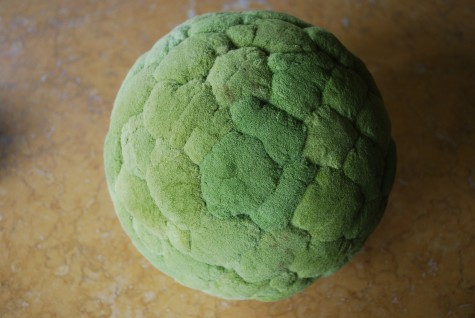
Cattails can be found in any and every marshy place near me.  I have collected them plenty of times for a fall arrangement.  Someone had the idea to cut them in sections, affix them to a sphere shape, and dye them; they did the finding.  Once they determined that a cattail was an object of aesthetic interest, they transformed it in such a way that this particular idea of beautiful is clear to me. 

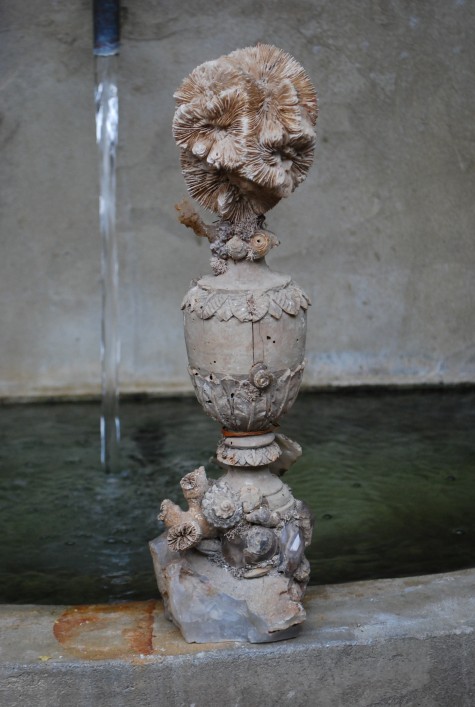
This very old Italian wood fragment was the beginning of a sculpture which includes a stone base, shells,and a finial of fossil coral. When I first saw it, I thought the wood fragment had gone down with a ship, and been preserved in some primordial mud.  Not so.  The objet trouve is the introductory and organizing shape for the sculpture that came later.

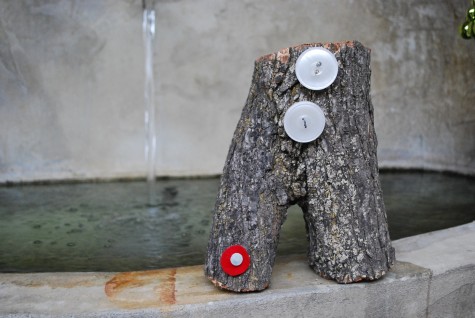
Jenny made me this sculpture for Christmas.  Clearly, it is a pair of pants.  This forked limb had some quality that attracted and interested her.  The resulting sculpture makes that clear.  I like it for what it was; I like much better what it has become, given her sculpting.   

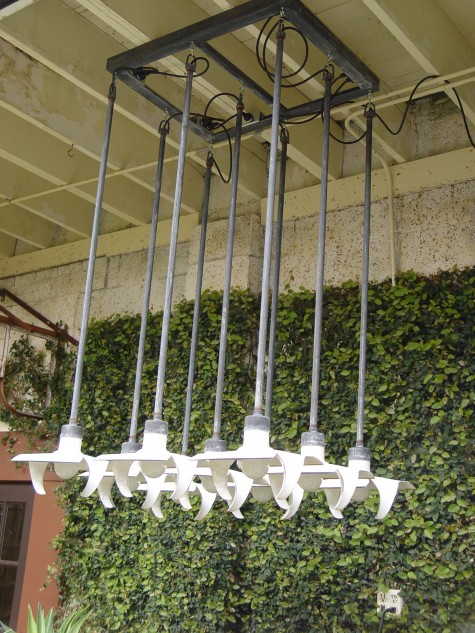
These white porcelain objects are lights from an English dairy farm.  I have no idea why they have this shape.  I am sure it was not a matter of what the cows or the farmer would find pleasing.  It is the special visual gift of utilitarian objects that they are designed simply to function properly and efficiently.   Buck arranged 9 of these lights in a grid.  A light fixture from found objects.  


Found objects have their place in a landscape, or a garden.  A landscape and a garden can provide no end of objet trouve.  I so like a street that goes both ways.