Placing Trees

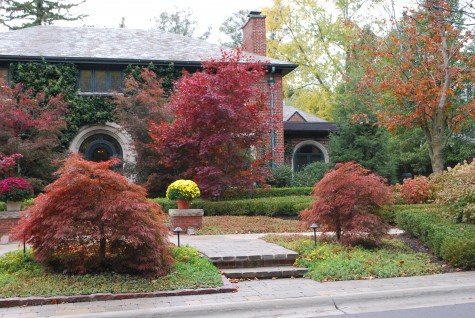
Some time ago I voiced the opinion that I was not a big fan of Japanese maples.  I heard back about that in spades. So yes, I will concede that they are beautiful trees with enchanting habit and great bark and leaf color.  But they can be very tough to place beautifully in a landscape.  The red leaved varieties are striking in appearance.  The flip side of striking?  Visually demanding.  A specimen tree is just this-a stand alone special element around which an entire space may be organized.   
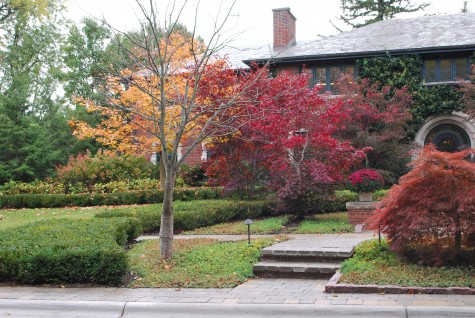
A beautiful specimen tree asks for a placement that reinforces this idea.  If the idea is to feature a particular plant, other elements in the landscape need to take a supporting role.  Of course landscapes can be organized around a series of spaces or rooms, each with their own diva.  In my own landscape, my trees are either hedged, or planted in drifts, as the divas of my landscape are ornaments.  A fountain pool and groups of pots are focal points.  This is by no means the best way to design a landscape.  This is merely what I like.     
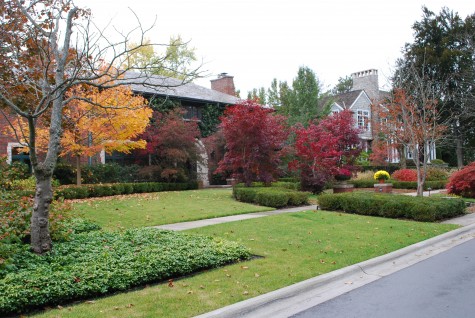
This front yard landscape was home to 9 Japanese maples, representing 5 different cultivars.  When I first saw it last October, some of the maples had black-red leaves.  Some had brown-red leaves.  Others were more clearly red.  In addition, there was a lovely sugar maple, showing yellow fall color in this picture, and 5 additional shade trees.  This made for 15 trees total in the front yard.  Some trees were in poor condition.     
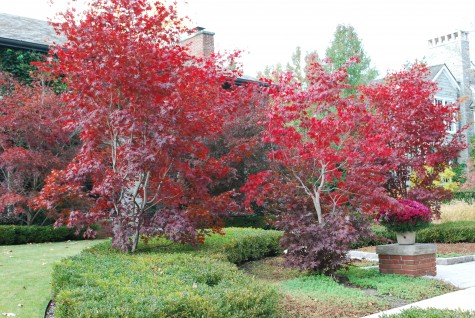
Landscapes in urban neighborhoods are tough to design. They require a judicious hand, and a willingness to edit.  Every landscape gesture needs to be informed by that scarcity of space.  A landscape also needs to work in close concert with that dominant element-the home.  A landscape that respects the architecture will read coherently. There are many voices here struggling to be heard.
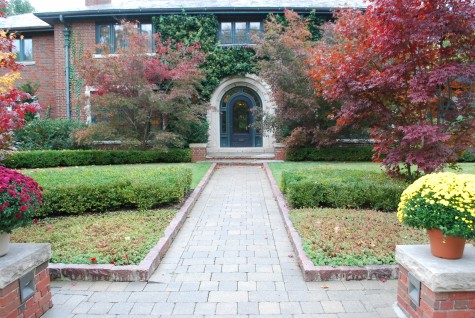
Of course it is easier to see years later how a placement of trees might be wanting.  Hindsight is 20-20.  Imagining the space a tree will occupy at maturity is an art; the best practioner I knew is this regard was Al Goldner.  He fearlessly placed trees in anticipation of what they might become 20 years later-even if the landscape looked too sparse and almost undone to begin with.     
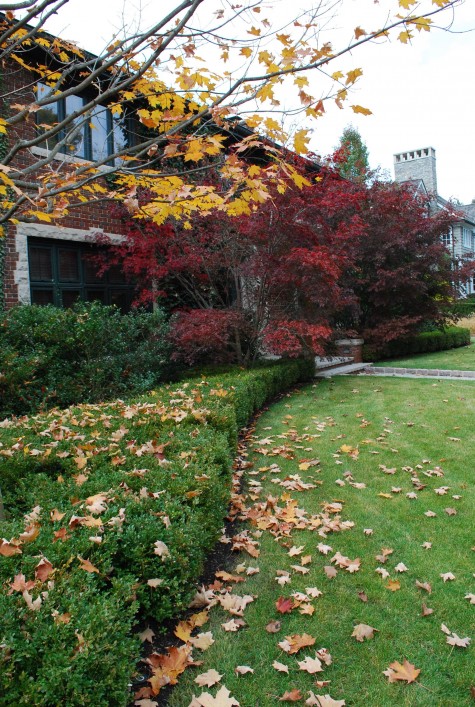
Trees planted very close to the foundation of the house may be lovely the day they go in.  Years later, they can obstruct any view of the architecture they meant originally to celebrate.  It is equally as important to consider the views out from within as it is those views from the street.  Several rooms inside are dark, as the windows are covered by branches of the trees.  These branches are equally obstructing the views out into the landscape.  
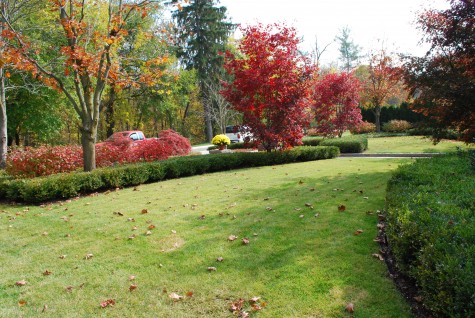
Every landscape has a foreground, a mid ground, and a background space.  Those spaces need to work, no matter the angle of the view.  The Japanese maples might have presented a completely different appearance, had they been pruned differently.  Each had foliage to the ground.  They read visually as giant red shrubs, not small trees with interesting branching, and an airy appearance.  Maintenance is a very important part of a landscape.
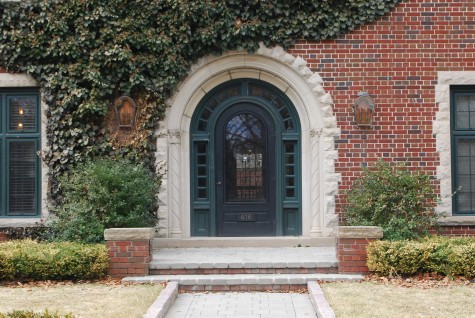
Once the trees were gone, other elements emerged.  A pair of hollies on either side of the front door grew at different rates, and generally suffered from trees planted over them. The boxwood had declined as well.  They have damage from leaf miners; perhaps they were pruned too late in the fall.  There is some work ahead restoring them to good health.   
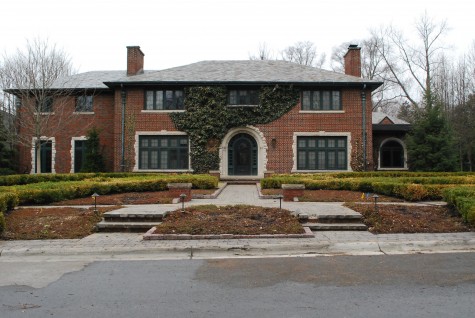

The beautiful sugar maple, and the hemlocks flanking each end of the house are appropriate and friendly to the architecture.  We moved a lot of plants yesterday.  Viburnums, azaleas, hollies, oak leaf hydrangeas, limelight hydrangeas, boxwood and fothergilla.  The renovation of this landscape is underway.
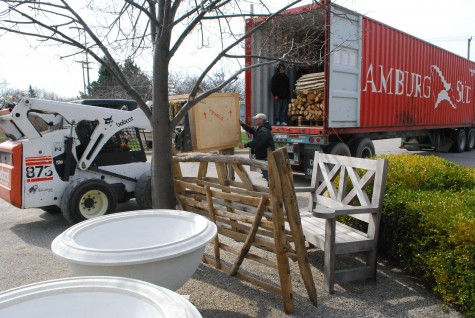
The Last Container From England

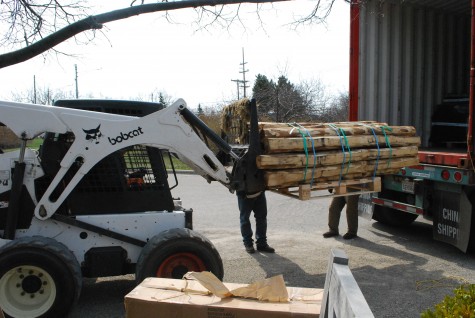
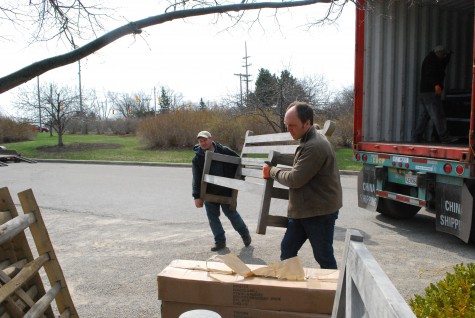
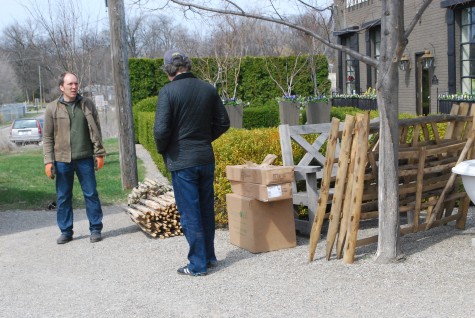
What a relief that this last container load of garden ornament from England is finally in my possession.  Though importing garden ornament from Europe really belongs on that “do not try this at home” list, it is incredibly exciting to cut off that lock, and unload the truck.  It has been seven months since Rob shopped in England-for him, the unloading is old home week.  I am always surprised by what I see, in spite of the fact that he sends me lots of pictures.  There is no substitute for the real thing.  

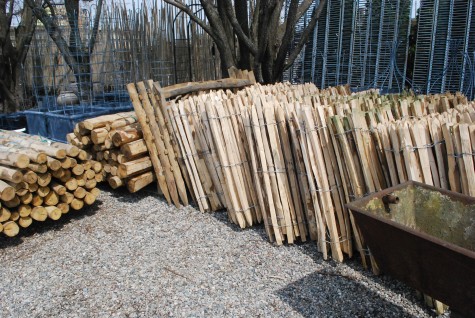
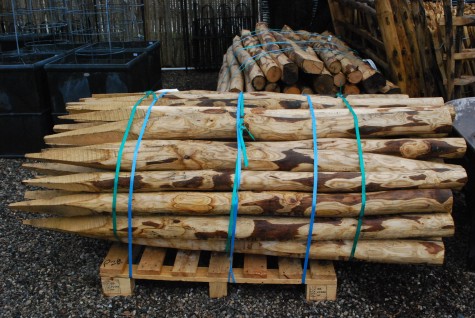
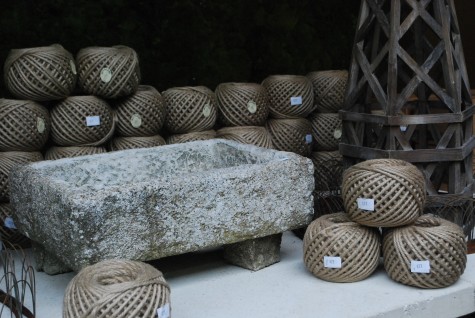
Some purchases might make you wonder.  Who imports fence poles from England?  Someone whose romance with the garden is long standing and on going-that would be Rob.  These are no ordinary fence poles.  They are whittled from sweet chestnut with a draw knife, and designed to anchor rolls of sweet chestnut pale fencing. Castanea sativa was introduced to Britain by the Romans; it is a very important tree in the English landscape.  An introduction to a segment of British gardening life is what came off the container-not a pallet of poles.

An exposure to the tools and ornament of a garden culture other than my own is a gift from an unlikely source-modern technology.  I am sure there was a time when garden ornament never travelled far from where it was made.  The ocean between my garden, and a British garden, does not seem as large as it once was, given shipping containers, giant boats, and trucks-not to mention the communications systems that keep them all functioning towards a specific end.  My local decomposed granite is so different than that granite available in California, but should you want our granite, it is possible for you to have it.    

These large simple wood panels are known as sheep’s hurdles. They are traditionally used to make a temporary pen for sheep taken to market.  What would I do with them?  One panel would make a suberb support for a lax growing rose; a pair might beautifully signal the entrance to a vegetable or cutting garden.  They would make a great companion to any number of vining plants.   

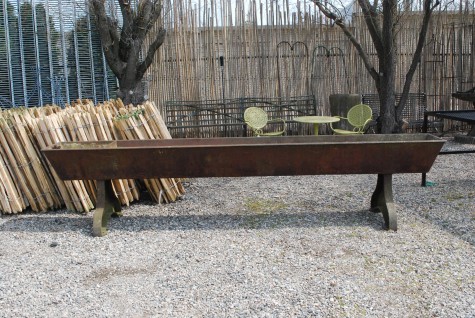
A pair of Victoian era cast iron horse troughs took my breath away.  OK, how does a horse trough get this level of respect?  They are visually very strong, and have great scale.

Six inch diameter chestnut poles are processed for fencing on a woodland site by a pale-maker.  The poles are stripped of their bark, and then they are riven by hand on the radial axis, to produce those fairly regular triangular shaped slats know as pales.  Once bound together with galvanized wire, the result is a rustic but entirely serviceable fencing.  The Chestnut Fencing Manufacturer’s Society puts the lifespan of this fencing at 20 years or better.  All of the above is courtesy of Chris Howkins’ book “Sweet Chestnut: History, Landscape, People”.   

These poles will do an admirable job of holding up the paling fencing.  Their history will add a good deal of flavor to a garden.

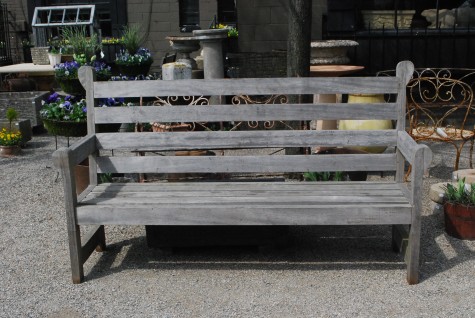
This weathered English bench is of classical design and workmanship.  Made from both teak and iroko, it has many years of service ahead of it. 

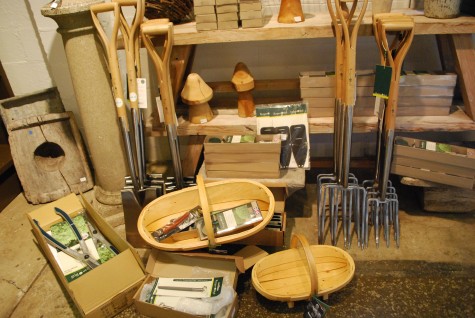
And for the first time, Burgon and Ball garden tools.  Based in Sheffield, England, they make sheep shears-perfect for pruning the soft growth on boxwood. 

    And lest I forget-this container had boxes and boxes of Nutscene jute garden twine.  Just to open the boxes is an experience; that organic and pungent smell of jute filled the garage.   We have just about all the fixings for a great spring now.  Like every other gardener we are impatiently waiting on some spring weather to go with.

Renovating A Landscape

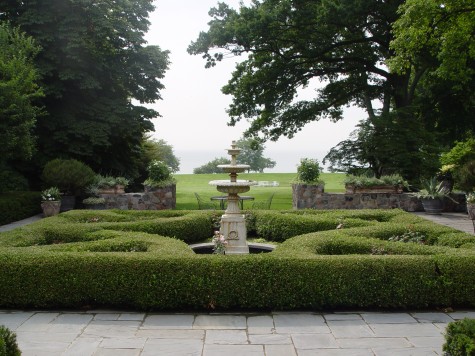
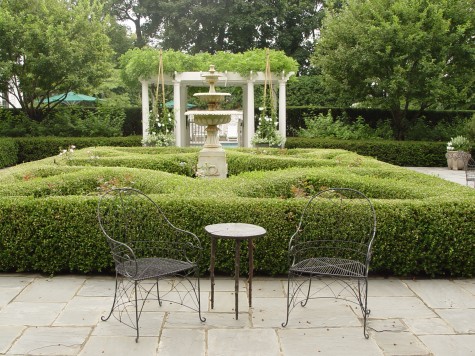
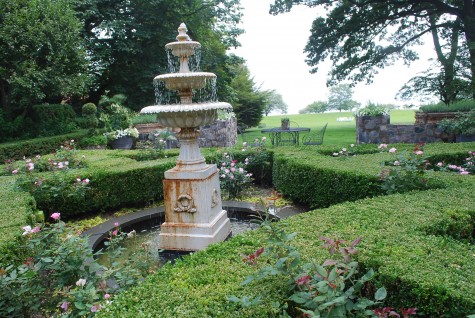
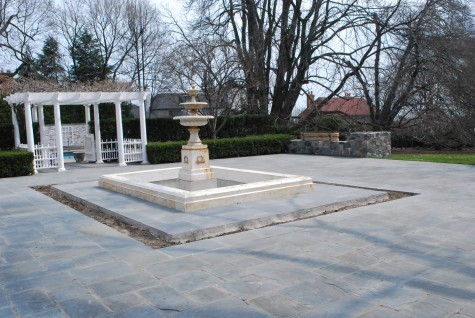
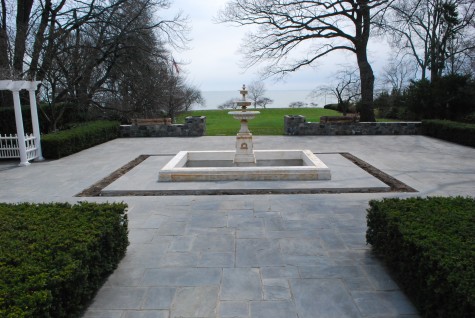
In my last essay, I spoke to the importance of determining what you need from your landscape.  This informs a new landscape, a landscape project, or a landscape renovation.  This client has been a client a good many years.  The boxwood parterre planted in the center of a bluestone terrace began life as plants just 15 inches tall.  A central fountain pool featured a small sculpture.  The landscape has changed a lot over the past 20 years.  Some years ago, the stone walls and planters at the far end of the terrace were installed based on a visit my client made to South America.  The fountain sculpture was replaced some years later by a very fine 19th century American cast iron fountain.  There were changes afoot.  All during this time, the boxwood was growing.    

At a certain point, this boxwood parterre had grown so large that the roses began to struggle.  As I have said before, a landscape never comes to maturity and stands pat.  Equality, stasis in the garden-not likely.  The strength of every element ebbs and flows-given the moment and circumstance.  That fluid community that loosely describes a landscape involves a great number of relationships that are always changing.  This part thrives and grows, at the expense of some other part.  A giant tree can pass away, leaving an entire garden community below wringing its hands.         

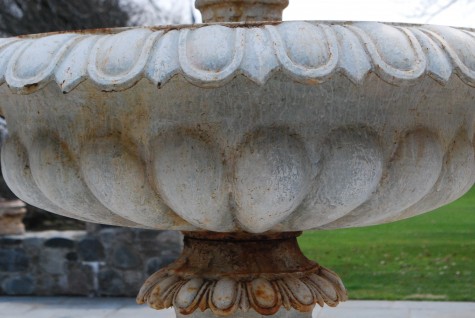
This beautiful 19th century American cast iron fountain was perfect for this landscape, but much overscaled, and much too important for the existing pool.  My client has a great eye, and thinks things through thoroughly.    Her strength vis a vis the landscape is an ability to plan for the future-one great move at a time.  Last summer, she let me know that the boxwood parterres, grown way out of bounds, had greatly diminished her available terrace space. She was ready to make a change.  Elements in a landscape have a lifespan.   

I think I am a good designer, but I would be telling you a tale if I were to say I designed on my own.  My clients say things, point out this or that-they enable me to design in a meaningful way.  They look at and live with that garden every day.  A designer whose pet look is evident in every project-in my mind, a failure.  Great design is about the results of a relationship, a conversation. My client knew better than I that the boxwood parterre had peaked-what would I suggest?

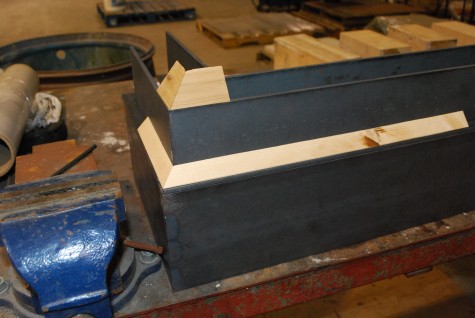
It was agreed that a larger fountain pool would better do justice to her lovely fountain.  I did manage to persuade her that a properly porportioned surround for her beautiful American fountain should be steel, and finished with degraded paint.  The fountain, and pool surround-we could suggest visually that both elements came together.  Some of the details of that surround we engineered in wood, and sent out to a skilled machinist to make. The steel pool surround weighs just about one ton.     

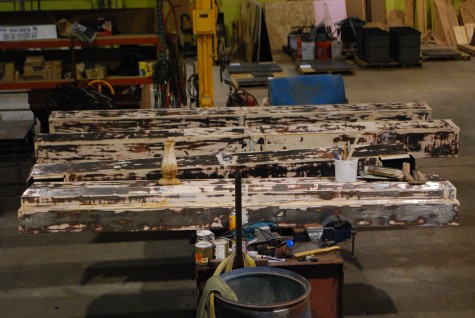
The paint finish was another story.   I primed the steel.  I sanded the primer off irregularly. I was interested in obtaining a reasonable reproduction of old paint.   

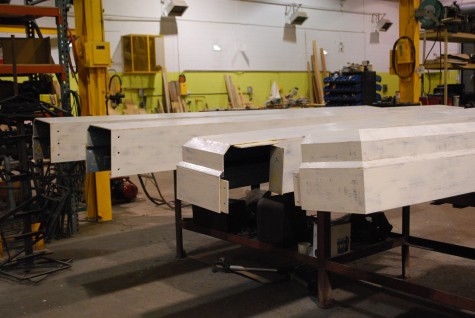
The final paint surface in the studio looked uniformly cream colored, butI knew the winter weather would work its magic. 

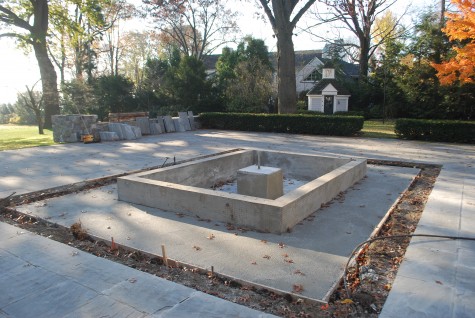
The boxwood parterre so long a fixture of this landscape is gone.  The terrace has that spacious feeling back again.  The fountain pool was poured 18 inches below grade; that portion of the pool, and the concrete pedestal for the fountain will be coated with black pool paint.  This will make the water surface reflective.  There is a plan for water lilies in the pool.  One the pots are put out and planted, and the furniture in place, the renovation will be complete.

The fountain surround will get a final paint finish emphasizing the soft grey and cream color you see here on the bowl.       


The last detail-the dark frame you see in the above picture.  A large terrace, or even a driveway, can benefit visually from a change in materials that breaks up the space in an interesting way.  A detail like this also serves to separate the brand new stone surface next to the fountain pool from the original stone.  This deters the eye from making comparisons.  In this regard I need not have worried; Albaugh Masonry did a superb job of making what was new look very much like the original. After I fill this frame with dirt, I am thinking of planting a very low growing plant that would tolerate foot traffic-perhaps Isotoma Fluvialis.  Other choices could be just as good looking.  This moment in a project is such fun.

Designing: The Inviting Landscape

 
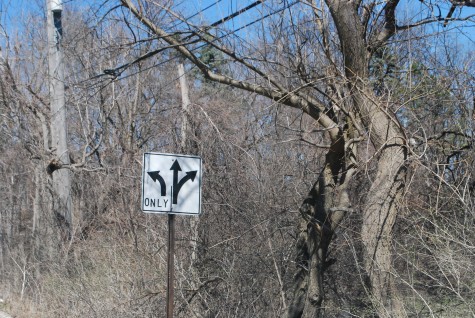
Our spring is taking her own sweet time turning on the lights and opening the door.  Was it not amazing to be outside in the 77 degree weather on Sunday without so much as a bud showing green on any woody plant?  A hoticultural twilight zone is what we have going on now.  That day, my tulips at home breached the surface of the ground, and went on to grow up 4 inches.  They are ready to get going-just like every gardener I know.  If you have issues with your landscape, I am sure you are wringing your hands over which way to go.  What lane will you choose?   

The very first order of business is to think long and hard about what you want your landscape to do for you.  There are lots of choices.  It could provide refuge from a frenetic world or a stressful job.    It could provide an environment for your kids to play.  It could be a laboratory for your tinkering; growing this plant from seed or nurturing that 3″ hellebore seedling can be incredibly rewarding.  Teaching your kids how to grow beans and potatoes-this has to be equally rewarding.  It could provide your family with home grown food. It could satisfy your longing for roses, or your lust for geometry. It could enclose you, provoke you, challenge you, amuse you, or knock you over.  How do you know what you want, and what you need?  Make a list, and edit.  Throw out all the 3 rated wants, and focus on the 8, 9, and 10 rated wants. This essay intends to address only one want-an inviting landscape.  The soft, fluid, and colorful landscape pictured above-inviting.  

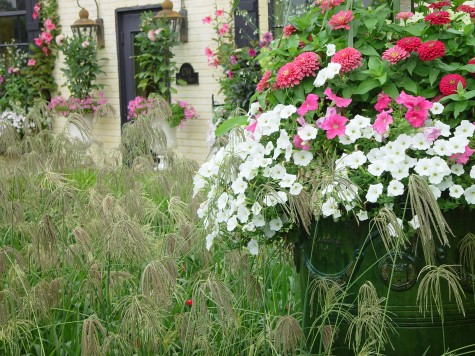
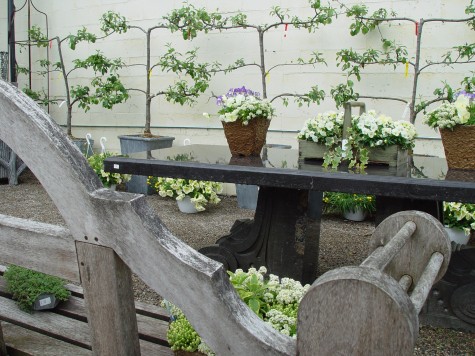
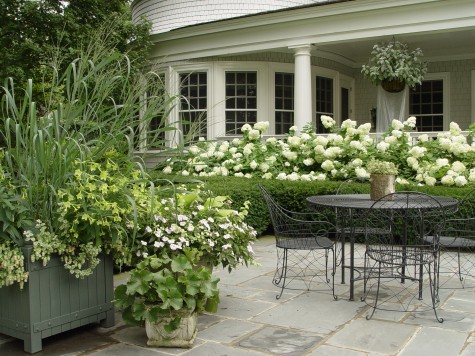
Landscapes that invite provide places to be, and places to sit.  Places to linger, places to talk.  Engaging places.  Inviting landscapes accomodate company.  Though this picture says much about structure-a table, a bench, the geometry implied in a series of espaliers in lead pots, what engages the eye the most are the flowers.  Flowers soften structures in friendly way. 

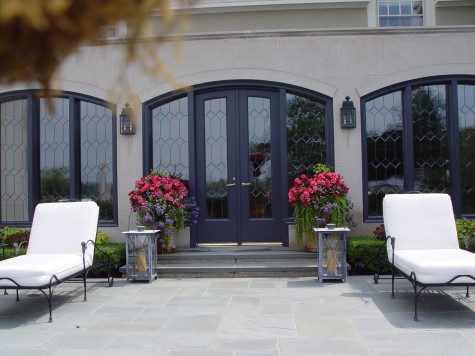
Pots at the back door say first up-here is the door.  Secondly, they say hello, and welcome.  This landscape without the pots would be fairly austere.  Though glass permits a view through, glass in the landscape is not transparent-it reads black from outside.  Should you wish your landscape to invite, soften the appearance of that black glass as best you can.    

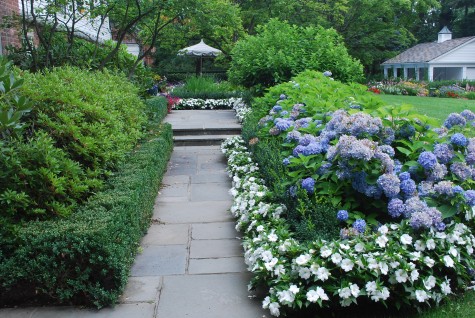
A walkway asks for a landscape of interest on both sides.  Avoid a walk with a garden on one side, and lawn on the other.  This makes a walk a border, rather than an experience. Lawn has its place.  Lawn that is utilitarian, and has a beautiful shape is as muich a part of the landscape as the trees.  Treat your guests to a garden tour before they get to the door.   A welcoming landscape encourages guests to arrive at the front door, smiling. 

Terraces are a hard surface of a certain dimension  laid on the ground plane.  They make for a surface that is navigable.  Though stone, brick and gravel are hard surfaces, they are natural surfaces.  They make it easy for groups to congregate.  Your son’s softball team and all of the attending parents, a fundraiser attracting lots of guests, a neighborhood group coming for lunch, a graduation party with friends and family-a terrace gives every guest a firm footing.  Beyond that, a terrace can be landscaped such that people feel welcome.  When I sit down on a terrace, I want plants at eye level.  This makes me feel comfortable, and welcome. 

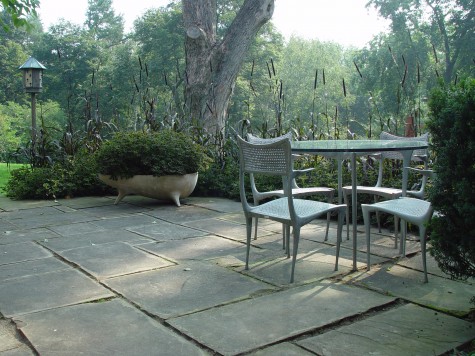
Some very contemporary landscapes make much of what I would call an immature and shallow call to the idea of alienation.   As if alienation were a goal a gardener should seek. Nature portrayed as alienated-oh please. Nature is involved up close in the lives of all of us.  Great geometry-I am on board with this idea.  Want to make your modern  landscape inviting-introduce a plant element that waves in the breeze.  Great modern landscapes can be as inviting as any cottage garden-just different. Clean, clear, and in motion; this modern terrace is inviting.   

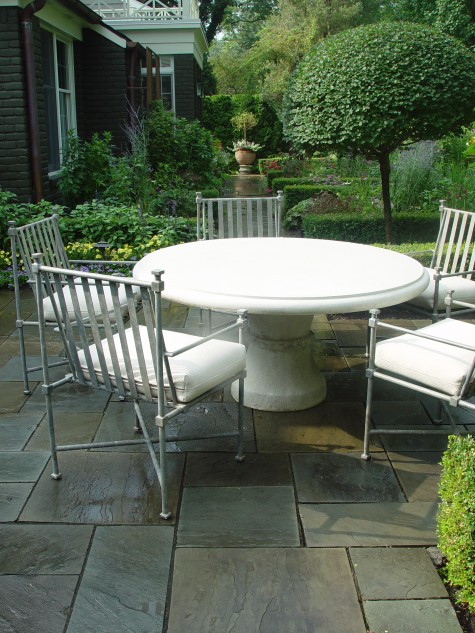
This established landscape is all about providing a comfortable place for friends and family to congregate.       


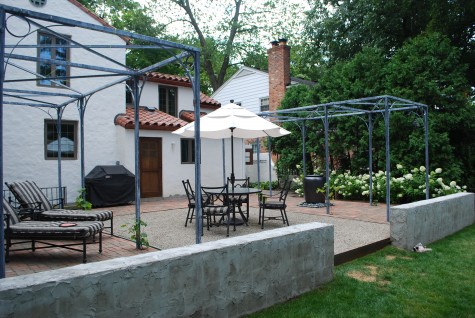
This new landscape is just about ready for those softening elements that will make this space inviting.