Sunday Opinion: Aging Beautifully


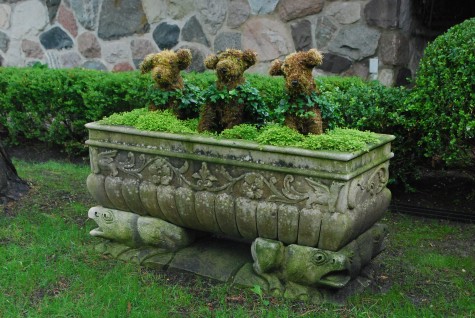
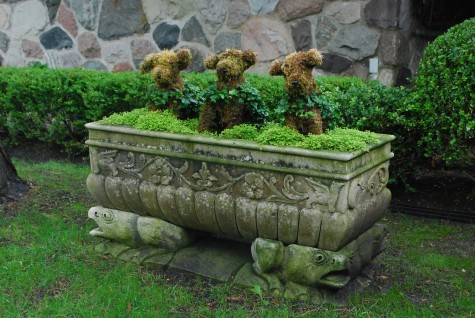
I had occasion to deliver a few pots to a client whom I did landscape work at least 20 years ago.  This picture of her Vincenza stone trough on a frog base that she bought from me 15 years ago I posted a week ago or so.  I like it enough to post it again.  The trough is classic Italian style-the three moss and ivy puppies sitting in a bed of lime selaginella is classic MM style.  I was so pleased to see that all these years later, that trough still looks tended to- great.
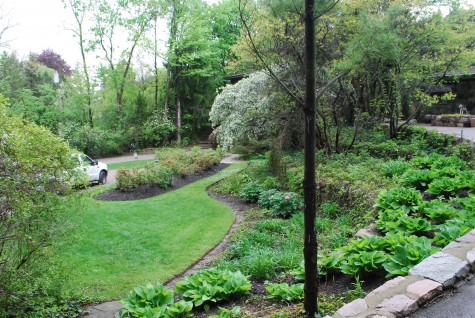
I recognized the beds of hostas and roses, some of the specimen trees, and the gravel car park. The landscape was long standing and established the first day I went there.  My client is has a point of view about design.  She loves her land and landscape, and handles all of it brilliantly.  I just lent a hand  on a few projects.  Every bit of her committment was still in evidence.  
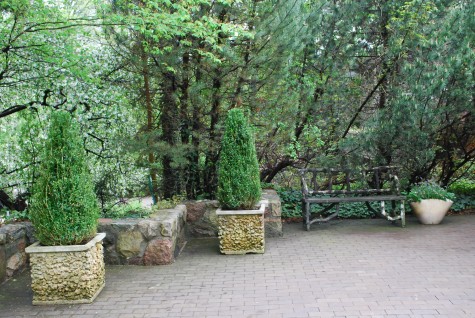
She bought some of the most beautiful garden ornament that ever crossed my path.  These antique square French concrete pots were hand carved in a volcanic stone pattern-they are stunning.  An early 20th century French faux bois bench-gorgeous.  All of the trees behind have been there longer than I have known her; they still thrive.  No doubt she has a hand in this thriving going on. 
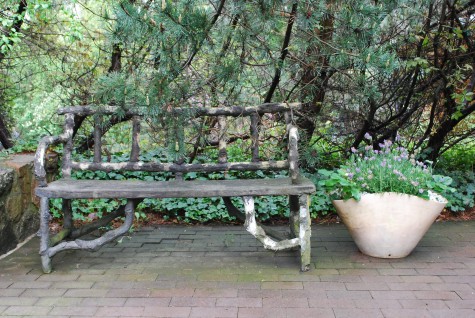

Next to that bench, a stoneware pot from my Branch studio.  We call thse hugging pots-they are pots deliberately out of round.  The pot was a gift from a group wanting to express their appreciation to my client over her community service to the arts.  They picked well.  A decidedly contemporary pot next to this 90 year old bench-my client’s idea of a good look.
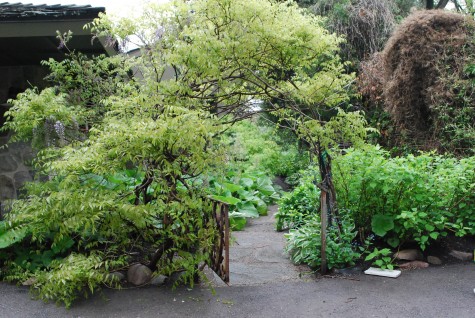
A hand forged iron gate to the side garden is about buried in an arbor of old wisteria.  I do admire how she lets living things express themselves without interference.  She seems to know just when to stop letting something go, and she responds to that gently.  Everything in her garden is kept just shy of chaos-the effort and confidence that this takes I greatly admire about her.   
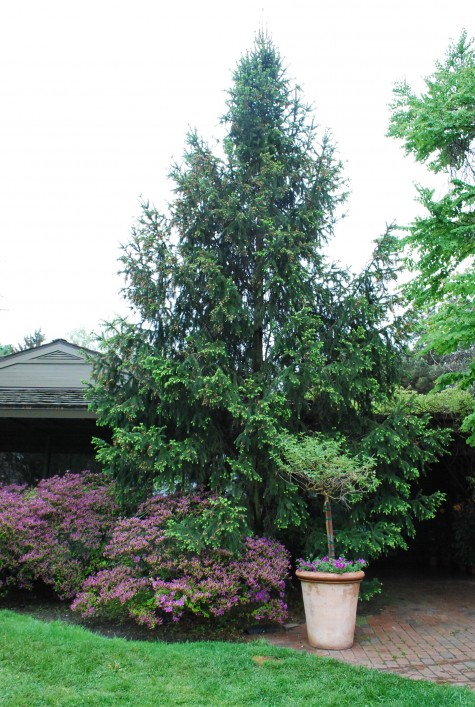
20 years ago I planted a columnar spruce next to the house-Picea Cupressina. In the intervening years, it has expanded to the limit of the space available, and no further.  The tree placement was fine, I am happy to say. Should a landscape look the best the day it goes in, there is a problem somewhere. This older landscape looks all grown up, in the best sense of the word.     
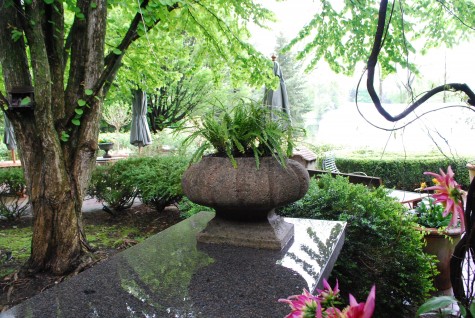
This antique concrete French urn looks perfectly happy planted with ferns on the granite countertop of the outdoor kitchen.  The one trunk of a trio of katsura trees planted at least 40 years ago is a great companion to this urn.  A very mature landscape that is thoughtfully looked after is such a pleasure. 
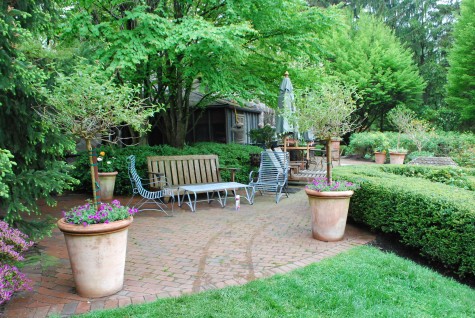
The terrace has lots of handmade Italian pots, and a rowdy mix of furniture and ornament.  The boxwood at the right in this picture- visible is just one section of an old snail shaped spiral. This brief visit delighted me.  It may not be front page news, but there are gardeners  shouldering the load of growing, weeding, maintaining, pruning, renovating and nurturing their small part of the natural world.   
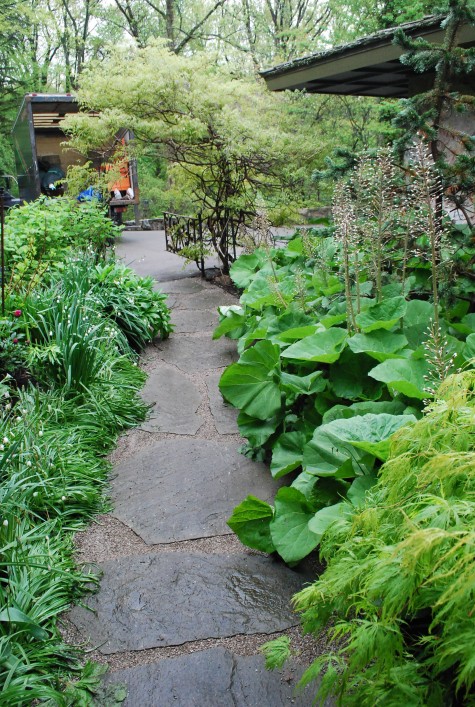

I own my house, and everything in it.  I own my car, my businesses, and my watch.  But I am only a steward of the land on which my house sits.  Stewardship is vastly different than ownership.   I have a responsibility to care for the land, the trees, my environment-any natural phenomena within my reach.  I know other gardeners with the same attitude.  Anyone who understand that ownership is a largely irrelevant notion, given a serious interaction with nature, has the potential to be a great gardener.  My client MM-she is a great gardener.
A Favorite Place

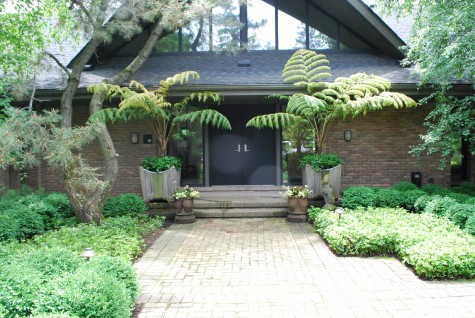
I have my favorite places.  What makes for a favorite place?  A client with an eye for beauty and a committment to the garden.  A client who is always willing to try something new.  That said, an ancient and sparsely foliated scotch pine flanks the front door-Mr. will not now, and not ever,  let me touch it.  This too makes for a favorite place-strong feelings.  The Australian tree ferns I have wintered in a greenhouse for them for about 10 years.  We cut them back to the main trunk in the fall.  By spring they are leafing out vigorously.  This year I underplanted them thickly with maidenhair ferns.    

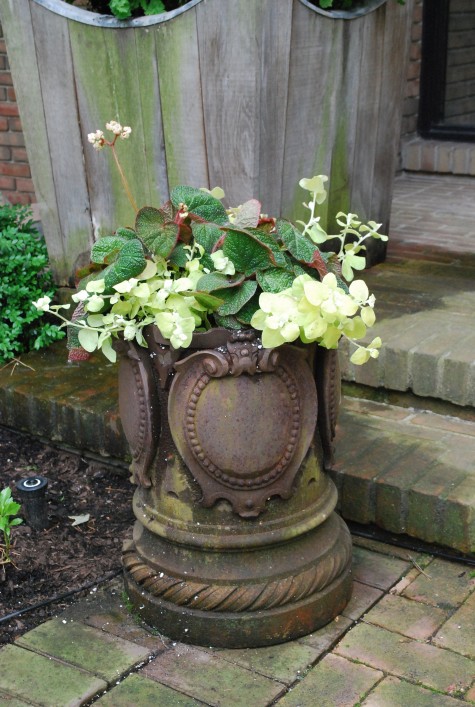
A pair of chimney pots got planted with an unknown begonia-I like the leaves.  The rusty colored hairs on the stems and backsides of the leaves look great with the rusty brown pots.  Lime licorice grows anywhere for me-sun or shade.  That pale chartreuse color will highlight those deep green leaves.

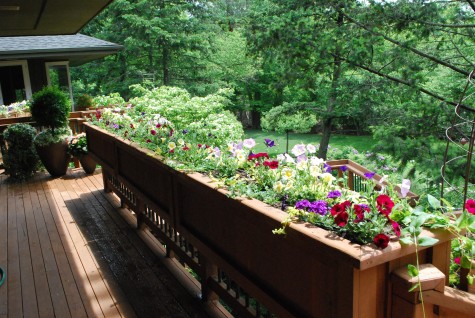
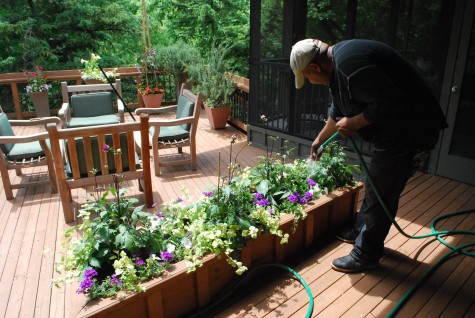
Planting day was a sunny day-so my pictures are not very good.  A lime, lavender, purple and yellow color scheme is enlivened with an occasion burgundy potunia-just for emphasis. Vinca maculatum will trail dowen long on the far side, as will the misty lilac wave petunias.

The small box got cactus flowered purple dahlias, purple angelonia (new this year) lanai blue trailing verbena, white petunias and lime licorice. 

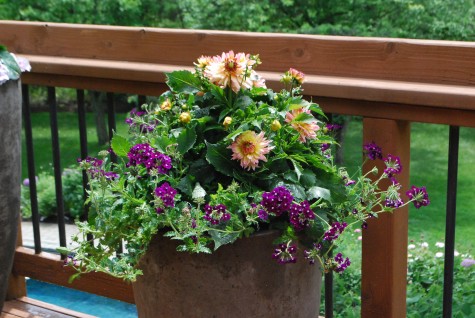
A pot nearby has a yellow and peach bicolor dahlia, and a skirt of dark red violet trailing verbena.  I like the forms of the plants together as much as I like the color.  I like the contrast of the big dahlia leaves to the slight-sized verbena leaves.  Plants have visual relationships on a lot of levels.   

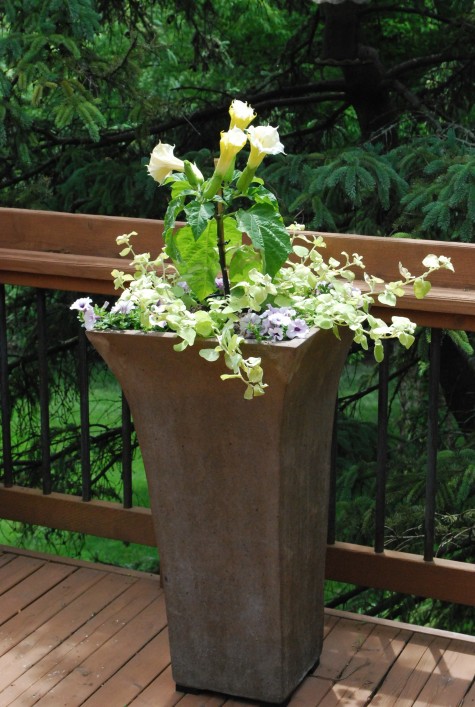
The centerpiece of this pot is a double (also known as hose in hose) datura.  I caution anyone who grows them-every part of a datura is poisonous.  The plants smell poisonous.  If you cultivate this beauty, wash your hands after you touch it.  Beyond the warning label lies a gorgeous big leaved plant with giant flowers.  A diminuitive white and lavender veined mini petunia against lime licorice is a cooly tart, and small textured mix.  The datura will be the star of the show.

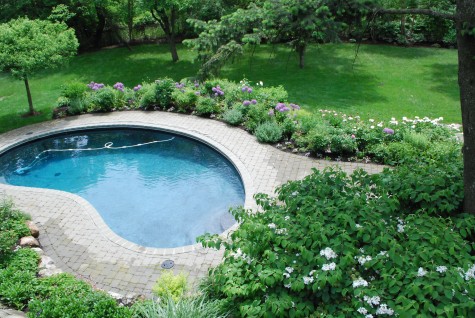
The perennial garden at the pool is just coming to life.  The peonies are out, and the roses are not far behind.  The purple alliums show well from the second floor deck; this is a garden primarily viewed from above.  We add some nicotiana and verbena bonariensis between the tall perennials, and plant an annual border to soften the edge of the pool brick.  This year, showy oregano, appleblossom petunias and heliotrope will fill in and cover the soil.   

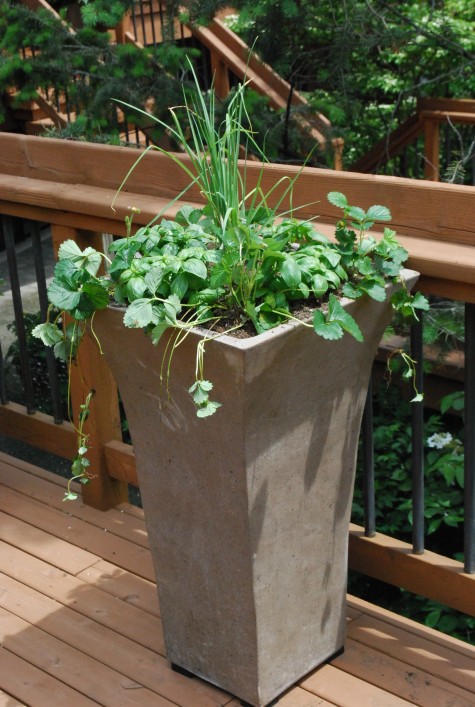
When my client asks for herb pots, she is really asking for basil pots.  I did a pair.  Leeks in the middle, and everbearing strawberries with pink flowers at the corners. Lots and lots of basil.  This I understand.  Its pungent smell and taste-irresistable.

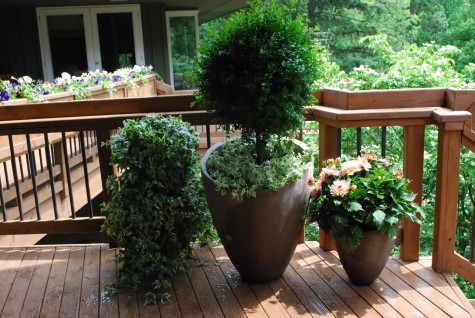
This trio of pots feature an old variegated ivy topiary, and a single ball boxwood topiary.  The boxwood got an underplanting of variegated licorice; the third pot is stuffed with a dahlia.  The pots are from Francesca del Re in Italy.  The are very simple, handsome, and frostproof.  The clay is so loaded with minerals that the pots are very strong.  We make sure no water collects in them over the winter.  Freezing water expands as it becomes ice-this process can damage pots.  These terra cotta pots have been outside for a good many years.

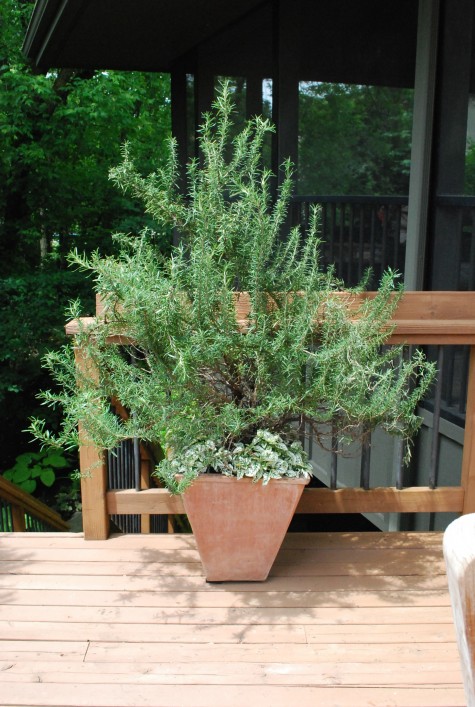
This wildly natural rosemary has belonged to my client a long time. The only thing we prune is the rootball; this plant has a life of its own going on.  This year, we underplanted it with white polka dot plant-I think I am going to like this. 


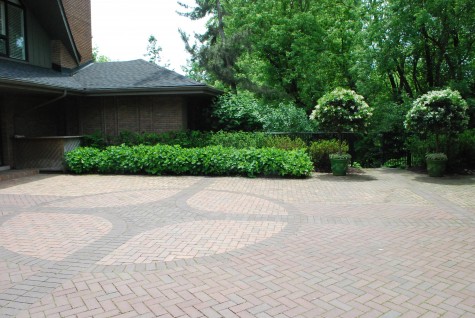
My first project with this client many years ago involved digging up every plant she had, and rearranging. This took 2 days.  There were lots of projects after this-not the least of which was the most romantic garden wedding I have ever been involved with.  My client-she drove that bus.  The story of the driveway?  The drive needed to be enlarged; the original brick was no longer available.  We took up all of the old brick, and reused it with a new brick in an entirely different pattern.  All of the pale brick you see here is original.  The two colors of dark brick are new. It looks entirely believable; the mix of old and new reads as one thought.  The 12 year old waxleaf privet topiaries got planted back in their summer home-they are just about to bloom.  Most every bit of this garden-swell.

Garden Designers Roundtable: Stone


Designing, planting and tending a landscape or garden is an avocation, a profession, a passion -and a nemesis of the most unpredictable and formidable sort.  The pure joy that a great garden has to give back has a substantial responsibility that comes along with it.  The landscape could be described as the responsibility for the health and happiness for a flock of living things. A lot of marbles have to be kept on the table-all at the same time.  Every plant that dies on my watch-I take it very personally.  Plants die routinely, and with astonishing regularity-in spite of knowledge and experience.


Some plants die from old age-every living thing has a lifespan.  Some things die from a particularly fierce winter, or relentless rain, or extraordinary heat.  Some things die from lack of water-of these deaths,  I am particularly ashamed.  Some things die from poor siting, or a a site whose ecology changes drastically-as in the loss of an old mature tree.  The living community that describes my garden is ephemeral-fleeting.  No tree, shrub, perennial, or garden experience comes with a lifetime guarantee.  Should you decide to garden, the disappointments are part and parcel of the experience.  Fortunately, a landscape has other elements that live longer.

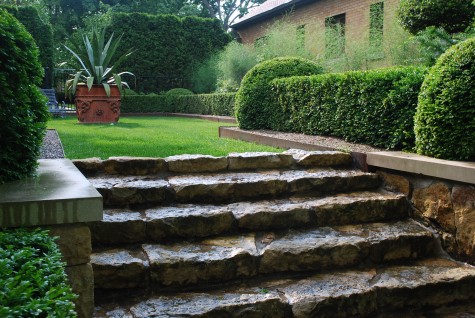
Some elements in my landscape shrug off the water, the winter, the heat; the stone in my garden is the next best thing to indestructible.  Stone persists in my landscape in spite of my neglect, poor science, or ignorance.  What can I count on to be there every day, as best as I could count on anything?  The stone stairs to my rose garden have been there as long as I have had my garden.  I would guess it will still be there, when I celebrate my 100th birthday.

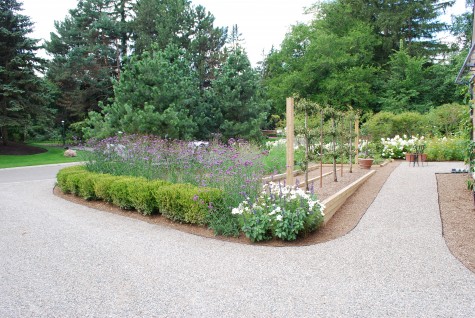
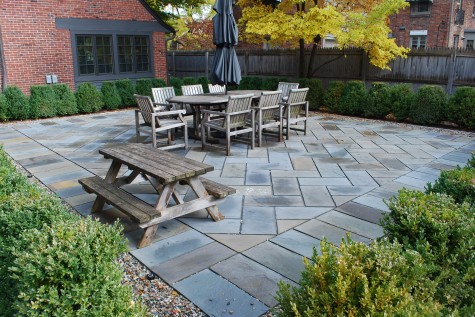
Stone in the landscape roughly refers to what we call hardscape.  Stone beautifully populates those places to be, that soil to be retained,  those spaces to entertain, and those walks with a natural material that provides an enduring hard surface.   Stone is eminently capable of expressing your need for a change of grade.  Stone provides paths and walks that enables travel from one space to another.  Stone provides a beautiful and durable surface for a terrace.  Compacted decomposed granite- shards 3/8 inch in diameter and smaller- makes level and hard surfaces that survive in driveways and garden paths, year after year. I so like balancing those living, and therefore fragile elements in a landscape with a crispy defined highly textural natural material that endures.

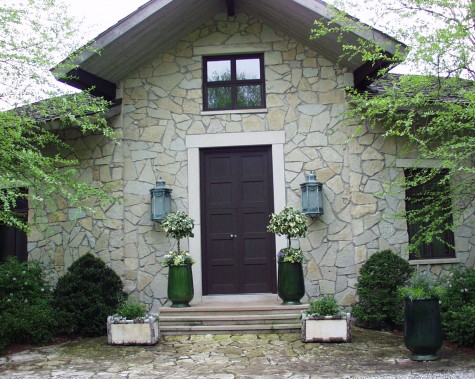
I am not a geologist-I am a gardener.  But I can say with great conviction that the stone readily available to me regionally is always my stone of choice.  Regional stone that is native to Michigan will look like it belongs in a Michigan garden.  Stone native to the East coast, or west coast I can appreciate, but a sense of authenticity of place is important in making a landscape visually believable. No doubt an entire library exists which describes the color, texture and use of stone world wide.  But I am primarily interested in stone that naturally occurs in my region of the country. In addition to bluestone and granite,  Indiana limestone, and Valders stone from Wisconsin are favorites. 
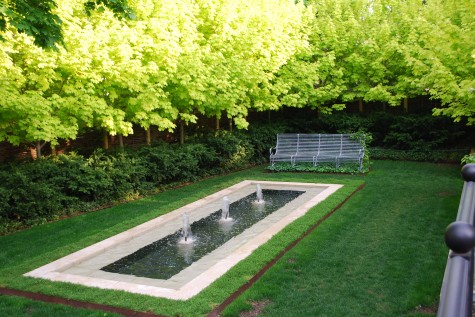
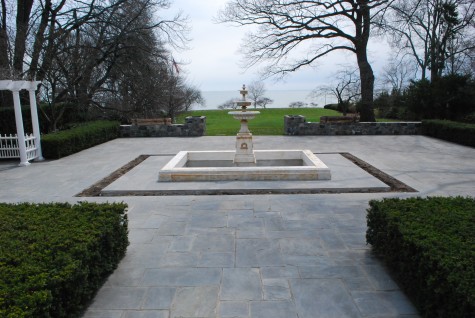
The fountain in my back yard is finished in Valders stone. The step down in submerged in water the entire season. This very high density dolomitic limestone is prized for its low water absorption.  This makes it ideal for applications in or around water. Indiana limestone, also known as Bedford limestone, is principally comprised of calcium carbonate.  The decomposition of marine animals at the bottom of the inland sea that covered the Midwest for countless centuries created limestone.  The limestone quarried near Bloomington Indiana is acknowledged to be the highest quality limestone in the United States. It readily absorbs water; the limestone caps on my retaining walls have aged beautifully.

Should you need a hard and enduring surface or wall, natural and native stone will endow your garden with a sense of permanence.  The formation of stone takes generations, and it will take generations to decompose.  Do not be shy about inviting a natural element into your garden with proven longevity.  It provides a quiet and appropriately natural foil for your plants.


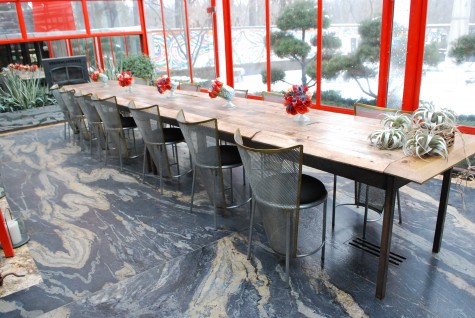
I was a rock collector, as a kid.   Every type of rock, every shape, every surface-I was enchanted.  Nothing has much changed; I have a big love for all manner of rock.  Stone carpeting the ground, stacked up like a wall, hand carved into a cistern, or half buried in a rock garden-I value it all.   The stone slabs carpeting this conservatory floor-I have never seen anything remotely like it before.  It has an exotic, architectural, and other-worldly look.

Stone cold, set in stone, stone faced, hard as stone -these are all phrases that describe a certain attitude that withstands the elements, the vagaries of nature, and popular sentiment.  Stone comes with an aura of history about it.  The eldest plant in my garden I estimate to be about 80 years old-a trifling age, compared to my stone. Relationships in a composition might be more important than the one, or the other. How an ephemral element interacts with a permanent element-always interesting. That great age one associates with natural stone has much to do with the creation of,  and value,  of stone garden ornament. 

Stone ornament for the garden is a centuries old art and practice.  A material which is virtually impervious and certainly accepting of the weather makes an ideal medium for sculpture, urns, finals, cisterns, plinths, and benches. Many antique pieces provides homes to thriving colonies of moss and lichens. Before Michaelangelo’s David was a sculpture, it was an ancient block of marble from the earth.  Antique containers and urns hand carved from a single piece of stone are rare, and very costly.  Dry cast limestone is a dry mix of cement, sand, mineral pigments and crushed natural stone, which is forced into molds, and vibrated under pressure until it fills the mold evenly.  This method of manufacture makes stone garden ornament more readily available and affordable.

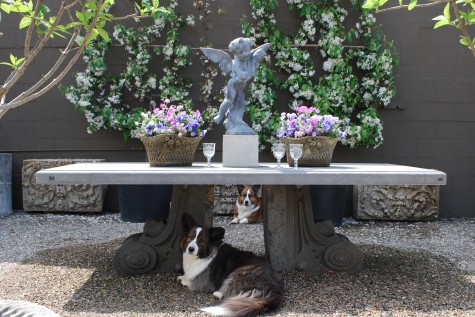
The stone in my garden is beginning to settle in.  Plants have decided to take up residence in its crevices, and on its surface.  I like how this makes me feel. This Belgian bluestone table with antique hand-carved corbel bases would indeed be lovely in a garden. Any gardener who has ever carried rocks around their garden, or had their fingers pinched setting a stepping stone knows that stone does not give.  I like a material in my garden with this attitude.

I wrote this essay in a special capacity.  I was so pleased that The Garden Designers Roundtable invited me to guest post with their group for the month of May.  The Roundtable is a group of garden and landscape designers who write regularly on topics related to landscape design.  This blog is a great read.  www.gdrt.blogspot.com.  Interested in an ongoing discussion of plants, gardens, landscapes and design?    www.facebook.com/GardenDesignersRoundtable.

To read all of the posts on the May discussion of stone in the landscape, click on the links below.  Enjoy!

Sunny Wieler : Stone Art Blog : West Cork, Ireland

Debbie Roberts : A Garden of Possibilities : Stamford, CT

Douglas Owens-Pike : Energyscapes : Minneapolis, MN

Ivette Soler : The Germinatrix : Los Angeles, CA

Jenny Peterson : J Peterson Garden Design : Austin TX

Rochelle Greayer : Studio G : Boston, MA

Scott Hokunson : Blue Heron Landscapes : Granby, CT

Susan Cohan : Miss Rumphius’ Rules : Chatham, NJ

Tara Dillard : Vanishing Threshold : Atlanta, GA


The Front Door

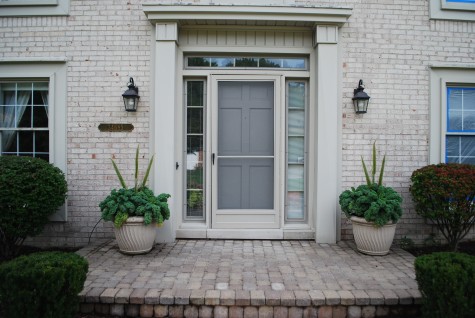
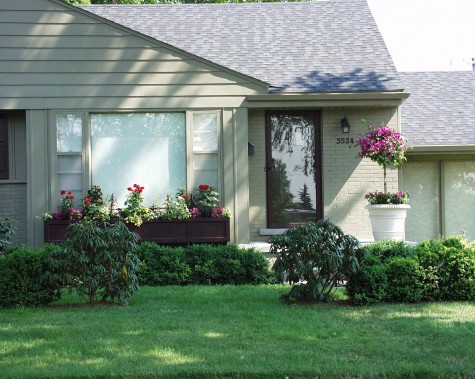
I never use my front door-unless I am outside after work, watering my pots. If I am out there watering, the chances are very good that I will exchange hellos with people walking the neighborhood.  When company comes, I am on the inside looking out.  Why I would care how the landscape at my front door looks-simple.  My friends are walking up that walk.  We have a visit or a dinner planned.  I have every interest in making that walk welcome them.  It takes a little time to get to my front door from the street; any visitor has time to see what I have going on.   The front door pictured above-my clients were interested in making a change. 

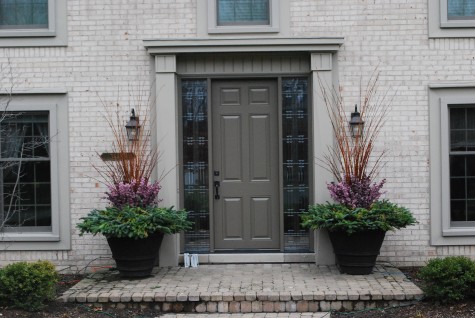
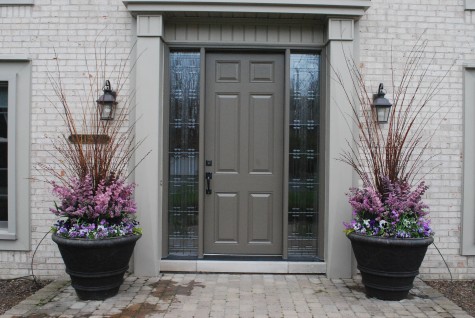
Making friends feel welcome is but one of the ways that my landscape gives me pleasure. My clients had the same idea.  They changed the door and sidelights for the first time in twenty-some years.  Their choice of a new door and sidelights-a beautiful update.  Part of that update was a new pair of containers for the front porch.  A porch generous enough in size to accomodate both pots and guests; I like the size of the porch.  These chocolate stained concrete vase shaped pots, much larger, and much more emphatic-they make a statement.  Purchased just in time for the winter season, we filled them with twigs, dyed eucalyptus, and a wide densely constructed nest of cut greens. The scale of the planters and plantings frames the front door in such a way to make the invitation read from the street.  This also makes friends knocking on the front door feel welcome. 

Just today, we planted these pots for spring.  The winter centerpieces we kept.  The height of the twigs, and the mass of the eucalyptus, are scaled properly with the size of the door, and the size of the porch.    Guests approaching have a sense of the landscape at eye level-this is a friendly gesture.  How I landscape places in my yard where friends come to visit-I like that landscape to put its arms around my friends, and say hello. 

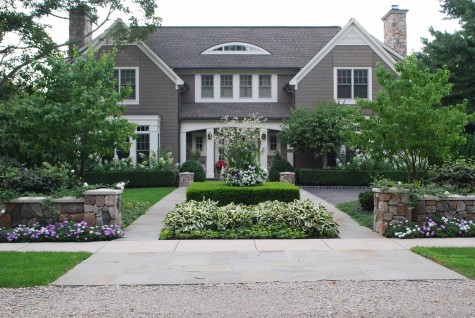
Some city gardens are built on very small properties.  A conscious choice was made here-to block the view of the front door with a luxurious square of boxwood, dominated by an antique urn.  I planted that urn very tall. How that planting obscures the front door makes the walk to the door an adventure.  Front yard landscapes have much to do with the relationship between the public presentation from the street, and the welcome issued to family and friends. 

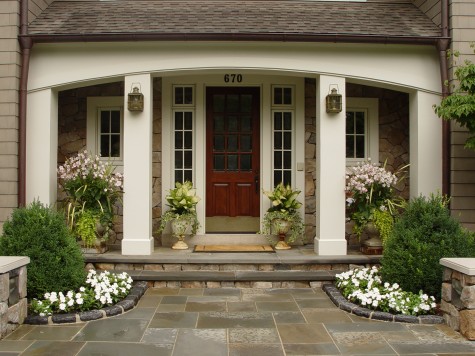
This front walkway behind that urn planted very tall is actually an extension of a drivecourt.  A shallow porch benefits greatly from its overscaled width.  I so like the decision to do four pots on a narrow porch.  Everything about the numbers of pots, the placement and the planting influences to what extent you say hello, and welcome.

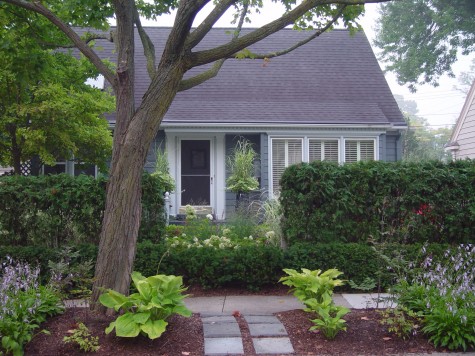
Some front doors are not symmetrically placed.  A tall portion of wall existed to the right of this front door.  A tall pot, barely visible here, is home to a planting of zebra grass and variegated plectranthus.  The planting is at eye level from the street.  The landscape successfully frames the front door. 

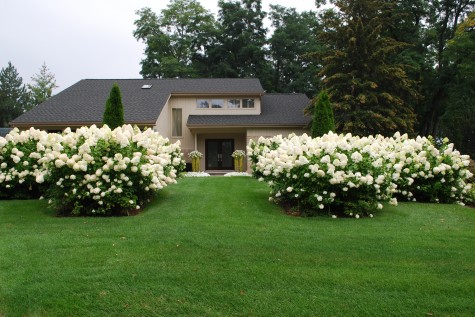
This client loves the big statement that her limelight hydrangeas make-they are glorious.  The view from the street to the front door-a long view.  Her contemporary faux bois selettes from France-they still read from a long ways away.  Up close, a mass planting of white New Guinea impatiens is complimented by lime green creeping jenny-the creeping is almost  4 feet long, come mid July.  There is no walk from  here to there-but there is a view that engages the eye in a lively way.

Not all porches permit pots placed symmetrically.  One planter at the door can be every bit as strong as a pair.  In this case, one giant planter is balanced by a substantial planter box.  The landscape obscures the walk.  This makes for a public presentation of the landscape separate from the private experience.  I live in an urban neighborhood.  This means I have concern about what I want to contribute to the beauty of the neighborhood, and how I might want to more personally welcome my guests. 


The back door of my property sees lots of action.  I load and unload the dogs every day-I park just 15 feet from the back door.  We take the trash out.  We come and go, and park here-all the time.  Treasured friends come in the back door regularly.  But my front door-the landscape and the pots-I have a thing about this special place.  It is my obligation and pleasure to present as beautiful a presentation as I can.  To the neighbors walking by.  To casual visitors driving by.  To special guests.  On my mind is what people driving by, and guests coming up the walk-what do they see?  What have I been so well mannered to put at their eye level.

Good manners?  Any guest of mine, I do try to consider their experience first- before I consider my own. Beautiful pots, overflowing with plants, at the front door-this is no doubt a gesture of respect, and affection.