Susie’s Pots


Making a move to renovate a landscape usually begins with some fairly compelling idea. Who would take on the mess and expense, unless there is some imagined outcome that will make for a decidedly better experience? As much as my daily routine has to do with tearing up people’s yards and putting them back together in some other way, I personally find change to be unsettling and difficult.  Maintaining the status quo has its attraction. I am likely to dig in my heels, and hang back until something throws me in another direction.  An appreciation and interest in the out of doors was a given for this client, but other issues were getting some play.
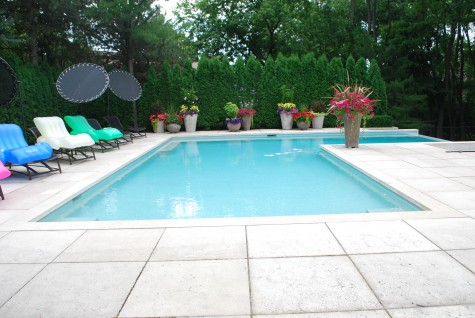
She had raised three girls, and was toying with the idea of moving to a smaller place, and making some time for travel.  Her decision about an outcome had to do with a few basic things.  She could not imagine a place she would like better than the one she already owned free and clear.  She had already spent a lot of time and trouble furnishing the inside of the house to suit herself.  In the end, she decided to stay where she was, and create a beautiful space outdoors that would make her feel like she was on vacation.  She is very happy with her own private vacation spot-I attribute that to her clear idea of what she wanted from her landscape. �
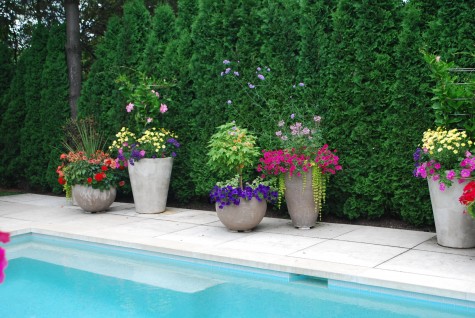
Everyone’s defining landscape decision is different.  Every committed gardener asks for something individual from their garden.  The important thing is to think through what it is you need and want before a shovel goes in the ground. Figuring out what you really want is not always so easy.  I might in casual conversation say I want vast perennial borders, but in truth I do not.  I work on perennial borders every day.  What I want when I go home is peace, quiet, and order. My landscape has lots of evergreens; they are very low maintenance and are beautiful all year long.  My container gardening is a foil for all of that-each one gets a new outfit every year.  They are my idea of fun.   
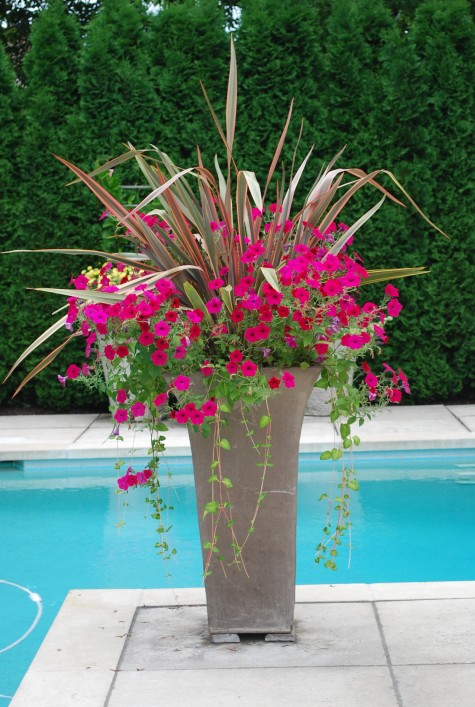
Susie’s pots are bold in color and form.  All of that resort style turquoise blue water asks for a strong color statement.  She enjoys taking care of her pots as much as she likes swimming in the pool.  The care of the pots is an everday pleasure, not a burden.  
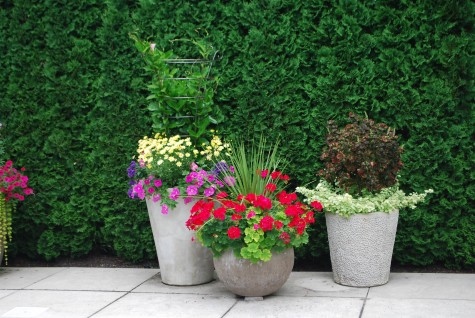
Our late June and early July have been scorchingly hot.  The annual and tropical plants thrive in that heat much better than I do.  Susie is poolside every day, enjoying the weather as much as her plants do.  I can tell at a glance that they get daily care.  Anyone lacking the drive or time to look after containers every day can still be successful with them.  The installation of automatic watering and the planting of drought resistant plants can go a long way to help with the maintenance. A care plan is as important as the design. 
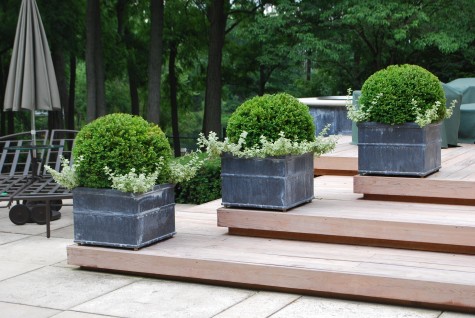
Three of her steel boxes have boxwood in them that live there all year round. The variegated licorice thrives on the boxwood watering schedule.  She does see this particular spot looking out the window in winter.  There is always something there for her to see.     
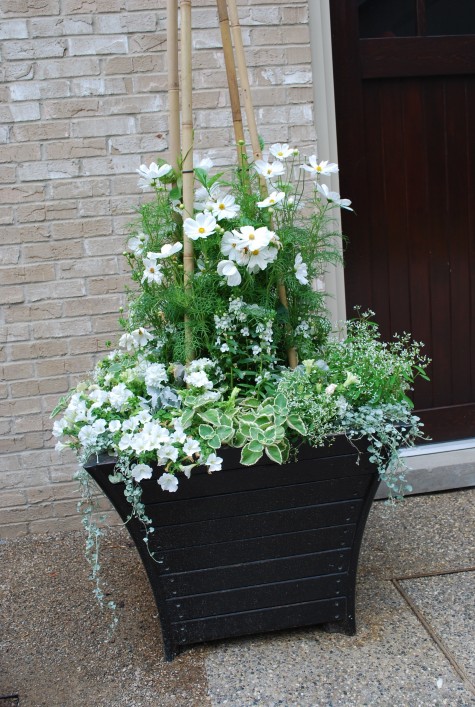
A pair of Belgian boxes were moved to the driveway.  She not only sees those boxes coming and going, she can see them from a window in her living room. My guess is that we will fill this box with something good looking for the winter months.
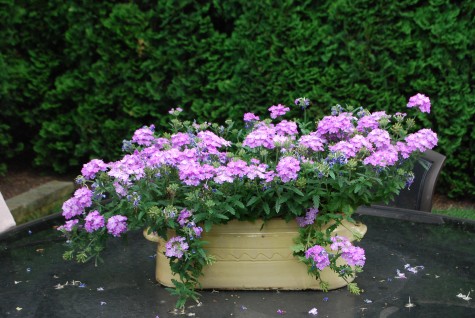
The dining table bakes in the sun all day long; the trailing verbena Lavender Star thrives in this environment.  The yellow glazed pot from Cliousclat in France, and that lavender provide a lot of color in a very small space. 
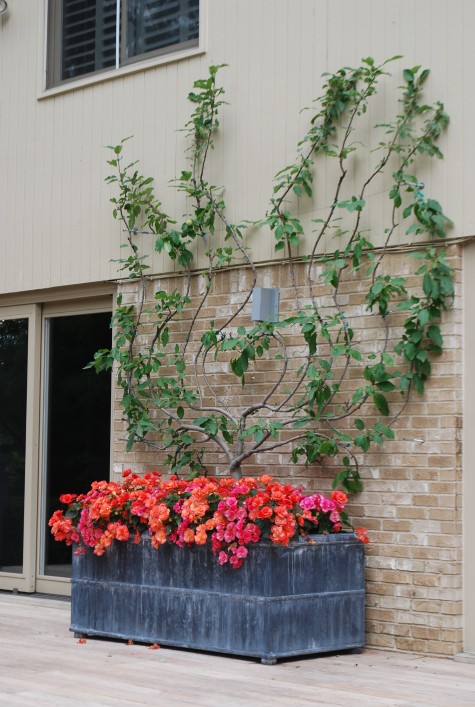
The apple espalier is now on its 4th year, living in a large steel box.  I had my doubts that it would live over the winter with its roots above ground, but she was willing to risk it. It is doing well enough that we need to install another wire up top, to keep the branches growing vertically.  An espalier grown in a heart shape-we both fell for it. 
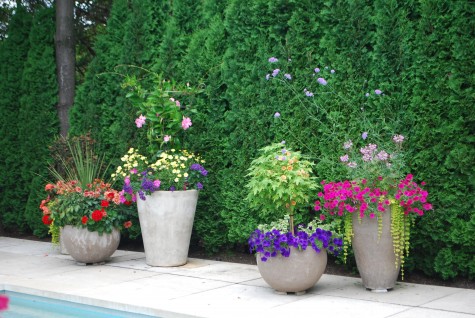
This pool yard would be every bit as beautiful without the container gardens, but such a landscape would not suit my client.  She truly enjoys making plants grow.  The responsibility is great, but the rewards for her are greater.  
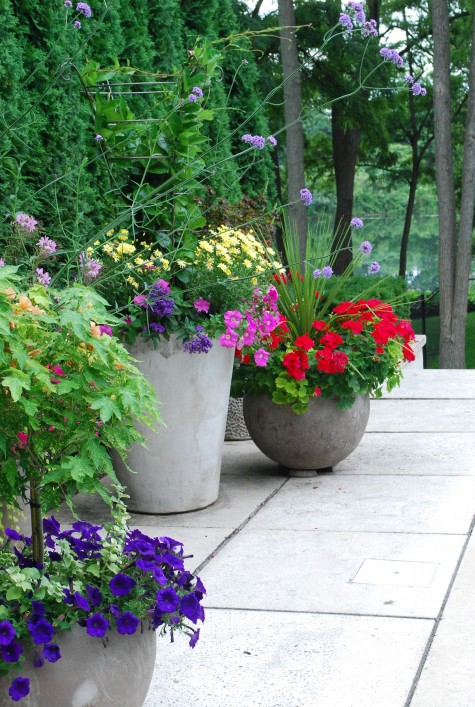
What makes people happy-it makes the gardening world go round.
Finishing Up

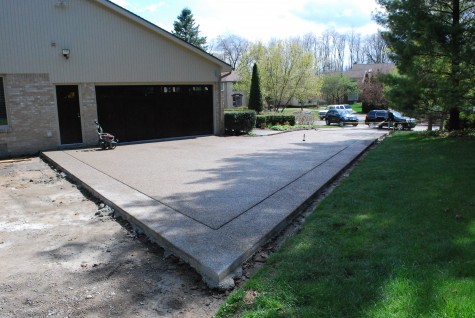
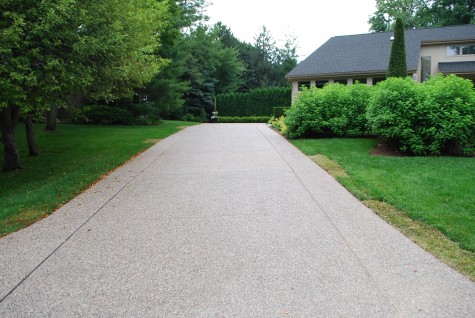
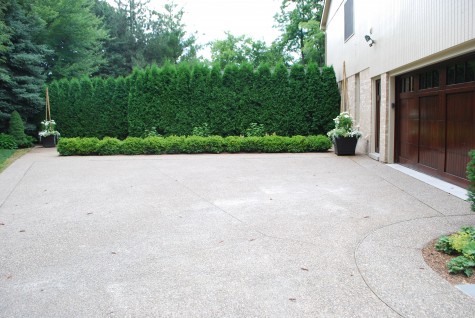
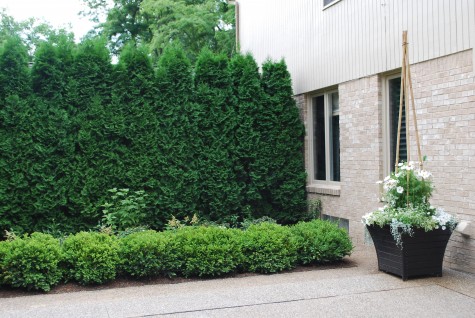
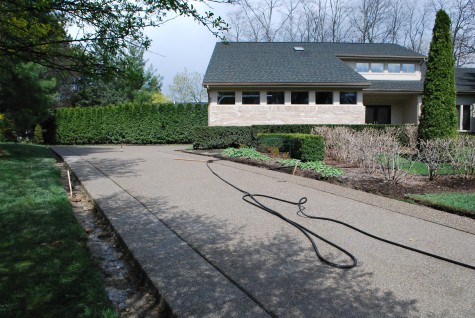
I have been working steadily on the landscape for this client for the past 6 years; every year we have done something.  The driveway garden we saved for last.  Her youngest daughter loves basketball-we could not take the driveway mounted basketball hoop down until she was ready for college-Jenna has just moved out.  The concrete driveway was almost 30 years old.  My client chose to replace it with concrete aggregate.  Concrete embedded with gravel has a much dressier look.  Why would we be looking for a dressier look?  The driveway landscape gets visited every day, sometimes multiple times a day. This is one spot that should always look great.    

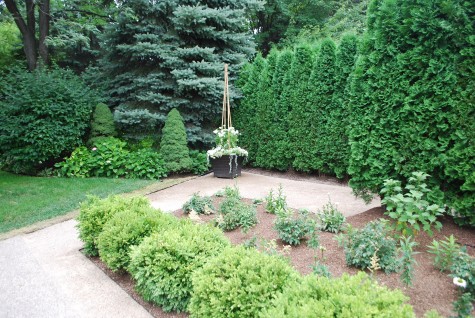
Given that the basketball hoop was coming down, an entire 10′ by 30′ section of concrete could be removed all together.  This 300 square feet would become a perennial garden.  The new drive had an 18″ border defined by a substantial expansion joint, filled with a rubber filler material.  The pattern visually breaks up the large expanse of concrete.   

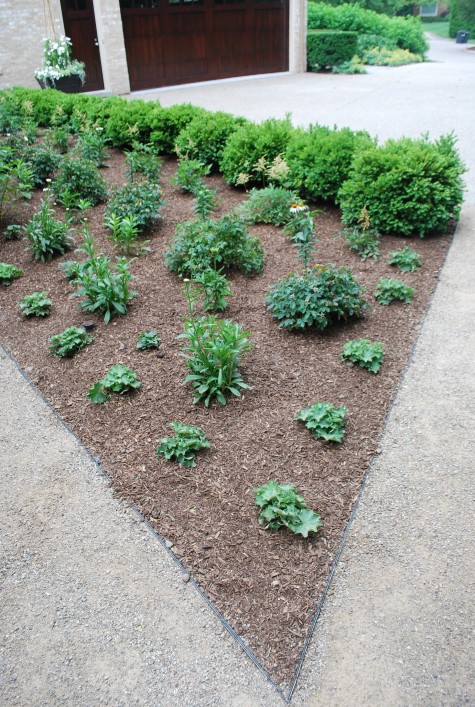
The driveway went in April 16-20th.  Given our relentless spring rain, and the advent of annual planting season, we only got back to finish this project a week ago.  This is a simple perennial garden-only tried and true white flowers.  White hardy hibiscus, white knockout roses, Casablanca lilies, white echinacea, Becky shasta daisies and white astilbe.  My client will not want to tinker with this-her tinkering focus is firmly fixed on her containers.

Nothing much is revealed during  the trip up the drive. This is deliberate.  The arborvitae in the back of the garden is faced down by green velvet boxwood in the front.  The perennial garden is planted in between the evergreens.  This will make for a finished and polished look in the winter-and a sumptuous look in summer.  

Eventually the tall perennials will make themselves known during the summer months.  But for the roses, all else will be cut down in late fall. 

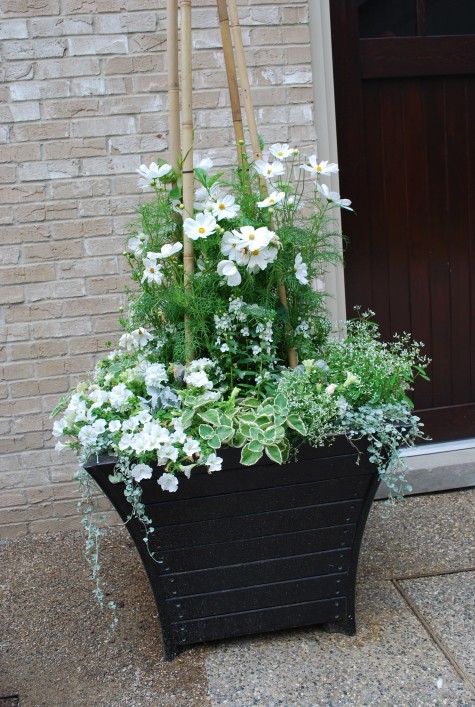
A pair of Belgian oak boxes stained a black brown have been on the rear terrace for a few years.  I brought them out front to provide accompaniement to this garden. I like seeing annual plants in proximity to a perennial garden-they  bloom on and on, no matter the status of the perennials. 

A decomposed granite path leads to the rear yard.  I got rid of all of the grass here-what a nuisance it would be to cut grass in this small space.  Anything I design, I ask myself what will be involved to maintain it.  Let me explain.  Anything difficult or beyond too challenging to maintain means that failure and frustration is bound to loom large. I like any design to be friendly and doable.      

We stuffed the Belgian boxes full of white annuals-white mandevillea, angelonia, Sonata cosmos, petunias, variegated trailing plectranthus, euphorbia Diamond Frost and silver dichondra. They looked great the day we planted.  Better days are to come. 


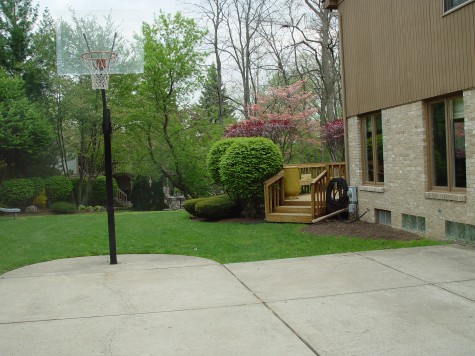
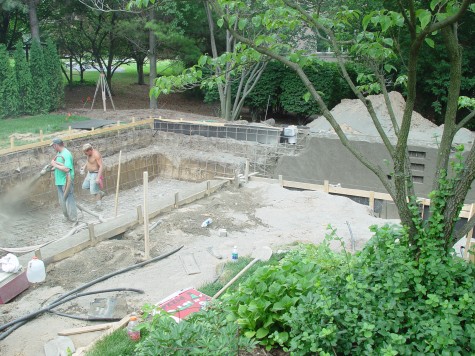
I took this picture the first time I ever saw this property.  Before the pool, and the pool house.  Before the arborvitae hedge. Before the cypress deck, and the stainless steel fire bowl.  Before we took down the basket ball hoop, and replaced the drive.  Before we tore out the pressure treated lumber deck.   A great landscape takes time.  A big block of time. My advice?  Take whatever time your dream takes.

July 4th

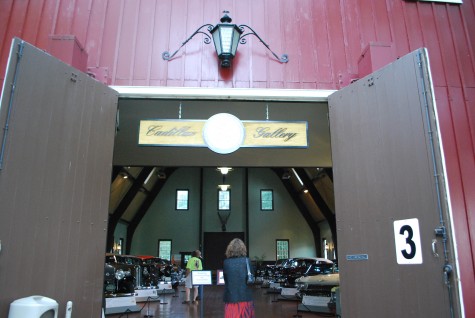
The last stop, on my 4th of July holiday overnight?  A visit to the Gilmore Car Museum in Hickory Corners Michigan.  Don’t forget, Buck was on this trip too.  As any machine that moves and moves fast is of great interest to him, our friends knew he would really enjoy it.  I am a Detroit girl, so of course I like cars-but I was not really prepared for what I saw.    

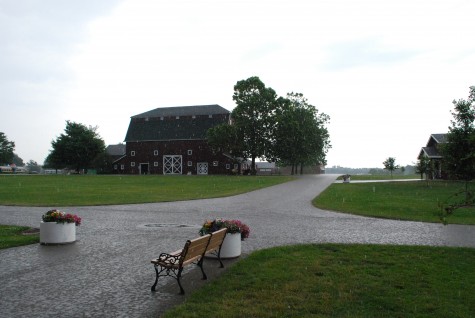
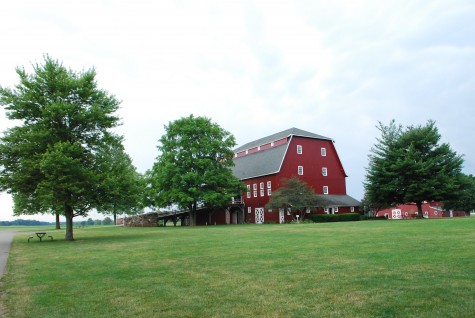
There are over 200 cars in this privately maintained collection. All of the details of how Donald and Genevieve Gilmore came to collect cars, and then open this museum can be accessed via their website- www.gilmorecarmuseum.org. Situated on 90 acres of land, there are 10 restored or reproduction old barns, all maintained in pristine condition. 

They house all manner of motorized vehicles, each one a visual treat.  Most of them I had never seen before.  Though their forms were incredibly varied, all of them had one thing in common.  They were sculpturally interesting objects in their own right.  I cannot imagine the design skill, thought, ingenuity, inventiveness and science that went into the manufacture of these objects. So many different fields of expertise are represented in each vehicle; many people and many processes had to come together in a very precise way.  It is equally as amazing that these vehicles were made in numbers.  This museum is a visual education in the history of the automotive industry.  

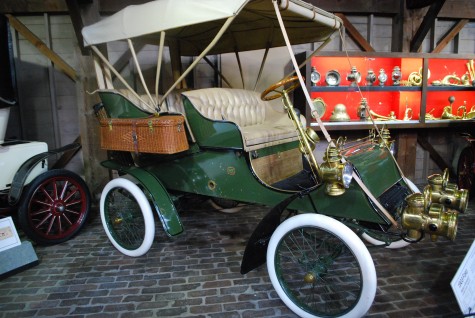
This model A Ford was dated 1903.  But for a few dings in the paint on one side panel, it looked brand spanking new.  The woven wicker baskets on each side-gorgeous.  I don’t have much to say about the individual vehicles, as I know so little about them, but I did have my favorites.     

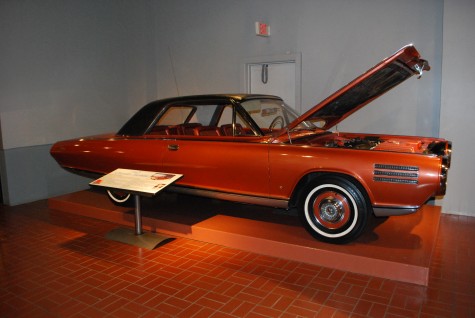
1963 Chrysler turbine

Checker Motor Co cabs

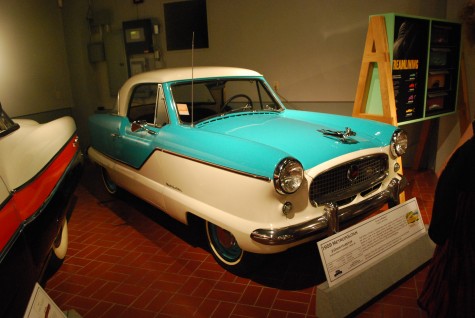
hardtop Metropolitan

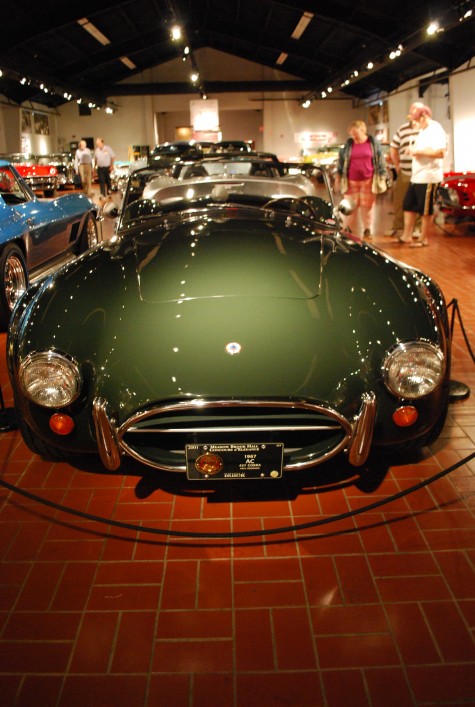
 Ford Cobra, courtesy of Carroll Shelby

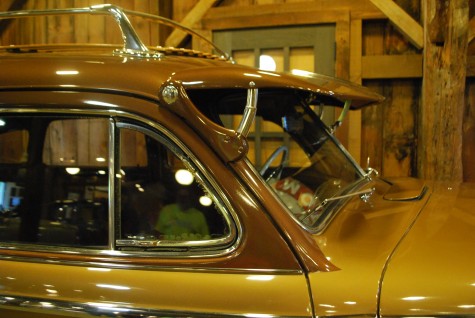
DeSoto detail

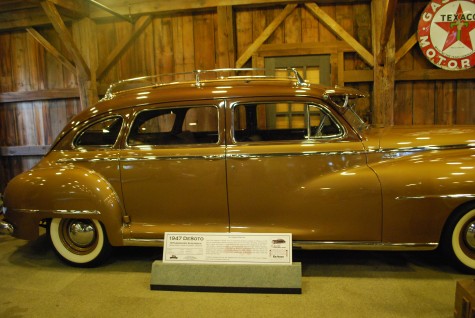
This 1947 DeSoto was my favorite. 


This was an in depth look at a uniquely American phenomena, and an appropriate way to spend a few hours in celebration of Independence Day.

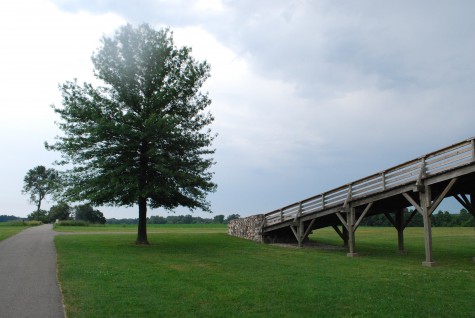
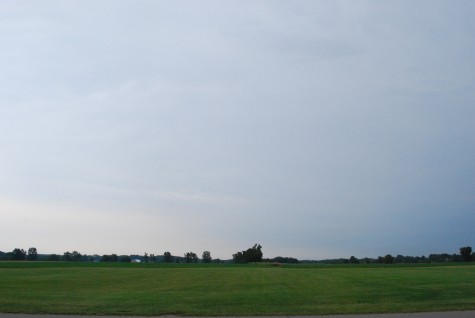
The grounds were every bit as uniquely American style as the automobiles.  The museum sits on a giant tract of land.  As far as I could see, mowed grass, and a few maturing shade trees-mostly sycamores. 

This is a vast landscape, mostly devoted to wide open spaces.

It poured hard for 20 minutes while we were there; what a pleasure to watch the rain.

This dose of Americana-inspiring.

Before And After

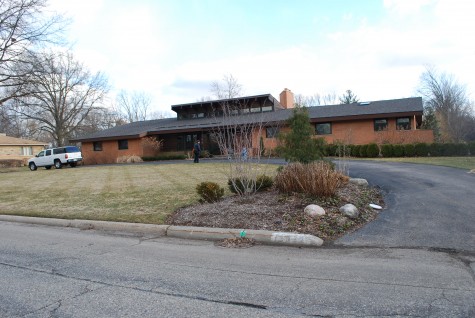
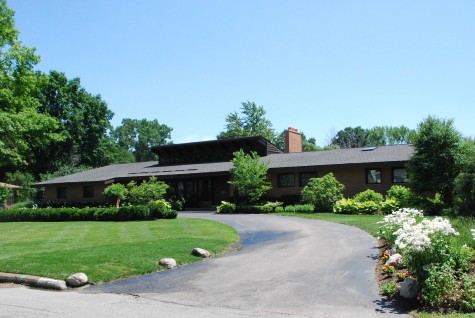
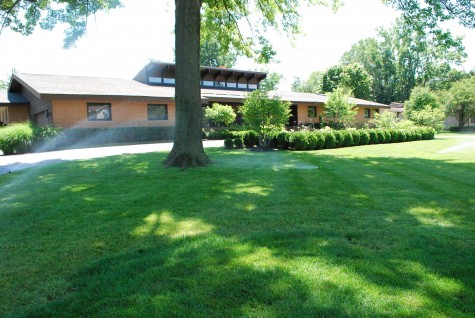
Some of my before and after projects are about such fine tuning, that you have to be there to see it.  This landscape is so dramatically rearranged, you will have no problem sorting it out.  This mid 1960’s modern ranch, belonging to a young couple with small children, had been gutted, remodelled, and added on to in the early 2000’s with the help of architect Michael Willoughby.  The landscape had been renovated, but without much regard for the striking architecture.  From the street, a small bed anchored by a beautiful chamaecyparis, an amelanchier, a few boxwood, and an assorrtment of perennials had suburban landscape written all over it.  A big hedge of globe arborvitae on the right side obstructed any street view of what was planted behind it.  There were boxwood on the left side of the front door, but no answer on the right side.  The left side landscape trailed off in the winter-nothing evergreen going on there.  All of the plant material was good-I just needed to transplant-and transplant lots. 

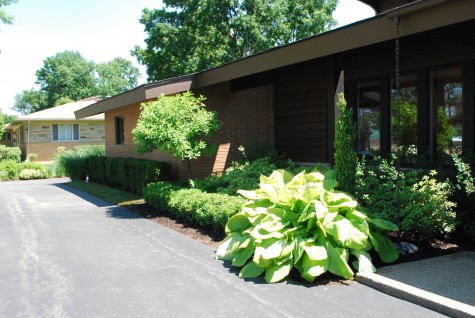
This picture I took today shows the globe arborvitaes moved to the center of the yard on the street side of the drive; they now enclose a perennial garden that can be seen driving up to the front door.  The small marooned bed on the left side of the drive was removed; that space was sodded over.  The chamaecyparis, and the perennials were moved to the right side of the drive.  The fabulous collection of mature Sum and Sunstance hostas are now visible from the street, given the globe arb move.  I am liking the long low slung look of the architecture-punctuated by a few well placed vertical elements. 

The driveway was the primary element of the front yard. But for 2 small and disconnected beds, the majority of the front yard was home to a single large tree, and lawn.  The majority of the landscape was confined to the house side of the driveway. Beds on one side of the drive-grass on the other.  A drive that appears to intersect a large bed makes the landscape more important visually.  Anyone who drives to the front door now has a landscape all around them.  This is very friendly and welcoming to company.

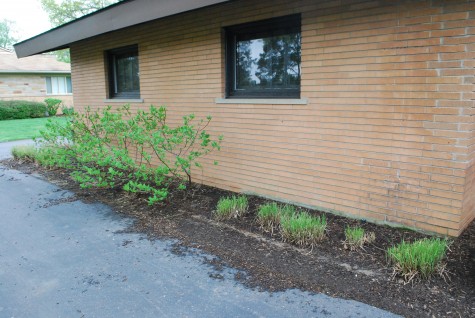
Homes of this vintage-my clients wanted to get rid of the gutters in favor of a cleaner more modern look.  Rain chains would be installed where absolutely necessary.  However, heavy rains pour off this roof.  A barked bed of hydrangeas struggling in the shade, and ornamental grasses do not  make a good winter presentation.  The spring look-not so swell either.  There is a lot of wall here-a wall that seemed to be asking for something evergreen.   

I know we have not gotten to the back yard yet, but the yews in the back yard were suffering in poorly drained soil.  We dug them up, and moved them up front-to higher ground.  Yews respond almost instantly if the unwelcome water gets drained away-this group of yews are looking great.   The grass patch in front of them-a raincatcher.  At some later date, another solution might present itself. In two days, I moved most every shrub on this property to different locations.  My quick idea here-get rid of a barked surface in a place that would get pounded by a heavy rain.    
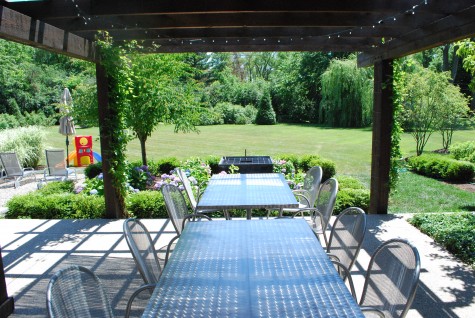
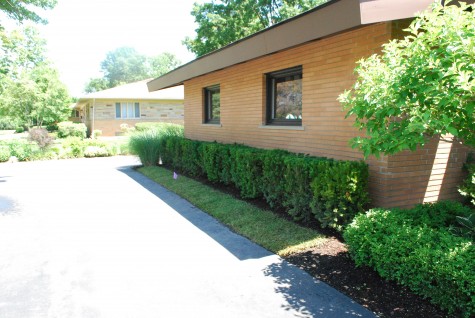
The best part of this redo-a substantial evergreen presence on the left side of the front door.  All of the rest of the existing plant material was beautiful, and very well cared for.  The challenge of this project-designing a renovation that would take full advantage of all of the existing plants.   

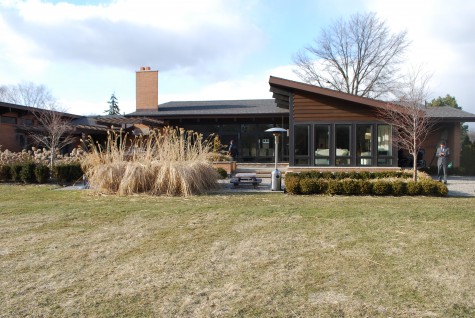
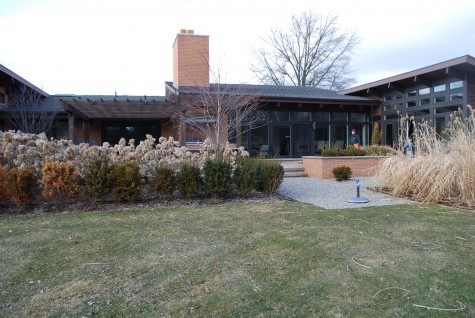
The rear yard was dominated by tall ornamental grasses, and limelight hydrangeas.  I am all for both of those plants-in the right place.  My clients have 2 acres of property.  Their view out to that property was completely obscured from their terrace by plants that grew too tall. 

A beautifully long and low slung house from the seventies asks for a landscape that respects the gestures made by the architecture.  The hydrangeas were a strongly vertical mass in a spot that asked for a view out.  The yews were suffering in the watery soil.   

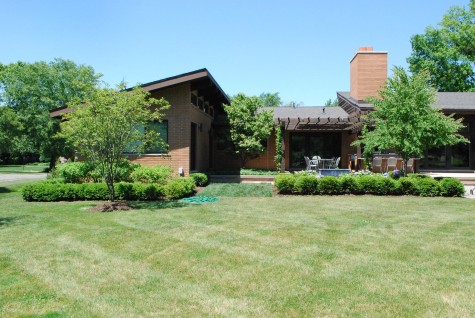
I moved all of the yews to the front yard.  I realigned the beds off of the terrace. The limelight hydrangeas off the terrace I moved to stage left, to in front of the bedroom wall.  The short All Summer Beauty hydrangeas planted in front of the left bedroom wall, I moved to the center.  I recut the three boxwood beds so the lined up with one another, , and rearranged the boxwood in a symmetrical way. A grass panel between the beds permits a great view of the dogwood on the terrace level from the yard.   My idea?  A crisp and clean landscape.  And a great long view from the terrace to the far landscape.  

Minus the yews and limelight hydrangeas, there was space for a fountain cistern.  We placed and installed it today.  I hear tell there will be water next Tuesday. The scale of the landscape here is better in keeping with the terrace.


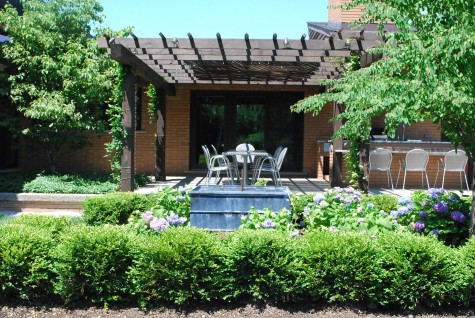
Last summer, my clients had a view out of of the sides of a big block of limelight hydrangeas.  Today, they have a a great view of their yard from their terrace, outdoor kitchen, and a pergola.  A great pair of modern dining tables and chairs are just asking for friends and family; everyone has something to look at now.  The fountain cistern is a mid-ground focal point; the sound of water will be lovely. I could not be more pleased about the great views they now have of of their property.  All of the effort that has gone into the far landscape can be seen now.  A good bit of their shrubby plant material found homes where they could better be appreciated.