Trees For Big Spaces


There are those trees that grow to an astonishing height, width, and girth.  The dawn redwoods in California-they are legendary, given their enormous size and age.   In Michigan, we have giant beech and maples in our climax forests.  The biggest trees I have ever seen in person are in the Upper Peninsula of Michigan.  Even the birch and the cedars grow to enormous size.  None of these trees were in yards-they were all part of virgin forests protected by the state.  Large trees need large spaces to flourish.  It has been some years since I re-landscaped this property around a very large copper beech.  I regret to say that it was recently cut down, and a smaller beech planted in much the same area.  As I could not bear to take down a magnificent tree of this age, I am very careful about placing them in the landscape.   
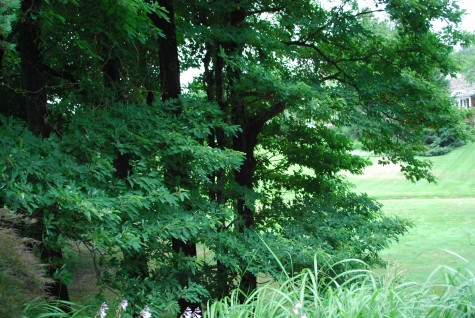
 If you are like me, you have a small property stuffed with no end of plants.  The one large Norway maple on my property influences the health and happiness of every plant within the reach of its shade and surface roots.  I dislike dealing with the consequences on the ground from this tree, but it is worth the trouble. At least it was planted 30 feet away from the house-for that I am grateful.  Small city lots are not so well suited for big trees-they need  wide open spaces.  This beautiful grove of sassafras trees is stately and elegant-and too large to capture with a camera unless I were in the yard next door.  Large properties like this are ideal for big trees.    
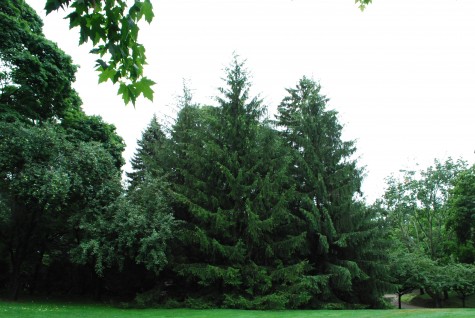
In another spot, a graceful trio of weeping Norway spruce that are so large they have become a single tree.  Removing any one of the three would reveal a not so green interior. But one thing is for sure.  All three have all the room in the world to grow as large as they might.  Any large growing planted forced to fit into a space that is too small invariably has that tortured look.  I rarely see a burning bush planted in a sufficiently large space.  Every euonymus alata compacta grows to 8 by 8 feet-and faster than you think it will.
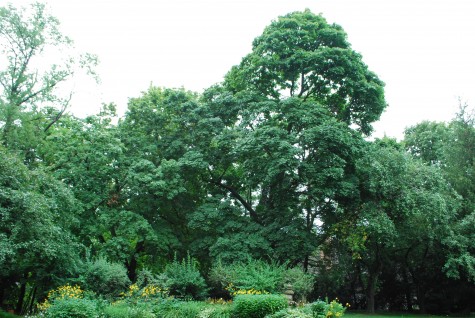
 

I have 8 Norway maples in my tree lawn.  The tree lawn?  That space between the sidewalk and the street is the tree lawn.  I would guess those maples have been there 60 years or better.  All of these very big and old maples are  failing; every year another giant branch fails to leaf out.  How so?  The concrete space between the sidewalk and the street makes for roots that go round and round.  Girdling roots can eventually strangle a tree.  My big street trees were beyond surgical help when I moved there, I am sorry to say.  I am too embarassed to publish a picture of my trees.  I would rather you see this old maple, growing vigorously. 
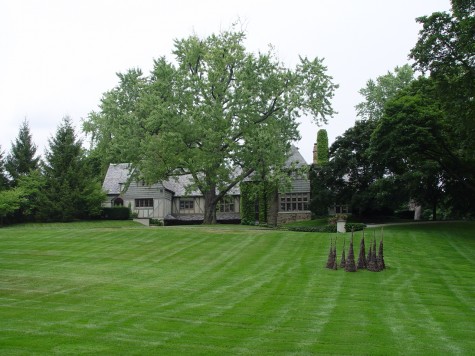
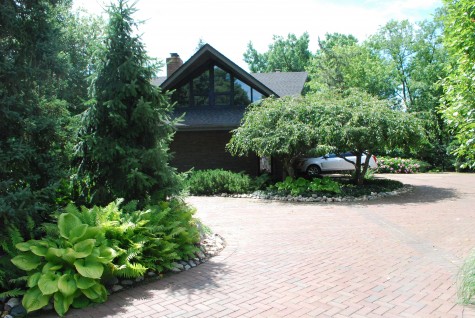
This beautiful oak tree is in a confined space; a driveway sunken below grade makes it impossible to see the drive from the street.  That circle is probably 45 feet across.  Whatever the space, it is enough to keep the tree happy and healthy.   
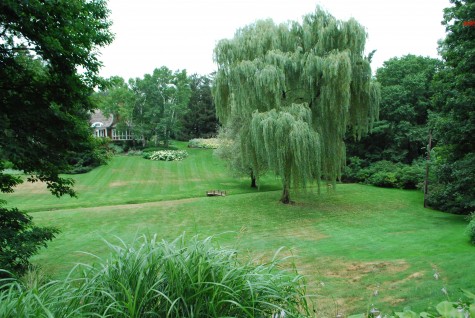
Weeping willow trees endure all sorts of bad press.  They are weak wooded and are always dropping branches.  But they have a great beauty about them, grown to stand alone in a large space. 
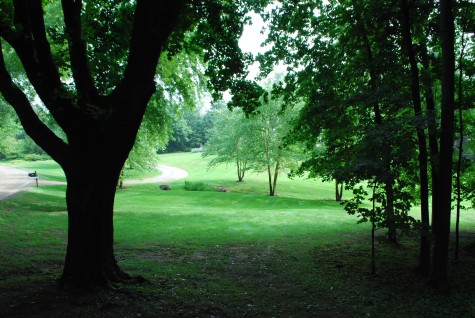
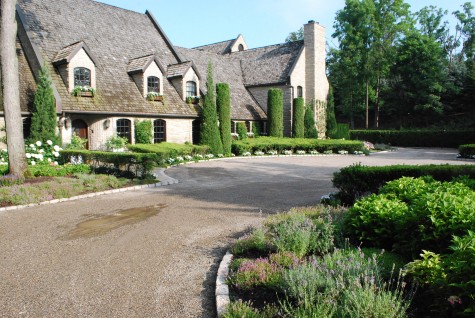
Trees and lawn spaces can make for very powerful and evocative landscapes.  People in this neighborhood have resisted paving the roads, even though the issue comes up for review every few years.  My client has beautifully peaceful views from her large property to the one adjacent.  The country style gravel road makes the landscape appear all the more bucolic.
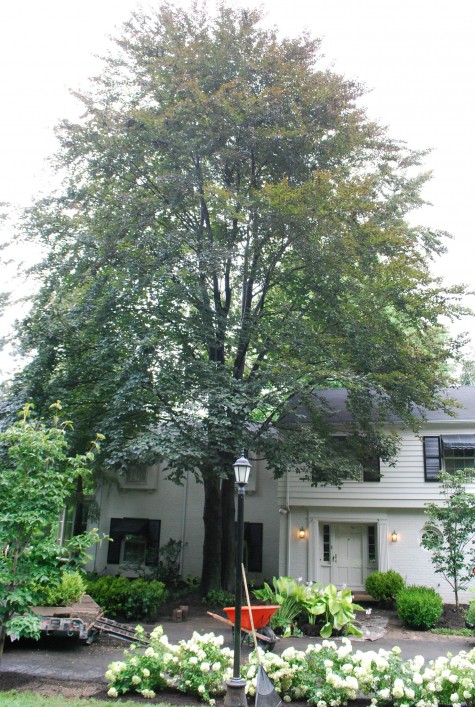
  

This landscape is entirely dominated by a double trunked green beech of astonishing size. Part of the landscape renovation will involve some changes to the irrigation system, as well as a plant palette that will cope with the shade cast by the beech.  I am sure when the tree was planted it was quite small by comparison to day.  Though it is badly placed, it is much too beautiful to take down.  So we will build on it.
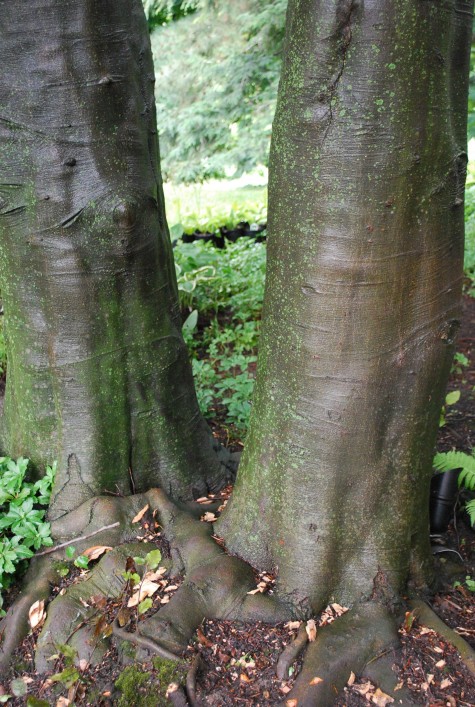
Twin trunks-beautiful, aren’t they?
Trees For Tight Places


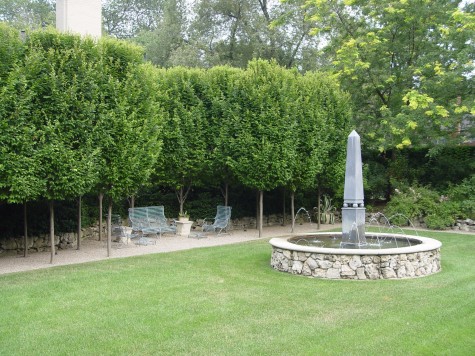
Any landscape is predicated on a finite amount of space.  A property could be described by a certain amount of square footage on the ground plane.  A landscape is comprised of lots of different elements, the largest of which would be the sky.  Next up, the trees.   I suppose a small urban property could be forested like woodland, but that assumes  the gardener has only one use in mind for their landscape.  Fortunately, trees come in all sizes and shapes.  A number of trees have a fastigiate, or columnar form.  This means just what the word implies.  The foliage or needles grow naturally in a column.  A tree with a restricted spread is a great choice for small gardens, for gardens that ask for screening, and for gardens asking for natural ornament.  Years ago, this side garden was in full view of a neighboring house.  Today all that remains of that view is a chimney.  The arrangement of pairs of columnar hornbeams have created a natural pergola that is home to a shady seating area.   

My first visit to this property immediately brought the idea of columnar trees to mind.  The back yard is very small, and adjacent properties very close.  The prominent feature of the yard-a beautifully constructed wall.  The soil had been mounded up against the wall, and boxwood had been planted against its base.  In the front of the bed, a collection of perennials. The boxwood and perennials obscured rather than featured the wall,  nor could they possibly provide screening from a neighboring house. The rear yard screen of hemlocks had grown thin, and was very wide at the bottom where no screening was really needed.

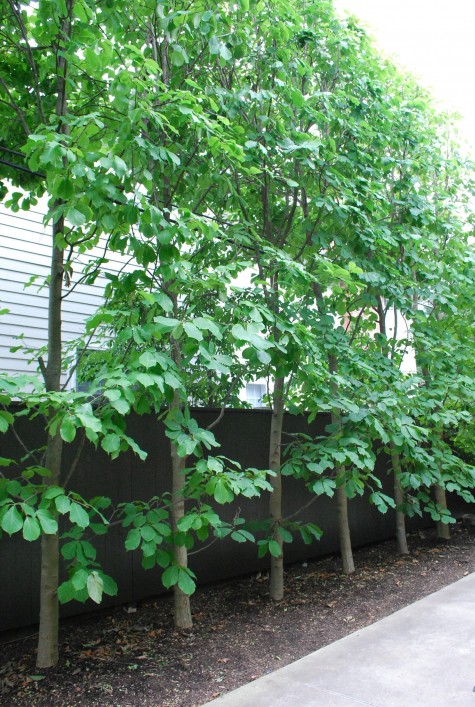
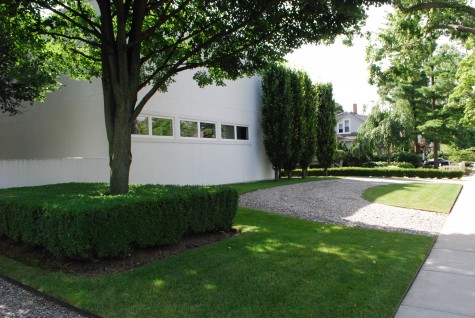
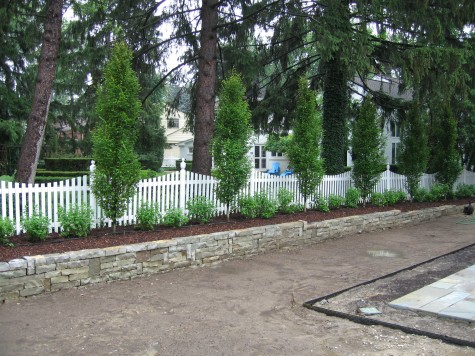
These columnar Bowhall maples will eventually completely screen the neighbor’s garage wall from view.  Lowering the grade meant much more of the wall was available to view. The hemlocks were replaced with Thuja Nigra, an arborvitae that grows narrow and tall.  A very small yard is now completely private, given the planting of  fastigiate trees.  The maples only occupy the air space; their pole-like trunks take up no room whatsoever.  The arborvitae are narrow at the bottom as well as the top.  This helps to make a very small space feel spacious. 

This back yard sloped steeply towards the foundation of the house; water in the basement was a problem.  A retaining wall permitted the soil at ground level to be graded away from the house.  The top of the wall was planted with hornbeams  spaced at 12 feet apart; they will grow together faster than you think.  Carpinus fastigiata is naturally broadly egg shaped, but it is quite tolerant of pruning.  The hydrangeas will make the wait for the trees to grow a little more tolerable.  It will be interesting to see what direction the client wants to take with pruning.  They have time to sort that out. The wall also gave the trees a little leg up, screening out the neighboring property.

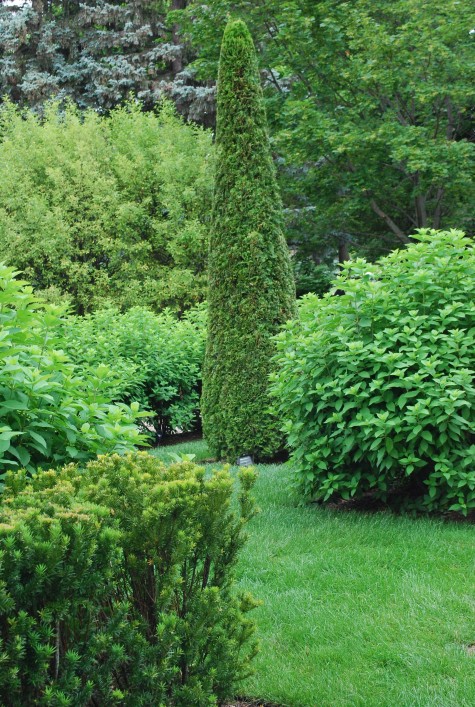
Arborvitae have a naturally columnar shape, but they also adapt quite well to closer pruning.  This landscape called for a vertical element which would not shade the surrounding plants.  A once yearly pruning is all it needs to keep it in shape.

This landscape features both pruned and unpruned arborvitae.  The pruned cylindrical shapes are very interesting and sculptural.  Pruning any tree or evergreen should be undertaken over time.  It has taken my palabin lilacs on standard 2 years to recover from the shock of my pollarding fit. 

There are those trees that are not particularly columnar by nature, but they are amenable to pruning.  The hybrid magnolia “Ivory Chalice”, a cross between magnolia acuminata, and Magnolia denudata, has been priuned to stay within the confines of this very narrow space along a driveway.  They have been happy here for over 10 years.

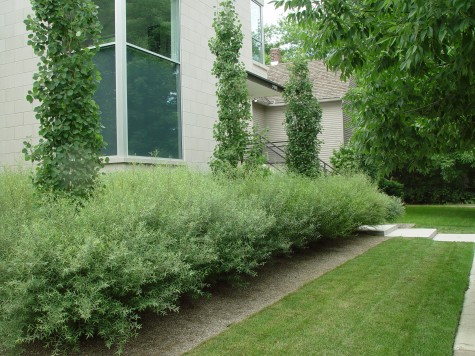
Populus tremuloides erecta , or Swedish columnar poplar, is a loosely growing columnar tree that will eventually provide some screening for the giant windows of this contemporary home. The rounded and scalloped leaves flutter in the breeze just like any other popple, and the fall color is great.  This tree may occasionaly have a branch that falls out-a little pruning will put that to right.  Even older trees are not much wider than 5 or 6 feet.

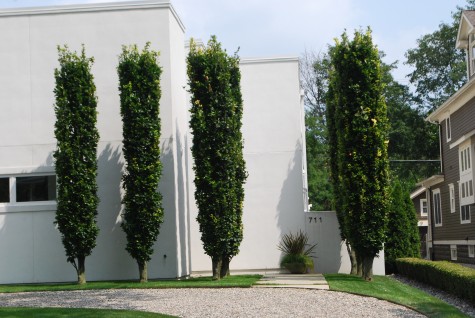
Of course the queen bee of columnar trees has to be the fastigiate European green beech.  Properly cared for, as these are, they make a very strong vertical statement. 

Once these trees reach the roof line of the house, they could be pruned flat.  Age will only improve these fine trees.

The Garden Cruise

I will admit to being a little tired today-the garden tour is an all day affair.  It happened to be conducted in 93 degree heat-but I am happy to say we had a great turnout.  The gardens to the last looked fresh and well tended.  The annual plants are thriving on our heat.  I did go through 3 cases of water at my garden-most people come to my place in the afternoon.  But I had a little treat waiting for the hot and the tired who came after 2.

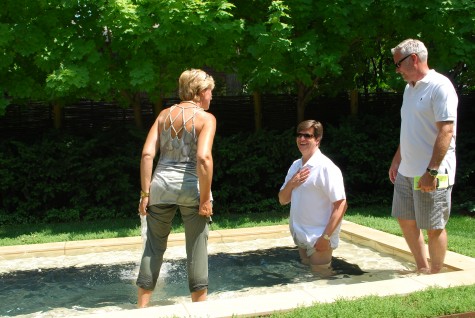
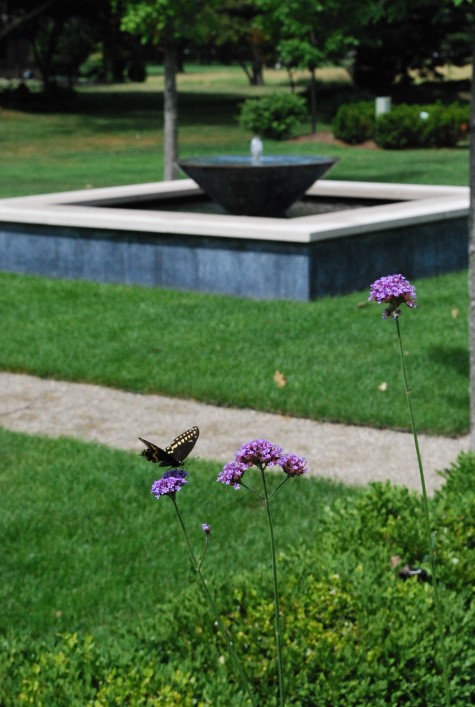
 My fountain is my most favorite feature in my landscape.  It is a pleasure to watch, and to hear.  But it turned out to be quite the cooler for my overheated guests.  I invited everyone to take off their shoes, and get in.  Almost everyone took me up on the invitation.   

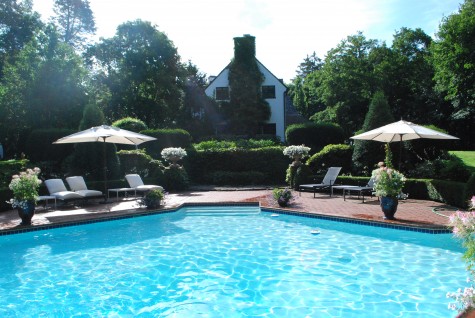
Six of the seven gardens on tour featured water in some form or another.  A pair of beautiful swimming pools-one from the late 1920’s, and one from the 1970’s-each made a strong visual statement.   I myself would not want one.I have a scaled down, hybrid version of a swimming pool.  My fountain is filtered and cleaned with same equipment that cleans a pool or spa.  This means my fountain does double duty-when I have a need, I get in it, and cool off.  This fountain could be home to a hot gardener, but yesterday it was home to a school of goldfish and some water cabbage.    

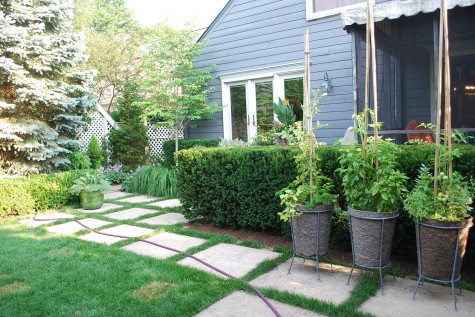
Not everyone has space for a vegetable garden that consumes acreage.  This small garden has a trio of tomatoes, underplanted with various herbs.  What is better in late summer than homegrown tomatoes?  This very small garden made a big nod to the idea of good food from the garden.

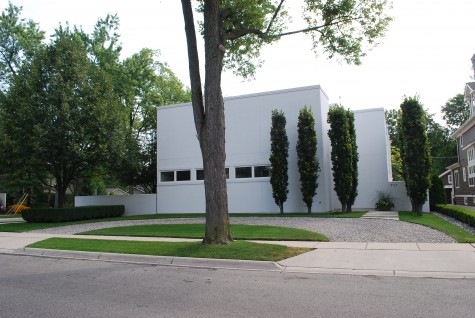
This very contemporary home I landscapes probably 16 years ago.  The columnar beech are maintained at a level beyond my wildest dreams.  It is an intellectually ad toughly minimal landscape.  I was happy to hear the level of discussion that I did.

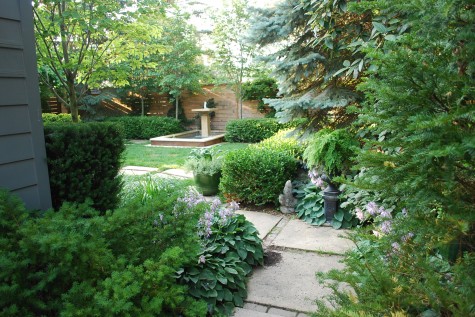
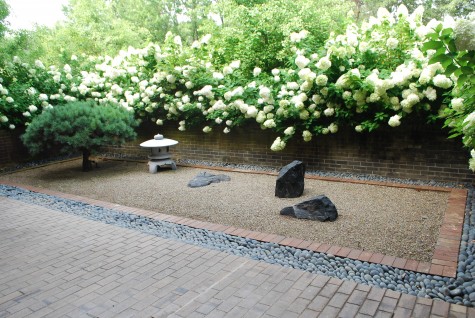
When someone calls me to design a Japanese garden for them, I direct them elsewhere.  I am a westerner by heritage, culture and experience.  Under no circumstances could I design a Japanese garden-I am woefully inadequate.  In this case, I did reluctantly design and plant a contemplative garden in that Eastern style.  There was much talk on the tour about this small space-unexpected, it was.  No kidding-it is the only landscape space I have ever done like this.

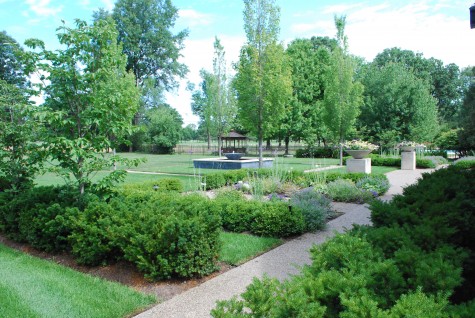
One of the Dearborn landscapes is freshly done-it has been in ground but 11 months.  The son of one of my oldest and most treasured clients got the bug for gardening from his Mom.  Many thanks, CB.  This house new to he and his family has been completely renovated.  A pergola with a solid roof is slated to go over his western facing rear terrace any day now.  This formal landscape with a decidedly modern twist-fresh and striking.

Perennial gardens,planted largely with white, purple and lavender hardy plants, got some help this first season from some verbena bonariensis. 

A Normandy style tudor on acres of land belongs to oted interior designer Linda Powers.  I had nothing to do with this old and established landscape.  I came late to the landcape conversation; I consult with her about her container plantings, and plant them.  Her garden was the subject of much conversation.  Her old Stewartia in full bloom-on every Iphone in the group.


It was a very hot day, yes.  But all manner of keen gardeners came out, and toured.  The reception afterwards-I had such a good time. At 5pm, Buck promised he would water the pots, so I could go that afterglow party.    I live a charmed life.

Garden Cruise Tomorrow

A few years ago this client in Dearborn put her garden on the garden cruise we sponsor every year to benefit the Greening of Detroit. If you are not familiar with the Greening of Detroit, in the past 21 years, they have planted thousands of trees, sponsored hundreds of urban farms, and made respect for the environment a mission.  Our tour raises money for them.   I had been working on her landscape for a good many years, and she was kind enough to agree to share it with others.  I am pleased to say that this year, her son Rich and her son-in-law Jason, have agreed to put their gardens on tour.

They are both young people; one landscape I designed and planted only this past summer.  Jason’s landscape and garden is entirely of his own design and installation-he goes so far as to grow his own flowers from seed under lights in the winter.  The landscapes represent very idividual tastes, and are entirely different.  What I like the most about them both is that young people are growing them.  I visited CB and her garden while I was in Dearborn checking out the tour gardens.  She and I both were struck by how the landscape suddenly seems mature and finished.  The landscape is looked after by Melissa and her crew from M and M flowers-her level of maintenance makes every landscape she tends look great.

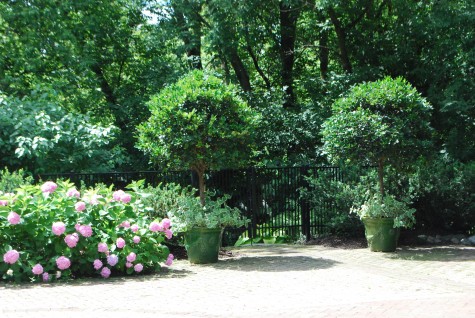
I have wintered these wax leaf privet single ball topiaries in a greenhouse for the past 8 years.  With root pruning in the spring, we have managed to keep them in these glazed French pots for 8 summers.  The hydrangeas were originally planted in the front of the house.  I moved them here to take advantage of a bigger dose of sun.  They seem entirely happy now.  Planting a landscape is just the beginning.  Some things will not do well.  Other things ask for a different spot.  Moving things around is part of an garden experience.  Most everything thing can be better, if you have patience and resolve.  I try to own up to mistakes early on, so the moving is not such an ordeal. 

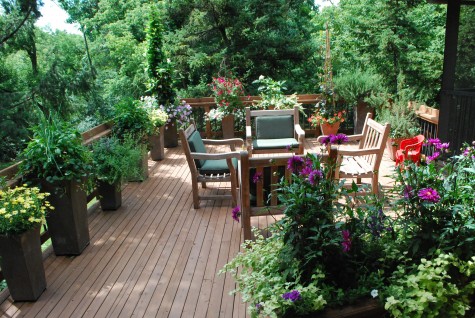
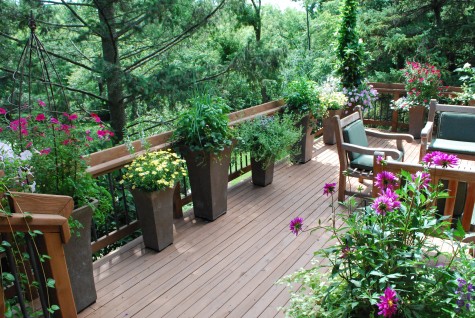
CB’s house is situated on a very steep lot; a deck upstairs spanning the entire barck of the house is her garden in the air.  Lots of containers help to create that garden.  On the far right, an old wild rosemary that spends winters in a greenhouse supplies the kitvchen.  On the left, 3 pots devoted to herbs-mostly basil.  To trail in the basil pots, everbearing strawberries. 

There are never many strawberries, but the idea of it is enchanting, and the texture of the strawberry leaves is great.  Tidal wave petunias, mandevillea and dahlias are thriving in the high heat we have had.

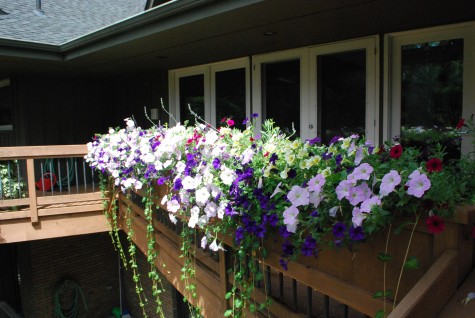
My only addition to the deck was to plan and build a pair of very long planter boxes installed outside the deck rail.  This keeps water and debris from the boxes off the deck surface.  Lavender, purple and yellow petunias are punctuated every so often with dark red violet potunias.  The trailing vinca maculatum will traill almost to the ground by the end of the summer.  There is very little maintenance to them. 

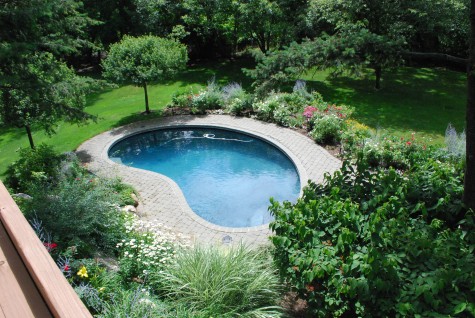
Several large perennial garden enclose the pool.  They have been struglling in recent years; the local deer polulation has exploded.  This year, Melissa installed steel post 4 feet tall all the way around the gardens, and strung them with three rows of fishline.  The deer have not touched a thing all season. I can hardly believe this is working, but it is. The lollipop Coralburst crabapple pictured is one of a pair that were planted in celebration of her son Rich’s wedding years ago.  They have matured beautifully. 

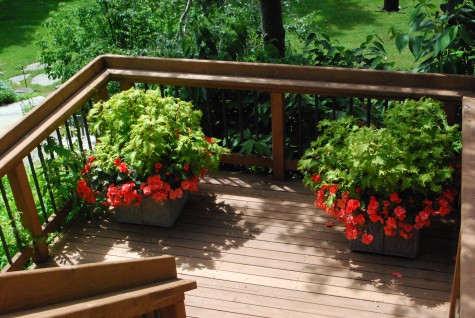
On the landing, two lead boxes with green coleus and orange begonias.  All of the containers have drip irrigation in them, and they stay in place all winter. The taupe colored terra cotta pots are frostproof terra cotta from Italy.  Each pot is elevated on feet, to prevent any water from collecting and freezing underneath.  I always enjoy planting these pots, and I enjoyed even more going back and visiting both the garden and my good friend CB. 

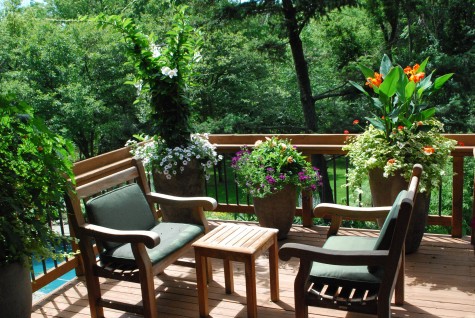
A small deck off the master bedroom is large enough for a pair of comfortable chairs, and 4 large pots.  The branches of some old Norway spruce in the backdround are a reminder of how high up in the air this garden really is. 

CB is an accomplished gardener, but today I am thinking about how much she has nurtured that interest in two young people in her family.   In my estimation, she has accomplished something very important.