Time

dunlap3-3

This Friday past I wrote some about a landscape renovation project I did in 2002. I planted a slew of carpinus fastigiata grown in 25 gallon pots for the bosquet pictured above.  The need for so many trees suggested trees of a reasonable price;  my clients understood that small trees would take hold fast and grow. No plant decision is ever easy; big trees that are transplanted at worst fail, and at best, take years to feel at home, root, and move in.  New landscapes are not hard to spot, even if large plant material is installed.  Most newly planted  plants have that distinctive look common to nursery grown plants.  Growers have different goals than gardeners.  But three years after the installation, these trees are starting to do what I knew they would, given time.
dunlap-2-9

Growers pay plenty in taxes for the land they own.  Their idea is to plant as many plants as they can,  per square foot.  A grower needs to plant closely, and harvest often.  So trees and shrubs are grown as closely together as good horticulture will allow.  These carpinus did have that skinny, grown in a row, look. Planting them too close together would have made for problems later, so there were some years my clients had to suffer the gaps in their screening.
dunlap-1-25

Perennials, including roses, are more quickly adaptable. A two gallon perennial is a big plant which will take hold in one season, given a serious gardener.  What you see here has everything to do with a gardener in charge. Though relatively easy to establish, perennials are plenty of work-deadheading, dividing and the like.  They also have a short lifespan, relative to trees and shrubs-unless we are talking peonies and asparagus.
dunlap-8-06-32

The small hornbeams took hold, rooted in,  and grew.  This photograph taken 5 years after the installation recorded a dramatic change; the view of the house next door is fading fast.  The bosquet is now a shady place to sit.
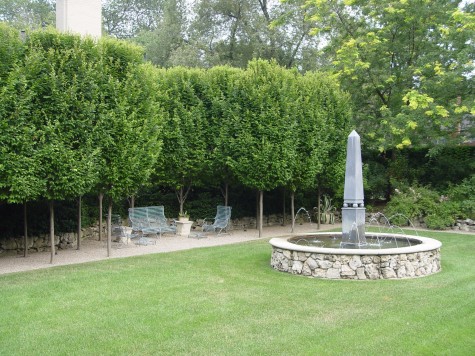
dunlap-8-06-35

What once was dirt-what once was a spare diagram for a space, is growing vigorously.  The day the installation was finished, these clients took ownership of the maintenance. It is a very good thing when a client picks up and carries on.   It did take some time to work out the irrigation issues, and there is a big pruning job to be done every spring.
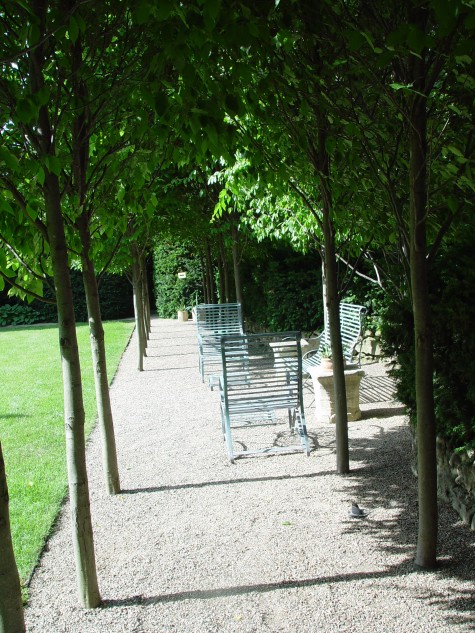
dunlap-1-22

They have pruned the interior branches such that the trees provide a vaulted green ceiling.  A suite of iron furniture is complimented by a pair of antique English capitals.  The long view to a group of  agaves in stone pots, and a birdhouse, is a good one.  A garden needs time to establish a look like this.
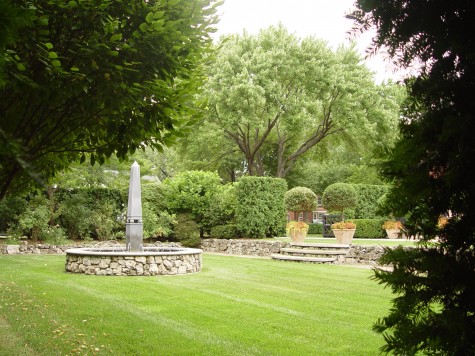
dunlap-8-07-18
The landscape is beginning to look in proper proportion to the existing mature trees and yews on the property .  Proper scale and proportion is tough to plan for, as it has to be imagined.  With time, any mistakes is spacing or choice of plant material will become apparent.  I see landscapes only 5 years old that are overplanted, and consequently overgrown.   This landscape is just beginning to hit its stride.
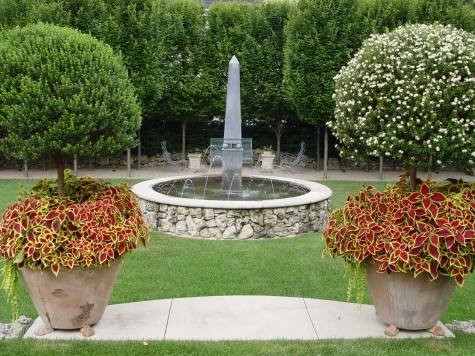
2006-pots-139

Even the topiary myrtles that go to the greenhouse for the winter have grown.  Their trunks have become substantial. Making something grow is no small accomplishment.  However, the patience to give a garden the time it needs is sometimes the best move you can make.
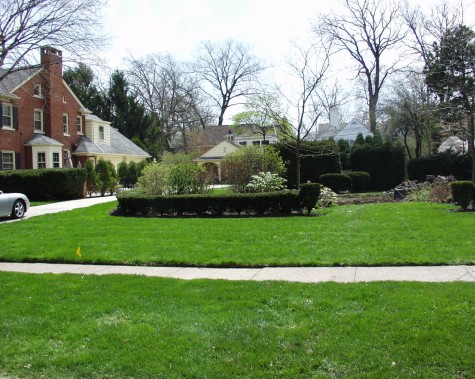
Saving the Stone

dunlap00141
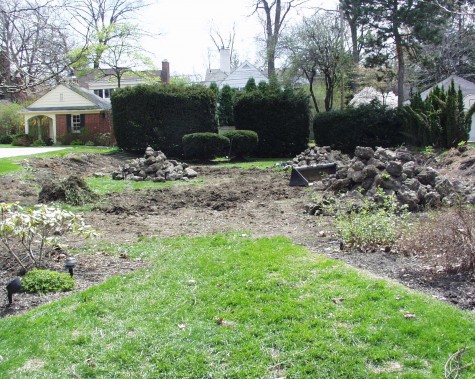
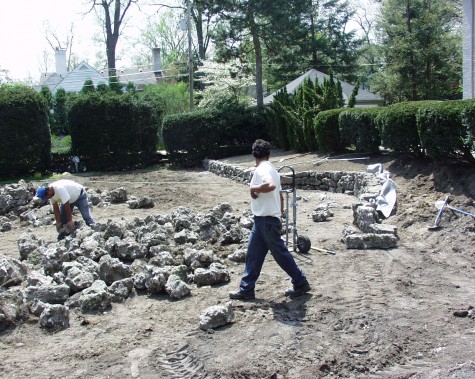
Eight years ago a client came in with a plan to renovate the side lot adjoining his 1920’s vintage house.  This part of his landscape had been a series of free flowing beds of flowering shrubs and perennials, edged in a volcanic rock I call Castelia stone.  Named for the town in Ohio where it occurs naturally, I see this stone in fountains, etc, at homes of this period.

dunlap0016
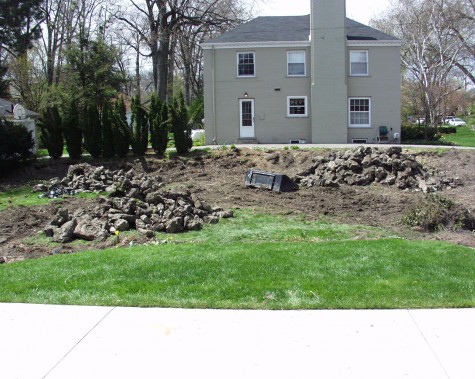
The land dropped dramatically from the grade of the existing driveway.The plan called for hauling away all of the Castelia stone, and installing a terrace of concrete pavers.  Alarmed by this, he thought a second opinion might be in order.  The stone was no doubt spectacular, and there was a lot of it.
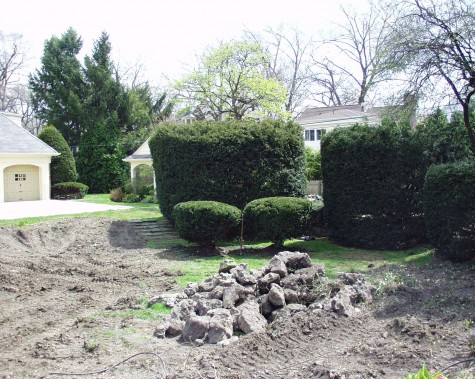
The  design issue of the day?  How could that stone be featured in a landscape that would be beautiful and appropriate to the house.? After hauling away ten yards of debris from overgrown shrubs and scrub trees, it became apparent that stone could be the key to solving the grade issues.dunlap00071
The land was a giant dish, bordered by my client’s drive, and his neighbors drive.  This stark view to the neighboring home was the dominant visual element.  I told my client I thought a formal sunken garden would be in order-an idea in which the existing stone would play a prominent role.  Sinking the garden down 20″ would also make the job of screening the neighboring house easier.

dunlap0021
An old flight of steps, now blocked by a yew of great age, had been the only access to this area of the garden.  The decision was made to orient the new sunken garden around a side terrace adjoining the house, and plans were made to allow for good access to the space.

dunlap20002
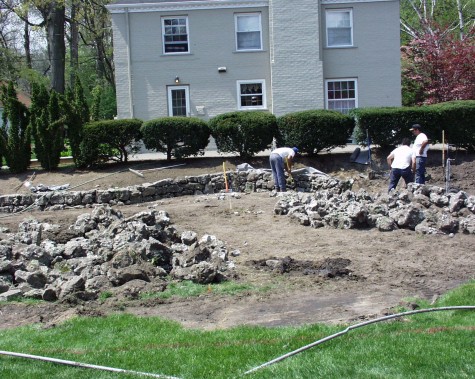
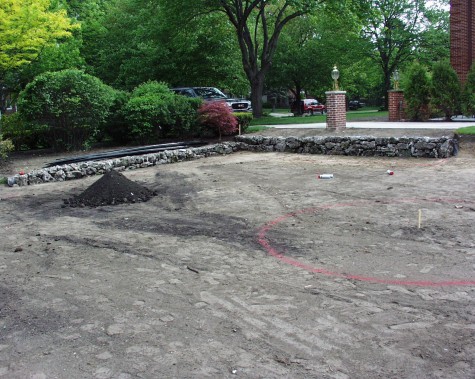
It is one thing to use materials that existed in an old landscape;  it is another thing to use it in such a way that it appears to have always been there.  The client was interested that the new landscape seem like it had been built on top of the old one.  We transplanted a row of old yews that had been a foundation planting across the front of the house to the lot line adjoining the neighboring house. We then sloped the soil down to a 20″ tall retaining wall of the old stone.

dunlap20005
Each stone was fitted into the wall by hand and by eye.  The use of any power tools to force a fit would have interfered with the illusion of age.  The evidence of modern tools would have immediately dated the wall as a contemporary construction.

dunlap10004
The ground was graded and regraded; soil was brought in to fill areas that were low; the ground plane was topdressed with topsoil in anticipation of the lawn.

dunlap10013
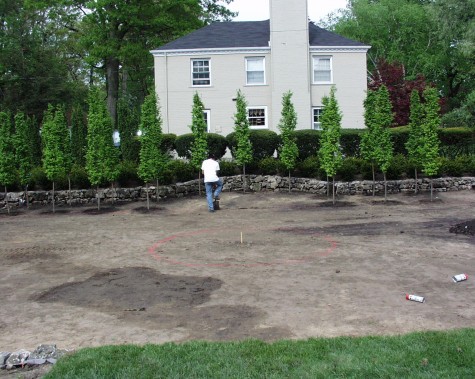
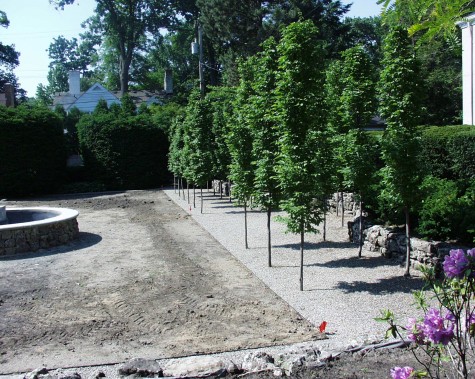
Densiformis yews were planted solidly on the slope down from the neighboring drive.  This gave the background landscape a bit of a contemporary feeling. The French word bosquet refers to a densely planted block of trees, which when grown in, provides an architectural element similar to a pergola.  These 25 gallon potted columnar carpinus planted as such would make an allee across the back of the garden, and would eventually screen the house next door.

p6100004
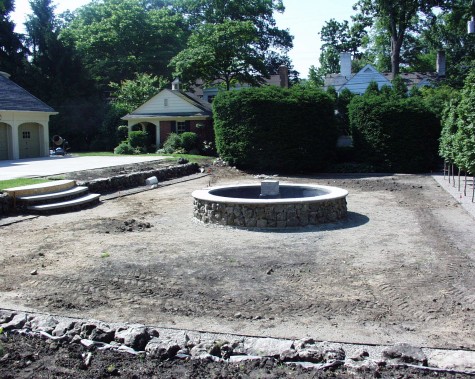
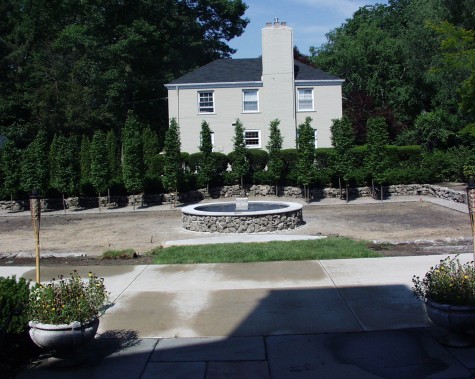
It was decided that a fountain, whose basin would be faced the in the same volcanic rock, would anchor the space.

p6100003
Edger strip was installed, and decomposed granite provided a hard surface under the bosquet.  This treatment also formalized the edges of the lawn panel to come, and celebrated the irregular surfaces of the stone.

p6100011
The radius of the fountain dictated the radius of the center of the bosquet. The center would have room for garden furniture.

p6150023
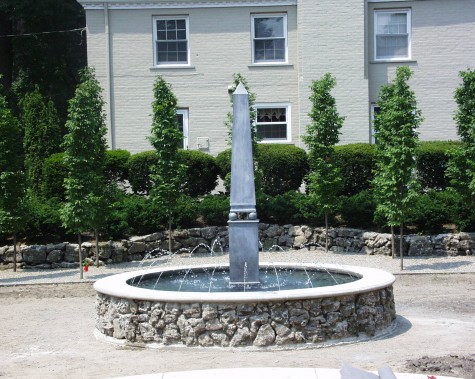
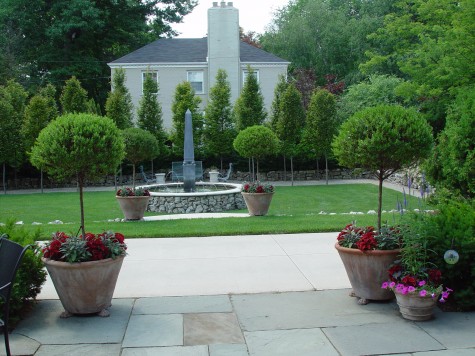
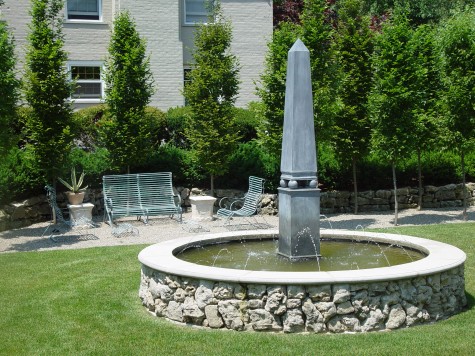
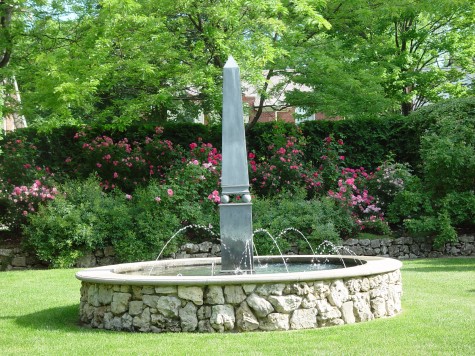
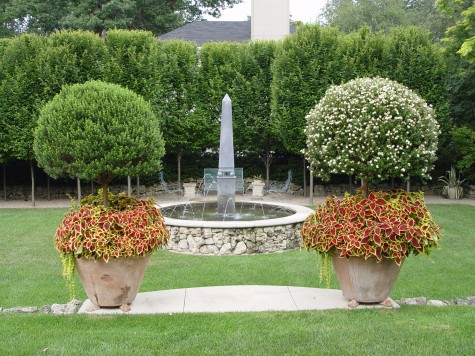
A contemporary European lead obelisk is a striking contrast to the stone.  A lawn panel is all that is missing now.

dunlap1a-1
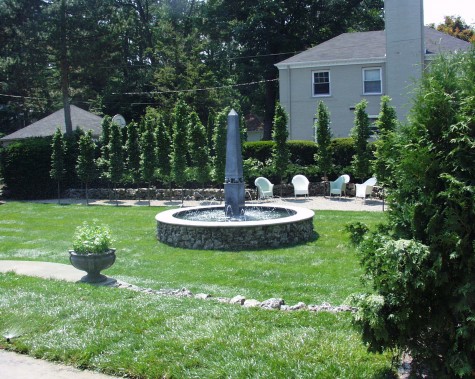
The resulting landscape is a great place to view whatever the weather, and a great place to entertain.  Its composition makes much of the relationship of old materials, and my client’s more contemporary design sensibility.

A Roof Over One’s Head

2007-barrett-construction-11-07-2
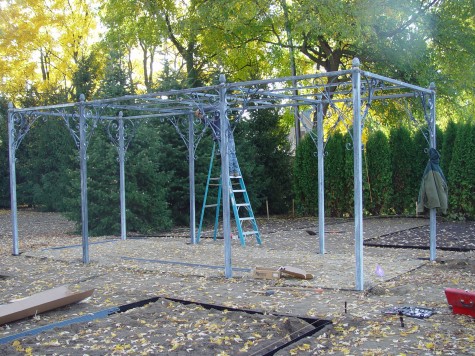
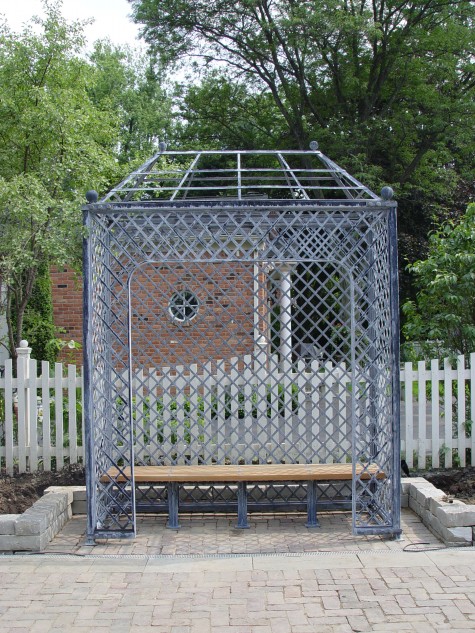
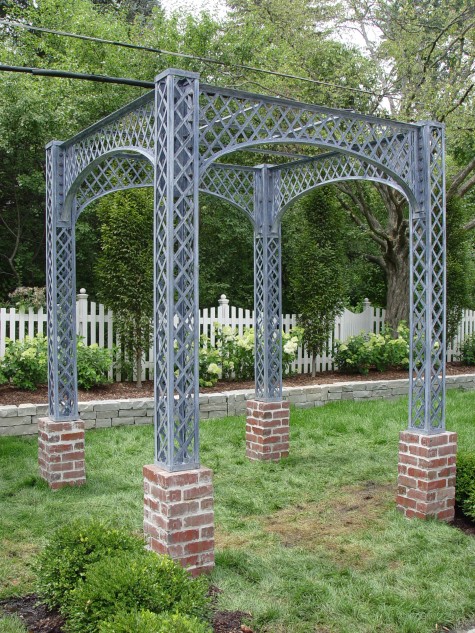
Pergola, arbor, gazebo,pavilion, grotto, umbrella, gloriette-there are plenty of  words that allude to a roof over one’s head in the garden. This steel pergola, at 9′ by 24′, is large enough to comfortably host a dinner party, or provide a spot to sit and view the gardens yet to come.   This pergola also provides a structure on which to grow vining plants. In this case I plan for 3 species of clematis.  The vigorous growing sweet autumn clematis will provide a living roof; the species clematis vitacella violacea, and clematis Jackmani Superba will bloom profusely with small flowers, up over the roofline.
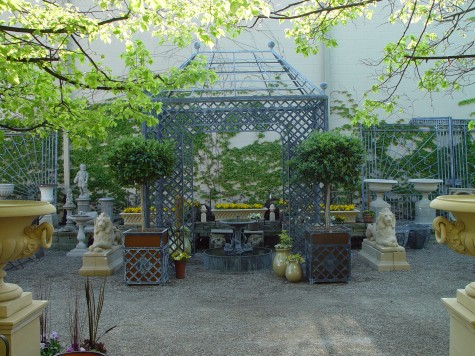
gloriette3This pavilion is very much about enclosure.  It would be fine with vines, and fine without.  The client who purchased this steel “building” had us construct cedar and steel benches for the sides; it became a place to meet in her garden.
e01

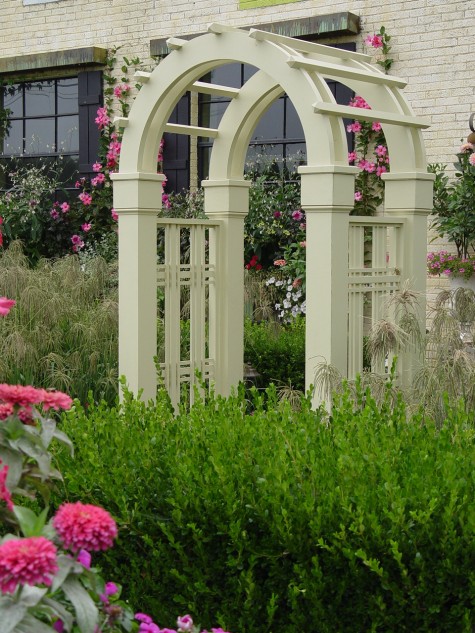
 An arbor celebrates the transition from one garden room to another.  An architect friend once explained to me that transition spaces in buildings are important.  Thery provide a space to exit, and a space to anticipate what is to come.  Wood arbors have a very attractive look, but there is maintenance involved.  If I plant a wood arbor, I try to plant something amenable to being cut back, or taken down, when repainting becomes necessary.  Some clients choose to let a paint finish wear; this can be a charming look.

dsc08581

 This large and sturdy arbor is situated at the juncture of an L-shape in the landscape.  It provides a center of interest for two entirely different gardens.  The brick piers match the brick of the house.  As the client intended for the arbor to have wisteria, or grapes, we made it overly tall.  A planted roof  lowers the ceiling; plan to be able to walk through easily even after the roof vines grow in.

etc-002

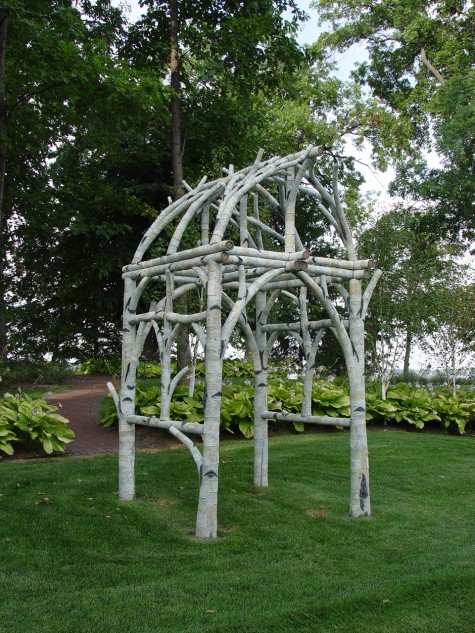
 An arbor can also be a sculpture in its own right.  This faux bois arbor is concrete and mortar over steel, hand carved to look like birch.  Contructed in four pieces for ease of transport,  it bolted together with stainless steel bolts once it was delivered.  This arbor took  over three months of one person’s work time  to fabricate.  It is a spectacular structure.  I designed the structure specifically for  the center of an oval lawn fringed in a  planting of Himalayan white-barked birch and Sum and Substance hosta. 

e03

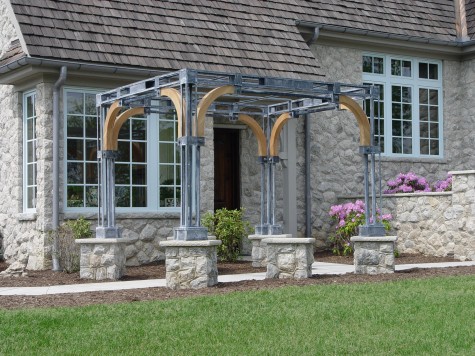
 This contemporary version of a French house had oak details that are repeated in this steel structure.  A berceau, or trellis- covered walkway, was a common feature in mid-eighteenth century French gardens. 

dsc08394

 This garden shelter with integral bench I designed specifically to provide screening from a neighboring garage.  As the space was too narrow for plants, this arbor distracts the eye from a less than desirable view. 

7-ford-16

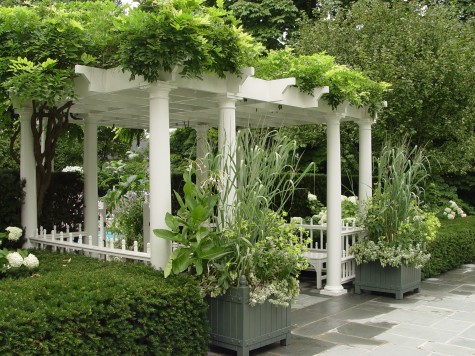
This classically inspired arbor and bench is home to several wisteria vines.  The vines are pruned regularly to keep them in bounds; all the growth is kept on the roof, providing a cool shady roof under which to sit between gardens.  A roof over one’s head in the garden can take many forms and be made of varying materials.  They can serve different purposes, in an ornamental way.

Lead Garden Ornament

1st3

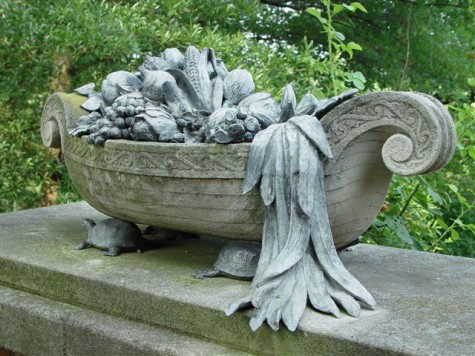
The manufacture of garden ornament, vases and sculpture in many ways was a revolution of sorts.  Most garden ornaments of  antiquity were created at great expense and time, as in hand carved, or sculpted, one piece at a time. This meant great garden ornament was restricted to just a few patrons of the garden arts.  As lead is quite malleable, and melts readily,  it can be cast. This meant ornament could be cast in multiples, and a  favorite stone ornament could be reproduced at much less expense than hand-carved stone. Imaginative manufacturing techniques made lead ornament of all kinds readily available.  This drop dead gorgeous stone and lead garden ornament pictured above was designed by, and executed under the direction of Beatrix Farrand, and installed at one of her best known landscape projects, Dunbarton Oaks, in Washington DC, in the 1920’s. 

615
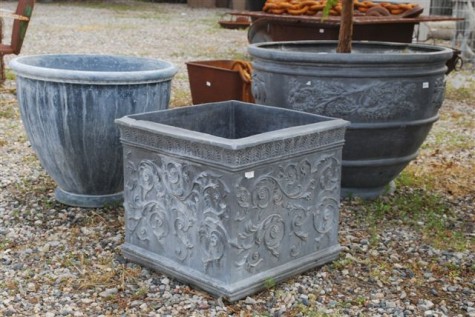
The Bulbeck foundry in England produces some of the finest lead garden sculpture, ornament and pots available anywhere in the world. The giant egg cup with acorn, oak, grape and rose motifs  is astonishingly beautiful.  It is a modern interpretation of an old lead planter from the National Trust gardens at Anglesey Abby. The Bulbeck square planter, with its delicate Florentine scrollwork decoration, clearly illustrates the degree of detail possible with lead casting.   Bulbeck lead is what I call the midnight blue four-door Ferrari coupe of garden ornament.  Lead panels out of the mold are rough beyond belief; the art here is in the hammering and finishing which produces the fine ornament you see here. The people who make these pots are artists; they literally sculpt these pots from a rough approximation of the finished piece.  Of more modest provenance and finish , the small plain lead egg cup pictured here is the work of the noted Canadian lead manufacturer, Richard Davies. His lead has some steel content; the difference in surface and color between the two manufacturers is evident.  Any or all of these pots would make much of a planting. 

713This lead running fox is the work of HCrowther Ltd, which has been manufacturing lead garden ornament  in London since 1908.  Their sculpture is particularly fine. This very appealing sculpture is as at home in a stone trough as it would be in the lawn.  My personal choice-set in a bed of European ginger.
811
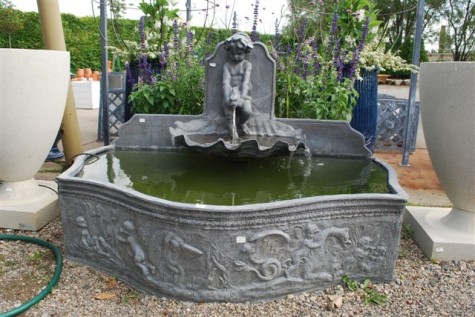
This Crowther fountain is equally as striking.  An entire garden could be designed around it.  This fountain design has been in production many many years.  Lead, and classic lead design, weathers and ages in a garden so gracefully.

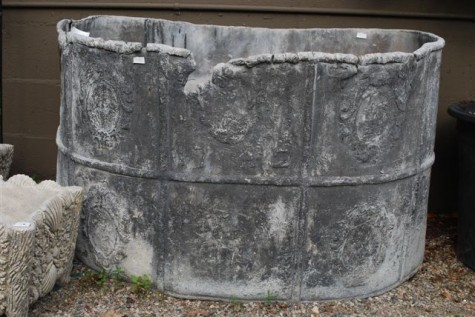
99This very old lead cistern carries the evidence of its age. The dealer in England from whom this piece was purchased thought it likely was at least two hundred years old.  Wave the history card in my face, and I am done in. 
513

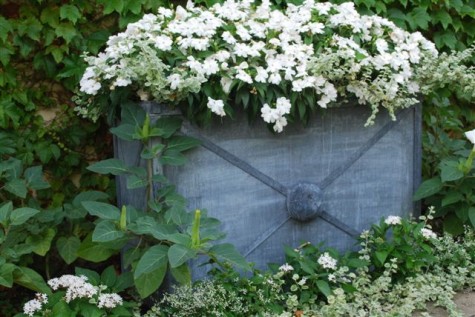
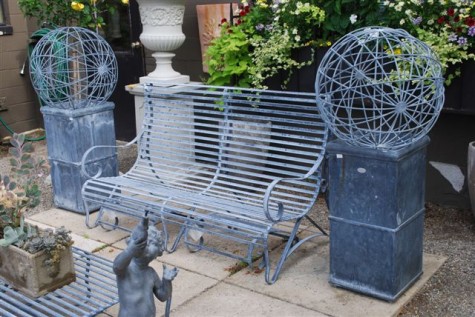
Lead garden ornament has become incredibly expensive.  The lead itself has doubled in price in a very short time, and the process is dirty, dangerous, and laborious.  The steel furniture, spheres, and boxes pictured above have a  finish very reminiscent of lead. This finish has the added advantage of protecting the steel from rust.  Steel is strong enough for furniture.  Boxes and pots made of steel do not collapse from their own weight, as lead is prone to do.  But best of all, this beautiful look can be had for much less than lead. 

118
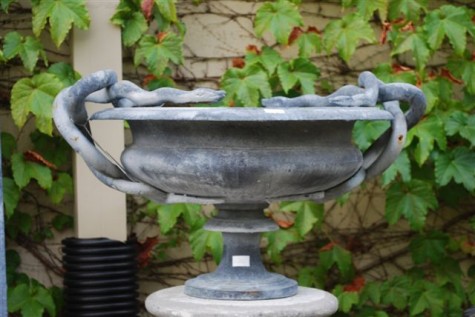
This old French iron snake urn has a new life, and a vastly different feeling than the rusty original.  Rarely would I touch the surface of an antique piece, but this piece was rusted beyond charming.  Removing the rust brought the snakes, and the beautiful shape of the urn, back to life.213
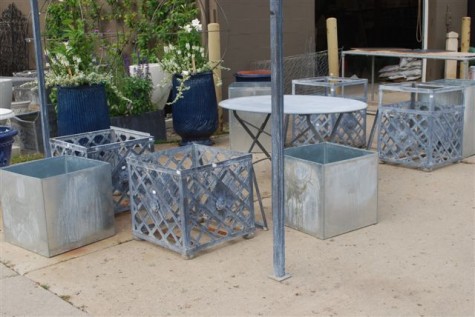
These acid washed steel boxes and galvanized planters are awaiting painted liners in the color of the client’s choice.  Steel combines well with other materials.

313
The galvanized sheet metal liner of this steel box has also been acid washed.  We can manufacture this large box very reasonably. I like good quality garden ornaments being available to lots of people.  Manufacturing in multiples, with less expensive materials, makes this possible.

106
Whether you choose lead or acid treated steel, it is indeed a very handsome look.