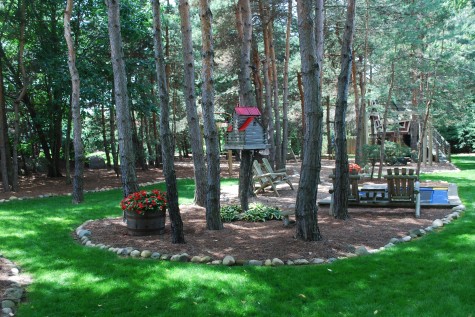
 I have never done one lick of design work for this client-she and her husband do their own. They design, they plant, they mow and maintain-on their own. They shop my store, and I may advise about this object or that pot, but they have a point of view, and they act on that. Parts of their gardens are designed for the pure unadulterated pleasure of their three childen. They cleared this shady area behind the house, and set to making that spot condusive to play. The blue rectangle in the above picture-an in-ground trampoline- what a blast.
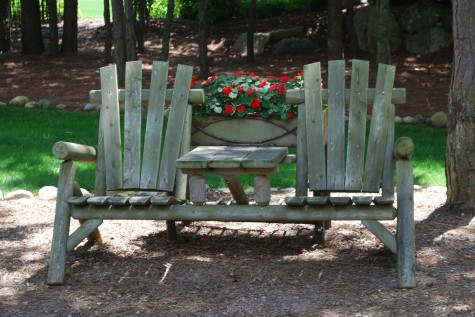 They like rustic and whimsical objects in their garden-this spot is no exception. The Adirondacks style bench with integral planter gives them a place to sit and watch the kids. The ground is thickly mulched with pine needles. This makes for soft landings.
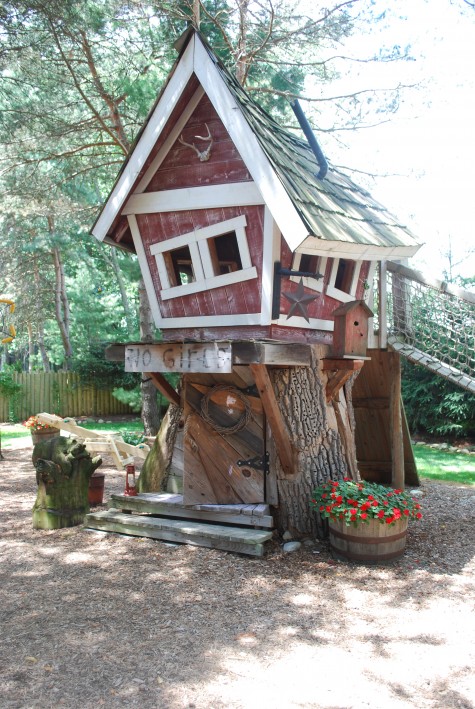 This playhouse began as an actual stump, to which a second floor was added. What small child would not be delighted to have this as a clubhouse in the woods? I could not help but laugh when I first laid eyes on this. Though the architecture was aimed at their children, it is incredibly beautifully built. The child-size doors keeps adults out. My favorite part? That brand spanking new roof, sagging dramatically.
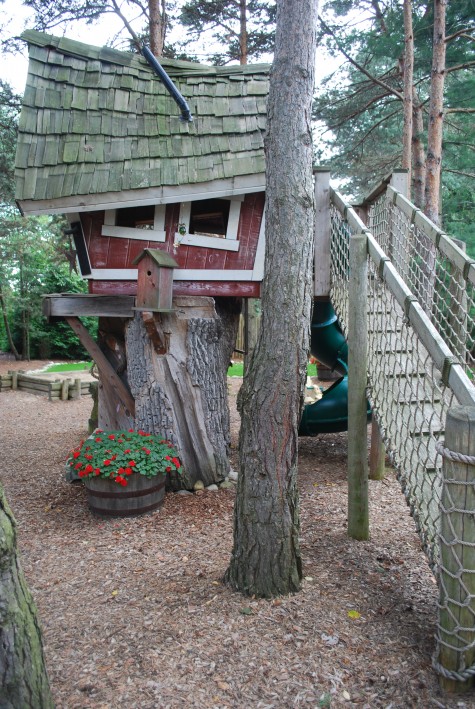 The staircase with its woven rope railings looks like a gangplank-I can imagine lots of childplay set on this stage. Nestled in close to an existing tree, and furnished with its own birdhouse and barrel of flowers, its a home away from home.
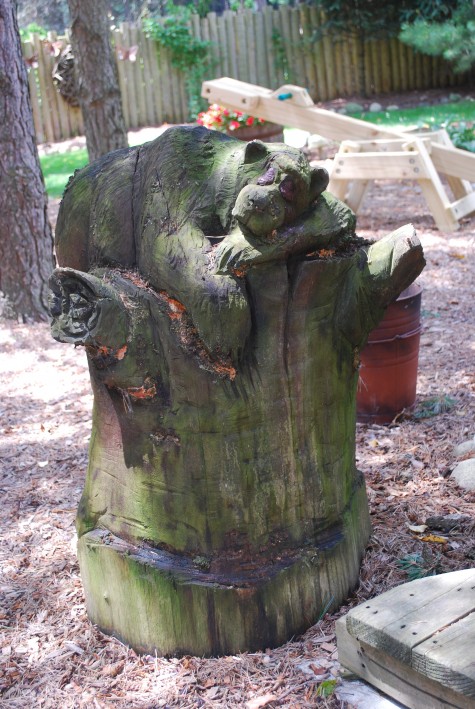
A stump sculpture depicts a bear, slumped over a tree stump, asleep. The wood is starting to acquire some moss with age. This kind of exposure to a woodland playground has to be good-don’t you think? This is as friendly, unassuming and undemanding an exposure to nature and natural forms aimed at kids as I have ever seen.
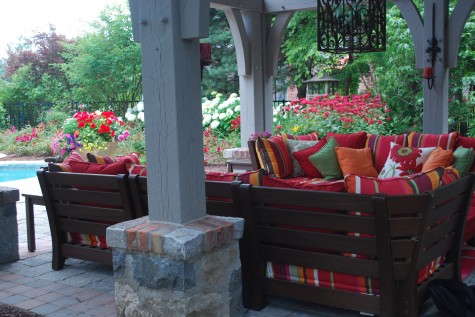 My clients situated their seating area close enough to the woodland to keep an eye on the kids, but this space was designed for grown ups. Oversized furniture and pillows upholstered in bright colored fabrics looks sumptuous and inviting. The pergola overhead makes outdoor entertaining in the rain a distinct possibility. There are gorgeous views to gardens on three sides.
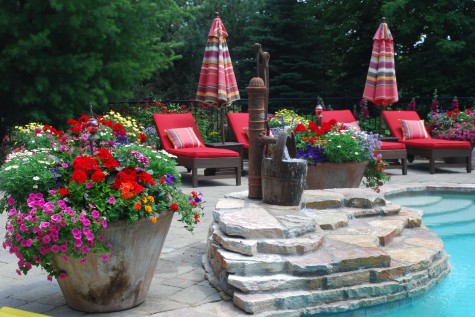 The pool deck is loaded with big handmade Italian terra cotta pots, stuffed to overflowing with annual flowers in mixed colors. The old farm pump spilling into a vintage wood farm bucket is not only whimsical, but fun. My clients tell me their kids love splling the bucket on each other’s heads. This does sound like great fun.
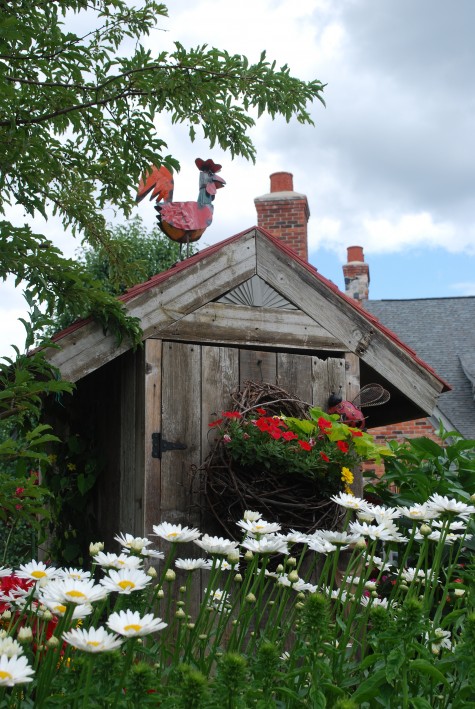
The front yard is home to a wood house built from pallets, originally part of a Halloween haunted house vignette. In the summer, the house gets dressed up like a garden shed, complete with a tin rooster on the roof.�
ll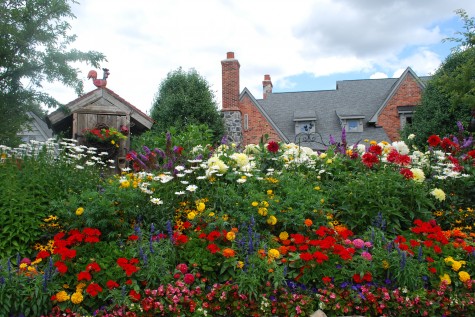
It is obvious that beyond the time and daily effort they spend making their gardens beautiful, this is a very happy place for a family. This garden is jam-packed with joy.
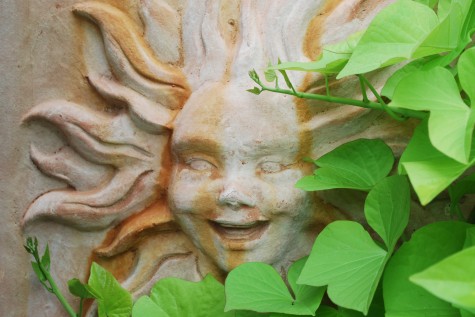
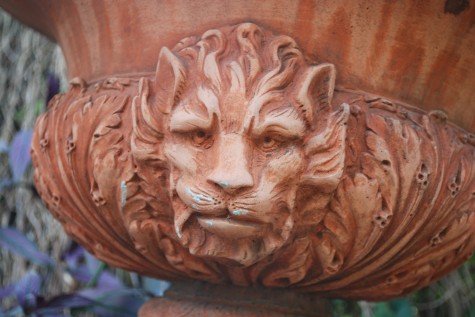 In much the same way as I imagine the face of a person I have only talked to on the phone, I imagine plenty about Italy, based on these faces. This face, part cat, part lion, part sun, part satyr-what is the meaning behind those wrinkled brows, and intense gaze? I have my own mythology which I have enjoyed imagining.
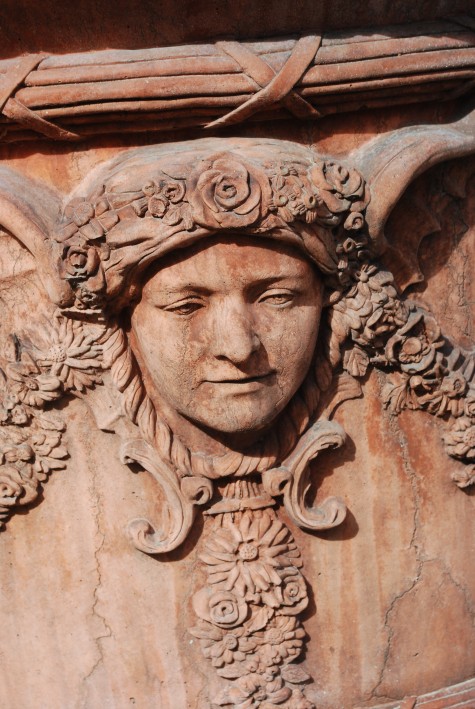
 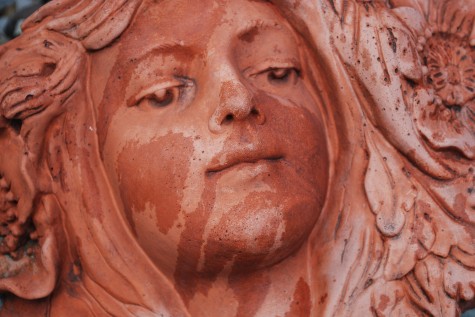 Some faces of the women can recall the Italian paintings of the Renaissance. The modelling of the features of this face is quite extraordinarily soft and fluid. The contrast of this face, with the heft and solidity of the clay is beautiful.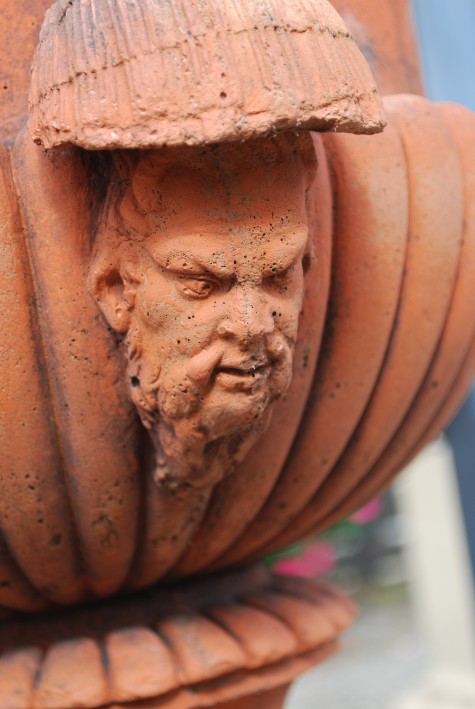
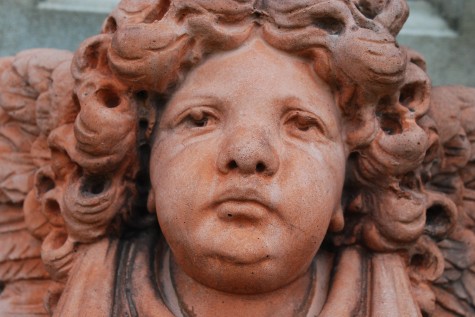 I see some of the history of Italian garden making and culture. This I get, before I ever fill them with dirt, and plant something in them. It also makes me careful about how I plant-so that a mature planting does not obscure what is represented on the pot.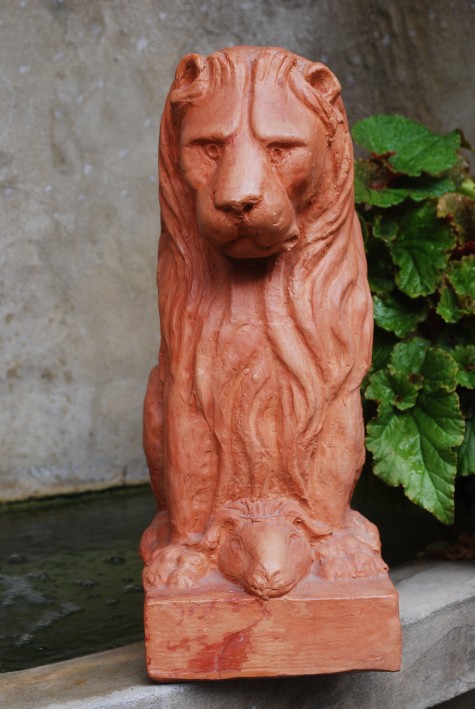
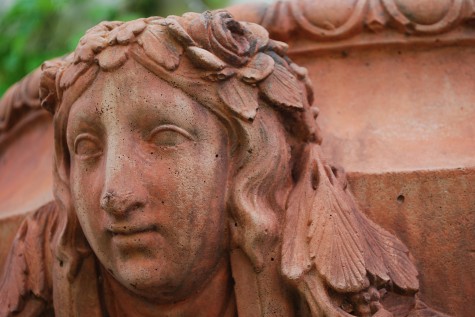 I like so much that the women have strong faces. She seems able and willing, her eyes wide open. Those who love the surfaces of their contemporary pots take just as much pleasure as I do from mine; everyone to their point of view.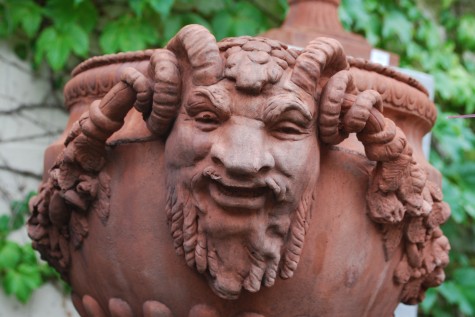
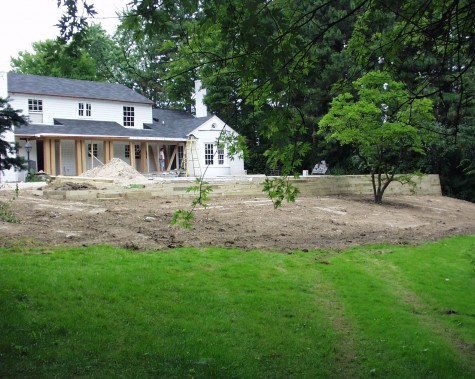
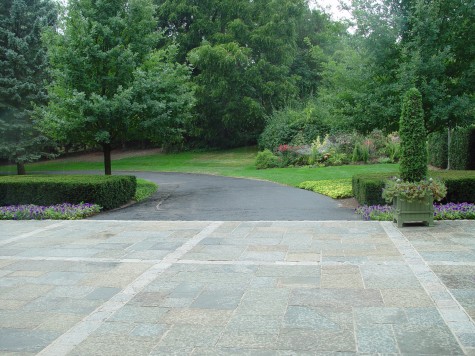
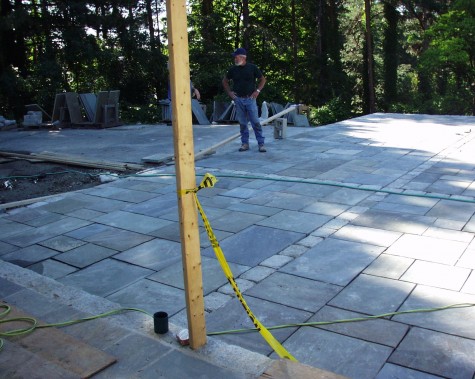 The driveway was equally close to the front door, and ran past the house to the garage. This made for little opportunity for a presentation of the house, and its fourteen foot width did not permit much parking. It seemed appropriate to splurge here. Two inch thick bluestone laid in a classic aschlar pattern, and bordered in granite setts announced the entrance in an elegant and spacious way.
 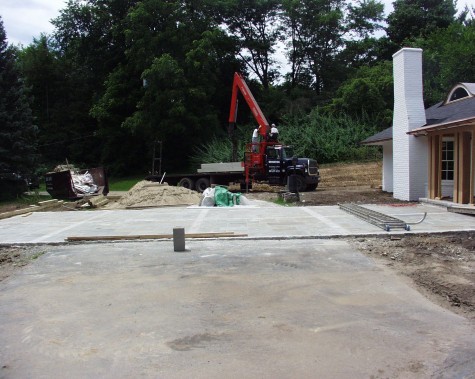 When not in use as a driveway, or for parking, this areafunctioned as a terrace. I have known my clients to host a pre-dinner hour here on a nice night. The asphalt would remain in place on either side. A stone driveway demands expert installation, a service which is well worth the expense.
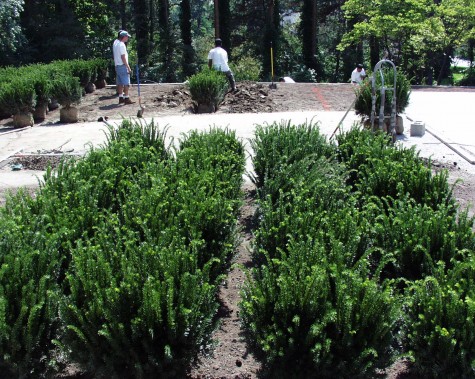 The landscape is simple. Rectangles planted solidly with yews abut four rectangles of pachysandra and matching English Oaks. The triple wide hedge of yews adjacent to the retaining wall provide security for people and vehicles. These masses of yews did have that polka-dot pattern for a few years until they grew in; proper spacing at planting helps to avoid cultural problems later.
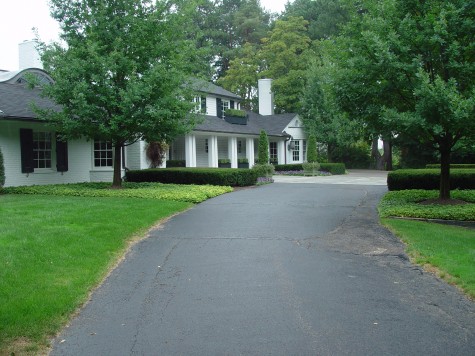 A driveway that runs parallel to the front door needs a landscape statement that signals an imminent entrance. This drivecourt landscape creates the impression that the garden came first, and the drive through second. The English oaks enclose the space, without obstructing the view of the house.
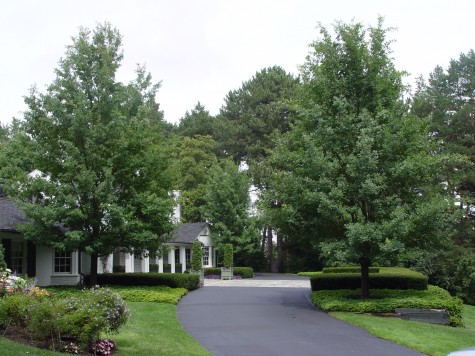 It has been a number of years since this garden was installed. This photograph clearly illustrates what a graceful space has been created from the simple idea of flat ground. Sloped spaces are not particularly sociable or functional spaces. Deciding how you need a space to function, should organize the design to come.
 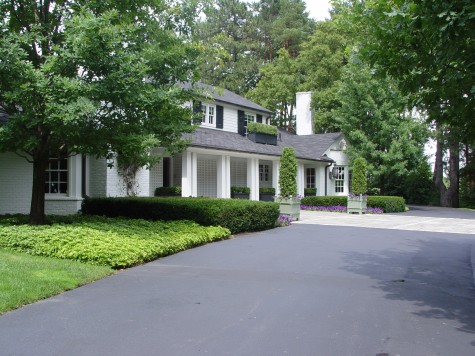 A pair of French orangery boxes from Les Jardin du Roi Soleil define the transition from driveway to walkway. These boxes have been manufactured in this shape, design, and color since ythe 17th century. The legs, corners and hinges are cast iron. Originally, the slatted oak boards and hinged iron permitted the boxes to be opened from the side. A lemon tree that had summered outdoors could be slid out of its box, and stored in the orangery for the winter. How’s that for a little romance?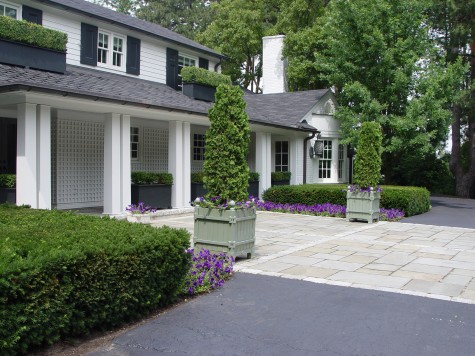
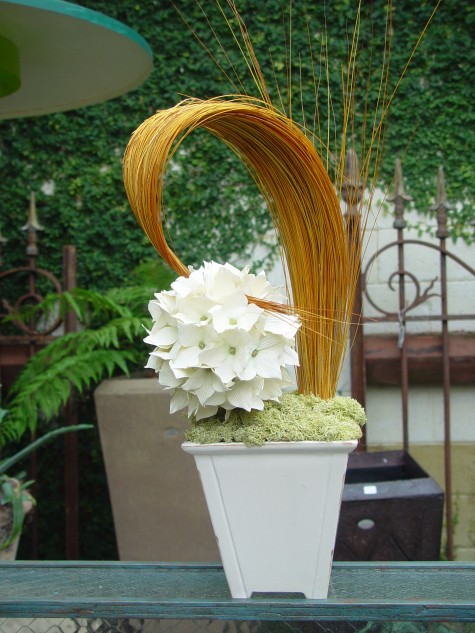 The last two nights the temperatures have been in the high forties and low fifties. Great. I am on the deck last night- in my fleece-having a glass of wine, and contemplating the end of summer. My plants in my pots have gone from gorgeous to grumpy. What to do? The topiary sculptures I make from natural materials in the fall and winter help me face the 6 months we have coming up in Michigan when the garden is dormant. The sculptures are set in dry florist’s foam-I use the John Henry brand. This sculpture, made from a dyed and preserved grass, preserved reindeer moss, and paper dogwood flowers, helps me to bring the beauty of the garden indoors.
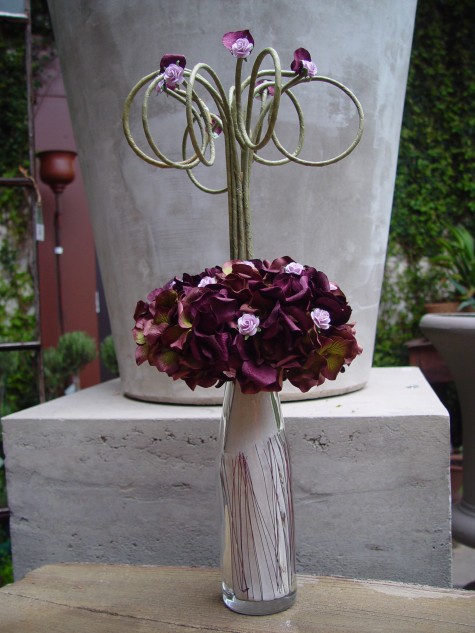 Glass can make great containers for sculptures. This vase by the Parisian artist Vanessa Mittrani is filled with white sand to give it weight. I seal the sand in the vase with a giant blob of hot melt glue, and wedge the foam in the top. Paper hydrangeas, mini-roses, and paper covered wire make for a sassy little something that reminds me of the garden. The purple paper hydrangeas bring out the purple/rust color of the wire in the glass.
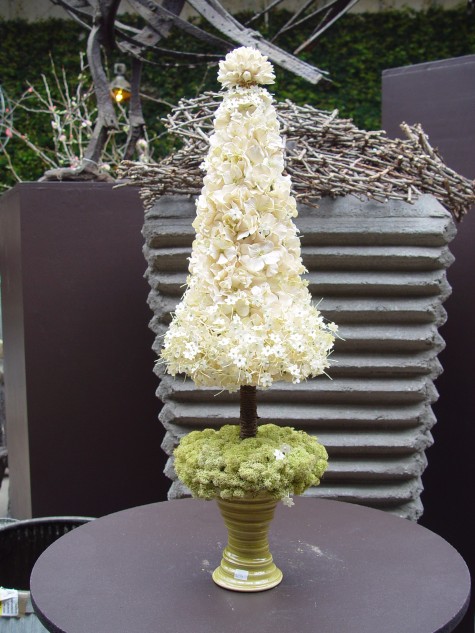 I consider paper a natural material, since it comes from trees. This combination of paper hydrangea petals, and diminuitive paper daisies describe a classic topiary cone shape. The flowery pompom at the top is constructed from individual dried bleached seed pods.
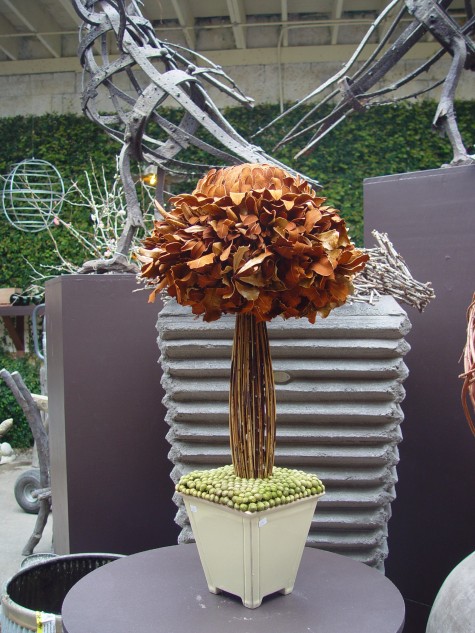 Integrifolia is a plant native to Australia, and probably other places as well. The leaves hold tight to the stems for a long time; they also take dye beautifully. This topiary began with individual leaves glued to a spherical form in a pattern reminiscent of an artichoke. As I worked towards the bottom, I reversed the curve on the individual leaves for more volume. The very bottom of the sphere is stuck with short branches just a few inches in length. Preserved reeds bowing out from a twig trunck make for a stem; the base is covered in preserved green seedheads.
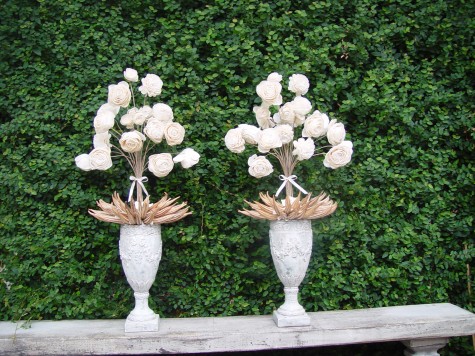 Paper roses on paper covered wires are a delicate contrast to the heft of dried okra pods.
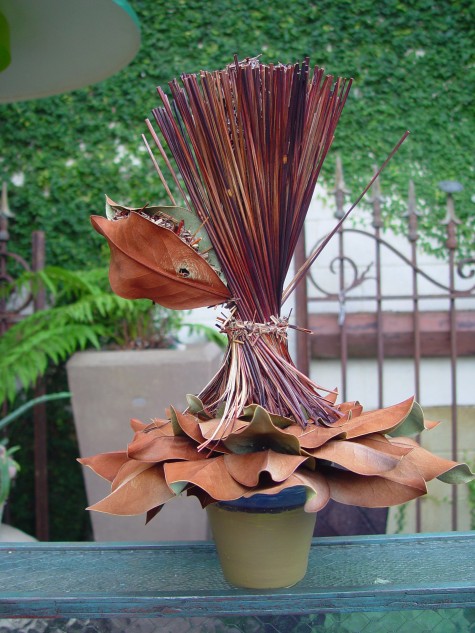
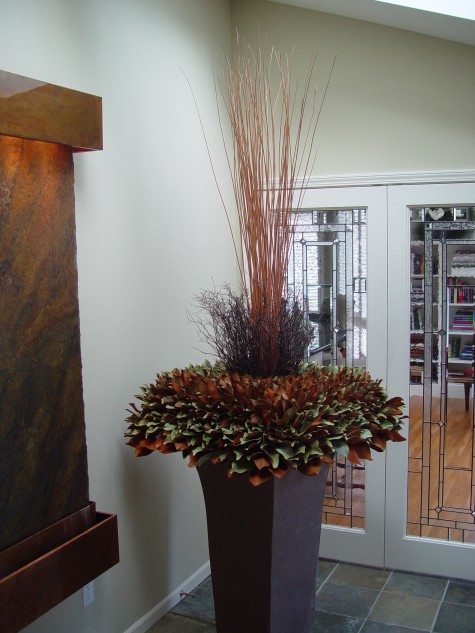 This very large scale sculpture has twigs and short birch branches for a centerpiece; the collar was constructed of fresh southern magnolia leaves. Magnolia dries beautifully, and lasts a long time.
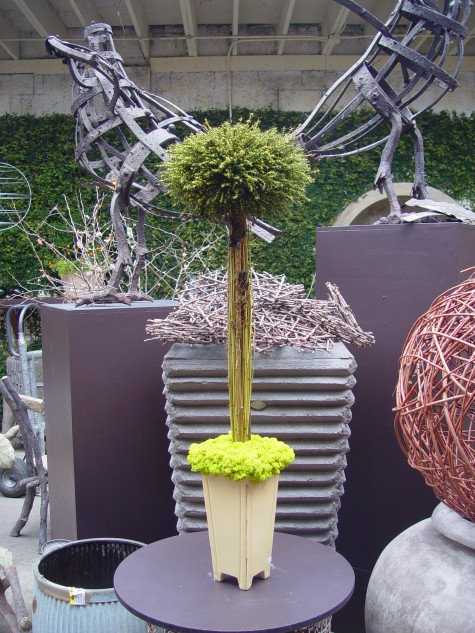 The science of preserving natural materials has become quite sophisticated. I for one would never have a house plant. I am happy for the season where I am not a plant caretaker. An object like this demands nothing from me; I just look. The reindeer moss in a color they call spring green is my idea of good color.
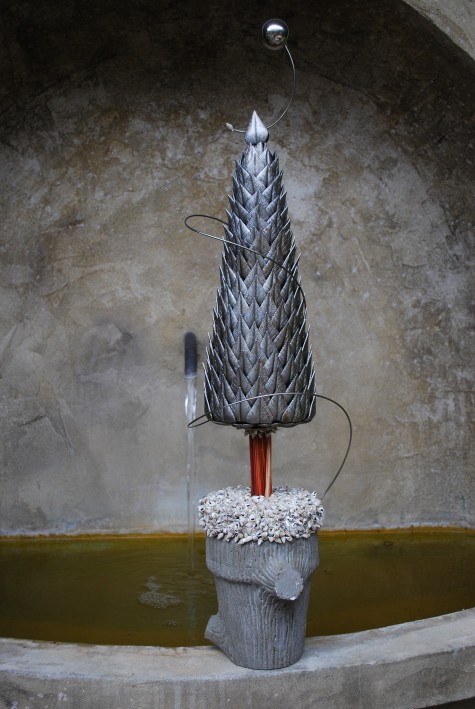 These steel leaves are by no means a natural material, but they describe one. The base was buttered with ceramic tile mastic, and embedded with tiny shells. The stainless steel wire is difficult to handle; I usually have to get help from a second pair of hands to glue it in.
 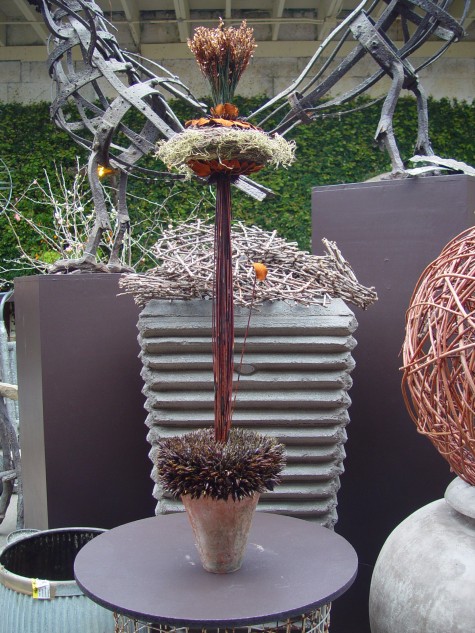 This whimsical topairy makes use of two bird’s nests made of various natural materials, sandwiched together. I buy these long stems covered with hundreds of chocolate seeds. After taking the seeds from the stem, I glued the individual seeds onto this base.
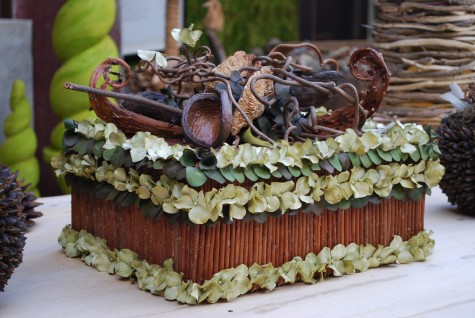 I call this a presentation box. The box itself is a photo box meant to hold 8 x 10 photographs. Should the box never have anything in it, it will still be fun to look at.