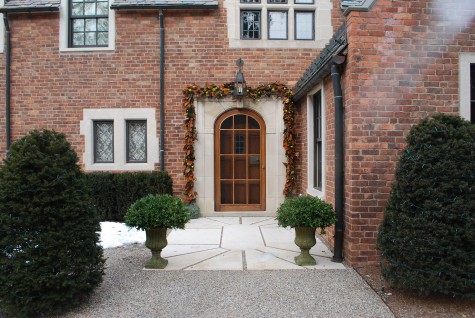
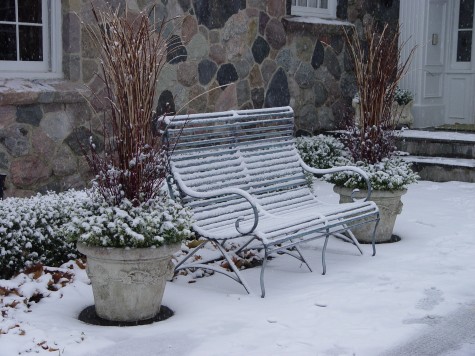
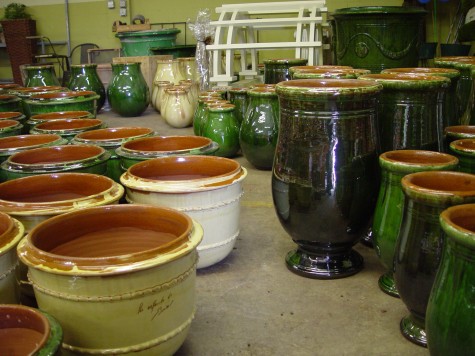
 I reluctantly agreed to play ball with those dogs of mine yesterday-in spite of the 9 degree temperature. We were not outside for long, but long enough for me to see the color of my yews had gone so dark they almost looked black. This cold color could not be further from how those yews look dressed in their spring green foliage. This set me to thinking about color as a design element. The glazed terra cotta pots manufactured in France for hundreds of years make a big color statement. Their strong color has a very Mediterranean feeling to me; the color seems very much a product of the climate in which they are made. When I see a pink stucco house, I immediately think warm climate; no doubt I react to color with an entire set of pre-conceived notions hovering nearby.
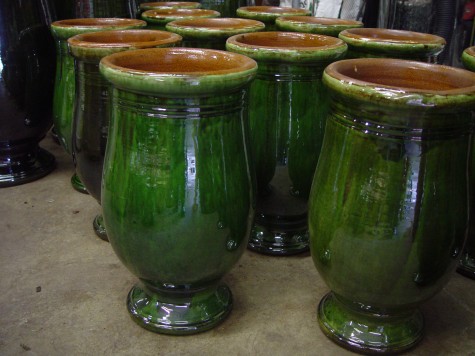 Though green is the dominant color of any landscape, this shiny green glaze is a color experience of a different kind. These pots have a much more formal appearance than a natural clay pot-whose natural and from the earth color is vastly more subdued than this. As glazed pots do not absorb water from the outside, the finish and color is as fresh in their tenth year as their first, provided none of the glaze has chipped. The vibrant color of these pots will strongly figure in how I would place and plant them.
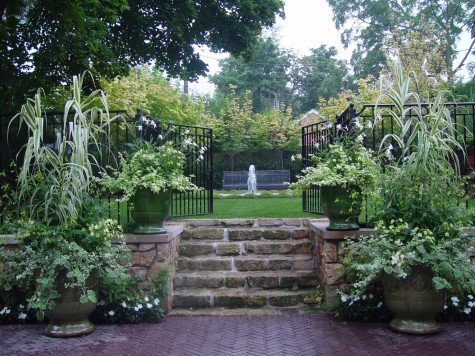 The color of these pots will always be a significant part of the planting composition. Unlike natural clay pots whose importance in the composition may be secondary or slight, the color of these pots attracts visual attention, and sets off the planting in a formal way. A green and white color scheme seems restrained and serene. Do these pots look out of their Mediterranean element? I think not. This leads me to think that before deciding a color won’t work, I should try it.
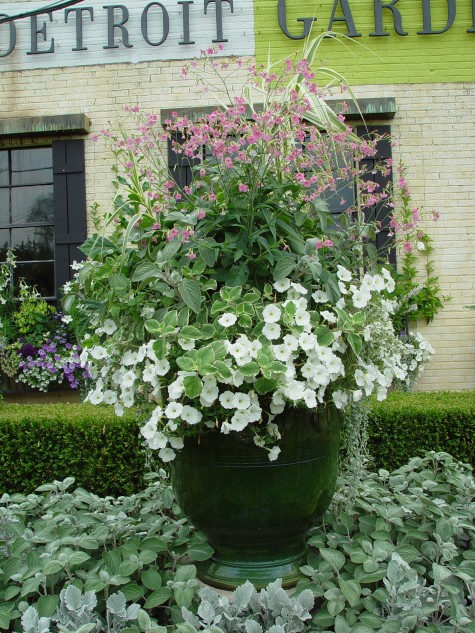 This color scheme branches out a bit into the pinks and greys. The pot is elevated on a concrete base, so the foot of the pot still reads even though the ground planting has grown in. The shiny green mass of the pot is a beautiful foil for the tiny naturally green leaves of the boxwood. Monochromatic, or one color schemes are quietly formal and restful in their simplicity.
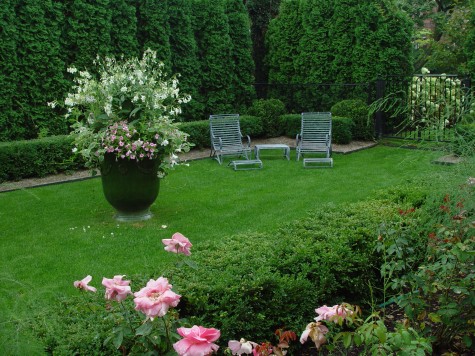 This pot is 12 years old. Mineral deposits from the water had dulled the shine of the glaze. It is remarkable how close the color is to the color of the existing evergreens and grass. This composition is more about texture, and mass, than color.
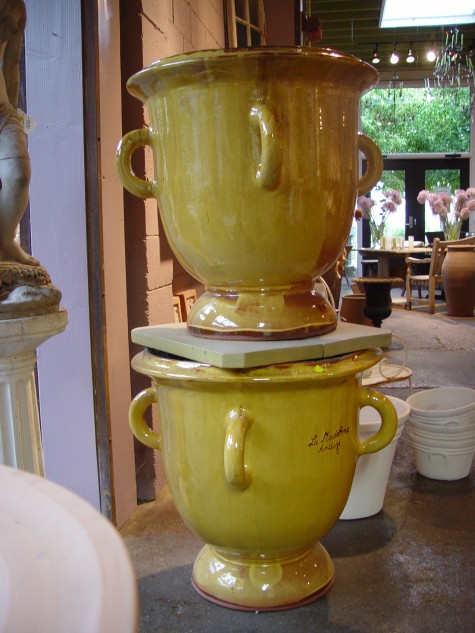 Yellow glazed French pots are perfect for places where any thing but neutral seems like a good idea. Shady gardens, or nondescript locations asking for a strong center of interest can get that from a splash of unexpected color.
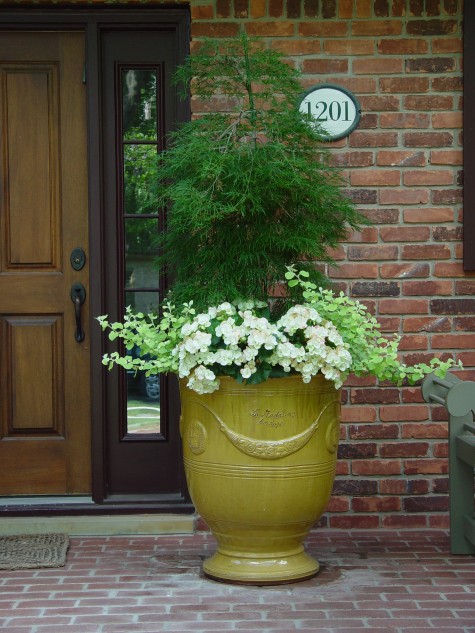 This pot is full of surprises; the yellow of the pot is just the beginning. A threadleaf Japanese maple makes an unusual centerpiece for the surrounding white begonias and lime licorice. The brick front porch, tough completely shaded by a second story balcony, has a fresh and striking appearance. Though delicate in color, these French pots are incredibly strong and durable. The clay of the large pots can be 3/8 of an inch thick or better, and they are high fired for extended periods of time.
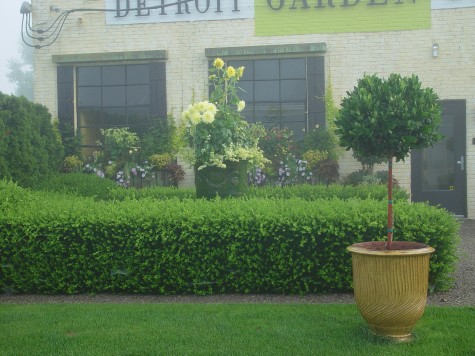 Some potteries have added more contemporary designs to their collections. This pot, known as a strie, refers to the striations formed from the pattern generated by the fingers of the potter; each pot is unique to the fingertips of the person who made it. The color of the pot helps to make it central to the entire composition of the garden. Simple color relationships read more clearly and strongly than mixed color compositions. Strong color relationships paired with more subtle color relationships is what creates rhythm in a composition.
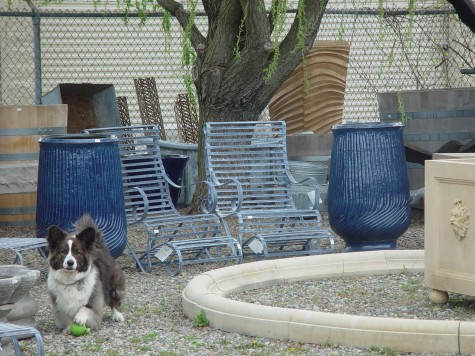 Blue glazed pots in the landscape can be tough to place. Though bluestone, acid washed steel, lead, water and sky all represent blue in one form or another, planting blue pots requires some thought. That glazed blue will be very influential in the look of the whole. Yellow flowers in a blue pot can look like a band uniform, or worse. Some shades of purple are deadly dull and irritating with this shade of blue; lavender and silver can be great.
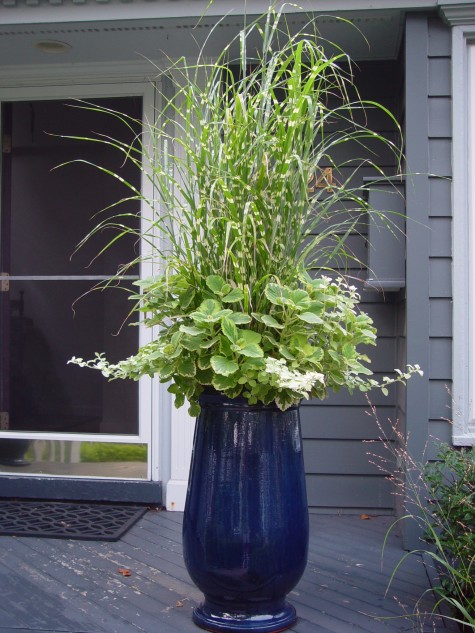
A greenish yellow and white, on the other hand, can be lovely in a blue pot. The important thing to remember with color is that no color is an island unto itself. Putting colors together that create interesting visual relationships-that’s part of what makes for good design.
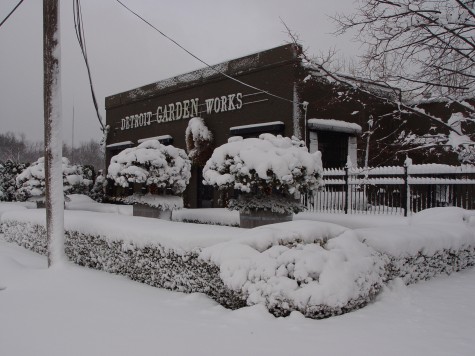
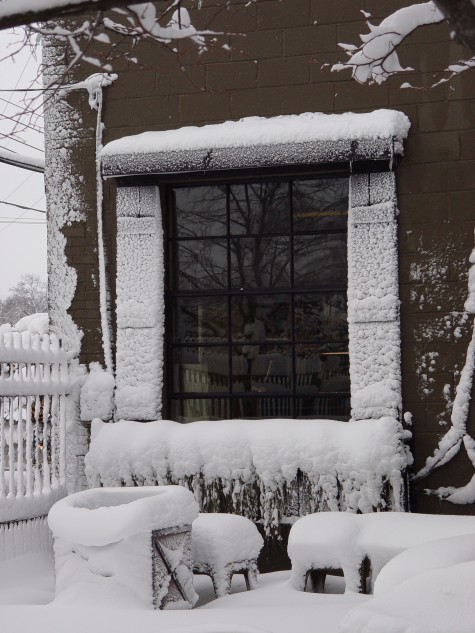 I go to work on the holidays too, as MCat lives at the store. I need to make sure he is ok; he gets pets, and holiday treats-daily attention. I have a greenhouse roof, modine heaters, and plants; any of the above could fail on any day-including a holiday. I only live 1.5 miles from work-this makes a quick trip easy. I figure I can handle any weather for that distance. But for a storm some ten years ago which had me holed up at the shop for 2 days, I am free, and lucky to be able to get to work, and just appreciate my snow.
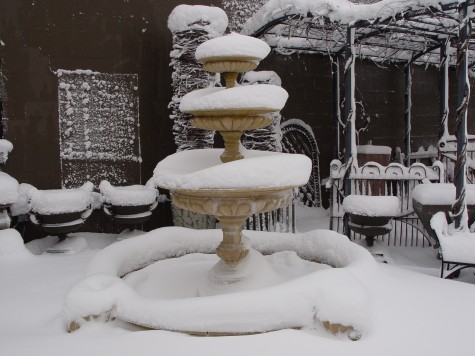 Though I am a person delighted by color, in the past few years I have become interested in Belgian design. Rob has persistently bought Belgian garden ornament; the Belgian landscape reminds him of Michigan. Long before Cote de Texas featured Belgian design (www.cotedetexas/belgian design) and Restoration Hardware got the notion to organize an entire collection with a Belgian flavor, he was out there, shopping in a country much like our midwest. Those interiors built around natural materials-the raw wood floors, linen drapes, the whitewashed antiques-the unexpected crystal chandelier-I love this understated look. This particular New Years Day looked like a Belgian day to me. The white, chocolate, taupe and cream- fresh, and not over wrought. Just how Rob would have it.
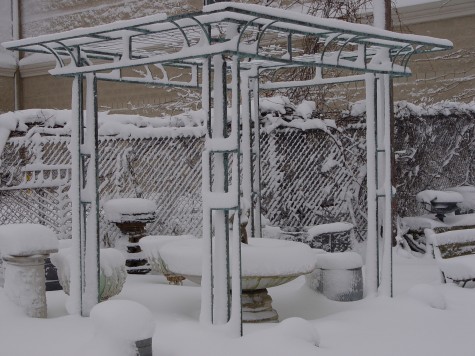 This heavy snow wiped out all the extraneous details. This copper pergola only suggested that aged copper color. Brown,white, and taupe-a limited color palette. There is such great beauty from just a few quiet details.
 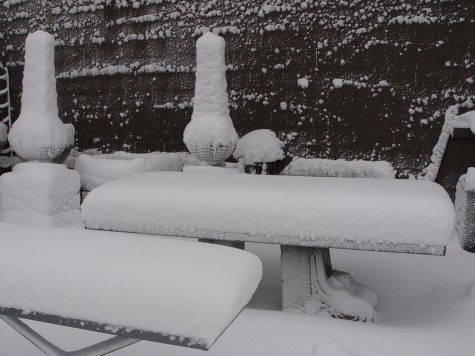 The snow added volume to what was already massive, and form to what had only been slightly suggested. The snow caught on the wall-an entire but silent discussion about surface. The irregular surface of the wall-I had never really seen this before. The snow detailed this for me.
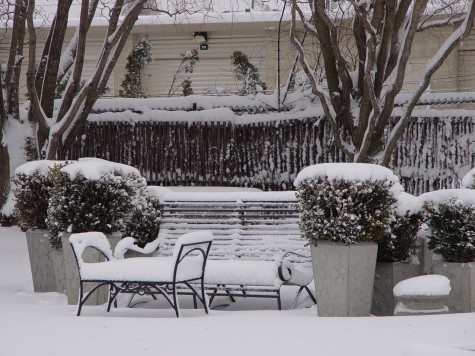 The Belgian hazelwood fence panels-if you thought you could live without them, you might reconsider. Do they not look beautiful outlined in snow? The squared boxwood planted in natural concrete pots, the black iron benches, the trunks of the willows outlined in snow, the cream metal doors on the building beyond and next door-I am thinking this looks great.
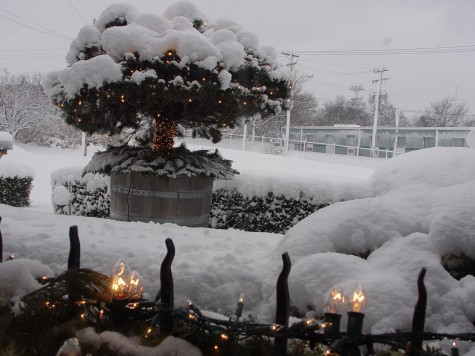 My old Scotch pines on standard, planted in these incredibly beautiful Belgian oak barrels, withstood the storm with equanimity. The white, the chocolate, and the bright light-what a gorgeous view I had out my office window. The old fashioned clear white c9 lights in the window box-my garden’s chandelier.
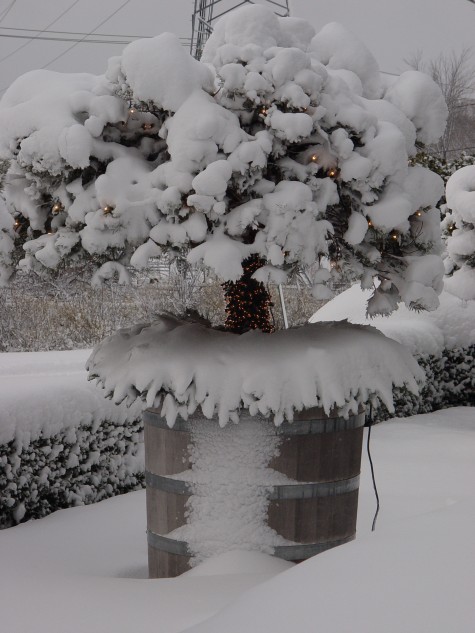 In truth, I could spend one year planning a single project-and it could never keep up with what nature whips up overnight. My 2008 New Years day-extraordinary.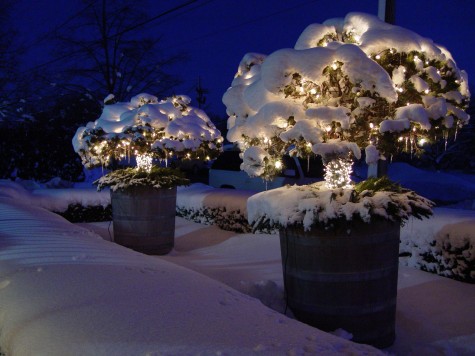
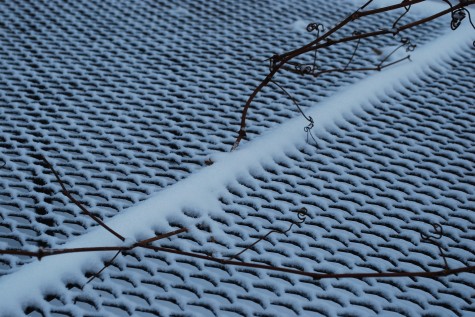 Were I to ask you which of three wallpaper patterns appealed to you the most, or which person you have most patterned your life after, you would have no problem understanding and answering the questions. A written definition of pattern is not this easy. A paisley is a shape that is readily recognizable; a series of paisley shapes, that repeat in a certain order, that the eye can recognize, forms a pattern. My steel grate plant table tops, dusted with snow, bring the pattern of the extruded metal into focus.
 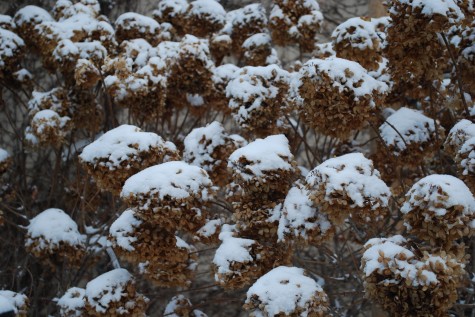 Many patterns exist in nature; early winter may be the best time to study them. The oval shaped dried flower heads of these hydrangeas make a visual pattern that repeats. They remind me of the old boxwoods at Dunbarton oaks that are pruned to resemble clouds. Cloud pruning is a gardening term gardeners recognize; the particular shaping and direction taken by an individual gardener makes a pattern. A distinctive pattern.
  Milo has a ball decorated with raised dots in an all over pattern. An all over pattern reads the same regularly, no matter what direction your view should take. There is no left or right, no up or down. The pattern of this light snow is very subtle; every diaphanous flake randomly covers the gravel in the drive. Nonetheless, the individual flakes make a pattern-a pattern I did not really pay attention to, until I saw the imprint of the ball dots-so regular and clear. The relationship of what came from the sky, with the pattern evidenced by that manufactured ball of his-on my mind today.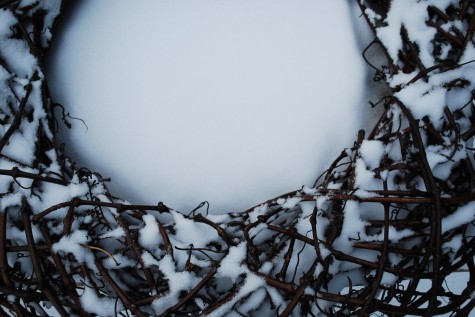
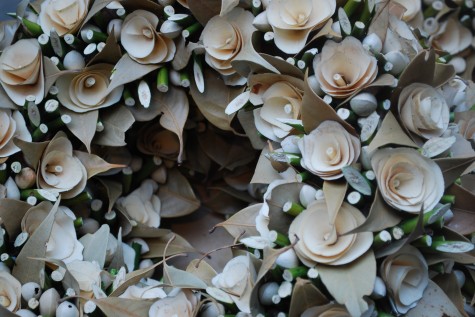 This wreath is comprised of small flower shapes constructed from wood shavings, twig stubs, and dried bay leaves. The pattern, to my eye, is all about the circle, repeating. A wreath is an ornament; the arrangement of organized shapes makes for a pattern. When I see pattern, I am at my most focused.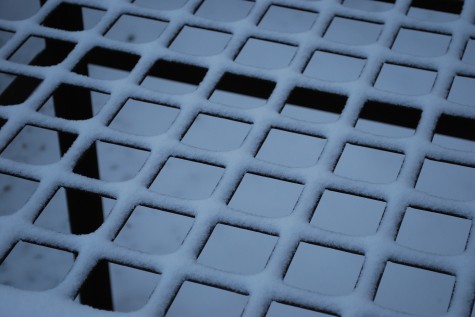
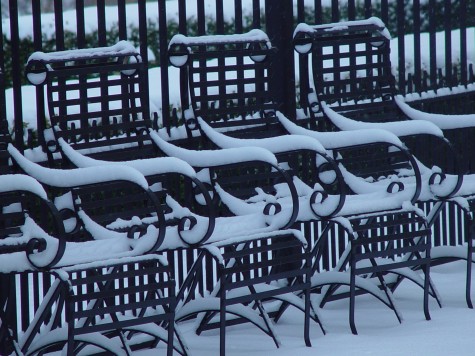 Early winter is the perfect time to think about pattern. The snow, the cold, and the low light, the absence of leaves and flowers that blur the patterns, presents me with a landscape graphically black and white. Now is the best time to see patterns. RobB just forwarded me a post from A Way to Garden (awaytogarden.com)-a doodle by Andre. His idea-to send a card to his garden. Thank you for all you have done for me, beloved garden. That post, and his card has been on my mind all day. My garden gives me so much; this quiet time gives me plenty of time to think about this. Though some years ago I was certain my gardening ended with the first killing frost-now I know different. These first early snows come with lively lessons, debate, original source material; I know to pay attention. Who knew there was so much to see, and think about in late December? I am looking, and listening. December-I welcome it. No kidding.
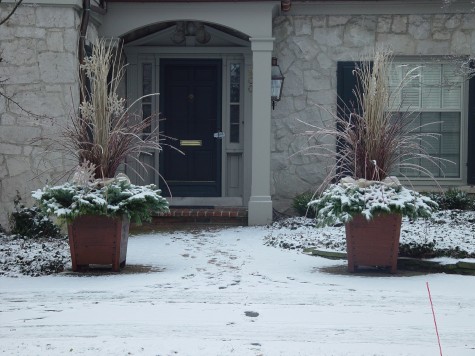 Were someone to ask me to name my most favorite winter pots ever, no doubt this pair would immediately come to mind. These varnished Belgian oak boxes put together with precisely spaced countersunk screws quietly remind me of a double breasted band uniform replete with brass buttons; dignified and all put together. The noble fir and douglas fir greens are generous and wide. The pale bleached willow sticks have a collar of natural stick stacks that have absorbed moisture from the air, and arched over-naturally. These pots have the most fabulously artless hairdos. Bottlebrush snowflakes hang here and there. Just enough structure meets weathering natural material. The good proportions of top to bottom please me.
 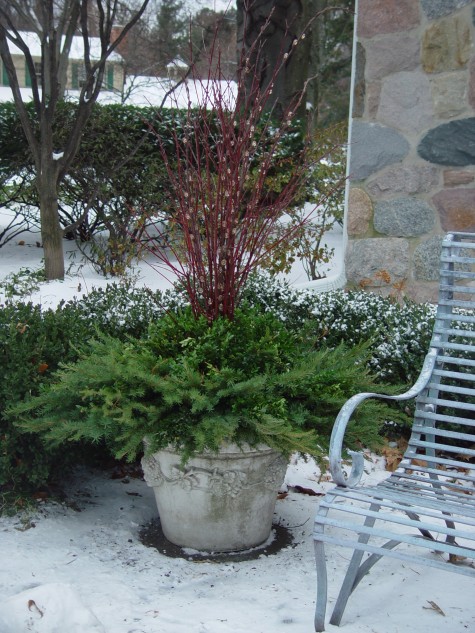 Though I personally have a mind to fend off the winter vigorously, I am lucky to have clients who do not mind the stillness of the winter season. They tell me: quiet, please. Represent me softly-naturally. Douglas fir and boxwood make such a great mix. A few stems of acrylic pussy willow adds just a little sparkle to the red twig.
 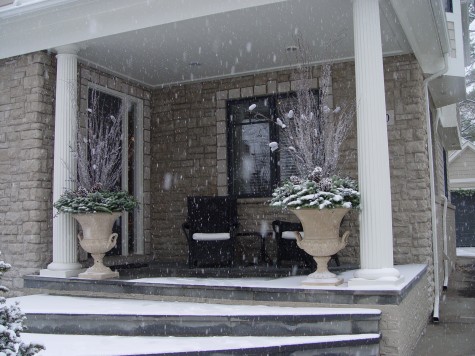 Intermittent snow in December dusts everything with white. This is beautiful winter weather-not the hit you over the head winter that is to come. The winter sculpture in this pair of pots demands nothing and expresses everything of a world gone silent.
 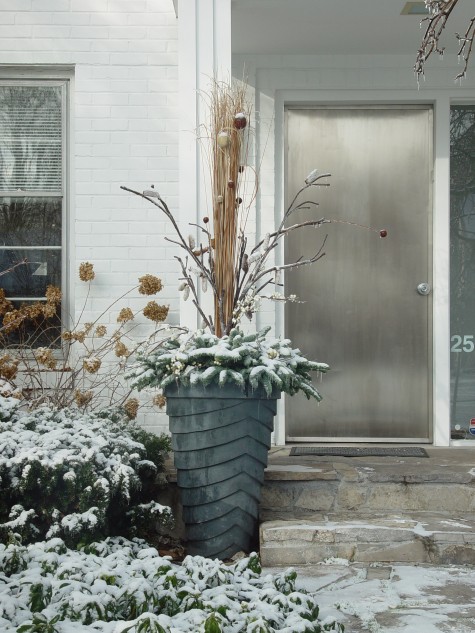 This client refurbished her front door in brushed stainless steel at my recommendation. This very contemporary Francesca del Re pot, and its winter dress, simply expresses the colors and shapes of her season. The color echoes what already exists in her hydrangeas and yews.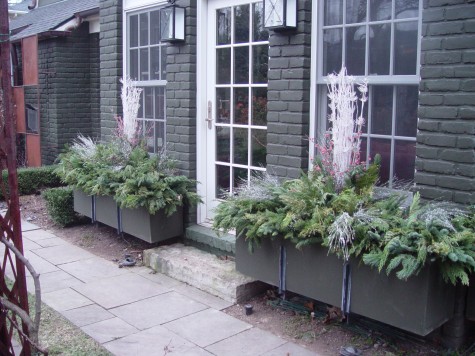
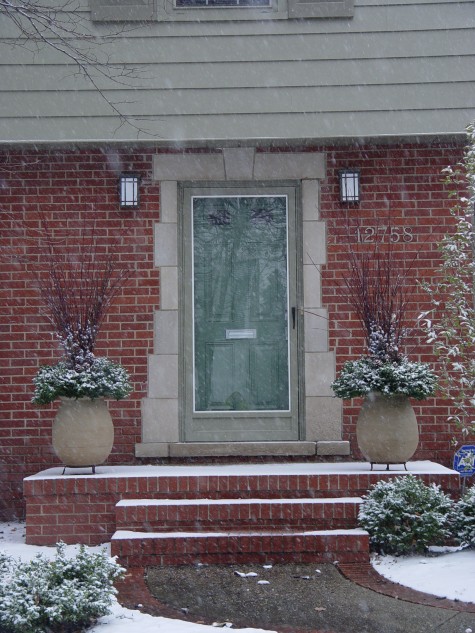 This pair of English stoneware pots from the Hode Pottery are frostproof-no need to bring them in. The simple trivet stands reveal the shape of the pots from top to bottom. A pot with a base larger than its opening benefits from a treatment like this. Twigs, cones and boxwood make for a dressy, not noisy display.