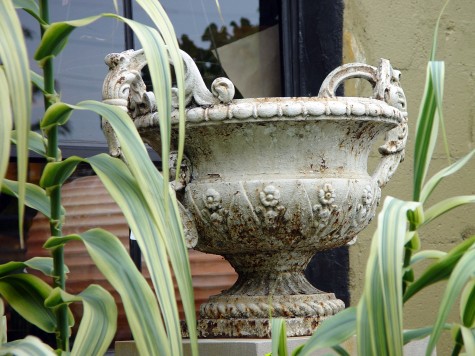
 Gardeners make choices based on lots of issues, but most can figure out what appeals to them straight off. Some love old crusty, rusty and well worn antiques; others find that state of gentle disrepair lacks visual punch. Many antique urns have been painted at one time or another; white having been a very popular color. Worn white will either be just the thing, or seem jarring. For others, the prospect of a classical urn leaves them cold-old or new. But if the idea of an urn resonates with you, which you will choose depends on several things.
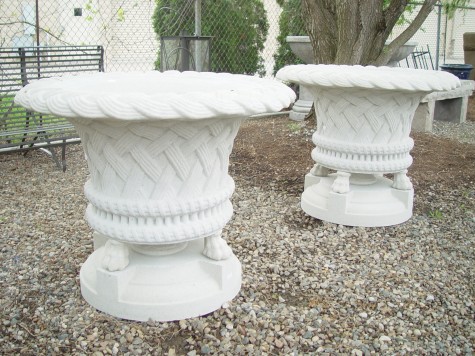 Dry cast limestone urns are usually based on classical handcarved limestone designs dating back hundreds of years. Many of those designs are European in origin. Dry cast limestone is a process by which limestone dust is mixed with a binder, and poured into molds. These reproductions are much more affordable than their antique counterparts. Some old designs would not be available at all, but for a reproduction. On occasion I find a piece I feel I must have, with no placement in mind. But a classical European urn may be very much out of place in front of a Cape Cod home. Now would these elaborately footed urns ring right against the backdrop of my own arts and crafts style home. However, they might be elegant and unexpectedly beautiful in a contemporary setting. The location you have in mind should influence your decision.
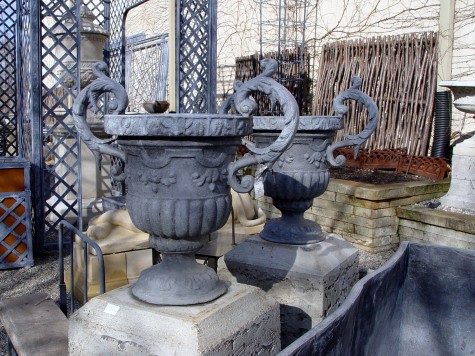 The scale of an urn is an important consideration. Very small urns may need pedestals to set them off properly. If the shape and decoration of an urn is a good bit of what you find appealing, then they need be placed where those things can be easily seen. Small urns have another significant disadvantage. From a small size follows a small planting area; you will need to edit your plant choices. Perhaps of more importance-how easily will you be able to water, and water again, when the weather gets hot? Small pots dry out faster than is easy to keep up with.
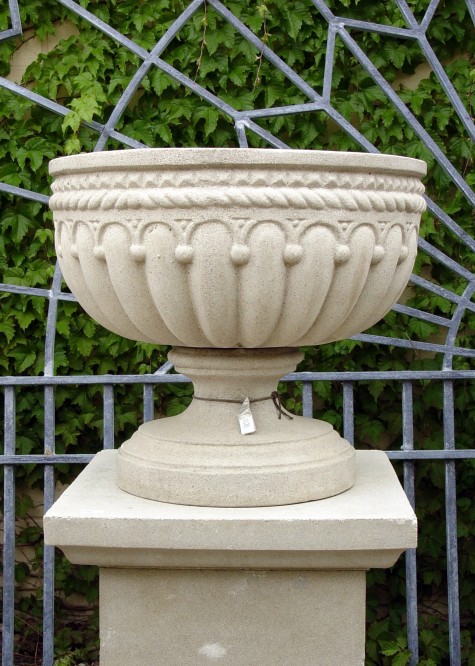 I like urns of a generous size. I have plenty of room to plant-either lots of one thing, or a collection. An urn planted such that in late summer it is a garden bouquet of good size is a pleasure. Watered properly, they retain moisture evenly, over a longer period of time. A container that can wait for me to get there with the hose- this I appreciate. Any urn I plant becomes part of the working garden. A gorgeous urn with a poor planting is a frustration no gardener needs.
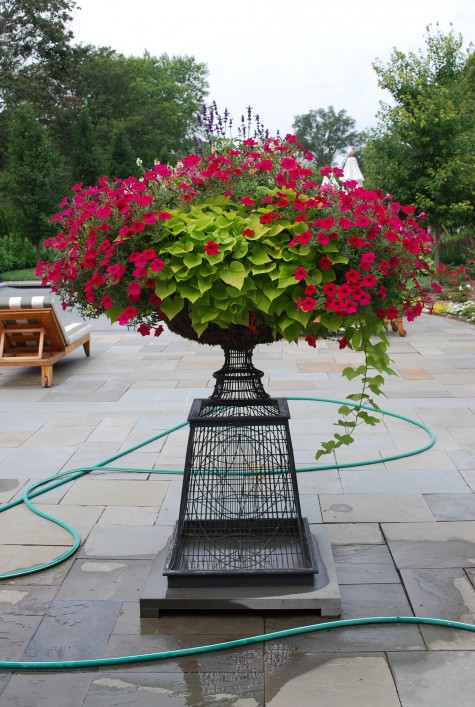
This English wirework urn is of English manufacture. It has a matching pedestal, which provides plenty of height for a good show of trailing plants off the rim. The bowl of the urn has all but disappeared by late summer. In this case, the lush planting is of more important visual importance than the urn itself. The plainest most homely galvanized bucket can be glorious- given an inspired planting. The only advantage of a decorative urn is a beautiful appearance during those times when they are not planted. In some situations, a container which is also a sculpture is a good idea.
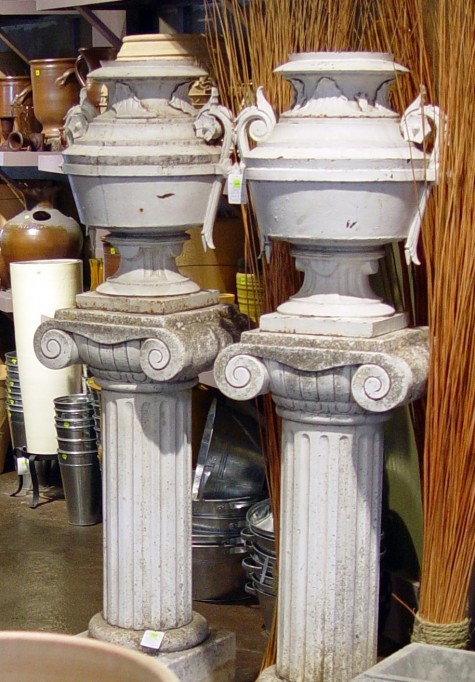 These French art deco style urns have such style and presence one might be inclined not to plant them. The Waterloo Urn I discussed in yesterday’s post is placed out in the open landscape. Unplanted, it could be placed anywhere calling for a sculpture-no need to have water conveniently nearby.
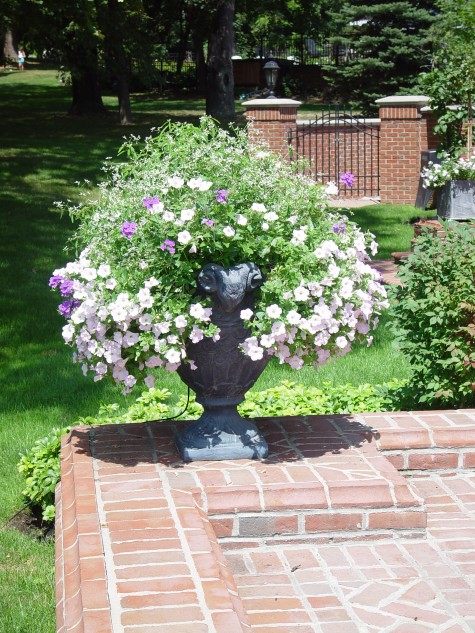 This lead urn is watered via a tube connected to the irrigation system in this yard. In much the same way as greenhouses tube their hanging baskets, or geraniums, these tubes buy a gardener a little time. They are not really a substitue for hand watering, as the coverage can be uneven, too long, or too short. If the tube runs on a nearby irrigation zone, that pot is at the water mercy of whatever else is being primarily watered. I am more than willing to look after my plantings; some automatic irrigation helps me to hedge this pledge. Those days that I come home really late will not need be a crisis. The level of your ability to maintain pot plantings is an important part of the selection process.
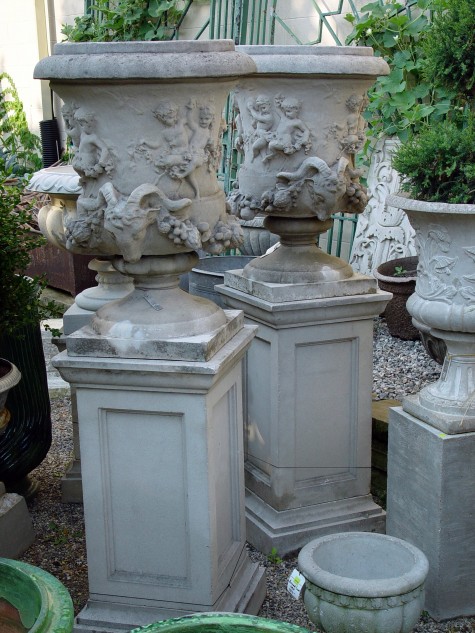 These concrete pots are English made reproductions, but they have that aged look. The surface is such that I would plant the tall, and vase shaped-nothing trailing. Ala some voluminously opulent Flemish flower painting. There is no choosing these pots if the decorative story being told does not greatly appeal-why cover up what so appealed to you in the first place? In this case, the urns and there plantings need to strike a balance, so they look great in relationship to one another.
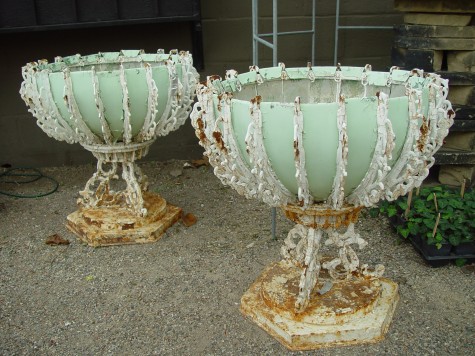
These cast iron urns with zinc liners are French from the Victorian period. That French green color is a dead giveaway. Their unusual and striking design would make them sensational in the right place. My year 1 choice would be to plant these with big blue agaves, and call it a day. After one season, something even more fabulous may come to mind. I will admit I did buy my house 15 years ago for the four urns outdoors that were original to the house-I had to have them.
![1660164496_ce85d76e9b_o[1]](https://deborahsilver.com/wp-content/uploads/2010/02/1660164496_ce85d76e9b_o1.jpg "1660164496_ce85d76e9b_o[1]")
![15a1[1]](https://deborahsilver.com/wp-content/uploads/2010/02/15a11.jpg "15a1[1]") When I first got interested in dealing in garden antiques, it was tough going- educating myself about them. Outside of a few well known reference books, garden auction catalogues proved helpful. A garden urn, I learned, is a container with a foot, or pedestal. The small urn pictured above was manufactured by the Coalbrookdale Ironworks in England in the 19th century, and is a handsomely proportioned piece.
When I first got interested in dealing in garden antiques, it was tough going- educating myself about them. Outside of a few well known reference books, garden auction catalogues proved helpful. A garden urn, I learned, is a container with a foot, or pedestal. The small urn pictured above was manufactured by the Coalbrookdale Ironworks in England in the 19th century, and is a handsomely proportioned piece. ![C0671[1]](https://deborahsilver.com/wp-content/uploads/2010/02/C06711.jpg "C0671[1]")
![256[1]](https://deborahsilver.com/wp-content/uploads/2010/02/2561.jpg "256[1]")
![831[1]](https://deborahsilver.com/wp-content/uploads/2010/02/8311.jpg "831[1]") These American concrete urns on associated pedestals came from the Philadelphia area. They are among the most favorite garden urns that have ever come my way. The bell shape is decorated with what seems like thistles to me. I know little else about them. They are in very fragile condition; I bring them in for the winter. Their rims have been so worn by rain and exposure to the elements that I can see the aggregate in the concrete mix clearly. Stately and frail, they are.
These American concrete urns on associated pedestals came from the Philadelphia area. They are among the most favorite garden urns that have ever come my way. The bell shape is decorated with what seems like thistles to me. I know little else about them. They are in very fragile condition; I bring them in for the winter. Their rims have been so worn by rain and exposure to the elements that I can see the aggregate in the concrete mix clearly. Stately and frail, they are.![C1311[1]](https://deborahsilver.com/wp-content/uploads/2010/02/C13111.jpg "C1311[1]") These diminuitive concrete urns have a highly textured surface, just like my thistle urns. They are old-vintage-pieces, not antiques. The faded red color is unusual, and the shape is beautiful. I could easily see them indoors. Old garden urns are fine unplanted. They have an aura and a presence that needs nothing else, should the sculpture alone please you.
These diminuitive concrete urns have a highly textured surface, just like my thistle urns. They are old-vintage-pieces, not antiques. The faded red color is unusual, and the shape is beautiful. I could easily see them indoors. Old garden urns are fine unplanted. They have an aura and a presence that needs nothing else, should the sculpture alone please you.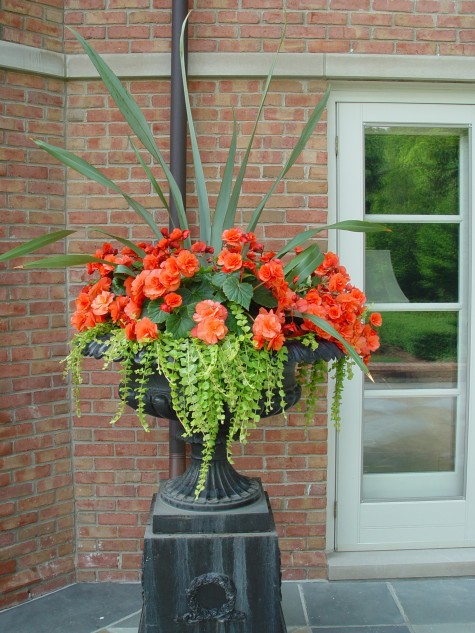
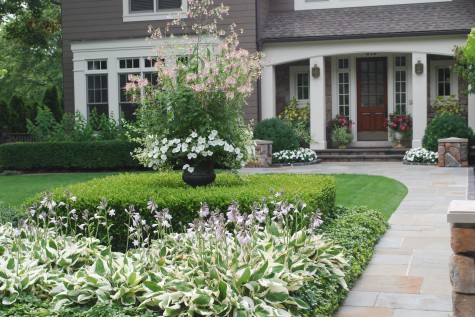
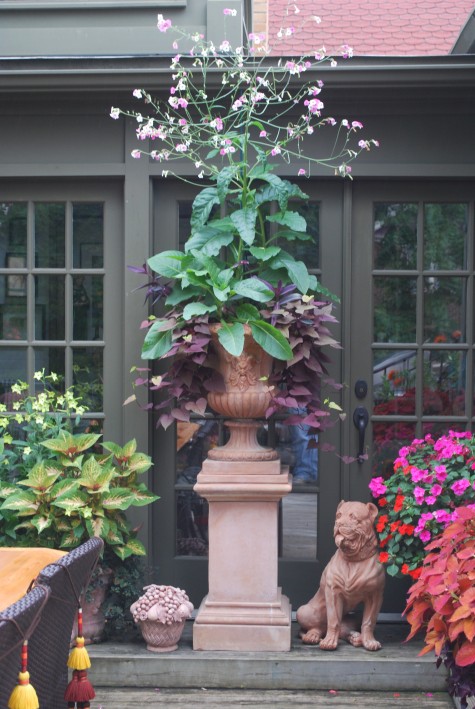 My own Italian terra cotta garden urns on plinths from Mital-I so love them. I trim what ever obscures their decoration. In the winter, I move them to my front porch, and plant them for the holidays. The rest of the winter they are empty, awaiting spring.
 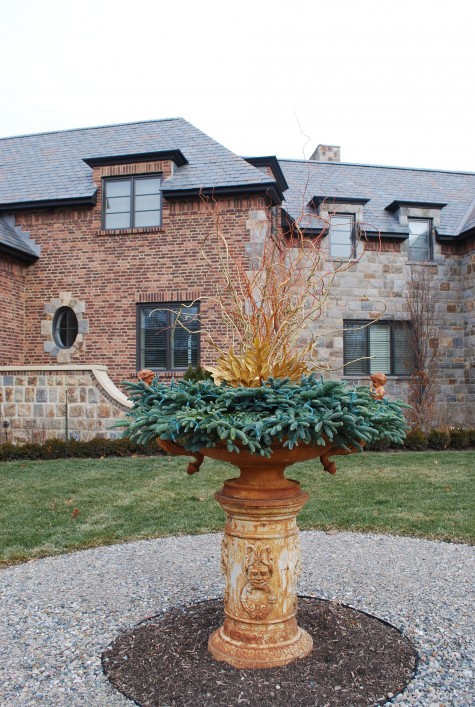 Antique urns take to a winter planting with ease. This client landscaped her yard to celebrate her fine antique footed pots. I completely understand this gesture.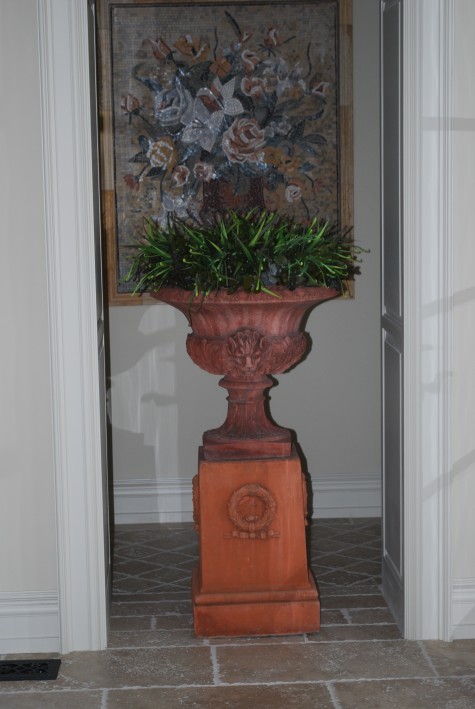
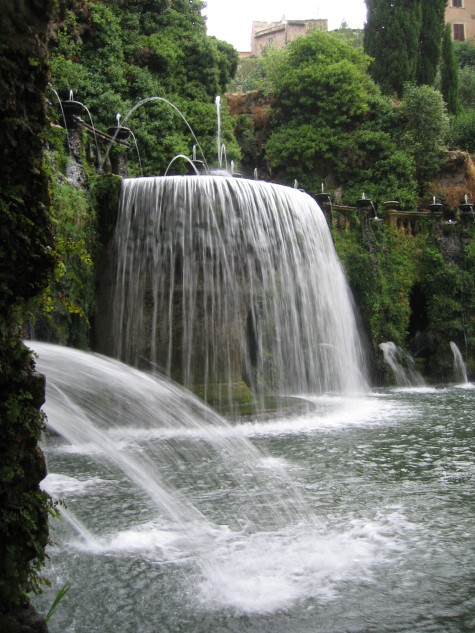
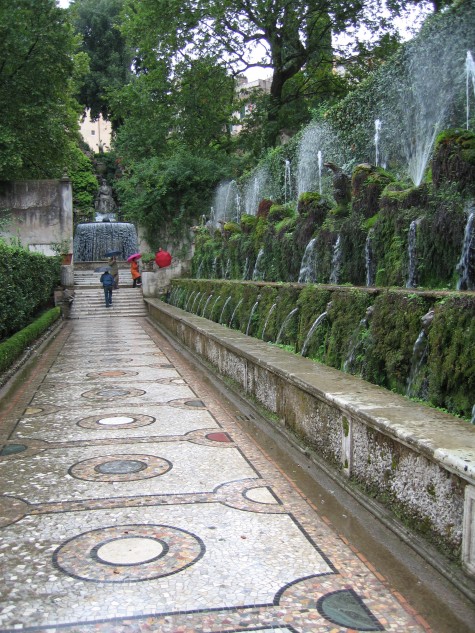
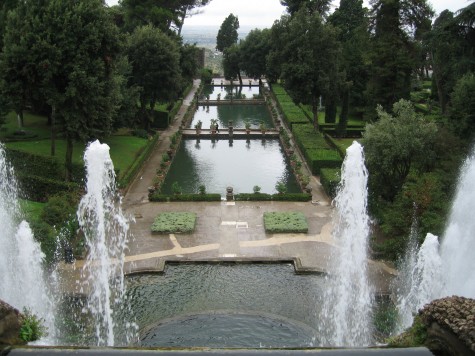 I have only visited this utterly romantic garden via these photographs of Rob’s. I can only imagine, for plenty of reasons, what it must be like to be there. My native topography is flat, and more flat. Only occasionally will a project come along with an unexpected change of grade as a central feature. With the possible exception of Tahquamanon Falls, water like this is not part of my experience. But that does not mean what I see here cannot be part of my vocabulary.
 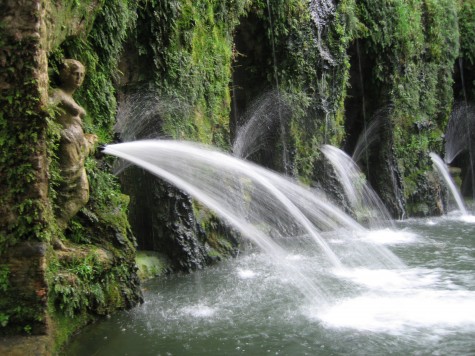 Other people’s gardens can instruct, provoke, and influence the way one thinks about a garden. The idea of fern and moss covered rock can be readily incorporated into any landscape, provided the conditions are right. Proper scale is a relative thing-but I try to err on the side of overscaled. As a friend and mentor once said, who wants to get to the end of their gardenmaking and think they were never bold enough. It’s a good thing in a landscape, to be driven by being bold enough.
 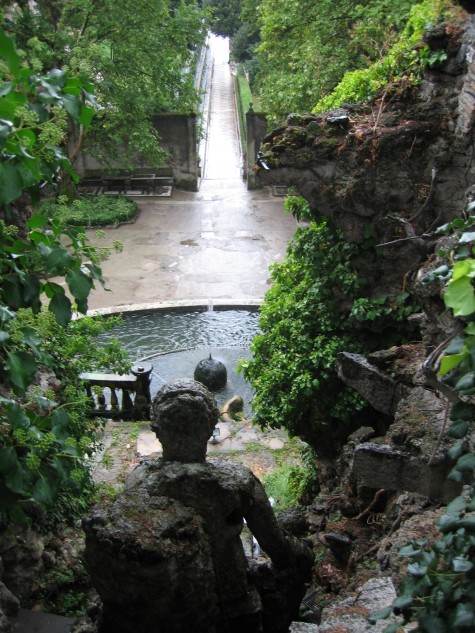 Lots of people own homes several stories high. I have likewise seen more than a few homes with two-story entrances. Then what? A landscape needs to address these features, and views. The beauty of the composition above lies in how it describes and emphasizes great depth, and space. In the foreground is a strong sculpture whose scale I suspect is much over life size. When my eyes go to what the figure in the sculpture must be looking at-the mid-ground fountain pool-its jet seems much smaller than the figure. Smaller in the midground is another way of saying further away. The terrace whose wet surface catches the eye next narrows to a walk. The wide entrance to the walk is clearly marked by tall walls; when the walk disappears from view, it appears much narrower. The end of the walk thus seems very far away. Where the walk leads-a mystery, from this perspective. This photograph is a rectangular flat object-but what it pictures appears to have great depth.
 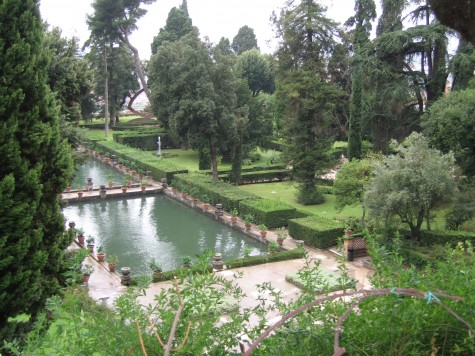 Every gardener knows any move gains importance when it is repeated. Though probably not accurately, I count 42 pots in this photograph. They make much of those rectangles of water, as do the yews in repetition. The shapes of those yews and lawn echo the shapes of the water. Far in the distance at ground level, a glimpse of that shade of blue that best says “I am far away”. That blue dwarf spruce you are thinking of might be at its visual best as far from your view as possible-rather than close up.
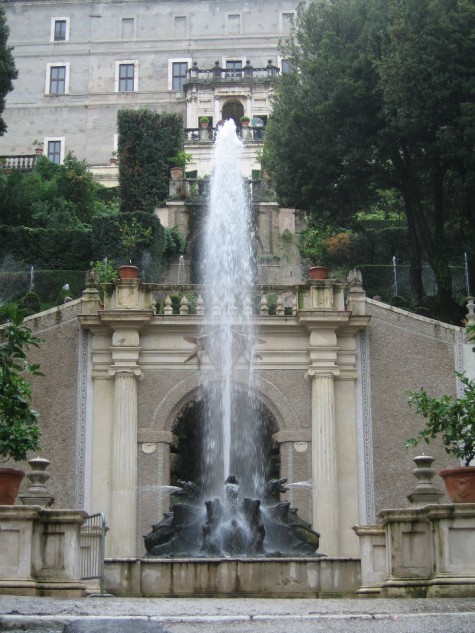 The scale and the height of this fountain jet is right, given the height and scale of the villa. My fountain jets at home will go fifteen feet in the air, should I feel like some big waterworks are in order. Given the size of my house and garden, that fifteen feet reads on the same order as this fountain, just at a different scale.
 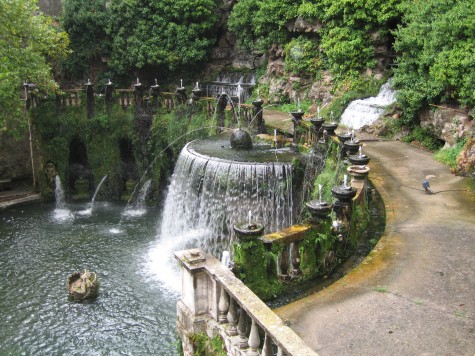 Everything in the architecture, the surfaces and the plantings are in support of this cascading water. There is no visual confusion aboout what exactly is the star of the show. Though elaborate in execution, it is very simple in design. I am quite sure the natural land forms influenced the design as much as any other element. A semi-circular wall of espaliers might make a similar statement on a property with little elevation change.
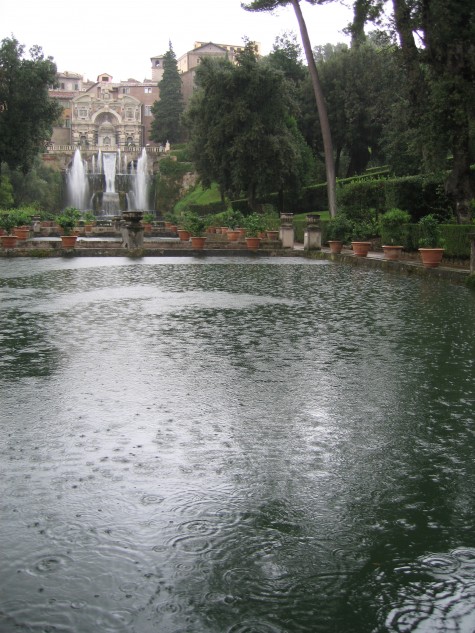 Looking back at the villa and its fountains from ground level, the pools seem immense, as they are close to your eye. The trees and sky are bigger than the villa; they keep it company, naturally. This property is in fact very large. It might be difficult to mask that, but it is a tribute to the designer here, Pirro Ligorio, that every aspect of his composition reinforces the depth and breadth of the space. Villa d’Este aside, it is possible to design such that no matter the size, any property can be visually spatial.