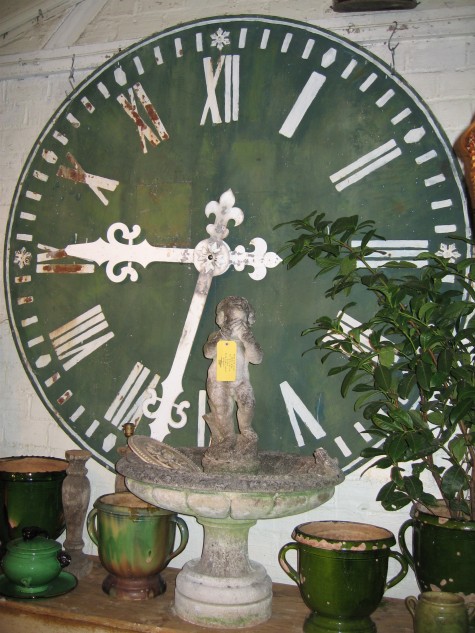
 The watch I have had strapped to my wrist my entire working life is a marvel. In spite of the heat sweat water and dirt, it churns on. This little workhorse enables me to to organize and schedule any number of things. Being off or behind schedule can be trouble; ahead of schedule-this I like. Around January 15, I take it off for 6 weeks, and let my internal clock handle the day. Landscapes have long been host to various mechanisms for telling time. The old clock face pictured above was salvaged from a monumental public timepiece in a Belgian town square, due for refurbishment after many years of service.
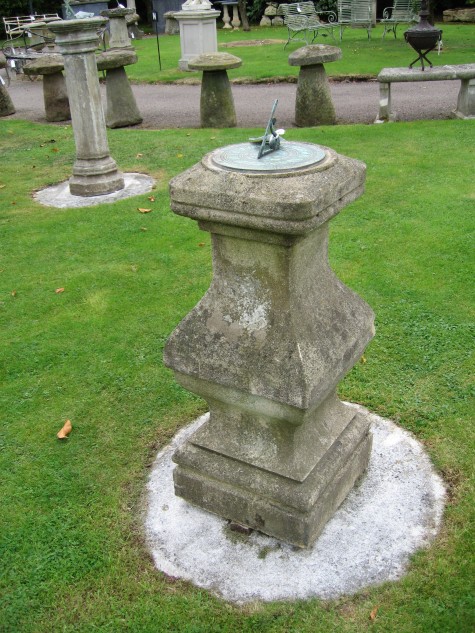 Sundials vastly predate the invention of watches and clocks; ancient cultures told time via the position of the sun in the sky. The device needed to be positioned in a sunny place in the landscape. As they are big chunky scientific instruments, people constructed them to be beautiful, as well as utilitarian. The dial portion of a sundial is small and unassuming. A flat plate was engraved or otherwise etched with a clock face. The triangular shaped gnomen set into the plate would cast a shadow from the sun, onto a different mark on the plate for every hour, or portion of an hour, of any given sunny day.
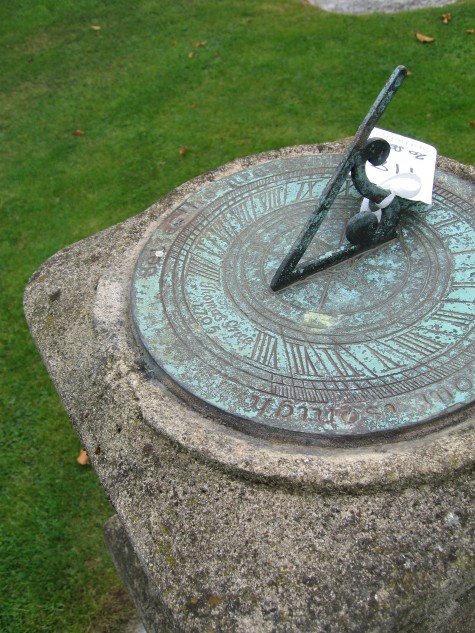 The engraving on the plates was often quite elaborate. This plate is engraved with the hours in Roman numerals; each numeral is further subdivided into increments of an hour. This plate is a beautiful drawing about time. The name and date- Thomas Grice,1705 might refer to the artist who engraved the plate, or the person’s garden to whom this sundial belonged.
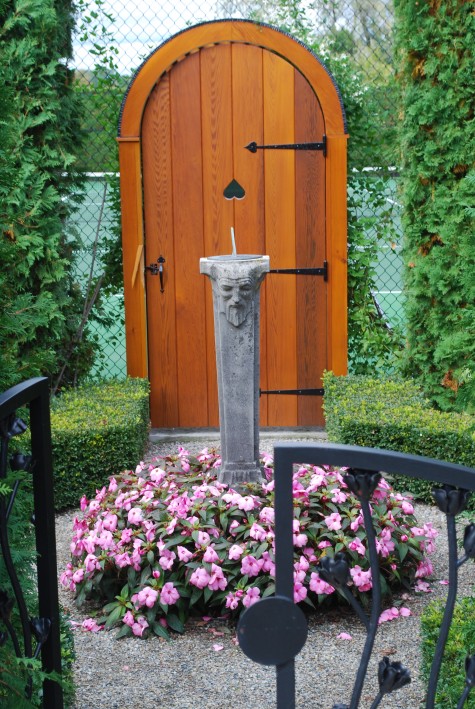
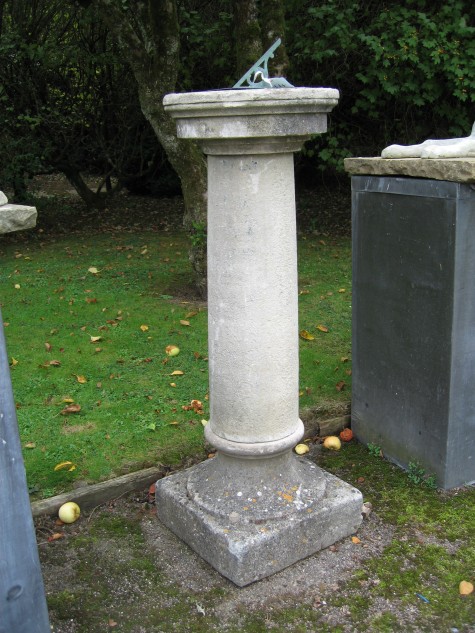 As the sundial needed to be placed in a level spot with the gnomen, or needle, set due north when the sun was directly overhead, the base needed to be sturdy, stable, and equally as lovely as the plate. This handcarved stone baluster sets the plate at 50 inches above grade-right at my eye level. Inscribed in spidery script, ” Let others tell of storms and showers/I’ll only tell your sunny hours”.
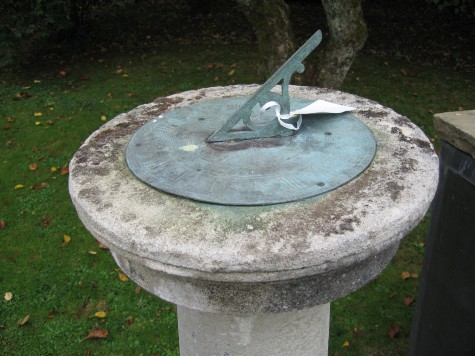 As a time telling device, a sundial has become obsolete. As a garden ornament, they are unmatched for their quiet beauty and dignity. They are as at home in a kitchen garden as a formal boxwood parterre. They refer to the ephemeral nature of life, and the repeating cycle of nature. I have never seen them made of materials that did not suggest permanence. Modern makers have expanded upon the traditional materials to include stainless steel, glass and mirror, but my favorites are the pieces dating from an age when they were still in use.
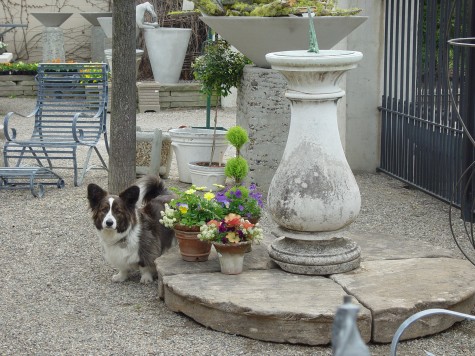
It is hard for me to believe that this sundial and base graced an English garden in the mid nineteenth century. It seems so unfazed by the 160 years it has been recording the movement of the sun in the sky. Michigan is not know for its sunny days; sunny winter days are scarce indeed. I have no need of a sunny day to appreciate a garden ornament of this caliber. I am also interested in how this object was part of another place and another time; there are days when I long for just that state of being. Garden spaces made from that longing have a special atmosphere about them that resonates with me.
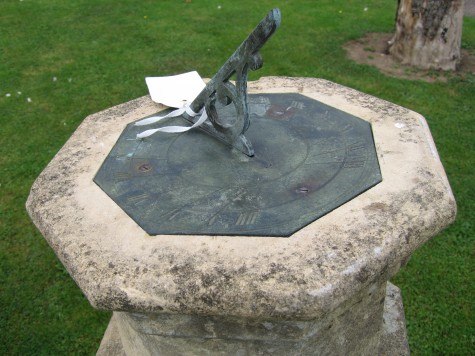 This collection of English sundials vary greatly in their details, but all of them are remarkably intact, considering their age, and exposure to weather. I am sure they will all find a new home in a treasured garden space.
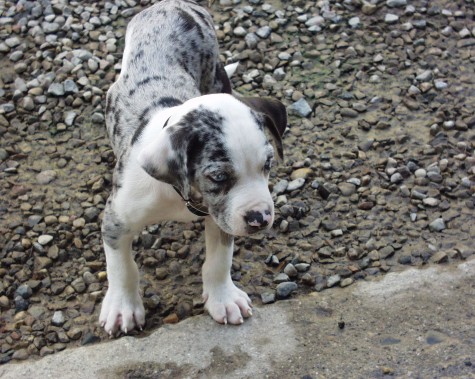
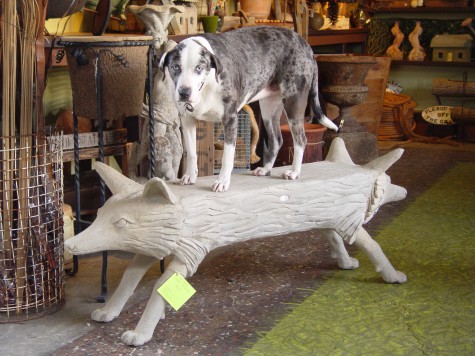 Troy is a gardener of exceptional ability, in addition to his gift as a sculptor. Growing up on a farm on the west side of Michigan, he grew a giant vegetable garden, ran a blueberry farm, did surveying, hunted, fished, and walked the woods. He came by his skills as a naturalist, naturally. He sculpted for me in concrete; this two-headed fox bench is his work. Annie went everywhere with him, including to the studio.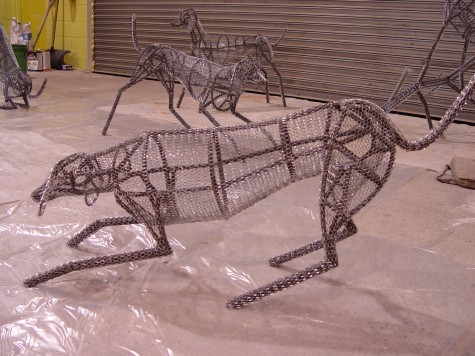
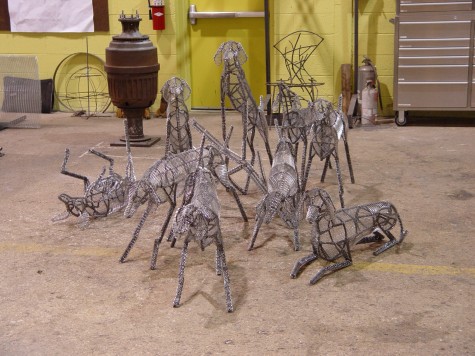 These very gestural and simple structures provide strength for the concrete and mortar to come. He squishes and packs concrete around these frames; the strength that a garden sculpture needs first and foremost, comes first. But I could tell from these frames I was going to like what came next. The outside mortar layer he hand carves.
 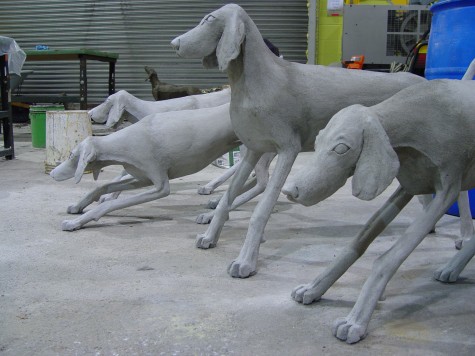 I was not prepared for how much I liked them. His sculptures of hounds are not about a biologically correct reproduction, they are about the heart and soul of his hound Annie. I was astonished by how much energy, motion and fluidity he managed to wring from a marriage of steel, and hundred pound sacks of concrete. This explication aside, these hounds won me over.
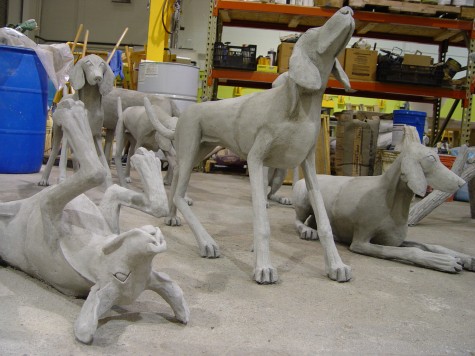 One hound was on his back, sunning and scratching, in the garden. Another was howling at the moon as if he had ten minutes to live. Yet another was tentatively down, those back legs were tucked under in such a position he could be cruising at a second’s notice.
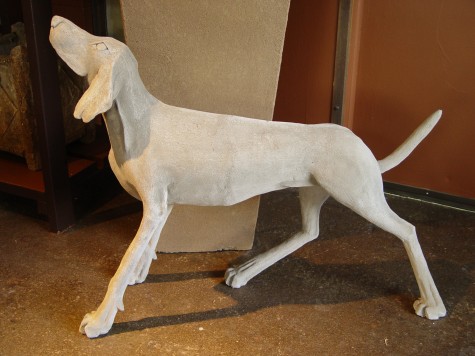 This sculpture makes clear the legs that make for balance, and the legs that carry the weight. The position of the ears suggest this hound just shook his head, and looked up towards the moon. Most garden sculpture leaves me cold; these hounds are right at home in a landscape.
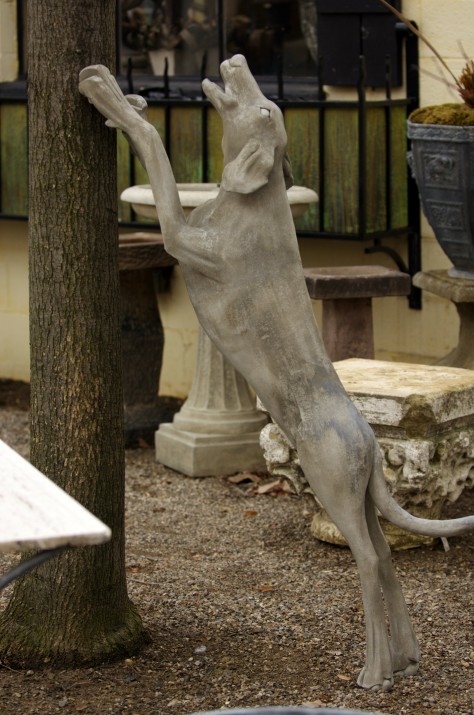 There was some discussion with Troy regarding sculpture that relies on the environment to be complete. He said, “don’t give me the history, just tell me what you need”. So ok fine, I asked him for a hound barking up a tree-the tree would be supplied by whomever took this barking dog home. She does have a good tree, and this hound has a good home.
 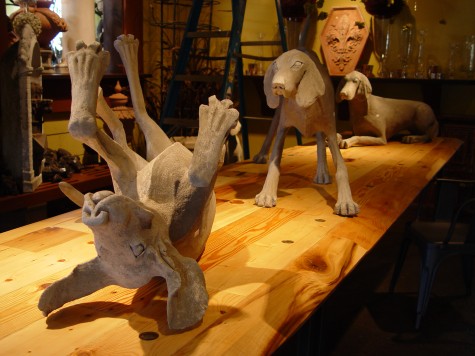 Troy’s sculptures of hounds could be in or out, up or down, on a sidewalk, in a bed, on a wall. I have placed 16 of them; they all moved away from me. When the garden wanes, I think about how much I value the sculpture that enchants me, all year long. His sculpture-creature comfort.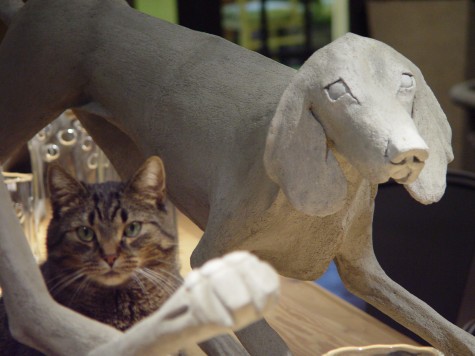
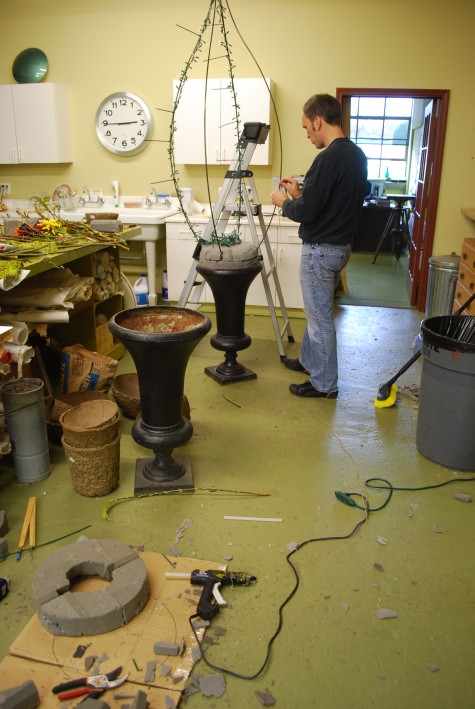 Our entire method of sturdily constructing an arrangement for a winter pot is predicated on one concept-you have to create the roots, and the trunk. I rarely worry about my summer pots going out of kilter. The roots of the plant secure them to the soil; plants grow upwards, towards the sun. I do not have that luxury in the winter, and Michigan has more than its fair share of stormy winter weather. So the mechanics of fastening all the materials is really important to the longevity and beauty of the piece. Tall skinny pots like these get lots of gravel in the bottom; a large centerpiece can be a big sail in disguise, just waiting for a decent wind to get airborne. We then construct a form in which to secure all the materials-glued up with industrial strength hot melt glue-that sits tight in the container. A loosely fitting form is just asking for trouble. If you have ever tried standing up in a pair of ice skates that do not lace up tight over your ankles, you know exactly what I am talking about.
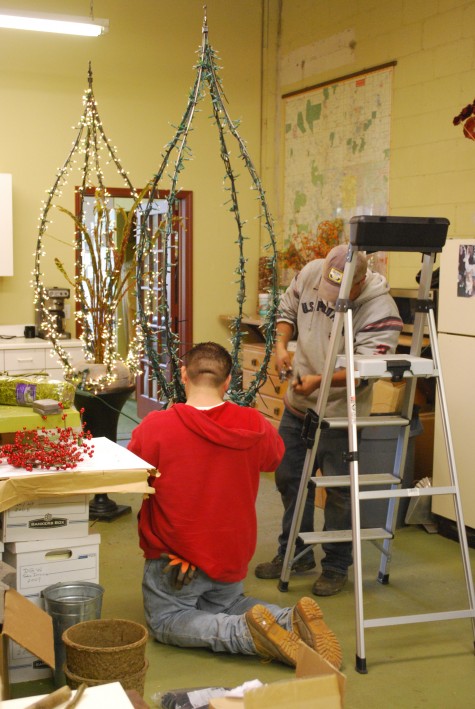 These pots will have lights in the vertical dimension; a steel form provides stability as light strings are heavy. They also make it possible to cleanly and crisply mimic a geometric form. As light strings shapes are governed by gravity, a rigid form insures they will be representing the form you choose for them today, next March.
 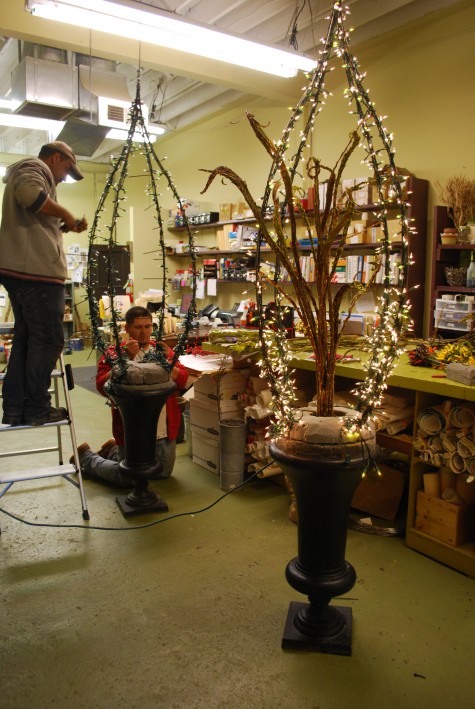 Winding the lights around a form is time consuming. It also makes the removal of the lights tedious. Zip ties make for an easy in and easy off. It’s also easy to spot in the above picture how close we space those zip ties; the closer, the better. Light string wires have strong kinks and curves when they come out of the package, but droop they will, given time. They do not hold a graceful curve on their own; we are generous with the fasteners. The centerpiece is set through a hole in the center of the form; a stout bamboo stake at the center of the arrangement goes far enough down into the pot to insure it stays vertical. There is something so wrenching about a listing centerpiece-who needs that in the winter?
 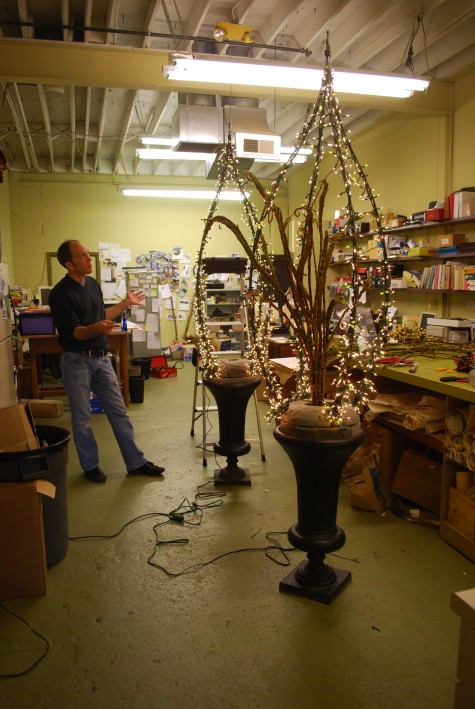 The fantail willow is set into the form based on a determination of the front elevation. When pots are placed such that they can be seen from all sides, we work in the round. As the form will be covered in a skin of lichen mat, the form is shaved into a rounded shape.
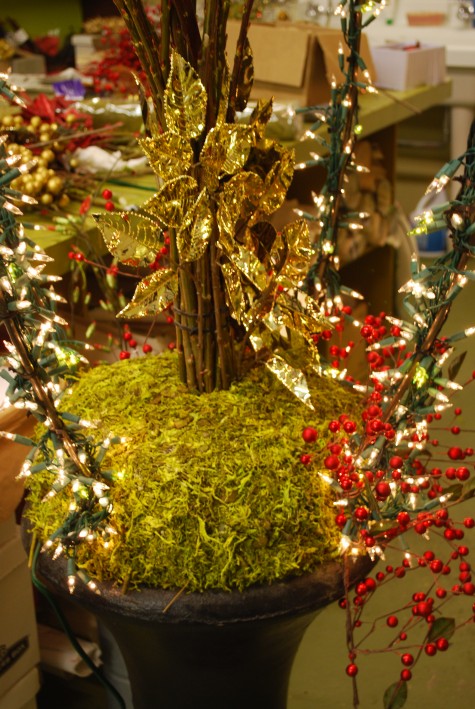 Once the form is covered in the lichen, we add a little icing to our lichen cake-just for the holidays. Gold leaves and a luminous red berry garland-yummy. These elements can be removed after the first of the year, so the pots look good throughout the winter. A client can use the lights in the winter-or not. The topiary form has a decidedly dressy look to it, with the added attraction of absolutely no maintenance. It will still look fine come next April, provided the construction is sound.
 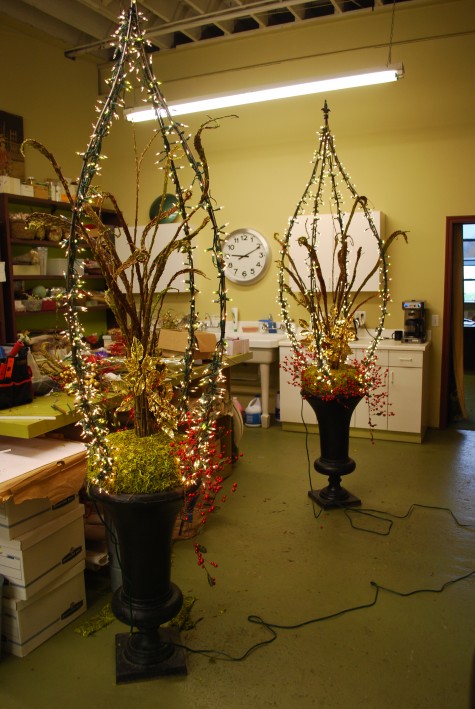 Getting the installation to match in a pair of pots is harder than you think. I try to work on pairs side by side. Some pairs of pots that demand a very formal arrangement, I make sure that one person does both. Everyone’s eye and hand is noticeably all their own. My rule of thumb-I work on the second pot, never taking my eyes off the first.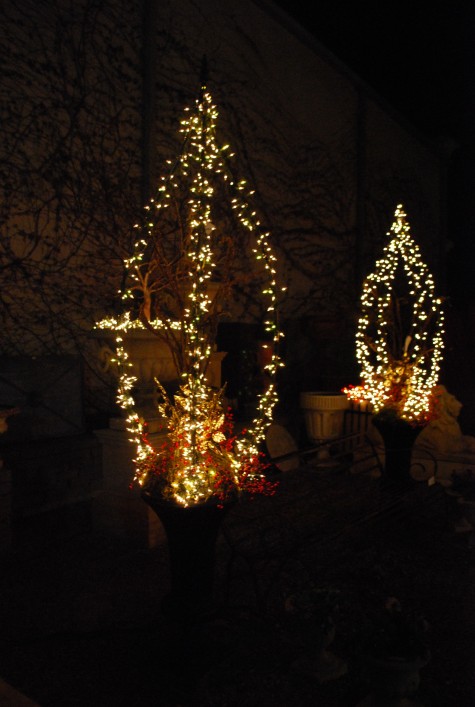
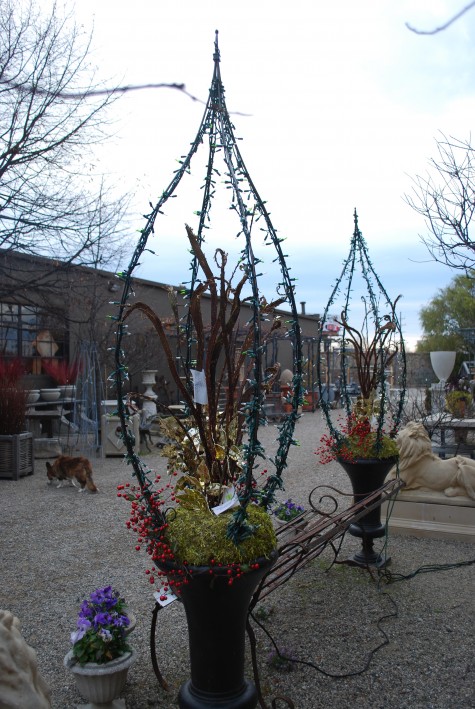 Your winter pots are the best they will ever be, the first day they are done. Unlike a landscape that fills out, and blossoms with age, there is no growing involved. They need to be constructed tall, wide, and robust from the beginning. The winter is a season that can handle a little unedited excess, with a dash of over the top sparkly, with aplomb.
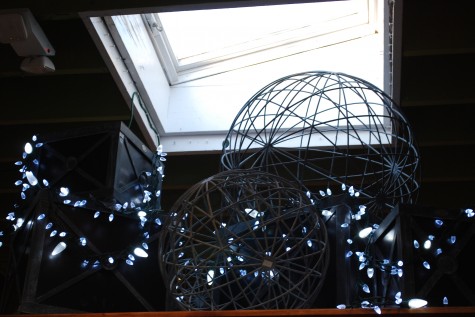
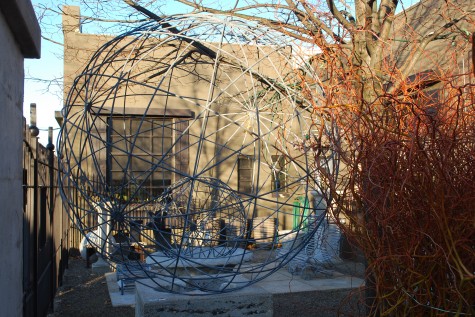 “Tuteur” is that elegant French word for those structures designed to support and make an orderly presentation of a vining plant. Vines are by nature unruly and out of control. Their exuberant habit of growth can be as exhausting to deal with as a recalcitrant two year old. Most plant climbers I find wanting for three things-good looks, thoughtful design, and proper size. Having made a succesful foray into steel wire structures via our spheres, it seemed time to design out the poor looks and clumsy design of what was available, and fabricate some good looking tuteurs I thought would work well.
  It was my intention from the beginning that a tuteur needed to be beautiful to look at once the garden had gone dormant. They might even be useful in another season. They might be designed with curves friendly to the natural shape of the vines. Those straight sided plant climbers with a curving vine bulging out of them-a bad marriage. And lastly, they need to be sized according to the eventual size of the vine they are meant to support-not to UPS shipping regulations. Some tuteurs have been designed to break down into several pieces-for economy of shipping; these never work.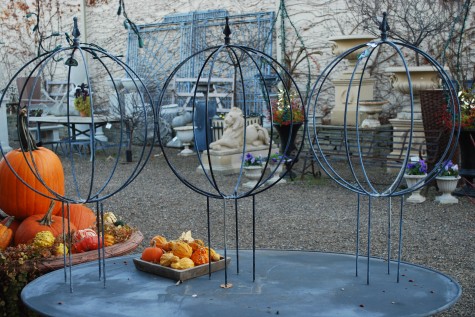
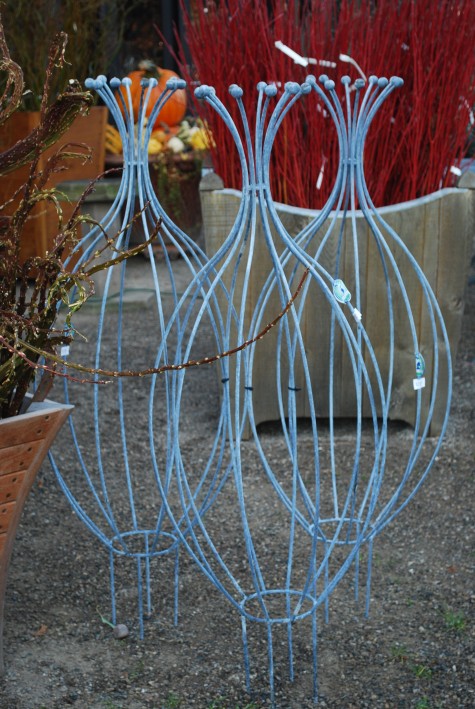 All of our tuteurs make reference to natural forms. Some say these look like onions or shallots; others are reminded of garlic cloves. In any event, we make these forms in three sizes; the size dictates the shape. Not all shapes work scaled up, or scaled down-this I learned from Rob. Sometimes the proportions have to be changed when the size changes. The ball finials at the top make the structure look finished and dressy. They also protect the gardener from a poke in the eye-has not every gardener be stabbed by their plant climbers, stakes and supports at one time or another?
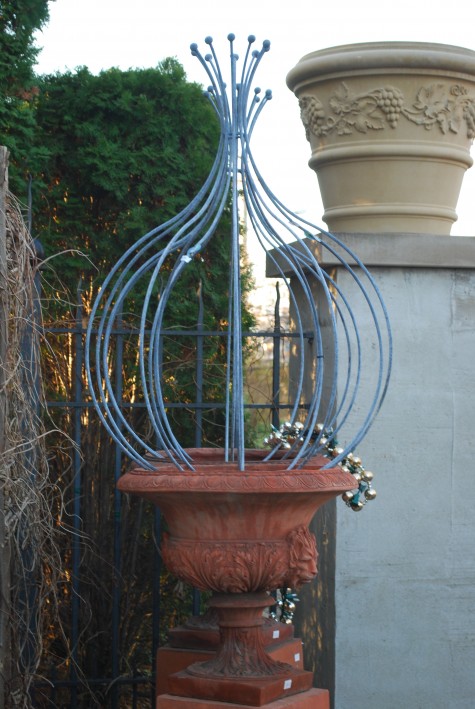 This pair of English concrete pots are all the better for their top dressing. The pots could be planted with ivy growing over one side of the tuteur in the summer-or not. They could be left out all winter empty, and look great. It is a test of a good garden pot presentation-does it represent as well empty, as it does overflowing with flowers?
 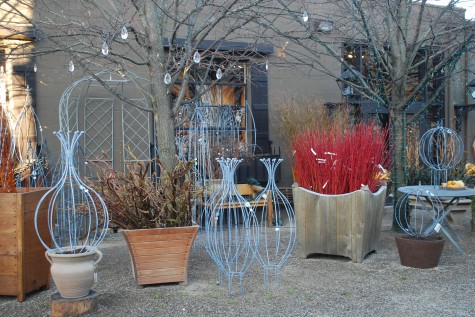 I did not anticipate how very much a part of the winter season these sculptures would prove to be. They look great with greens, berries and other materials from the garden at their base. They make something showy of our off season.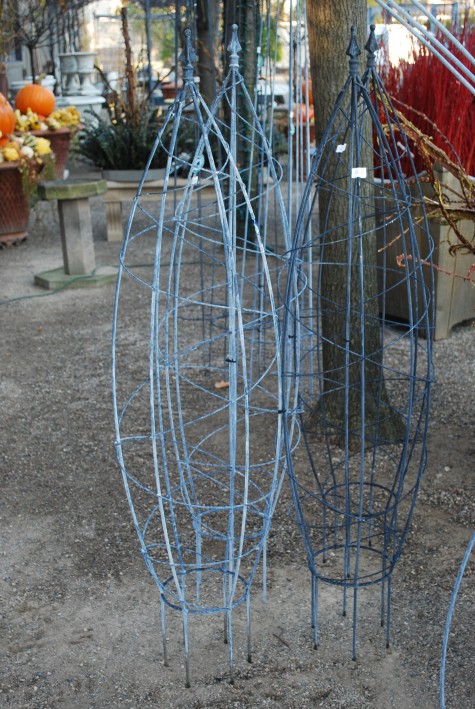
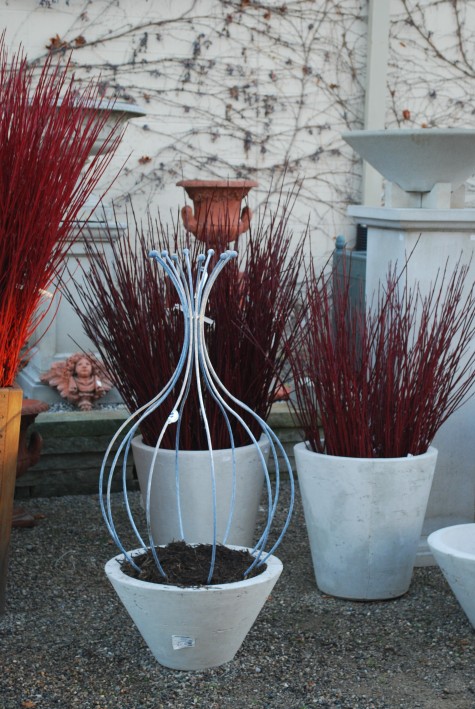 The shapes work in both contemporary and traditional gardens-what a relief to be able to offer a client with contemporary taste, a tuteur that looks like it belongs to them.
 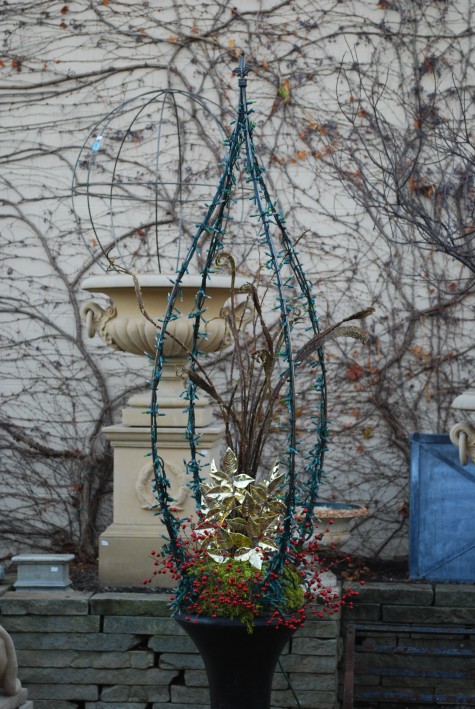 Decorating for the holidays outdoors is a form of gardening, and those strings of lights common to the season are a type of vine. Some tuteurs we design fulfills this purpose. They are very simple in shape, and overscaled such that the lit forms read as topiary at night. It will not be long before it starts getting dark at 4 in the afternoon here-any gesture defiant of the dark, I like.
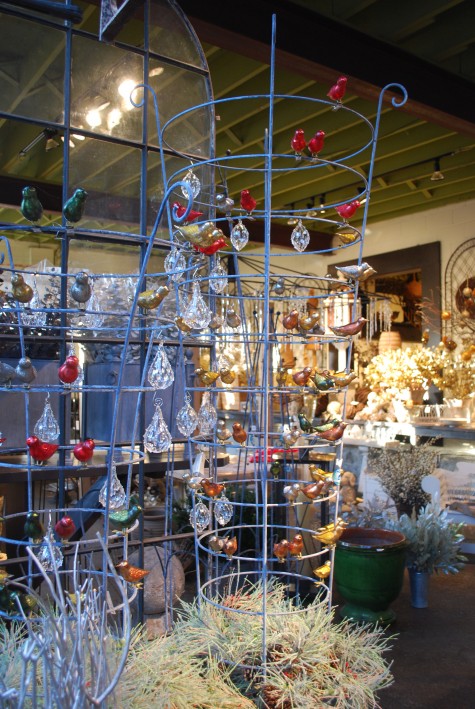 This is my favorite climber, designed after Rob’s hand wrapped galvanized wire tomato cages. The tuteur is much larger at the top than the bottom. My sweet autumn clematis may have 6 stout stems coming out of the ground, but once it gets to 14 feet tall, it is billowing out in every direction; this tuteur handles that. The fern curl detail at the top is a simple reference to the look of an ostrich fern breaking dormancy in the spring; this is a form I never tire of. We make these in a range of sizes. Our individual plant stakes of this design come straight out of the ground or pot, and then gracefully curve out to catch whatever happens to be growing that way. We make them as half rounds that can be snugged up against a wall. In short, we are gardeners, designing for gardeners. In this application, they provide wire perches for a collection of holiday birds.