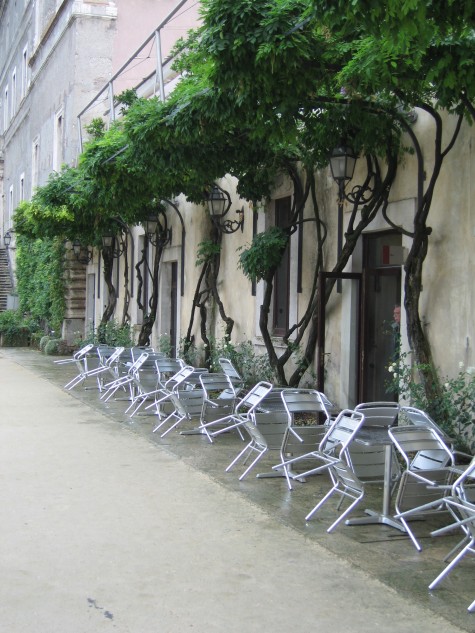
 Vining plants have a very special charm. Provided they have secure support, they take up little to no room in a garden. Most of them are energetic growers; this I especially appreciate in a plant. Wisteria gives new meaning to the phrase “willing and able”, but with proper support and ruthless pruning, their sculptural effect in a garden will rival their long and languid racemes of flowers in June. I would only advise that any thought of planting wisteria should be undertaken in tandem with where the iron will come from. Iron support, and iron fisted supervision are must haves. Any other scenario risks waking up to it growing in your bedroom window.
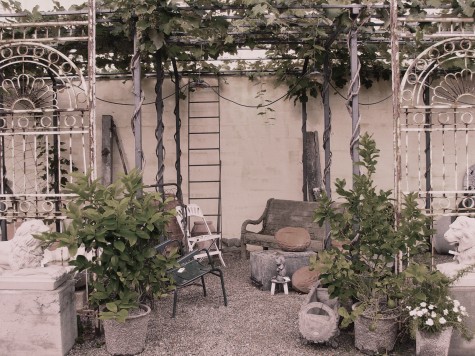
The grapes I grow at the shop you would not much want to eat- too sour. The green wine grape “Niagara” I grow for the beautiful color of its fruit, and its hardiness in zone 4-5. The first few years I wrapped the trunks; my black iron pergola heats up on a sunny day in January; the precipitous drop in temperature once night falls can cause the bark to crack. The soil here in no way resembles soil. Rocky, stony, and sandy is the order of the day, and the grapes seem to like it fine. The wild grapes on my fence grow like mad; we cut them back regularly during the course of the summer, lest the property be overrun.
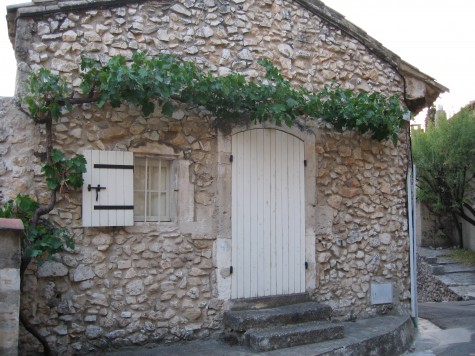 Grapes are like any other vine-lax in habit, and best grown within the confines of a well run dictatorship. They are sterling performers with a good gardener at the helm. But like the willows and dogwoods I discussed yesterday, their strong suit is about the harvest. I will never grow grapes for the table or for wine; I suspect the art and science behind that is considerably more than I imagine or could grasp. But I do value the look and feel of ornament made from materials from the garden.
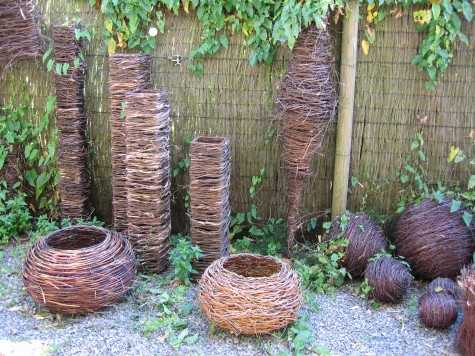 My shop has featured many garden ornaments made from vines and flexible twigs over the years. They never seem to loose their appeal. Those woven over a steel framework have an astonishing long life; they are as beautiful breaking down as they are brand new. Every year I pick up a large French basket from a client planted with a colony of medium sized agaves, amazed that it is still all of a piece. Enamoured as I am of Belgian design both inside and out, these airy, often hairy objects are a beautiful foil to brick, plaster, stone, concrete and iron.
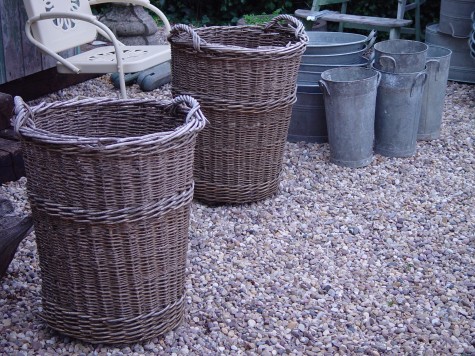 Only in England would you find a business named The English Hurdle and Basket Center. Despite sounding like remedial center for floundering collegians, it actually produces vessels and baskets of great artistry. The graceful shapes belie the skill and strength needed to form them. The artist Serena de la Hey, for whom I have the greatest respect, creates truly inspired sculpture for the garden. My very first purchase for my shop in 1995 was a order for one of her boar sculptures. She is well worth a look; www.serenadelahey.com.
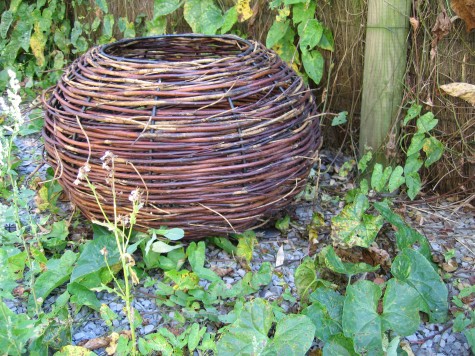 The framework that is visible here makes the object eminently renewable. Though the wood and bark of willow is remarkably resilient to weather, it will eventually deteriorate. I appreciate the chance to renew, redo, and rethink an object; this is a good part of the appeal of twig and branch sculpture.
 Though this stag looks perfectly at home in my client’s landscape, it is made in California. The metal frame will last a lifetime. The willow is painstakingly woven; the sculpture is heavy and sturdy. Carleen’s life size animal sculptures are enchanting. I have seen enough of them to recognize which of her artisans is responsible for a specific piece. This is grape vine, beautifully rendered.
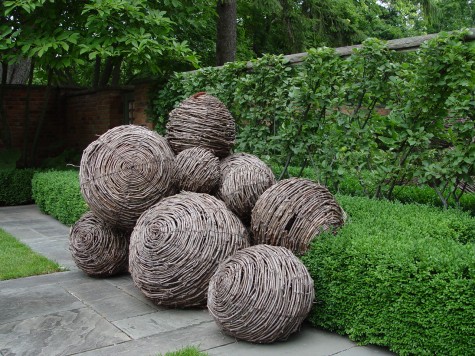
No matter whether contemporary or traditional in flavor, garden ornment from vine and twig has an appeal that sits right up next to my gardening bones.
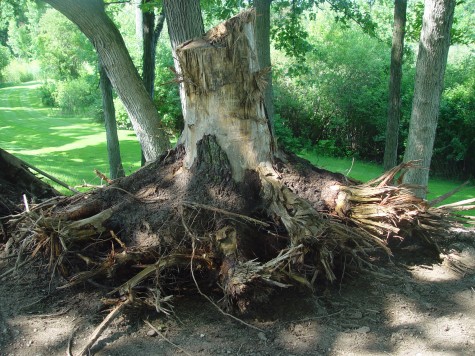 Some months ago I wrote an essay about designing a landscape for a sculpture, but perhaps equally as sculptural were the tree trunks that played such a critical role in the realization of that design. I do not think I ever physically understood what a tree was all about until I was face to face with these stumps. Farmers need to clear land to plant their crops; this means digging out the stumps. The microorganisms that decompose wood work at a snail’s pace. In farm areas in Michigan it is common to see fences made from these stumps. For this project, I persuaded a farmer to part with 150 feet of his fence. The experience would provide me with a graphic understanding of what goes on inside the bark of a tree.
 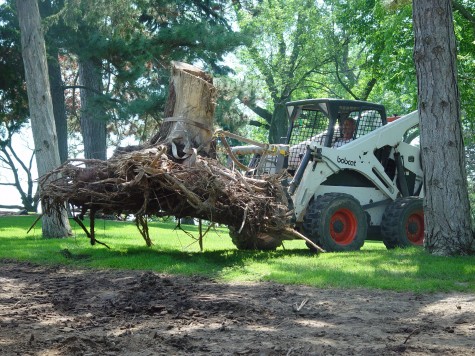 What arrived by flatbed was vastly more than I had bargained for. They stood eight feet tall and were much better than that in width. Though the fence had been in place for 10 years, handling the size and weight of them was a strain both for my crew, and my bobcat skid steer. The thick wiry roots were as unyielding as steel. It is so easy to stop truly seeing those things one sees every day. A lifetime of seeing these giant living things rising out of the ground to incredible heights had apparently dulled my sense of them.
 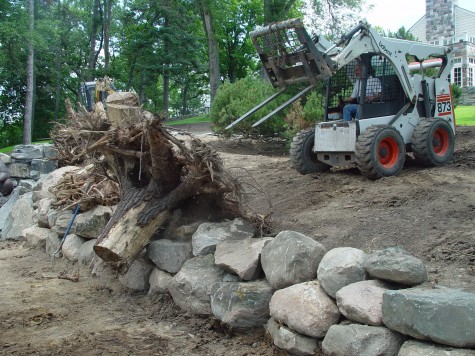 I was so struck by how the heart of a tree lives on long after its green life has gone down. The heartwood is transformed by an internal chemical process into a material of great strength. The wood of a tree enables nutrients to travel from the roots to the leaves, its core function is to keep the plant upright. This exposure to wood is much different than looking at planks, or plywood, porch furniture, or fuel for my fireplace. Processed wood is obviously a material that few could do without, but these raw forms are incredibly beautiful.
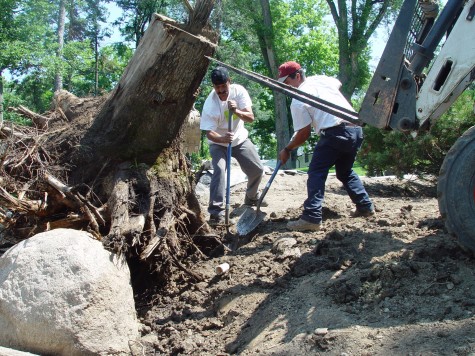 Setting them in place took days. Placing them close to the final location was done by machine. This was just the beginning; as I wanted them to look as though they might had always been there, we dug them in. The forks on the skid steer held the stumps in place, as it would have taken an army to do that by hand. Though this group of trees was no longer living, the story of how the network of feeder and support roots broadly rise out of the ground and grow to support these very large plants is there to read.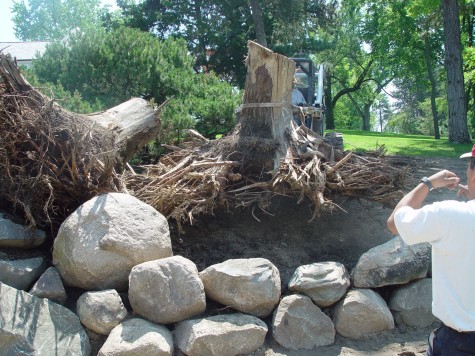
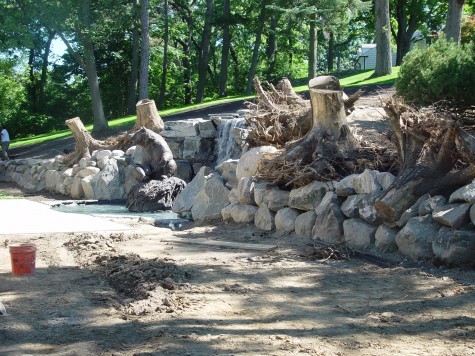 It is a very good idea to consider what will need to go on below ground, and what will eventually be-before planting a large growing tree. I have had occasion to tell clients that their silver maples were an excellent example of God’s biggest weeds. Urban lots and tree lawns are poor locations for giant trees. They suffer from restricted space and rootzones. Given that it takes a long time to grow a tree, imagining the eventual size at the beginning only makes good sense.
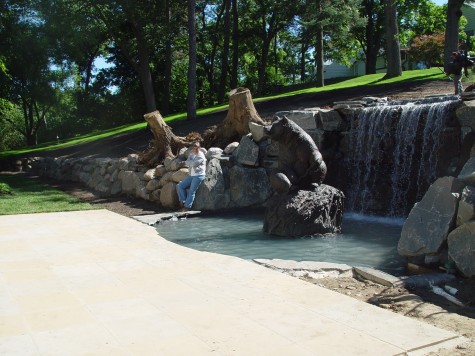 This nine foot tall bronze bear seated on his beaver’s nest is getting some company of a similar scale. The rain to come will wash the stumps. The digging in will deposit soil in pockets, enabling plants to grow. A collection of dwarf conifers would cover the ground.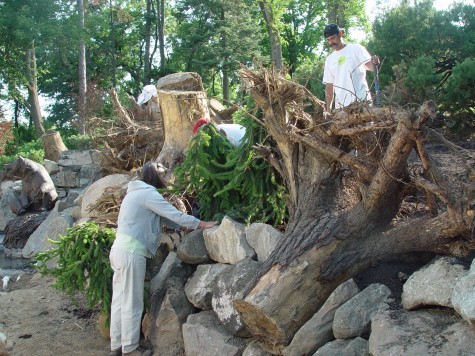
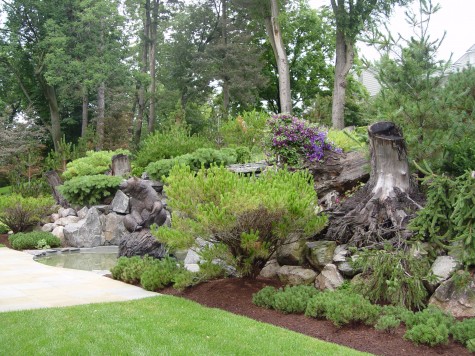
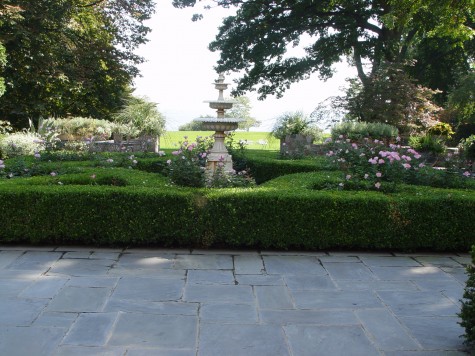 I have clients whose interest in gardens runs to green, and more green. Though my love for the green of the plant is every bit as great as my love for their flowers, I have never had the discipline it takes to restrict my own palette like this. But I find that whenever a client represents their own point of view outdoors, the result looks just right.
 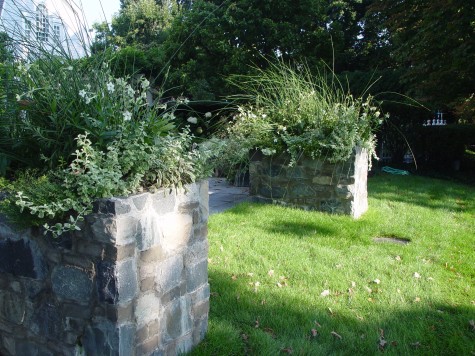 These large stone and brick piers punctuate a pair of walls that partially enclose a terrace. I plant them with a mix of plants whose textures are as unlike stone and brick as possible. This is a matter of directing visual attention. The window boxes on the roof of my shop are not so gorgeous. They are made of galvanized sheet metal ordinarily used in the production of ductwork for the heating and cooling industry. The sole function of those boxes is to hold the soil, nutrients and water for the plants-they have no visual interest in and of themselves. The intent here is to acknowledge the beautiful surface of the container as much as the planting.
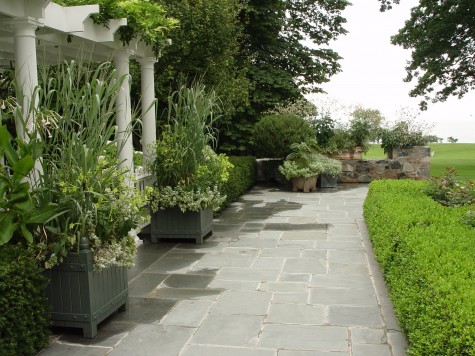 A green planting has a quiet and serene look, as the greens so closely relate in color and value. The green of these painted Belgian oak boxes harmonizes with the color of the bluestone terrace; the relationship is a subtle one. The Dallas Blues panic grass repeats that color. Monochromatic color schemes tend to read that way, although an ocean of orange is anything but serene. Add some contrasting purple to that orange, which in turn contrasts with the green, and you have a visual party going on. These greens speak softly.
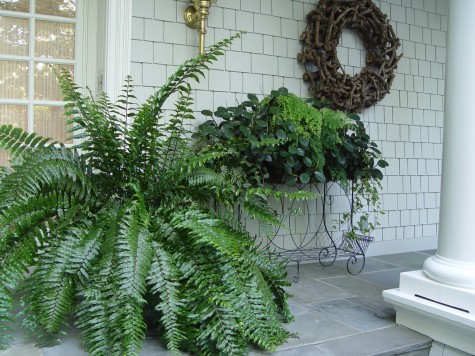 A porch planting plays the spiky texture of a tropical fern off the round chubby leaves of a of large scale pepperomia; the effect is pleasing, not demanding. The elegant English wirework planter reminiscent of vintage conservatory furniture is balanced with a simple and very rustic wreath that hangs on the wall year round.
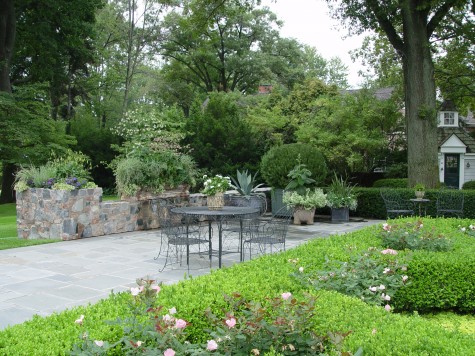 The container collection is a beautiful one. An American stoneware grape panel container from the 1920’s, and English lead and the Belgian oak box are very different in materials and forms, but very much alike in feeling.
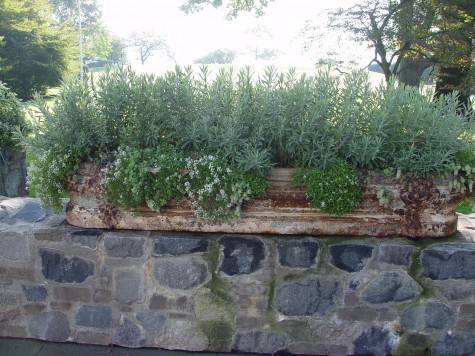 A pair of very old and distinctive French iron planters sit on the walls. I usually plant them with lavender, and alyssum, showy oregano, and whatever other herb like plant seems appropriate. The effect is graceful; the muted colors of every aspect of this space invite contemplation.
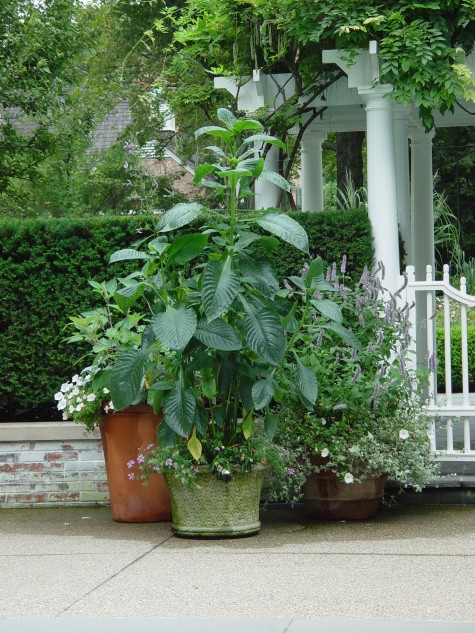 Some plants stay green all season, as our summer is too short to permit flowering-as in this large tropical salvia. The fine perennial hyssop hangs on to the ghostly lavender of its flowers a very long time; this is repeated in a lavender trailing verbena. Though there is some color here, it is the relationships of the greens that reads first and foremost.
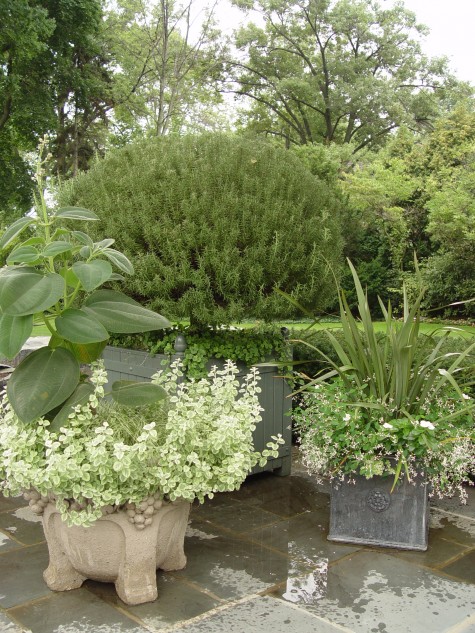 I think the leaves of tibouchina grandiflora are surely my favorite. The large oval leaves are completely covered in fine white hairs; they are a marvel. Their contrast to the needles of the rosemary topiary is considerable in form, and little in color. Variegated licorice is one of the most versatile of all green plants. The leaves sport two different shades of green; the blotches are very blue green, while the edges are more yellow-green. It works with every plant with which it is paired. This collection of pots benefits from the lively effect of its habit of growth, and relative lightness. Subtle does not mean sleepy.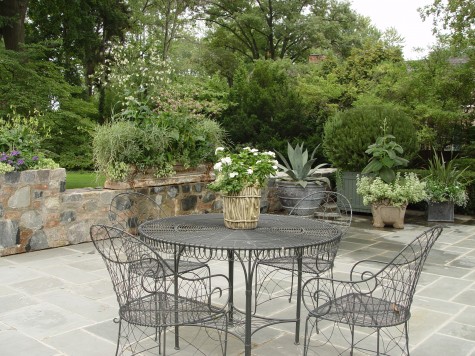
 As my clients were bound and determined that Allie, Snoopy and Vladdy would be members of their wedding party, their choices for a wedding venue were slim to none. I was happy for them to get married at the shop, and equally happy to welcome the canine members of their family. Since the decision was made some six months prior to the ceremony, I had the chance to plan a garden that would look great on their late, late summer date.
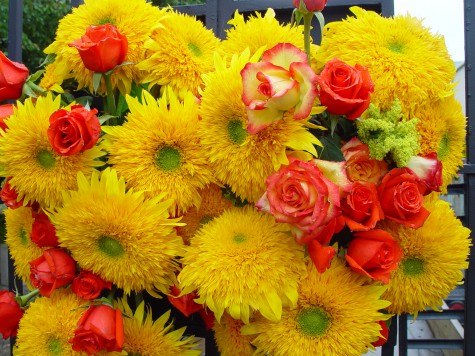
 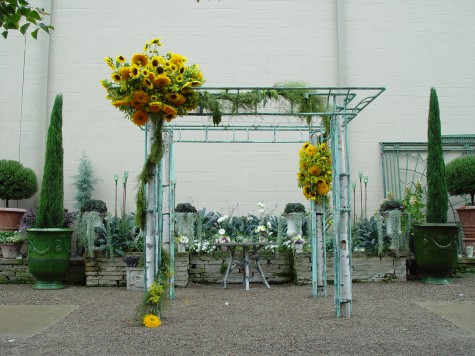 A copper pergola would provide the chuppah necessary for the ceremony. We infilled the poles at each corner with birch bark tubes. This blue and white scheme dictated the selection of plants as much as the season would. A collection of Italian cypress, giant rosemary topiaries, kales and cabbages would look swell come wedding time. Luckily a local grower has a very late batch of sunflowers, including the ultra double “teddy bear”. That intense yellow would warm up the arbor in a happy and sunny way. A goldenrod garland casually draped over the chuppah provided the roof necessary for the ceremony.
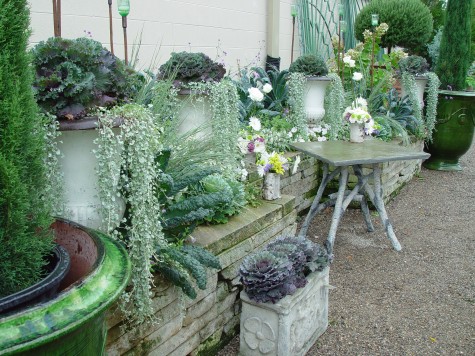 Silver dichondra has a distinctly blue cast; its diminuitive felted leaves were a great contrast to the giant blistered kale, “Nero di Toscano”. Short blue foliaged fescues, white million bells and showy oregano made good companions for the massive cabbages. White iron urns showed off the long tails of dichondra to good advantage.
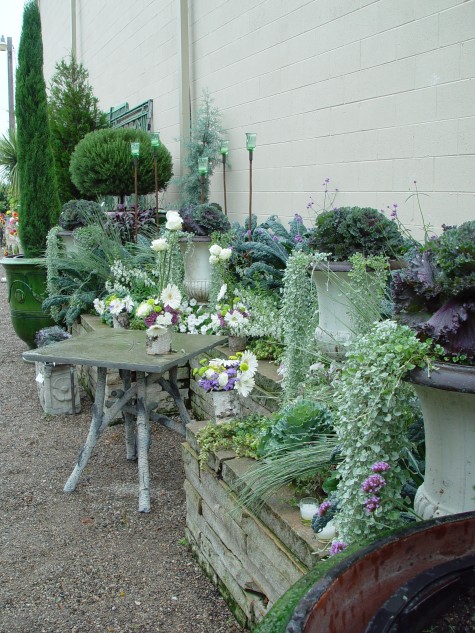 As the ceremony required a table be available for the Rabbi, my clients chose a carved concrete faux bois piece whose legs were carved and acid stained to look like birch. The wedding party flowers in lime green, white, and lavender repeated the color scheme of the garden. Is that old rosemary topiary not a dream come true?
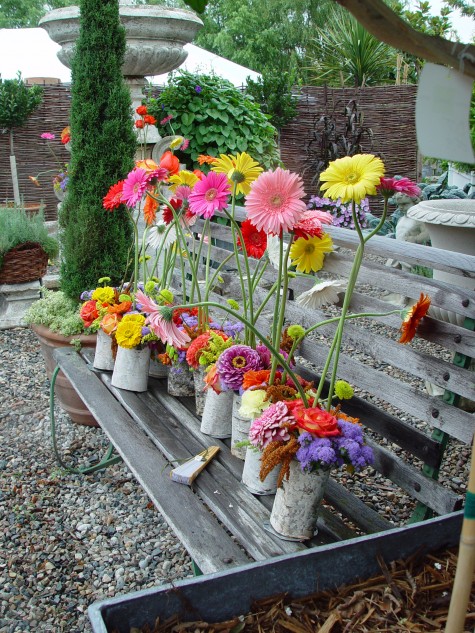
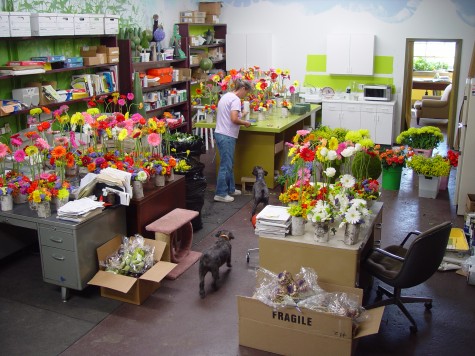 The plan for the reception involved nine 8′ long tables set end to end in the drive. Small glass vases covered in short birch bark tubes held late summer garden flowers available from the growers at my local farmer’s market. These 45 small arrangements centered on the tables would run for the entire 72 foot long reception dinner table.
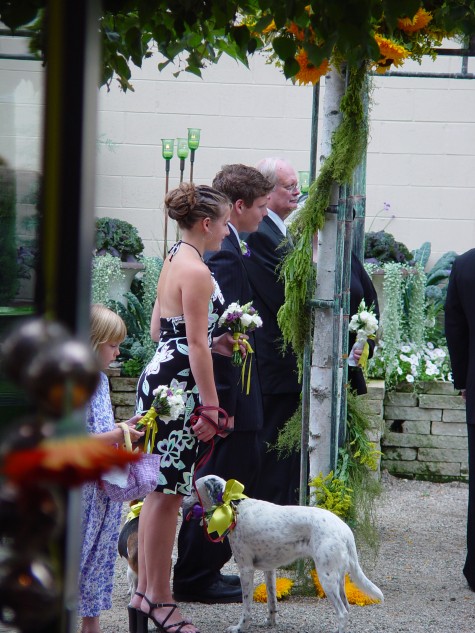 Allie and Snoopy were nervous, but they did take their big lime green satin bow and flower collars in stride. They did mill around-but just a little bit. All in all they were very well behaved.
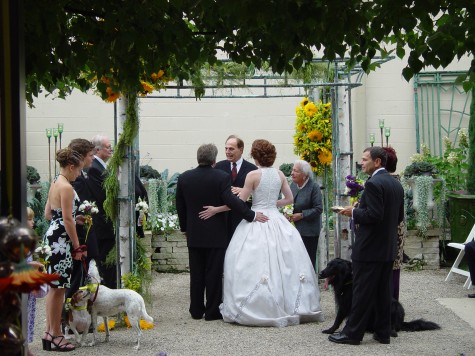 Vladdy was ordinarily fairly dignified and unflappable; he sat calmly through the entire ceremony.
 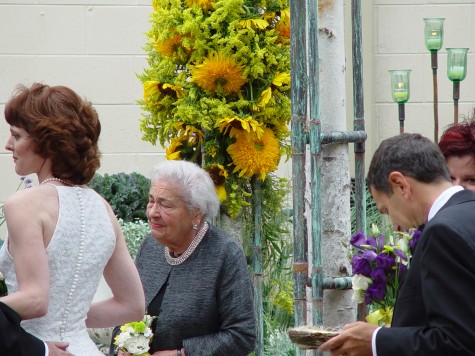 It was a beautiful wedding, and I was happy to have a part in it. There is something so satisfying about a small ceremony for everyone involved. When there are but a few details, every detail can be very personal and thoughtful. I think they were so pleased to be able to have their dog family there that day.