A Restoration

Some garden ornament is so irresistable that you don’t mind doing some restoration. This very old French cast iron and porcelain vase is dated on the side-Paris, 1827. That it was 183 years old, of great size, and unusual in its construction and surface-this made it a very intrigueing and compelling object.  I arranged to purchase and ship it to Michigan from Florida-having only seen pictures. 
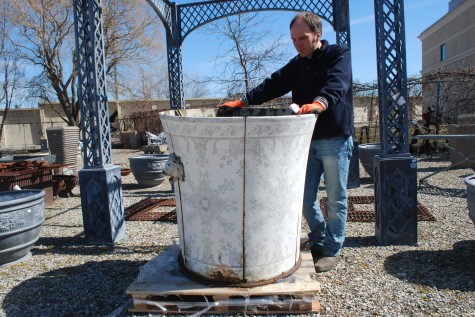

Though I expected to see considerable evidence of its age, pictures do not tell everything.  I was enchanted with its worn porcelain surface; the original pattern is so beautifully faded.  I had visions of it placed and planted in a landscape such that the benefit would be to everyone’s mutual satisfaction.  The sheer scale of it was exciting.  One of Rob’s pictures from Italy is of a massive Italian olive jar that served as a prop to an old climbing rose planted next to it. This vase brought the possibility of that level of romance to mind again. 
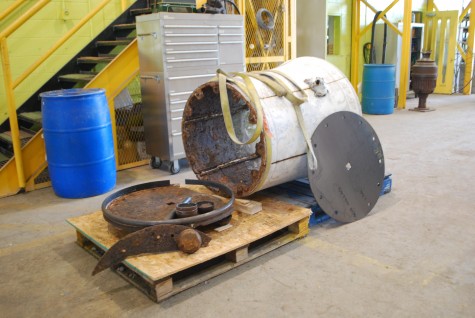

However, the vase had issues. The thick cast iron base plate had deteriorated considerably over its very long life.  Buck doubted that the trip from Florida had anything to do with the fact that the base was in pieces.  The bolts which fastened the base to the top had completely rusted through. It was just very old, and in need of some restoration. It took four people to get this piece over to the Branch studio.  Buck had a 1/4 inch thick piece of steel cut to make a new base; the restoration project would have to get in his queue-at the end of the line.  
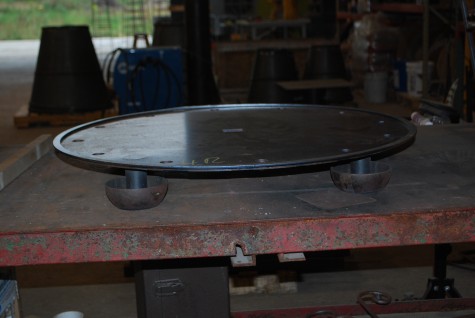
He had the base drilled with holes, hoping that he could weld what was left of the bolts to the new base.  He  would work on it as he had time; the new base and feet got completed in fairly short order.  What was to come would take a lot more time, and be quite involved. It would have to wait until there was time.  Early this summer a landscape project came along that was calling for this vase. My client fell for it just as fast as I had; the restoration process picked up speed. 
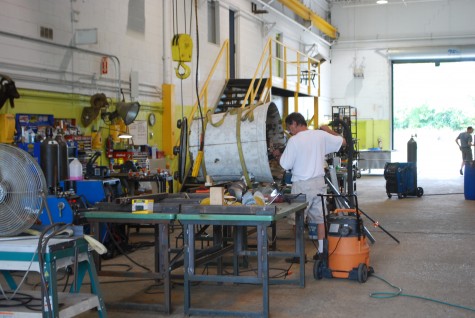
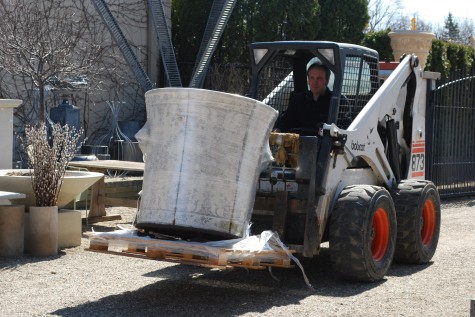
The first order of business-getting the vase in a position and at a height where he could work on it. A bridge crane in his studio which can lift and move up to five tons at a time is a handy gizmo at a time like this.  He was able to thread straps through the bottomless pot, and set it on a work surface.    
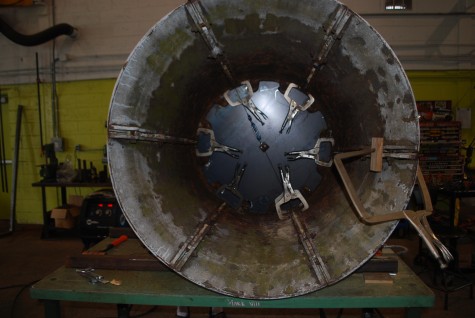
The vase is comprised of six separate cast iron panels.  Each panel had two flanges which allowed each piece to be bolted to the next.  Construction of course was dependent on the technology of the time.  The inevitable spaces between adjacent flanges were stuffed with some kind of caulk which had dried, shrunk and otherwise deteriorated to an alarming degree.  Once the vase no longer had a bottom, realigning all the panels to recreate the original round shape was a challenge.    
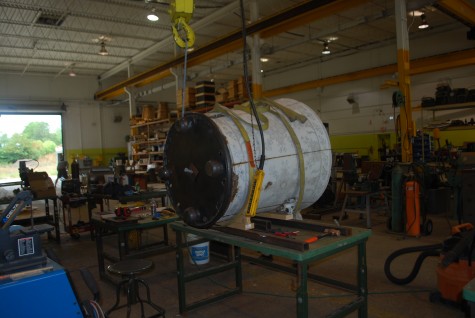
With the pot stabilized on the table, the bridge crane would help him maneuver the base into place.  The process of fitting the new base to this piece took what seemed like days. 
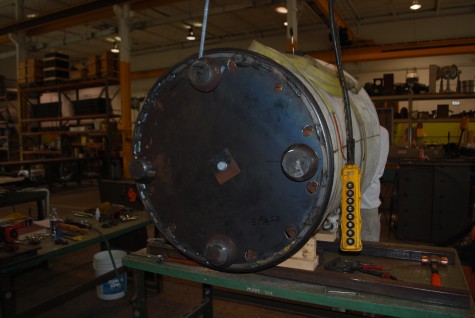

Buck finally called this morning to say vase and base were one again. He was able later to weld the old rusted stubs of the fastening bolts to the new base.  He plans to finish the steel in dark grey automobile primer.  I know it will be beautiful.  The landscape installation is finished, and ready for the delivery and planting of this vase.  I cannot wait.
The Silver Maple

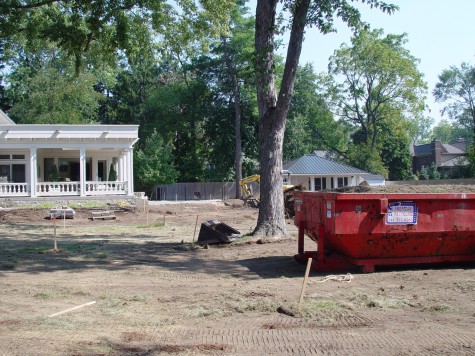
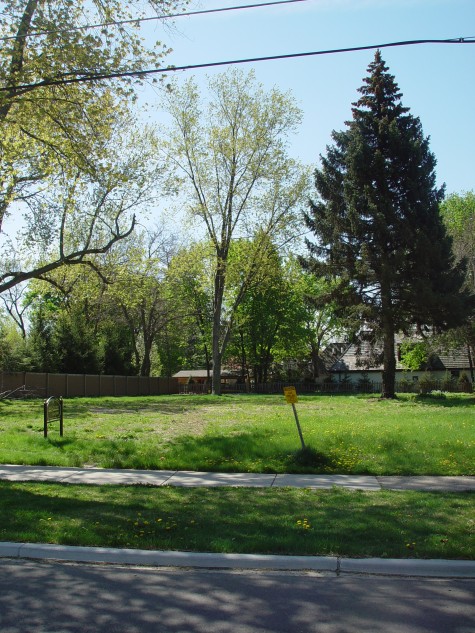
A client purchased an empty lot next door to them, with the idea of completely reinventing the landscape such that two properties would read as one. Though it did not have the best looking shape in the world, there was an existing silver maple they were reluctant to take down. I understand this feeling completely; I do not like to take down trees either. I work with existing plants all the time; we would work with this one. 

Every other plant on both lots was dug and moved.  The maple was out there on its own. I did not want to design a landscape around this tree; it was in less than ideal condition.  There were views across the new lot that would be important from the rear porch; I could tell right away that the landscape design would be impacted by this tree.   I designed the schematic landscape as if it were not there, knowing that when the time came, I would be working around that tree. 

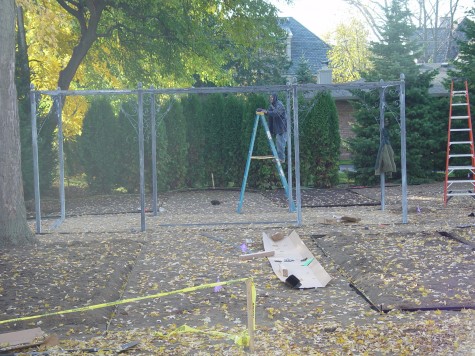
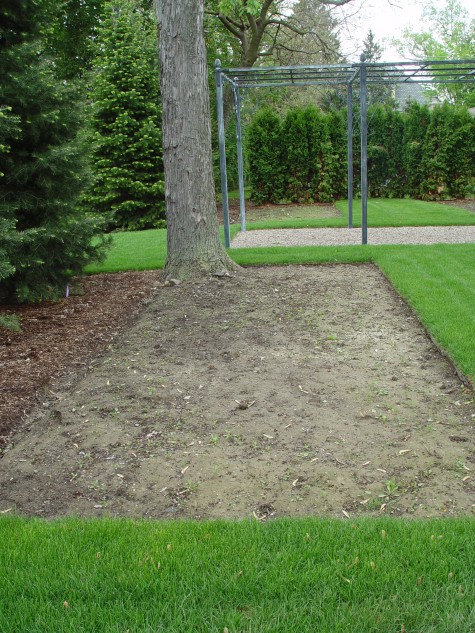
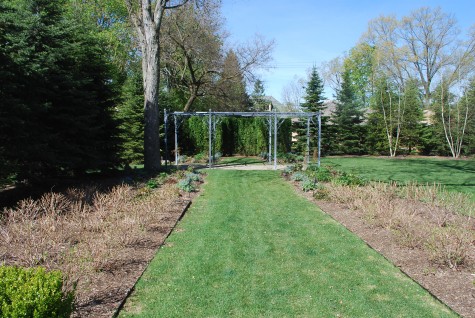
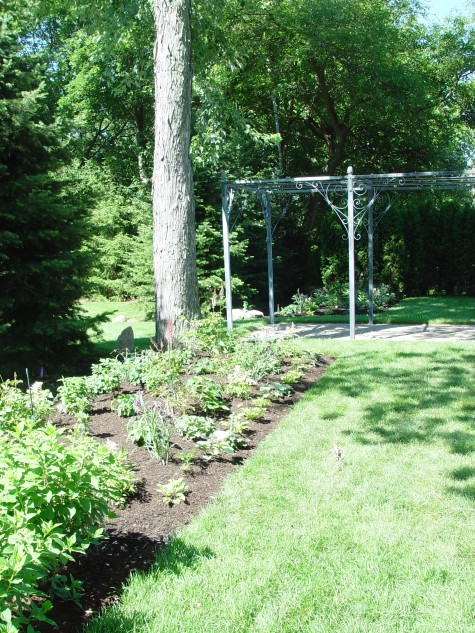
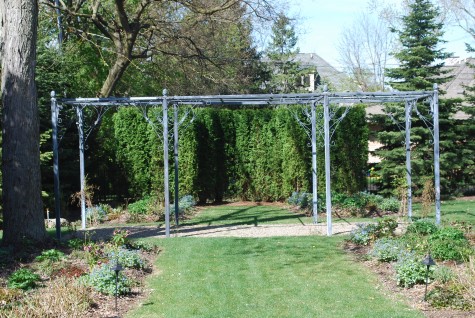
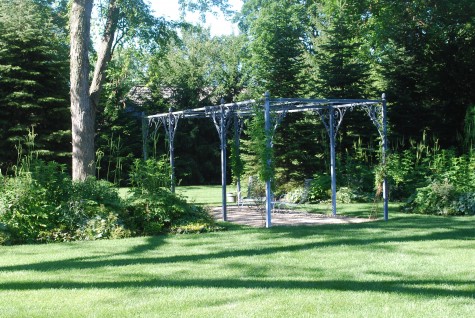
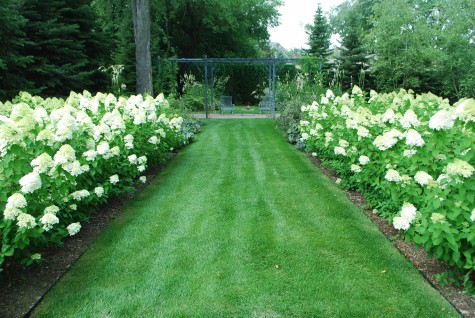
The landscape eventually called for four large perennial beds that would terminate in a radius of arborvitae.    A pergola 27 feet long set midway and perpendicular to those beds visually anchors the space.  The silver maple is just barely visible on the left; the trunk is half in, and half out of the bed.  I rather like a very formal design that is punctuated by some unexpected  element.  The element of surprise can be a very effective way to focus attention on the overall geometry of the space. 

There was but a very short time that this view would be visible.  Once the plants were installed, it would look like that tree had sprouted and grown out of an existing garden. The fact that the trunk tips slightly away from the garden lends a little visual weight to that argument.  Much more difficult than than getting this tree to work with these four quadrant gardens would be getting the perennials to work with that tree. The maple casts a good deal of shade-the shade was by no means even.  I wanted a tall and substantial garden with plant material that repeated the same mix in each quadrant.  My client wanted perennials with white, lavender and purple flowers.

The view out to the gardens is a long one. What was an empty lot is not so empty anymore. I believe that even if the maple had fallen within the grass path out to the pergola, the design would still have worked. Three multi-trunked birch that had once been in the back yard were successfully transplanted to the side lot. 

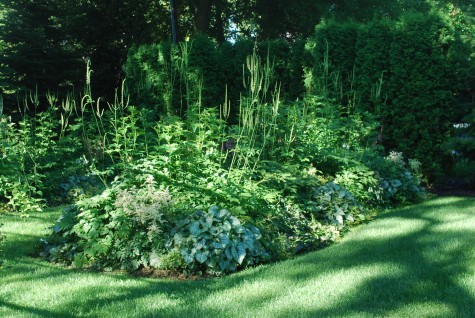
I chose plants with a reputation for tolerating varying conditions.  Hellebores I knew would do fine even in the sunnier areas. Bridal Veil Astilbe, and Astilbe Tacquettii Superba do well here.  Gold drop hosta, Jack Frost brunnera, White Innocence and Concord grape tradescantia and alchemilla mollis were planted along the border with sufficient space in between to allow for some low annual planting. The dominant plant is snakeroot-cimicifuga racemosa.  Its white bottle-brush flowers on long graceful racemes give a garden the height I was after.  Monarda fistulosa Claire Grace gives a  great show of lavender flowers at about the same time.   

The pergola was planted with sweet autumn clematis, clematis Jackmani Superba, and clematis viticella violacea. It has been a challenge to keep the rabbits away from them, but they finally seem like they are taking hold. 

I plant an occasional nicotiana alata white, here and there.  White Japanese anemone and aconitums are the star of the show in very late summer. They are just budding up now.

It has been three years since this garden was planted; it seems to be doing well.  Of course there will come a time when some division or replacing will be necessary.  The clematis are a little behind schedule-the day when they are dripping from the roof of the pergola will be a good day. 


The silver maple in question has company now.

Sit Wherever You Like

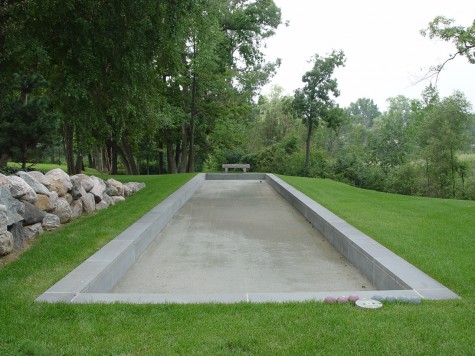
The garden bench at the far end of this bocce court is a simple three piece affair made from 10 inch thick slabs of Canadian granite.  It took more than a few men to haul it to this spot, and set it up.  Short of an earthquake, it will probably still be sitting quietly in this spot 100 years from now. A courtside bench is a utilitarian gesture-nonetheless, I like the look of it here.  Though I don’t often sit in the garden, I like having that opportunity.     

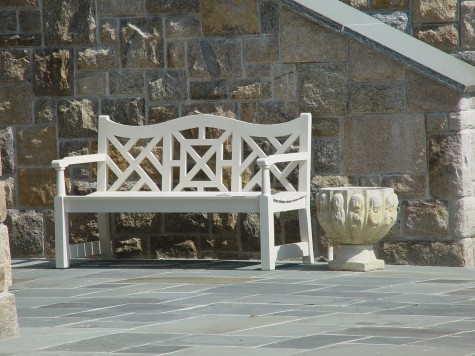
This classic English Chippendale style painted bench lightens the look of a massive stone wall. The curved seat makes it comfortable for longer than a moment.  This picture was taken on a sunny, very early spring day; I remember the warmth radiating from the stone made it a very comfortable place to sit.  Garden benches do a great job of providing a place to enjoy a moment outdoors. 

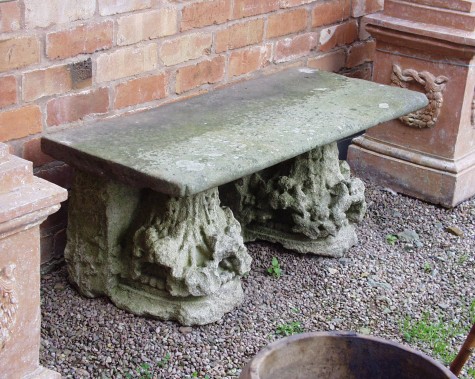
Very old age has blurred the detail of the carved limestone legs and feet of this English bench.  The feet remind me of a Clydesdale draft horse; this bench has a very strong and sturdy look.  Though the legs are massive, the bench is short.  It has a charmingly eccentric appearance that could make a shady spot in a garden seem more like an enchanted forest.    

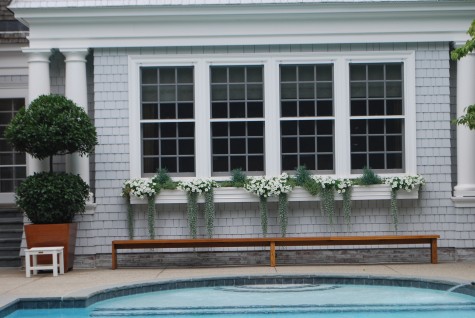
The long and low oak bench was made specifically for this spot on a pool deck next to a Belgian oak box.  Both pieces are finished with marine varnish that is redone every few years.  The warm golden brown color is a beautiful contrast to the white, greys and blues that dominate. 

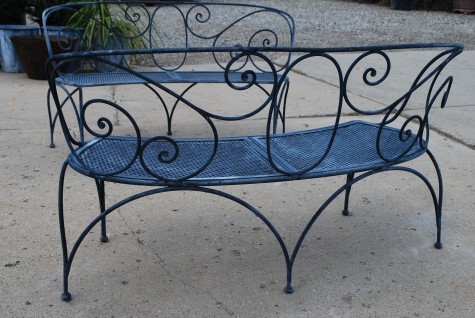
These galvanized and acid washed steel benches are reproductions of an antique French bench.  The original bench was painted white; the paint is worn through and the steel has rusted in a number of places.  Though the style and size of both are identical, the difference in finish makes them look entirely different.  It is interesting how a color or a finish can change the identity of any object.   

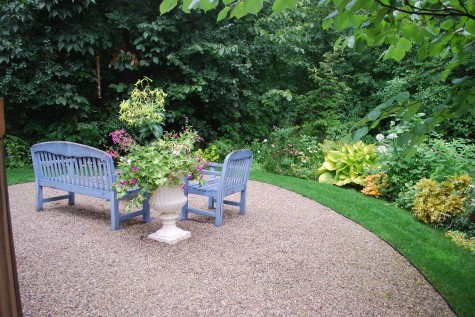
This country style bench is painted a beautiful French blue. A sitting area facing the garden-the person who owns this bench gives away what he considers the important view, by how he has placed the furniture.  It is not so usual to walk into a space, and see the back of a bench.  He clearly is interested in a front row seat in his garden. 


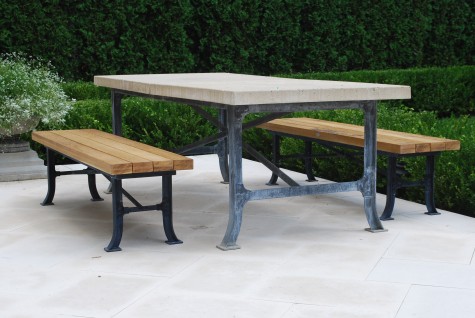
These oak and steel benches were made to match an existing Belgian table with a concrete top. Benches at a dining table are friendly-people can sit elbow to elbow.  This white oak will weather to a soft medium grey.   

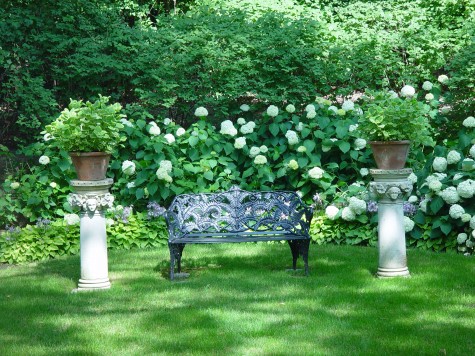
This grand Victorian cast iron bench with stylised fern leaves is flanked by a pair of antique English limestone pedestals.  Very formal and elegant, it compliments a formally designed shaded garden.  Cast iron in a garden will need to be repainted once in a while; the combination of iron , oxygen and water invariably result in rust. This seems like a fairly minor amount of maintenance for a garden ornament as lovely as this.    


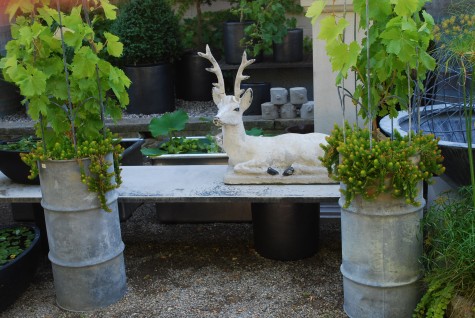
This bench, home to a resting French concrete deer, puts a pair of cylindrical planters in contact with an old composite science lab table top.  No one said a place to sit in a garden has to be fancy, it just has to seat you in a style that pleases your eye.  There’s nothing quite like sitting out in the garden.

Late Summer

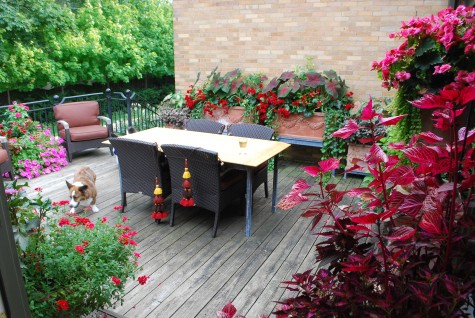
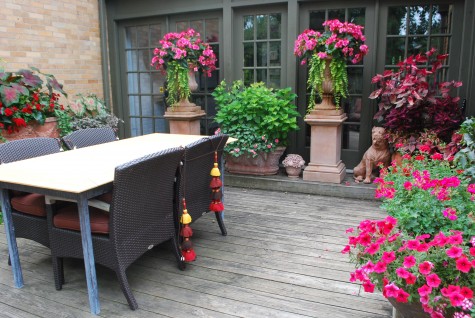
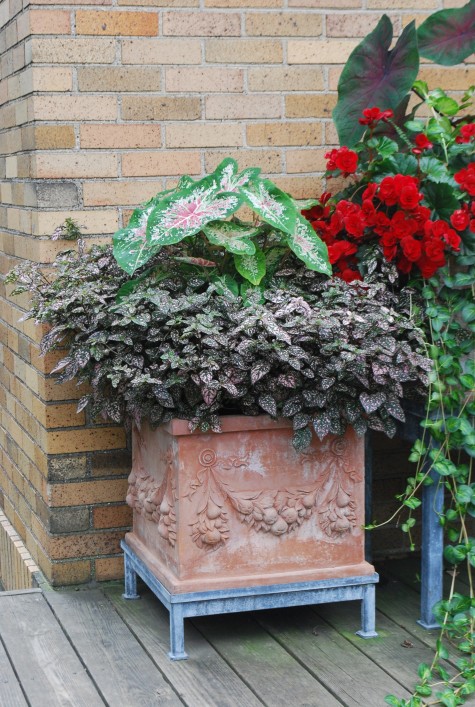
The view out onto my terrace right now is lush and loud.  really loud. I like to plant this group of containers with a different color scheme every year.  This year’s  pink and red spectrum runs the gamut from light to dark, from moody to electric. But the overall effect is definitely on the rowdy side.  Sometimes you just have to get certain things out of your system by giving them a try.  Having never planted anything red at home before, I scratched the itch.  The Mital Italian terra cotta rectangles are on a north wall , so they demand a planting that is shade tolerant.  The red caladiums provide a lot of a rich red/green mix in the leaves- which I like. The tropical ferns and the vinca maculatum are essential to the look.  The red solenia begonias are brilliantly red.  Since red and green are opposite one another on the color wheel, the combination makes for a lot of visual action.  Had I the chance to do it over again, I would plant lime irisine in the back; that very tall lime green with carmine veins would make the caladium red read more dramatically.  The big empty wall behind those pots-wouldn’t you think I could sort that out?

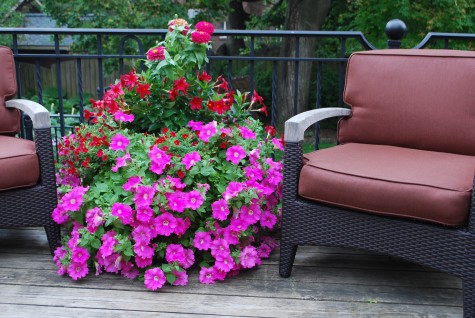
There is nothing particularly fancy in this pot-red mandevillea, cherry sun zinnias, cherry million bells and giant pink petunias.  What is of interest is the vigor with which this planting has grown.  These plants like being neighbors, and they like this pot size and location.  Everything observed in the garden will come in handy the next time around.  Where’s my journal?

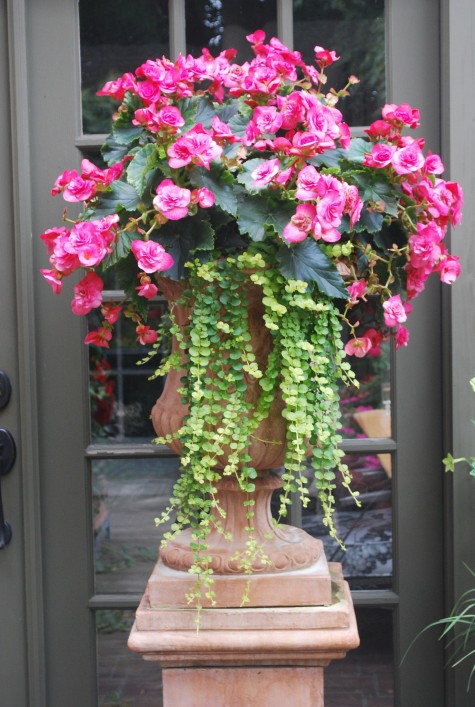
My pink begonias have suffered some from sun burn.  This has never been the case with the apricot or orange solenias.  It made me study the sun on this wall more carefully.  It turns out there is a lot more light here than what I thought; what I assumed was an eastern exposure is actually south easterly.  How I could have planted these pots 14 times for part sun and done ok is a testament to every plant’s will to live; they suffer me kindly. The red irisine has tried its best to grow luxuriantly, but the top leaves bleached from the sun during our long run of hot sunny weather.  I am hoping for a better fall. 

You can spot the sunburn on the pink solenia begonia in this picture. That orange solenia shrugs off the hot sun is called varietal variation.  This series of begonias is the easiest of all to grow, in my opinion. The pink apparently needs more protection from direct sun. I am sure there will be no pink begonias here in 2011; I am a quick learner.  I don’t mind trying to grow things that are tough to cultivate, but I have to balance that interest aginst how much time I actually have to put to any aspect of my garden.    


Though the botanical name is not part of my vocabulary, I do like polka dot plants. Available in white, pink, and rose, they remind me of a choir.  A big and coherent voice generated from a cast of thousands. They thrive on pinching; they thicken up, and represent.  This moody pink and green foliage plant compliments this rose pink and green caladium better than I could have hoped for.    

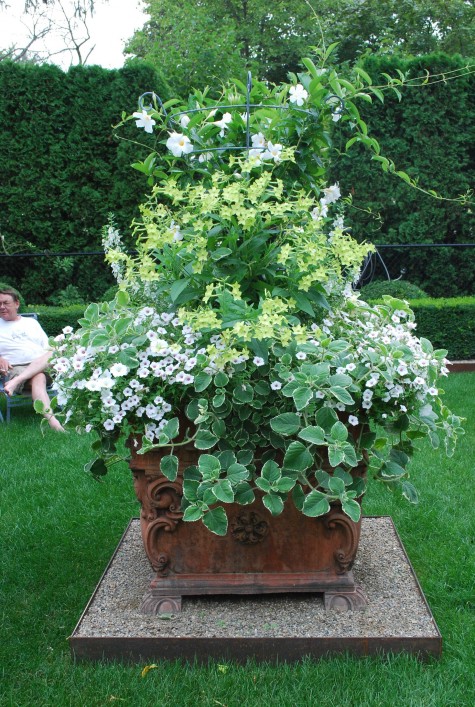
Last year this English concrete square of classical Italian design was home to a homeless ancient agave.  That agave went to a client this spring; I was on my own with a planting scheme.  Though I planted a white mandevillea, white angelonia, lime nicotiana alata, gobs of silverberry mini petunias and variegated plectranthus, I worried that the planting would never grow up into and spill over this massive pot.  It may be mid August, but I like what I am looking at now.   

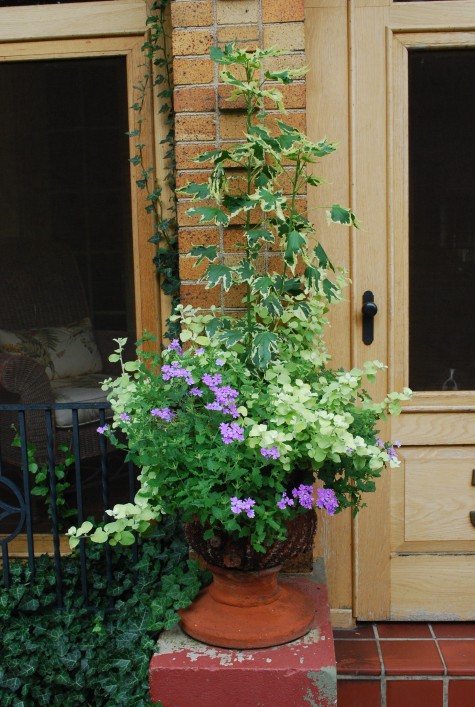
I have never had pots on the limestone pillars integral to my front door.  My idea to move these antique English terra cotta log pots to the front, from the rear deck-capricious.  I so love the look of these pots here-but keeping water on them given a merciless exposure to western sun has been a challenge.  This variegated abutilon is great looking-I plan to have plenty of them for spring.  The verbena and lime licorice tolerate a hot spot.  How these small pots dry out has been a lot of trouble-worthwhile trouble.

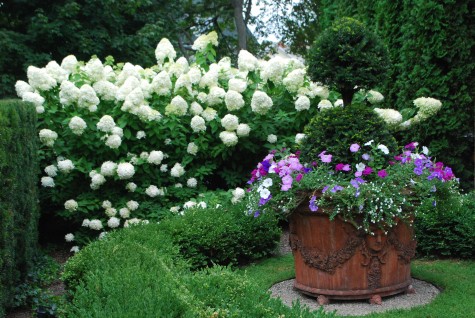
I am so happy with my English concrete pots fabricated in the classical color and style reminiscent of Italy. This is my third season with them-and I think my most successful planting.  Taxus topiaries-I had never seen them before a visit to Mori Nurseries last year.  These double ball yew topiaries rule the garden just outside my front door.  They seem quite happy in these enormous pots-the soil moisture is steady.  The generous skirt of mixed petunias, cerise pink verbena and white bacopa-a perfect foil to that seriously dark green form.  I am delighted.      


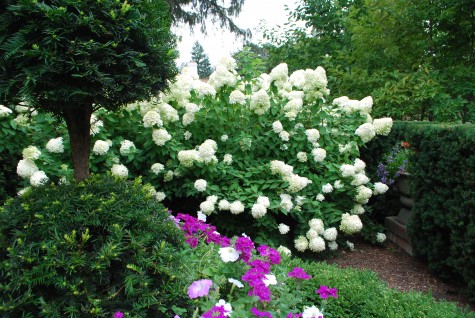
My late summer garden views-I like them.