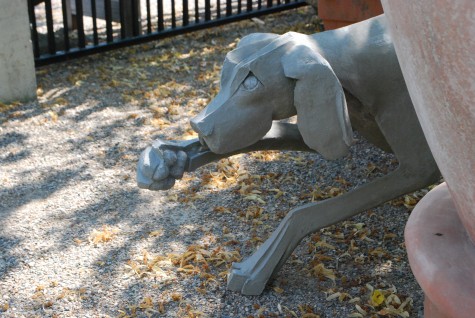
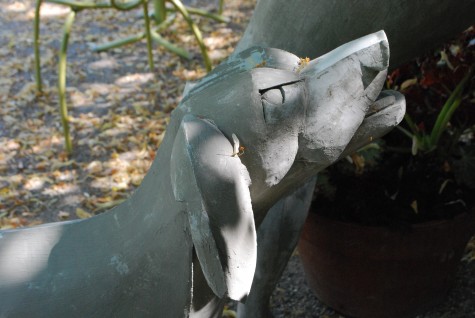
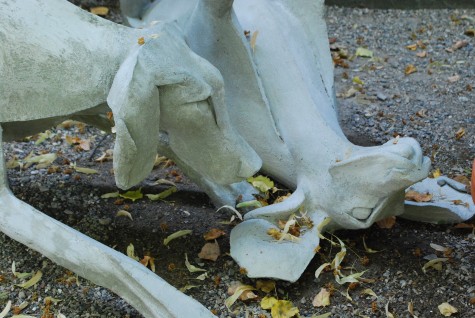
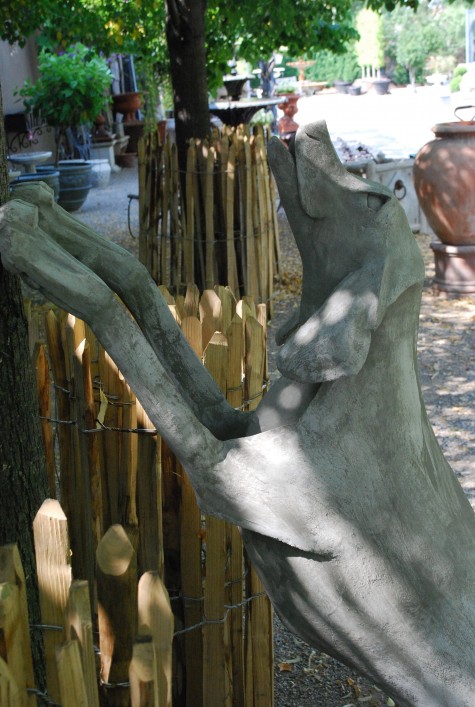
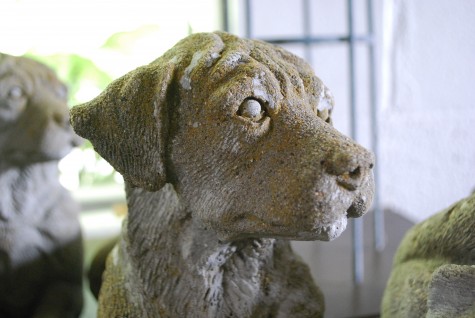
 Rob has put a great collection of vintage and contemporary concrete garden dogs together.
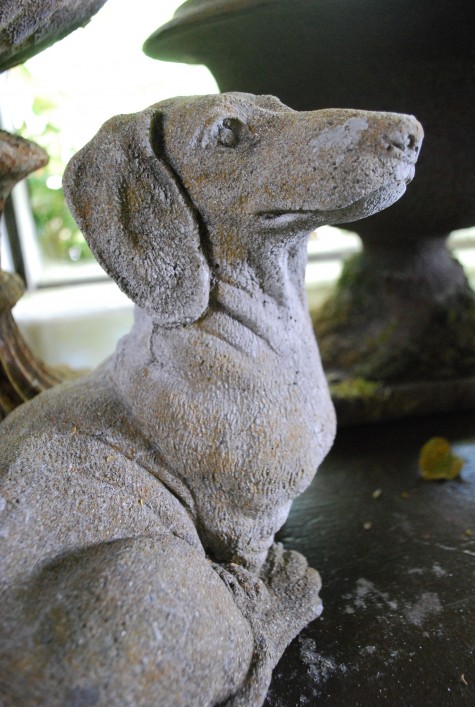
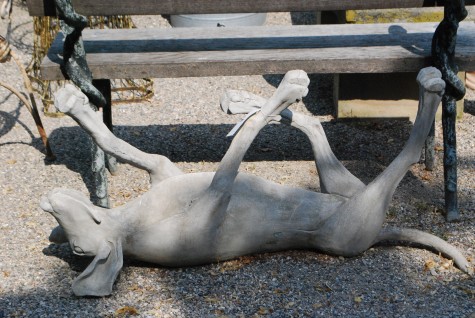
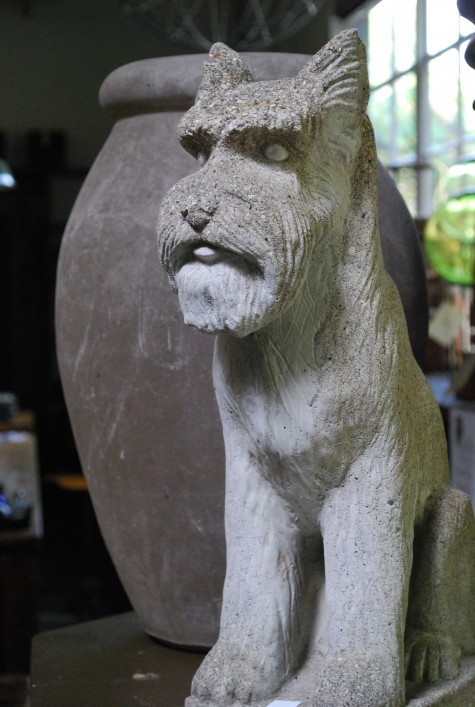
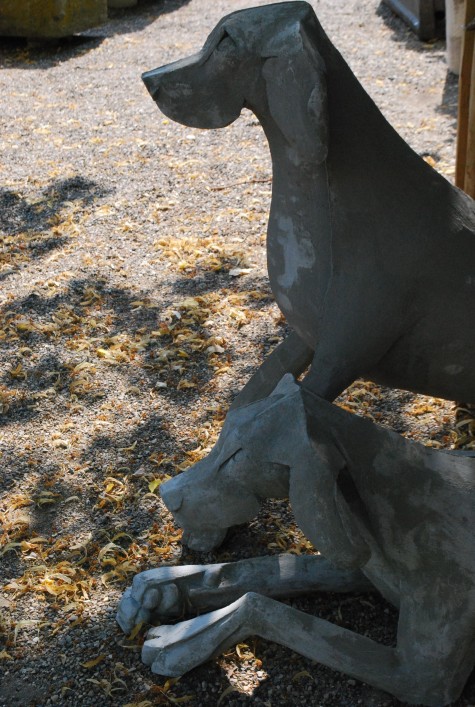

This live wire is all mine.
Deborah Silver is an accomplished and experienced landscape and garden designer whose firm first opened its doors in 1986.
Rob has put a great collection of vintage and contemporary concrete garden dogs together.
This live wire is all mine.
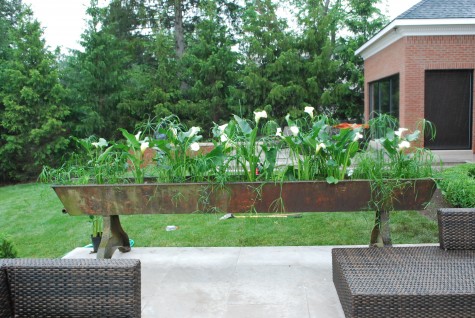 The mid nineteenth century cast iron horse watering troughs Rob found in northern England last September have a new and happy home; my clients really like them. It seemed fitting to me to fill them with water again. But this time, no horses. A collection of papyrus and white calla lilies in the gravel filled water flooded trough-this will be a good look, once the plants orient to the sun. Papyrus (marketed now as King Tut grass, and mini-Tuts) stems break with the least disturbance. But water plants recover faster from damage than soil grown plants. When they are happy with the water temperature and sun exposure, they grow vigorously.
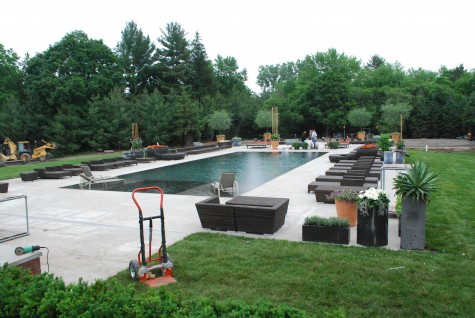
This pool terrace is large. The 27 containers I placed on the limestone do not seem like too many. Groupings of 5’s and 3’s improve the visual impact. My clients favor a clean simple and modern look; the pool furniture makes that statement loud and clear. I took my cue from their expressed interests, and their choices in furnishings.
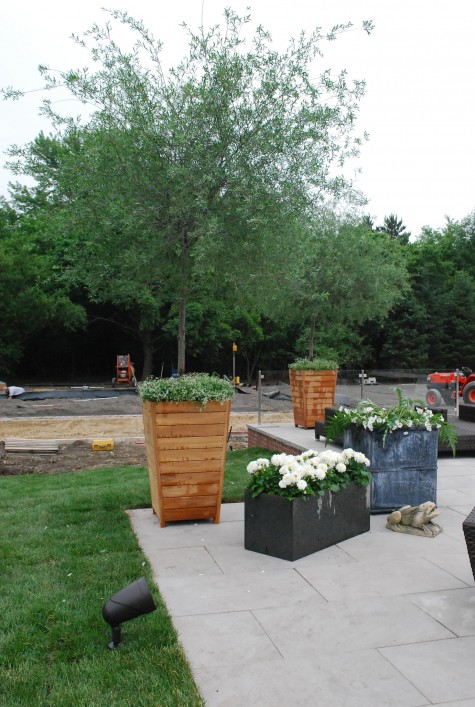
Four top grafted willows on standard in tall Belgian teak boxes are the stars of the far view. The wild and wooly silvery foliage atop a barely two inch caliper trunk-very beautiful in these tall contemporary boxes. The head of the tree is vastly overscaled for the v-shaped box. I cannot really articulate why I so like the proportion of the tree to its boxy home-it just looks really good to me. The planting in the giant steel box looks underscaled, yes. But once those silvery cardoons get to growing, the scale will be perfect. The white Gallery dahlias lined up like soldiers in a rectangular volcanic slab trough represent white in a strong way.
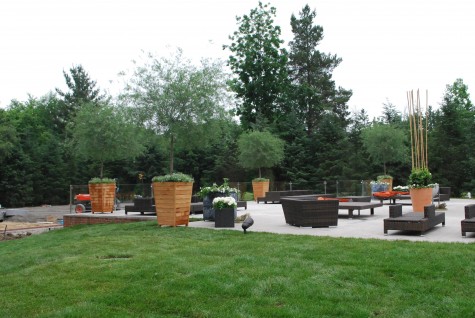 A pool terrace of this scale needs something going on in the airspace. The topiary willows are doing a fine job of that. A single large French terra cotta vase from Ravel, to the right in this picture, is planted with 8 gallon size mandevillea vines. A grouping of twelve foot tall natural bamboo poles will provide an aerial home for those vines. A hot pool terrace will set them to climbing. The poles are a visual element that occupies and defines the airspace while plants get to growing. A terrace of this size needs a big idea about the borders, and a bigger idea about ceilings. Comfortable spaces embrace company. Exciting spaces make explicit reference to size and sky.
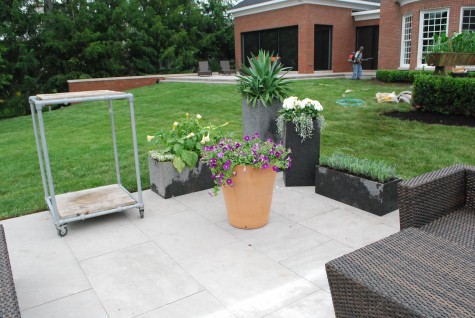 Five containers clustered in a pool terrace corner male a statement about relationships. A rectangle planted solid with lavender will contrast in form with a spiky agave. A tall rectangle stuffed with white gallery dahlias and silver dichondra will be a great foil to a large volcanic trough planted solidly with double white datura. The French terra cotta pot from Ravel-I planted it solidly with Whispers petunias. The purple accents enliven this grey/green and white planting scheme.
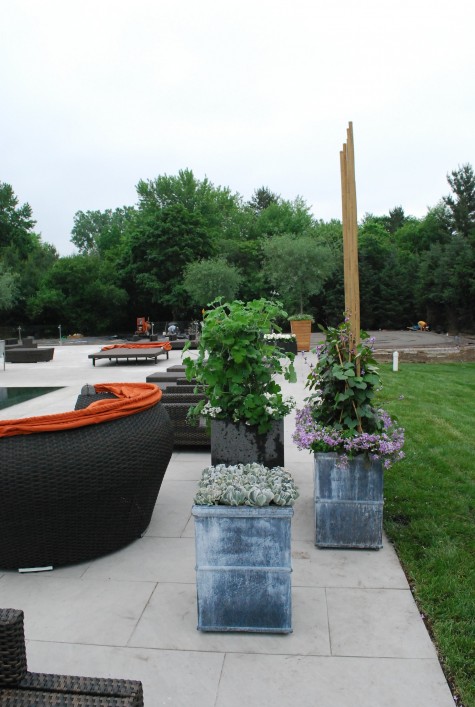 This pair of steel boxes viewed from the side-a little visual trickery is involved.. The foreground square tall box is planted solid with some blue succulent whose name I have never learned. The tall volcanic stone slab box is largely occupied by a geranium-no kidding. Some scented geraniums can grow to astonishing size. It will only look larger, better, and loaded with white flowers in 6 weeks. The right hand box is a rectangle-the long view is not available here. I like a view that tricks the eye.
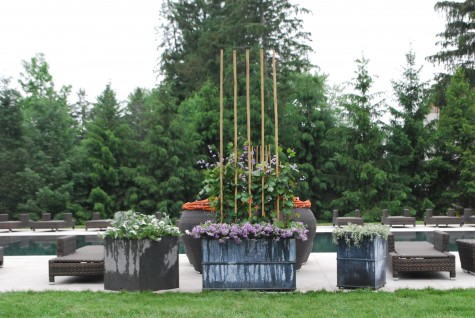
Give horizontal view, it is clear what seemed to be a square tall box is in fact a rectangle. In this rectangle, I planted four hyacinth bean vines. The four absolutely vertical natural bamboo poles will provide plenty of support to these annual ornamental vines. The placement of the 8 foot tall vine supports-a contemporary gesture.
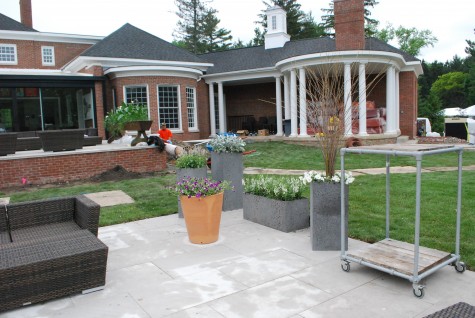 Contermporary container plantings call for lots of one thing, and little in the way of mitigating circumstances. Be simple, be direct, be subtle, be strong, be confident. None of these containers call for traditional or formulaic plantings. Pick a plant, and plant lots.
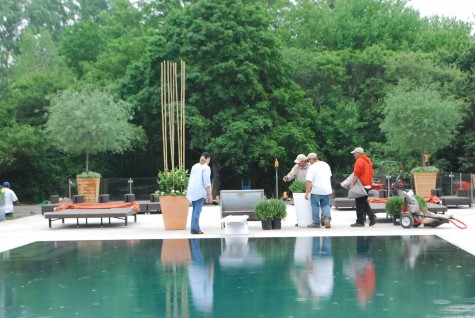 Three times today we had heavy and steady rains. We kept planting. A last minute addition-a Ravel pot from France painted white. This afternoon, we delivered the white French pot, and stuffed it full of rosemary trimmed into spheres.
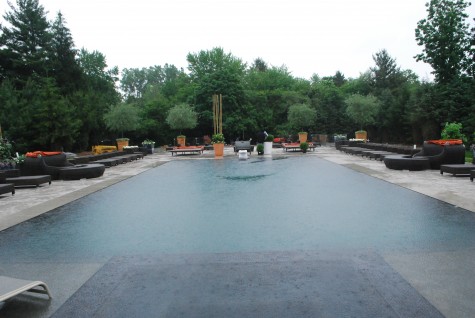
We finished our plantings at 4pm this afternoon-during the third hard rain of the day. I am not complaining-I am a gardener, so I relish whatever the weather brings. I looked over every square inch of my territory before I left. A client with an event at 7:30 pm- we helped them to be ready.
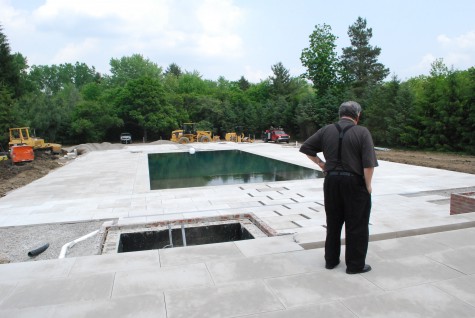
My shockingly chilly and record setting rainy spring has given way to temperatures hot as bloody blazes. Temperatures in the mid nineties sounds like July or August-not early June. I hate planting an annual, a perennial or a tree when it is 95 degrees. That level of heat is incredibly stressful to transplants-not to mention people. This pool and terrace under construction needs containers-now. It would be a challenging environment for plants newly transplanted even if it were not 95 degrees. This will be a blisteringly hot spot in the summer, even on a cloudy day.
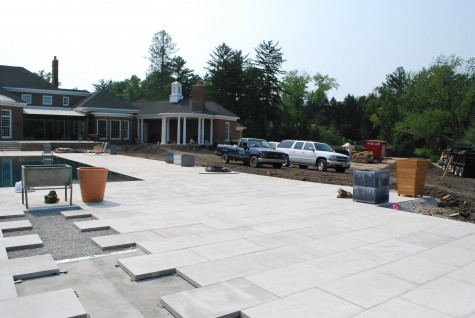
Annual plants have very small root balls-think of it as a life trying to survive in a coffee scoop. Growers use soiless mixes for a lot of reason. A soilless mix is sterile-no weeds or disease can infect a crop. Soiless mix is light and easy to handle. It provides a grower with a lightweight medium that they can fertilize to their personal specification. If all annual plants were grown in home grown garden soil, no one would have the strength or patience to haul all that weight home and out to the garden. I transplant all of my container plants into real soil. That soil will give up its moisture slowly. This will help the small plants to get established, in spite of their peat based root balls.
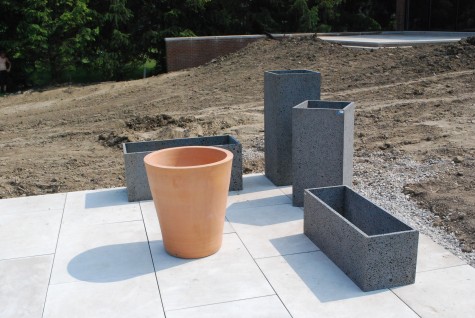
A soilless peat based mix can dry out in a matter of hours on a blisteringly hot day. What this means to me is every flat or case of 4 inch flowers needs to be soaked before we load in the morning-never mind that it has been watered 3 times the previous day. Those growers who have plants under glass right now-their lives are a misery. Anyone who grows plants is infected with that miracle of life gene. They would water non stop until bedtime if they needed to. There is that instinct to preserve life. Preserving life in these containers will require careful plant choices. This means plants that like very hot and exposed locations.
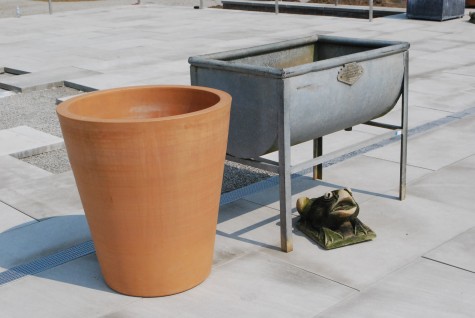 Newly planted plants may need daily water when the temperatures skyrocket. Serious water deprivation may not kill a plant, but it can stress a plant such that its growth is greatly compromised. Make the distinction. Do not water just because it is hot. Some plants wilt from heat-not a lack of water. Butterburrs and dahlias come to mind. They will perk up when the temperatures drop. Water those things whose roots are dry, and water until you are blue in the face. A water bandaid does little-soak thoroughly. Thern let the soil dry out before watering again. Overwatering plants in very hot weather is like issuing an engraved invitation to any fungus that happens to be nearby.
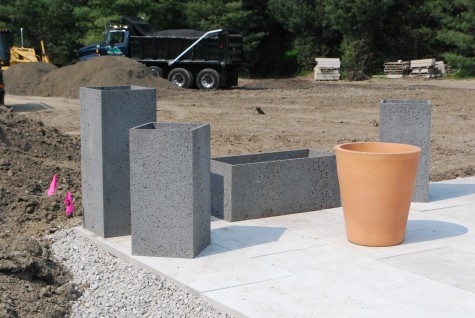
Clustering pots in a smaller area is a good look, but it also has some practical value. I have containers in 4 places in my garden-and I have a hose nearby for every one of those spots. Grouping enables me to display a collection. The collection of pots and the collection of plantings will have interest individually, and as a whole. These containers are made from large slabs of volcanic stone-hence the perforated surface. I am assuming the slabs are cut with a giant saw. The simple round French terra cotta pot is a good foil both in shape and color to the severely geometric grey stone.
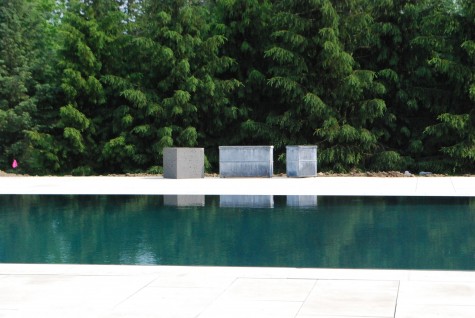
Steel box and rectangle keeps a single stone square company midway down the length of the pool. Of course this arrangement could change, once the pool furniture is placed. No matter how many times I study the plans and diagrams, there is no ubstitute for seeing all of the elements in place.
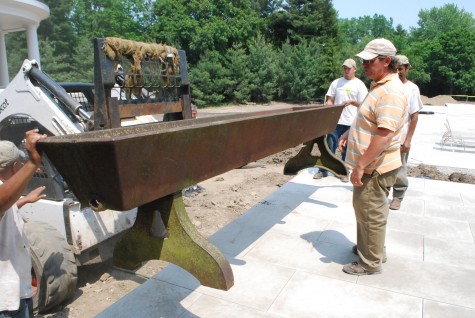
This pool terrace asked for a good many containers. Both the pool and the terrace are very large. My clients selected what forms and shapes appealed to them; I put together a collection. I placed all of their containers on the terrace today-it was 105 degrees. During the entire time I was arranging, I was oblivious to the heat. Not so my crew. They were doing the really heavy lifting. A pair of antique English cast iron horse troughs from the 1850’s weighed over 1 ton each-these we placed with a front end loader. Once we set them in place, each trough was lifted off the ground via 12 pairs of hands, so a hard rubber spacer could be placed underneath each leg.
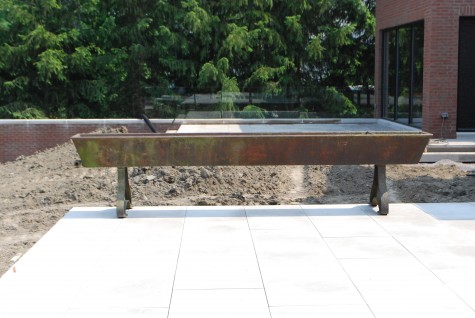
My clients are wicked intelligent, and have a clearly sophisticated point of view. Though they have a decidedly modern perspective, these antique troughs appealed to them immediately. They were certain that they wanted them. They work beautifully here. They have a very dramatic setting here, which they can handle with aplomb.
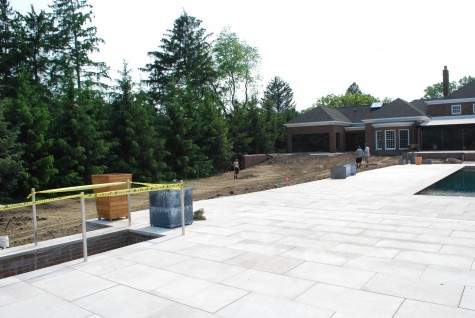
A pool terrace this size asks for a very large statement from every container. I have some thinking, and some shopping to do.
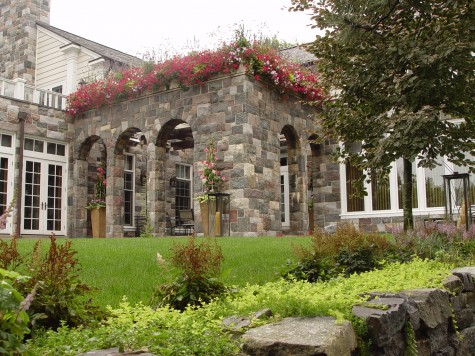
Designing, planting and tending a landscape or garden is an avocation, a profession, a passion -and a nemesis of the most unpredictable and formidable sort. The pure joy that a great garden has to give back has a substantial responsibility that comes along with it. The landscape could be described as the responsibility for the health and happiness for a flock of living things. A lot of marbles have to be kept on the table-all at the same time. Every plant that dies on my watch-I take it very personally. Plants die routinely, and with astonishing regularity-in spite of knowledge and experience.
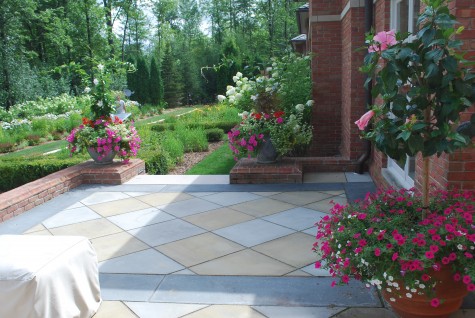
Some plants die from old age-every living thing has a lifespan. Some things die from a particularly fierce winter, or relentless rain, or extraordinary heat. Some things die from lack of water-of these deaths, I am particularly ashamed. Some things die from poor siting, or a a site whose ecology changes drastically-as in the loss of an old mature tree. The living community that describes my garden is ephemeral-fleeting. No tree, shrub, perennial, or garden experience comes with a lifetime guarantee. Should you decide to garden, the disappointments are part and parcel of the experience. Fortunately, a landscape has other elements that live longer.
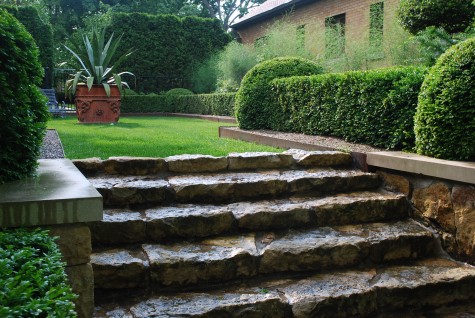
Some elements in my landscape shrug off the water, the winter, the heat; the stone in my garden is the next best thing to indestructible. Stone persists in my landscape in spite of my neglect, poor science, or ignorance. What can I count on to be there every day, as best as I could count on anything? The stone stairs to my rose garden have been there as long as I have had my garden. I would guess it will still be there, when I celebrate my 100th birthday.
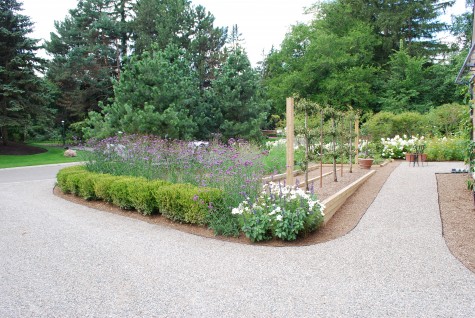
Stone in the landscape roughly refers to what we call hardscape. Stone beautifully populates those places to be, that soil to be retained, those spaces to entertain, and those walks with a natural material that provides an enduring hard surface. Stone is eminently capable of expressing your need for a change of grade. Stone provides paths and walks that enables travel from one space to another. Stone provides a beautiful and durable surface for a terrace. Compacted decomposed granite- shards 3/8 inch in diameter and smaller- makes level and hard surfaces that survive in driveways and garden paths, year after year. I so like balancing those living, and therefore fragile elements in a landscape with a crispy defined highly textural natural material that endures.
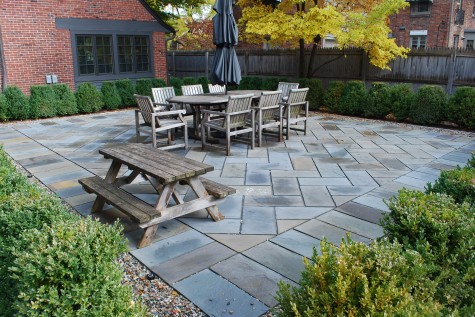
I am not a geologist-I am a gardener. But I can say with great conviction that the stone readily available to me regionally is always my stone of choice. Regional stone that is native to Michigan will look like it belongs in a Michigan garden. Stone native to the East coast, or west coast I can appreciate, but a sense of authenticity of place is important in making a landscape visually believable. No doubt an entire library exists which describes the color, texture and use of stone world wide. But I am primarily interested in stone that naturally occurs in my region of the country. In addition to bluestone and granite, Indiana limestone, and Valders stone from Wisconsin are favorites.
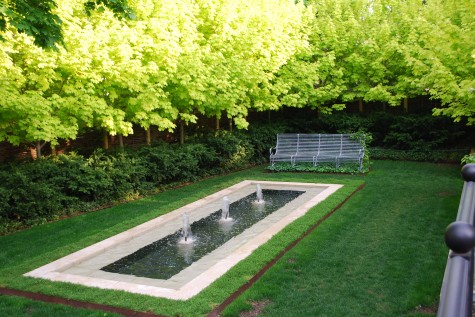
The fountain in my back yard is finished in Valders stone. The step down in submerged in water the entire season. This very high density dolomitic limestone is prized for its low water absorption. This makes it ideal for applications in or around water. Indiana limestone, also known as Bedford limestone, is principally comprised of calcium carbonate. The decomposition of marine animals at the bottom of the inland sea that covered the Midwest for countless centuries created limestone. The limestone quarried near Bloomington Indiana is acknowledged to be the highest quality limestone in the United States. It readily absorbs water; the limestone caps on my retaining walls have aged beautifully.
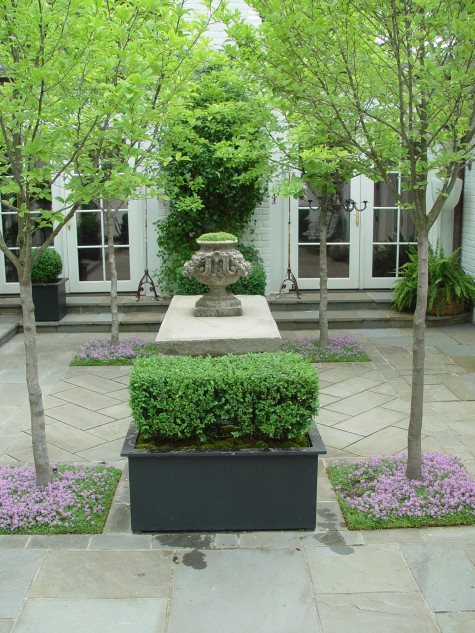
Should you need a hard and enduring surface or wall, natural and native stone will endow your garden with a sense of permanence. The formation of stone takes generations, and it will take generations to decompose. Do not be shy about inviting a natural element into your garden with proven longevity. It provides a quiet and appropriately natural foil for your plants.
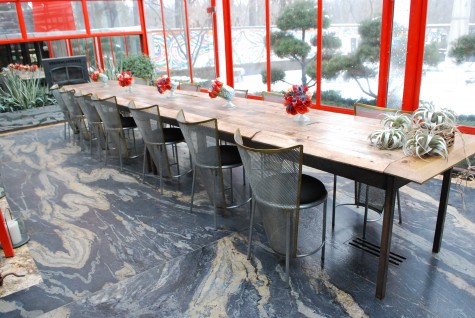
I was a rock collector, as a kid. Every type of rock, every shape, every surface-I was enchanted. Nothing has much changed; I have a big love for all manner of rock. Stone carpeting the ground, stacked up like a wall, hand carved into a cistern, or half buried in a rock garden-I value it all. The stone slabs carpeting this conservatory floor-I have never seen anything remotely like it before. It has an exotic, architectural, and other-worldly look.
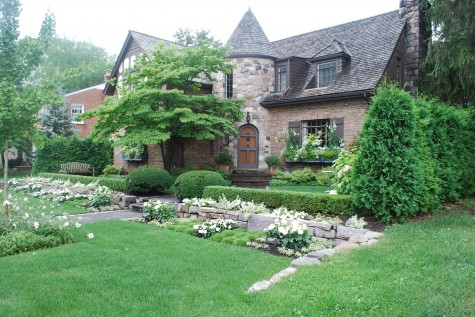
Stone cold, set in stone, stone faced, hard as stone -these are all phrases that describe a certain attitude that withstands the elements, the vagaries of nature, and popular sentiment. Stone comes with an aura of history about it. The eldest plant in my garden I estimate to be about 80 years old-a trifling age, compared to my stone. Relationships in a composition might be more important than the one, or the other. How an ephemral element interacts with a permanent element-always interesting. That great age one associates with natural stone has much to do with the creation of, and value, of stone garden ornament.
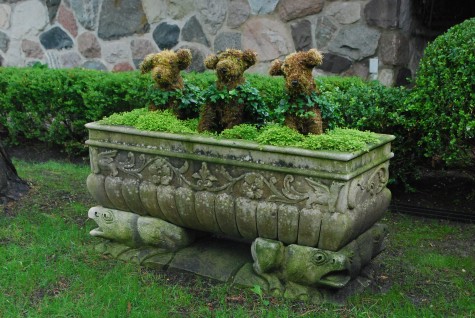
Stone ornament for the garden is a centuries old art and practice. A material which is virtually impervious and certainly accepting of the weather makes an ideal medium for sculpture, urns, finals, cisterns, plinths, and benches. Many antique pieces provides homes to thriving colonies of moss and lichens. Before Michaelangelo’s David was a sculpture, it was an ancient block of marble from the earth. Antique containers and urns hand carved from a single piece of stone are rare, and very costly. Dry cast limestone is a dry mix of cement, sand, mineral pigments and crushed natural stone, which is forced into molds, and vibrated under pressure until it fills the mold evenly. This method of manufacture makes stone garden ornament more readily available and affordable.
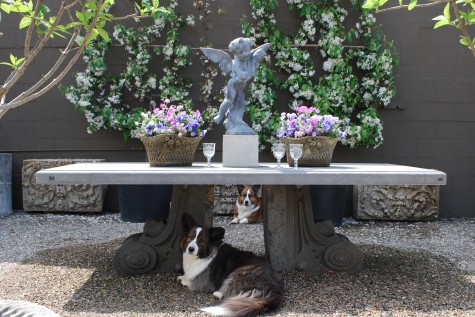
The stone in my garden is beginning to settle in. Plants have decided to take up residence in its crevices, and on its surface. I like how this makes me feel. This Belgian bluestone table with antique hand-carved corbel bases would indeed be lovely in a garden. Any gardener who has ever carried rocks around their garden, or had their fingers pinched setting a stepping stone knows that stone does not give. I like a material in my garden with this attitude.
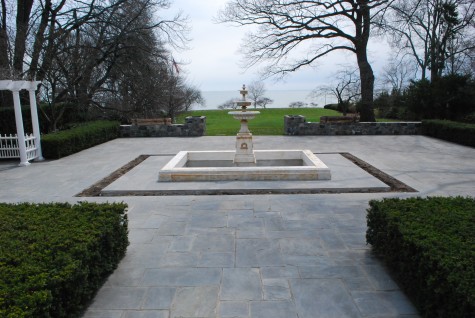
I wrote this essay in a special capacity. I was so pleased that The Garden Designers Roundtable invited me to guest post with their group for the month of May. The Roundtable is a group of garden and landscape designers who write regularly on topics related to landscape design. This blog is a great read. www.gdrt.blogspot.com. Interested in an ongoing discussion of plants, gardens, landscapes and design? www.facebook.com/GardenDesignersRoundtable.
To read all of the posts on the May discussion of stone in the landscape, click on the links below. Enjoy!
Sunny Wieler : Stone Art Blog : West Cork, Ireland
Debbie Roberts : A Garden of Possibilities : Stamford, CT
Douglas Owens-Pike : Energyscapes : Minneapolis, MN
Ivette Soler : The Germinatrix : Los Angeles, CA
Jenny Peterson : J Peterson Garden Design : Austin TX
Rochelle Greayer : Studio G : Boston, MA
Scott Hokunson : Blue Heron Landscapes : Granby, CT
Susan Cohan : Miss Rumphius’ Rules : Chatham, NJ
Tara Dillard : Vanishing Threshold : Atlanta, GA