The Last Container From England

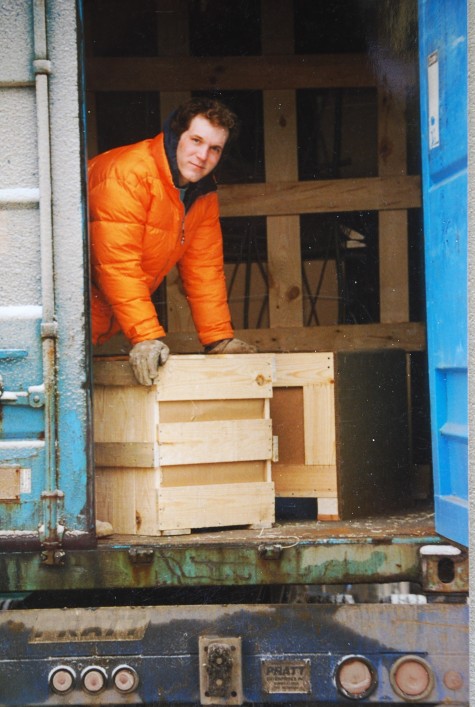
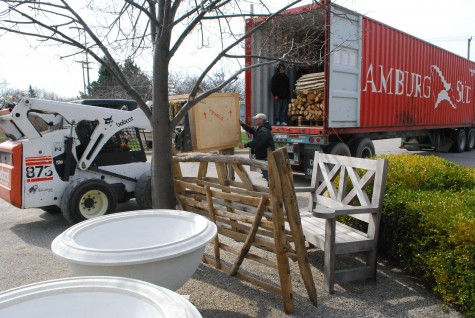
What a relief that this last container load of garden ornament from England is finally in my possession.  Though importing garden ornament from Europe really belongs on that “do not try this at home” list, it is incredibly exciting to cut off that lock, and unload the truck.  It has been seven months since Rob shopped in England-for him, the unloading is old home week.  I am always surprised by what I see, in spite of the fact that he sends me lots of pictures.  There is no substitute for the real thing.  
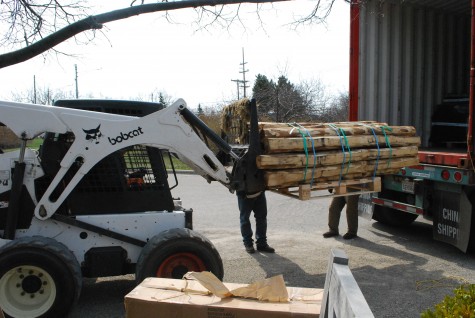
Some purchases might make you wonder.  Who imports fence poles from England?  Someone whose romance with the garden is long standing and on going-that would be Rob.  These are no ordinary fence poles.  They are whittled from sweet chestnut with a draw knife, and designed to anchor rolls of sweet chestnut pale fencing. Castanea sativa was introduced to Britain by the Romans; it is a very important tree in the English landscape.  An introduction to a segment of British gardening life is what came off the container-not a pallet of poles.
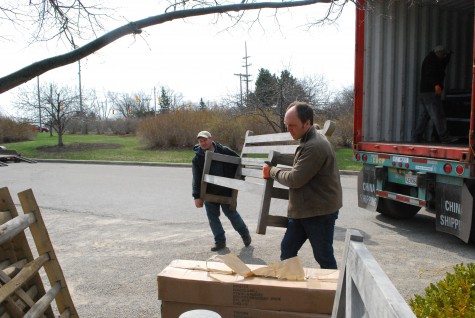
An exposure to the tools and ornament of a garden culture other than my own is a gift from an unlikely source-modern technology.  I am sure there was a time when garden ornament never travelled far from where it was made.  The ocean between my garden, and a British garden, does not seem as large as it once was, given shipping containers, giant boats, and trucks-not to mention the communications systems that keep them all functioning towards a specific end.  My local decomposed granite is so different than that granite available in California, but should you want our granite, it is possible for you to have it.    
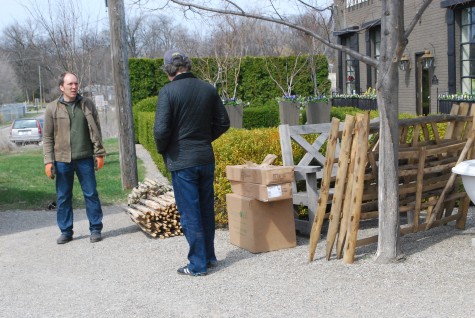
These large simple wood panels are known as sheep’s hurdles. They are traditionally used to make a temporary pen for sheep taken to market.  What would I do with them?  One panel would make a suberb support for a lax growing rose; a pair might beautifully signal the entrance to a vegetable or cutting garden.  They would make a great companion to any number of vining plants.   
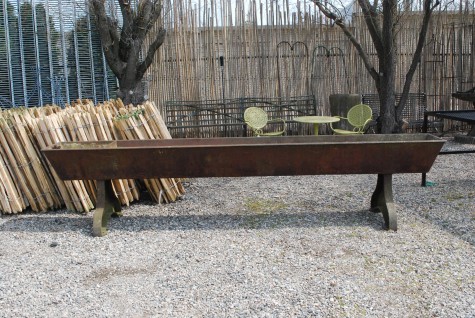
A pair of Victoian era cast iron horse troughs took my breath away.  OK, how does a horse trough get this level of respect?  They are visually very strong, and have great scale.
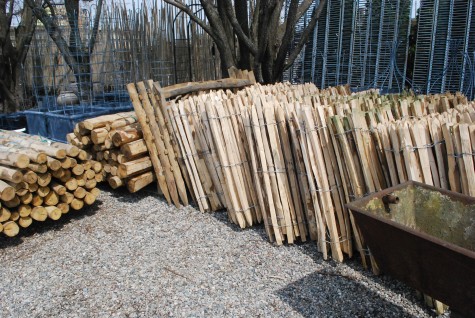
Six inch diameter chestnut poles are processed for fencing on a woodland site by a pale-maker.  The poles are stripped of their bark, and then they are riven by hand on the radial axis, to produce those fairly regular triangular shaped slats know as pales.  Once bound together with galvanized wire, the result is a rustic but entirely serviceable fencing.  The Chestnut Fencing Manufacturer’s Society puts the lifespan of this fencing at 20 years or better.  All of the above is courtesy of Chris Howkins’ book “Sweet Chestnut: History, Landscape, People”.   
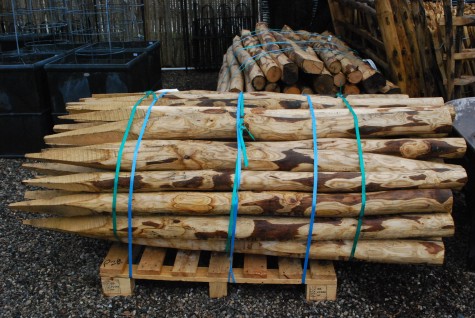
These poles will do an admirable job of holding up the paling fencing.  Their history will add a good deal of flavor to a garden.
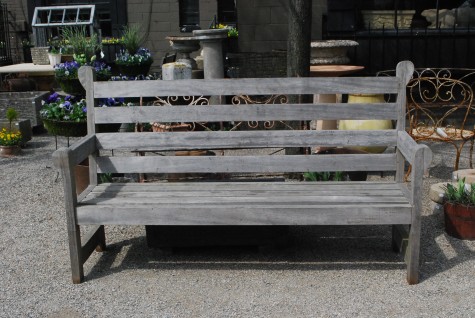
This weathered English bench is of classical design and workmanship.  Made from both teak and iroko, it has many years of service ahead of it. 
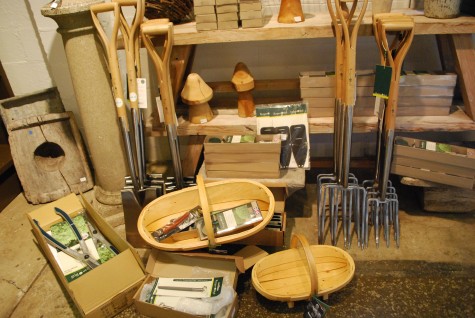
And for the first time, Burgon and Ball garden tools.  Based in Sheffield, England, they make sheep shears-perfect for pruning the soft growth on boxwood. 
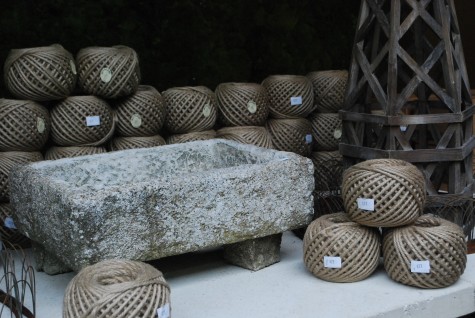
    And lest I forget-this container had boxes and boxes of Nutscene jute garden twine.  Just to open the boxes is an experience; that organic and pungent smell of jute filled the garage.   We have just about all the fixings for a great spring now.  Like every other gardener we are impatiently waiting on some spring weather to go with.
Renovating A Landscape

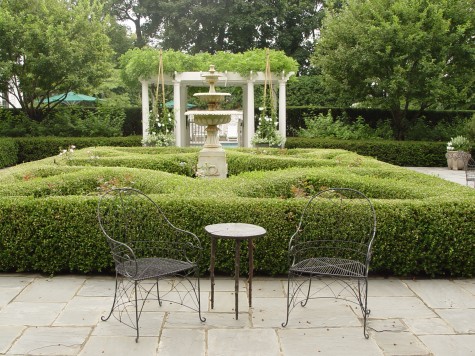
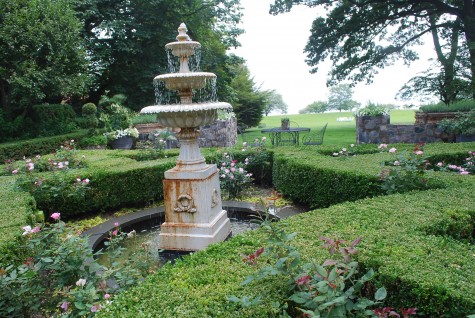
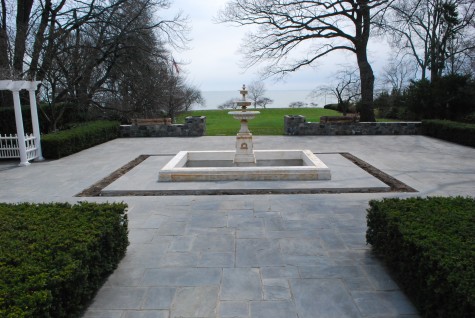
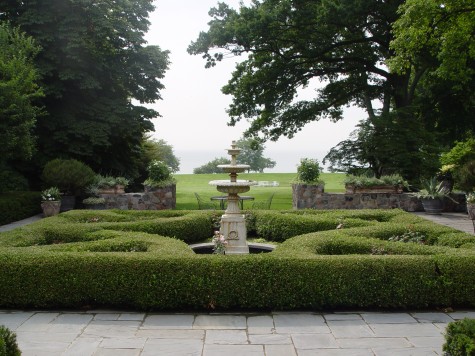
In my last essay, I spoke to the importance of determining what you need from your landscape.  This informs a new landscape, a landscape project, or a landscape renovation.  This client has been a client a good many years.  The boxwood parterre planted in the center of a bluestone terrace began life as plants just 15 inches tall.  A central fountain pool featured a small sculpture.  The landscape has changed a lot over the past 20 years.  Some years ago, the stone walls and planters at the far end of the terrace were installed based on a visit my client made to South America.  The fountain sculpture was replaced some years later by a very fine 19th century American cast iron fountain.  There were changes afoot.  All during this time, the boxwood was growing.    

At a certain point, this boxwood parterre had grown so large that the roses began to struggle.  As I have said before, a landscape never comes to maturity and stands pat.  Equality, stasis in the garden-not likely.  The strength of every element ebbs and flows-given the moment and circumstance.  That fluid community that loosely describes a landscape involves a great number of relationships that are always changing.  This part thrives and grows, at the expense of some other part.  A giant tree can pass away, leaving an entire garden community below wringing its hands.         

This beautiful 19th century American cast iron fountain was perfect for this landscape, but much overscaled, and much too important for the existing pool.  My client has a great eye, and thinks things through thoroughly.    Her strength vis a vis the landscape is an ability to plan for the future-one great move at a time.  Last summer, she let me know that the boxwood parterres, grown way out of bounds, had greatly diminished her available terrace space. She was ready to make a change.  Elements in a landscape have a lifespan.   

I think I am a good designer, but I would be telling you a tale if I were to say I designed on my own.  My clients say things, point out this or that-they enable me to design in a meaningful way.  They look at and live with that garden every day.  A designer whose pet look is evident in every project-in my mind, a failure.  Great design is about the results of a relationship, a conversation. My client knew better than I that the boxwood parterre had peaked-what would I suggest?

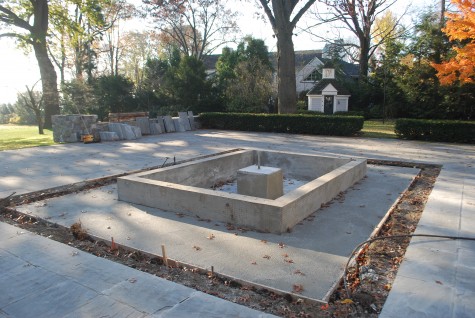
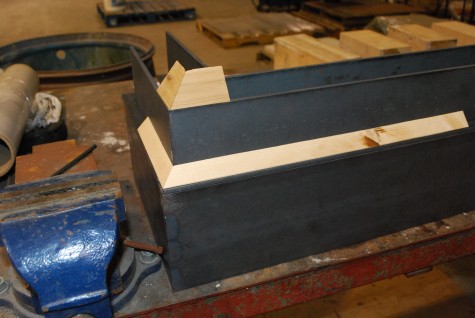
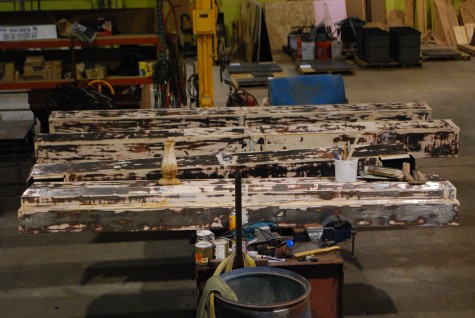
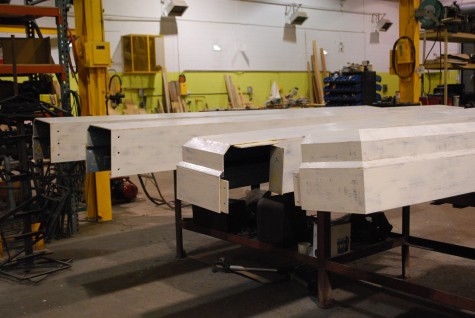
It was agreed that a larger fountain pool would better do justice to her lovely fountain.  I did manage to persuade her that a properly porportioned surround for her beautiful American fountain should be steel, and finished with degraded paint.  The fountain, and pool surround-we could suggest visually that both elements came together.  Some of the details of that surround we engineered in wood, and sent out to a skilled machinist to make. The steel pool surround weighs just about one ton.     

The paint finish was another story.   I primed the steel.  I sanded the primer off irregularly. I was interested in obtaining a reasonable reproduction of old paint.   

The final paint surface in the studio looked uniformly cream colored, butI knew the winter weather would work its magic. 

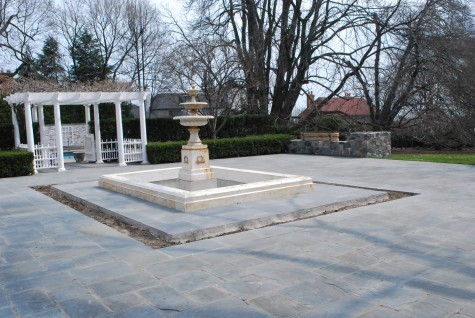
The boxwood parterre so long a fixture of this landscape is gone.  The terrace has that spacious feeling back again.  The fountain pool was poured 18 inches below grade; that portion of the pool, and the concrete pedestal for the fountain will be coated with black pool paint.  This will make the water surface reflective.  There is a plan for water lilies in the pool.  One the pots are put out and planted, and the furniture in place, the renovation will be complete.

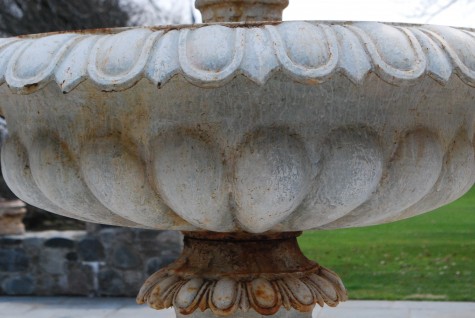
The fountain surround will get a final paint finish emphasizing the soft grey and cream color you see here on the bowl.       


The last detail-the dark frame you see in the above picture.  A large terrace, or even a driveway, can benefit visually from a change in materials that breaks up the space in an interesting way.  A detail like this also serves to separate the brand new stone surface next to the fountain pool from the original stone.  This deters the eye from making comparisons.  In this regard I need not have worried; Albaugh Masonry did a superb job of making what was new look very much like the original. After I fill this frame with dirt, I am thinking of planting a very low growing plant that would tolerate foot traffic-perhaps Isotoma Fluvialis.  Other choices could be just as good looking.  This moment in a project is such fun.

The Grand Hotel Topiary Sculptures

I do not remember what year it was, nor do I remember why, but Rob and I took a trip to New York-it may have been to see the Lucien Freud exhibit at the Met, and eat hot dogs after in Central Park.  On the way, we visited every place in Pennsylvania that we thought might have garden ornament or pots.  We visited Campania in Quakertown; I was unable to convince them to part with a single piece of their vintage Italian terra cotta.  Can you hear me sighing?  Meadowbrook Farm, just north of Philadelphia, was a delight to visit.  J. Liddon Pennock, noted garden designer and plantsman, willed his 25 acre estate and gardens to the Pennsylvania Horticulture Society in 2004.  He kept a small nursery and shop there; I made my first garden ornament purchase ever there.  Eventually we ended up at Longwood Gardens-wow.  I could write for days about that place, but what enchanted me the most were the topiary ivy sculptures.  I bought the book.   

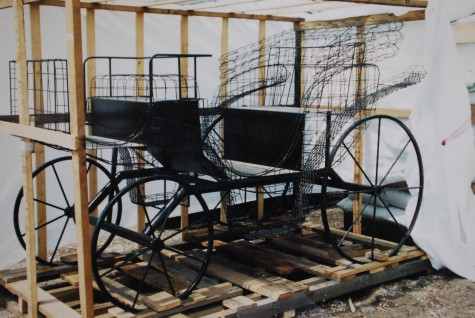
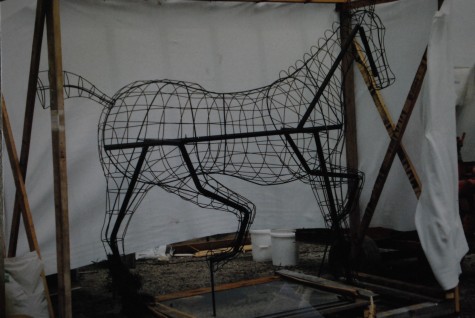
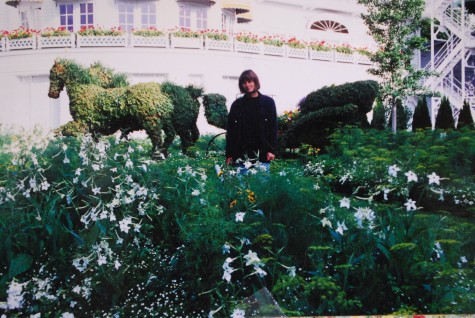
The topiary were not rooted in the ground.  The plants were rooted in every surface of the sculptures. The New Topiary: Imaginative Techniques From Longwood  was a do it yourself topiary stylist’s dream book come true.  Patricia detailed exactly how they were constructed.  The steel frames had been made at the Longwood Manufacturing Corporation (no relation to the gardens) and stuffed with plants at the gardens.  I could not get these sculptures out of my mind.  On the strength of what I saw at Longwood, and what I read in the book, I managed to persuade Grand Hotel to invest in 3 topiary sculptures.  A pair of Hackneys, drawing a carriage, as depicted in their logo.  They agreed.  Some months later, the three steel and wire topiary frames were delivered to me-it was my turn. 

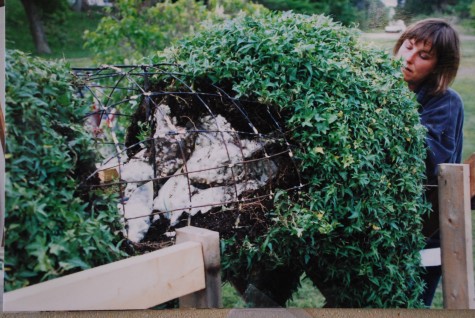
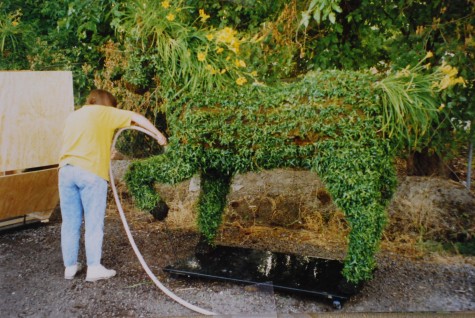
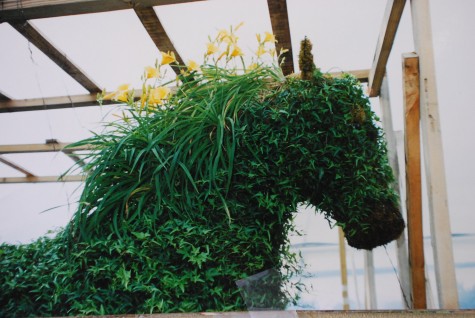
This glimpse of the interior of one of the horses helps tell the story of the construction.  The topiaries were built in horizontal layers, from the hoofs on up. A layer of the frame was covered in a netting of fishing line.  Florists moss was pressed into the fish line.  3 inches of soil came next; individual ivy plants were planted sideways in the breaks between the moss.  The body of the horse-much too large a volume to load up with soil.  The belly of each horse, a collection of styrofoam peanuts packed loosely into individual plastic baggies.  The worst enemy of any topiary built in this way-topiary erosion. The styrofoam interior had to perfectly conform to the available space without any air pockets.  We packed and stuffed, and packed again.  This photograph was taken when I had to repair a horse that had suffered a too rough a ride back to Mackinac Island in the spring.  A large topiary such as this requires a lot of patient work.   

It is easy to see in this picture how the plants were layered horizontally.  Finishing the forms took 400 hours-I remember this-and the countless miles of fishline and boxes of moss.  Truth be told, it was much more than I bargained for.  What it took to make these sculptures road ready-I had no clue; frankly, I grew up with these sculptures. I soaked the sculptures thoroughly before they got packed in their crates.  I would get them back in the fall, and winter them in a makeshift greenhouse I had put up for exactly this purpose.

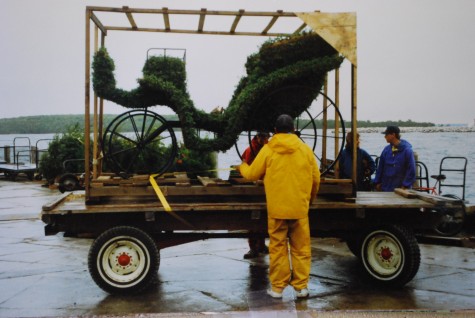
I kept the original crates that the frames came in; Mackinac Island is 340 miles north of where I live. I knew the sculptures would need to travel.  A forklift loaded them on a boat, and offloaded them onto a horse drawn wagon for their trip up the hill.

I planted Stella D’Oro daylilies in the manes and tails.  I found glass eyes for the horses from a taxidermy shop.  They were finally ready to be placed in the garden. 

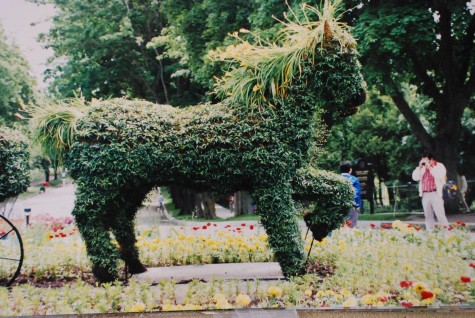
They made quite a statement.  This garden had a focus.  No matter when I visited, someone was taking a picture.  This part felt great.  They made the garden so much more friendly, and personal.  They invited people to interact with the grounds and gardens.

Back then, they were the star attraction in the Triangle garden.  Today they reside in a giant lawn space in the tea gardens.   This particular year, the tea garden was all white, pale yellow, and dilly.  So many dill plants and white nicotiana alata. 


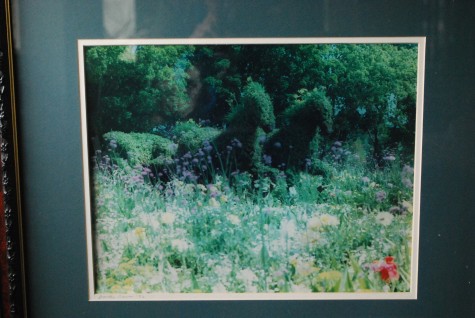
Dorothy Farmer, noted gardener and supervisor of the Cranbrook Gardens auxiliary for so many years took my favorite picture of these sculptures.  She framed a copy of her picture, and gave it to me.  My photograph of her picture is terrible, but perhaps you can discern a little of what felt like magic to me.  The one red canna at the lower right-the odd man out.  She asked me about that.  Every garden I design has one plant that does not fit.  Most times I do it, in acknowledgement of nature.  In this garden this particular year, 1996,  I planted it for the owners of Grand Hotel.  Their interest and committment made a special moment in a garden possible.

Getting It All Together

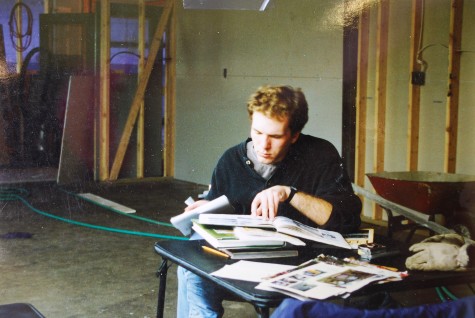
Rob was instrumental in getting it all together.  When he wasn’t shovelling out old asphalt tiles, old records and debris, he was putting together a trip to Europe to shop. Though he may seem very low key, he has a fire burning for anything garden related.  That first trip to Europe, he was nervous.  Not nervous to go, not nervous about not having regular hotel reservations.  How could he make hotel reservations, when it was not clear where he would go?  He was nervous he wouldn’t find anything to buy.  I was nervous about the plane, and the big fluid travel situation, but I knew he would find great things.  He has a superlative eye, and endless energy for what interests him.     

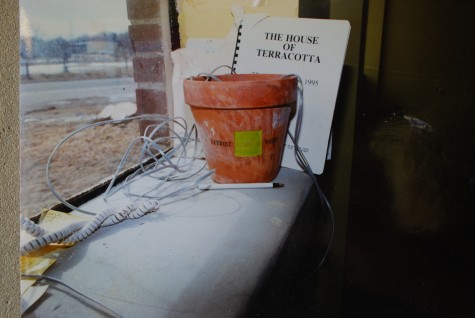
Since we would be bringing terra cotta from Italy, it only seemed appropriate that we find a way to put our logo on a terra cotta pot.  A printing place that specialized in sandblasting patterns into glass made 25 of these pots for us-I still have one.

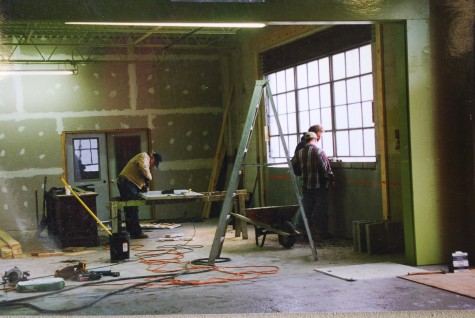
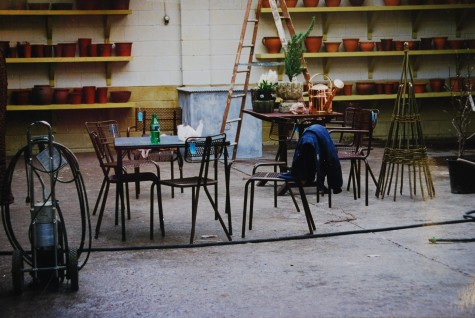
The finishing of the shop was well under way.  Don Taylor supervised the installation of a new bank of windows, a new window sill, dry wall mudding; of course we painted for days. We learned first hand what the phrase brick and mortar means. In this room, the first floor painting on the concrete-a tangle of grape vines and grapes.  I remember it all being very exciting, challenging, and loads of fun.   

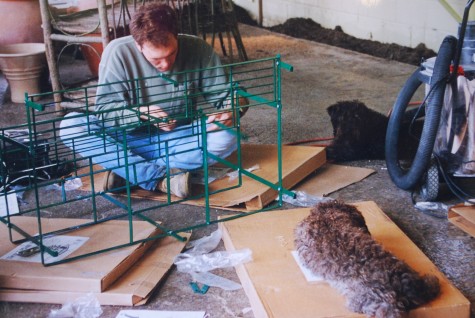
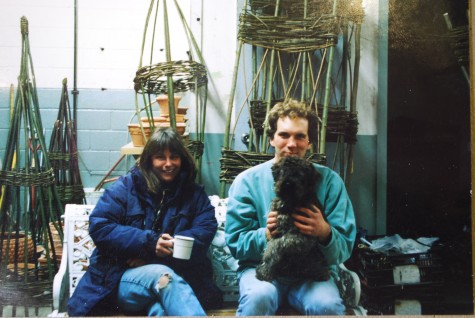
Some things that came in required assembly-Rob did that too.  His schnauzers took to living on cardboard boxes as if they had done so their entire lives.   

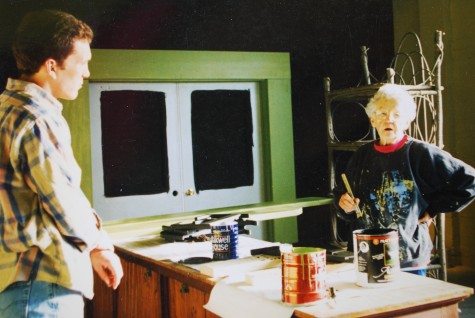
Ann Berg was Rob’s grandmother; he persuaded her to come for a visit, and help out.  The plywood letters that spell out the name of the shop on our sign in front was carved in exterior plywood by Rob’s Aunt Esther and Uncle Ken.  Rob sent them the logo, which they blew up by 300 percent, and used as a template.  All of the letters, among a lot of other things, got painted by Ann.  My Mom-doing this kind of thing was not her forte.  But she did loan me 14,000.00 when I was about to run out of money.  3 years later when I had the money saved to pay her back, she waved me off.     

The day the first container arrived was a magical moment for all of us-but more so for Rob.  Communications 15 years ago were not like they are now-I really did not have a very good idea of what was in that box.  But even Rob had not seen everything he bought all together at once.  Would there be lots of objects all singing different tunes,, or would there be a collection?
No one deserved that day more than Rob-he had worked so hard.  In many ways, this 15th anniversary is really Rob’s day.  I had every confidence that his voice would make the shop different than any other place devoted to gardens.  I think this is still true today, and I am very appreciative of that.  I am much more involved in the buying now, as I can instantly see objects in other places and other countries via his I-phone.  But back then, he had to go it alone.   

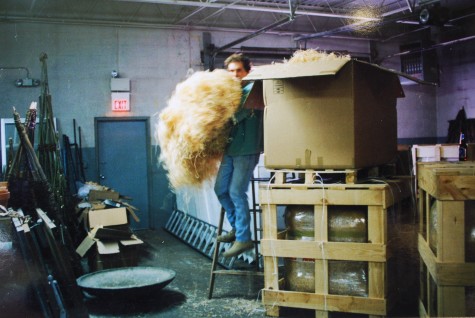
At one point the entire garage was awash in excelsior.  Everything fragile was packed in those coarse wood shavings.  We recycled every bit of it-over the following 5 years.  Having in my possession, however briefly, what other people had made for the garden in places far away-everything that got unpacked felt like a gift. 

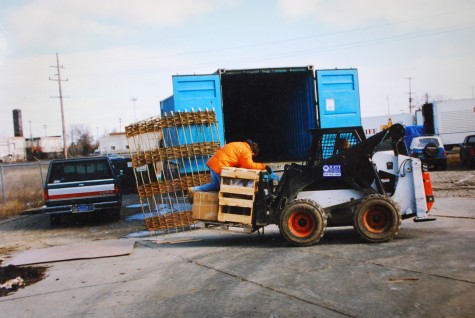
There would be many more containers to come.  Each ocean going packing container is locked once it is fully packed.  That lock can only be cut off once it is delivered to the person to whom it is sent.  I have all of those container locks-this most recent one is number 43. But this first container unpacking was a perfect moment.  


We were very close to putting away the paint sprayer, and sending out invitations to the opening.