New Faces

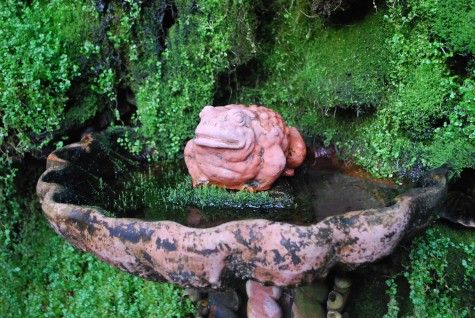
 What’s new-we are on the verge of a change of seasons.  Is that new?  No, not really.  The change of the seasons, the full moon, the length of the days, the natural changing of the guard – not new, cyclical. My crocus are poking out of the ground right now like they do every year at this time.  It is their time to emerge, no matter the weather.  It could be a good year, or a wash for the crocus. Right now, I am watching a blizzard bury those buds out the window; I hope they survive the insult.  The forecast for tonight-a shudderingly chilly 11 degrees.  However there’s plenty going on inside that is new. Though I have had this Italian terra cotta frog for 15 years, he looks new, having had a much needed soak and scrub down.  
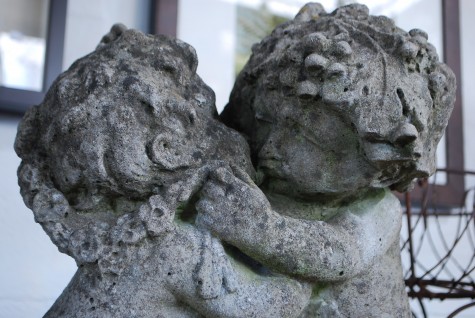
Though I can appreciate abstract sculpture in the landscape, figures and faces appeal to me more. Putti, cherubs and angels have a long history of representation in the garden.  Though I have always thought cherubs and angels had a religious connotation, the putti are usually mischievious and romantic figures. This antique limestone sculpture of putti is charmingly typical. The embrace is all the more charming for a garland of flowers.   Putti were a very popular subject matter in Italian art, especially during the Renaissance and Baroque periods.  Garden sculpture in the Italian style can be found in many western European countries.  My collection of terra cotta pots-classical Italian in style and make. This sculpture greatly predates the cast limestone works of contemporary ornament makers, such as Haddenstone, or Chilstone, who produce their version of these kissing putti.  
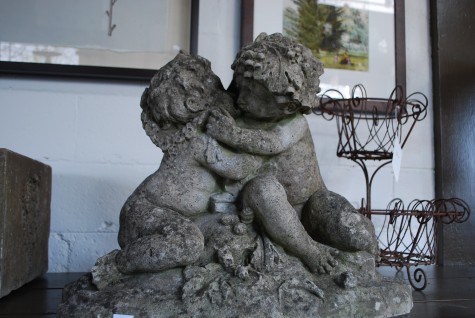
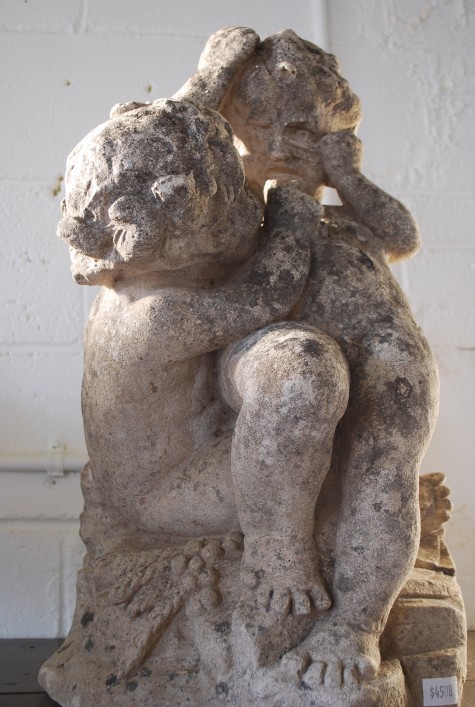
Should kissing putti not be your idea of a great subject for a garden sculpture, we have the companion piece.  These putti appear to be having a serious disagreement about something.  With representational sculpture, there is a story being told-a narrative.  The one is so enraged with the other, he is tugging at his own face.  One cannot help but smile at the level of frustration depicted here.  Both of these sculptures have been reproduced many times by different companies. The age of these sculptures imparts a patina to the surface which is as important as the subject matter.      
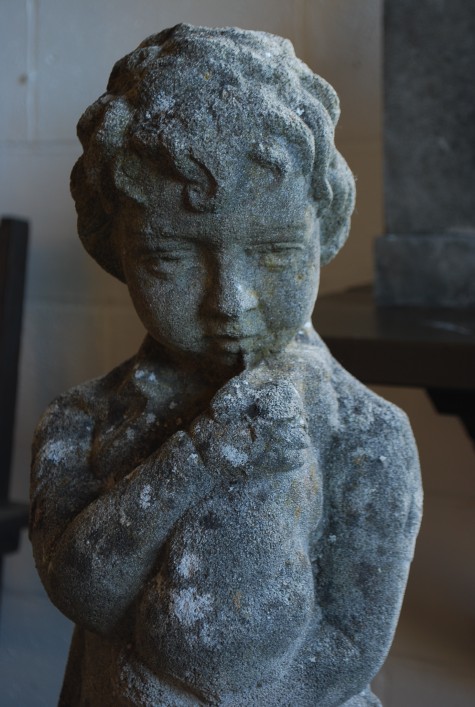
The face on this antique English garden sculpture is quietly and typically English in character.  The young boy is holding a rabbit.  Not seen in this picture-he is wearing nothing but a cape!  I am sure there is a story here; the English garden antiques dealer from whom he came called him “Rabbit Boy”; no other information was forthcoming.  His expression is serene; he will be easy to place in a special spot in a garden. 
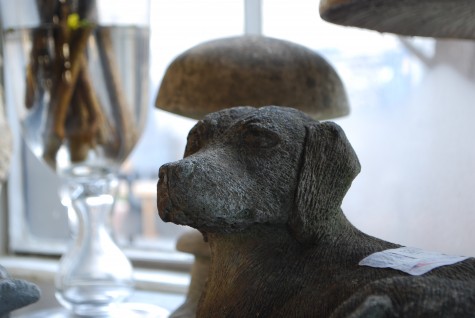
This carved concrete dog is old enough to have acquired a great patina.  The dog has that stoic serious look that I love so much about my corgi Howard.  There are those dogs that have jobs, and take their job to heart like this retriever-and then there are clown dogs like my Milo.   
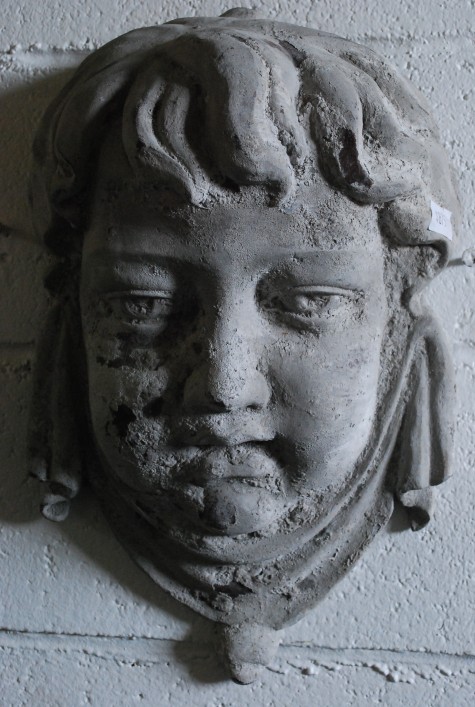
More than likely, this is an antique architectural casting that might have been a medallion on a wall or pillar.  I am guessing here.  The origin of this cherubic face-I have no idea. Lots of garden and architectural ornament was produced with no stamp or identifying marks.  We can often date an iron piece based on the level of corrosion, the composition or appearance of the paint, or lichens growing on the surface.  Some blackened limestone pieces can be dated to the Industrial Revolution.  But often the story needs to come from the imagination.  
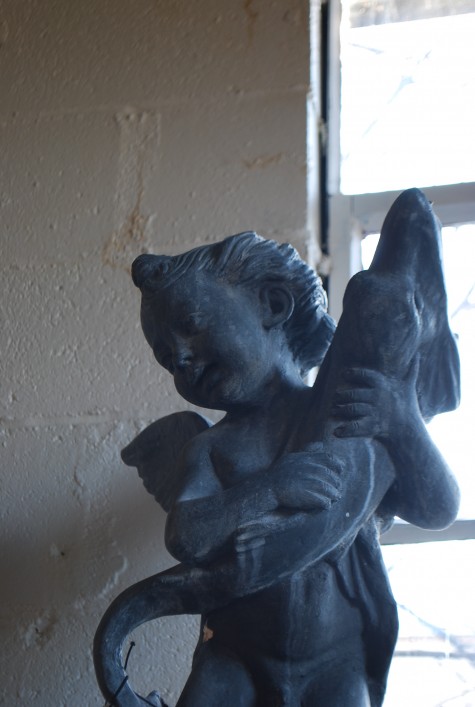
 This vertical spouting lead fountain of a boy holding a fish is easier to trace.  Made by H. Crowther Ltd. in London, it is after the original by Verrochio, sculpted between 1435 and 1488.  The orginal is still on display at the Palazzo Vecchio in Florence, Italy.  It is another example of a figurative representation so popular with gardeners it is still made to the present day.   
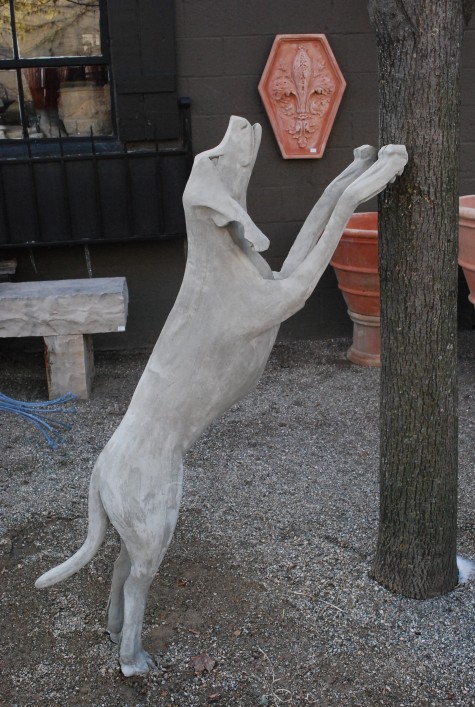
A local sculptor is in the process of hand carving his third pack of hounds for me.  A steel and concrete core is finished with a hand carved mortar layer.  This hound barking up a tree is a perfect garden ornament, as it clearly interacts with the landscape.  The sculpture is very contemporary and pared down interpretation of the spirit of a hound.  
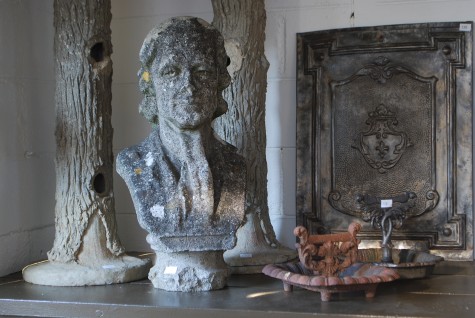

A bust is a sculpture representing the head, shoulders and upper chest of a person.  This particular carved stone bust is English.  Who is portrayed here, I have no idea.  A bust can be a powerful focal point in a garden, especially if set at eye level.  Making eye contact is one of those complicated things that living creatures do.  Any of these sculptures new to the shop, I would place in the garden at eye level, so the conversation could begin.
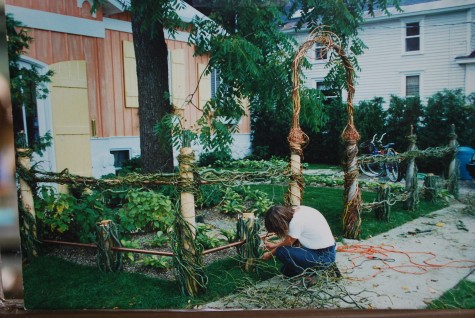
A Fence Of A Different Sort


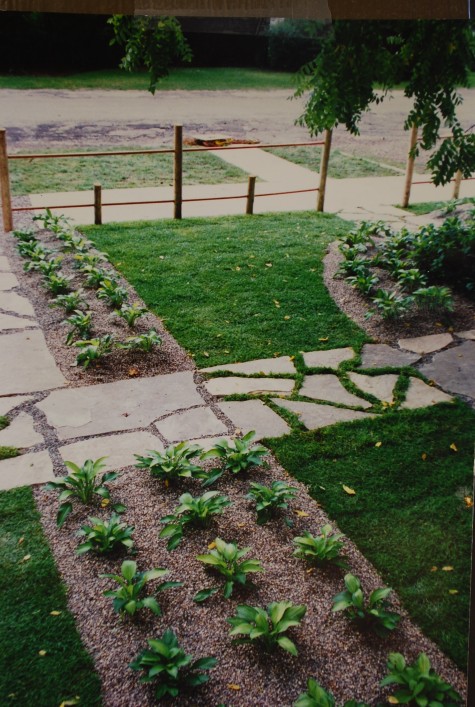
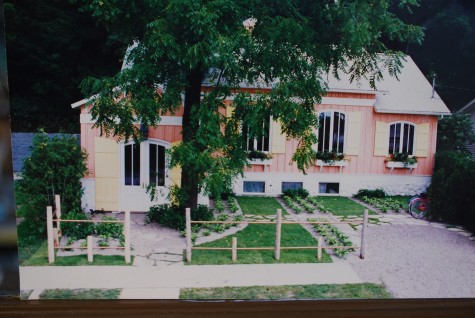
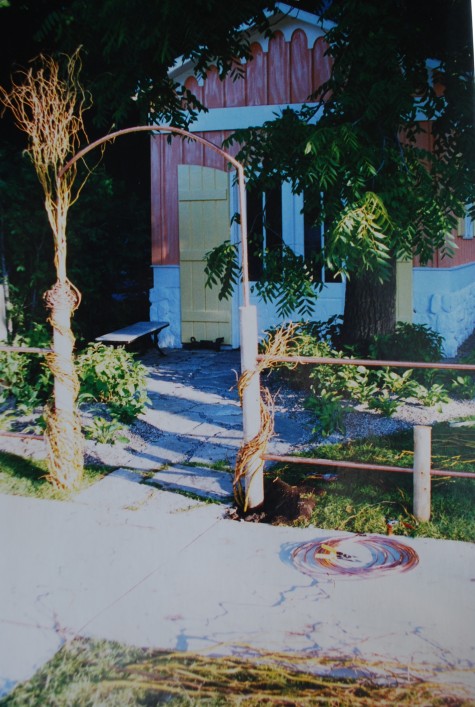
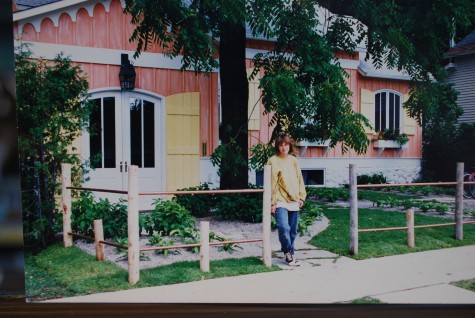
What am I up to here?  Many years ago I installed a fence which was more sculpture than fence for a young client who owned a  second home in Harbor Springs.  Second homes, vacation cottages-they have landscape requirements all their own.  People go to the cottage to have fun, and relax-not work.  The landscape needs to survive and thrive with intermittent care.  I would hate driving up to a landscape that looks neglected.  Lake and woods properties can be easy-whatever nature has seen fit to put there is generally quite beautiful.  But this second home was in a neighborhood in a northern community right on Lake Michigan. Lacking a woodland, or sand, beach grass and water, some kind of landscape was in order. 


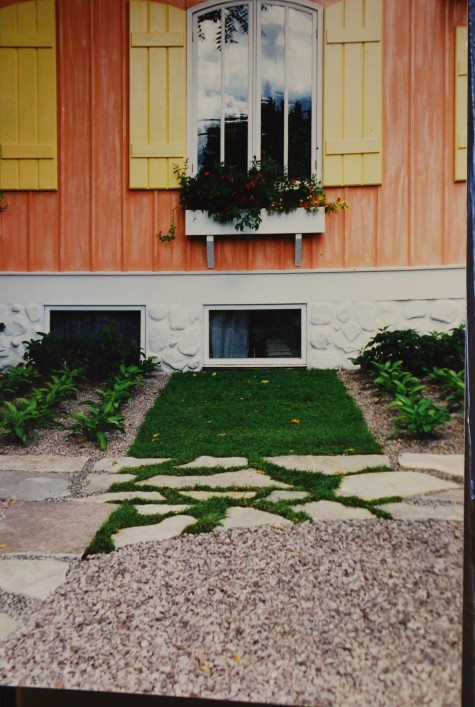
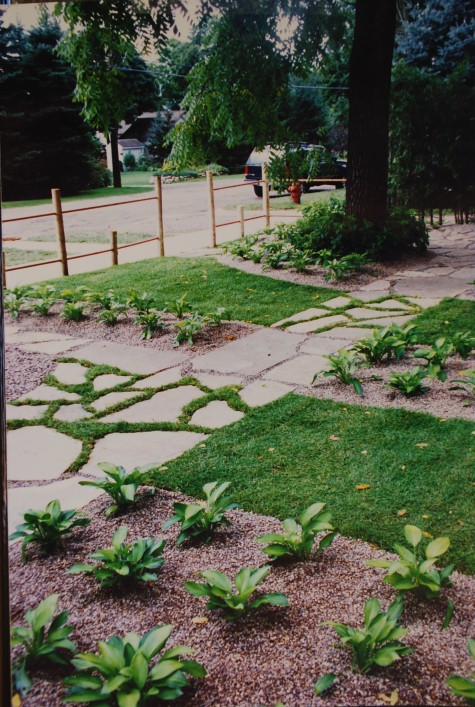
The house was small, and the property very small.   A gravelled car park, and a stone walk across the yard to the front door were the first order of business.  The gravel, grass, and rows Sum and Substance hosta would cover the ground plane with stripes.  My young client happened to be an artist; she was interested in a design with a strongly graphic and whimsical quality. A few Annabelle hydrangea would provide some height and interest during the summer months. 


The large shuttered windows seemed to ask for window boxes.  Both the width and the location of the windows and boxes would dictate the placement and the width of the lawn stripes.  As the boxes were fairly high off the ground, easy access to them with a stepladder would make caring for them all that much easier.  The grass stripes would lead your eye right to the boxes. It is a fairly simple matter to automatically irrigate a window box, if you already have in ground irrigation.  This is not foolproof, but it can buy you some time. 

   
The dry laid flagstone walk which traversed the yard perpendicular to the stripes was set with large joints.  Where the walk crossed over a grass stripe, we put grass between the stones.  Where it crossed a gravel mulched stripe of hostas, we put gravel between the stones.  The size of the joints between stones depends on what kind of traffic you expect to have.  Guests in sneakers would do just fine with such a walk-guests in high heels would need to pay careful attention.    

The property featured a giant walnut; I knew the hostas would tolerate that.  But something seemed missing.  Some element that would strongly reflect the point of view of the owner-something fun. And most of all, something that would not require regular maintenance. So I designed and built a fence- not to screen, nor to keep anything in or out.  A sculpture of a fence, if you will.   

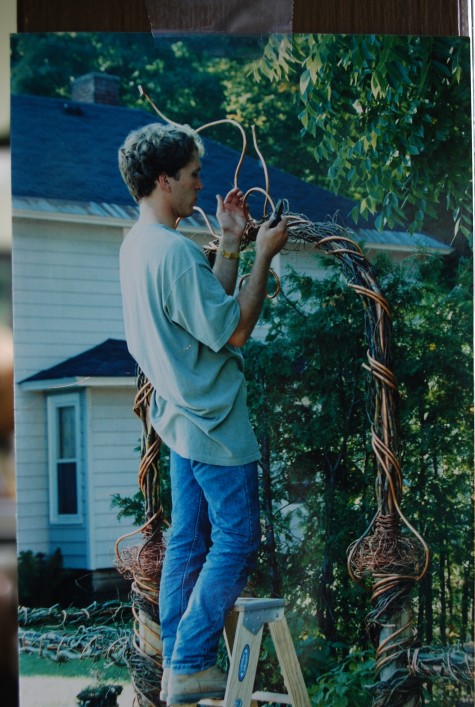
We built the fence with three materials.  Peeled cedar fence poles, available locally, would form the uprights.  Tall posts alternating with short ones would provide interest on several levels.  We drilled through the cedar poles, and used copper plumbing pipe for the horizontals elements, and an arbor that would go over the walk.  Fresh cut curly willow would informally spiral around the posts.  The willow would be held in place with 1/4 inch copper tubing.  The fence post finials-a nest/hairdo of copper wire. 

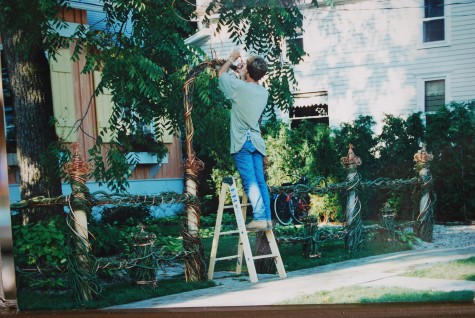
Rob handled the contruction of the arch.  10 foot long willow pieces were inserted in the ground next to the cedar post, and wound up and aroung that post.  Smaller willow braches were added to the top of the post, and secured with copper tubing.  The flexible tubing repeated the shape of the wire finials, and went on to wrap and secure the willow to the rigid pipe.  As I gave all of the pictures of the finished fence to my client, the shape of the top of the arbor is from memory-I think Rob made an informal fleur de lis to finish.

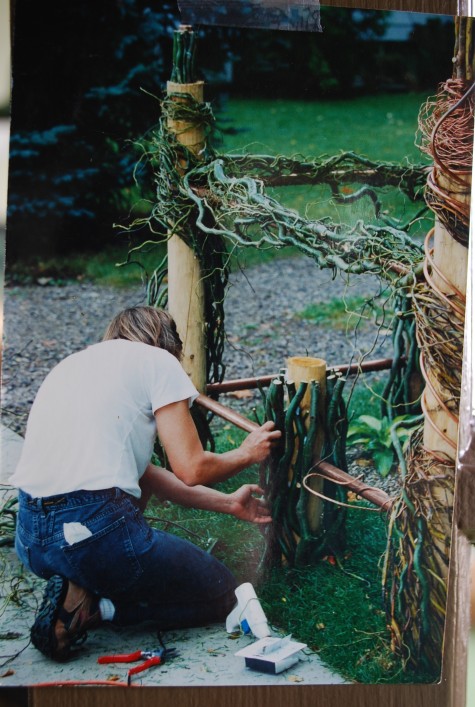
All of the rigid pipe was covered in curly willow, and secured with copper tubing.  This was not a particularly orderly or repetitive process-we did what we thought looked interesting.  The relationship of the metal to the willow proved to be great visual fun. 

I did hot melt glue the short willow pieces on the low posts, more as a method to hold them in place while the water pipe was wound round, rather than a securing mechanism.  I remember coming by long after finishing the fence-some of the willow stuck in the ground had rooted.  What unexpected fun.  There would be other construction projects featuring willow, but this one was especially satisfying.

Once the fence bones were built, I was ready to go.  Is the fence still there?  It would be about 17 years old now.  I have no plans to go back and look.

The Olive Jars


Apparently I am still writing about Italian terra cotta-bear with me if you can.  The container that arrived just a few days ago has brought back a flood of memories from the past fifteen years shopping for great terra cotta-I have some 35mm images that describe those memories.  Once the shop had a home, and an address, Rob went shopping not one bit more seriously, but in greater volume, and with more confidence.  In the early 1990’s, he met and did business with Klaus and Ilona-they brokered Italian terra cotta from a number of different potteries.  Rob would meet them in Florence, and shop.  Though Klaus was German, his mother lived in Tuscany-in those days.  Rob became part of their Italian/German family.  Many bottles of great chianti and home bottled olive oil from Klaus’s Mom arrived in the container with our terra cotta in those days.  They helped bring order to Rob’s orders. Few of the potteries we bought from did much business exporting to the US.  The order we placed very early on with Carlo Chiti-the money disappeared, and our request for pots went unanswered.  Carlo Chiti-if you are out there, we are still waiting for our pots.  Klaus and Ilona no longer rep Italian terra cotta, but their generous help and support more than a decade ago taught Rob much about how to shop in Italy.     

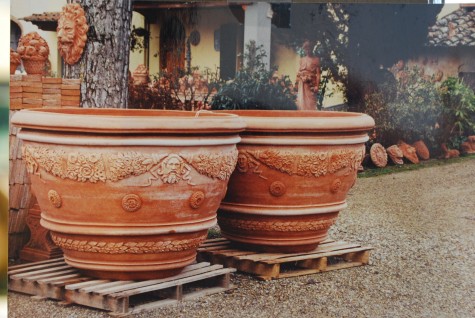
The terra cotta pots, and sculptures manufactured by Mital are legendary.  Giant and ornately sculpted vases from Mital grace gorgeous gardens all over the planet.  In my opinion, the most beautiful classical Italian terra cotta pots ever made come from Mital.  My own terra cotta collection revolves around pots from them.   

A series of terra cotta pots of this exact design were made by Franco’s grandfather early in the 20th century for the Biltmore Estate.  These replacements for two broken pots, made from the original mold, were about to be shipped when Rob visited Mital in 1998.  Based on this photograph, I ordered three of them for the shop.  One client spoke for all three-he is as crazy about classical Italian terra cotta as I am.

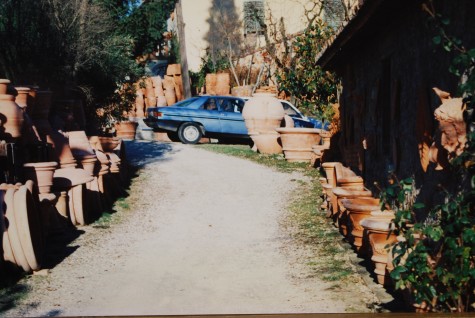
Rob’s first trip to Mital in 1998-not so much about the history.  It was much more about meeting people.  Franco’s father’s vintage Lancia was as much a part of the landscape as the terra cotta.  There was much discussion of that car.  The personal relationships that Rob nurtured so many years ago over a love for fine terra cotta was instrumental in our ability to offer fine terra cotta to our gardening clients.  

I cannot speak or write with any authority about the use of terra cotta pots for storage of olive oil.  But I do know the terra cotta of the 12th and 13th century primarily consisted of jugs to hold water (mezzine), tiles and bricks for buildings, and jars for storing certain liquids and grains (orci).  By the 16th century, as the production of olive oil became an increasingly more important agricultural product in Tuscany, the production of orci-those jars used for the storage of the oil- increased accordingly-dramatically. 

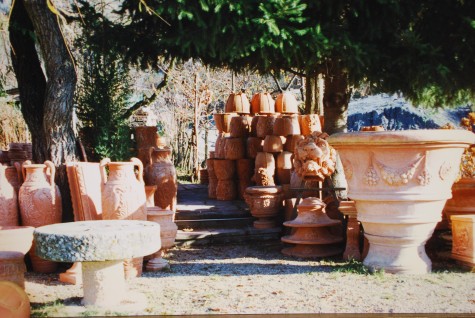
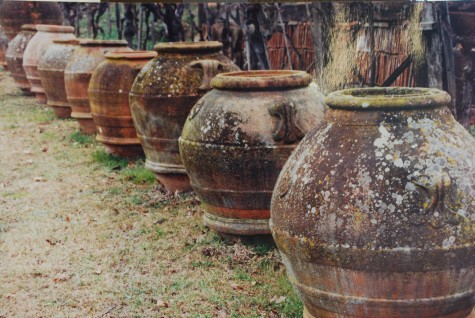
In the yard at Mital, an incredible collection of antique terra cotta olive jars, side by side the olive jars still in production there.  What was once traditionally made in Italy to store oil is still being made, though their use has expanded.

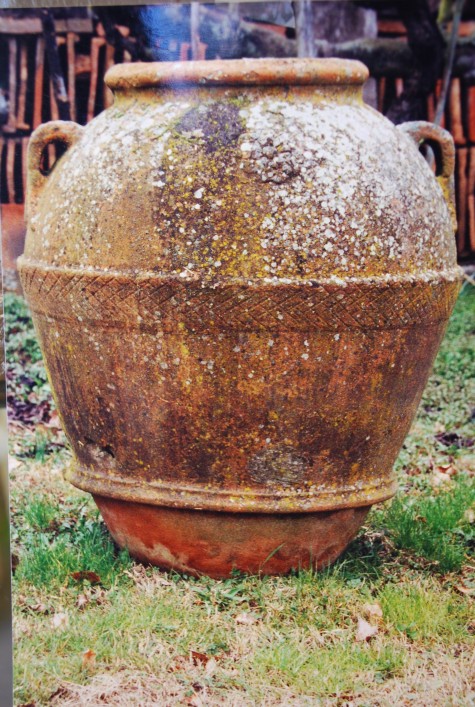
   The ancient olive jars at Mital-a collection amassed over a lifetime by his father.  Franco was clear-none of the ancient jars were for sale.  Though they were simply diplayed at the pottery, they were a treasured reminder of all the the history of his craft.  Glazed on the inside, olive jars both new and antique have a distinctive shape.  The large oval bodies tapering at the bottom permitted the jars to be stored upright in metal or clay rings, or in wood braces aboard ships.  The relatively narrow necks still permitted easy access to the oil; the handles were useful should the jar need to be moved.

Olive oil should be stored in a dark cool place for maximum longevity.  The jars-perfect for this.  But ancient terra cotta olive jars are incredibly beautiful in their own right. My personal collection of terra cotta from Italy includes one 18th century olive jar, purchased from an Italian antiques dealer in northern Italy.  The year it arrived from Italy, Rob filled it with water.  Unbelievably, the scent of olive oil filled the air.     

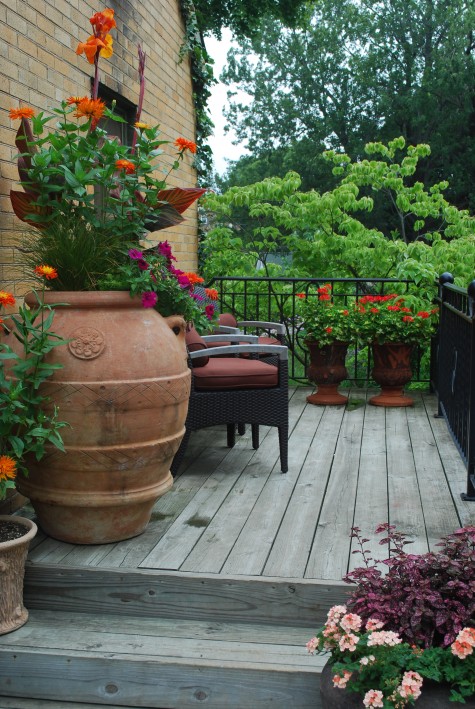
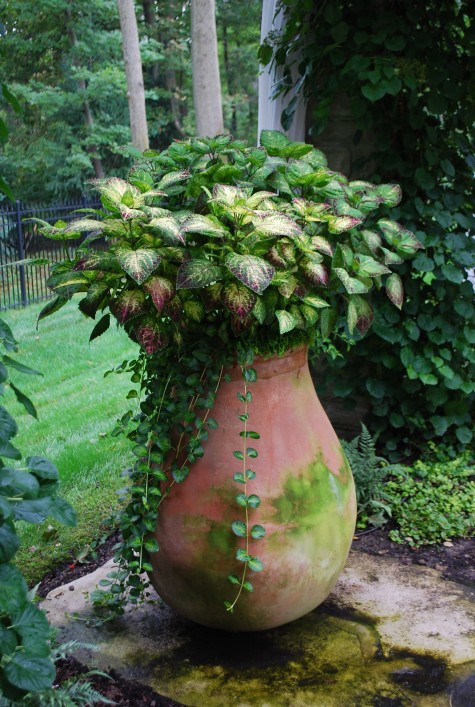
Though I plant my jar with flowers every year, it is every bit beautiful enough to stand on its own, unplanted.  The day it is moved to the deck for the summer is a very good day indeed. I spend plenty of time thinking through what I will plant-this part is my pleasure.  

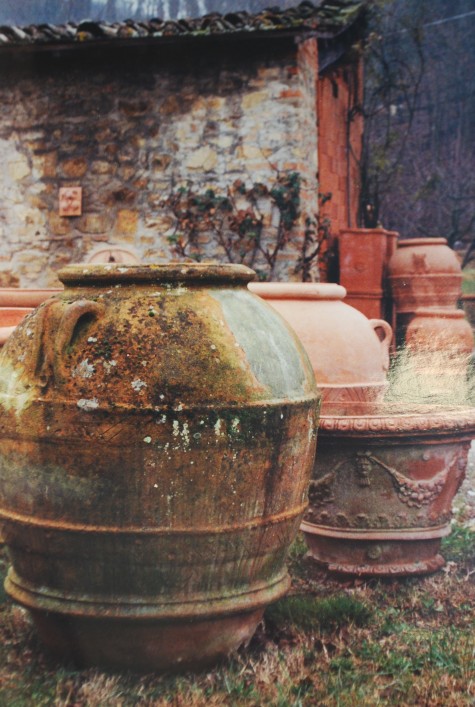
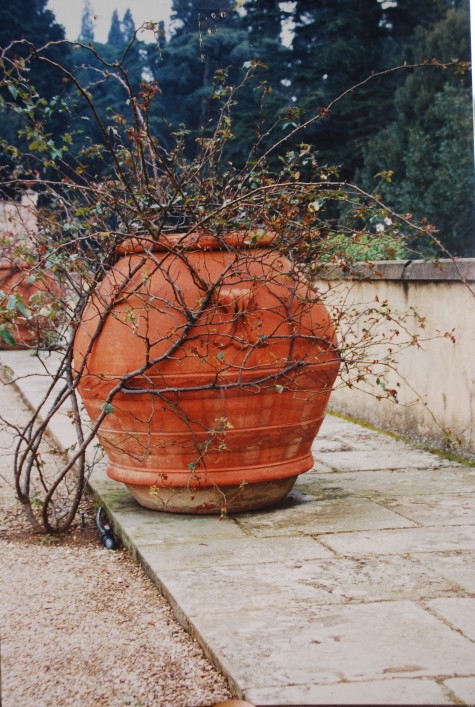
This Italian olive jar, empty, but faithfully supporting a climbing rose-this might be my most favorite garden photograph ever.  I have no idea where Rob took this picture, but it describes what I love so much about Italian gardens-they have a long standing romance with their gardens that is unmistakeable.   


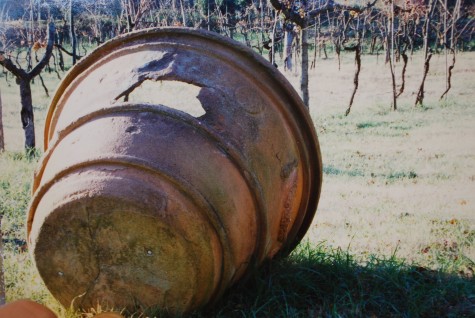
This ancient terra cotta pot with obvious damage is an important visual part of this vineyard landscape.  I am sure it was not placed here for that purpose.  There simply was no thought to discard it.  If I had the chance, would I buy a pot such as this?  No doubt-yes I would.

Italian Terra Cotta

These three words-Italian terra cotta-are more than enough to get my attention, and make my heart pound.  Terra cotte-translated literally from the Italian-fired earth.  Pots fashioned from fired earth-what could be better?  What better container in which to grow a plant?  Containers from clay-what could possibly be more basic and natural?  The clay pot is a gardening icon.  I have stacks of them in my garage-I would wager that you do too.  On occasion, a client will fill their trunk with unneeded clay pots, and bring them to me.  Who could bear to throw one away?  Crusty with age and use-all the better.  I have yet to have a client insist on a brand new clay pot, if all I have in a size they need is a used pot.  Used and vintage plain terra cotta pots provide just as good a home for a plant as a new one.    

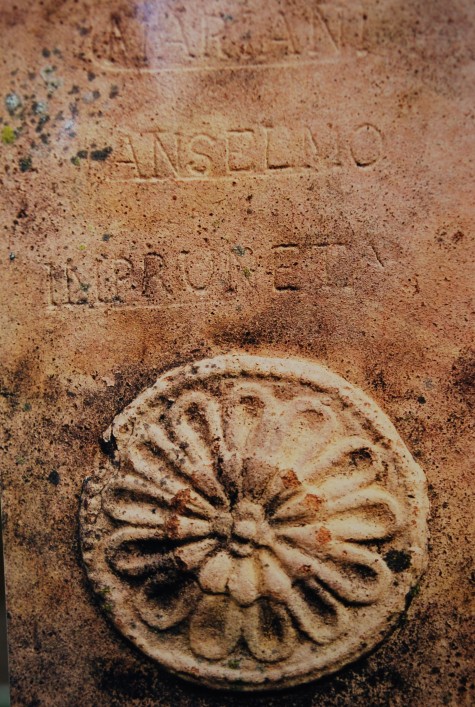
Italian terra cotta has been a part of my gardening life as long as I can remember.  The machine made clay pots of my twenties were no nonsense sturdy and functional.  Though the clay is fired, it is porous.  The clay will wick moisture away from the roots of a plant.  This can be helpful if you are a heavy waterer.  If you don’t always get to watering whern you should, a glazed or other moisture conserving pot might be a better choice.  That porousity also means that the container breathes; air is essential to proper root development.   Machine made terra cotta will break if dropped, or left out over a Michigan winter.  There are two critical factors that influence the durability of a clay pot.  The quality of the clay is crucial.  The best terra cotta pots on the planet come from Impruneta in Italy; the local clay is superior in quality.  The other factor-the temperature and duration of the cooking. Fine handmade Italian terra cotta is fired upwards of 1700 degrees.  The purpose of a long firing is a maturation process by which the pots are “soaked” with heat.      

Machine made terra cotta has its place.  They are available in an astonishing range of sizes and shapes.  It is important to properly size a pot.  Underpotting a plant leaves no root for root development.  Overpotting a plant can result in the soil staying too wet for too long.  Azalea pots and bulb pans are low and wide; this shape is specifically designed for shallow rooted plants that do well in less soil rather than more.  Long toms (a reference to tomatoes) and rose pots are tall; they accomodate the long root runs of these types of plants.  In any event, a classic clay pot is basic to anyone who grows plants.  A handmade Italian terra cotta pot-an object of great beauty and durability.     


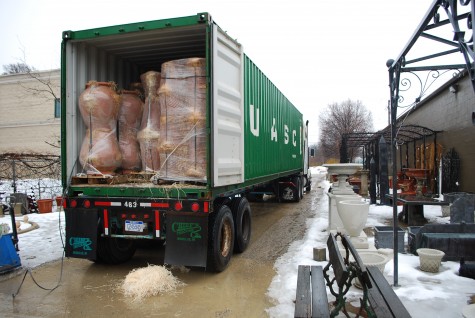
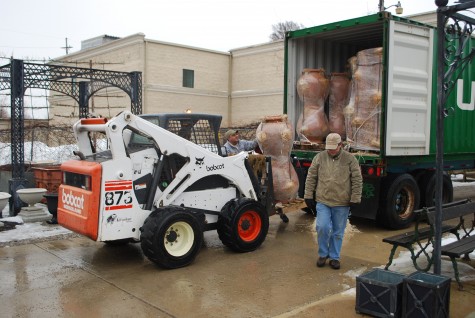
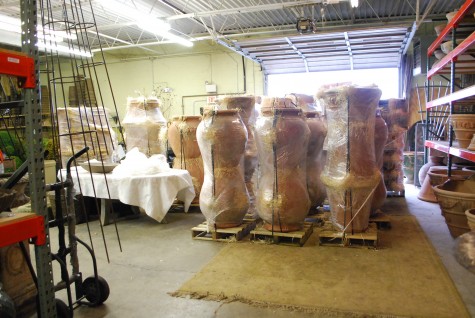
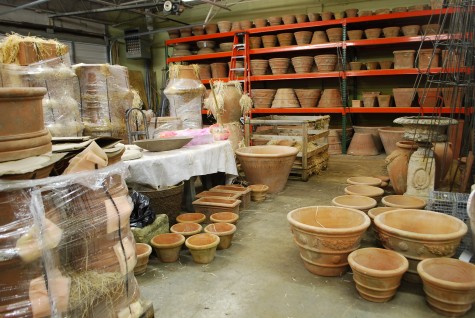
Delivered yeserday, an entire container of handmade Italian pots.  The container is 40 feet long, by 10′ wide and 10′ tall.  There were a whomping lot of pots on that truck.  Why so many?  Having a container delivered empty to the pottery means the packing costs are less; they pack and protect their pots quickly and expertly.  Of the entire lot of hundreds of pots, one was broken.  But the big issue is the volume.  When we buy lots of pots direct from the manufacturer, we get a better price per pot.  This helps make a handmade Italian terra cotta pot more affordable. 

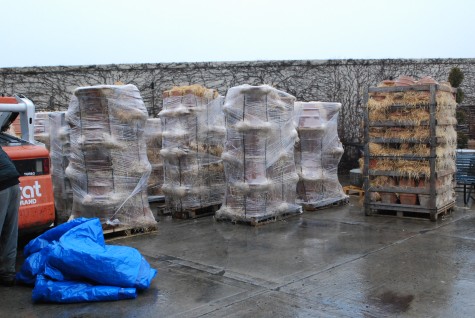
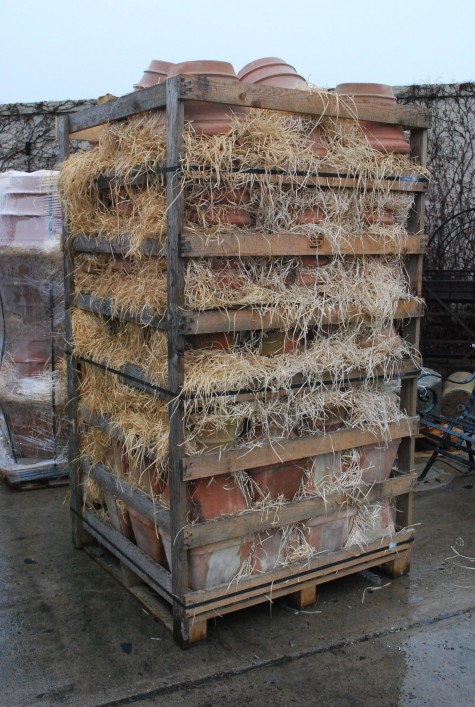
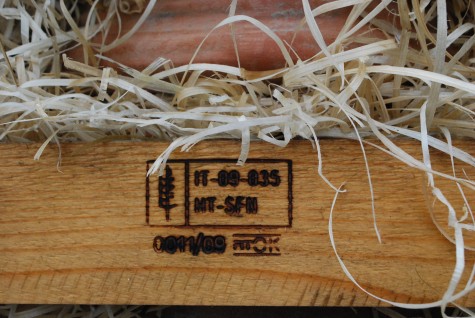
Any wood that comes from overseas has to be heat treated, so no pathogens come along with the pots.  Even the pallet wood is cooked.  Likewise the excelsior-the pots are protected with wood shavings when they are stacked, and anywhere the steel strapping material touches a clay surface.     

Each pallet is then shrink wrapped.  I imagine the trip across the ocean on a boat can get dicey in bad weather.  The durability of these pots helps make shipping them easier.  Should you thump a terra pot, it should ring with almost a metallic sound.  This tells you it is a high fire pot.  Pots that thud when thumped-low fire.   

This is an embarrassment of riches in terra cotta pots, but it means someone who needs four matching, or 8 matching might find something they like.  The soft orange color will beautifully compliment a planting.  Their rugged good looks you will have for a very long time, given proper care.  My own pots, but for 3 large English made concrete pots in the classical Italian style, are impruneta terra cotta.  A beautiful clay pot is tough to beat.  The first pallet of pots I bought 15 years ago was Italian terra cotta-I still remember what a thrill it was to unpack those 14 pots.  They were very expensive, as is anything you bring over from Europe, a little at a time.  But every one of them found a home, and many of them I am still planting for those clients. 


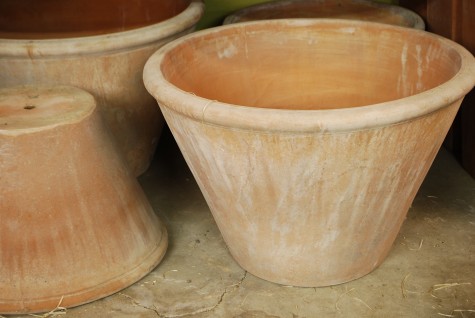
You may be wondering what about this pot enthralls me so much.  It is not just the simple beauty of the form, the soft color and subtle surface.  

A beautifully planted Italian terra cotta pot can mean this for a garden.