Planting Window Boxes

A window box is just about my most favorite container to plant.  They represents the best of all possible worlds.  The planting area is larger than most containers; I like having lots of space to plant.  This means lots of possibilities.  Window boxes come without any of the headache of planting large areas in ground.  My ground holds water too long.  Standing up to plant is a treat.  Having planted all manner of plants in the ground the past 30 years, I like having a big body of soil, and a raft of plants, at eye level.  The year I broke my leg, this feature was especially appreciated.
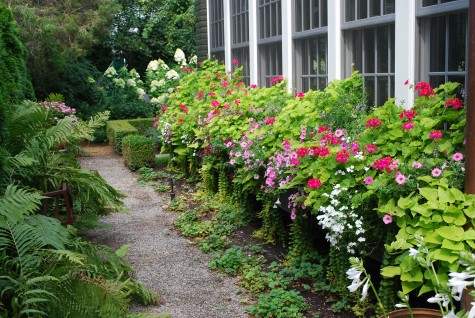
These boxes we built and mounted on the exterior wall of a sun porch.  The view from inside is swell. The Persian Queen geraniums, petunias, sweet potato vine and what all else is in these boxes can be easily appreciated at eye level.   
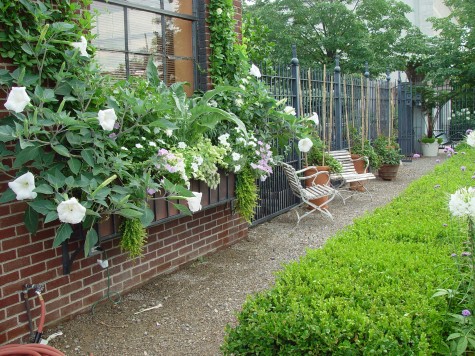
Many of the boxes I plant, I have constructed. My main complaint with commercially available windowboxes is that they are not correctly sized to their companion, the window.  They are often too narrow, too shallow, and too short-perfect for UPS shipping regulations, but not so great for your garden. A window box needs to be generously sized; a big soil mass will hold water long enough for you take a breather once in a while from your watering chores.  If your idea is to have a back row of plants, a middle row, and a front finishing row, the box needs to be 12 inches wide.  I like 16 inches deep-lots of soil and drainage material.   I like even better a box which is longer that the window in question.  Ths permits tall plants on the outside edges that do not obscure your view out.  My shop boxes are sized this way.  I had room this particular season for datura, cardoons, and cup and saucer vines growing on the walls.     
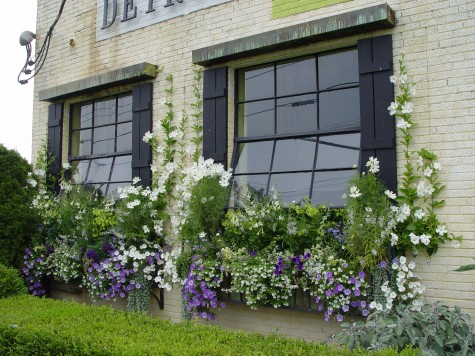
One year I grew white mandevillea on wires on either side of the windows.  OK, I was not much looking out of my windows at this point in the summer.  But the view is entirely in your control-maybe your boxes need to be mounted to the wall lower that you think.  Think about the mature height of the flowers-where do you want that to be? I like my boxes on the wild side-the Sonata white cosmos and lime nicotiana grow large.  My boxes are plenty large enough to handle them .  
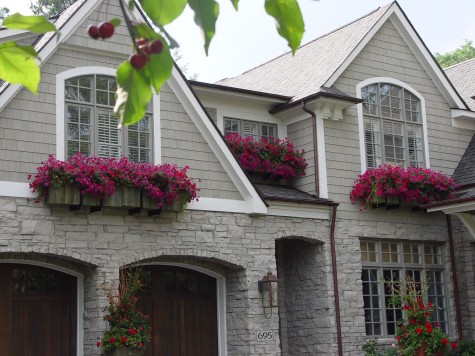

Second story window boxes have a very European flavor.  I am sure you have seen those pictures of window boxes stuffed with trailing geraniums on homes and businesses in Switzerland, or the window boxes on the shop walls in London.  The planting of window boxes dates back to Roman times, when wall hung boxes were used to grow herbs.  The first gardens were of course devoted to growing things to eat.  Later, gardens were also devoted to ornamental plants.-I can think of nothing else that will dress a window better for summer than a box stuffed with flowers. 
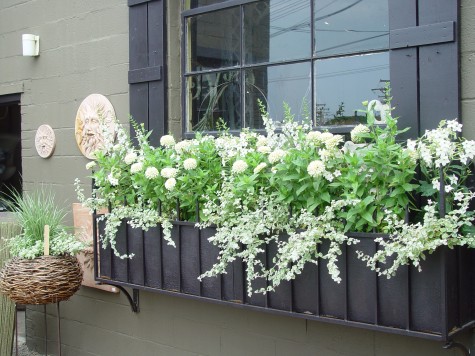
The generous size of a windowbox means you can explore a planting idea in greater depth. Should you be interested in exploring color relationships, you have the opportunity to introduce various shade variations on a theme.   If your point of view tends to the contemporary, a box full of one favorite architectural might be just the thing.  Should a cottage style garden interest you, a big box will permit you to go wild to your heart’s content.
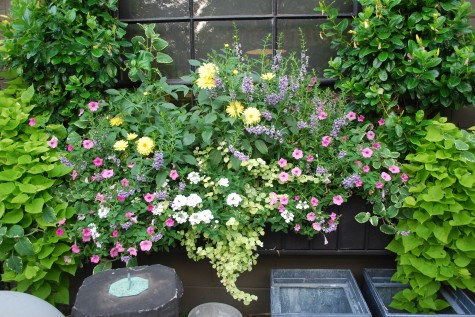
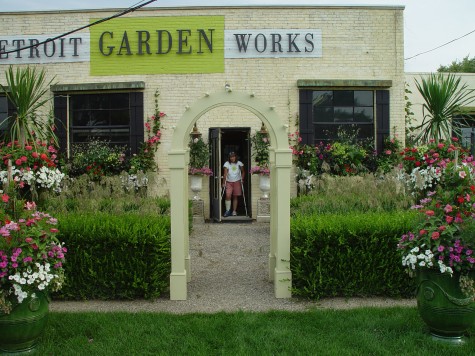
Most annual plants are happy in a big box.  The soil is good, the drainage is even better.  The plants are easy to groom and dead head.  The landscape at the shop-trees in the ground, and a decomposed granite covered ground plane.  The only flowers I have are from the 7 window boxes, and containers that I plant.  The overall impression is of a profusely flowering garden. 
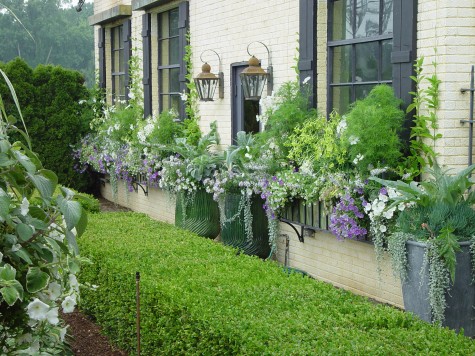
The boxes put the flowers above the level of the boxwood hedge; it is easy to see them.  The 11 boxes on the roof can be seen from blocks away.  Granted that your taste in gardens may not run to this level of exuberance, but I see part of my job as encouraging people to take up gardening.  And that one’s choices of plant material and combinations are many.  
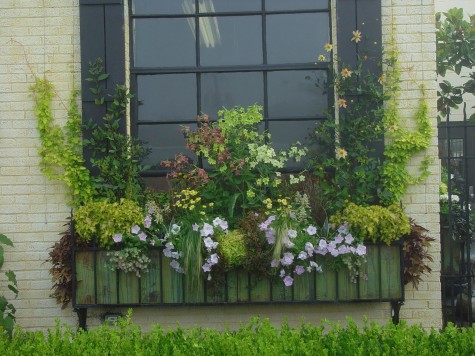
This lime, brown and lavender box had a moody feedling to it-I still like it.  I cannot remember the name of the copper flowered nicotiana, but it was beautiful.  The color of brown sweet potato vine looks great with other colors besides lime-I like it with orange, yellow, and cerise justg as well. 
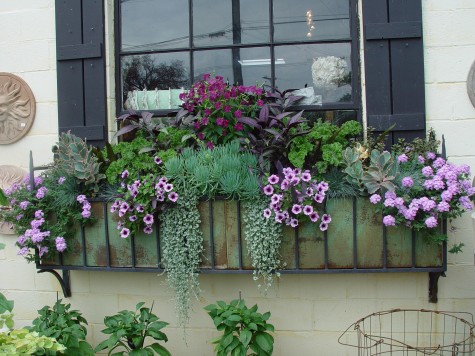

The first year that Perfume Purple nicotiana came out, I was entranced with the color.  This box was composed around that one plant.  That red-purple color is very unusual-I shoopped all over for plants that might compliment that color. The red markings on the Persian Shield was much the color of the nicotiana. The lavender star verbena and petunia of unknown name did a good job of repeating that color as a pastel version.  The blue-green succulent I recently learned is a senecio, and a blue-foliaged kalanchoe (??)  seemed like a good foil.  What will I do in the boxes this year?  Don’t know yet.
An Extraordinary Garden

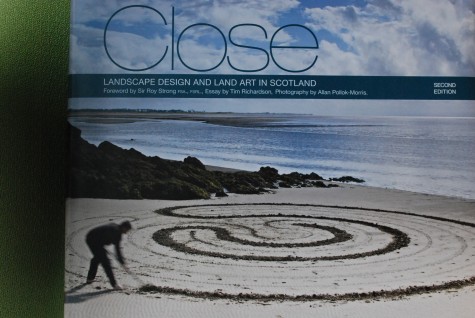
I do think I wrote this winter about some of the books I was reading-winter means gardening from afar in my zone.  Given the snow-I read.  Courtesy of and on the recommendation of Rochelle Greayer at Studio G, I  I bought a book.  “Close: Landscape Design and Land Art In Scotland”.  The well written essays in the book were written by Tim Richardson.  The stunningly beauty photography-by Allan Pollok-Morris.   

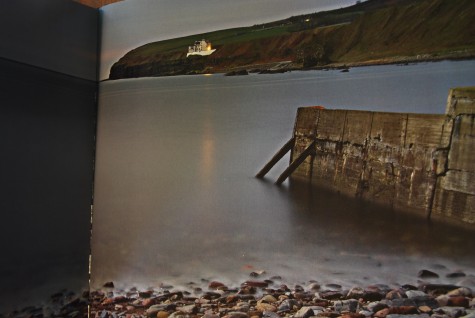
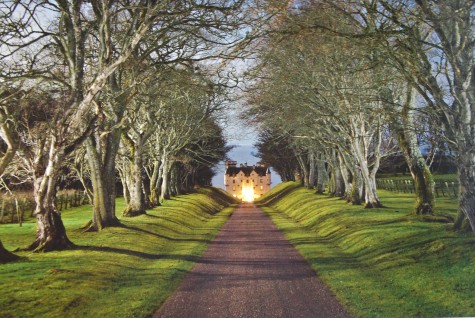
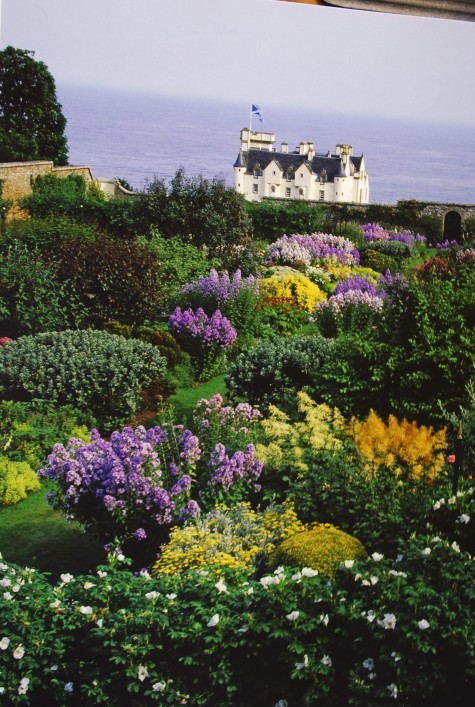
I have had really good reason to be reading this book.  Spring got arrested some weeks ago, and has yet to make her bail.  The past few weeks, 4 days of seven have been called on account of rain.  Can you hear me sighing?  Moving on beyond a missing a good many days of spring season-I am reading.  Some books take my mind off the winter that seems to be lingering.  This particular book deserves a place in your library, should you have the space.  One garden in particular has captured my imagination.  Dunbeath Castle, Caithness, Scotland, is extraordinary in every regard.  Dating from the 17th century, perched on a cliff overlooking the sea-heartstopping.   

The gravel drive to the house is lined with ancient and windswept London Planes.  How the drive is sunk into a valley between a pair of grassed knolls-stunning.  The welcoming light at the house, all the more intense given the probable length of the exposure of this photograph-so beautiful.  The sea visible beyond the house- this is a long view with no end.  This may be the most enchanting landscape I have ever seen.  Maybe more extraordinary than the landscape-this photograph.  My copy is poor, but you get the idea.  Allan Pollok-Morris created a work of great beauty.  If there ever was a perfect moment in a landscape-this has to be it. 

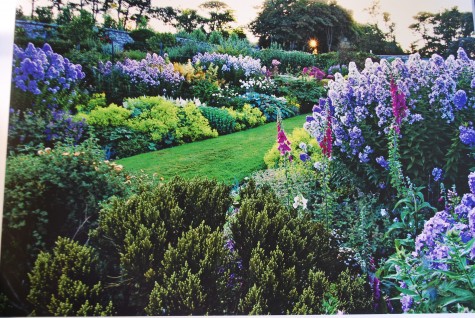
I was astonshed to read that this cliff in Scotland regularly endures 100 mile an hour winds.  I see no evidence of that here; the perennial garden is walled.  These perennial borders are breathtaking.  The book tells me that the landscape designer of record currently is Xa Tollemache.  What she has accomplished here, in  concert with her client, is extraordinary.  The stands of heliotrope blue campanula- breathtaking.  

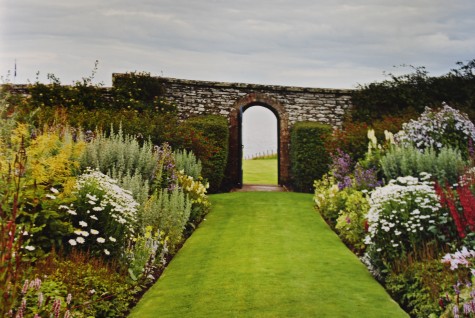
The tall walls protect the perennial gardens here from high winds.  Every spring at the shop, we have broken pots, topiaries snapped off -utter distruction from wind.   This photograph makes me understand that a truly beautiful garden depends on a committment to protect.      

This walled garden is a considerable distance from the castle perched on a cliff overlooking the sea. The work that is involved to foster and permit this garden to thrive is staggering-this is obvious.  My garden is by no means a fairy tale-but I do work at it.  My garden, and the gardens I design, ask for a gardener in charge who happily takes responsibility.  I know lots of gardeners like this. Fairy tale gardens-I depend on these to encourage me to do better.  

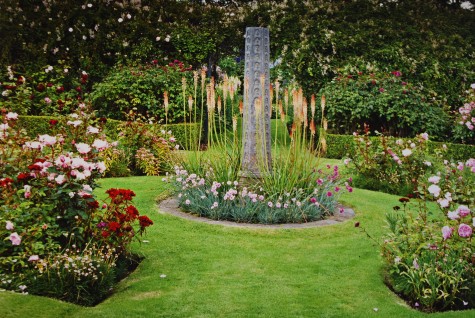
At the center of this rose garden-an ornament whose provenance is unbeknownst to me.  No matter. The very tall and beautifully blooming tritoma would be lost without that central ornament of unknown orgin.   The rose garden laid out in concentric circles-lovely.   

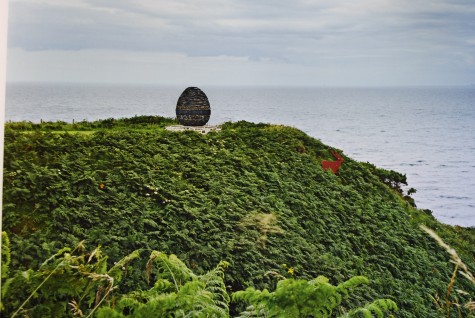
The cairn pictured above-do not ask me its material, or inventor.  The plant material clothing this steep slope dropping to the sea-I cannot provide any information.  The red steel reindeer a third of the way down the precipitous slope-I have nothing to add to this photograph.  Make all of what you see in this photograph what you will.  All of the delight of it is the visual experience.      

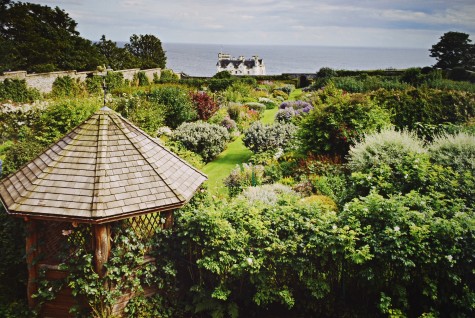
I love the congestion suggested by Mr. Pollok-Morris’s photograph.  Lots and lots of plants.  A relationship he suggests between a castle, and a distant gazebo overgrown with plants. The sea in the background-anything but cultivated and tended.   


This meadow at Dunbeath Castle-I cannot take my eyes off this photograph.  It is as beautiful as any perennial border I have ever seen.  Amazon has this book available-I highly recommend it.  Beyond this,  I can only say that landscapes and gardens of this caliber are rare; the chance to see it in any form is a great pleasure. The essays of Tim Richardson, and the photographs of Allan Pollok-Morris,  in regards to extraordinary landscapes in Scotland-they shine.

The English Horse Troughs

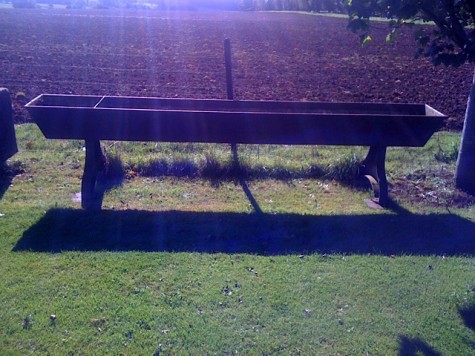
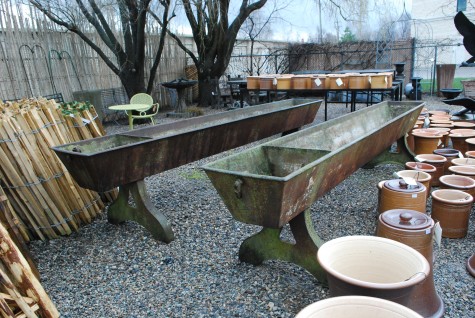
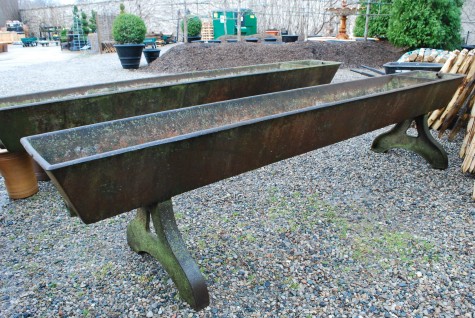
In my possession at this moment, a pair of English cast iron horse troughs dating back to the late 19th century in England. When Rob sent  me this picture-I fell head over heels-instantly.  They are beautiful objects in their own right.  Even more important, they have presence.  A big and considerable presence.  Rob’s photograph of the morning sun shining obliquely on a freshly plowed English field, and this 12 foot long trough set in rough grass makes one thing clear. Some objects come with an aura that just won’t quit. This picture with no horse trough-adrift. 
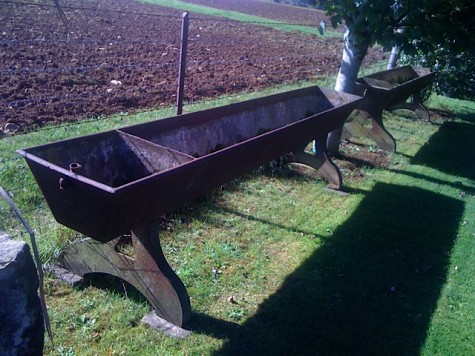
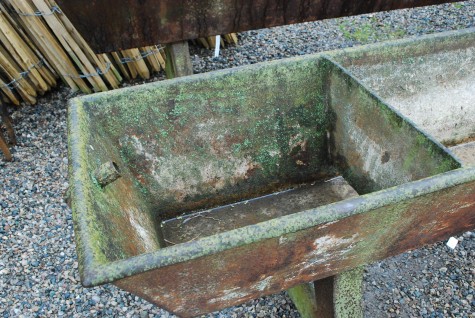
See what I mean?  Could you not have everything that this place, and these troughs imply?  You may also be wondering about how Rob came to shop next to a field.  This particular person buys and sells garden ornament as a side line to his primary business; he is a farmer by trade.  The objects he he has available are not so many, but always of a certain caliber.  Located close to the Cotswolds, I would guess these troughs were locally made. They were built with a specific function in mind-making fresh water available to horses.  I would further guess draft horses.  Horses who did the heavy lifting, the big work, on farms pre the industrial revolution.  The cast iron is very thick and substantial, as are the legs.  There is an inlet for water, and an outlet.  The feet have holes which would have permitted bolting the troughs to a hard surface.  A draft horse is a very heavy and powerful creature; no doubt they could upend these troughs, should they have a mind to.  Our farmer/antiques dealer thought circa 1880-1890.   I have no idea how much they weigh, but we were only able to move them with a loader. I can still smell the farm on them.  

They are massive, simple, and handsome. I can easily imagine a lineup of draft horses getting a drink.  The cast iron is of very fine workmanship; lichens and mosses have colonized the rusted steel on the outside.  At the water line and below on the inside-lime deposits from the water.     Should you not have a crew of draft horses, I could see an entire collection of meadowlike flowers growing in them, as in dwarf cleome, hyssop, angelonia, verbena bonariensis and annual queen anne’s lace. Oh yes, this list could be expanded; the troughs are big. What about nasturtiums, sweet william, basil, juncus-and what else?   I could as easily see a giant rosemary hedge underplanted with curly liriope.  Heartstopping.  I could see it stuffed with lavender, or Tuscan kale.  I could see something different planted in them every year, for years and years to come.   I could see schemes for more years than I have left.  This, I like.  

It would be a fairly simple matter to outfit them with 3 or four fountain jets that would recirculate water.  They would be great set on gravel, or in a garden bed.  Do not be afraid of ornament of great scale, age, and presence.  This kind of beautiful is a good think for a garden-it gets the old blood moving. 

Would one not look great in a formal vegetable garden with raised planter boxes-planted with herbs?  I think I could draw a scheme a number of different ways.  The trough perpendicular to an arrangement of four boxes. Four parallel boxes, interrupted by a trough.  These troughs are tall and solid enough to provide a wall, broad enough to house an entire community, beautiful enough to enchant.  Can you tell they are my most favorite thing to come off this last container? 

Each trough has a small section at the end-called a baffle.  The hose in the early days, and the pump for the water much later was housed here.  The baffle slowed the flow of water to the trough-so not one drop would be wasted from splashing.  A means to slow the flow.  I see a lot here.  History, utility, agriculture, gardening, landscape-everything that means something to me.  My advice?  There are those things you can manage without.  There are those things you cannot live without.  Shop for your garden accordingly.

Errington Reay & Co. Ltd


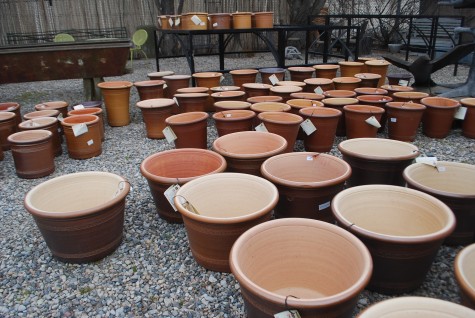
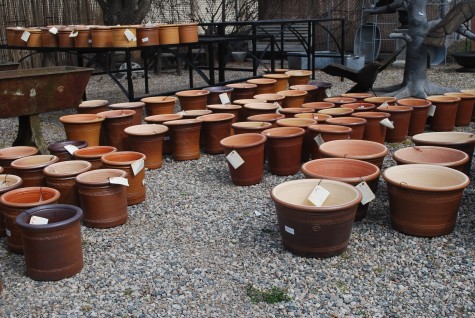
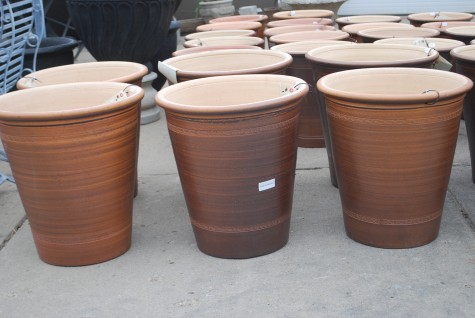
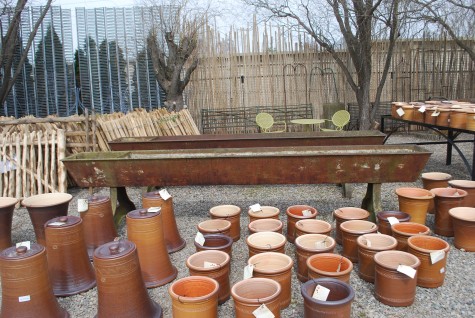
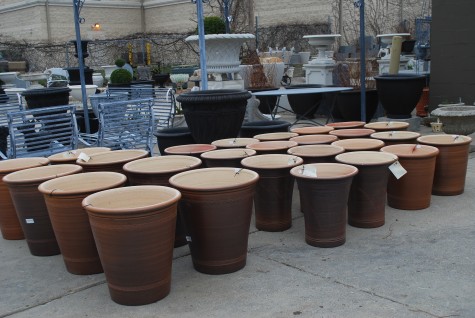
I am awash in English salt glazed garden pots,  hand made at Errington Reay & Co in England.  The pleasure is all mine; I am delighted with them.  Rob has been interested in this pottery for a few years.  This past fall, a shopping trip to England made for an opportunity to purchase them.  They are beautifully varied in shape, texture and color.  They have a very English look about them.  What do I mean by this?  To my mind, English garden pots are as much about utility and serviceabillty as they are about aesthetics.  These pots are thick and heavy; I am sure they will withstand the perils faced by any object left outdoors. No matter the shape, they all have plenty of space for plants.  They are sensibly roomy. 

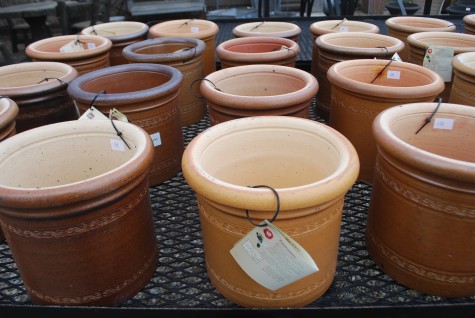
Some pots are shaped like crocks, others like mixing bowls.  The shapes are simple enough to invite any number of uses.  They are all asking to be put to use.  There is a quiet beauty to this.  Each pot is hand made; this is evident.  All of the pots have a salt glaze finish.         

 �
Salt glazed pots date back to the 18th century in England.  Doulton-Lambeth, which later became known as Royal Doulton, manufactured lots of salt glazed pots and sanitary ware.  In the 1830’s and 1840’s, salt glazed sewer pipes helped provide better sanitary conditions in urban areas. At the hottest moment of the firing, common salt is thrown into the kiln. The sodium in the salt reacts with the silica in the clay, to form a glossy coating of sodium silicate. This results in a a subtle texture that resembles that of an orange peel.  

Some salt glaze is colorless, or quite purplish in color given the presence of manganese in the glaze.  We have had French salt glazed pots on occasion from the Poterie at Noron.  These pots are various shades of brown given the iron oxide in the glaze.  No two pots are exactly ther same.  Rob thinks they have the look of freshly baked bread.   

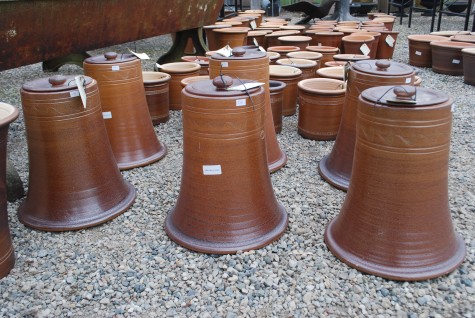
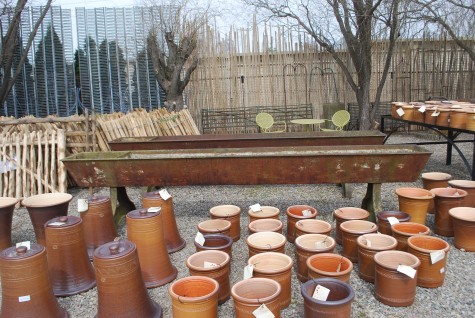
Clean air regulations passed in England in the 1870’s prohibited the production of salt glazed clay in urban areas.  Royal Doulton quit producing pots with this glaze as a result.  Errington Reay and Co is the only pottery in England currently licensed to produce salt glazed pots.  Pictured above, their rhubarb forcers.  Placed over an emerging rhubard plant, they limit that plant’s ability to produce chlorophyll-this is known as photosynthesis.  Once the rhubarb has produced shoots above ground, the lid of the forcer is removed.  The plant grows towards the light, in limited light.  This results in more tender rhubarb.  They can also be used to blanch asparagus; so called white asparagus is green asparagus grown in the absence of chlorophyll.  

These tall pots would be great for any plant needing a long root run-tomatoes, for example. The pale biscuit color of the interior of the pots is just as lovely as the color of the outside 

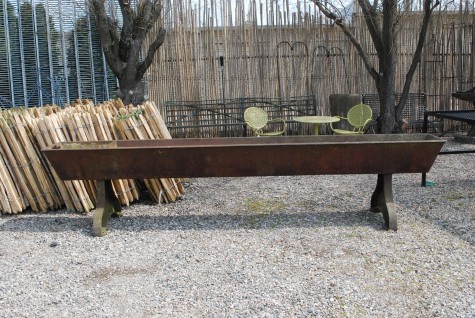
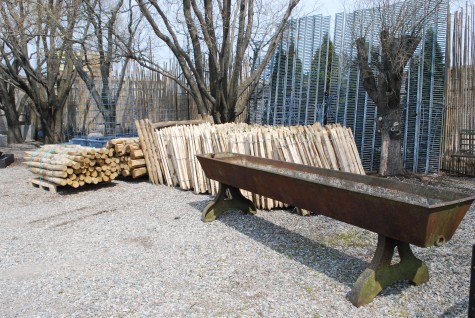
The lot line is full full of these freshly unpacked pots.  The pair of horse troughs with their richly rusted surface visually explains everything about the iron oxide in the salt glaze.


Errington Reay & Co was founded by Robert Errington and William Reay at Bardon Mill-the site of a water powered woolen mill established in the late 17th century.  “Since Victorian times, when it earned its nationwide reputation for high quality sanitary ware, drainage pipes and ornamental pottery for domestic use, Errington Reay has remained a traditional family run pottery.  We still only practice traditional ways of hand throwing, hand moulding and casting.”  This is just part of what is written on the tag that comes with every pot.  We are very pleased indeed to offer them.