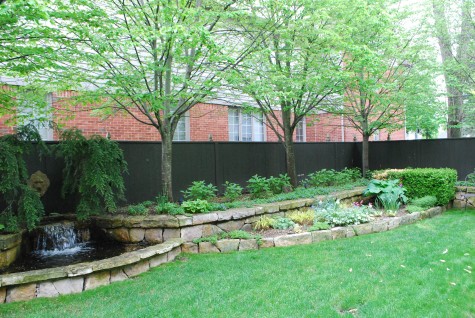
 I would say relatively few of my clients fence for privacy. Most gardeners would choose plant material to screen untoward views. if they had the chance. But very small urban properties-mine included-do not have the luxury of space. This client designed and had built a fence which would afford him some privacy from neighbors very close by. Painted that shade of disappearing green, it would screen the garden at the ground level from a neighboring house. The lindens would provide screening in the airspace, an important consideration in neighborhoods with two story homes in close proximity.
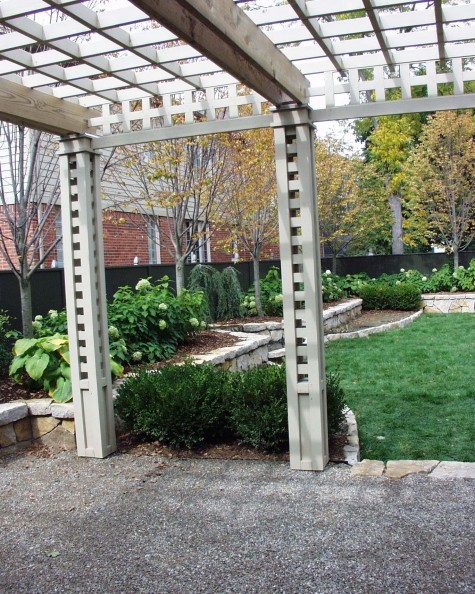
Though the landscape has the appearance of a sunken garden, the lindens were actually planted in raised beds. This did a great job of making the ground plane of the yard even more private. The trees create the illusion of a much bigger space than what actually exists. Only the trunks occupy any space in the yard. The tree tops are shared with the neighbors, creating more privacy for all. A wood pergola with a gridded roof and gravel floor would provide space for seating and dining.
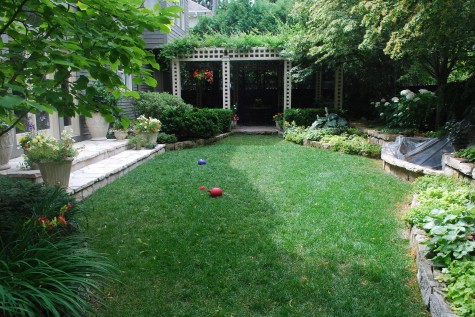
10 years later, the lindens had grown considerably, and grown unchecked. I will specify lindens for screening in a small yard, as they respond really well to pruning. Left unpruned, they grow to enormous size. The privacy fence appeared black in the increasing shade. The hydrangeas were getting that leggy light starved look. A wisteria vine planted on the pergola had run rampant, and had almost completely covered the roof. 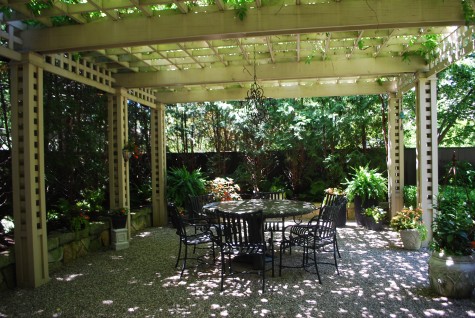
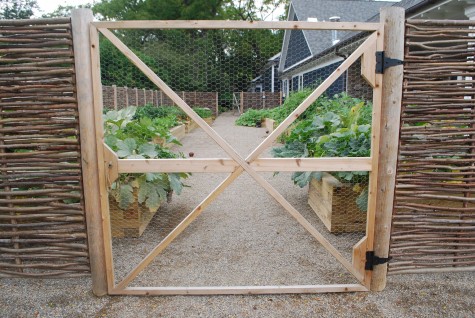
Arborvitae that had been planted in the raised beds around the pergola; there was insufficient room for any more lindens. The privacy they afforded from yet another neighboring house had further limited the available light under the pergola. An update was in order, the first of which involved the fence.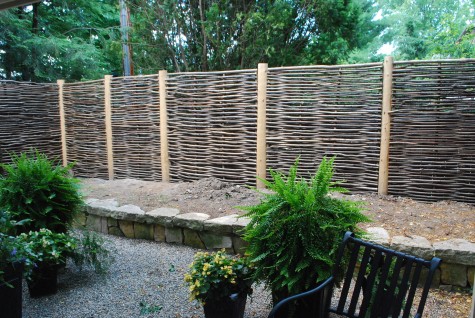 The arborvitae were removed altogether, in favor of a new fence. Though these Belgian woven hazelwood panels provide a lot of privacy, light still comes through. The wood for these panels is farmed using a method known as coppicing. The shrubby trees are periodically cut back to the ground. This hard pruning result in long straight branches, suitable for weaving into the panels The coppice wood from which the fencing is constructed still has its bark. This gives the fencing a much longer life. Importing wood from another country that still has its bark is a laborious and expensive procedure. Both US customs and the USDA have to be absolutely sure there are no pests hiding under that bark. The peeled cedar fence poles come from the upper peninsula of Michigan; 4 feet is set below ground to insure the fence will stay straight.
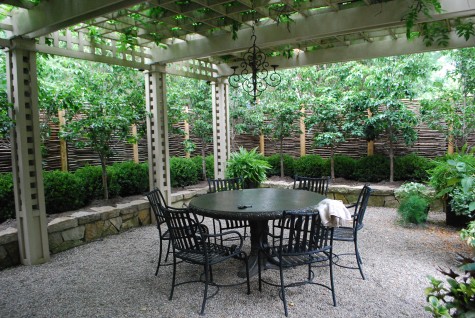 Venus dogwoods were planted in lieu of a large growing evergreen; their airy habit of growth will provide privacy without blocking so much light. The wisteria got a much needed haircut and thinning. The boxwood will will provide some green during the winter months, and will never grow so large as to obstruct a view of the fence.
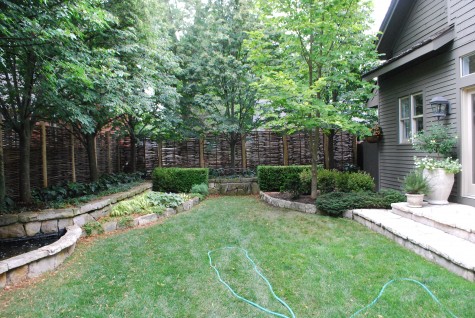 The lindens were given their first haircut. Pruning trees that have never been pruned involves small steps over a period of time. In a few years, they will read as a deciduous hedge above ground. All of the other plant material in the yard will grow better, given the extra light.
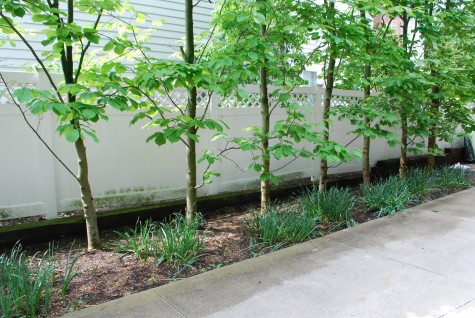 The original back yard fence found a new home in the front yard. A neighboring white wood fence with a lattice border was not particularly appealing to my client, nor did it do any justice to the trunks of a hedgerow of Ivory Chalice magnolias. Along the driveway in front of the garage is a pass through-not a spot to linger. The solid wood fence provides complete enclosure close to the ground. The magnolias do the work up high.
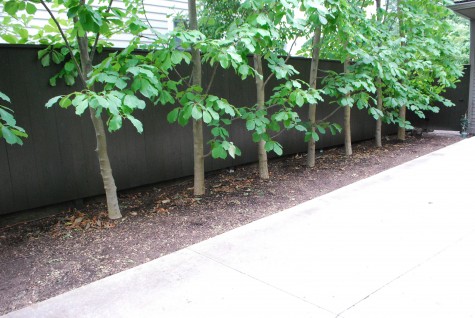
The dark solid wood fence handsomely compliments those tree trunks. Most importantly, this fence clearly represents the aesthetic of sense of my client. It is important to drive up to a landscape that pleases your eye.