At the risk of encouraging my good friend and client Janet to send me an email demanding to know when I will quit talking about her on this blog, I will talk about her again anyway. I cannot really remember how the subject came up, but many years ago we were talking about what she got from her Mom that has proved influential. Parents try to get plenty to stick in their kids minds and hearts-what actually works out is another story. “You never know when you will meet your intended”, her Mom said. Though Janet is sure this was in reference to her not wanting to get dressed up for a date she was definitely not looking forward to, this big idea very much describes how she gardens.
Janet has a five acre garden. That in and of itself tells you plenty about the level of Henry Mitchell-esque defiance of which she is capable and ready to put to use. She looks after that landscape every day, every year, as she believes that unexpectedly, the perfect garden moment might show up at the front door, and ring the bell. Or maybe a good gardening friend, or the Queen of England; no doubt she would treat either visit with equal care. She intends to be ready. But five acres of landscape also means the chances are excellent that on any given day, and in any given year, somewhere on that huge property, a garden disaster is either brewing or in full bloom. She may tell me she is going to dig up all her roses, and grass over the damn spot, but don’t believe her. I have never known her to give in, or give up. All of us at one time or another give out; there are times when I am just too tired or too disgusted, but this state of mind never lasts very long. Over the past 25 years I have seen Janet’s garden not ready for Janet-but I have never seen it not ready for her intended.
I sold my 5 acres fourteen years ago in order to finance the purchase of the building and property that houses my store. I moved to a city house, with a city-size piece of land. The unexpected benefit? My exposure to garden disaster is limited; I look after a tenth of what I used to. Some disasters may seem large, as there is no hiding them. One of my Princeton Gold maples is such a disaster I may have to dig it out. I may be thinking the “for pete’s sake” thoughts, but if I need to start over in that spot, I will. I have no reason to complain; this tree thing will get sorted out.
Meaning, I intend to be ready for my intended. Every day when I get home, my garden and landscape gets what it needs for an hour or two-maybe more. Buck is good natured about our conversation about the day that has to happen in tandem with the watering or the deadheading. As he came to me with an exposure to landscape that involved riding the lawn mower around 3 hours, twice a week, like it or not, I am impressed with this. Should I start to apologize for a particularly lengthy evening garden project, he likely will interrupt with “What if Janet rings up tomorrow that she would like to pop around for a look ?” When I am done laughing, I realize she definitely is on my intended A list-as is anyone really serious about gardens. I furthermore believe there are people on that list I have yet to meet , or I dream about meeting. So like she does, I do what I need to do, every day.
We are finally getting some warm weather. The Michigan dog days of summer can take their toll. The grass threatens to go brown, there is fungus brewing in the magnolias, and the zinnias, at the end of a scorching day the pots wilt like I have not watered them in a month, the perennial garden flags, the panic grass falls over. Such is the garden. Keeping up every day is my only defense against coming home to disasters that have multiplied such I would want to fall to the ground and weep. This I would no doubt recover from. But what if I was about to meet my intended?
Last night the light was so beautiful when I got home. Buck was already watering, thank God. I parked my car on the street, cleaned up the day’s garden debris, and got out my camera. Though I do not think my 2009 garden has peaked yet, maybe it has. Just in case, I took 189 pictures, of which I saved 50. In 10 days, I may take another set, and throw these 50 pictures away. Equally likely, in ten days a late summer storm with wind rain and hail could shred it all-and I will need those 50 pictures. So I have a set of pictures I can look at while I am picking up the pieces, or when I can’t stand one more minute of snow, ice and 19 degrees. Maybe a certain picture will show me in January that I need to make a change. I take pictures regularly; this helps shore up my garden spirit, given how ephemeral a garden can be, and how important the memories of it are to me. Lest this sound entirely too gloomy, I firmly believe the best is yet to come for my garden, for Janet’s garden-for everyone’s garden.


 showy oregano chocolate sweet potato vine







 This lead running fox is the work of HCrowther Ltd, which has been manufacturing lead garden ornament in London since 1908. Their sculpture is particularly fine. This very appealing sculpture is as at home in a stone trough as it would be in the lawn. My personal choice-set in a bed of European ginger.
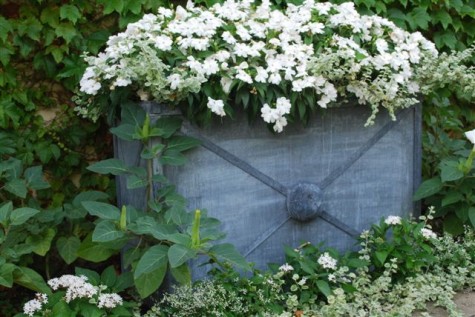
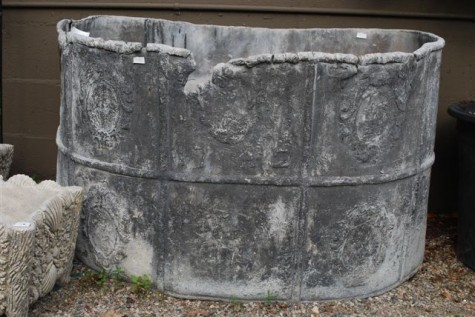 This very old lead cistern carries the evidence of its age. The dealer in England from whom this piece was purchased thought it likely was at least two hundred years old. Wave the history card in my face, and I am done in.

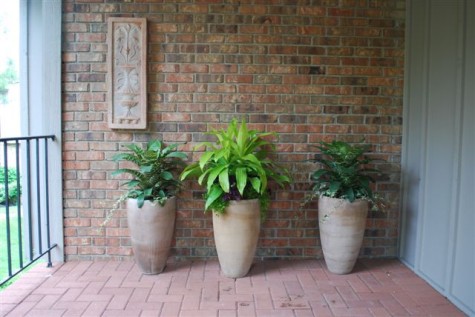
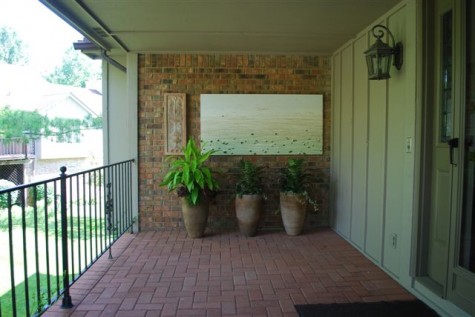
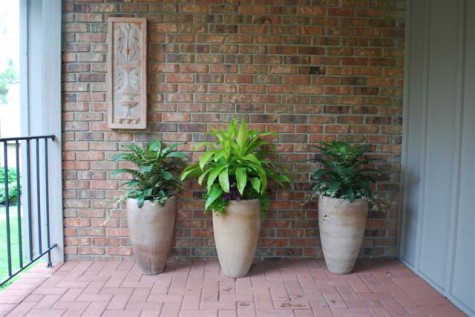
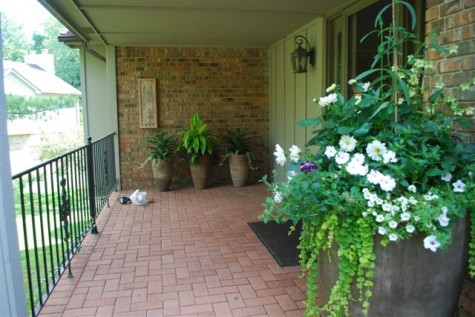 The walk culminates in a covered porch; the front door is at right angles to the walk, and not visible until you are right up there. All of this makes the brick wall they see coming up the walk an important element in their landscape. We started with pots, as there is no ground to plant in; this part looks great. But I thought that wall needed what all walls seem to need-a sculpture, a painting, a mirror?
 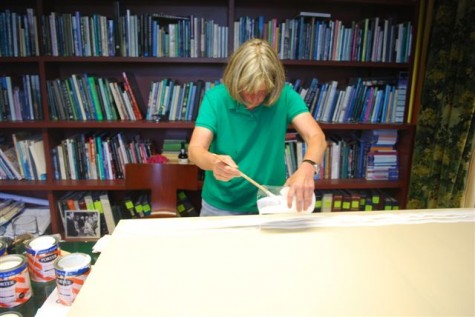 As my clients have quite a collection of art, they were receptive to the idea of a painting. Paintings that survive the weather need to be made of different materials that what an artist ordinarily would choose. I paint on extira board, which is used for making exterior signs. It does not absorb water, nor does it deteriorate outdoors. Porter Paint is a 100% acrylic paint; it is color fast, very tough and hard, and sheds any weather. As this paint is actually exterior house paint, and does not have the body of artist’s colors, I decided I would pour the painting. A beaker was the perfect tool.
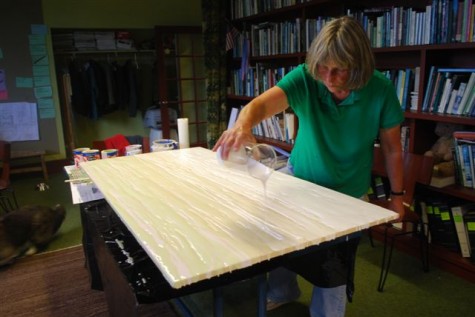 I poured the painting over the course of about 4 hours. Some areas I wanted to blend colors. In other areas, I wanted colors to sit distinctly side by side. All in all, I poured one and a quarter gallons of paint-a big fluid situation, to say the least. I supported the extira board underneath on 8 quart cans of paint, so if the board sagged from the weight of the paint, it would be evenly supported.
 Within 3 days, the surface of the paint had skinned over sufficiently that I could stand it up to take a look. While I was happy with the color and the shapes, I wanted more texture. The painting would be viewed from some distance coming up the walk. The near view, on the porch, would present a different look. I wanted to address both views.
 Using a carpenter’s awl, I poked, scratched, lifted up and pushed around that partially dry paint. The areas of paint I lifted off the surface, I stuffed with pieces of bamboo. At this fairly wet stage, I needed to support the paint until it dried. Once the paint was thoroughly dry, I stuffed those shapes with preserved reindeer moss.
 �
�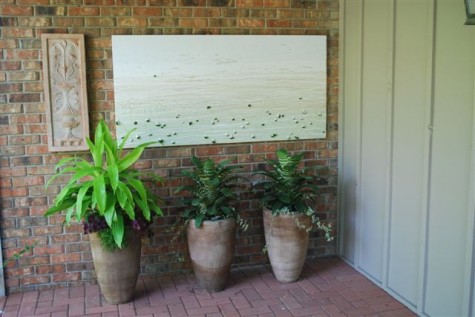 The close view I like. All the elements are different, but they look good together. The Italian terra cotta plaque is so much more important visually than when it had no company.