childhood home 1955-1969
Deborah Silver is an accomplished and experienced landscape and garden designer whose firm first opened its doors in 1986.
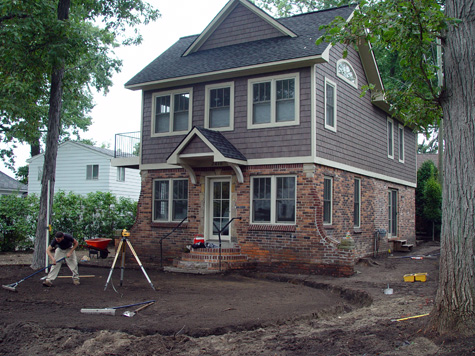
I spent the day of the Greening garden tour at home, talking to people about my landscape, but I also fielded a lot of questions about Rob’s. From “which garden is Rob’s?” , to “what was his idea here?”-and so on. Apparently the store was so busy he was unable to get to his own garden, and talk about it with people. What a shame. As he is such an integral part of Detroit Garden Works as manager, buyer, and dreamer, people are naturally curious about what his personal landscape is all about. I’ll try to tell the story as best I can, as I think it warrants telling.
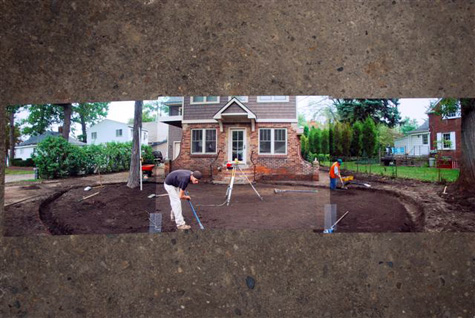
He is a formidably talented designer. More and more he consults with clients about the placement of ornament, pots and the like. He has a gift-you just need to ask him to put that to your project. Until you lay eyes on what he has done with this very small piece of property, you don’t really understand the extent of that talent. I have over the years installed this terrace when he would be in Europe, or snapped up that collection of nyssa sylvatica (his favorite tree) when I ran across it. He spent no small amount of time designing this landscape for himself, consulting with me, and reinventing the design; he finally, reluctantly, signed off. I knew I had to wait until he was out of town; one fall while he was shopping in Europe, my crew installed it.
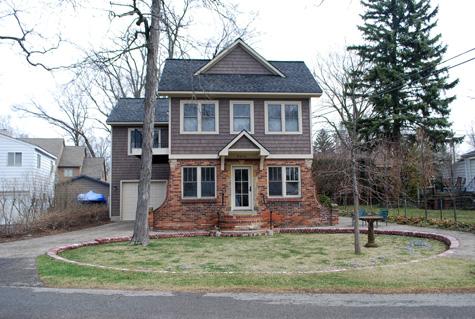
It’s important for clients to see a designer put themselves in the same boat a designer might ask a client to row. Making things grow, and pulling a landscape together, can be much like rowing upstream. If you are to entrust your garden and your money to a designer, you want to feel confident they know what they are doing, and that they have been in a boat much like yours. This spring, the bones of his place looked great. Simple strong gestures from a sure hand. No matter how he fretted, the result was confident. If it appears a design is in place on this the bleakest day of the spring, they you can be assured it will only look better as the season goes on.
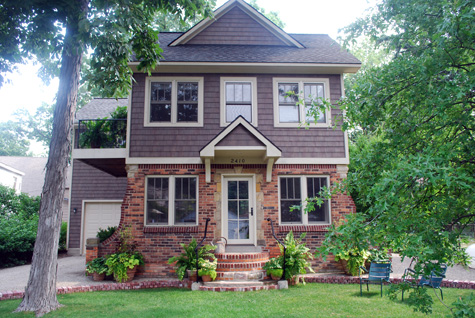
It’s a very tough thing to go home and garden, when you eat, breathe and sleep it for other people, most days of the week. He told me two things were paramount. He wanted to make much of his view of the lake, and he wanted something along the lines of cohesive lake cottage style. This may sound vague, but he had no problem putting it together. And he wanted it manageable; its pure torture to have something in a garden that needs attention, when you have no energy to answer. He likes having no back yard.
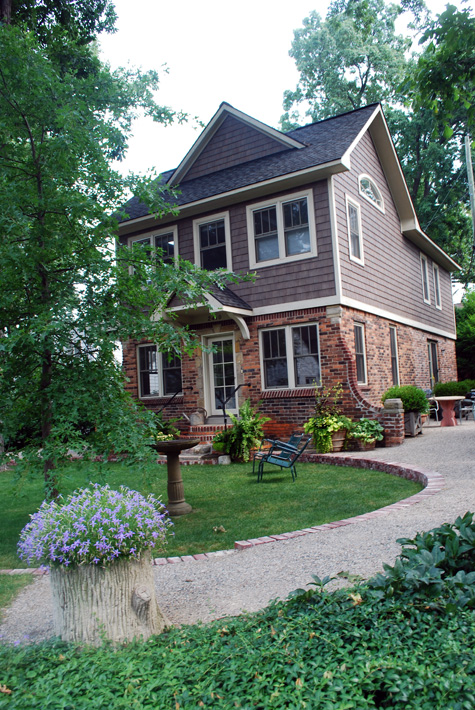
This very old French faux bois tree trunk planter is home to a thriving colony of laurentia; that pale heliotrope blue is a rare color in an annual. So light, so delicate-everything that the planter is not. The side terrace garden is a mirror image of the shape of the driveway. The terrace itself is screened from the road just enough, by a wing wall, backed up by giant boxwood in a stocky Belgian wood planter.
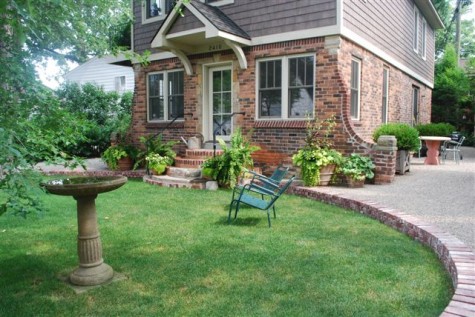
Two chairs in the front yard are front and center to the lake view. A quietly beautiful vintage American birdbath from Ohio is kept company in the sunken oval of grass by a gracefully swooping pin oak. This tree, his specific choice. The simple Italian pots stuffed with ferns, heucheras, selaginella and the like have that strong woodland mossy feel.
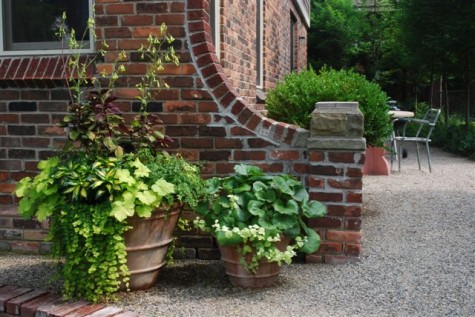
The wing walls are a distinctive feature of the architecture of the house; the placement of these two pots make note of that. The placement of the collection of pots direct the eye around the entire space, and suggest what is yet to come.
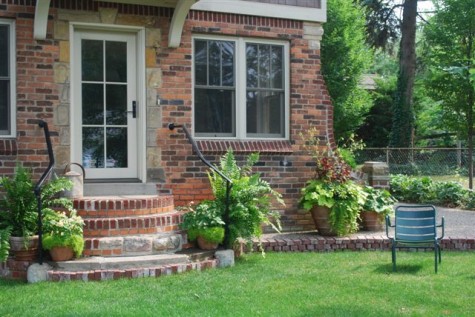
I discovered while installing this landscape that the exterior walls has been buried in soil berms. The house is actually quite tall coming out of the ground. The collection of pots counterbalances the height of the steps, and sets them down visually. The architecture of the house and steps can be seen all the way to the ground. This gives the landscape a European flavor. Years of travelling Europe to buy for the store has much influenced him.
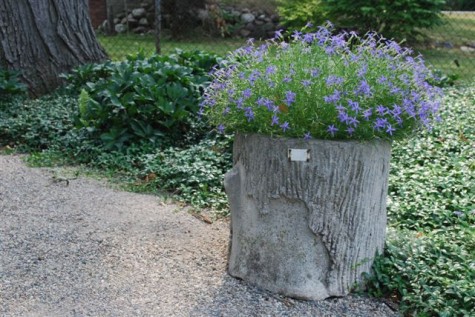
Rob knows how to place an object in a garden such that it will give you pause-quietly. Thus this planter, half on the gravel path, half off. Though the volume is turned down to a murmur, this landscape has a very distinctive voice.
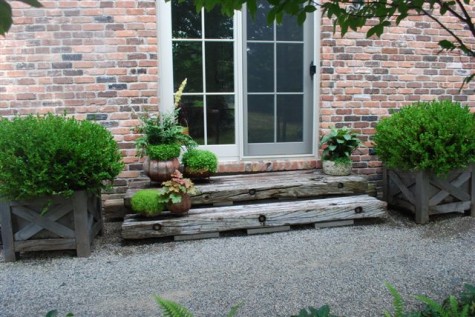
The story of these steps says everything about the fire he has burning. These giant bolted panels of railroad ties have been lying in the abandoned railway two track next door for the past 14 years. He finally wheeled a ball cart, rated to carry 1800 pounds, over there, loaded these 8 foot wide fragments onto the cart-horizontally- and ran them up hill all the way to the store-in the incoming traffic lane, no less. He told me he had no plan for what he would do, had a car appeared. He tells me he had to lie down for 15 minutes once he got them here; he was rode hard and put away wet, getting the steps of his dreams home. What kind of heart for gardening do you have to have to do this? A very big one.
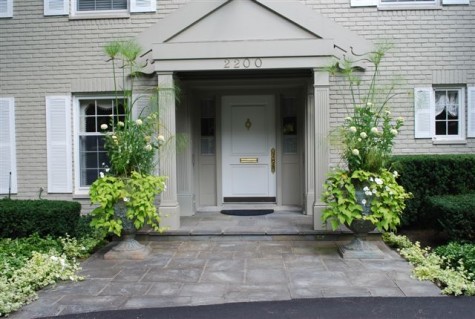
Strictly speaking, walkways are about transportation. The washing machine that needs to get to the laundery room, the guests for a dinner party, hauling soil in a wheelbarrow to a bed in the garden-all kinds of activities rely on the walkway.
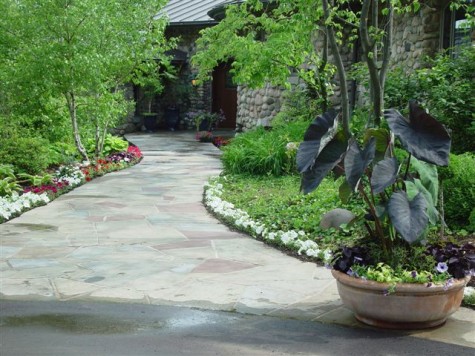
This does not mean that the utilitarian route shouldn’t be scenic. This generously sized slate walk has some beautiful curves; a curved walk invites lingering and looking. The walk is plenty wide enough at the drive to swing the car doors open, and drop off multiple guests.
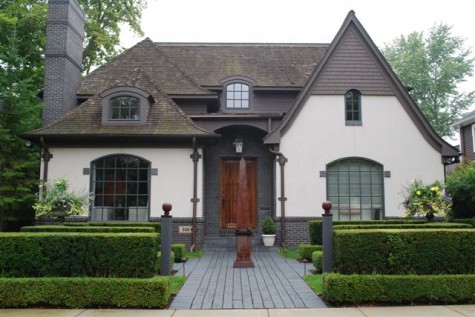
This is one of my favorite walkways. I managed to persuade my clients to install a wood walk; they were dubious both about its serviceability, and its longevity. However, it used to be that all roads were made out of wood; they fell for this. 4″ by 4″ pressure treated lumber, in 8′ lengths, were routed to look like bricks. The boards were laid over a 8″ deep gravel base. After 6 months exposure to the weather, I was able to stain it black. It has been in place a good many years now. The new owners of the house re-stain it every few years. The ends of the taxus hedges have fence posts of the same material, capped in rusty steel ball finials.
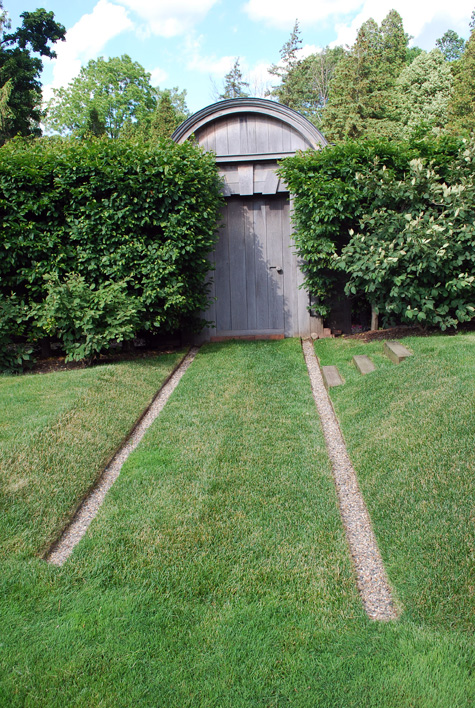
Not all walkways need to be a hard surface; grass makes a beautiful walk. These gravel troughs signal the change from the lawn, to a lawn walk. The length of the gravel trough gives visitors plenty of time to contemplate the massive door, and what might lie behind it.
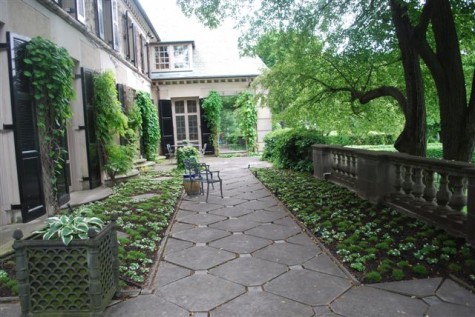
Some walkways belong to a terrace, or a series of terraces. The identical material and pattern gives visual weight and grace to this walk between terraces. The aged cut limestone tiles, punctuated with limestone dots, is a striking way to get from here to there.
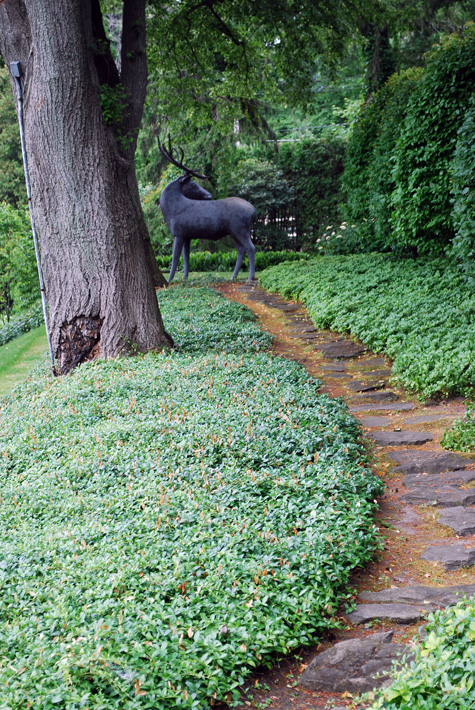
Some walkways are more about defining a view, than transportation. I can attest to the fact that having pushed a wheelbarrow along this path countless times, I would much rather look at it, than use it. The simple stepping stones describe a view without intruding on it.
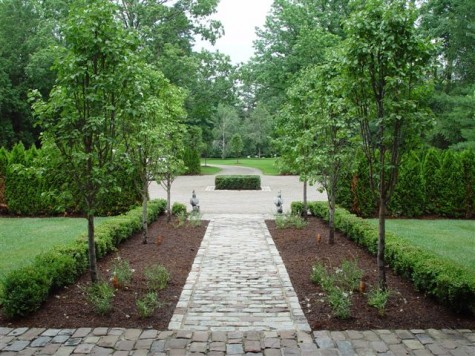
Some are fortunate to own homes where the old or original materials still exist. This house built in the 1920’s was graced with with a walk of old granite setts. As they had heaved about with the frost, and were a little dicey to walk on in the winter, the entire walk was taken up and reset. This was a bit of maintenance that counted for much; this old walk softens the newness of the new landscape.
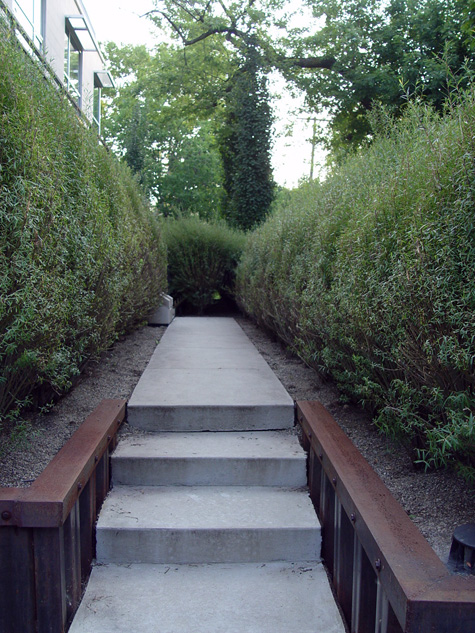
This steel and concrete walk is sharply contemporary. The softly trimmed hedges of blue arctic willow are a great contrast. There are so many good ways to get somewhere, are there not?
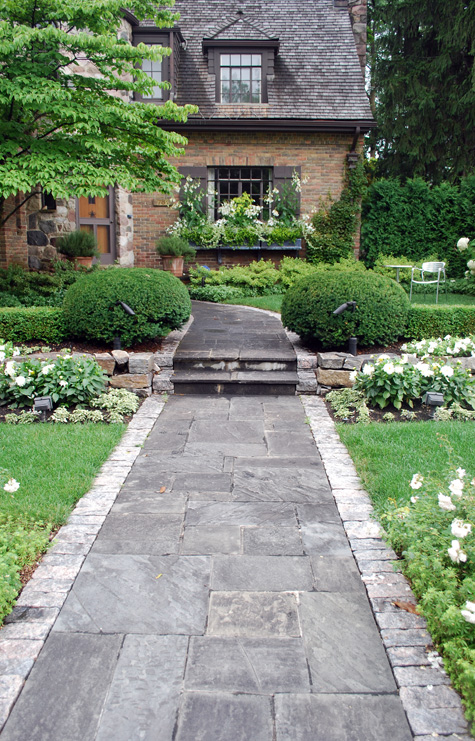
In my opinion, the walkway to the pearly gates looks pretty much like this.
As much as I try to have great enthusiasm for everything in a garden, decks leave me cold. It isn’t the wood; I like wood outdoors. Its wood in the air, and those heavy wood railings that seem so standoffish and separate from the landscape. This deck was barely above ground, yet it had heavy looking wood railings that intruded on every view. Its construction was more about not wanting to level the ground, than creating a garden surface to live on.
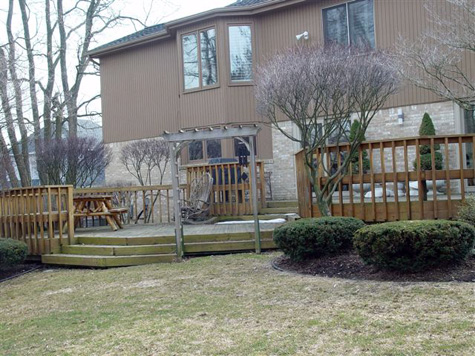
My biggest design concern for a terrace surface is what you see, when you are seated. In this case, what you see are bars. This makes the terrace a jail, not an integral part the landscape. Though I realize that some terraces are so high up that it would be against code and just plain dangerous not to have railings, there are other ways of handling those rails. In this case, no rails were really needed.
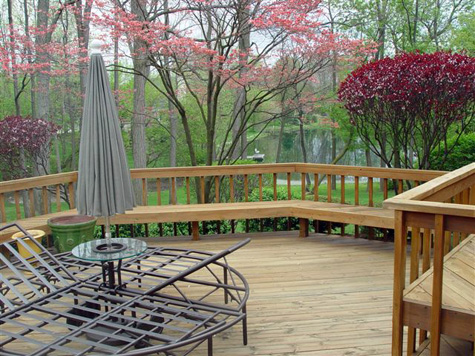
There is a beautiful view here that is blocked. I was able to persuade this client to ditch the deck, as a side note to designing and installing a swimming pool. One thing leads to another; I count on that sometimes.
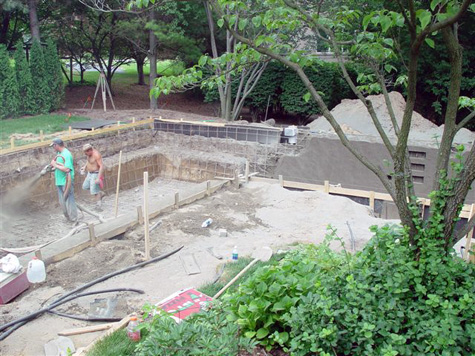
The property had considerable elevation and pitch, but the house was sited on the end of the property with the smallest space. I designed an L-shaped infinity edge pool, for which we still needed a variance to obtain a permit. We were too close to the lot line in one area; we would eventually install a hedge of arborvitae to completely screen the pool from the neighbors.
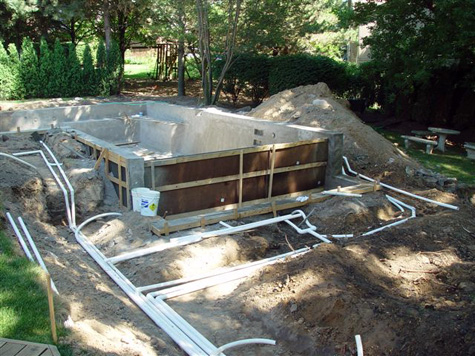
Pool construction is a dirty and lengthy business. The corner of the dreaded deck seen at the lower left edge of this photo explains the extent of the grading work necessary.
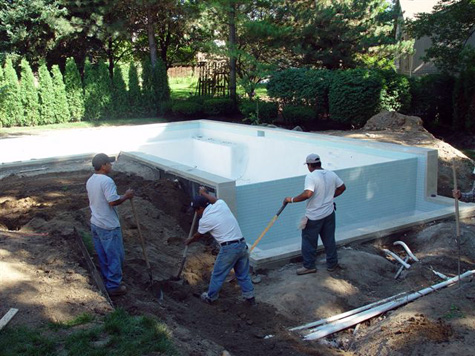
Pools usually have tile set in the space between the grade of the water, and the grade of the top of the pool. Just like a bathtub, pools get rings that need to be readily cleanable. The pool wall below water gets cleaned mechanically by whatever filtration system a client chooses. We chose small pale blue glass tile, as my client wanted a light colored pool interior, that would look blue.
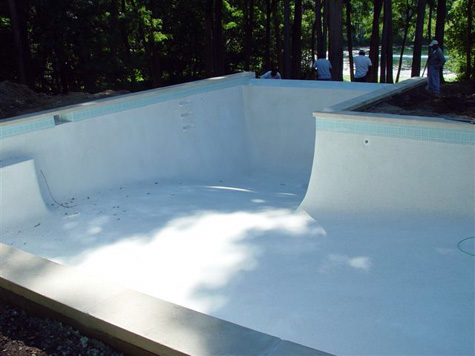 I like dark surfaced pools that reflect whatever is in the sky. However, some people do not like jumping into water where the bottom is not visible. Its a matter of personal preference. This pool thus has a white pebbletec surface.
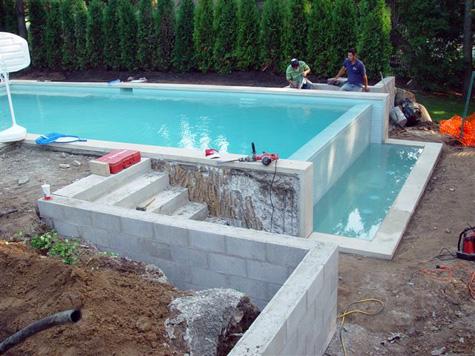
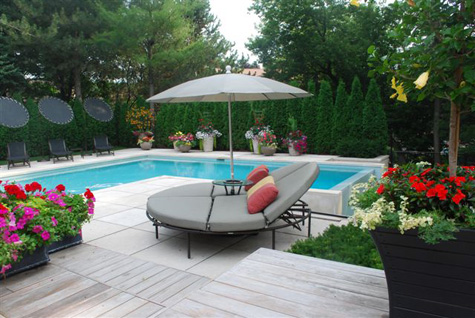
Full of water, this pool is azure blue; it was just what she wanted. Once the pool was finished, we built the stairs, and poured 3′ by 3′ concrete tiles with a terrazzo like surface for the pool deck. Then it was time to deal with that original deck.�
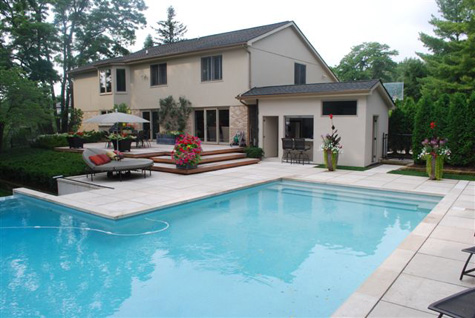
Happily she agreed to tear it out, and start over. We built a deck from cypress, with mini-decks that cascade to the pool deck surface. A pool cabana with a mini kitchen and bathroom keeps all the pool activity outdoors. It is a clean simple look.
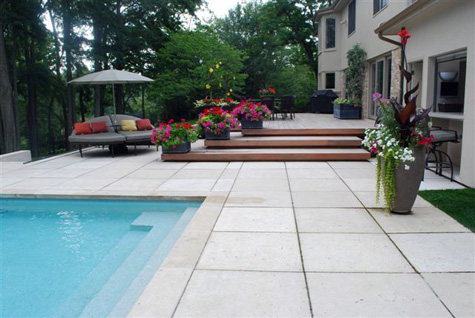
The pool area has plenty of pots that she takes care of herself. The deck is competely integrated into the pool garden. Its a lively space perfect for entertaining. The simple landscape is is part of the space. There is a beautiful view to the pond now. She says she feels like she is on vacation every day-which is exactly what she told me she wanted.