Trimmed Up


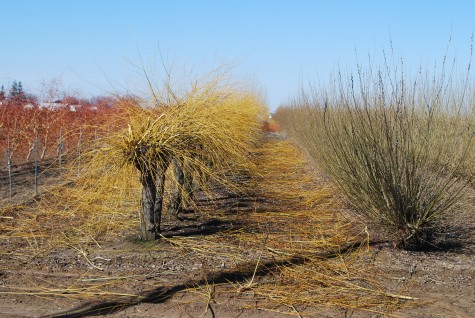
Last March, when I was thinking about taking on writing a daily blog for the first time, I had some ideas about it-not the least of which had to do with the seasons.  I wanted to write what I thought day to day-not especially about the past, and maybe a bit about the future.  The news of the day-in this I was most interested.  The winter is excruciatingly long in Michigan; making writing for day to day interest in the depths of my winter, for other gardeners stuck in a similar spot, a challenge.  In defense of the winter months, lots of design issues can be broached and discussed. I have done that, maybe in more detail than you like. The 2010 store collection and how it came to be looks great-but all of this is lacking a certain kind of life. No collection comes to life until the plants get here. All I have a mind to do right now is think and talk about plants.  Steve has been on a road trip, checking out nurseries from whom we have plants ordered and soon to be on the way.  Relevant to my Sunday post about pollarding, his photograph above is of a willow stock plant, being pollarded.  The branches will not be used for firewood, as they are frequently used in Europe-these rootless cuttings will be sent out to growers all over who wish to grow on this cultivar.  These trimmings will become trees someday.         
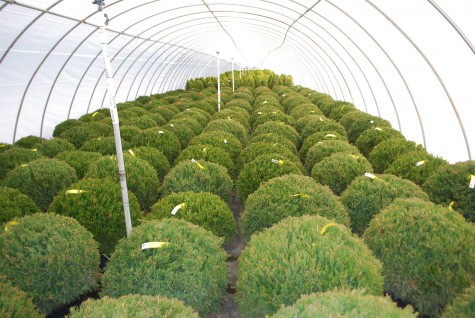
Some older boxwood specimens spend the winter in tunnel houses.  Winter snow loads can devastate what has taken many years to grow. A tiny boxwood you may purchase at a nursery most likely takes seven years to get to that 12″ size.  Bigger plants take many more years to grow.  Nursery people do what they can, to protect what has taken so much of their time and effort, to grow on. 
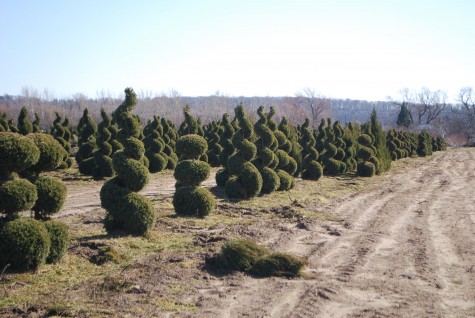
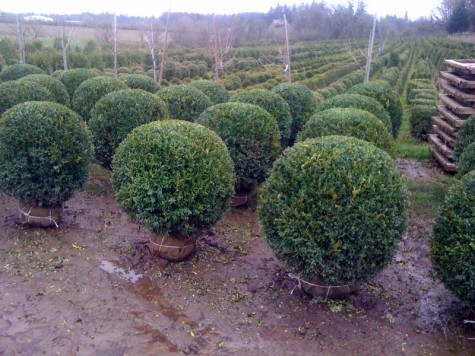
I so love this photograph of Steve’s.  The dirt road, impressed with dusty tractor tracks, is in stark contrast to these painstakingly grown and trimmed plants.  Wow-do you not think you are looking at an alternative planet?  Or at the very least an alternative idea about plants?  Like trimmed topiary plants or not, the energy, will and work cannot be denied.  Growers and gardeners-a relationship.
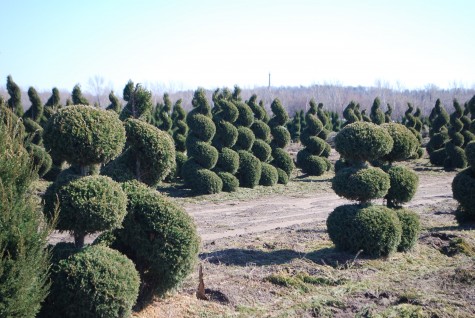
I spoke for a big group of these plants.  They are beautifully grown, and healthy.  But I mostly admire the hand in evidence that sculpted these plants.  Make no mistake-so many years, so much effort, so much passion-one has to pause and admire what made this field come to be.  Growers by and large have no prize in mind-they grow, and live to grow.  Their hands-I plan to celebrate them.  I am sure you do too.
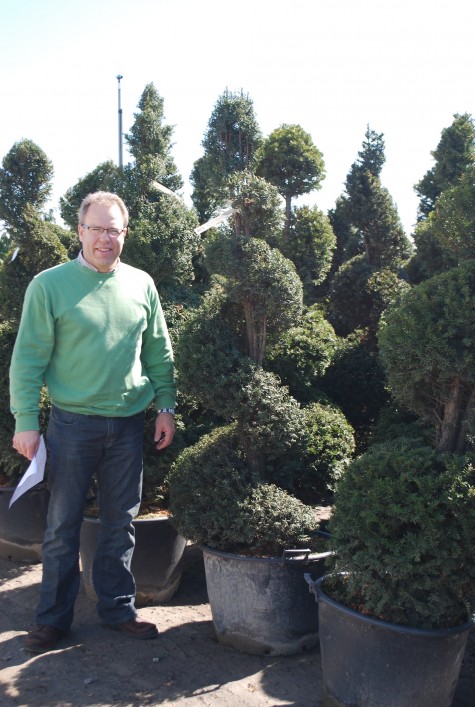
I see junipers grown and trimmed in this fashion regularly.  Yews grown like this-news to me. When I think old, gorgeous, and thoughtfully grown yews, I think England.  I am now seeing old and trained yews on my side of the pond-I will have some. Sensational topiary plants grown on this side of the ocean-I am clapping my hands. 
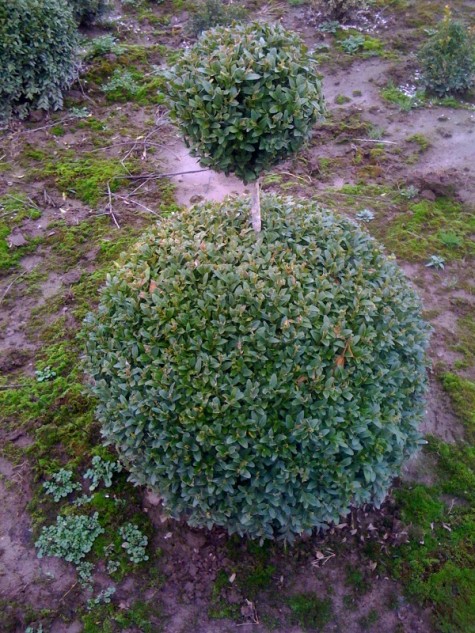

Buxus Sempervirens is not hardy in my zone.  I have avoided the plant like the plague-who wants to deal with a serious gardener’s grief when they loose a major plant?   I cannot plant this species of boxwood in the ground-all of us need to be committed to taking them into the garage for the winter. These topiary grown and trimmed boxwood would make my heart pound, planted in pots-a handtruck taking them to shelter for the winter is well worth the effort.    
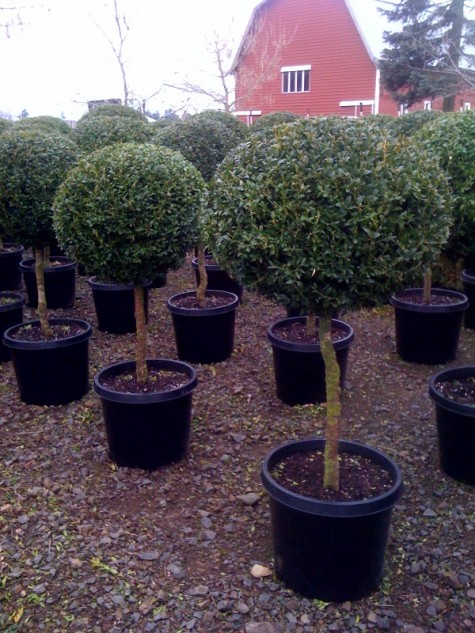
 My pots are standing, waiting for plant material of this caliber.  How they have been grown and trimmed up before they ever get to me-many thanks to those growers whose committment and investment stands largely behind the scenes.  The hands put to a living plant by any gardener-no matter personal or professional, no matter a home or a growing field-I so greatly value this.
 

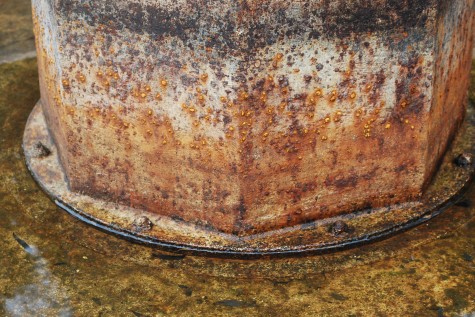
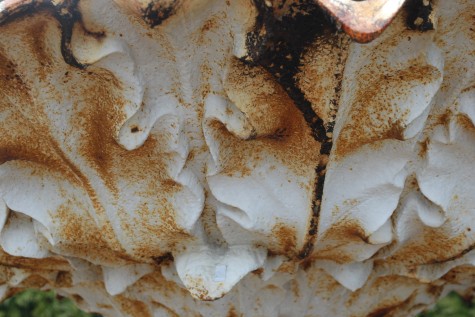
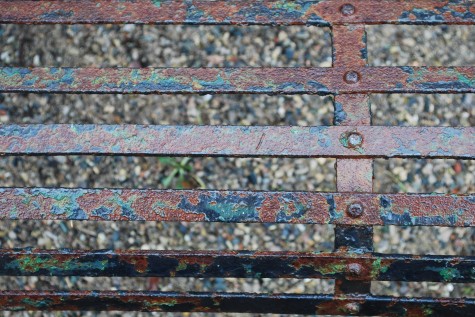
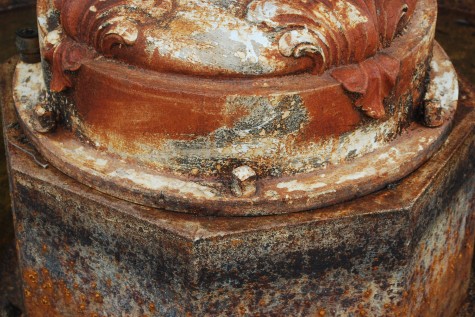
At A Glance: Rusting Steel


Layering

I spent the better part of this week walking from one end of my property to the other- watching Rob and a crew haul out everything he had ordered for spring, tear the entire existing space apart, and put it all back together.  I could not even guess how many thousands of pounds of terra cotta, stone, wood, lead, were involved all told-but I would guess many.  I thought his method was smart-everything got moved into the driveway lane, leaving each side ready to be cleaned up, and re-raked.  Though our all over surface is compacted decomposed granite, it doesn’t feel like spring until it every vestige of last year gets raked out. Those of you who know of the late Allen Haskell-he took up, washed, and relaid all of the gravel in his nursery every spring.  Think of it.  Beyond relevelling the gravel, even more interesting was how he put things together. 

I would not have a word for this, but for Pam.  She designs, plants, and maintains gardens, so she has a point of view about it.  She was telling me she admired another desgner she knows for her ability to “layer” in plants.  By this she means plants are paired or grouped so while one is going quiet, another is coming on.  Daffodils with daylilies, or oriental poppies with phlox, or phlox with Japanese anemone.  Skilled perennial garden designers are adept at arranging plants to avoid what I call a gaposis. I like treating these perennial spaces with big growing annuals, but some like to handle this perennially. A large clump of oriental poppies going dormant is not such a pretty sight-something needs to be coming on strong in the spot in front of that poppy-otherwise a gaposis. 

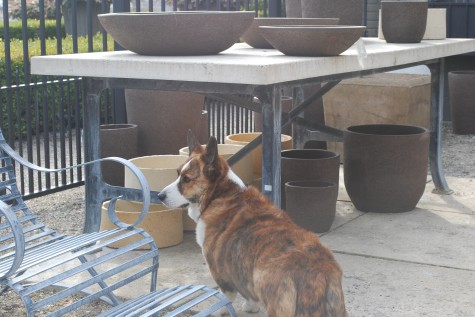
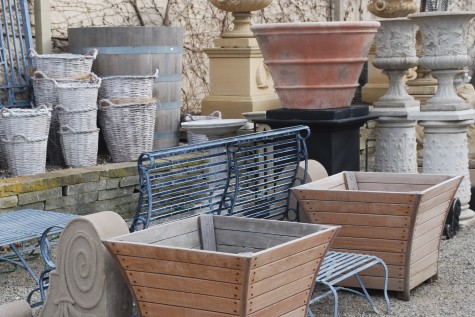
I think this is a good description of how Rob has arranged the outdoor spaces. He packed materials in close quarter that seemed to like each other or play off each other.  In this case, the steel striped bench echo the wood stripes; its scrolls recalls the scrolling corbel detail.  Surfaces and colors are different, but friendly. Lots of materials and styles are represented here.  His arrangement is a conversation about choices.   


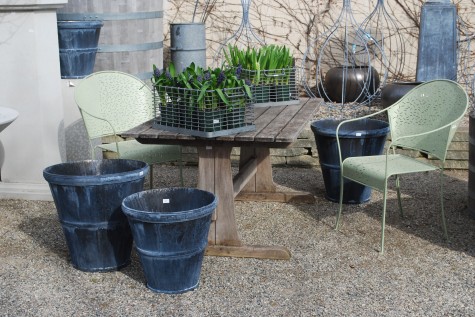
Contemporary garden ornament can include a wide range of objects. This early twentieth English wood trestle table is clean lined enough to be quite comfortable with some galvanized steel wire crates, and some painted French garden chairs. The round acid washed steel pots are finished with a nod to traditional forms, but have a subtly more modern shape.  

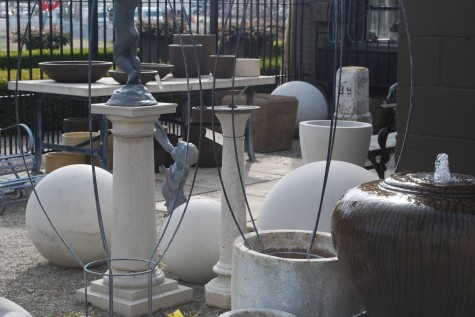
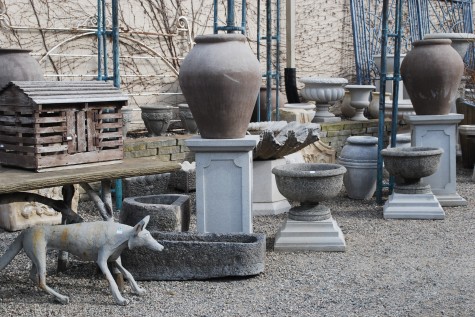
This space is densely populated.  On the table, below the table, in the air, on the ground-everywhere you look, something is going on.  I am surprised how amiable the contemporary limestone balls are to the modern lead sculptures of classical design.  I do not see any argument about to erupt.  I suppose any object for a garden implies that partnership-all of these things have a landscape to come in common.  Maybe this accounts for how they all get along. 

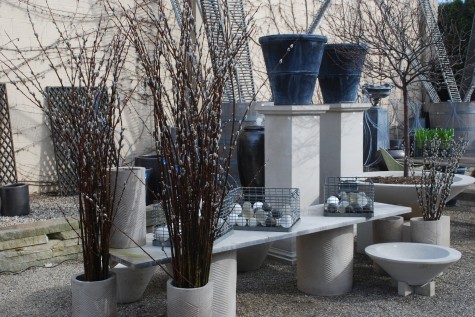
A pussy willow stem and a trench drain have almost nothing intrinsically in common.  What they do share is how they are arranged in a similar V-shaped fashion.  The color of the iron repeats the stems of the still dormant Boston ivy. What a different view will present itself once that wall is green. But given the early spring season, I like the bouquet shapes.

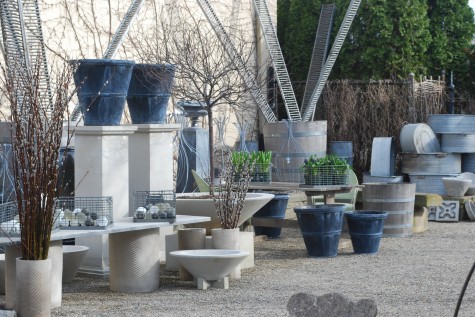
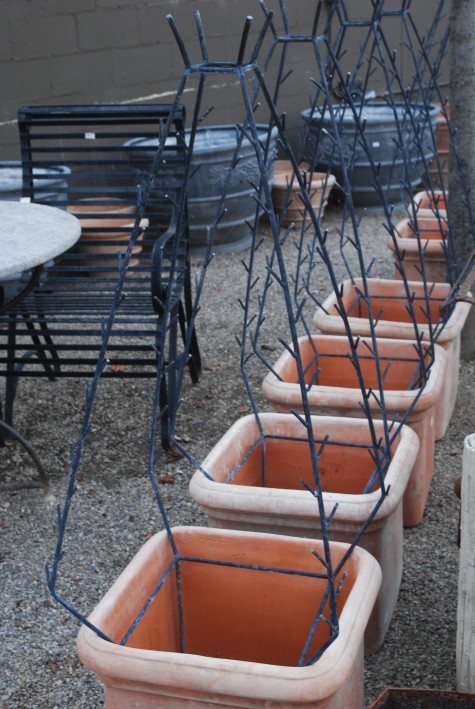
These steel tuteurs are Rob’s interpretation of some formally trimmed yews at Versailles.  I have already been scheming about what could be planted inside them, that would still reveal the outer form.  But it is the multiple forms in multiple pots that makes for such a big impact.  The blue/grey and terra cotta color scheme is repeated in the background in a very rhythmic way, alternating pots of different shape and height.  

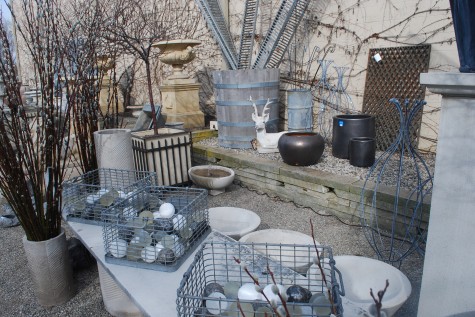
An arrangement of geometric shapes is so pleasing to the eye; the V-shapes in differing materials compliment that.  The color is strikingly contrasting-black and white, with just a little in between.  A restricted color palette is a modern gesture; the twigs soften this.  


He has quite an eye, and an ability to layer all his own.

Design Elements Matter


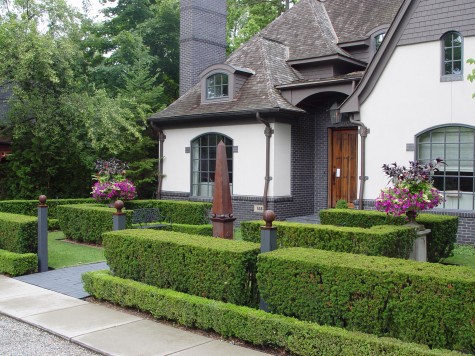
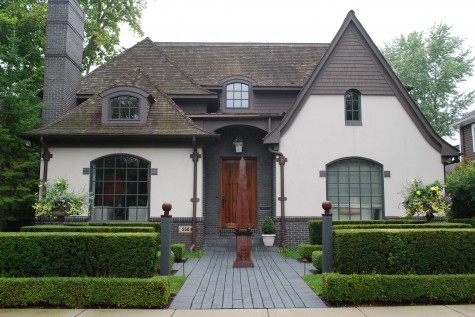
Those of you following this blog on garden design may be crossing your eyes and feeling like blacking out this past few weeks.  I have gone on about the elements of design-maybe too long. I try the best I can to illustrate, and not instruct.  My ability to peel off into a snow bank, or winter weary meadow, is a little compromised right now, so I have been photographing close to home and on solid ground.  When I am done apologizing, I am still left with the conviction that a clear understanding of the elements of design applies to any 4 square feet on your planet-your dining room, your kitchen, your garden, your driveway. No kidding.  I hope to illustrate and not instruct- via this very small property I landscaped some years ago.  Though the front door is massive, the property square footage is very small. No need to put the landscape under a microscope-the house came with an intensely small space. Every move counts.   

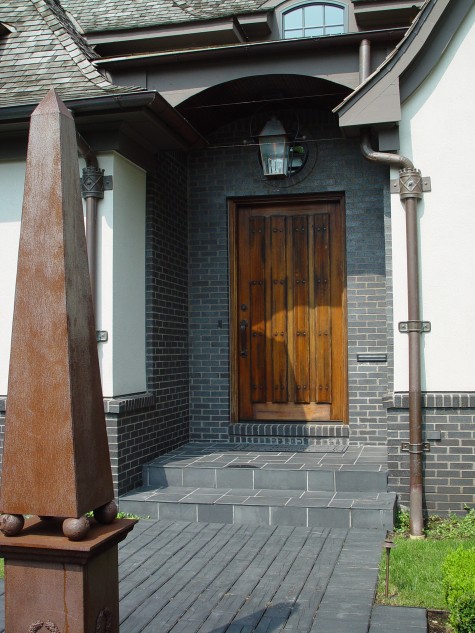
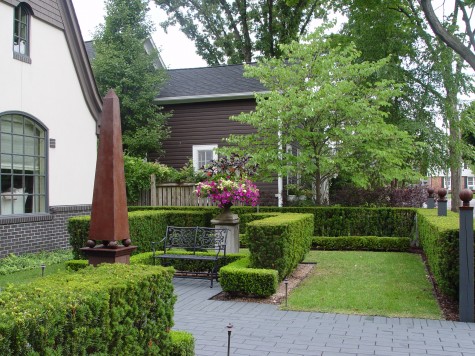
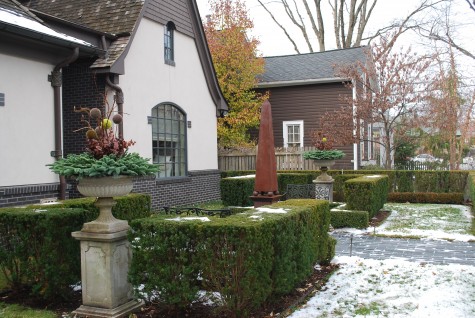
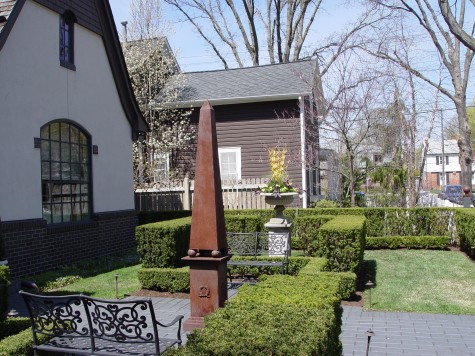
This landscape relies much on a configuration of evergreens that stand fast every month of the year. Whatever the weather. My original client sold this house some time ago-my new clients are grade A stewards-any beautiful old landscape is a direct result of the intensive care of the present, and not age-this idea via the essays of Henry Mitchell. The yew hedge fence, and its black stained posts and rusted finials, echo the rusted obelisk placed front and center.  A pair of pots on pedestals placed side to side, and planted for each season-who knew a pair of pots could rule a garden like these do.  


It cannot be 20 feet from the street to the front door.  I persuaded my clients to install a wood sidewalk-each length of pressure treated lumber was routed to resemble bricks-after one year of weathering, I stained them black.  There was a time when roads were made of wood-that history is not especially pertinent to this design. What is pertinent is what one sees.  A look needs to stand on its own, no matter any history or explanation.   A short walk needs a distinguising feature-a new thought.  Any gesture, no matter how short,  can illustrate a love of the out of doors without instructing. A wood sidewalk-different.  Still looking great after all these years-this I love. 

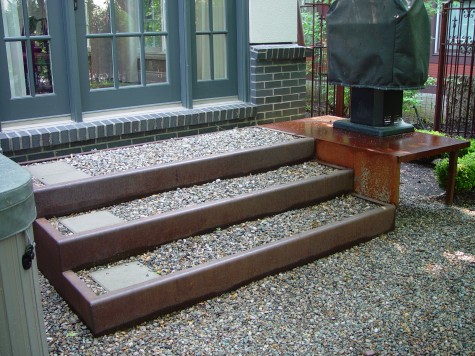
The rear yard-a patch of ground that would comfortably accomodate 12.  The simple solution-gravel the entire area.  Plant four lindens at the four corners, to provide some natural shade corner to corner.  The steps to the back door-I did not switch materials.  Simple in a small space means the repetition of one material amounts to the impact of many hands to the same end.  These corten steel risers retain the gravel surface steps.  On the floor, everywhere else, gravel.    

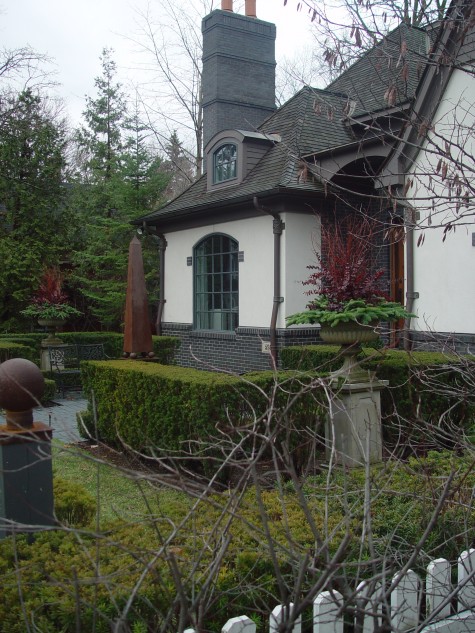
When winter comes, leaves are shed. Shrubs of great volume are but a shadow of their summer self.  The evergreens keep on going on- but what is remarkable here, given it is mid-January?  Those two pots on pedestals, stuffed with materials for the winter, carry the day.  The design elements in play here are many.  No need to know the words, if you can see.  

No matter the late lame snow, the design elements of this garden are strong; grown in. There is a living presence, and pattern, that pleases the eye.  Their garden ornament takes on a bigger role in the half year we know as winter.  I like my front garden and landscape to be eye-ready, no matter the season.    

Once spring comes, we change out those pots.  Their idea of spring brings the neighborhood to life -many houses on this street do much the same.  Designing thoughtfully to the betterment of all -what a great idea.  Those elements that make a difference-take some time to look, and make them work for you.