These great photographs are courtesy of Rob Yedinak.
Deborah Silver is an accomplished and experienced landscape and garden designer whose firm first opened its doors in 1986.
These great photographs are courtesy of Rob Yedinak.
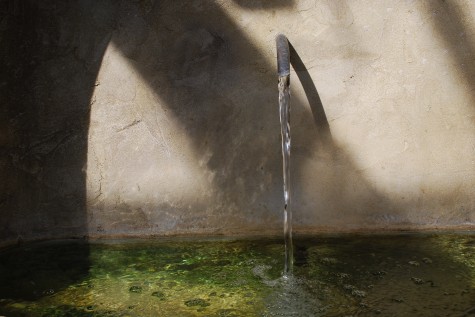 Our weather has taken a decidedly balmy turn the past few days; we have temps in the fifties. I expect it will take a turn for the worse sooner or later, but today I am enjoying the sun. The cold, snow and ice of a Michigan winter is usually bearable, but the grey could make you black out. I am always ready for some sun. I was outside today with no coat, enjoying that sun. Even indoors, the light is brighter and stronger. The days are longer. I welcome the reappearance of the sun. The season is changing-delightful.
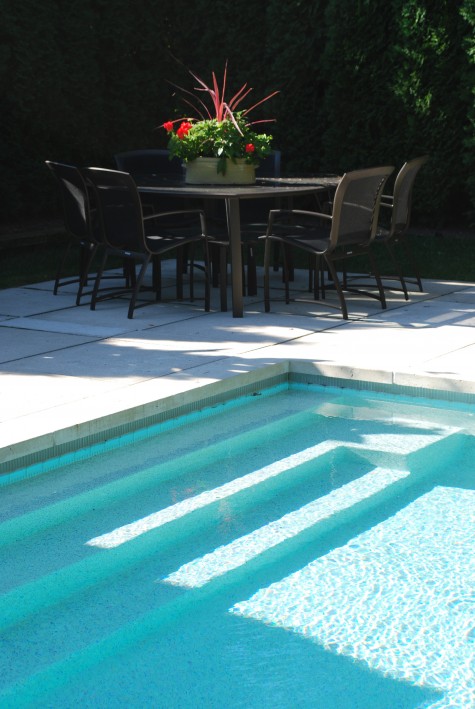
Sunlight is essential to living things. Books are written and lists made of those plants that tolerate shade. The unspoken implication here-nothing living loves the dark. When I was young, I killed many a shade tolerant perennial thinking it was shade loving. I am in discussion with a client now about a design for a pool, so there has been much talk about sun and games. Sunny and shady. Imagine your life long enough to see what, where, and how you want to live outdoors.
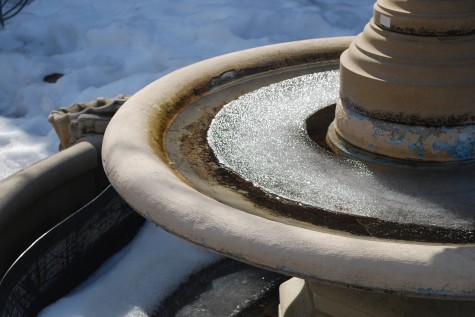 Water one observes can be sited in a number of places. Shadier locations will provide perfect conditions for mosses and other water loving plants to take hold. Shading 75% of the surface of a pond will not only provide refuge for fish, but it will make the job of balancing the pond ecologically much easier. For those that have an aversion to cleaning a pond mechanically, an understanding of the role of the sun is essential. Read up. A fountain burbling in the shade can be peacefully overrun with everything that blows in and takes up residence-beautiful. Sunny water-don’t you want to get in?
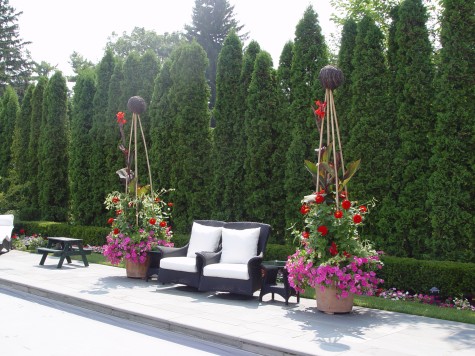
Pools for swimming are another topic altogether. The right siting for any activity outdoors-look to the sun. I want to swim in the sun-water is cold, even in midsummer. Enjoying a sunny July day at pool side-fine, for a while. Watching kids play in a pool, or having lunch outdoors-a shady spot is a good idea.
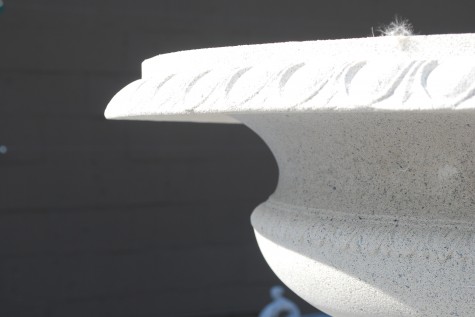 White or light surfaces poolside will reflect sunlight, and be cooler for bare feet. Reflected heat and light will dry you off in short order. Drying off in the sun-like being on vacation. If you are old enough to remember putting sheets on a bed that have been sun dried on a clothesline-this a simple and exquisite pleasure. Dark surfaces absorb the heat of the sun, and radiate that heat. A shady location sporting dark surfaces may be a late summer refuge. Hard surfaces take a long time to heat up, and a long time to give up their heat. Plan for some, if it is your idea to be outside, late fall.
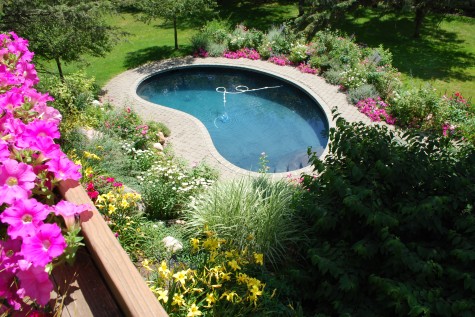
Pools with dark interior surfaces reflect light. A swimming pool that doubles as a reflecting pool has a long season of use. Dark surfaced pools absorb the energy from the sun-the water will be warm, but the bottom of the pool is usually obscured. Cathy’s pool is very unusual, as it can be seen from far above; she has a view of warm water in a dark surfaced pool, to the bottom. The interior color of her pool contrasts sharply with the surrounding garden. She gets as much from looking at her pool as being in it. The big idea here? Make moves that deliver at different times, in different seasons.
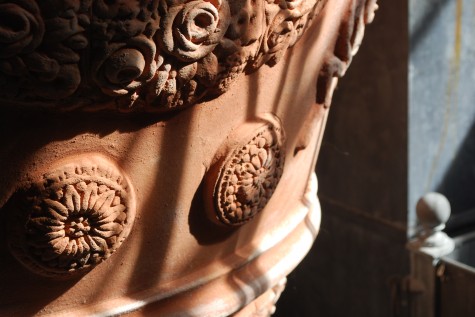 This handmade Italian pot is indoors until the weather reliably warms. Nevertheless, its detail is brought to life by the light of the spring sun streaming in the window. The surfaces closest to the light are white; the shadows are black. What goes on in between is a matter between you and your designer. Or between you and your gardening self.
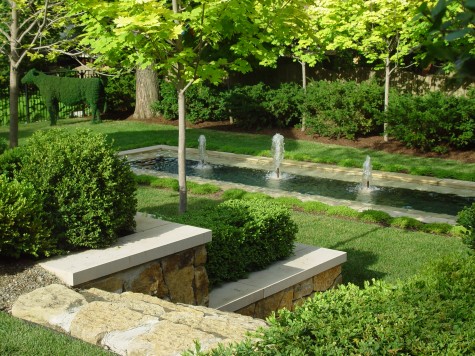
My fountain is 26 feet long-of course the conditions are different end to end, and they change, given the course of the day. Mostly sunny is the outlook for my home water-I am ready for it when I get home at the end of the day. On moody days, it is enough to just watch it. This post may seem to be a rambling late winter stream based on a lot of thoughts; you are right about that. I am waking up to lots of design work needing spring readiness. But this warm March day, I am also dreaming about a warm summer’s day, and some water.
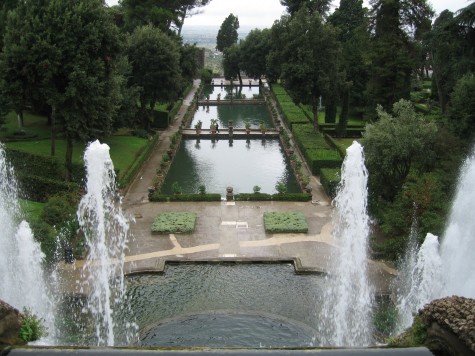
One of my favorite clients and dear friends took off this morning for Rome. As hard as it is for me to believe, she insisted my post on Villa D’Este inspired her to go visit her granddaughter who is on foreign study in Rome-and by the way, go see that garden. By this time last week, she had enlisted both of her daughters-one of whom is Carol, the proud Mom of said student Grace. Daughter Diane is an RN living in California-she flew out for the Romefest. Four other friends signed on. She organized an entourage- soon to land in Italy. Tonight, I think.
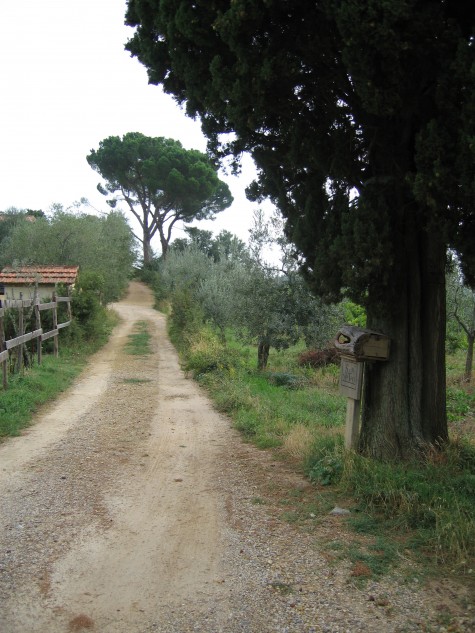
She has the week ahead planned. A guided visit to the Vatican. Villa D’Este, of course. A request from me for an Italian boater with an orange band. A cooking course she thought sounded like fun. I have no details on this, as once you use the word cooking within my earshot, I black out. Some time she has left to Grace to organize. Her energy puts me to shame.
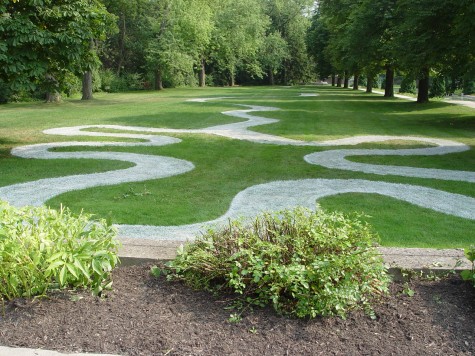
I am thinking about her, as she loves to travel. She so enjoys the garden tour we do every year; she has been trying to worm out of me for weeks where this year’s tour might take her. She drive-travels straight through to get her granddaughter back to Clemson University in September, and drive-travels again to pick her up at year’s end. She travels in other ways less literal. She considers ideas outside her realm-she is happy to go anywhere, and decide if she likes it. She is a traveller.
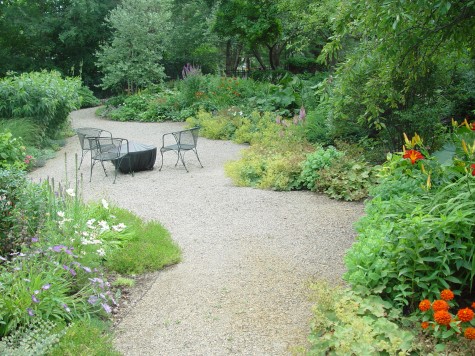
I am not a board a vehicle and go traveller. I hate the packing and the time it takes to arrive at a destination. I am not crazy about being away from home. I travel-reluctantly; the process exhausts me. I am always happy to get where I am going-what is not to like about seeing new places. Whomever can convince me to travel-many thanks. When NASA figures out how to beam me up, I will be first in line. On occasion, something or someone will beam me over to what never occurred to me-best regards, and many thanks for this. But I am always thinking about travelling when I design.
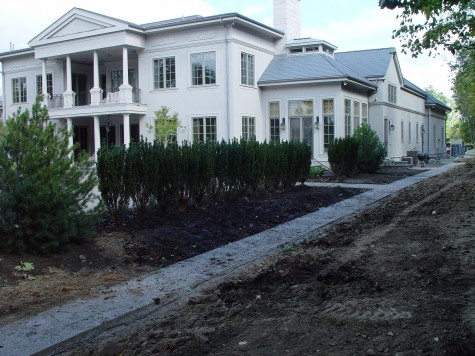
I know travel is a key issue in design. Once a mortgage survey is in my hands, my first move is to decide how, why and where one might travel in the landscape. For anyone designing their own landscape, I would encourage them to build some roads in their garden. Some roads need to be two lane. Other roads can be a skinny dirt two-track. Some places need stop signs. Other places need roundabouts. A travel sceme is essential for you, your kids, dogs, and guests. Plan your routes before you decide anything else.
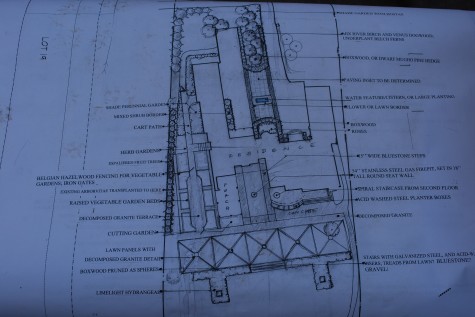
How will you get from the house, to the grill, to the terrace, to the trash, to the rose garden, to the street, to the back door, to the compost pile, to the picnic table-how will you drive through, walk through, and linger in the space? Where will your family and friends congregate? If you were to walk your garden with a video camera running, would a story be told? Expand off road wherever you have a mind to.
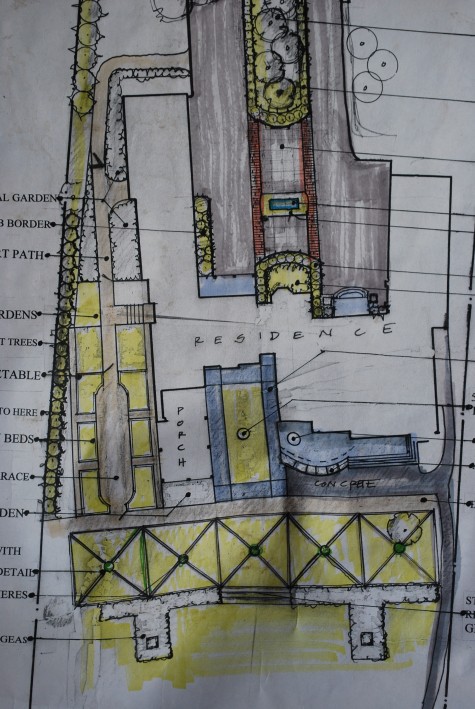
No writer/gardener I ever read more clearly and more beautifully addresses the travel particular to the journey of a gardener than Dominique Browning; I have talked about this before. Her discussion of the evolution of her garden has everything to do with travelling through, and lingering here or there. When she is stopped, she is stopped in her tracks. When she moves on to somewhere else, there is a big pair of lopping shears in her hand, and /or significant emotional travel involved.
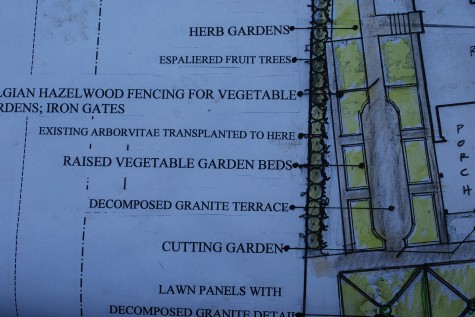
She has a sense of humor about her basic unwillingness to budge off her comfort spot. She is entirely dispassionate about all of her passions. I admire this in her. Her writing encourages me to loosen up, and move around more. How you will live, perch, lounge, work, read or take a nap are questions that need to be addressed before you make moves.
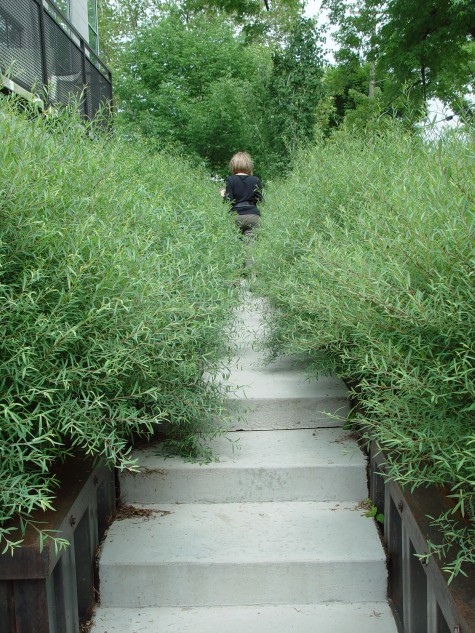
No matter how glued I am to my place, I put that aside, and encourage myself to take my clients somewhere. Somewhere better than they thought they could have it. Think about this, you people who have a mind to design your own gardens. If you have a notion to hire a designer, first and foremost understand how you will travel through the landscape they have designed for you.
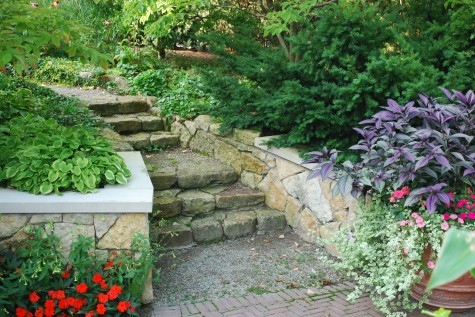
Jane’s travels are much more than I have detailed here. Like all of us, she has roads to travel, like them all or not. Getting control of the layout of those roads may make things easier. Some paths are 25mph quiet zones. Others have lots of traffic. It is important to get this part right. Some badly placed plants can easily be moved-your routes, not so easy to redo. Whether you use a piece of paper, a garden hose, landscape paint, or stakes and strings, taking the time to plan your trip is a good idea.
Every three dimensional object has a surface of one sort or another. The dictionary defines surface as the outer or topmost boundary of a 3-D object, the external aspect of an object, or a portion of space having length and breadth but no width. How unhelpful is this? It seems simpler to just think of the surface of an object as its skin. That skin can be represented by different textures. Paintings have subject matter, composition, color, line, mass-a whole raft of qualities. But how the artist physically handles the paint determines its surface. I happen to be thinking about surfaces, as I had someone ask me recently why I did not carry fiberglass or plastic pots and ornament.
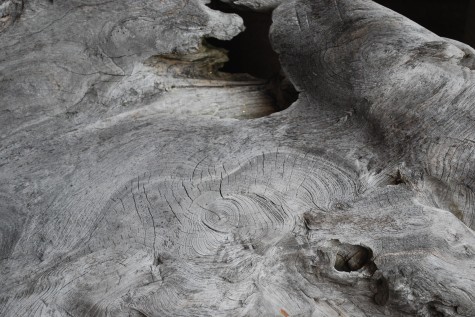
Most of my reasons have to do with a love and interest in what nature has created. Natural materials-wood, terra cotta, stone, dirt, leaves, flowers, water-are living materials. That life imparts a beauty to them like nothing else can. It might be a stretch to think of stone as living and breathing, but I do. It makes emotional sense to me that my garden and landscape be kept company with objects made from natural materials. I once taught a class in vegetable gardening for the Greening of Detroit; I did recommend that anyone worried that their natural soil was contaminated, think about planting their tomatoes and potatoes in garbage cans. Were they old enough to be split at the bottom, or have gashes in the sides, all the better for the drainage. But if I have a choice, I favor the real thing.
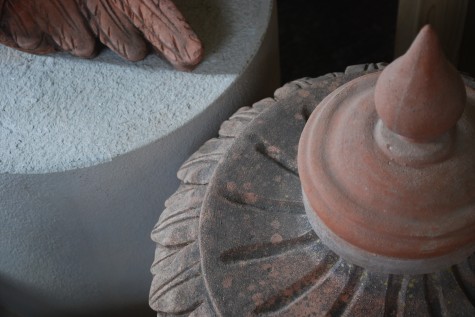
Terra cotta, absorptive as it is, can provide a home for other living organisms such as mosses and lichens; no wonder old terra cotta is my favorite material for pots. The combination of plants and terra cotta is naturally beautiful. I have no objection to made-made materials, as long as they are manufactured to look like what they really are. Fiberglass or plastic made in imitation of any natural material always looks like an imitation. Fiberglas pots made with an unabashedly natural fiberglass surface can be very good looking.
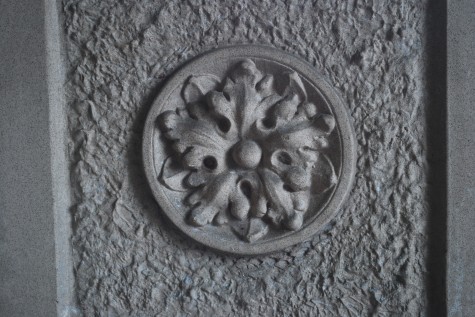 Pictured above is a panel of a terra cotta square pot made by the Galloway Company from Philadelphia Pennsylvania in the early 20th century. The river bottom clay from whence their pots were made is naturally this color. There is no mistaking this is a natural material, even if you have never seen anything made from cream colored clay. The surface is genuine; it rings right.
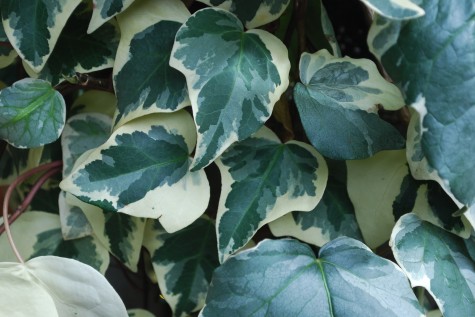 Do you even have a number in mind for all the different kinds of leaves that must exist? Their surfaces can be hairy, shiny, matte, smooth-there is no end of variation. But what they all have in common are surfaces that are unmistakeably alive. They live and breathe. I could not really explain what it is about a living surface that is so evident. Suffice it to say that I have yet to see an imitation that was truly convincing.
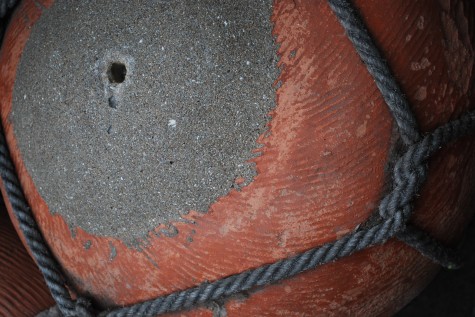 Concrete is a man made material which I greatly like. These terra cotta oyster floats have blobs of concrete which help to weigh the floats down in the water. Concrete as a material is at its most beautiful when its surface accurately represents exactly what it is-concrete. Of course everyone has had to make concessions of one kind or another over their garden. I myself have concrete terra cotta pots made in the style of classical Italian terra cotta. I have three places where I wanted a pot in situ 12 months of the year. My concrete pots enable this. Their workmanship is incredibly good. However nothing moves me more than the clay.
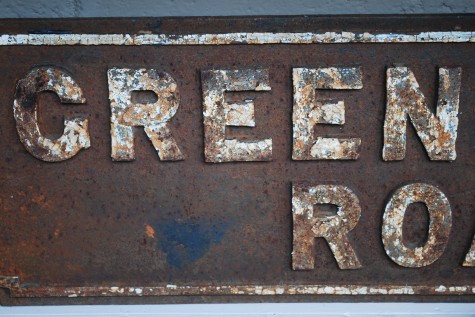
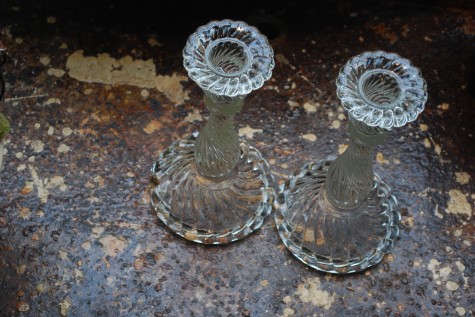 Steel and iron are likewise a product of human technology. The surface of steel will age, as it corrodes. The pits in the surface can provide a home for small plants, just like terra cotta. How steel ages can be very beautiful; age on a man made surface greatly enhances its appearance.
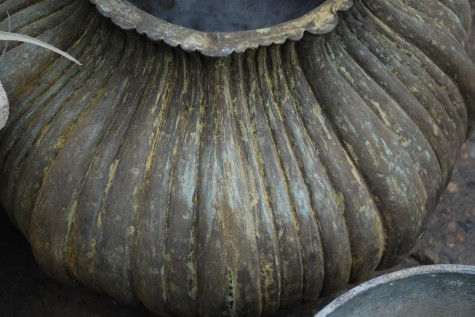 The surface of this terra cotta pot looks like a painting. I have no idea how it was done, but there is no evidence of paint. Whatever altered the surface has soaked in, and become part of the clay. I am told the material is mineral based-as are many pigments.This treatment I can live with. The shape and texture of this pot is beautiful as well-it reminds me of a squash, without trying to look like a squash.
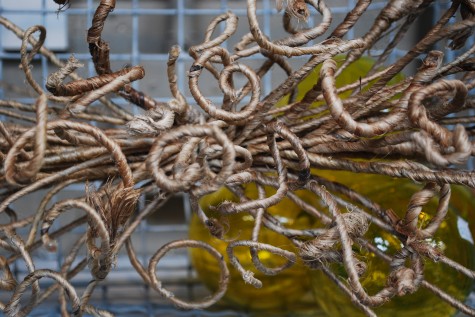
This very heavy gauge wire is wrapped with hemp twine; the wires originally formed stems for some wood shaving flowers. I think I liked these stems better than the flowers, so I saved the stems. I took giant needle nose pliers and secured all 20 stems in the middle with the 21st stem. After curling the ends, I had myself a decent looking bow. Natural materials-I like having them around me.