A Modern Landscape


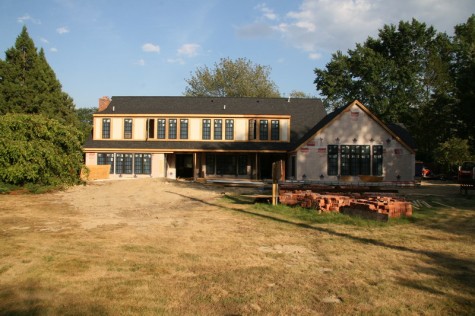
I am sure every city in every state in this nation has those larger than life, extraordinarily talented people who produced design that endures.  My city has many examples of residences conceived and built by Harold Turner. This master builder, responsible for the construction of many buildings of Frank Lloyd Wright, went on to build a number of residences in my city whose beauty still shines so many decades later.  I am not an architectural historian, nor am I well versed in the life of Harold Turner, but I knew my client had purchased a home of architectural and historical significance.  My part of this-study that building, the grades, the views,  the spaces-and make a move in concert.            
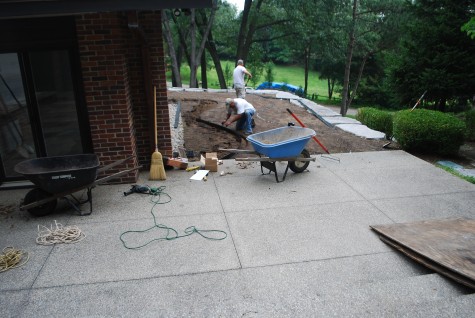
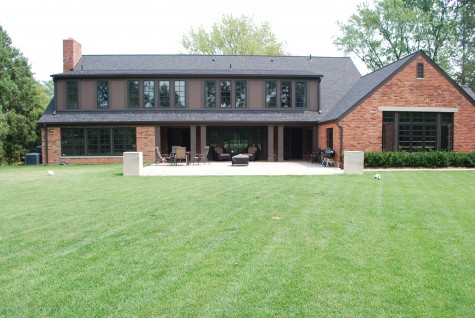
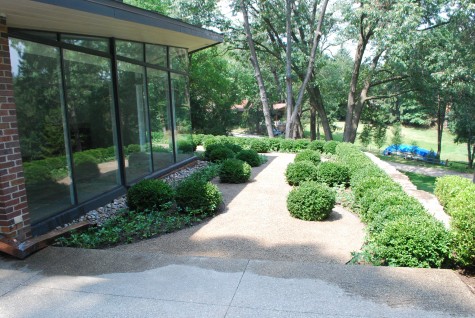
The living room of the house faces the rear of the property.  Floor to ceiling windows ask for the outside to work seamlessly with the inside, and provide year round interesting views. A wide open L shape, each wing of which is some 30 feet by 14 feet,  describes on the ground plane a pair intersecting glass walls.  Terraces at either ends of the wings suggests a landscape which permits leisurely travel from one end to the other. 
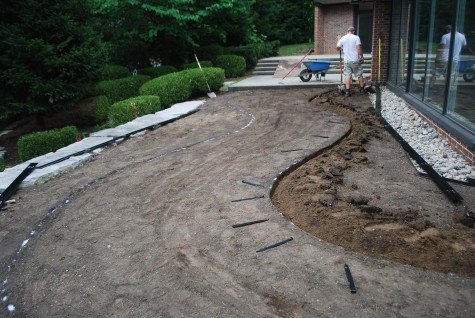
The strict geometry of this rear profile of this Turner house filled my head with curves.  How so?  The glass prow is so strong, why would I interpret or dilute that gesture?  Repeating the geometry he established for the house-what need would there be?  It seemed to me that a simple but sculptural landscape that made much of the view the design of the house made possible was in order.  
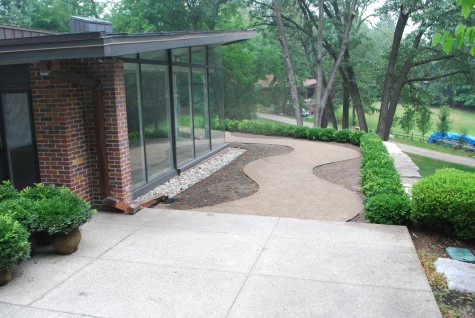
This landscape plane was entirely grass when I first came to visit. A default design.  This space had no need of a mower-it had need of a landscape of interest that would look good in any given season.  The journey from the library side of this house, to the master bedroom side of this house-it seemed to me that a path would figure large in the landscape design. The stone retaining wall casually stacked and irregular in shape seemed out of keeping with the palette of materials established by the house.  An initial hedge of Green Velvet boxwood screens that stone from view, and encloses the space.   
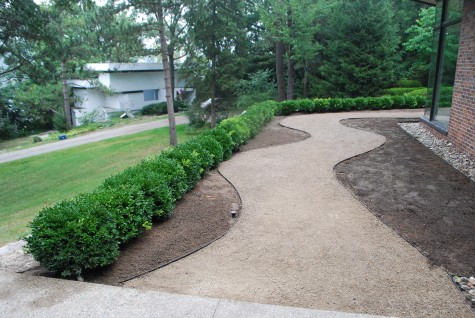
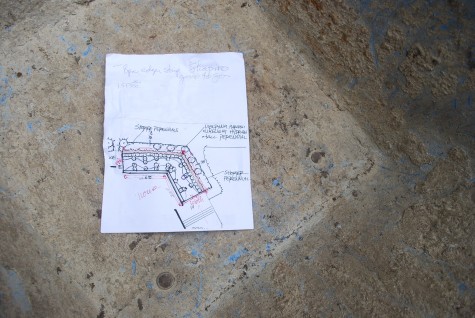
Decomposed granite is a favorite material of mine.  I mulch plants, I build driveways, I compose entire landscapes around that material that brings the parks in Paris to mind.  A walkway all about generous curves seemed a good companion for this house. My client does like to entertain; the wide walk makes for places for guests to visit, and good circulation.  The granite is a quietly versatile material that echoes the surface of the existing concrete aggregate.  Used in conjunction with steel or aluminum edging, it can cleanly outline interesting shapes.
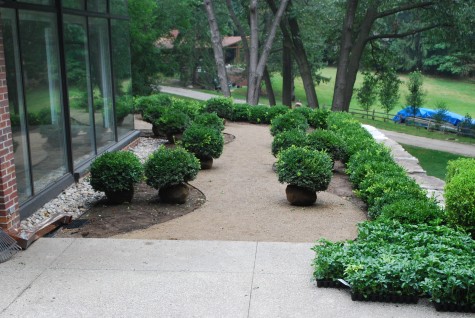

There is always the danger that a small space will become a corridor to somewhere else-a visual racetrack, if you will.  Planting another series of boxwood, set perpendicular to the house and boxwood hedge, will slow down the traffic.  Unlike the boxwood in the hedge, these plants are placed in the bed, and in the gravel individually.  Individually placed plants read as individual sculptural elements.   
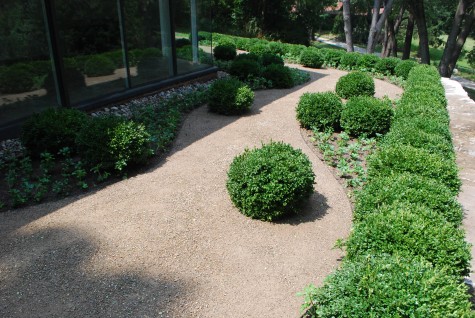
Seven sets of three plants each are placed such that the gravel walk space opens and closes.  Pachysandra fills the empty spaces in the beds; when grown in, their mass will reinforce the pattern of the walk.     
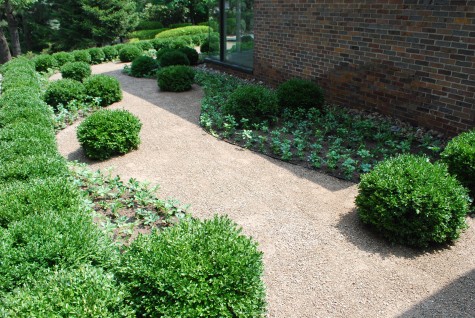
There will be decisions to be made about the pruning.  The hedge could be boxed-the individual boxwoods pruned as spheres. Or vice versa.  The boxwoods set in gravel could alternately be pruned as squares and spheres.  The distinction that is drawn between the inidivdual plants and the hedging plants will be an important part of how the landscape reads visually.  We will see what direction my client is inclined to take.  Beyond this decision, the maintenance will be minimal. 
Photographing The Garden

A camera is one tool a gardener should not be without.  You will not remember what your garden looked like on June 2, when it is the following March and you are trying to put a plan together for the new season.  No matter how simple the device, a camera provides a valuable record of that which is by definition ephemeral.  No landscape has a pause button.  It is always changing. Some things I do differently every year. I want to remember what was. I am not a photographer; I take snapshots of projects under construction.  I try to photograph all the annual plantings-although this year I am way behind getting that done.    

I do believe that gardens are never wonderful every day, day after day, but they do have their moments.  Ursula Buchan’s book “The English Garden” is chock full of the most amazing photographs of gardens at their perfect moment.  I don’t always know when one might present itself, so I drag my camera everywhere.  The camera is a monocular machine, and records nothing of my emotional investment in my garden.  There are times when it can see better than I. It helps me to see what I may be missing, or figure out what I do or so not like.  If you are like me, it takes a while to sort out what you would want to do again, and what you might not want to repeat.      

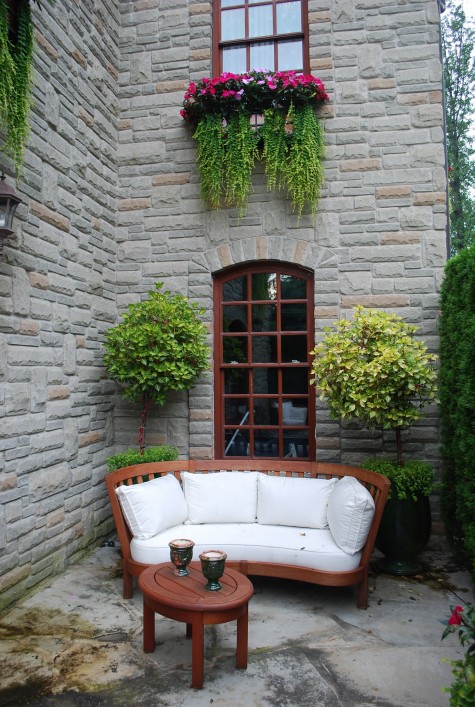
These two irisine topiaries are very different shades of green.  One gets a little more sun than the other.  How plants grow is very much dependent on their siting.  Growing perfectly matched pairs of plants even under conditions you would think were identical is difficult. If you go back to my previous picture, you will see what I mean.  Uniformity of growth is an important issue to hybridizers for exactly this reason. These are the kinds of things that occur to me when I look at my pictures.  

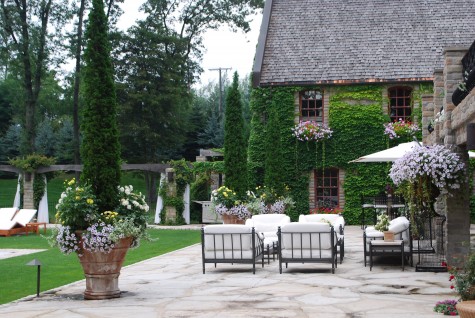
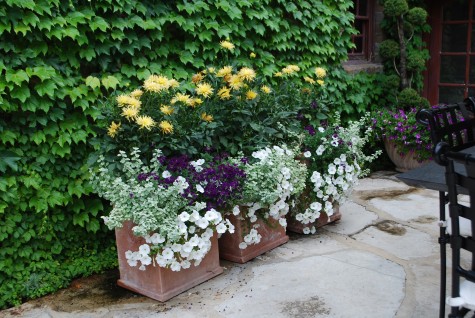
Color in a garden is delightful.  Light colors read well and stand out against the dark greens that dominate the landscape.  Pale yellow, lavender and white is a subtly elegant combination, and is repeated in these containers in different ways.  It is hard to do any photographing on a sunny day.  If you are an accomplished photographer, you will know what to do to get your camera lens to squint-this is a skill I do not have  An overcast day will permit pictures in which the color is saturated, as the light is even all over.   

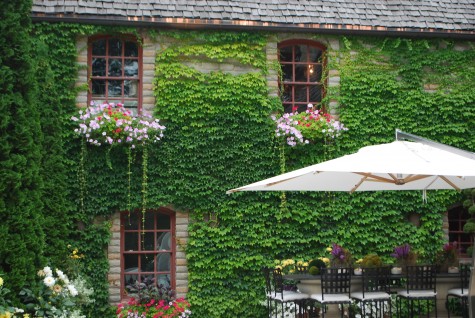
Window boxes that are up high benefit from a simple planting, as you see a mass from a distance, not individual plants.  Vinca maculatum makes a great trailer.  They grow very long; their chartreuse variegated leaves are large and interesting. When I look through the lens of my camera, I see things in a different way.  As a picture has four edges, it can help force me to compose.  There is something interesting going on at every level on or against this very tall wall. I have a picture of that. 

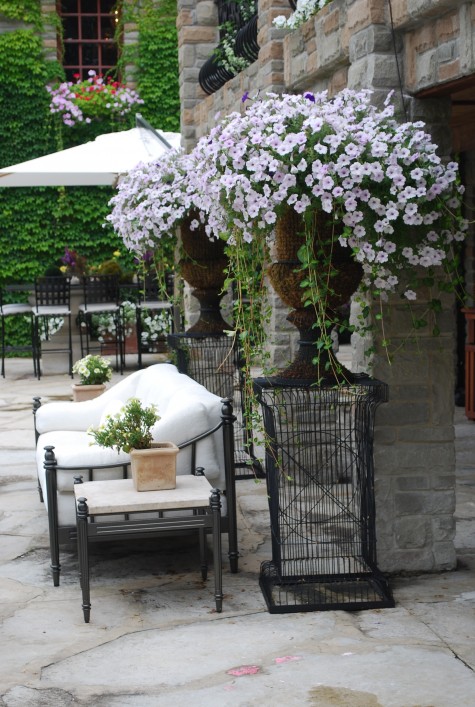
This wirework urn was planted with a single 10 inch basket of mini-petunias.  The plant is obviously happy with this location, and the amount of water is it getting.  I am also certain they are getting a regular feeding.  The vinca will reach the ground in another few weeks. I would plant petunias here again.

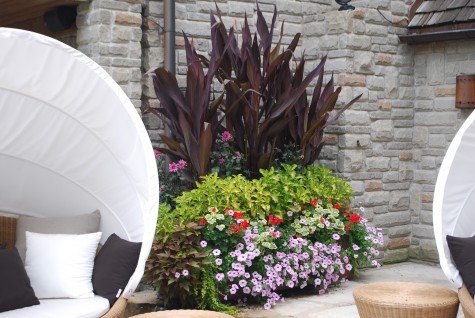
This iron cistern placed in a corner reds on its own, as it is isolated from the main terrace.  I have planted darker versions of the yellow and lavender.  On a whim, I added some orange bullseye geraniums.  Not everything needs to match.  The dark foliaged cannas look great with the stone and the trim on the house-this was not at all in my mind when I planted.  I have my camera to thank for bringing this to my attention. 

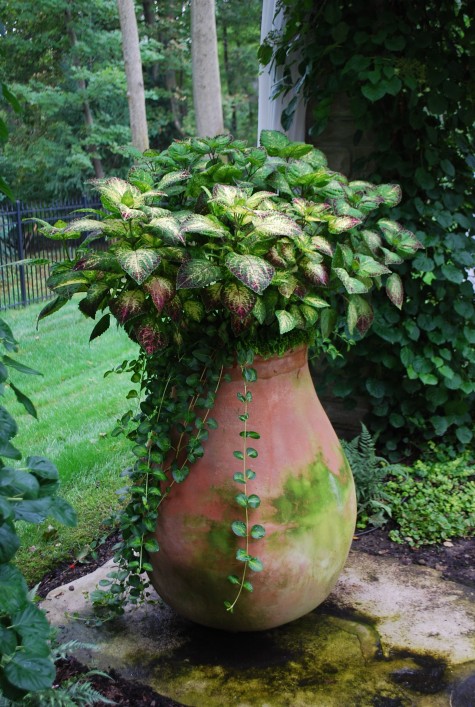
The planting in this Italian olive jar is pleasing in its overall shape, and growing robustly.  Set in a very shady pot, who knew the moss growing on the side of the pot would play such a big roll in the planting.   

Dahlias have dramatic flowers, but they come with with a lot of green leaves.  This picture suggests to me that maybe dahlias are better planted low, where the tops of the plants are the main view.  Or perhaps they need a plant will grow up in front of all that green without jeapordizing the health of the dahlia.  The flowers look like they are floating.  I have time before next season to figure out what would work better.  All of my snapshots will be a big help.

A Michigan Gardener

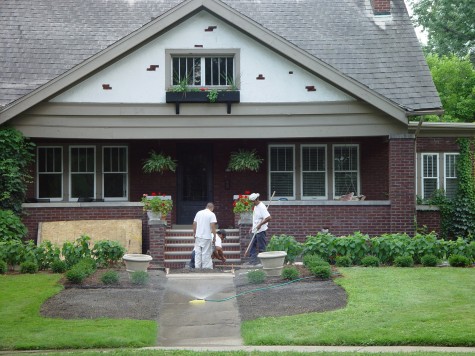
I have been gardening long enough to now have clients who are the children of clients.  I like this.  One such Bebe child belongs to one of my most favorite clients.  Cathy loves her landscape, and her garden, and she has put all of her effort and care behind that for as many years as I have known her.  Her son seems to have inherited all of this passion from her.  Though his favorite place to be is on the golf course, or horsing around with his kids, he is very keen about the out of doors.  Rich and Sue’s first house-a bungalow with not much of anything going on outdoors save some mature pines.  We got a plan together, including some concrete work, and installed the landscape.  Notice how the ground drops awkwardly to the sidewalk-we would fix this.

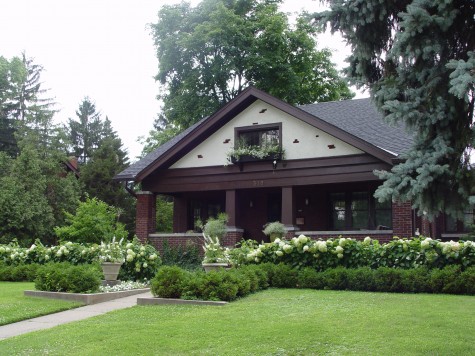
Some years later, the real gardening story is apparent.  The day I walk away from an installation, my clients are armed with as much as I can give them about looking after what they have. But it is instantly apparent which clients fall, and fall hard, for their landscape. Check it out- the plants have grown, and are healthy.  The pots look beautiful-and most astonishing, the Annabelle hydrangeas are standing upright.  Two years into his stewardship of a substantial hedge of Annabelles, a terrible storm knocked them all to the ground-just as they had come into full bloom.  Rich was beside himself.  He had to have called four times about what to do to restore them to their former glory.  He was genuinely devastated by a storm laying waste to his landscape.  Being young, smart and exceedingly sassy, he was sure he could wave a wand, and get those belles back on their feet.   I would get off the phone, having listened to his latest restoration scheme, and burst out laughing.  A client more obsessed than me-rare.  I will admit when I went to see what he had done, I was impressed.  Believe me, those hydrangeas ever after that disaster in 2006  had the staking mechanism in place the first day of spring-I am talking March 1.

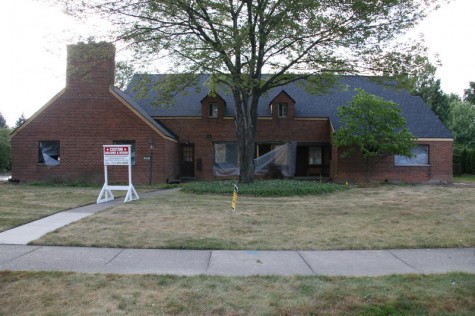
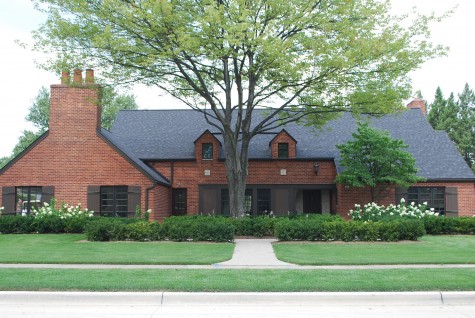
Years later, there is a new house.  Like the old one, there was precious little in the way of landscaping, and even less that he liked.  Before I could even protest, he had taken things down, and shovelled other things out.  A lengthy renovation of the house ensued, but I knew I would get a call sooner or later.  In 2008, he was ready for a plan.  I find the house very interesting architecturally; note the pair of entrance doors in the front.  The landscape design would feature that pair of front doors.

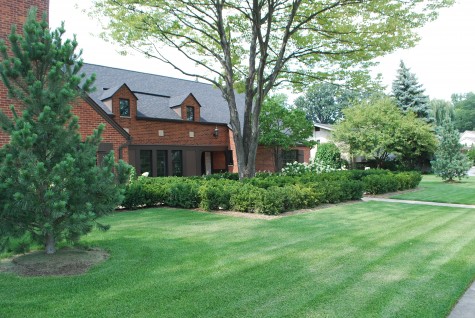
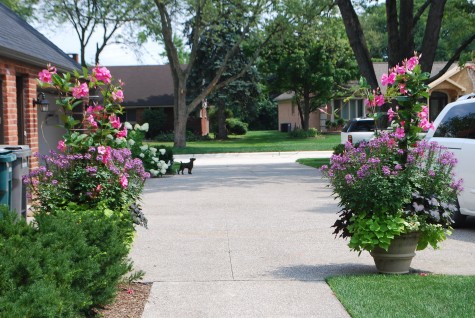
The view from the street tells little.  This I like.  A landscape plan that details an unusual entrance landscape not seen until a visitor is close to the door-the best of all possible worlds. Be friendly to friends.  Posit an elegant statement from the street.  Urban landscapes ask for public and private spaces both.  The house looks beautiful from the street.  The walk to the front door splits into two walks, and goes around the old maple which dominates the landscape.  Once you are inside the yew hedge; a guest can choose which door they want.    

Three days ago I had an appointment with Rich and Sue-about the rear yard landscape.  I could tell he was gunning for me.  The front yard looked superb.  The grass was cut and edged. There were no weeds anywhere.  The symmetrically placed pinus flexilis “Vanderwolf’s” in the lawn are thriving.  Not visible in this picture are a slew of Sum and Substance hostas planted at the base of the maple. My visit a year ago-there was still a weedfest going on under that tree. My threat to revoke his license to garden in the state of Michigan apparently worked.  

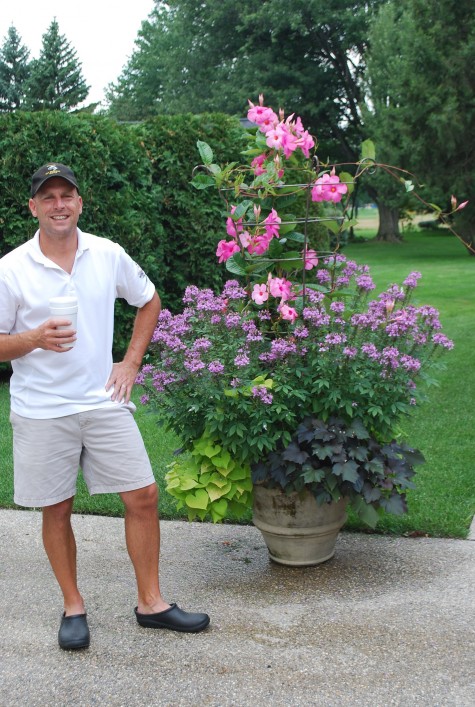
This Michigan gardener can annoy me beyond all belief.  If I tell him the sun will be coming up tomorrow morning, he will want a substantive explanation in support of my theory.  He asks more questions than I have time left in my life to answer.  But how could any gardener be miffed for long, once they laid eyes on this container planting?  This mandevillea, prone to spider mites, and fungus, can be the devil to grow.  But there it is, gorgeous and very well grown.  His Spirit Violetta dwarf cleome are the best I have seen anywhere this year-and that includes the plants in my pots at home.   Can you not tell he knows all this?    

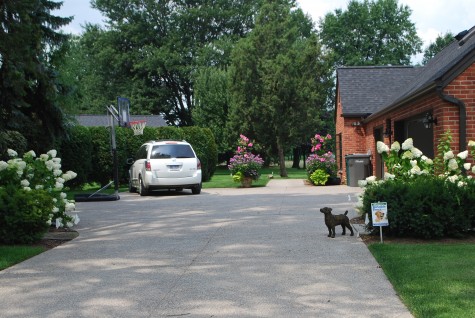
They brought this pair of stone Italian vases with them from the old house to the new.  There is no problem spotting them from the road.  This is the first year he has not blown in unannounced on a May Sunday afternoon with Sue, Violet and Rich III in tow, wanting not one scheme for his pots, but multiple schemes from which to choose, a mini-dissertation on the merits of each scheme-and the plants to go with.  When this past June came, I knew he did not need me anymore.  Rich, your pots are really swell.      

The largest part of the house renovation was in the back. Not in this picture-the view from all those new windows to the golf course.  He would be seconds from the links, and sublimely happy about it.   

We three have been kicking around the landscape plan for a year now. This rear terrace faces west, and Sue is very clear she has had enough of the blaring sun from which there is no relief.  She tells me the kids cooked eggs on the concrete aggregate terrace surface on a 98 degree say this summer. After sitting at the table for 1/2 hour, I believed her. Not obstructing the views to the golf course both upstairs and down have been the subject of much discussion, but I could tell even Rich was getting tired of the design and development phase.  So the plan is to go ahead with the landscape and see if it provides the shade they need.  If it does not, we have a plan Aplus in the works.  I will keep you posted.   

Sunday Opinion: Two Hands

Two hands come standard issue. Lucky for all of us gardeners, but this familiarity makes it is easy to take them for granted.  My two hands are small, but they  have sixty years worth of use behind them.  They are a gnarly as any tree root, but what they are still capable of still astounds me.  They type the sentences for my almost daily posts.  I pet the corgis down with them every day, several times a day.  They hold a toothbrush, a paintbrush, or a watercolor brush effortlessly.  I put my clothes on, I tie my shoes, I put the key in the lock when I leave home-three fingers of one hand handles the steering wheel of my bus-the Suburban.  They unlock the door at work, punch in the code that turns off the alarm, fire up the coffee pot, feed the corgis, open the doors, shade my eyes from the low early morning sun. 

They are equally adept at working a zipper and taping trace paper over a mortgage survey. They can unscrew the top off the milk in the morning, and the sauvignon blanc much later on. With my two hands, I set the table for dinner, arrange flowers in a vase, carry the plates outside.  One hand holds the match that lights the dinner candles. That one hand goes on to hold my fork,  wave off an early mosquito, make my ear of corn available, put my napkin to my face.  The two of them tell the story of the day; Buck says I am always waving my hands. They scratch where I itch, they rub my eyes when I am frustrated or tired. 

They are the most amazing tool I have ever had at my disposal.  They grip my trowel at the proper angle.  They dig on their own, when the idea of locating and using a trowel leaves me cold.  I feel with my hands where a topiary plant needs a stake and a tie-no need to see.  Feeling what a plant needs gives you a leg up; I cannot explain what I mean by this.  I assess the texture and viability of soil, once it is in my hands.  I push the smallest of seeds into the soil with a finger.  I transplant with all ten fingers attending the occasion.  I prune, snip, deadhead, stake, divide, plant, water, feed, harvest, store, fast freeze.  My hands power my spade, my fork, my pruning shears, my hoe.  My garden tools imply, and require my hands. 

I can hold many precious things in the palm of my hand.  A seed. An earthworm.  The palm of a hand outstretched-a gesture of friendship.  The palms of two hands up-hello.  In some cases, they say “I give”.  Mostly they say welcome-and very glad to meet you.  Holding hands-a fresh and friendly gesture that dates back centuries.  What two hands are able to accomplish is formidable. The two hands of one person in concert with the 100 hands of fifty other people-a movement.

 Your garden’s biggest ally-your hands.  I do lots of work for clients that is much about ideas, and drawings.  It is of such serious importance to communicate ideas with a client.  My hands do their part; they draw.  They point out, they trace the edges of a composition, they explain. But real gardening gets done all over this planet, in individual gardens, given one person with willing hands. Hands dig, divide, replant, move-willing hands make the most beautiful gardens.

Take some time to think about how your hands endow your garden.  Look at those hands differently.  Those hands of yours that dig, waver, plant, maintain, entertain-those hands of yours that make for a life; I will repeat.  Those hands of yours are a treasure. 

I value what comes to mind.  I so value that I can think, assess, backtrack, move over, rethink, reassess.  But my most favorite and trusted tool-my hands.  I trust what I can get my hands around, what I can feel, what I can make work out, what I can shape-given my two hands.   

Successful design relationships are all about a group of hands that connect.  If a designer whom you are considering does not encourage you to shake hands-back off.  There is someone else out there that you would be happy to hold hands with.  Should you have a mind to design for yourself-pay attention to what those two hands of yours favor.  Should you be uncertain as to which oath to take, favor what your hands find true.  I am very sure every gardener planet wide puts two hands to their garden. My two hands-how lucky I am to have them.