A Landscape In Focus

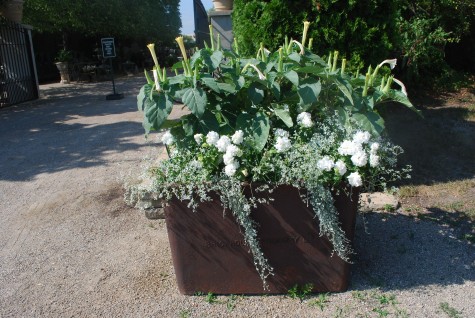
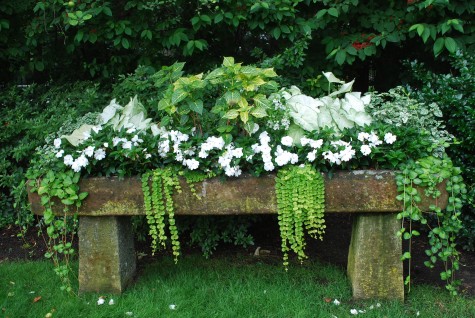
Every landscape presents something upon which the eye will focus.  Designing with the intent of guiding the eye can be the toughest part of the design process, as you may need to envision something which is not yet there. Or the visiting eye may focus on something to which your eyes have become so accustomed, you literally do not see it any more.  Garbage cans, pool equipment, air conditioning units-these are prime examples of what may be more prominent in your landscape than what you imagine.  I often see transformers and air conditioning equipment surrounded by giant hedges.  I wonder if this hedge style treatment does not in fact draw more attention to an unsightly object than the unsightly object itself. The very beautiful object pictured above, an English trough of considerable age; was placed where the lawn becomes a mixed shrub border. The border itself is quiet and unassuming; the planted trough organized the space visually in a strong and lively way.  The white flowers can be seen from a great distance in several directions.   
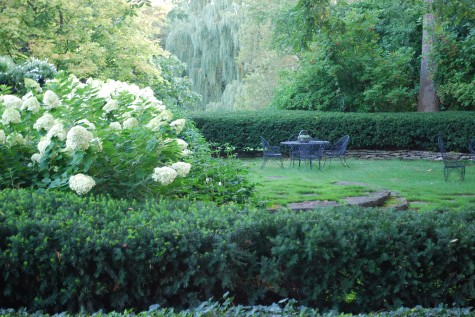
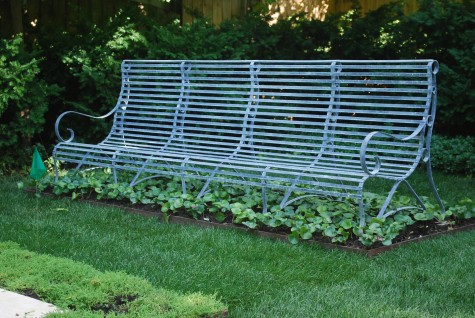
Garden furniture can likewise punctuate a landscaped space to good effect. This landscape has a natural and park-like feeling. Though this dining suite may not be a dinner destination, it encourages vistors to linger in the garden by providing seating.  Though the furniture is wirework, it becomes a visually organizing metaphor for the intent of landscape.  Parks usually provide places for people to be, and observe the outdoors.   
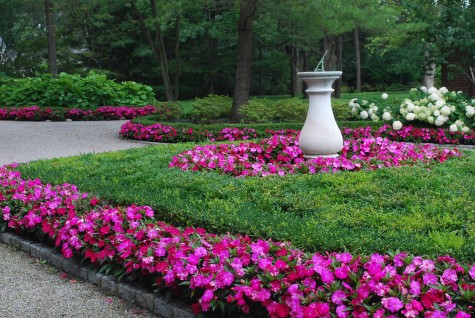
This very fine antique English sundial holds court in this landscape.  Aided and abetted by its massive size, striking shape, and pale limestone material, it grabs the eye the moment it comes into view. 
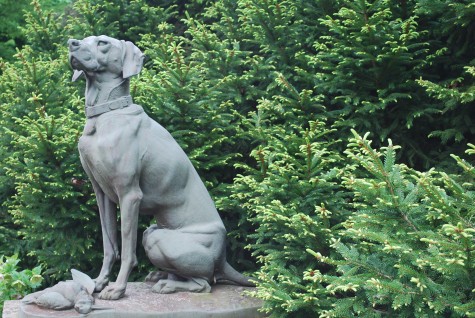
This 19th century French cast iron hound is one of a pair, flanking the entrance to my drive.  I see my driveway twice a day-this makes it an important garden to me.  My picea mucrunulatum is a gorgeous old plant; they were in my front yard when I bought my house 15 years ago.  I moved them to the drive, so I would be sure to see them every day.   The dogs draw one’s eye first, they invite a viewer to look more closely at this beautiful evergreen. 
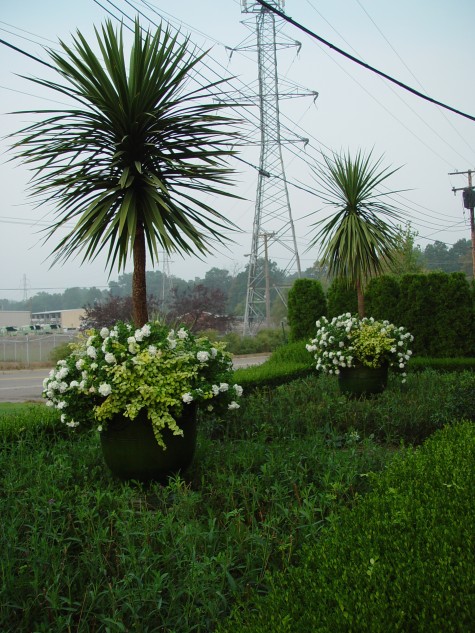
Not every local point is an object.  These old spikes-who could pass them by? One year I had in my mind to do an annual garden with a little Mediterranean feeling. Those massive spiky heads atop those gnarly trunks-noticeable.  Most of the visual vistors to my shop are the people who drive by every day.  A focal point of this scale is sufficiently significant enough for a quick look.  It might even encourage someone of gardening ilk to turn around and come back for a more thorough look-see. 
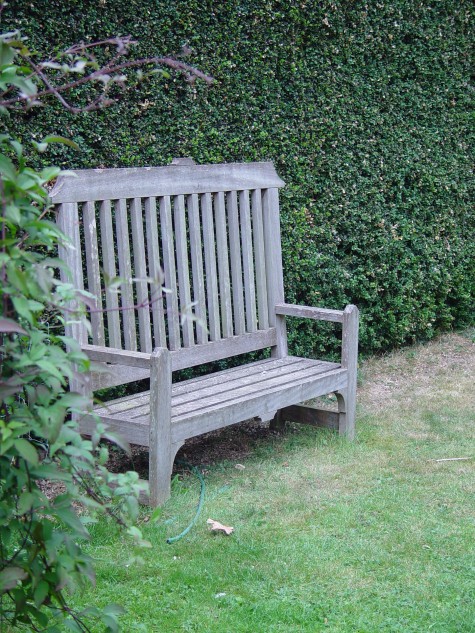
This weathered English teak bench is handsome and solid. One hardly notices the browning tips on the boxwood, or the hose.  Some objects have the power to distract one’s eye away from something that is not so lovely.  If I had to have a hose available in the garden, I would want to stash it under just such a bench as this one. 
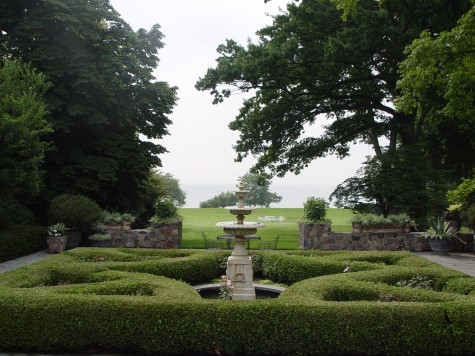
This landscape has a stunning distant view of a lake, and mature trees.  But this 19th century American made fountain does a great job of holding the entire view together.  In the lawn, a suite of white wood garden furniture.  The furniture helps to visually describe how far away the space is from the spot where I am standing.  It further more organizes the lawn space.   I do love the composition of this landscape from this particular view.  There is a strongly represented foreground, a defined mid-ground, and a dreamy far ground.  The large trees between the lawn and the lake proide a quiet backdrop for the fountain.  They also further define “at a distance” in a visual way.    
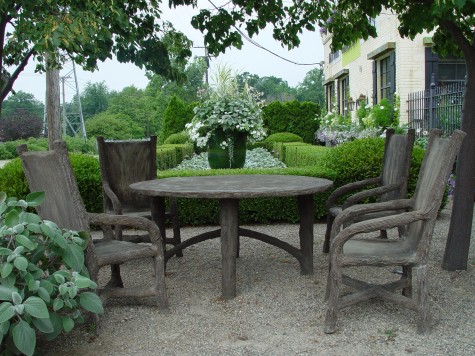

This concrete furniture I no longer have, but I did like what it did for the front of the shop.  Concrete chairs are completely impractical for a dining space that gets used every day in the summer, but they are a great choice for providing a focal point in a garden.  I have the luxury of changing what sits between these trees every year.  What pleases you in an ornament, beautifully placed,  can influence the look and mood of your entire landscape.
Taking Charge Of The Clock


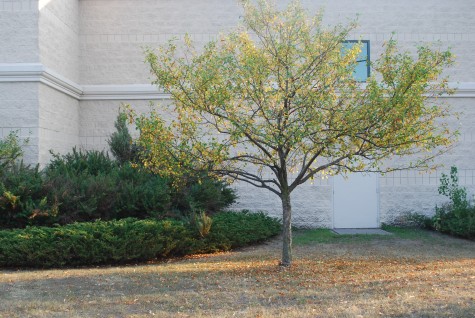
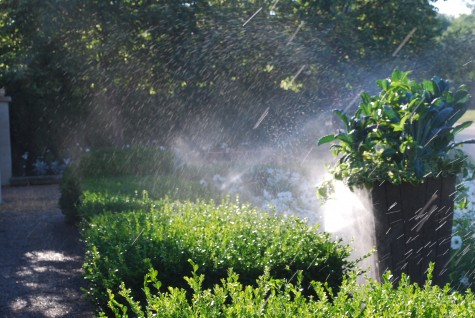
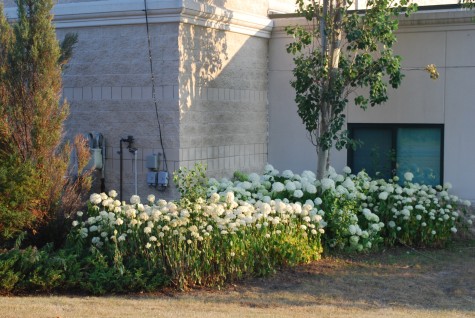
The new owners of the business that is right next door to my shop has not, to my knowledge, used their automatic irrigation system during the past two years.  It shows.  I installed the landscape for this storage company probably 14 years ago; the owners took great pride in the appearance of their business.  As I cannot imagine that whomever owns this place now would want to pay what it would cost to replace the landscape, I choose to conclude that they have neglected to take charge of their clock.  Their irrigation clock.  I cannot imagine upon seeing these Annabelle hydrangeas, they would not run to the clock, and switch on the water. 


The landscape is in serious water distress.  The crabapples are shedding leaves trying to stay alive by having fewer areas that are loosing water; I actually think the grass is dead. As I would rather write about a property owner who has a water problem they are trying to solve, I have a story. I do have a good client who lost three newly planted trees this spring; they drowned.  It has been a process of trial and error to sort out the drainage issues from the irrigation problems.  Upon engaging a new company to troubleshoot their irrigation system, numerous problems in the design and maintenance of the system became apparent.  As an irrigation system is installed underground, you cannot spot the problems until they show up in the form of dying plants.  Too much water can be as deadly as too little.  Should you be so fortunate as to have in ground irrigation, you have a great tool within your grasp to provide water to you plants when they need it-without dragging the hose.  The key-learning how to take charge and program your clock. 

My clients were fortunate to secure the services of a first rate irrigation company.  When I say first rate, I mean there is a thoughtful and thorough person at the helm. He repaired all of the leaking pipes and heads.  Then, he went to the clock.  Most of what I will be covering regarding managing an irrigation system is paraphrased from what he took the time and trouble to explain to my clients.  First and foremost-an irrigation system is not your big brother.  It is a machine that needs to be programmed, depending on the season, the weather, and the types of plants you are watering. 

In the early spring, and in the later fall, when the temperatures are not above 60 degrees during the day, cut back on the water.  When the weather is cool, the evaporation of water from the ground slows considerably; one a week watering is fine.  Once the daytime temperatures go above 60, set your grass zones to run every other day for ten minutes. This is a benchmark that may work for you, or not-but it is a place to start. Grass in shadier spots where the evaporation rate is less, water less.  Grass in full sun next to the asphalt pavement may need 12 minutes every other day.  As grass can survive without water for 60 consecutive days, take the time to set the clock, and adjust the times if necessary.  When it pours rain for two days, shut the machine off.  

Shrub beds, trees, and established annuals need less water than grass.  Check to be sure you lawn zone is not accidentally watering a shrub bed-that bed may be getting unneeded overlap from one zone to another that could damage those shrubs.  Established trees and shrubs rarely need that much water, unless there is a drought-so resist the urge to water by rote.  Always err on the dry side.  If things look wilty, turn the time set to water on the clock up.  If things look brown, turn the times way up.  If things look saturated, or yellowish, turn the clock to the “Off” position.  Automatic means just that-whether it is hot or cold, whether we have had 2 inches of rain yesterday, or no rain for a month, an irrigation machine will continue to water that the same time and rate as the last time you looked at your clock and set it.

Taking 15 minutes a month to tune up your clock will save you countless hours and effort dragging a hose.  Both Rob and Steve handwater everything-but their properties are small.  I will say that though they have no automatic irrigation, both of their landscapes are happy and healthy.  As I said, err on the side of too little. 

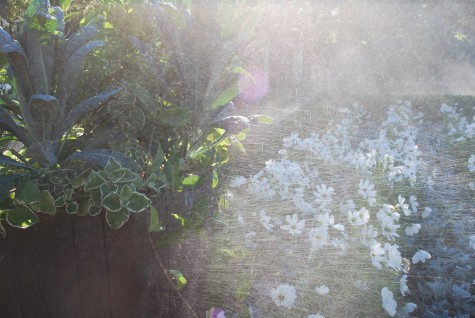
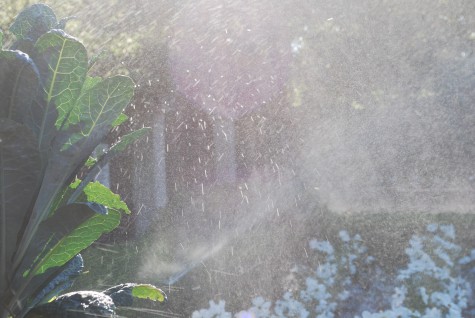
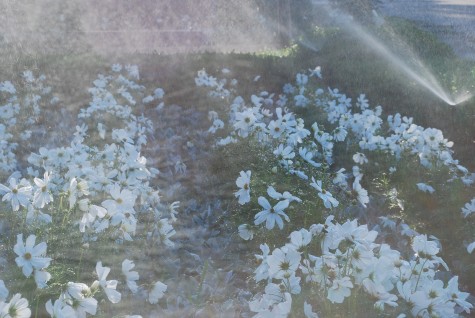
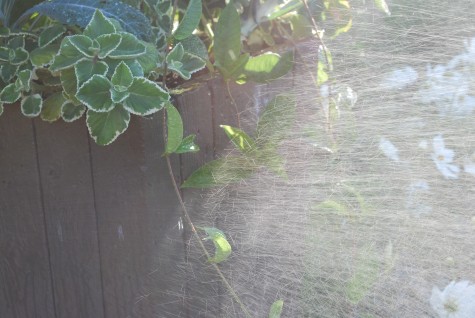
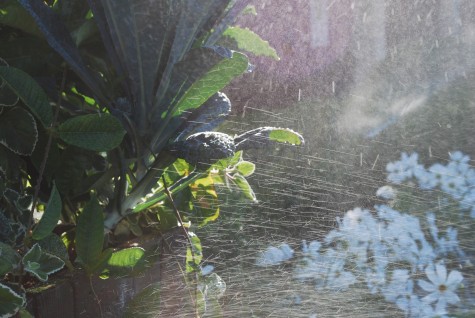
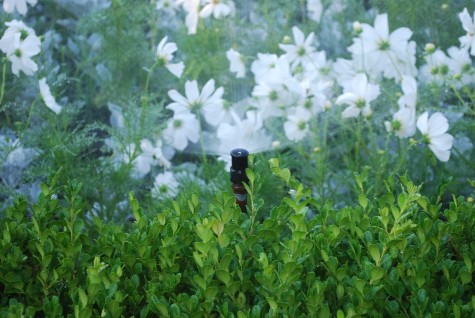
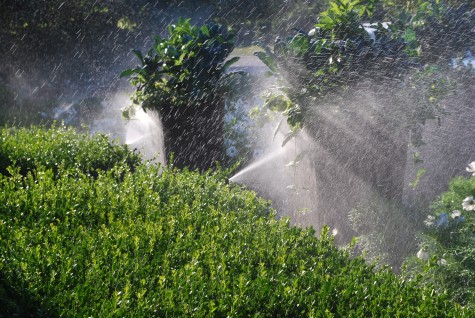
Automatic irrigation sends water into the air via a nozzle, or head, that is set to pop up once the irrigation goes on. Some nozzles that cover vast areas of lawn rotate as they spit out water.  Smaller areas of shrubs or perennials may have nozzles called mist heads, that cover a much smaller area. Common to every nozzle is a flow rate.  A good irrigation contractor will adjust the rate of flow of water after assessing all of your existing conditions.  If you have zones that overlap, or zones in shade, you may want to reduce the flow.  Less gallons per minute.  But once your contractor has tuned up all of the mechanics to the best of his ability, thre responsibility for running that system will fall to the property owner.

Airborne water droplets evaporate quickly.  You may use 100 gallons of water, of which only a percentage reaches the roots of the plants you are trying to water.  For this reason, in ground irrigation is not designed to water new plants.  Hand watering, that puts the water to the crown and roots is a necessity.  A dusting of water over top a plant that has not yet sent out roots into the surrounding soil is not enough.  New plantings need to be watched-and have your hand put to them.  A babysitter will not do. 

I will be the first to say that irrigation clocks were designed by some engineering type whose thought process is pretty much alien to my own.  My clock is far too complex-just like my Suburban.  I need forward, neutral, park, stop and go-I have 58 separate positions possible for the driver’s seat.  This is vastly more than what I really need.  I still have to call my irrigation person with questions about the clock.  For certain, the one thing I have done that I find invaluable-a map of all the zones, and what they cover, pasted up next to the clock.  I am only now learning how to change the duration of time on any zone given the percentage feature.  When it is extremely hot-over 85 degrees, I up all the times on all the zones 140% to 200%.  Ordinary summer hot, 85 degrees or less, I may water at 100%-130% of my normal time.   


As I said first up, every bit of this came directly from, or is paraphrased from from Jack Linderman, who owns The Living Painting.  Should you need some thoughtful help from an excellent irrigation contractor, I can recommend him.  www.thelivingpainting.com.

The Last Little Bit

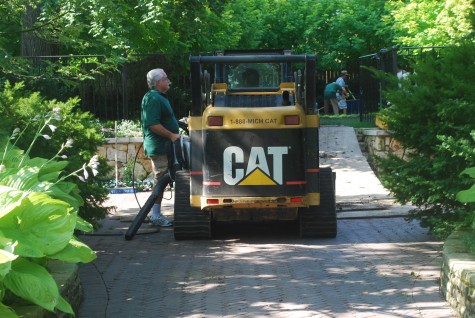
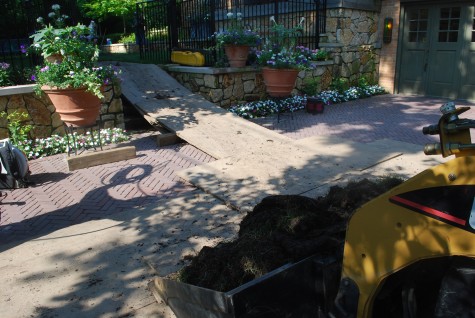
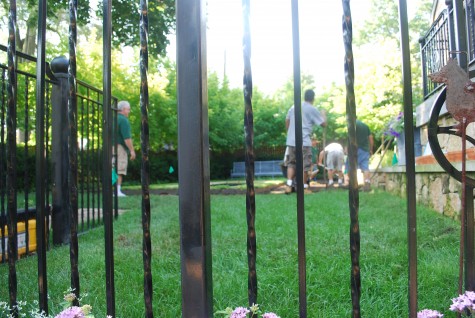
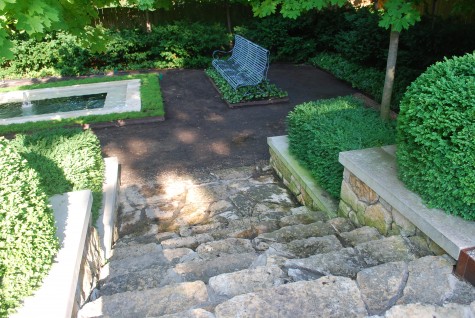
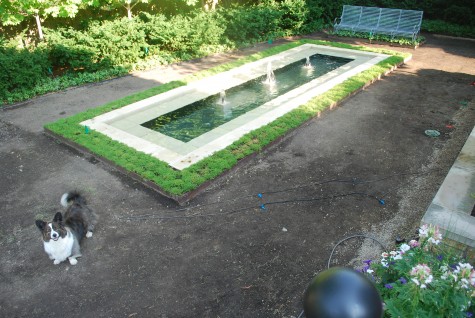
My entire landscape budget and a lot more for 2010 went to repairing the fountain of my dreams.  So fine.  But every gardener knows how one improvement  project can lead to another. Buck made new steel edger strip for me, so the herniaria surrounding it would be on the same plane as the stone pool coping.  All of the herniaria had to be replaced, so why not fix that grade while I had the chance?  Given the heavy spring rains, it became apparent that the pool yard did not drain.  The grass was drowning-especially in the shadier end of the garden. So why not fix the lot of the problems, and then move on to some place else in the garden?  GP Enterprises came with a loader, a sod cutter, a plenty of plastic pipe. Their primary business is in the sale and moving of very large scale plant material, but they do drainage. Ralph would regrade the yard, install drainage pipe in gravel, and drain the water away in a solid pvc pipe to the driveway level garden.  Sounds like fun, yes?   

I know this sounds about as interesting as a trip to the dentist, but I knew it was time to address the problem.  The entire yard was torn up anyway-what harm could a little more commotion do?  The grass that came out of that yard had that too wet and rotting smell to it; I had made a good decision.  The best part of the story-the water in the pool yard was going to empty into my bed of butterburrs.  Butterburrs thrive on water; they are happy in decidedly swampy conditions.    

I went back to work after the first few yards of sod were stripped off.  I am only a fan of watching the deconstruction phase of landscape in someone else’s yard-not my own.  Too much water is frequently a problem in landscapes where the irrigation systems run amok.  But some ground just does not drain fast enough to keep plants healthy.  Too much water has the potential to rot the root hairs of every living plant.  The irony here-no matter how much water you pour to a plant with root rot, there is no absorption going on.   

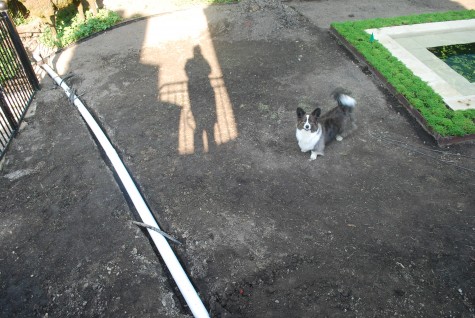
Of course the Corgis thought the dirt was great fun.  They ripped around, rolled in it, tracked it onto the pool coping, and into the house.  Fortunately this phase was only to last 24 hours.  


A perforated drain set in pea gravel was placed at the base of the wall.  The nicked irrigation lines and low voltage lighting lines got repaired.  I was handwatering my new herniaria, in addition to all of my pots.  Having this to deal with in the 95 plus degree heat working outside all day long was exactly like a visit to the dentist.  Not visible in this picture-I finally ripped out all the not hardy helleborus angustifolius, and replanted the remaining ferns with European ginger.  I am happy about this change.

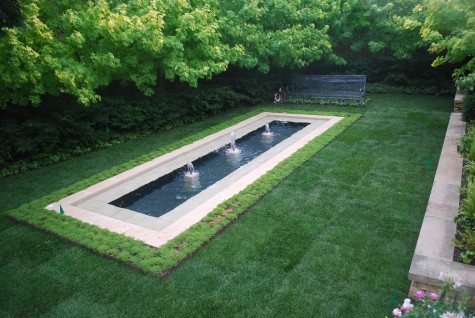
The drain pipe in place, all that remained outstanding was a finish grade, subtly sloping towards the drive, and the grass.  Positive drainage-as in ground pitched such that water would naturally drain to a good spot, is the drainage method of choice.  Pipes can get clogged, or are too small to handle a deluge of water.  But where there is little pitch, a well done drainage system can be the difference between a landscape that thrives, and a swamp. 


I do like my grass; it will take a while for this sod to root sufficiently such that it can be mowed. That green is the best, is it not?   


This part of the garden is finally ready for company.

Blistering

I am hard pressed to remember an early July with a string of days over ninety degrees, and going on to push one hundred degrees.   For five days now, our weather has been blistering hot.  Of course every gardener’s attention turns to the well being of the plants, when the weather goes haywire.  The obvious medication for relentless heat-water.  OK, watering is essential, but informed watering puts your efforts where it counts.  Water does not solve every high temperature  issue.  Annual plants-they love the heat.  Most are native to tropical climates where high temperatures are the norm.  I have no idea off the bat where cosmos originate, but those needle like leaves mean they are drought tolerant.  Why is this?  Plants take up water, and the leaves sweat.  A plant with a minimal leaf square footage transpires slowly.  The giant leaved ligularias and butterburrs have enormous leaf surface; in the sun, or at the end of a hot day, their leaves are alarmingly droopy.  Don’t sound the SOS yet.  Heat makes all of us sweat.  But heat does not necessarily mean they need more water.  You can overwater plants, trying to cool them off. 

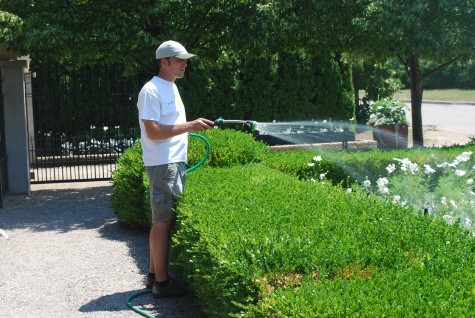
Rob has had a hose in his hand for the better part of a week.  Hot and dry conditions affect our trees, our container plantings, our boxwood-he waters.  The extreme heat-I am seeing him in a baseball cap for the first time in 18 years.  He looks like someone I never met-disconcerting. This astonishing tail end of June excruciatingly high heat makes the job of watering a critically important job.  People and plants alike suffer-proper hydration is key.  

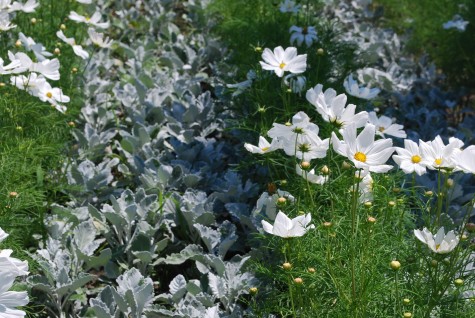
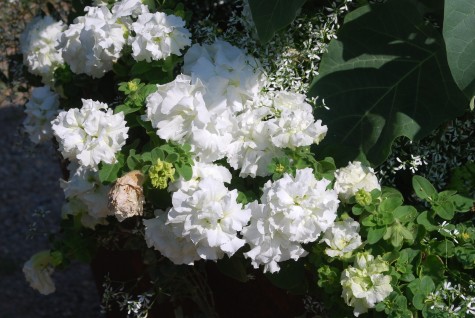
This photograph taken in full sun does not much speak to heat.  White flowers look fresh, no matter the temperature.  The silver dichondra is waving to the right-your only visual clue that this 95 degree day was accompanied by a strong, drying breeze. Every plant in this old cistern is heat resistant.   The burgeoning datura centerpiece is immune to the high temperatures.  The thick leaves that transpire slowly-an ace in the hole.  Petunias-so drought resistant.  Euphorbia Diamond Frost-should you want to grow giant euphorbia, water sparingly.    

These ultra double white petunias grow long-it is their only fault.  Should you plant them with company that disguises their leggy arms-they shine. Never mind the withering heat. 

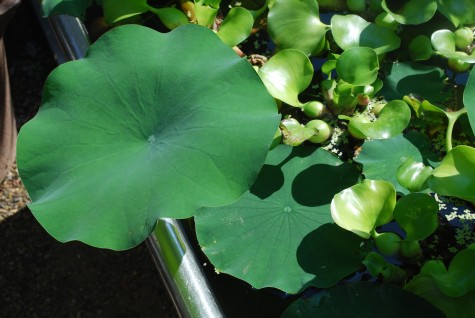
Lotus-they love the heat. Those giant leaves never wilt- why would they?  Submerged or just above the water’s surface every day, they look juicy no matter what the temperature.   Clients that have no time to water- a container stuffed with water loving plants and lots of water-this might be an idea worth pursuing.   

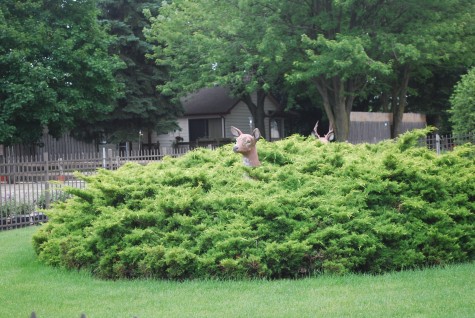
Junipers-even people who do not really garden know the word.  They thrive on neglect-meaning, the less water, the less of everything, the better.  Like the annual cosmos, their needle like foliage presents little surface area from which to transpire. 95 plus degrees-the junipers are unfazed.  Should you have really high heat, sort out what needs water, and what is wilting from heat.  If your trees and shrubs need water, soak thoroughly.        

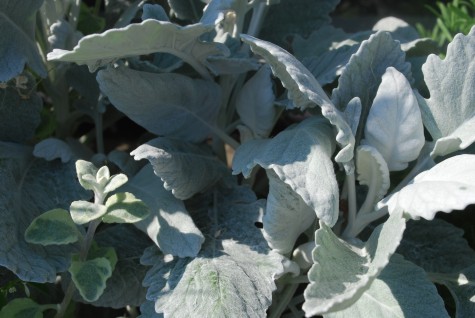
The cirrus dusty miller-no one grows this plant but my grower-at my request. The large silver felted leaves are so much more beautiful than the serrated dusty miller-would you not agree? These large hairy leaves are heat resistant-but big leaves need your hose when the going gets tough. 

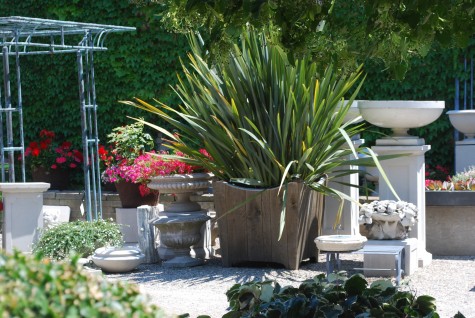
Phormiums-New Zealand phormiums-are immune to high temperatures and dry conditions.  This plant-I have had it for the better part of ten years.  I have never seen it wilt.  If you garden in intense heat and dry conditions, get some phormiums going on in your garden.  They look fresh and great, when it is one hundred degrees.   

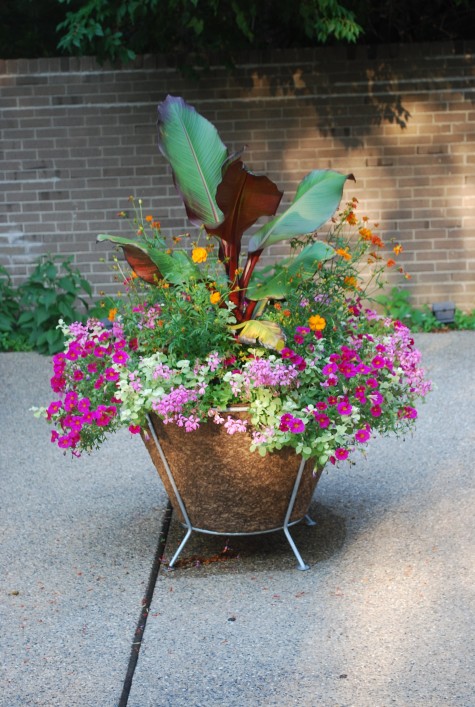
Most tropical plants love the heat-this banana centerpiece is no exception. Should extreme heat be sweeping through your neighborhood, remove those leaves at the soil level that threaten to rot. Encourage good air circulation. Clean culture is a good idea.  I water the surface of the soil-and not the leaves.  Heat and water provide an ideal climate for mildew and other fungal infections.  Just like you, I have the idea to put as much as I can to a distress call; this weather makes me want to shower everything with cool water.   I have desperation watered plenty of times.  Should you get a garden SOS, think before you act.    

Late day comes, sooner or later.  What you were sure would flop over and expire lives to see another day.   


It is appallingly hot-no gardener in my region questions this. Nature-she has a way of making everything in a garden a challenge.  My annual plants are loving this heat, and growing like crazy.  Keeping them watered is like adding a part time job when I already work full time. But when I look at my plants, all in all I like what I see.