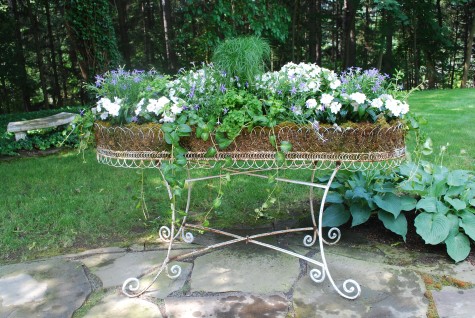
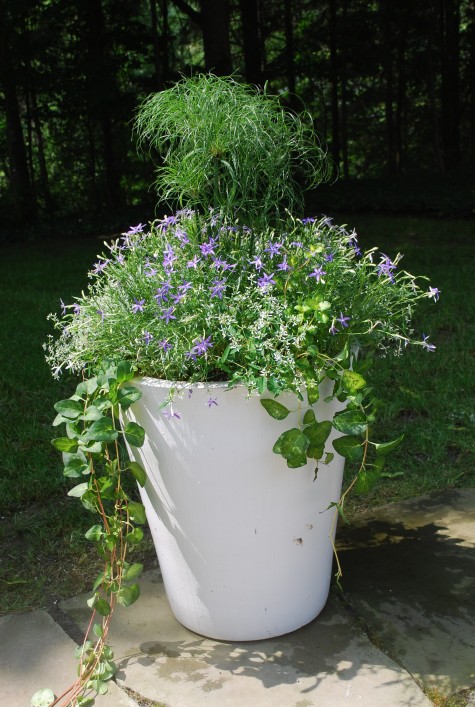
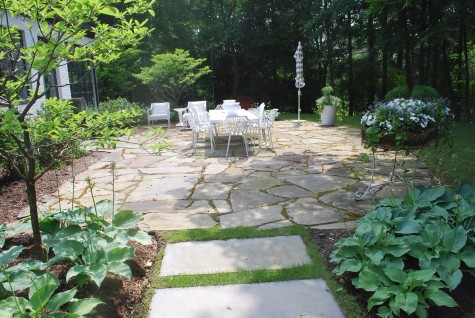
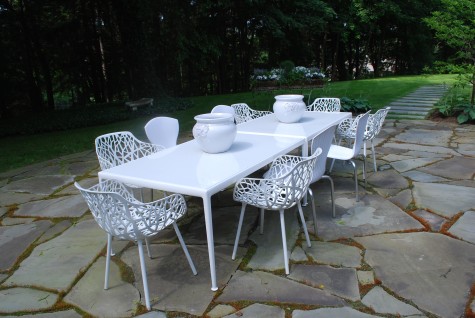
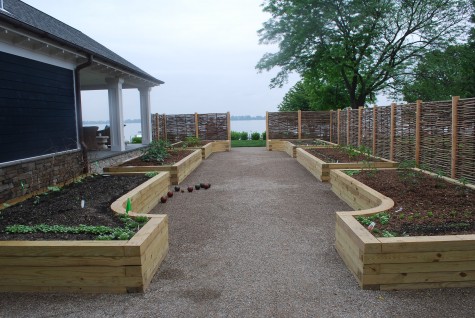
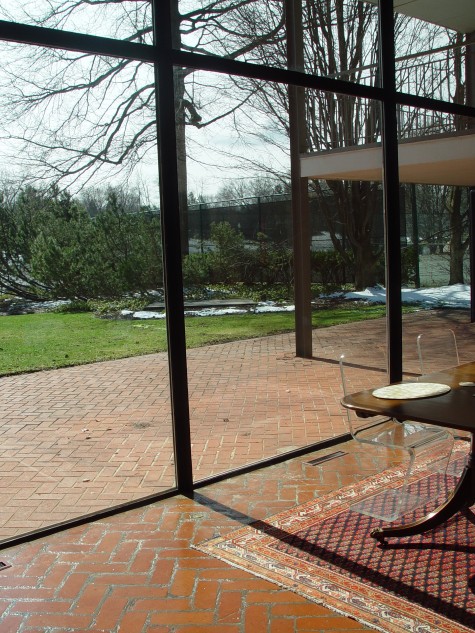
 This is my year to focus on hard surfaces in the landscape. Having just had a knee replacement, stairs and uneven terrain are a challenge. Even walking on grassy slopes is difficult. I have had a very personal experience with what hard surfaces can provide in the garden-and the lack thereof. They are a necessity for vehicles; even the underground grass support grids do not support regular or heavy vehicular traffic. Interior hard surfaces support all manner of human activity. Flooring for kitchens, bathrooms, living rooms, bedrooms-there are so many choices. As is apparent in the above photograph, should you wish to have some outdoor space that will support human activity, a hard surface of some sort is a good idea. The interior flooring flowing outdoors-a beautifully utilitarian and visually satisfying gesture. Outdoor “rooms” are very much different in feeling and execution than interior spaces, but in or out, a level hard surface can facilitate plenty in the garden.
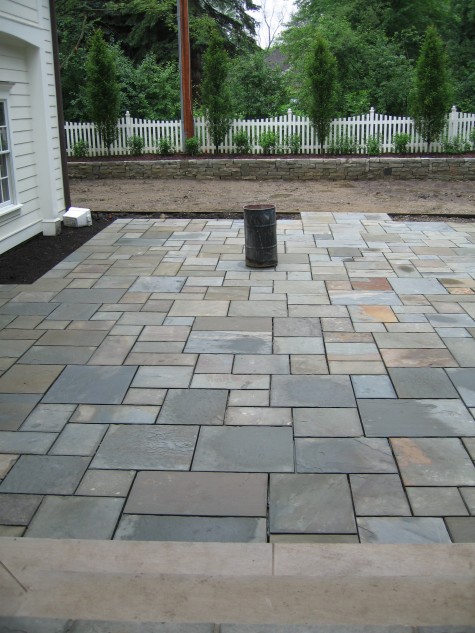 This bluestone has been cut in what is known as an Aschlar pattern. Several sizes of squares and rectangles can be laid in a pattern that seems random at first glance. The pattern allows a stone mason to lay the surface quickly-as there is a big idea governing the sequence of the stones. The appearance of random makes it a good choice for landscapes not demanding an ultra formal or ultra contemporary hard surface treatment. Interesting that-very formal and very contemporary landscapes have much in common . This bluestone is graded and sold as “full range”. Full range refers to the wide color variation in the stone. Each stone exactly the same color-selected stone such as this demands a premium price. Expect to pay over and above for select. Each stone is as much about what was discarded for a job, as what is acceptable. The muted colors of the full range is easy on the eye. Should you be thinking of a large terrace, darker is better. No one needs their terrace glaring up at them.
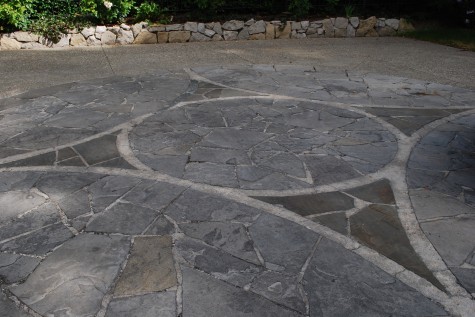 Some large hard surfaces-by this I mean a drivecourt, benefit from a change of material, or mixed materials. Cars and UPS trucks are large, and need lots of paving. This concrete aggregate drivecourt is punctuated by a compass built from hand cut bluestone slabs. The pattern draws the eye away from the large expanse of hard surface. A group of materials is good, should your paved space be large.
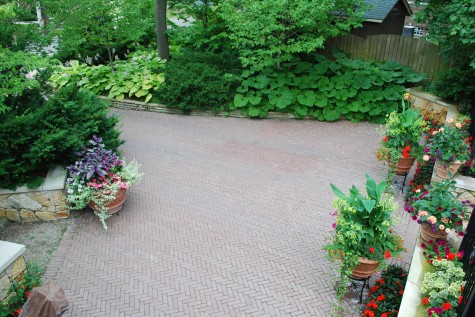 My own narrow driveway opens into a piazza of considerable size. The driveway/piazza design was done in 1930-I have not changed one dimension. Whomever designed it, I am appreciative. My driveway opens into a terrace, which is driveable. The brick which surfaced both was still intact, but heaved up here and there. Impossible to shovel, and dicey to walk on. I replaced the brick with a Belgian made concrete brick made by Unilock- called Capthorne. The uniformity of the brick makes it easy to lay. It is equally easy to move over, and stand on. It gracefully represents the unusual original drive and drive terrace.
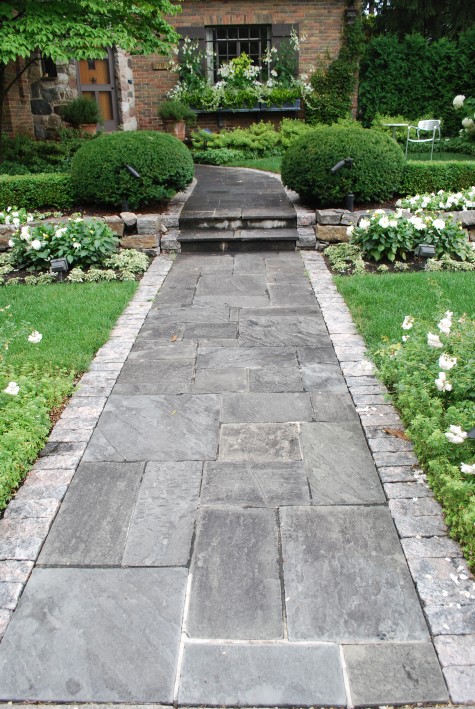 Stone-cut and carefully laid-there is nothing like it. This walk, bordered in granite setts-it is my all time favorite. My client and his stone mason laid this walk long before I met him; his love of natural materials and precise planning produced a hard surface that is incredibly beautiful.
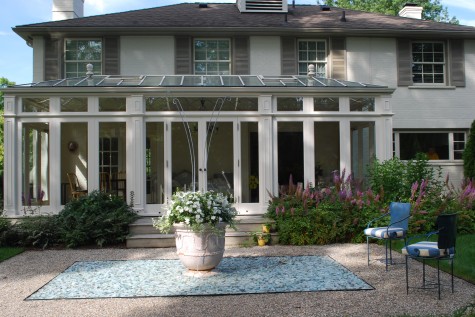 Some hard surfaces are not so hard. Eric and Julie liked the idea of water in their yard-but had no interest in the upkeep. A frame of decomposed granite encloses a hard surface of recycled and tumbled blue bottle glass. The glass-a maintenance free suggestion of water. The terrace seems small, and intimate, given the change of materials. Switching, matching, investigating harmonious materials can make a hard surface lively.
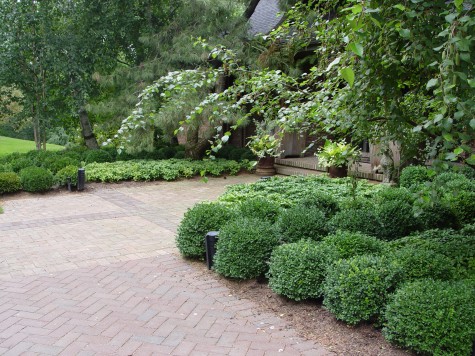 Concrete pavers are not my favorite. I like my concrete to be honest about being concrete. Concrete in imitation of some other material-hmm. Some landscapes demand natural materials-no imitations need apply. Some modern and contemporary landscapes demand materials not one bit natural; materials conceived and generated via the human hand can be stunning. The big idea here is about authenticity of place. Should you own a tudor home in the English style, stay away from concrete-unless you find a believable hard surface material. Should you own a mid century modern house, look at the brick from the same period. A contemporary home-read and research concrete-it is a material appropriate to you. Should you be in between, lay the concrete pavers, and water copiously. A moss fringe around each concrete paver-a visual blessing.
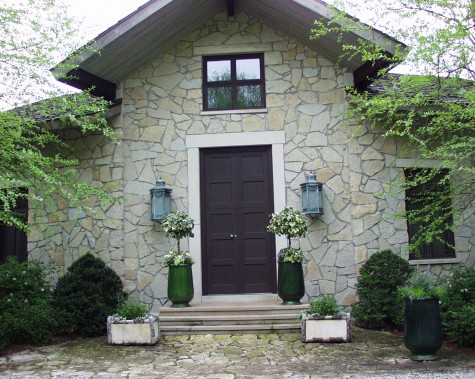 The architect Michael Willoughby designed and built this home. The stone on the walls-he repeated on the ground. I so love how his spare vision does not lecture. The hard surfaces are extraordinarily soft. The hard surfaces here, beautiful.
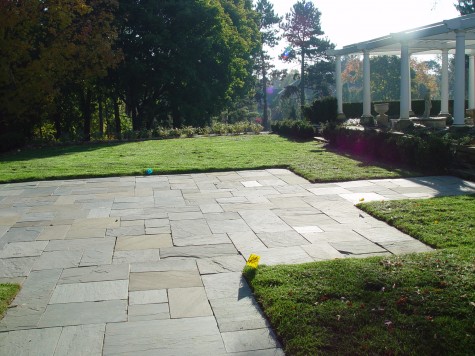
No doubt you have places in your garden in which you intend to entertain, have dinner, meet friends, relax. Your choices of what lies underfoot-many.