Making Everything Work

There is a stage in the design and development of any project where it seems like a good idea to take the lines, shapes and descriptive words off the page of a drawing, and see what those lines look like-standing up. This idea is on my mind, as I saw a scale model today of a house a client will build this coming spring.  Even the elevation changes of the property were represented by stacked sheets of thin balsa wood, cut into the curves that represent the actual existing grade. Given how pleased I was to see this 3-D representation, I  can appreciate how a client may need something from me that transforms lines on a page into volumes and shapes.   What will this look like-a completely legitimate question. It is simply human nature to want a window that reveals what is to come before we get there.
 

Smaller projects do not have a budget that includes the time it takes to build a scale model.  Frankly, few projects call for that.  Any client who does not mind my sharpee marker sketches drawn against a panoramic view of their house and property gets virtually the same thing as a model-just a rough version. I am not interested in the elegance and polish of a presentation-I am interested in understanding. But certain issues cannot be dealt with on paper, or with a model.  An outdoor space could not be less like a drawing on a page.  A real space can shred a drawing and demand what never crossed your mind. 
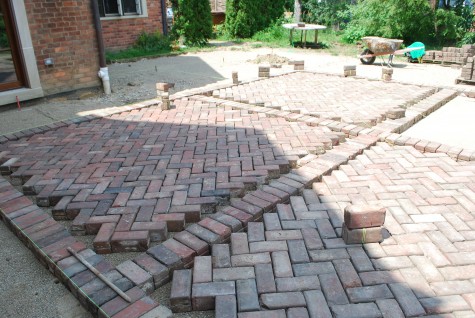
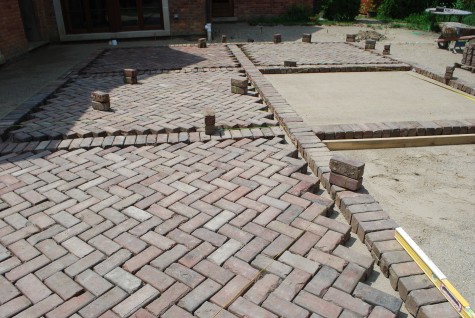
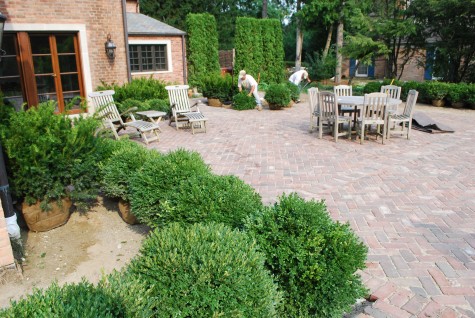
These old street paver bricks made in Ohio circa 1920 are anything but uniform.  Laying brick in a herringbone pattern requires great skill and planning, so the pattern does not drift.  Albaugh Masonry is known for their ability to beautifully handle a difficult installation-but these irregular bricks were proving next to impossible.  This kind of trouble you might anticipate on paper, but reality is all about standing in a space, trying to make everything work.
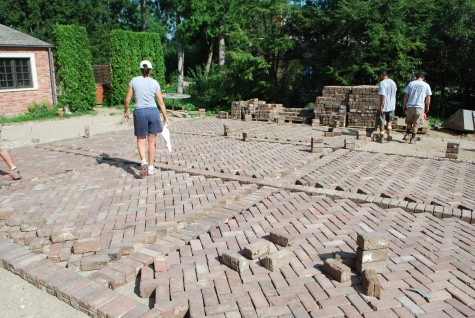
My cliennt-she is committed gardener.  She stood in this space for days, plan in hand,  working with Albaugh  to work things out. Understanding between a designer, a client and a tradesperson makes for a great outcome.  The suggestion from Albaugh that the terrace be configured in 9 smaller herringbone blocks of equal size, separated by a soldier course, was a good one.  They felt they could keep the herringbone dead on given this design.  God knows they tried to get those hand made bricks to work out every direction over 900 square feet. Who knows how many times this group sorted and resorted these old bricks, in order to get a surface that was true and square.   
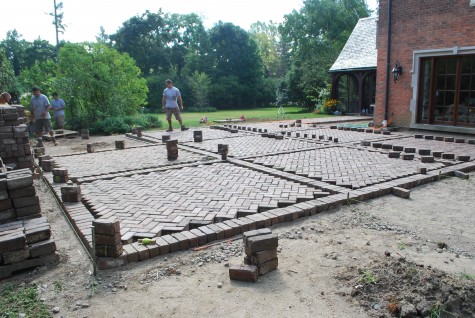
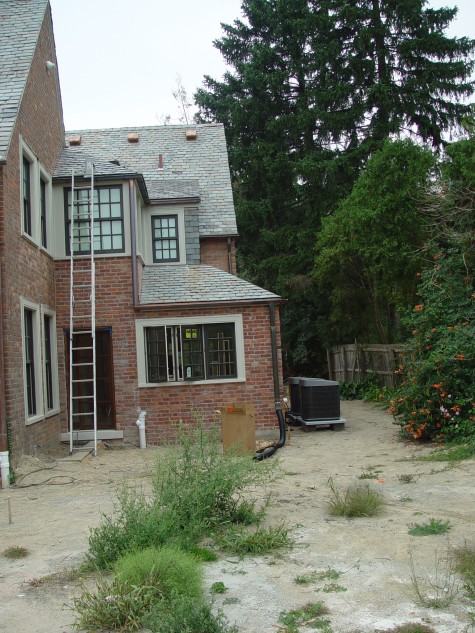
The late day sun slanted across the terrace reveals the beauty of the brick-and the installation.  As this home was built in the 1920’s, this final choice of a terrace material makes a great run at convincing a viewer that it had always been there.  Choosing materials on this basis has been of interest to this client in every phase of the landscape renovation.  Many plants original to the house were kept, or heeled in until a spot could be made for them.  Any passionate gardener understands what a whomping lot of work this is.   
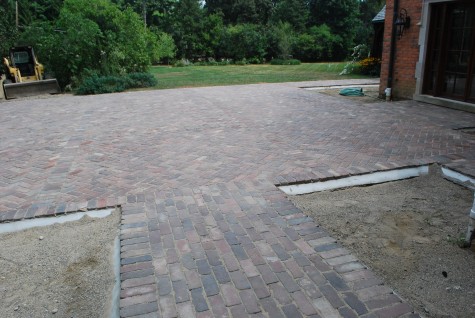
Changes made on site have a way of turning the rest of the world up side down.  There is a part of me that so admires the math.  Change a floorplan or terrace so much as 6 inches, the entire space is affected.  My love of the math aside, making everything work is my idea of successful design.   
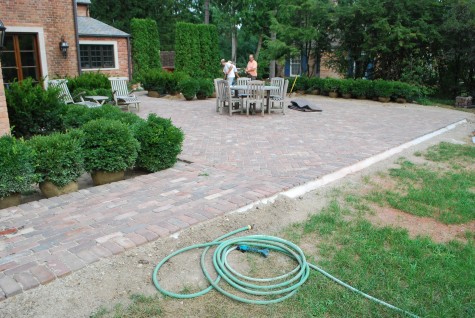
We began the landscape installation today.  How everyone involved would make everything work was the order of the day.  That moment when an installation begins is the most intense work for the lot of us.  A client, a masonry contractor, an irrigation specialist, a designer, a landscape company-there are lots of voices that need to tune up, and figure out how to be in harmony with one another.     
The art of communication-in my opinion, the most difficult art.  Paintings, sculpture, crafts, decorative arts-they are all about the vision of a particular and singular artist.  Landscape design is all about a successful and fluid relationship between a client, designer, and tradesperson. I thrive on this.
A Secret Garden

Who knows how many times my Mom read The Secret Garden to me.  Once I learned to read on my own, I doubled up my exposure to this well known children’s tale.  Though I was taken in by the relationship that was forged in the privacy of a beautiful garden, I was more fascinated by the garden itself.  Walled off from the world, quiet, serene-the possibility of a completely private world all of one’s own imagination and invention enchanted me.  I have clients who live in old neighborhoods in close proximity to other families. Those neighborhoods are in transition now.   Old modestly sized homes are being torn down in favor of much larger homes.  

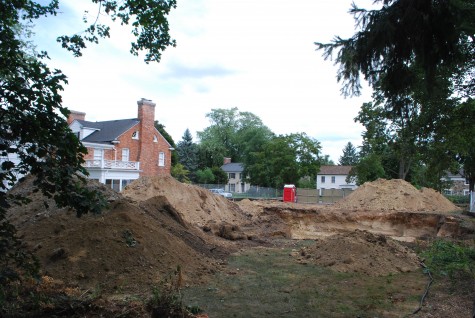
I have a client in just such a situation.  The lot behind her has been summarily clear cut; a large home is in the works. All the the old trees on the lot line that screened her from that neighbor are gone.  An old and deteriorated home next door has been sold, and is scheduled to be razed.  A new home, no doubt bigger and taller than homes original to the neighborhood has her feeling under siege. On the garden tour this July she commented to me that though I live in an old neighborhood with small lots and many large two-story homes, my yard is completely private.  She had an interest in staying ahead of the construction that would loom over her on two sides of her property for the at least two years.    

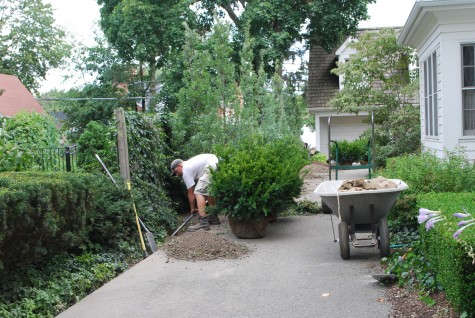
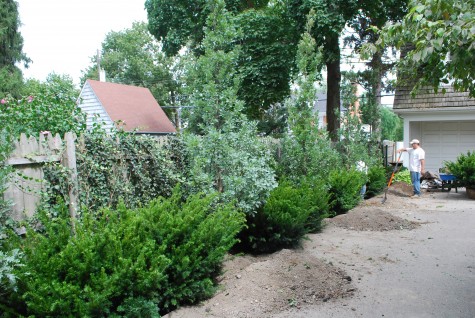
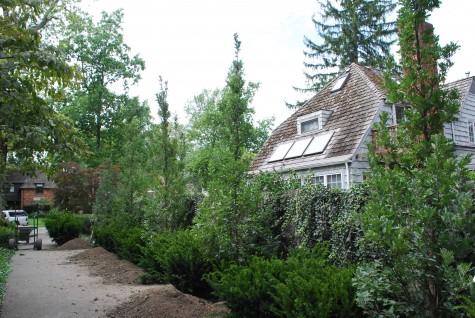
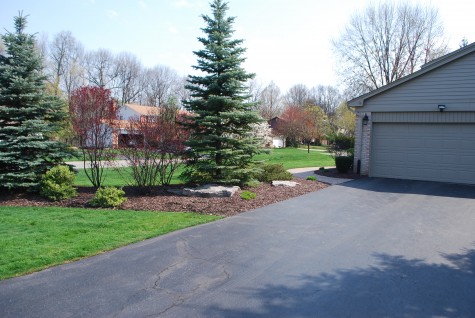
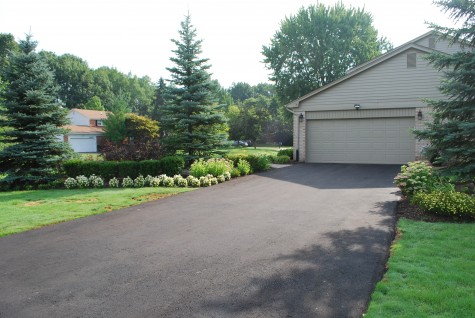
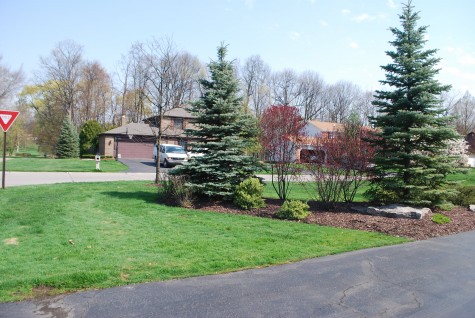
Lots in her community are small; the parcels reflect a time and place long past. She was willing to reduce the width of her driveway to less than 9 feet, if it meant that she could plant screening in anticipation of a new house next door. I understand this need.  I like my neighbors, but I like my private garden more.  I have no need or inclination to be privy to what my neighbors are up to.  Most importantly, I want the sanctuary that a landscape can provide.  We saw cut a strip out her asphalt driveway so we had room to plant.     

Arborvitae as a screening material in a right space has its limitations. When very tall, they fall prey to ice storm damage.  They grow wider than one would like.  Like many evergreens, they are much narrower at the top than the bottom.  If you need screening up high, a layered planting works well.  Deciduous trees provide great screening of a neighboring second floor.  A columnar tree takes up relatively little room on the ground plane.  Carpinus, gingko, tulip tree, beech, amelanchier,-there are plenty of choices.  Planting an amiable evergreen between the columnar trees gives you an evergreen screen occupying the first five feet out of the ground-excellent.  Driving up the drive, or walking down the drive for the mail, there is privacy.  

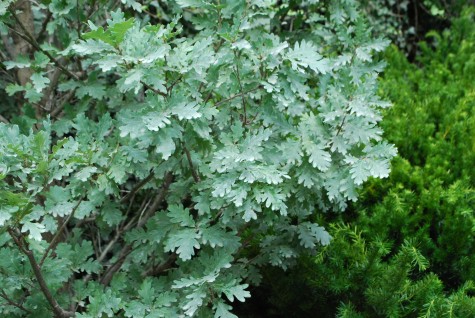
This columnar English oak hybrid, Crimson Spires, has densely growing blue green leaves, and a decidedly columnar habit.  This cultivar of English oak is stubbornly hardy-never mind its good looks.  In two years these trees will be branching out such that my client will get the gist of her secret garden.  Within 8 years whatever goes on next door will not be part of her landscape.   

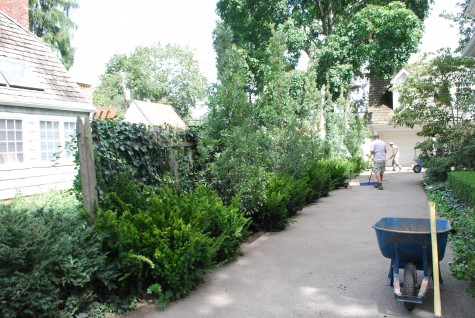
On the lower level, we have another issue to address. The neighbors wood fence is old and quite deteriorated. What will be when that fence is replaced, or not replaced?  The densiformis yews will make how the new neighbors will handle their landscape their issue, and not hers. 

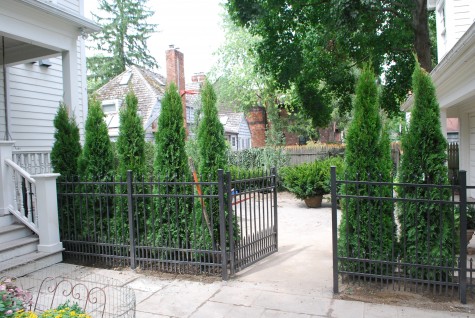
We planted a secondary screen which will add another layer of privacy to the back yard.  The arborvitae “Emerald Green” has a beautiful deep green color year round, and grows quite dense.  I will recommend that this hedge be maintained at the height of the gutter on the garage.  This will make the maintenance of the hedge more manageable.  It will also make the rear yard garden entirely private from this side. 


We will see if the narrower drive is easily negotiable. If it proves to be too narrow, there is an option to add a little more drive on the house side.  The views out from the windows on this side of the house will be green.

Generating Curves

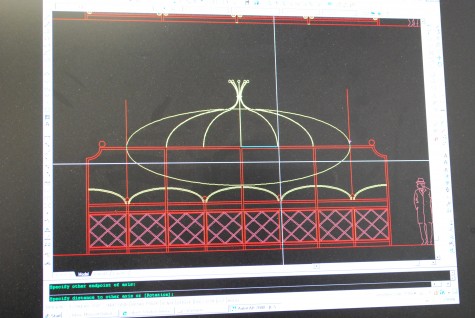
I have a big love for formally conceived and planted landscapes.  Nature does wild, asymmetrical  and completely unexpected far better than I could ever hope to.  A client with whom I have been in negotiations for three years regarding her irrigation system flooding and killing her plants finally came around this spring.  “I see that the trees in the parks do just fine, though no automatic irrigation is in place.”  A client who is observing nature at work-what could be better?  I like to observe nature at work, and create spaces for people based on those observations.  Though I have a big love for the intersection of horizontal and vertical lines, I am the first to admire spaces with beautiful curves.  This design of mine for a steel pergola is organized around the elliptical shape you see in the drawing above. Should it ever be built, the bottom part of the ellipse will be implied, not represented.  Beautifully curved landscape beds imply circular shapes, though all of that circle may not be represented.       

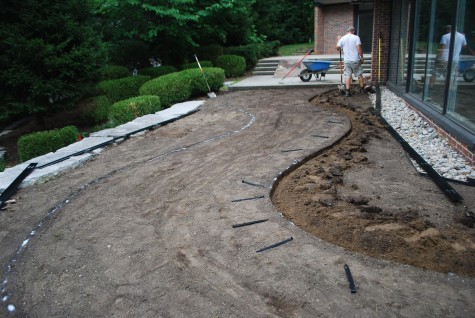
A recent project was all about compound, curving shapes. I generate these shapes by hand; I spray dots on the ground to start.  Should you be generating curved beds, I would recommend the following.  A curved bed needs to be curved from start to finish.  Once even a small portion of  a curve goes flat, it looses impact. Some have luck dragging a hose-this method has never worked for me.  For large curves, a stake set on a proper radius, with a string attached can generate the portion of a circle you need.

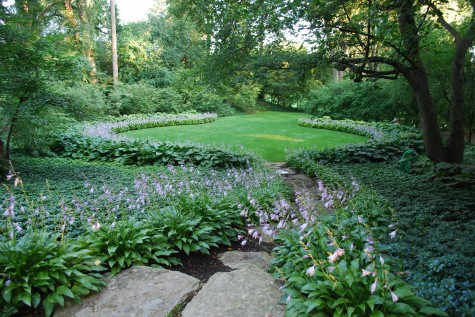
Though this lawn panel appears elliptical from this angle, it is clearly circular when you are in the space.  Finding the center of the space took some trial and error, but I was finally able to wrap the string around my landscape paint, stretch it tight against the centering stake, and dot it in.  Circular shapes, and circular sculptures or spheres are visually very strong and stable.  Several cultivars of hosta fringe the lawn panel.  The relationship between this very geometric garden and the naturally planted surrounding landscape provides visual interest. 

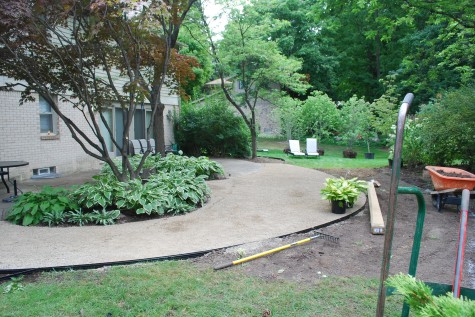
Big swooping curves can relieve the feeling that a space is small and stuffy.  The placement of this house on its property means a very large front and public space, and a small back yard.  The addition of a curved granite terrace makes the rear yard feel bigger, more airy.  I know there are those gardeners who edge their beds by hand, but I am not good enough to hand generate a good curve with an edging spade; I invariably go off.   An investment in some edger strip pays off in the long run by keeping lawn out of a bed or terrace. 

For curves to read well, they should be simple and large.  The best way to assess if your curved beds have the impact you are after is to look at those spaces left over when you are done with your curve work. Whether they be the lawn, a pathway, or the property line, those spaces should look graceful too.  Any bed needs to work in conjunction with what is not the bed in order to be visually striking.  

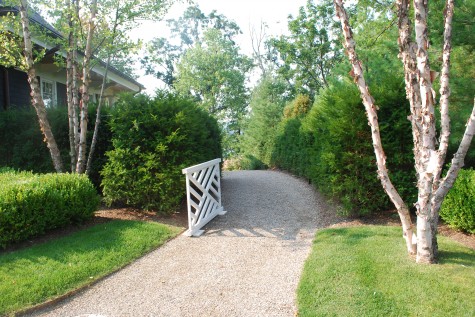
Curves provide opportunities to screen views, or provide a sense of anticipation about what will come next.  This gravel path reveals little of what is to come, as it both curves and drops out of view from outside the gate.  Transitional spaces such as this one are very important in giving a landscape a sense of continuity as you move through it.  Even the smallest yard cannot be properly experienced all at once.

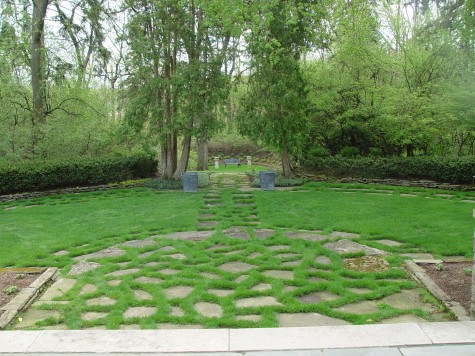
This old flight of stairs and lawn terrace were designed on a very large radius.  All of the attendent plant material was planted in concert with this shape.  In the distance, a circular garden whose center of interest is an antique garden bench flanked by a pair of Georgian pedestals.  This is a very formal but understated design based on the circle. 

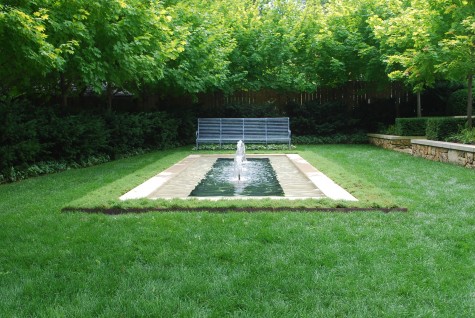
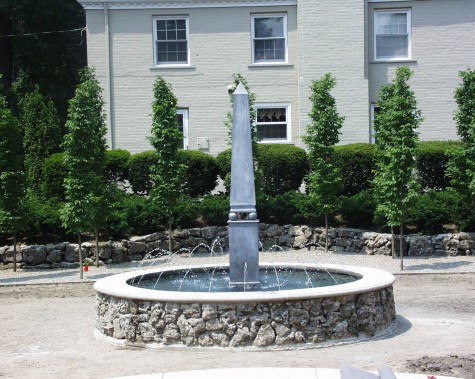
This circular fountain is the dominant element of the landscape under construction here.  Curving the retaining wall in the background away from the fountain is a response to the importance of that fountain.  Any gesture that gets repeated emphasizes the importance of that gesture.   


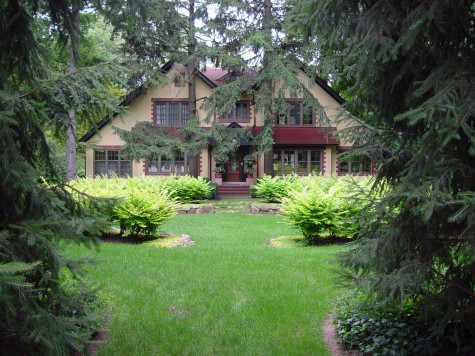
Though the view in to this landscape presents a formally constructed sunken garden in a circular shape, the choice of plant material keeps that formality from seeming out of place with the style of the house.  Gold vicary privet is a plant one saw routinely in suburban landscapes 50 years ago.  It was usually planted as an accent plant, given its astonishly bright leaf color.  In this application, the vicary gives weight to a curved shape located in a space shaded by the surrounding mature spruce. Choosing the shapes of places in a landscape ahead of choosing the plants-a good idea.

Rearranging What Is Already Yours

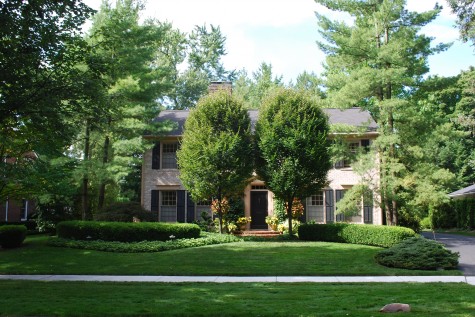
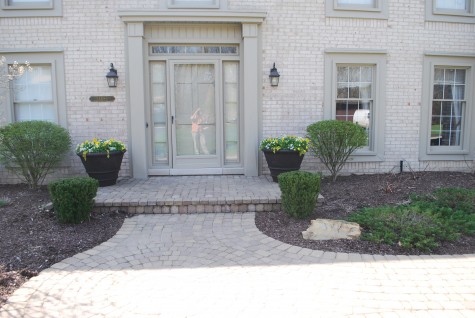
Even the most carefully planned and planted landscapes can go awry, given enough time and circumstance. So no wonder that landscapes that were planted without regard to mature plant heights and sizes, eventually suffer and decline from that reactionary style of pruning that turns every green plant into a shadow of its glorious self.  The person who decided to plant euonymus alata compacta-burning bush-in front of a house with windows that are only inches off the ground, and in spaces scarcely 3 feet from walkway to wall, or 6 inches from the foundation of the house- this person knew only enough to be dangerous. A spectacularly grown compact burning bush is every inch of  8′ by 8′.  This would be 64 square feet of loosely structured shrub whose charm lies in its casual ability to densely screen a large space, and its brilliant red fall leaf color.  There is no sign of such in the above landscape; the burning bush have been bit back to the quick by an electric hedge trimmer with an unlicensed person at the helm.  In this case, a lawn cutting crew moved on to landscape maintenance without one shred of knowledge about proper pruning.  Landscapes thus maintained age very quickly.  

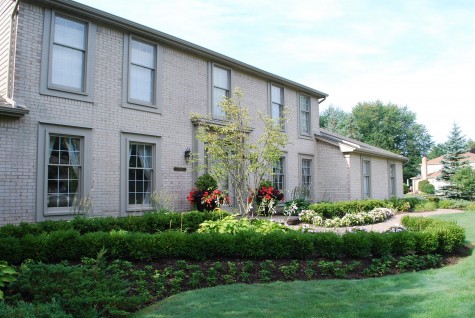
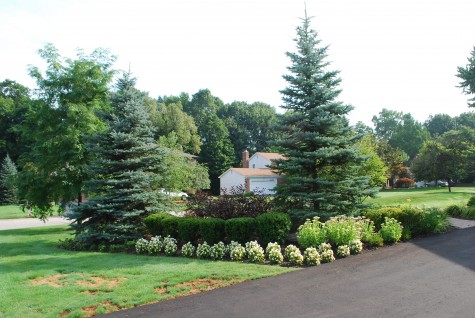
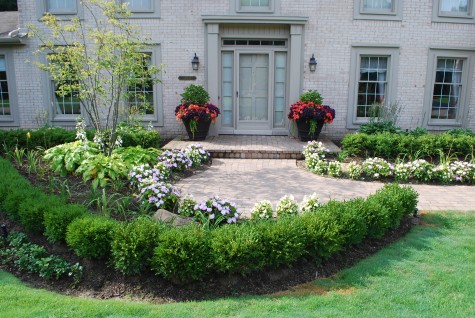
Given that this client has a sizeable property, we found a home for the burning bush where they could spread their wings, and live in peace.  Existing boxwood was dug and replanted in a more generous and informal curve.  New boxwood across the front of the home can be maintained at a height that features rather than obstructs the windows.  Unseen as well they should be-variegated hostas were collected from 5 different locations on the property, and planted in mass behind the boxwood.  Thery will mature at a height well below the bottoms of the windows.

Plants die-from disease, from physical damage, from drought or overwatering, from poor placement-or from old age.  Barked landscape beds give the impression of neatness and care, but eventually the empty spaces outnumber the planted ones.  The red leaved sand cherries in this bed have reacted to their yearly flat-top buzz cut with long leggy and unattractive stems.  The spruces which 10 years ago had plenty of space are further putting the squeeze on those badly pruned shrubs.  We moved these stick bushes to better pastures, and moved in some of the same species that had been languishing in another bed in the shade.  

The yews from the front of the house-pruned exactly like the burning bush, were moved and grouped so they could grow together as a mass.  They hide the bare legs of this new group of sand cherries-by nature a very short lived and disease prone shrub.  I would guess that by the time the spruces close in on one another, the cherries will be at the limit of their lifespan.  Shrubs and perennials can fill these awkward gaps in a landscape which inevitably occur when you place plant material with enough room to grow.  

The hydrangeas now underneath the spruce skirt were moved where they had light and room to grow.  The two oddly placed variegated euonymus were dug from a number of spots, and planted in a mass that will grow out in a pleasing way.  We filled the rest of this bed with existing plant material that needed a more friendly home.

It will take time for all of the plants to grow out of their hot air balloon shapes, and have a a natural and relaxed look.  Annuals and perennials do a great job of filling the gaps, so the bed looks fully planted.  A landscape renovation is not always about introducing new material.  It can be about moving, dividing, rearranging, relocating what no longer works.   

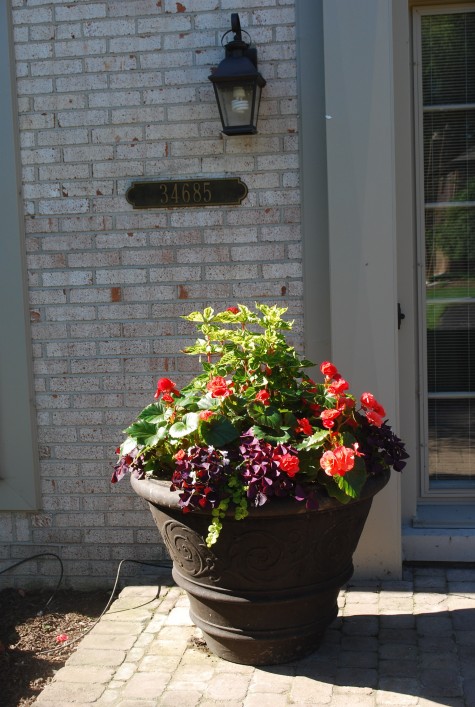
New pots on the porch was the first step in revising this entrance planting.  The picture above tells more than you ever wanted to know about bad placement, worse pruning, and bark.  This landscape was much about what was performingly poorly, and missing.   

Most of the plant material you see here came from someplace else on the property. Recycled plant material, some new boxwood, and some annuals make this porch a far more inviting spot. I am the first to suggest when something just needs to go, but I do try to imagine what it would look like, or how it might better perform in another location.    

Newly planted plants have that fresh out of the nursery look. But plants will settle down and grow, given proper siting, planting, and care.  As for the rest of what you have, there may be a new landscape sitting there, waiting for a new arrangement.