Some Thoughts on Spacing

Once there is a landscape plan in place, there is the matter of the plant count.  Determining a plant count has much to do with spacing.  I have read much about rules for spacing plants properly for optimal growth, but the issue is more complex than that.  For instance, if I am planting pachysandra, and space them at a foot apart, I need one plant per square foot.  For 500 square feet, I will need 500 plants, or about 10 48 count flats.  If I space them at 6″ apart, I need 4 plants per square foot, or 2000 plants, or about 40 48 count flats.  Option A asks for a modest up front investment, but I see a lot of time ahead devoted to weeding, the purchase and spreading of a lot of mulch, and a lot of water thrown on bare ground.  I also see a grim looking space for probably 3 years.  My solution?  Start a groundcover bed small and plant densely.   Enlarge it next year, or the following season- only that number of square feet you can plant densely.  My mature, healthy beds of pachysandra-individual plants are much less than an inch apart.
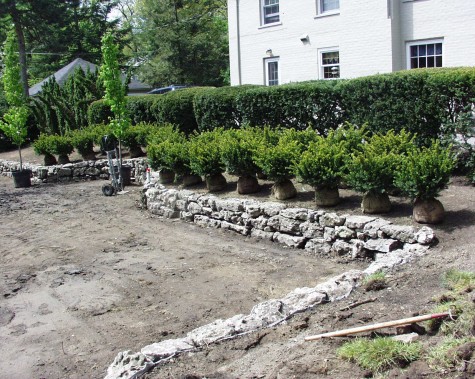
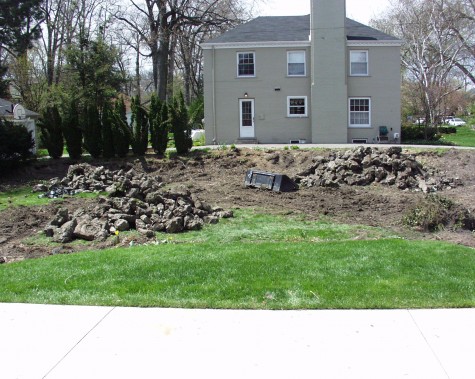
Spacing evergreens has everything to do with the desired outcome.  Should I plant a taxus densiformis in the middle of the lawn, and give it 50 years to grow, I will have a single plant of considerable size.  A hedge, or a mass of yews is more about a community. Sometimes I look at the distance between the rootballs.  The big idea here-everybody has their own subterranean digs. This may mean that the foliage touches.   
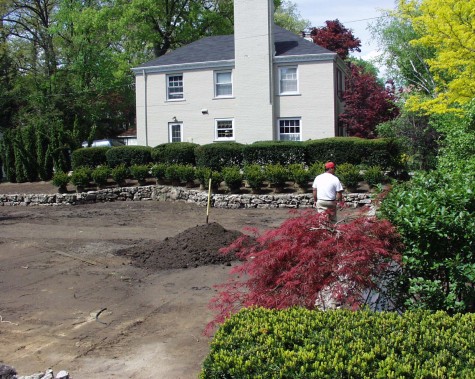
Plants are much more sociable than I.  I want my space. I was never so conscious of the need for my own space than after my knee replacement.  I was less than stable on my feet, and was not interested in an enthusiastic Golden Retriever broaching my borders. But plenty of plants do well planted in close quarters.  They are completely happy to relinquish their individuality, and become a part of a larger community.
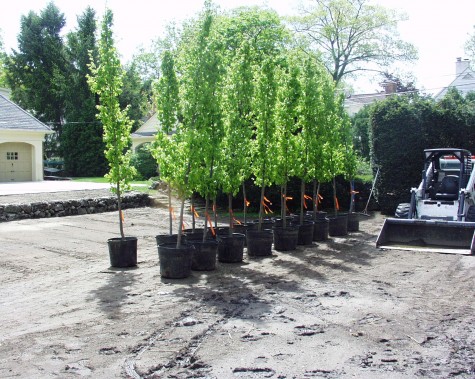
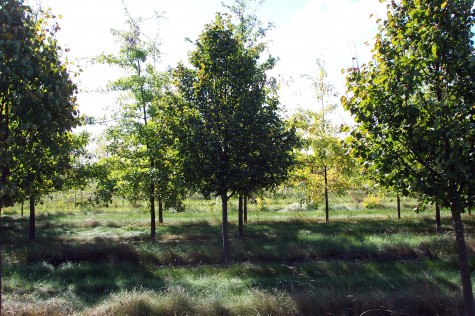
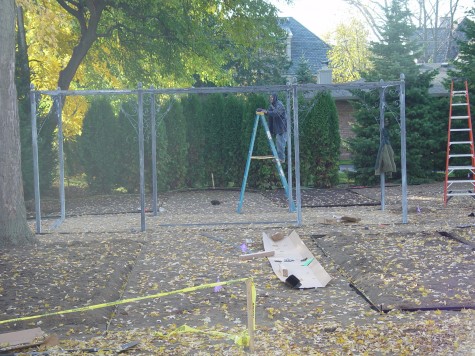
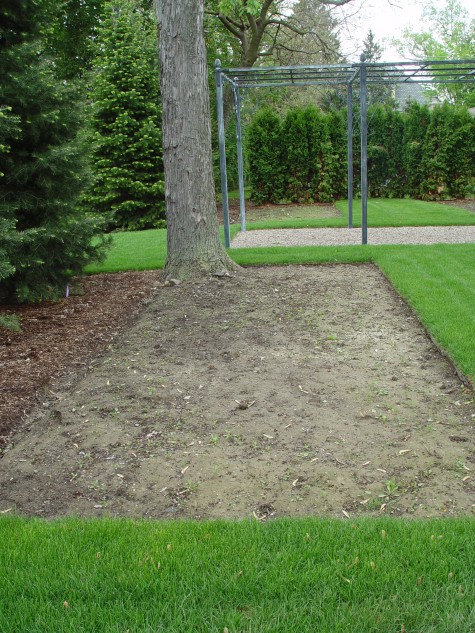
One of my most favorite landscape moments-the arrival of the plants.  These 1.5″ caliper fastigiate hornbeams in 25 gallon pots would be planted as if they were the poles of a pergola. Carpinus betulus “Frans Fontaine” is a culitvar of fastigiate hornbeam which is slower and more densely growing than the species.  Even so, it will grow 30′-35′ tall, and 15′-18′ wide. I spaced them at 8′ on center, knowing they would grow together.  Someday there would be a green roof under which there would be shade.   
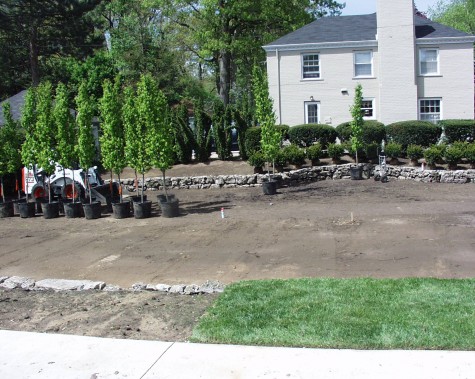
I had other reasons which influenced my spacing.  The house next door loomed over this side yard property.  Evergreens would have provided year round screening, but they occupy a lot of space at the ground plane.  My clients wanted to entertain in this space.  Given enough time, and spaced close together, they would eliminate this view of the neighbor.   
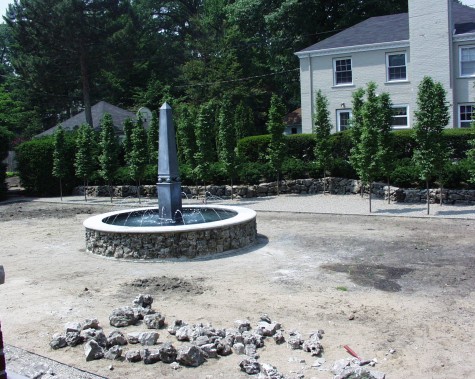
Carpinus are also very tolerant of pruning.  Decisions about spacing are specific to the species in question.  The vast majority of green spaces have not been planted by a person.  There are those wild places densely populated by plants.  No natural forest or meadow is at equilibrium; some plants are coming on as others are in eclipse.  Perhaps a lighting strike will “prune” a giant tree such that new plants can take hold around it.  Should you be interested in the exceptions to any gardening rule, visit any wild and untended space. 
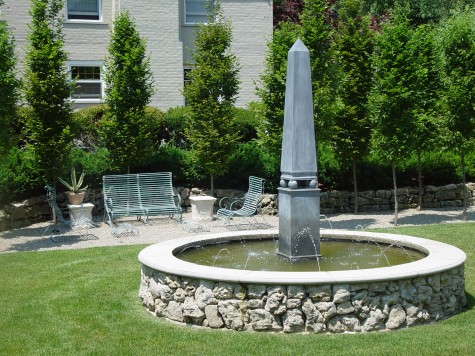
Five years later, the new yews have grown together to make a mass.  The topmost row of yews had been transplanted from the front of the house; the new yews will eventually cover their bare lower limbs.  It sometimes makes more sense to underplant an old and ungainly shrub rather than tear it out.  These big old yews will eventually become part of a simple mass.Eight years later, the house next door has all but disappeared. As the carpinus grow taller, they can be selectively pruned on the underside to permit easy passage beneath them. 
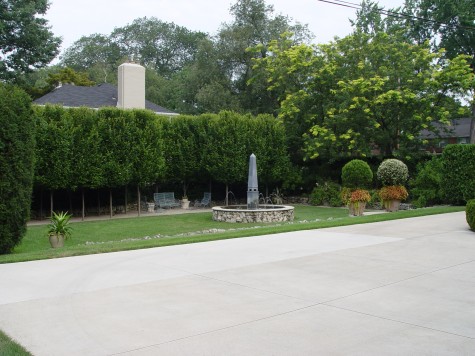
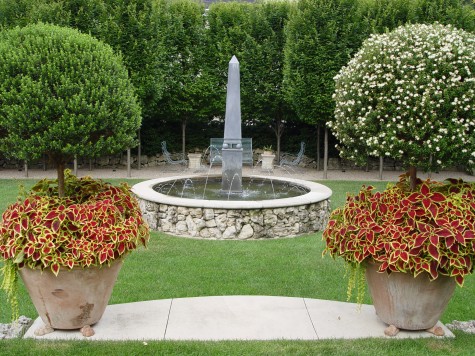

The yews planted behind the carpinus are planted on a gentle slope that rises to the neighboring driveway. Though the shade has become considerable, they are green and well needled from top to bottom.  Allowing those densiformis yews to keep their natural shape is in large part responsible for their continuing health.  Yews do not respond so well to hard formal pruning.  Once all light is blocked to the interior of the shrub by a proliferation of growth on the exterior, those inner branches will go bare.  I have begun planting Taxus media Moonii in place of Hicks yews, as their natural growth is much more upright and formal. 
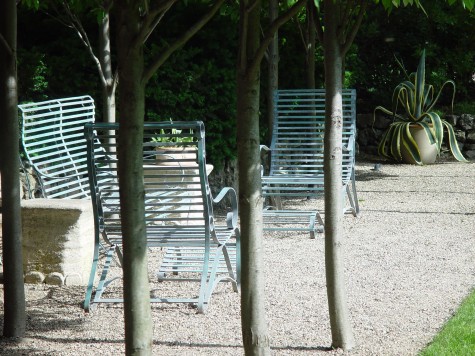

This is a great spot to sit.
Stature


Stature is a concept everyone understands. Any human being 6.5 feet tall gets attention-just for being heads and shoulders above the rest of us.  A physical presence makes an unmistakeable impression.  Alan Armitage has made a life’s work of studying plants.  His shoulders-a whole body of work about what plants work, and what plants a gardener might consider passing by.  His head-he writes and speaks intelligently and passionately about that human activity close to those shoulders-gardening.  You may agree or not with him, but he has stature such that any serious gardener would give pause, and consider what he has to say.

Anyone of stature has the power to give pause. That the modern world is geared towards everything running at top speed, anything that slows me down has stature.  True stature has to do with size, persistence, experience, and longevity. Trees do a good job of filling that bill. They are very large plants. I have read that the standing weight of a 26″ diameter hardwood is 4.2 tons; a mature oak tree will have close to a quarter million leaves.  Some trees live a thousand years.  Others grow to towering heights.  Some grow in wild places never having had any care, and endure. 


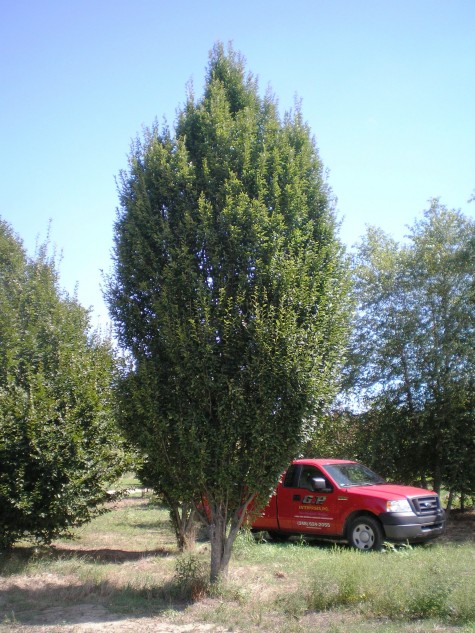
 This columnar beech is almost 30 feet tall, and has been growing at a tree farm a good many years.  GP Enterprises sells and transplants big trees.  This is a very specialized part of the landscape industry, as the cost of the equipment which which moves those trees safely and successfully is astronomical to buy, operate and maintain.  Not everyone needs a tree of great size, but sometimes the stature they confer on a landscape makes a lot of other work unnecessary.  What a person might spend on shrubs or perennials over the years can come to a lot more than the cost of one large tree.

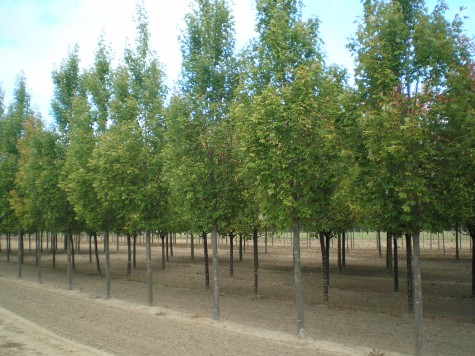
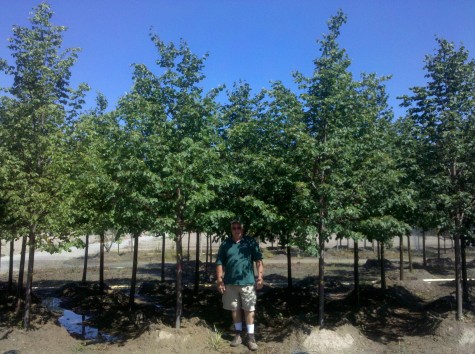
Any tree has stature potential; small trees are reasonable to purchase and take hold much faster than a specimen sized tree.  That said, the most difficult part of adding young trees to a landscape is the placement.  No one wants the expense of taking down a very large tree planted too close to their house, or their sidewalk.  A properly placed large growing shade tree can look lonely before it grows into its own. These 4 inch caliper Bowhall maples pictured above will eventually tower over the ground plane.  Planted at the corners of a 12 by 12 or 15 by 15 foot space, you will have a maple tent in not so many years.  Plant 8 or 12 trees, a  pergola big enough to entertain in.  You can see the potential for a landscape feature with stature in this picture.

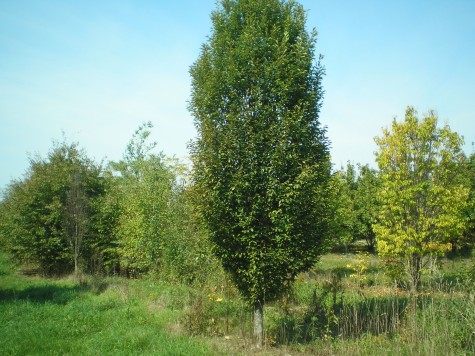
Columnar carpinus has a natural growth habit that reminds me of an egg with a softly rounded top.  Columnar trees do not co-opt all the available sun, and they do a great job of screening out an untoward view.  Maturing at 40 feet tall, and 30 feet wide, they have an elegant form that appeals to me.
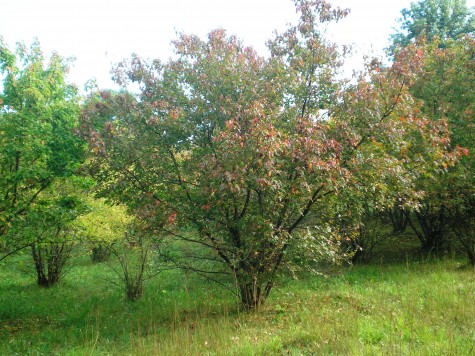
This older multi-trunked Amur maple has an entirely different look than the carpinus.  The carpinus I would call architectural, and imposing-the Amur maple is graceful and lovely.  This insouciant amur maple meadow is as visually successful as a formal landscape-just different.  The choice of a tree or trees can influence the atmosphere of a space. 

 
Ralph Plummer owns GP Enterprises, and though he landscapes, builds retaining walls, engineers drainage and grading, he has made a life’s work of moving and planting big trees. Even if he were not 6′ 6″ tall, he would still be a person of great stature.

The Silver Maple

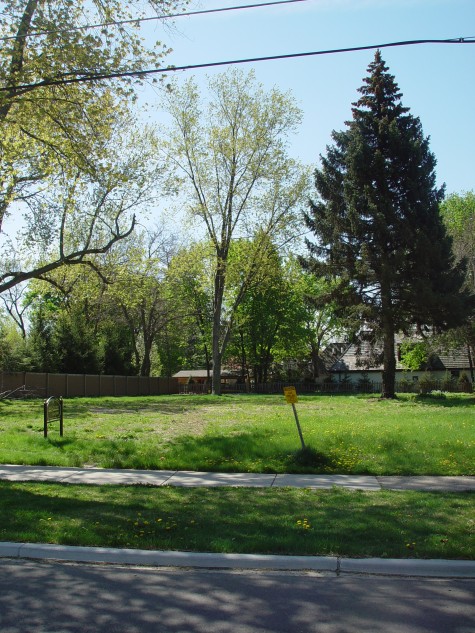
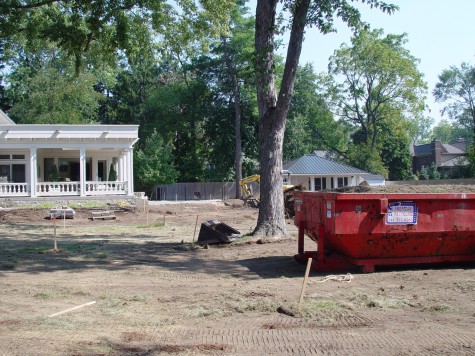
A client purchased an empty lot next door to them, with the idea of completely reinventing the landscape such that two properties would read as one. Though it did not have the best looking shape in the world, there was an existing silver maple they were reluctant to take down. I understand this feeling completely; I do not like to take down trees either. I work with existing plants all the time; we would work with this one. 

Every other plant on both lots was dug and moved.  The maple was out there on its own. I did not want to design a landscape around this tree; it was in less than ideal condition.  There were views across the new lot that would be important from the rear porch; I could tell right away that the landscape design would be impacted by this tree.   I designed the schematic landscape as if it were not there, knowing that when the time came, I would be working around that tree. 

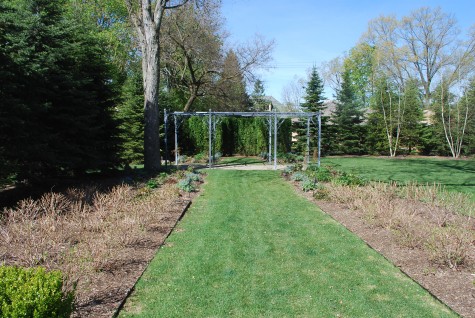
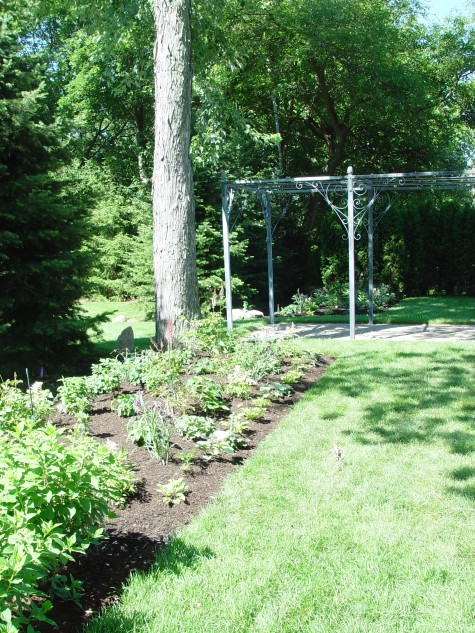
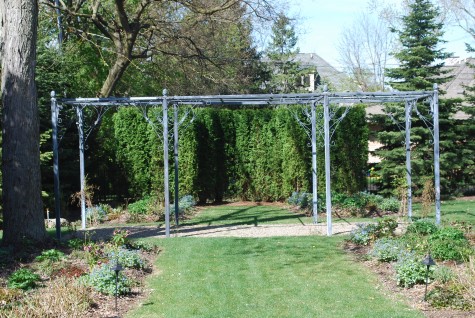
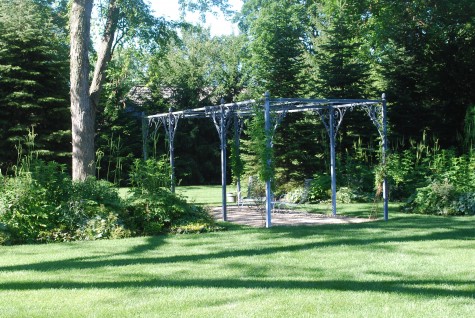
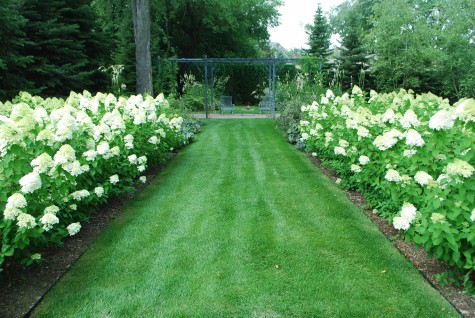
The landscape eventually called for four large perennial beds that would terminate in a radius of arborvitae.    A pergola 27 feet long set midway and perpendicular to those beds visually anchors the space.  The silver maple is just barely visible on the left; the trunk is half in, and half out of the bed.  I rather like a very formal design that is punctuated by some unexpected  element.  The element of surprise can be a very effective way to focus attention on the overall geometry of the space. 

There was but a very short time that this view would be visible.  Once the plants were installed, it would look like that tree had sprouted and grown out of an existing garden. The fact that the trunk tips slightly away from the garden lends a little visual weight to that argument.  Much more difficult than than getting this tree to work with these four quadrant gardens would be getting the perennials to work with that tree. The maple casts a good deal of shade-the shade was by no means even.  I wanted a tall and substantial garden with plant material that repeated the same mix in each quadrant.  My client wanted perennials with white, lavender and purple flowers.

The view out to the gardens is a long one. What was an empty lot is not so empty anymore. I believe that even if the maple had fallen within the grass path out to the pergola, the design would still have worked. Three multi-trunked birch that had once been in the back yard were successfully transplanted to the side lot. 

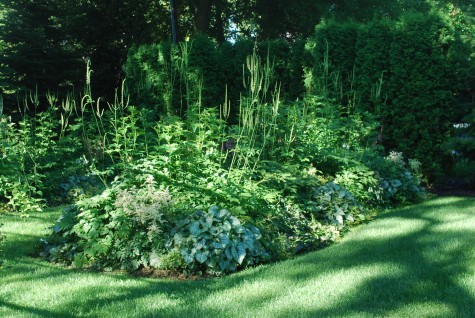
I chose plants with a reputation for tolerating varying conditions.  Hellebores I knew would do fine even in the sunnier areas. Bridal Veil Astilbe, and Astilbe Tacquettii Superba do well here.  Gold drop hosta, Jack Frost brunnera, White Innocence and Concord grape tradescantia and alchemilla mollis were planted along the border with sufficient space in between to allow for some low annual planting. The dominant plant is snakeroot-cimicifuga racemosa.  Its white bottle-brush flowers on long graceful racemes give a garden the height I was after.  Monarda fistulosa Claire Grace gives a  great show of lavender flowers at about the same time.   

The pergola was planted with sweet autumn clematis, clematis Jackmani Superba, and clematis viticella violacea. It has been a challenge to keep the rabbits away from them, but they finally seem like they are taking hold. 

I plant an occasional nicotiana alata white, here and there.  White Japanese anemone and aconitums are the star of the show in very late summer. They are just budding up now.

It has been three years since this garden was planted; it seems to be doing well.  Of course there will come a time when some division or replacing will be necessary.  The clematis are a little behind schedule-the day when they are dripping from the roof of the pergola will be a good day. 


The silver maple in question has company now.

Taking A Test Drive


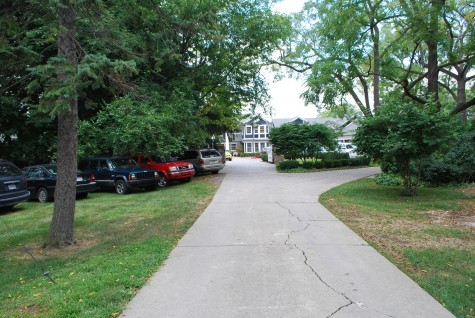
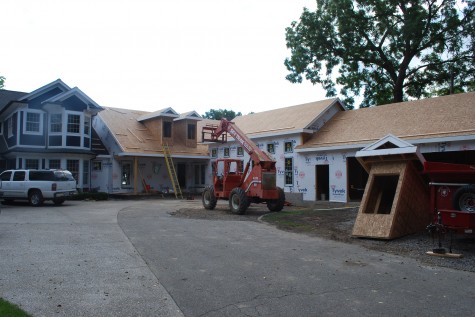
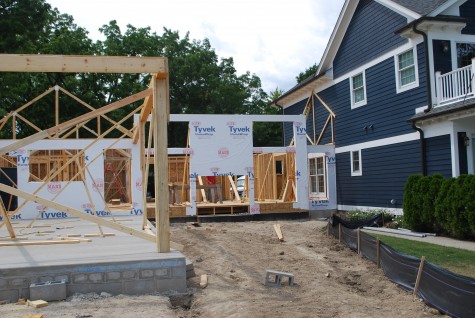
Finishing up a long project feels great.  This time, I was invited back for a Sunday afternoon reception along with every other contractor that had been involved in the design and construction of the addition, and the landscape that followed.  Lake houses tend to have lots that are deep and narrow, which places homes in close proximity to one another.  My clients had the opportunity to buy the property next door to them, and decided to add onto their house.  Driving up yesterday I was pleased the most about the driveway.  The old drive curved off to the right, to the neighboring property. In the course of the project, it was redone in such a way that the approach leads physically and visually to the front door.     

The white concrete aggregate pavement you see here on the left belonged to my client.  The asphalt drive swinging to the right-the original road.  This surface had to be redone not only for aesthetic reasons, but for circulation.  I did not want a drive that led vistors to choose the addition/side door in lieu of the proper front door. 

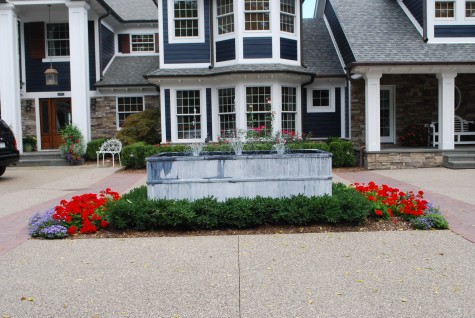
The stripes of brick set in the concrete aggregate run on either side of a 4′ by 8′ fountain cistern. This describes on the ground plane what is now the center section of the house. This landscape/driveway element divides the drivecourt space into three distinct areas, and additionally provides for a good amount of parking.  A large drivecourt was a necessity; the house is beyond walking distance from the main road. The driveway approach actually services three homes, so onsite parking was a must.

To the far right in this picture is a short run of decomposed granite that connects to the main drivecourt, so there can be parking and circulation in and out when they entertain. No one could tell from here that there were 12 cars parked on the drivecourt.  I like landscapes that are good looking as much as I like landscapes that work. 

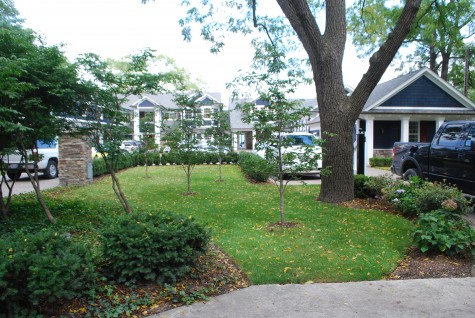
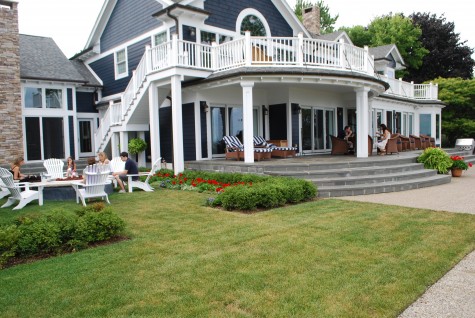
On the water side, the main job of the landscape was to integrate the two properties and make them feel as though they had always been one. This requires taking a lot of the existing landscape apart, and relocating it.  A previous post I wrote on this project detailed a flat plane of grass bisected by granite X’s and boxwood dots.  This elements extends across the entire width of the property.  Both the repetition and size of this feature help to unify the two spaces.  I was so pleased-Buck had a hard time spotting what was original, and what was added.

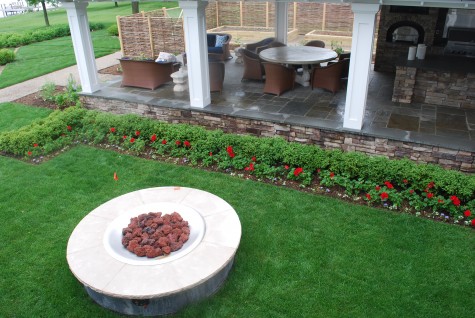
What had been the end of the house is now a backdrop for another seating area on a level different than the original bluestone terrace. The firebowl set at seat height provides a dining table for larger gatherings.

The covered porch terrace is set at the same height as the original terrace.  The stainless steel firebowl has its own cozily enclosed space.  I am sure it will be comfortably out of the wind on a chilly fall day. The covered porch with an outdoor kitchen is immediately adjacent to a large fenced vegetable garden.  

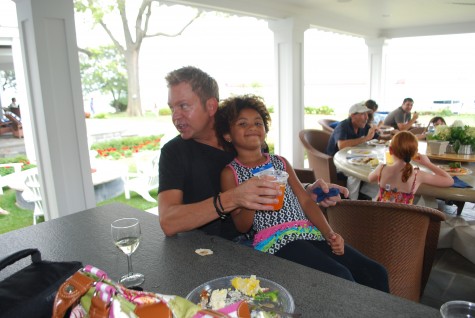
The enormously and formidably talented Jeffrey King was there with his partner and kids in tow.  He was responsible for all of the interior design-which is fabulous by the way. Don’t ask for pictures-that story is for him to tell. He was involved in every facet of this project from start to finish-he has a gift for encouraging the best from others. The house and garden was full of people.  There were places to visit, and sit for a while, eat, converse-both inside and out. It was a delightful party; a house and garden full of people is a good thing. 

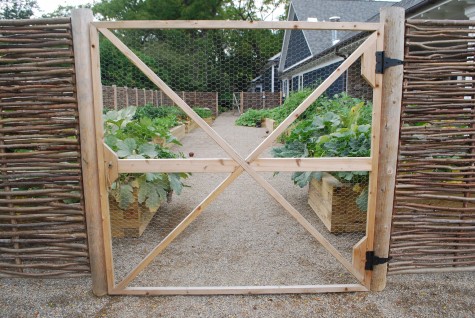
The vegetable garden is the hit of the landscape. The raised beds are filled with Steve’s soil recipe-which includes a generous percentage of worm castings. Everything she made for the reception except the chicken came out of this garden-much to everyone’s delight. The food was out out of this world. They have not only given away scads of vegetables, but they have played a version of bocce here, and held two dinner parties set at a pair of long wood tables that have been in the family a long time.  My favorite part-the wood gate is an exact replica of my client’s father’s vegetable garden gate in Italy.  Design development and installation that works its way around to what is personal, and matters to a client -this is the point at which a design relationship gets to be thick, substantive, lively-and good all around.


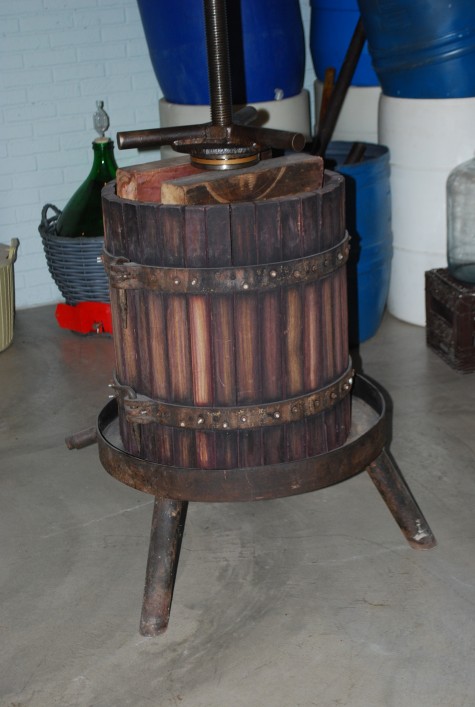
Little did I know that the basement has a room which houses wine making and sausage making equipment passed on to them from family.  Apparently father and son will be making wine.  All the way home, all I could think about was where to plant some grapes.