The Painted Border


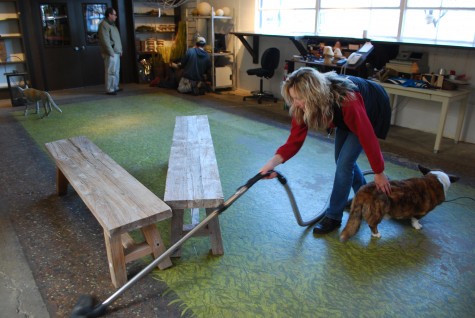
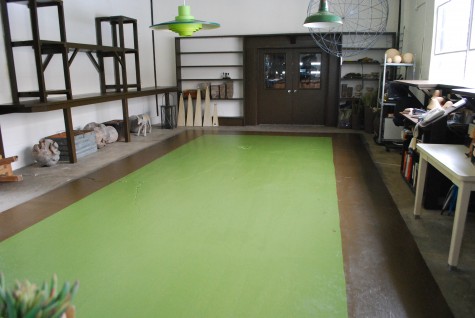
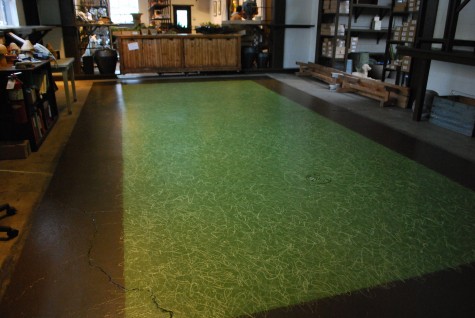
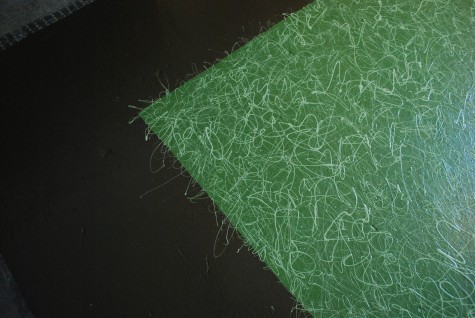
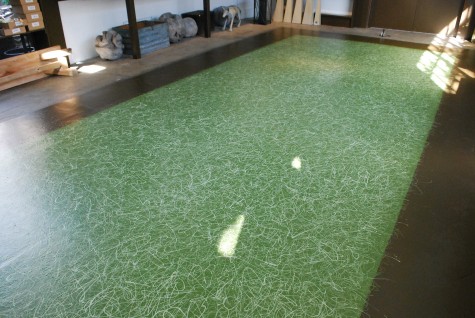
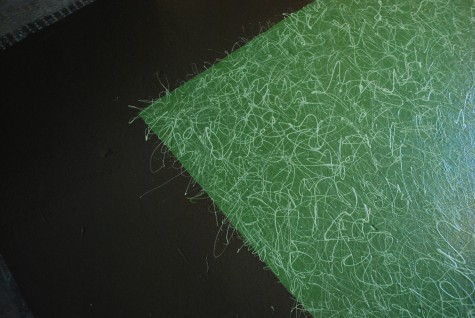
Repainting this concrete floor has gone on for over a week now.  I am hoping to finish up quick.  A container from England is sitting in customs; we need to be ready for that delivery. The four color green ground of this painted rug needed a border.  The base color is a dark chocolate.  Though I knew where I wanted to go color wise, I needed a texture that was unlike the texture of the ground.  Contrast is not strictly confined to color.  Though I had the best time signing the floor with loops of paint in a steady stream from my stir stick, I wanted a different texture for the border.  A clear definition of the edge.
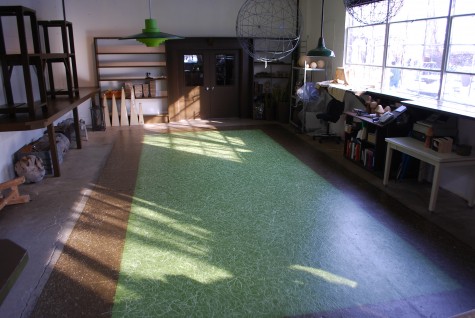
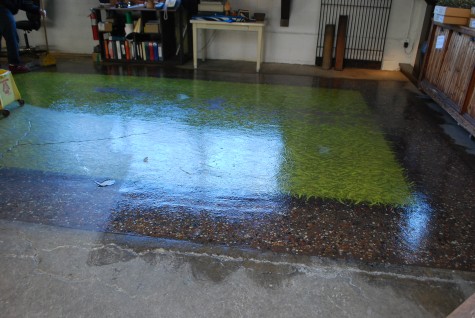
The border is entirely painted with drips.  Those of you who read this blog regularly know dirt follows me around.  It is always under my fingernails, and in my sock tops.  As a painter, I know anything I wear will sooner or later show evidence of the painting process.  I am likely to have paint on my shoes, my hands my face, and my hair.  It is a life condition-I have no other explanation.  Paint drips usually land on me.  My plan-the paint would drip on the floor, and not so much on me.   
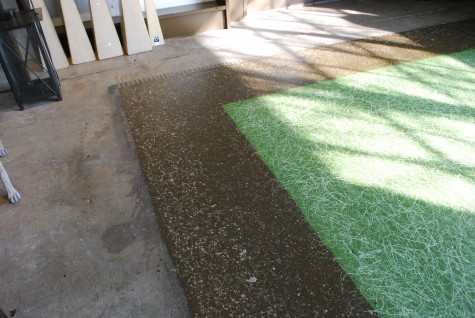
I was after a gravelly texture.  It seems like it ought to be the simplest thing in the world to get paint to drip-it happens unbidden all the time.  But regular drips, not too fast drips, not too big drips-this involves paint at a perfect consistency.  Thick enough to permit multiple drops, but thin enough to deposit small and civilized gravel-like shapes.  This part was work.  It will be a good thing when this floor is covered with the great things we have coming for spring.  My globs, lines and blips tell the tale.  3/8 inch and down decomposed granite is remarkably uniform.  My painting is anything but.    
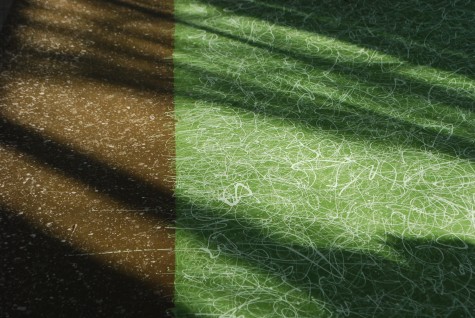
But a paint card laid is a paint card played-there is no mopping up.  I could work another two weeks to erase any evidence of my hand, but why would I want to?  My approach to landscape design is formal-whether the result is traditional or contemporary.  I favor landscape design that emphasizes structure and utility.  Distilled design that makes a clear statement.  But I do understand that the most formal design on paper is subject to wind, weather, grade, hardiness, and all manner of unforseen caprice.     
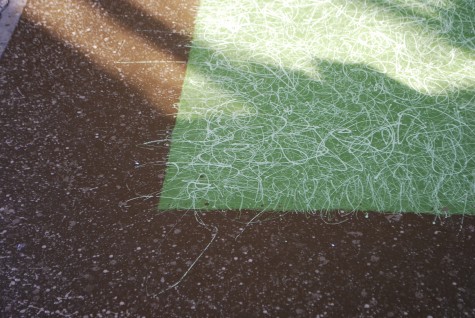
It may be what I like the best about this painting are those capricious places. A loop of green paint might find its way out there, should the muscles fueling my hand unexpectedly flex.  An inadvertent flex might end up being my favorite part.  My advice?  If you want to paint a floor, make a plan, lay it out, prepare for any eventuality, and then go for broke. The same applies to a garden.  Plan your heart out.  Then go for broke. 
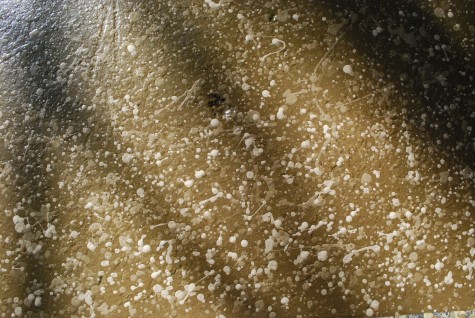

Those irrepressible blips are a personal signature.  When I sign a check, or a document, or a letter; when I design a landscape, I sign my name on the dotted line. My signature on the dotted line is not a guarantee of perfection-it is a vote of my confidence in my work.  What I do confidently is anything but perfect.  But it might be interesting.
A Signature


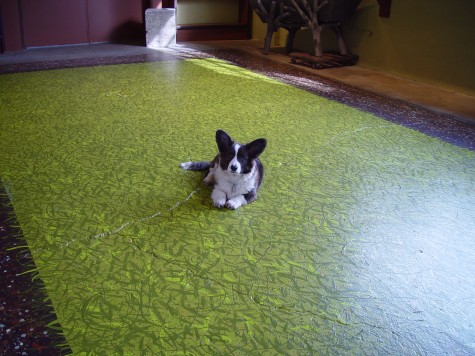
We are into the maelstrom phase of the spring redo of the shop.  It seems like everything has been moved, washed, and otherwise made ready to make friends with what what is on its way here.  Ourt first container from Europe-in customs in Romulus as I write.  Some months ago I wrote about a concrete floor that I had painted to resemble a “tapis vert”.  Lierally translated from the French, a tapis vert is a green carpet.  It is to my mind the most elemental version of a garden.  Every garden bears the signature of the garden maker.  A group of plants are arranged, have a form, that comes from human hands.  Though a wild meadow studded with poplars may not seem to have a signature, it does.  Certain and specific species thrive there.  The placement of the trees has everything to do with how seed is dispersed.  The most natural wild place has a signature, no matter how subtle.  Milo was a baby when I painted the floor with my representation of a lawn edged in gravel; he could not wait for the barricades to come down so he could go lie on it.   

Five years has taken its toll.  Lots of traffic from both people and objects had dulled the colors.  There were places where the paint had simply worn away.  Since spring is all about fresh, a fresh take on the floor seemed in order.  Moving everything to the sidelines was a big job, as was a thorough cleaning.  The paint needs every chance it can get to stick.  Howard decided to pitch in and help Pam with this. 

The floor got washed twice, and hand dried, in an effort to remove as much grime as possible.  The cleaning of this building is a full time job.  Dirt, plants and water get tracked all over.  Last time, I painted with floor with Benjamin Moore exterior 100% acrylic paint in a satin finish.  Acrylic paint is much harder than latex; the paint finish is washable, but not too shiny.  This time, I decided to use the acrylic version manufactured by Porter Paint.  We use this brand on all our painted furniture that goes outdoors, and on the extira board panels in the Jackie boxes we make.  Porter paint is a paint of choice for sign painters.  It is extremely durable outdoors.  This floor gets plenty of abuse-every muddy or wet day in every season, someone is bringing what’s on the ground across this floor.  Durability is important. 

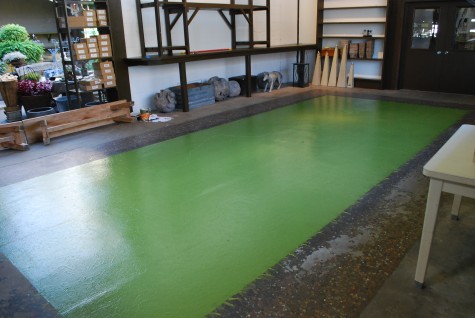
What particular green to use as a base coat-I spent plenty of time stewing over that.  As the previous painting featured a green leaning towards yellow, I decided to change to a grass green.  Fern green.  A green not yellow, not blue.  Just green.  You cannot tell the temperature from this picture; the building is cold this time of year.  Big and drafty and a fortune to heat, we keep the temp down and out coats on-usually somewhere between 50 and 55.  This means the paint dries slowly, but I cannot imagine taking on a project like this any other time of year.   

The chocolate border is a paint color called “afternoon tea”.  How appropriate to the time of year.  Have you ever picked a paint color that had a name you did not like?  I haven’t either.  The person whose job it is to name paint colors-they must be bursting at the seams with ingenuity, and endowed with a stellar vocabulary.  Two base coats were applied-this part took 3 days.  Letting the paint dry enough is essential.  I do like to apply a second coat as the first coat is just barely shy of being dry.  I believe this makes the top layer stick better.   

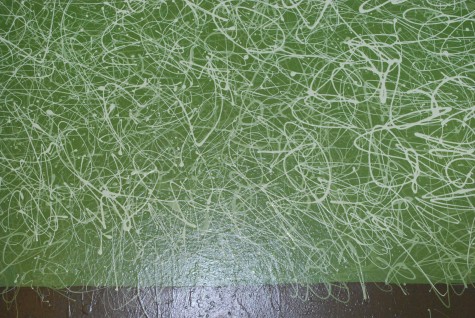
The texture of the green ground the first time around came from a series of stokes meant to have a grassy feel.  I am sure I applied 3 additional colors over the ground.  Ths time I had something different in mind.  I wanted to apply the paint as if it were being written rather than painted.  This meant thinning the paint down until it ran a bit.  All of the paint was applied with a paint stir stick, not a brush. 

My paint stick was just inches above the surface while I was writing-this was a tough position to maintain for long.  But it was great fun.  That paint stick was a cross between a baton, a light stick and a pen.  Sometimes I would draw, sometimes I would sign.  I shook the stick on occasion like Milo shakes off the snow.

What did I write?  Whose names did I sign?  You will have to decide for yourself, come March.

The border-tomorrow.

Black And White

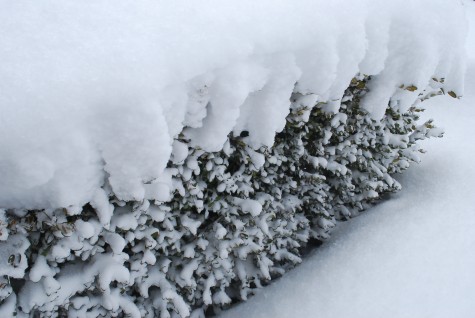
Looking out the window yesterday, I was crushed by what I saw.  Snow falling at a rapid rate.  Nor did it quit-hours later there was still snow falling.  Wouldn’t you think that after all the snow we have had in the past 5 days, that nature would be out of snow?  Are not the snow reserves in the upper atmosphere completely depleted?  Is nature not exhausted from her nation wide, days long snow and ice dump, and needing to scale back, or take a nap, or something?  Is she not getting a little bored with all the white everywhere, and thinking to switch on some other type of weather?  Change the channel, maybe?  I have places where the 30 inch tall boxwood has a snow top hat over 36 inches tall.  Yes, the snow came spectacularly wrapped in a wind package.     

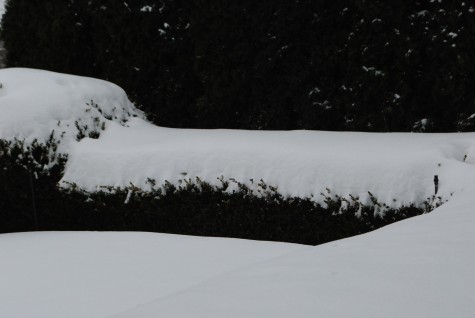
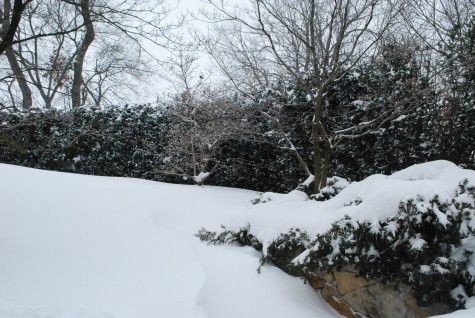
It’s not as though I have no tolerance for winter weather-after all, this is my 60th winter in this zone.  But the volume of snow we have had has wrought a remarkable change in the landscape.  That every crisp angle and shape is blurred-an ordinary consequence of the Michigan winter.  But the volume of white in the landscape is making every other still struggling to survive color go black.  I can always tell when the temperatures get very cold-my yews at home will go black green.  Today they make a black hedge with a few white specks.  Boxwood is a lighter green color-this boxwood has gone black from the sheer volume of white engulfing it.  In spite of my exasperation with the current weather,  I am noticing that the extreme contrast between black and white is painting a graphically stark and pared down picture of the design of the landscape.      

Perhaps the very best time to look at whether the design of a landscape is working is when it is reduced to its black and white bones.  Every sculpture, pot, fence or other inanimate object has a shape that is unmistakable.  The shape and size of this brown pot makes a far stronger statement than its surface decoration.  When I look at pots for a specific spot, I consider the shape and proportion first, and its color or surface decoration second.  The most gorgeous pot in the world will not look like it-placed in the wrong spot.  I am getting a lot of visual help from the snow here.  It blankets the ground, and every other horizontal surface.  There is no grass, water, flowers, dog toys, bugs, leaves or birds to distract me. I can see the form, as it is all that is there to see.  I suddenly realize why people photograph objects with a white background.  To better see the object, yes?  It may be that the ability to design has something to do with being able to see like this-in spite of all the extraneous noise.  Winter is an incredibly quiet time in a garden, in more ways than one.            

These wirework plant stands have details that could be lost, depending on how they are planted. The round shape will persist no matter what-making them a great choice where they can be viewed in the round.  Against a flat wall seems like a less than optimal placement for this piece.  I can clearly see the relationship of the round object to the straight wall of an iron fence.  Celebrating what an object does best means looking long and hard at that object, and its relationship to a place.  A fence creates an implacably strong shape and visual direction.  Perhaps that is why serpentine walls and brush fences are so visually compelling.  They are so unlike our intellectual idea of a fence.  Trees planted close together so as to make a fence is an unexpected experience of a tree.     

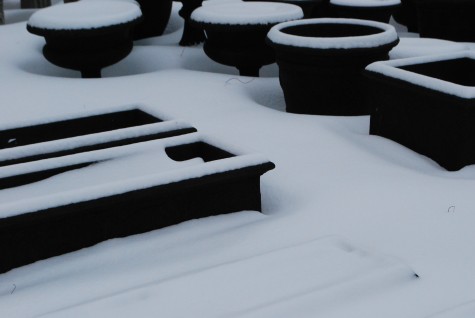
The placement, shape and mass of every object in a landscape-live or not creates visual relationships.  Symmetrical relationships are calming, orderly and dignified.  Asymmetrical relationships are dynamic, fluid, rhythmic. These concrete pots at the shop were placed to make efficient use of the space in which they are stored-not to look beautiful. The snow is so deep, the true shapes are obscured.  The rectangle in the foreground is buried in snow.  All I can really see here is the relationship of the black shapes to the white shapes.  That relationship makes a description of depth.  The mass of white in the foreground narrows to a ribbon of white that moves back in space diagonally to the grey- white in the far background. I see like this routinely. Seeing like this enables the ability to compose.      

Every woody plant has an overall shape.  Individual branches have their own shape, line and texture.  Now might be the best time to look at trees and shrubs, should you be looking to add one.  Should you want a dogwood worse than you need the size and shape of a dogwood, at least you know up front what the issues are; I am assuming you have covered the horticulktural bases.  Deciduous shrubs that have been pruned into balls and squares tell all on a black and white day.  You can decide if that style of pruning is what you want.  My pollarded Palabin lilacs looked beautiful this morning.  Another gardener might not warm up to that woman generated shape; natural, it is not.  


The stairs to the kitchen door are not only obliterated from view, they are buried under a drift that is amazingly deep. But the shape and the directional quality of the yews is apparent.  This hedge has panic grass planted in front of it; I never see this view in the summer.  I might some day want a different look, that does not obstruct the hedge, and its relationship to a magnolia and a kousa dogwood.  I can see what the change would look like.  More simple.  Maybe visually stronger.  Could it be that this part of my garden has so much competition for attention going on that it is not as good as it could be?

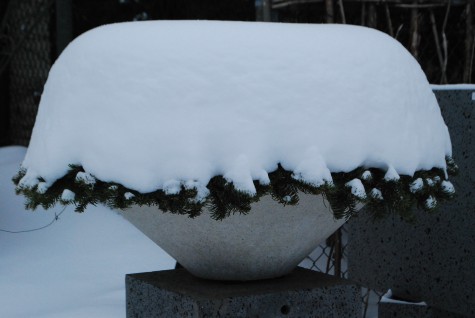
This contemporary limestone V-shaped bowl had a leftover wreath from the holidays on top.  That wreath has proved to be an excellent snowcatcher.  That snow gives me an excellent idea about what a single species summer planting might grow up to look like.  It furthermore tells me that if I plant every plant vertically, rather than turning the rootballs of the outermost plants outward, I will end up with a stiffly vertical mature shape.  Is this what I would want?   It also tells me that a minimally trailing plant will best illustrate and preserve the view of the geometry of the pot. 

My picea mucrunulatum came with the house; they were planted on either side of my front walk.  As I know them to be slow growing, and wider rather than tall, I moved them both to a spot on the drive where they had plenty of room to grow and mature without restriction.  I never do one thing to them-except look at them.  That was a good move.  This black and white day reminds me what a beautifully complex texture they have. 

Cardigan welsh corgis have very short legs.  Milo’s might be 8 inches long.  The snow depth is much more trouble for Milo than for me, but he is good natured about it.  Corgi cum rabbit, he is these days.  His only complaint is that I am reluctant to follow him out there.  I finally had to get out there-before he completely disappeared.  The overnight forecast?  More snow.

A Hot Spot For Cool Plants

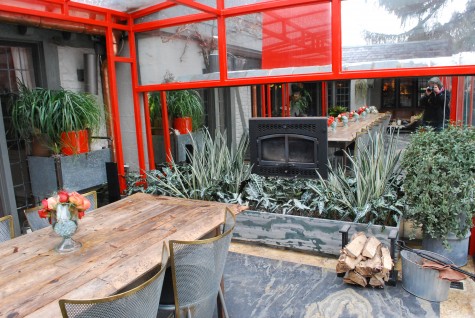
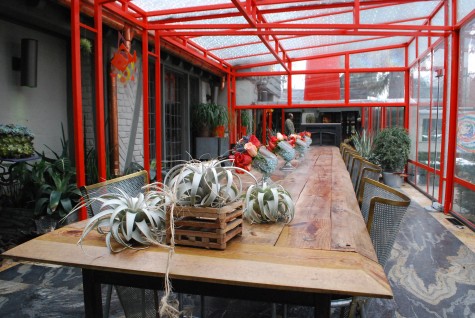
I have a client with a vision that defies description.  Her vision well may be, is no doubt, visionary.  I have a history with her that spans quite a few years, but I am never ready for what might come next with her.  I have seen her collect the most amazing and esoteric objects-for both inside and out-and gone on to see her put it all together in a way that never crossed my mind.   A few years ago she had the idea to roof a rear terrace.  I was not prepared for a steel structure painted orange, and a dichroic glass roof.  As I have since learned, dichroic glass is layered with metal oxides.  Thus the sparkles that make for a little shade.  Dichroic glass-very reflective.  The roof, in no way symmetrical, in no way expected. 

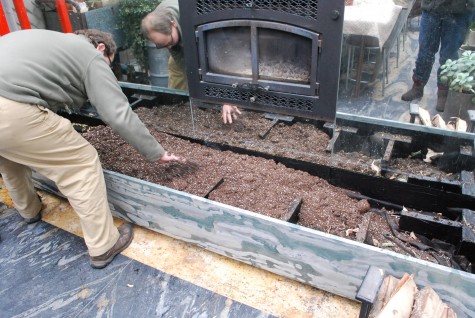
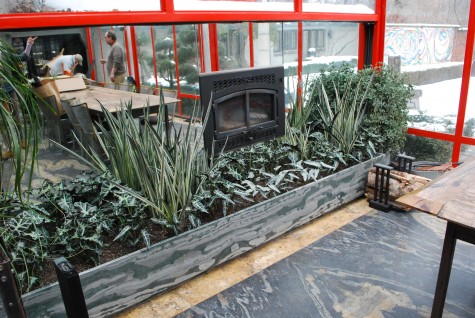
It did not take long for her to have the idea to enclose the terrace with a roof space with glass walls. A conservatory, if you please. The upshot-a conservatory of the most un-conservatory sort you can imagine. New this winter-integral planter boxes made of marble.  A very visually active and sassy marble.  I went shopping for the plants.  Whenever anyone says home greenhouse to me, I cringe.  A working greenhouse is just that-lots and lots of work.  Professionals manage this with a steely dedication.  Most home greenhouses I have seen are neglected affairs.  The remains of holiday pointsettias stashed under the bench.  Struggling tropical plants.  I would not recommend them to a home enthusiast, unless they promise to live in that space.  Places you live in have a whole different feeling than places you visit.  My basement is a good example. This conservatory space-a space in which to live.  

The orange steel structure, and the marble floor-what plants would I choose? The dichroic glass makes for more shade than you would think.  A collection of black and silver alocasias-Black Velvet, Silver Arrow, and the very rare Alocasia Tigrina Superba seemed like a good idea.  They are a supporting cast to a particularly beautiful sanseveria-Bantel’s Sensation.  Sensational, indeed.  Grey, green and black-much like the marble, and the cast iron fireplace. 

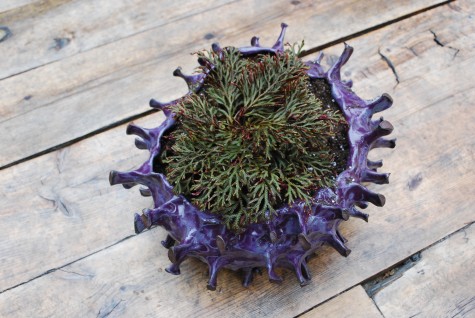
A fabulous purple glazed sea urchin shaped pot from my client looks all the better for a planting of Selaginella “Ruby Red”.  Please note, It was not so easy to choose a plant for this partcular container. I have planted no end of green and lime selaginellas in pots-this variety is new to me.  I am falling for it-hard.  Little pots demand little growing plants.  Some horticultural relationships are about the idea of an equality of contributon.   As growing things never are at rest, a sensible start-little for little- makes for a reasonable approximation of equilibrium.  This is a fancy way of saying, match your plants to their environment, and watch what will come of it.       

My clients lives in the space-any chance they get. This entirely accounts for how compelling and lively a living space it is.  She has created an environment that is warm, provocative, and compelling.  I have been here to dinner on occasion-the room, the food, the music, and the conversation-magical.  Even with the winter light, there is a sense of life that makes for liftoff.  Some of the most interesting conversations I have ever had happened in this room.  Make of this what you will.  

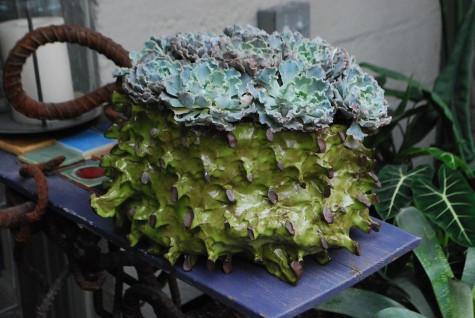
A second, and larger glazed sea urchin pot-I planted it solid with Escheveria Shaviana. Is this not a a happy relationship?  The color relationships and similar textures-very happy.  How do gardeners shop for plants?  For the flowers?  For the habit of the plant?  For the hardiness?  The designer in me shops for the visual relationships.  My background in the science of horticulture saves me from foolish choices most of the time-but not all of the time.  

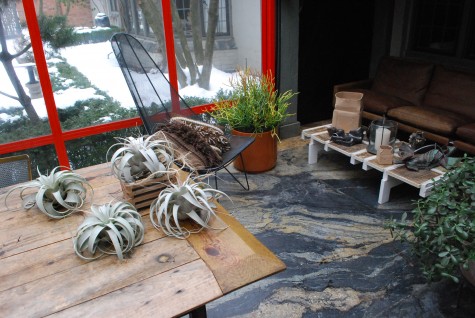
Tillandsia Xerographica is a plant I had never seen before. They are strikingly silver grey.   Before trying to plant this extraordinary space, I would not have given them a moment’s notice.  This space-they belong.  Tillandsias are bromeliads.  They are commonly referred to as air plants.  A plant you can lay on the table, which will thrive with a generous misting twice a week-astonishing.  

This space is incredibly beautiful-my pictures do it no justice.  It is unlike how I think.  It is unlike what I usually see.  My client- she is a visionary girl.