Beyond The Holiday


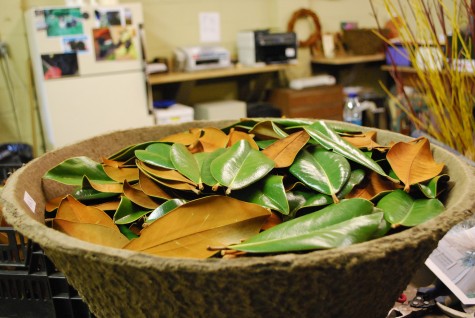
I had casually suggested to a client in December that her need for a pair of topiaries that would fit in a small and tall l-shaped space between a doorway and a bookcase might be easily handled with magnolia. I could imagine that a topiary some 6 feet tall, and very thin would gracefully, but noticeably fill the spot. The Magnolia Company was glad to oblige; they sent me a case of branches. The first order of business-remove all of the leaves from the branches, and grade them by size.  Petite, small, medium and large.    
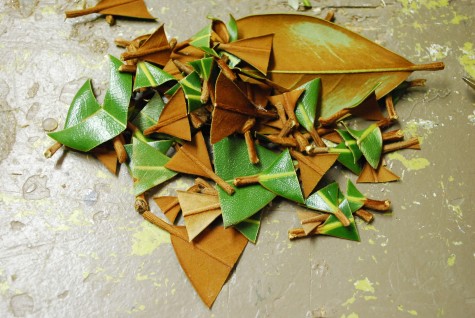
There are leaves in this world that do all sorts of good, beyond their life in a garden, or on the dinner table.  Eucalyptus comes immediately to mind, as does integrifolia. They do the heavy work of bringing a sense of the garden indoors in spaces or places that cannot support living plants.  Give me a topiary from dried or preserved leaves-never ever buy me a house plant.  I like to look in the winter, not look after. Once I cut the stem from a magnolia leaf, I can shape it, and glue it to a form.  Should I be graceful with my cutting, you would never spot that I had changed its shape.  As this client favors very formal and precise shapes, the core of these topiaries would be a stout bamboo pole.   
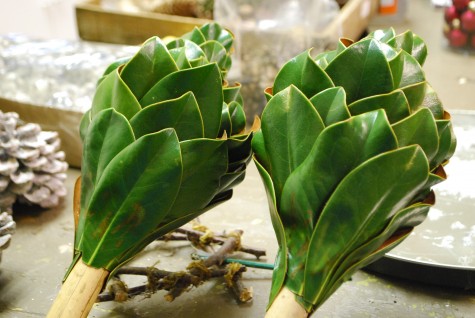
The petite leaves formed the top.  Most of the lower portion of the leaves were cut away.  Succeeding leaves were spread with hot melt glue, and applied in overlapping rounds.  This is a little hard to explain with words. but I glue some leaves flat-others I scrunch the bottom, as if I were ruching, or smocking them. This curves the leaves from side to side. The brown bruises you see in this picture-the heat from the glue.  These heat marks need to be covered by the next round of leaves. This initial glueing I did on the bench, but every so often I would stand the pole up.  The construction of any ornament so depends on the view.  Leaves at eye level read entirely differently than leaves overhead.   
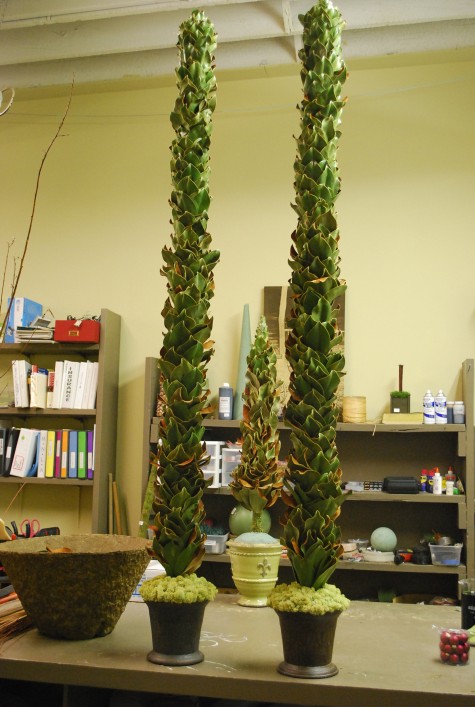
My work bench is at a height convenient for me to work on a project at eye level. I may move sculptures such as these to the floor, or onto a stool, depending on what I need to see clearly.  My client’s antique iron pots had no trouble handling the weight of the pole, and the leaves.  This picture catches the sculptures at a juvenile, and therefore awkward time.  Magnolia leaves move, curl, and twist as they dry.  Only the bottom of the leaf is secured with glue.  The natural drying process I cannot exactly predict-that is a big fluid situation.   
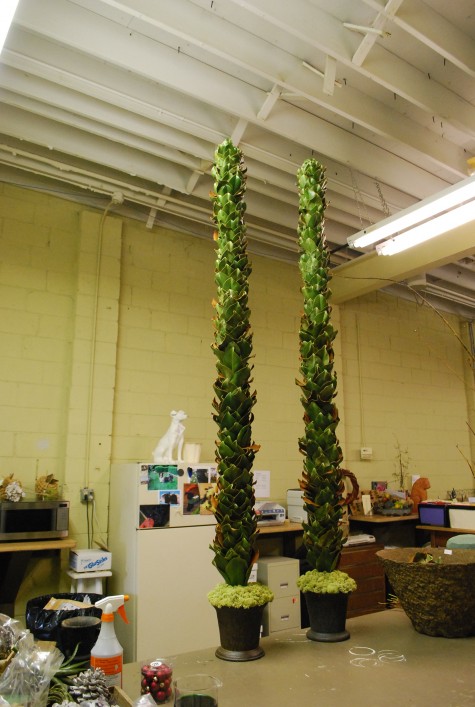

Three days later, these magnolia columns are evening out.  Why is this?  The leaves are moving and changing shape as they dry. I did my best to plan for this phase.  Predicting the curl and the fan out-very difficult.  I do the best I can, given my experience with these leaves. The construction of these topiaries is not unlike the construction of a landscape.  Any move you make needs to take into account growing, and maturation.  There is no substitute in landscape design for a vision of what the future might bring.  A showroom in Atlanta carries faux magnolia leaves by the box. I could not bring myself to buy them, even though they would never crack or break.  The natural magnolia leaves in their dry state have a grace and beauty that makes taking care of them worth the trouble.   
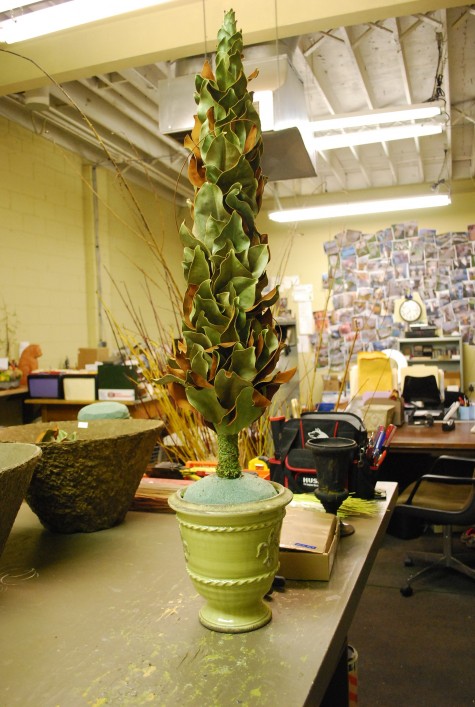
The leaves are easily manipulated when fresh; the dry leaves have a mind of their own.  This topiary was constructed initially with fresh leaves, and then infilled with completely dry ones.  This makes it easy to control the finished overall shape.       
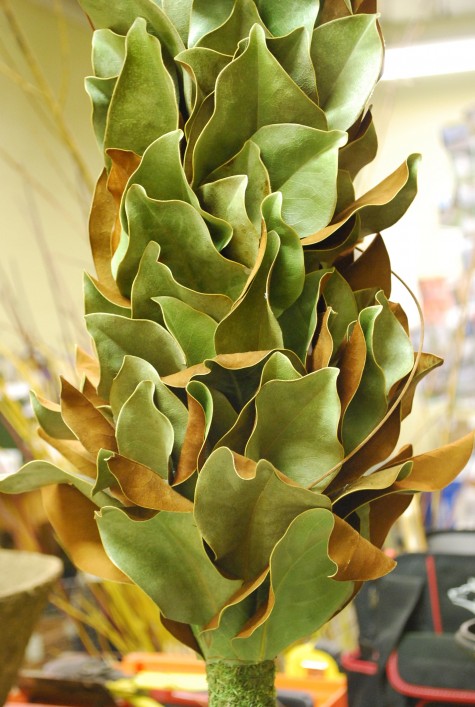
The stalk of this topiary, a wood stick covered with moss.  The stick is straight and stable, and sharpened at the top. 
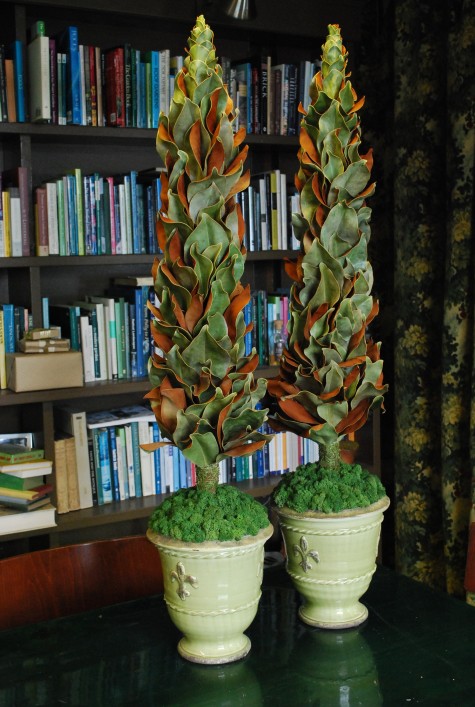

Dark green reindeer moss is glued over the dry foam form that fills the pots.  Preserved with glycerine, it will retain its color and shape indefinitely. A pair of magnolia garlands left over from the holidays made three topiaries for the shop. All that’s needed now-the finishing touchup on those leaves.
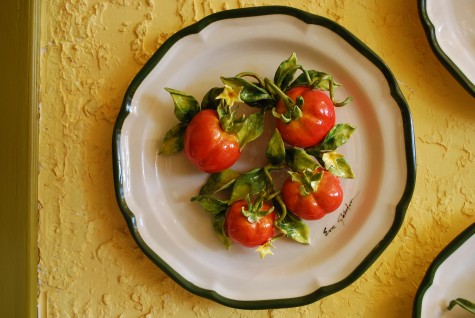
Eva Gordon

I am just back from a week’s buying trip for the shop and the landscape company that took me to Georgia and Tennessee.  I shop in Atlanta first and foremost for holiday 2011.  What better time?  The holiday and winter work is fresh in my mind.  My holiday season goes way well into January-I am not complaining.  I rather like it.  Whatever work I do usually has a sidecar attached.  What could be different?  What could be better?  Where do we go now?   Shopping the Atlanta Mart for holiday is not for the faint of heart.  Three buildings in the heart of downtown Atlanta, each in excess of 20 stories, is home to manufacturers of every description.  Holiday.  Gift.  Garden.  Museum.  Children.  This list is long.  Atlanta hosts business owners from all over the country; this is the Mart’s main event of the year.  The showrooms are packed.  It takes every bit of 5 days to see everything, put an idea for a collection together, and place orders.  This usually means 5 days that start at 8am and are still going on at 8pm.  Some showrooms are permanent, but open only on specific days or specific shows.  Some showrooms are temporary; Eva Gordon shows on the temp floors.     

Eva is a Canadian ceramicist; I would guess she is in her mid seventies now.  She comes to Atlanta every January.  Though her work is well known, she comes to Atlanta herself.  She wants to talk to people like me, who own shops, about her work.   I greatly admire her work-I admire her more for this.  The Atlanta Mart is a forum, a place to show, for no end of talented people who have the idea to convince people like me that their work deserves attention. The Mart is much about people meeting over beautiful work.      

This is a shopping trip of a different sort.  It could not be more different than my Monday afternoon Christmas trip to a store in town to browse and buy a gift for a friend, or for Tine.  This is a working shopping trip.   The Atlanta show-any hundreds of showrooms, each and every one stuffed with objects that I may or may not have a love for-this is work to focus, and really see what is there. The work is to make a plan, sort out what you like, and buy. What am I thinking will drive the 2011 holiday season, and what else is out there that will make my idea clear?  I may visit the better part of the showrooms we like spread out over 60 floors 2 or 3 times.  I walk until I cannot take one more step.  Part of the fun of this shopping trip-I am not alone.  Atlanta is alive with shop owners from all over the country- much like me.  I meet some of them at Eva Gordon’s booth.  All of us like her work.   

Atlanta in January is my idea of a working vacation in a warm climate-but for this year.  They were slammed with 7 inches of unexpected snow, and incredibly low temperatures just before I got on the road.  Ice, and more ice.  This city has no store of salt for bad weather, nor do they have a plan for bad weather.  No plows.  I delayed my trip there for two days, hoping  they would sort it all out.  The downtown area looked a little like the beach-tons of sand had been spread over the ice.  The Atlanta police direct traffic at the intersection of the 3 buildings all day and every day- so everyone can cross safely.       


The winter beach streets amused me-I am from a northern climate that handles wintry weather routinely. Meaning, we melt the snow.  As there is no postponing the show, Atlanta did what they could to welcome their guests.  It is a lively, energetic and friendly city.  Who knows how Eva Gordon got here, but I am happy she did.        


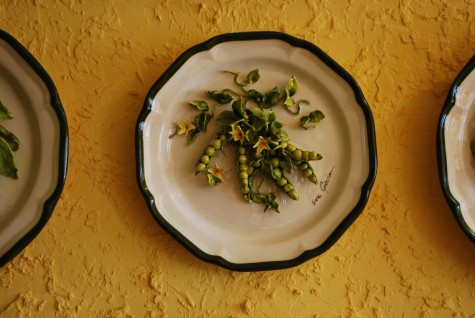
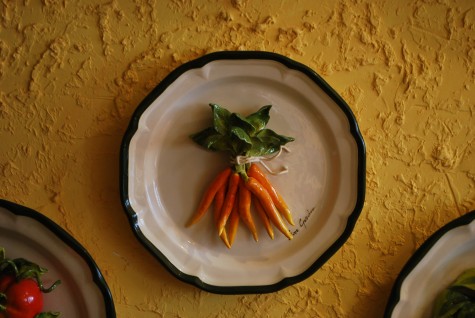
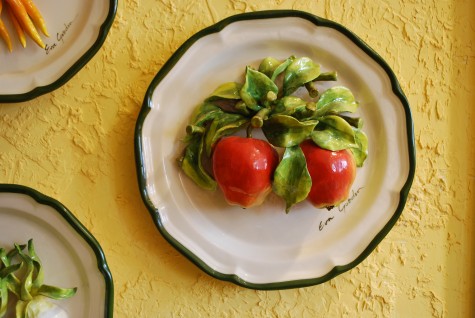
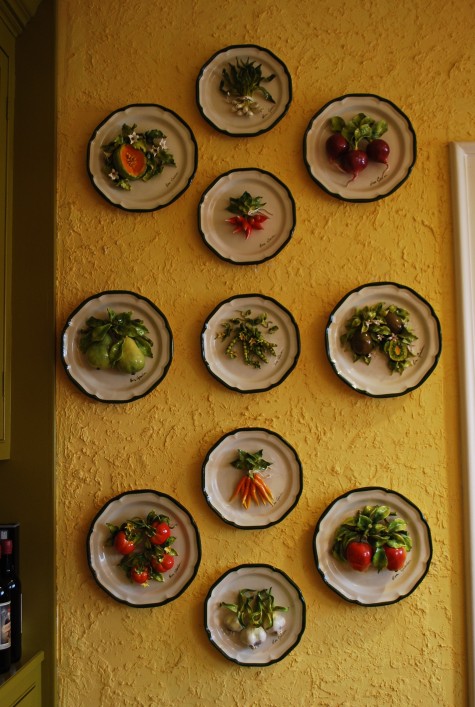
Any fruit or vegetable, any garden idea, any holiday reference to the garden-no matter the medium-I am in Atlanta searching.  I searched for the better part of 5 days.  Did I mention that Eva Gordon’s plates make my heart pound?  My pictures are from a wall in my kitchen; I think they look great.

Favorite Greens

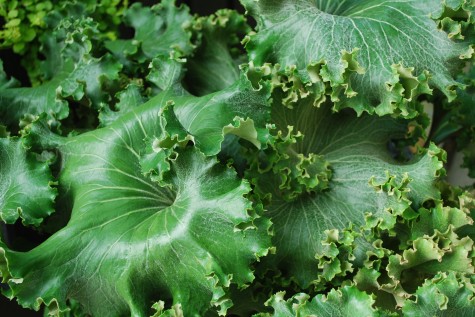
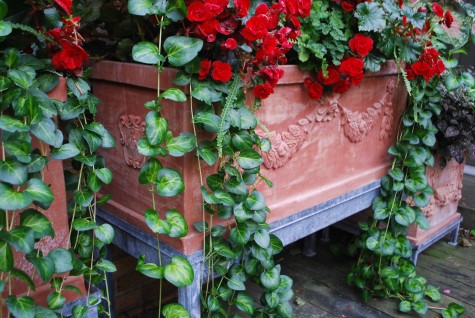
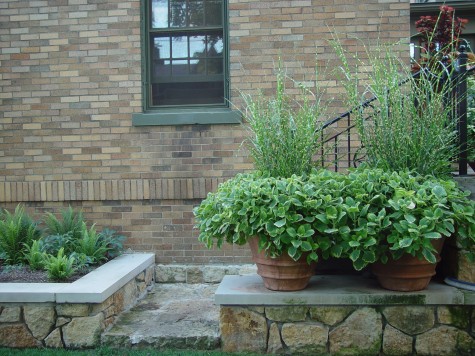
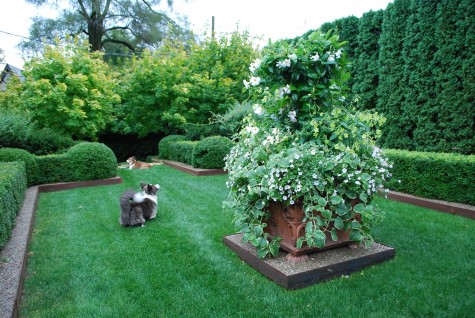
Though I posted last week at some length about my favorite greens, I was in fact telling a tale.  If I had to choose between lima beans and farfugium, I would gladly do without the lima beans. The vast majority of a garden is green-this makes picking favorites difficult.  But farfugium crispata has an especially gorgeous green leaf; large, undulating, and in this case, heavily ruffled. The trailing vinca maculatum has a thick glossy leaf, with both forest green and lime markings-but it is the habit of the plant that gets my attention.  This plant will send out runners all season long, and trail two stories, given the chance.  During the fall cleanups, I potted up every plant I had planted in containers in May.  They were still growing vigorously, the beginning of November. I am interested to see what they might go on to become next season. This green plant has it all over the traditional vinca vine one sees in container plantings. They would make a swell start for a hanging garden.     

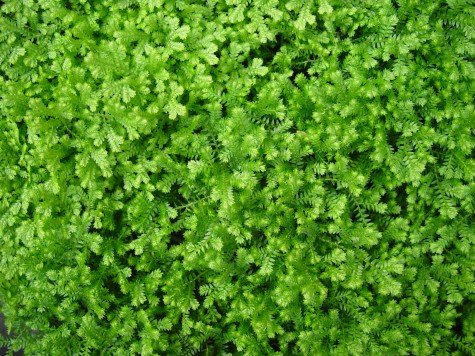
Selaginella, or club moss, is a spreading green plant with tiny scale-like leaves.  They like moist shade, and will spread indefinitely if they are happy.  They make great container plants, in combination with upright growing plants that will not shade them out completely.  They are great in combination with begonias and tropical ferns.  This lime green version is especially handsome with a big leaved pepperomia.  The pepperomias-I cannot believe I left them off this list.  I like them all; the more the better.

Green and gold plectranthus is a vigorous and lax growing green planted, sporting large felted leaves.  They are related to coleus.  The plant can be pruned into shapes if pinched regularly-just like a coleus.  They grow large, so they need big company.  This zebra grass rises above the fray, as my friend Denise would say.   

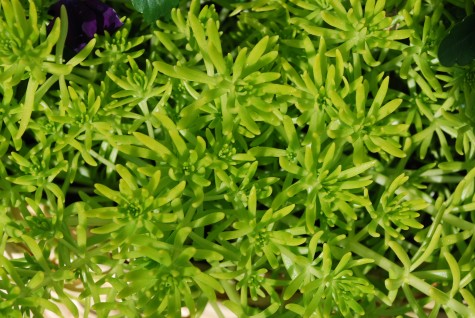
Angelina is a succulent which is hardy for me. I have had it winter over in pots; I have had it stay green, wintering over in pots.  It trails just enough to make it good in any size pot. Any scrap of a piece that falls on the ground roots.  Willing, this plant. 

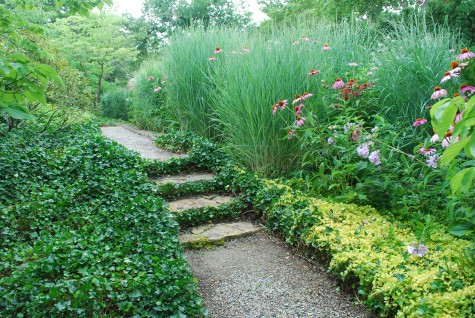
There are plenty of greens represented here-the panic grass is my urban version of a meadow.  The baltic ivy was here when I moved here, and it still going strong 15 years later.  I planted a few planted of lysimachia nummularia aurea-the lime version of creeping jenny, on the edge of this path.  2 years later it is holding its own with the ivy.  The combination of the two groundcovers is interesting.  Creeping jenny trails long in pots and window boxes.  It is equally at home in boggy locations, or at the water’s edge.  It will burn in full sun unless it has constant moisture.  The best lime color requires a part sun-part shade location. 

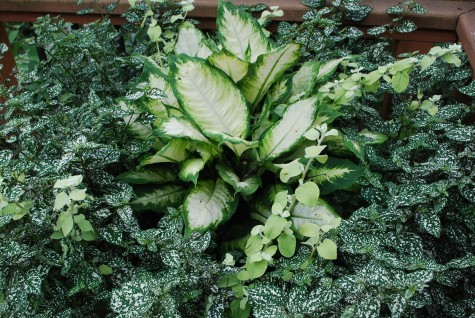
Polka dot plant, or hypoestes, has similar requirements. Popular as house plants, new cultivars such as pink splash, do well in containers in partially shaded locations. They can be made to grow in full sun locations, but you need be very mindful of the water. They make a great supporting cast plant for shade loving tropicals or caladiums.  As you can see, they mix well with lime licorice too. The white spots help lighten up a really shady location.     

Most places in my yard are green.  This large pot has a little white from a mandevillea and some petunias, but the lime nicotiana alata and gren and white plectranthus keeps the green dominant.  In a mostly green garden, the visual focus shifts to texture, shape, surface, volume and mass-all things that interest me.     


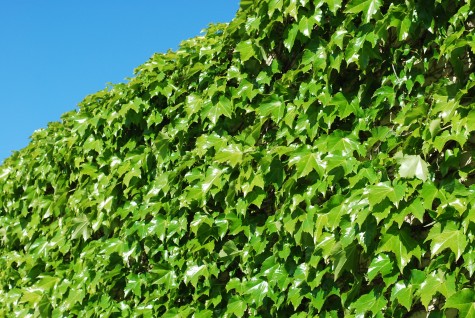
I do not miss seeing the concrete block wall that is completely obscured by this boston ivy.  600 square feet of concrete in the vertical plane-not so pretty.  This green plant securely attached itself to it, and grew without any attention from me. When it sheds its leaves, I can see that 15 years of attachment to this wall has not damaged it in the least bit.  I am sure I could write about good greens every week for years, and not get to the end of them.  This green part of gardening is great fun.

The Shell Tower

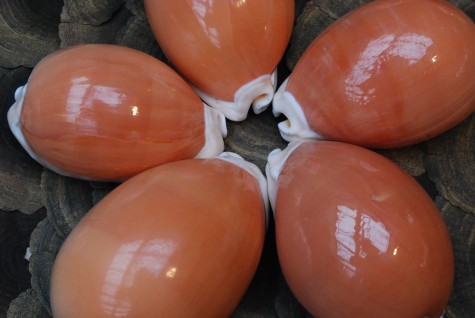
My collection of wood fragments, stones, mosses and bugs pale in visual comparison to my shells.  They are objet trouve of a special sort.  I am not a shell scholar; I am a shell finder. My first trip to Lake Michigan, my first trip to Atlantic ocean, a visit to Cape Hatteras-I have some shells that I collected.  I have 8 of these particular shells-they found me. Meaning, I wrote a check.  I had to look up the name-Cypraea aurantium.  I do not know what waters call it a native, but there is certainly nothing like it in the Great Lakes.  I know nothing of its habit, or habitat.  But I do know they are incredibly beautiful objects.  This photograph does not begin to do the shape, the surface, the color, or the texture any justice. It might be the most fabulous outfit for a living organism that I have ever seen.  I have had them in a bowl in my drafting studio for years.  To hold them in my hand, turn them over, and imagine the life they once protected-an experience of the miracle that is nature.   

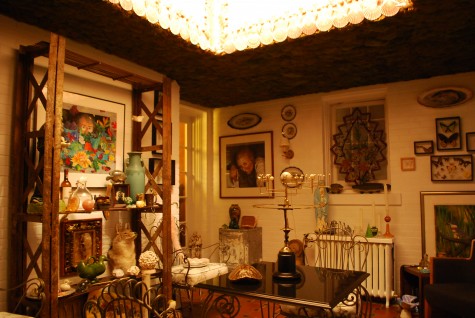
I have a big love for the miracle that is nature.  I have a room-a repurposed back porch- devoted to my objet trouve.  My beaver skulls-to look at those teeth, I have no problem imagining them felling trees for their dams.  Bugs, butterflies and rocks.  Old letters.  Sculptures, prints and plates of birds, fish, and flowers.  I call this room the reliquary-a place for various relics.  A friend gave me her Mom’s collection of Susan B Anthony dollars-a sign of the importance of our friendship.  Painted plaster saints.  Quirky sculptures made in grade school, a hydrangea ball from Espace Buffon in Paris.  It is a collection of objects of interest, beauty, or meaning.  Souvenirs, if you will.   


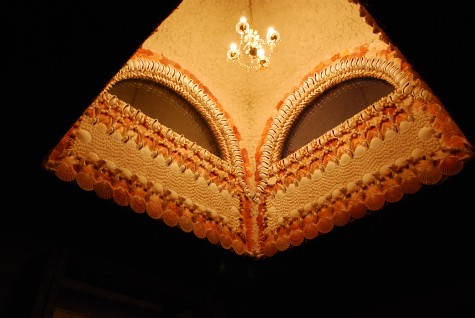
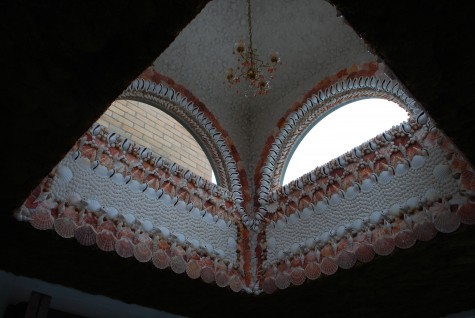
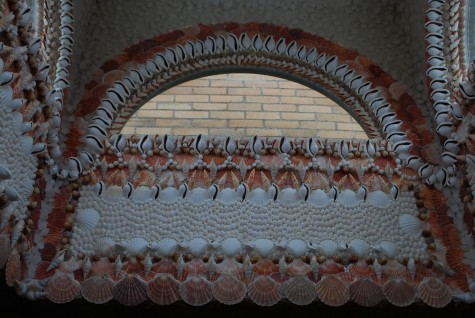
The shell grottoes in Italy and England-how I envy those gardeners their shelled fountains and follies. Would I ever get there to see them in person?  My climate would not permit any such expression of my own outdoors.  This room was looking like a home for the shells, but it was already stuffed with this and that. I went up. I had Don Taylor take the ceiling out, and build me a six foot square tower some 14 feet off the floor-in exterior grade plywood.  Each side of the tower had a half round window-I wanted the tower to be flooded with light.  My shell collection was no doubt inadequate for the job.  I went shopping.   


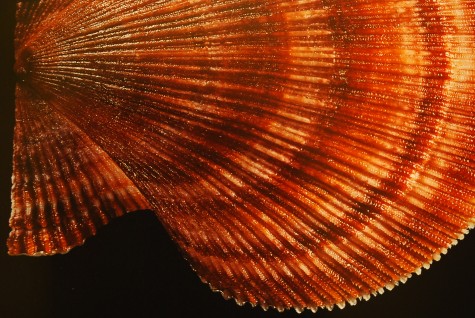
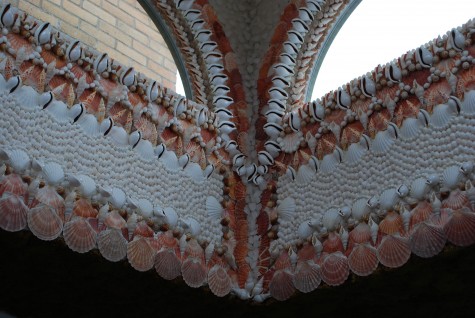
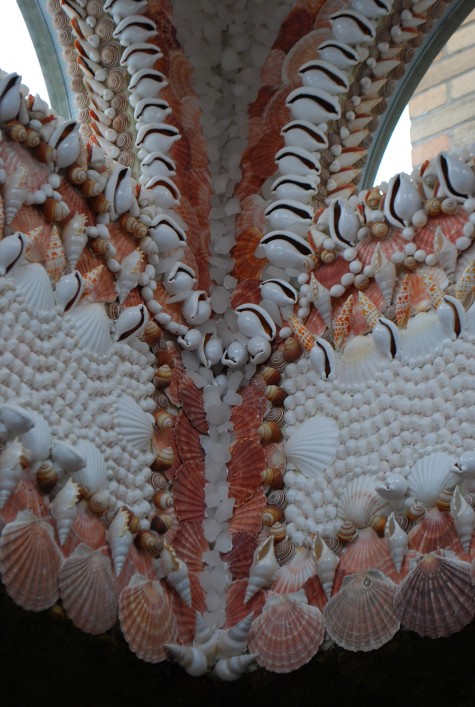
How does one design a shelled tower?  I didn’t.  I decided arbitrarily that all of the shells would be peach, orange, and white-and any combination thereof.  I bought lots of everything, as I had no idea how I would proceed once I was face to face with the project.  I loved this approach.  I cannot treat a landscape project like this.  I was completely at ease that it would just evolve.  My shopping for shells taught me much about rarity.  Rare shells, like my cypraea, are priced by the shell.  Abundant shells are priced by the hundreds, or in the case of small shells, by the gallon.  This Irish Flat pictured above-the bounty of the sea.  They are large, and inexpensive.  I bought lots. 

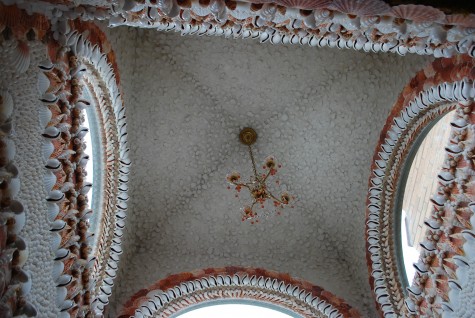
The ceiling scared me.  I rented scaffolding; I needed an 8 foot ladder just to get to the scaffolding surface.  The thought of climbing another tall ladder based on the scaffolding, and gluing shells in a pattern up over head-whoa.  Who knows where I got the idea to glass the ceiling.  But one material and one material only up there seemed like a good idea.  Beach glass-that adjunct to shelling-perfect.  Perfect, but not that easy.  Where does one get lots of tumbled recycled bottle glass?  I did not have enough time left in my life to collect it.  I found it; an objet trouve available in quantity.  25 pound boxes, sent from California.  The cost of the glass-next to nothing.  The shipping-astonishing.  I was even more scared now-which felt good.  I spent the better part of a half day all winter long, the music blasting, on a ladder.  750 pounds of beach glass went on that ceiling to start.  I glued multiple layers of glass.  I wanted the tower to look rounded-not flat-sided.   I had help with the adhesive part.  Ceramic tile mastic-I liberally buttered each piece of glass with it, and pressed up.  It took no time to stick, but a week to cure. I would glue as much as I could stand to before my fear of the height would overtake me.  Not one piece of glass has ever come loose. 

I planned ahead a little bit-electricity which would power a light fixture was in place before I started with the ceiling.  Once the glass was on the ceiling-now what?  I took my cue from the shape of the windows.  I cannot explain the design any other way.  I made one move, on all fours sides, and regrouped.  These pictures do not show the put up and rip down days. It was my winter; I had time to make mistakes or changes, and start over.    

Out the tower window to the west-my chimney.  Around the window, I glued an embarrassment of riches in egg cowries. Then I shelled the wood molding that came with the window.  Then a window molding fashioned of a double row of Irish flats.  Each shell I sorted by size.  No one would notice a gap from the floor, but I was on the scaffolding ladder, face to face with the chimney. The design had everything to do with the view from the floor-I am sure I went up and down that pair of ladders plenty.  The tower itself was built amazingly true and square, but shells of a given species vary considerably in shape and size.  A lot of tinkering went on.     

None of the shells I used were rare.  The smallest of the shells-the white calpurnus that I glued up by the hundreds-are barely an inch long. Each and every one of the other species of shells has a distinctive shape, pattern, and color I like. Better yet, I have my own folly.  

This project took a little over 2 months of my winter.  The good part- I cannot remember one thing about the weather, the snow, the cold or the gray that year.