Planting In March


I know I made much this past week about planting a more beautifully designed hanging basket.  The challenge was such, I have the troubled dreams to prove it.  All of the notes I made this past summer inexplicably disappeared.  The lesson here-any idea, phrase, phone number, concept or design that you really need-write it down, and insure its safekeeping.  Notes and notebooks, scrapbooks, file folders, magazine clippings-all of these are a good idea.  Some ideas occur way ahead of their time.  Keeping them written down, visually documented, and readily available is the best backup to insure that what is close to you heart gets a hearing when the time is right.  Well, the time isn’t really right yet, but I was ready anyway. 
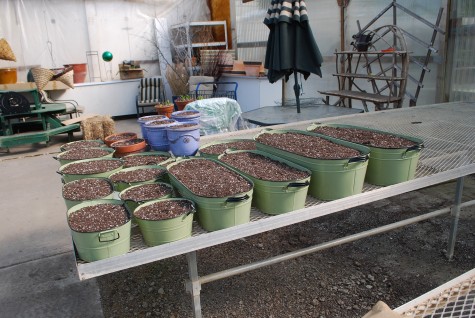
     

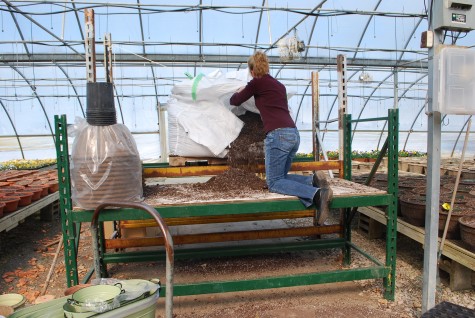
I wanted to be past the dreams stage.  It was time to put my show on the road. I drove out to Bogie Lake Greenhouse yesterday with Pam, and some containers in tow.  I had an idea to plant some 50 containers for spring, in addition to the hanging baskets of my dreams.  Ambitious, yes.  But the big fact of the matter is, as Coach John Wooden once said, “It’s what you learn after you know it all that counts.”  My big ideas got a dressing down.  I am used to planting at the shop; I have already sorted through everything that Mark has available, and have at hand the plants that strike my fancy.  This is a highly edited version of his greenhouse.  Many of them are in color by the time I get them-I rarely buy plants from a list-I buy what I see, and like. Pam got right to work-she had all of the containers filled in no time.  I was cruising the greenhouse with Mark, when reality began to sink in.    
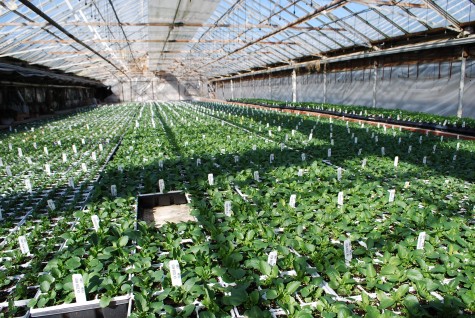
Spring plants in mid March are  tiny green blobs-a few roots, and not much leaf to speak of on top.  I faced an ocean of violas and pansies-all green.  They are just where they need to be, perfectly timed-to be perfect in a month.  I don’t know about you, but  great color combinations in spring pots can be tough to achieve.  The blues, lavenders, violets and red violets in pansies don’t always go together.  Red violet pansies look great with red ornamental kale-dark purple pansies go blah.  It became apparent that I would need to rely on my memory of color, my memory of the colors in the various mixes-or the notes that I could not find.  If I was thinking I would have mature plants in  color from which I could design-I thought wrong.
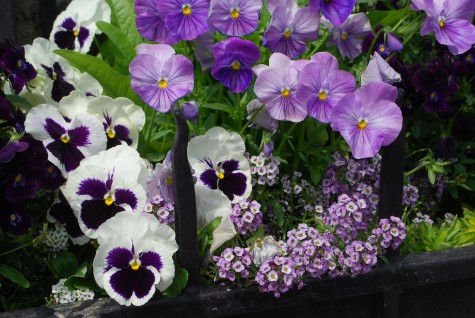
You can see from this picture that all of the purple in question has a decidedly red-violet cast.  Do I know the names of these pansy and viola cultivars-no.  Even when I did manage to match a cultivar name to a picture in a seed catalogue, I did not feel one bit better.  Color pictures in a catalogue may give a feeling for a color-or not.   
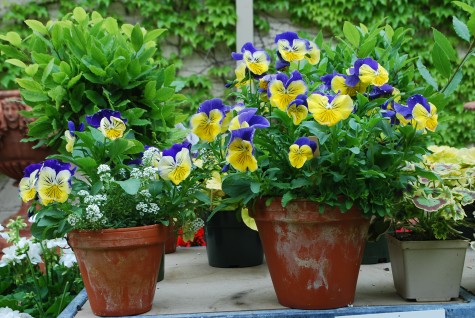
The purple is this bicolor pansy is not at all red violet.  It has a heliotrope blue cast, to my eye.  Red-violet alyssum in this pot would make me wince.  Citron alyssum, which has a decidedly cream yellow cast, would have worked better than the white alyssum you see here.   
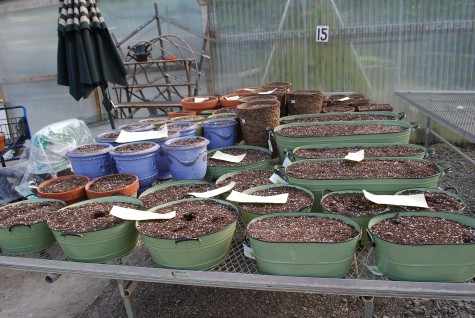
So I did what I could-all of the schemes came from my head and memory. Pam planted pairs of pots with a variety of spring annuals including pansies, violas, phlox, angelina, osterospermums and so on-and we’ll find out later if I can design in the dark.  I didn’t even approach the hanging basket planting project-I see I have to plan them on paper.  The time to plan combinations is at the height of the season-when color, texture and mature size is all right there to be seen.   
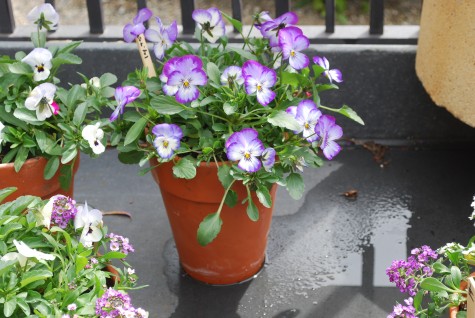

I have new resolve to photograph all of the flower cultivars I like to use-from the start of the season to the close.  I will have then a catalogue of my own making, so I can plant green, if need me.  We’ll see how far I get with that.
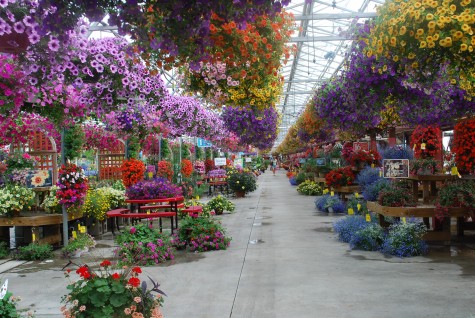
Though these baskets are lush and well-grown, I have something different in mind.  To that end, I’ll spend some time planning, before I plant.

A Catalogue Raisonne

A catalogue is a book that describes a collection of some sort.  A catalogue raisonne usually refers to an exhaustive list of artworks that can be attributed to a given artist. Both describe to my mind a seed book.  How so?  A seed catalogue may represent an exhaustive list of what nature has created.  Or it may be an exhaustive list of what a seed house has created in conjunction with nature.  I read seed catalogues in the winter, though I grow little from seed.  Reading about gardening is one way to keep involved when no digging can be done, and the garden is in hibernation.  The catalogues provide information about plants that can be grown from scatch.  They also detail the merits of particular cultivars, advice on germination techniques-I like reading it all.  Of course the first purpose of a particular seed catalogue is to sell their seeds-so every variety sounds like a must have.          

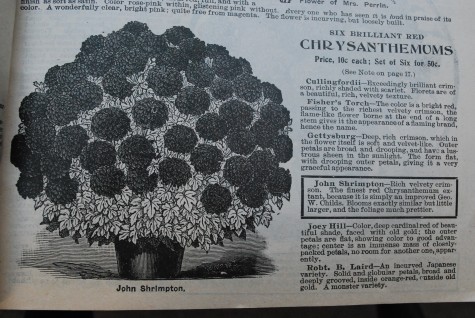
As I am easy prey to the thought that I must have everything and anything associated with gardening, I read the seed catalogues, cover to cover, hanging on every word.  Buck is enormously amused that I will read a seed catalogue devoted exclusively to tomato seeds, and based on what I read, make a list of my top 7 tomatoes to grow-even though I never go so far as to order the seed and actually grow them.  I read, reread, and saved every plant catalogue published by White Flower Farm; I learned a lot about perennial plants by virtue of that rereading.  I have also read plenty of nonsense in catalogues-there really is no substitute for trying things out yourself.  I have a collection of vintage and antique seed catalogues which I treasure.  Most of them list seed that is no longer available.  The drawing of John Shrimpton chrysanthemum pictured above-an artist’s charmingly rendered idea of what the purchase of a packet of seeds might bring to a garden.        

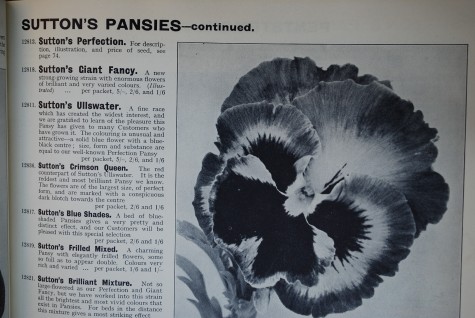
Sutton’s Seeds has been in business in the UK since 1806.  This says a lot about them, and it says a lot about the importance of gardening in England.  My Sutton’s catalogue from 1935 lists many varieties of Sutton’s pansies.  Does this mean that Sutton’s actually hybridized and produced seed themselves?  I see no Sutton’s pansies on their current web catalogue.  I am sure how seeds are produced has changed considerably since 1935.  But as I have no plans to actually grow pansies from seed,  I have as much interest in the 1935 version as the 2011 version-maybe more. 

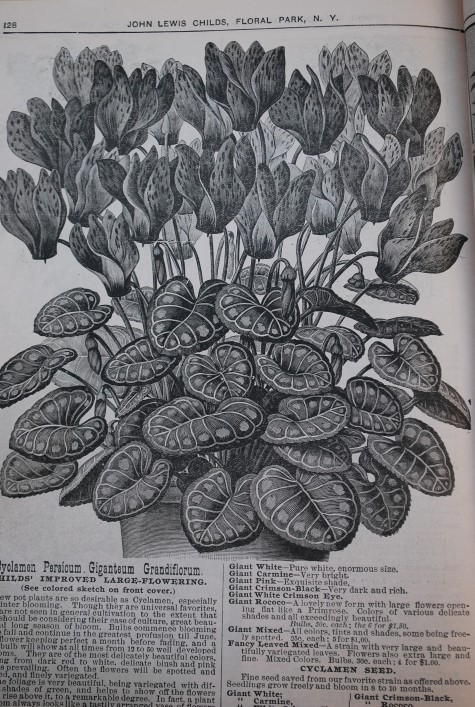
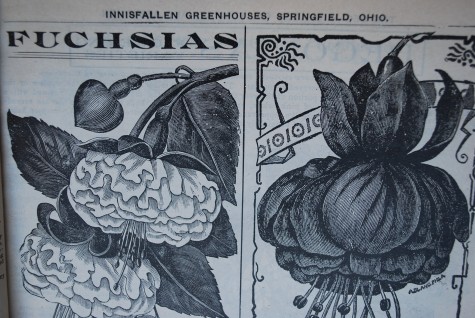
Many of the early 20th century American seed catalogues were illustrated with black and white drawings, or etchings. Who knows when photography became more common in seed catalogues.  Many of these renderings are quite beautiful in and of themselves.  Drawings and photographs of the plants and flowers that would grow from seed are an essential sales tool.  Can you imagine a seed catalogue illustrated with pictures of the seeds themselves?  Even I would find that daunting.  A seed catalogue is a catalogue raisonne of  hope as much as anything.  Buy some little black specks catalogued as cyclamen seed, and someday you will be rewarded with a plant with strikingly marbled foliage and masses of delicately beautiful flowers.   

The transformation of a seed into a flowering plant or tree or shrub has been scientifically documented in lots of ways.  But that in no way completely describes the process.  You might call this the art created by nature.  I call it a miracle. 

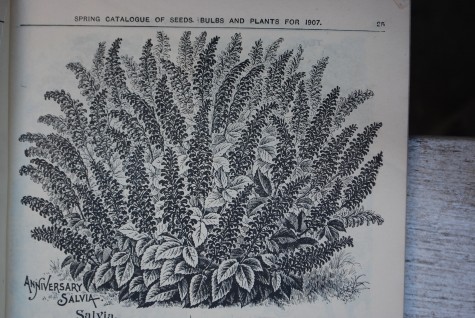
Anniversary salvia was a variety offered in the 1927 seed catalogue published by Marshall’s Seeds-in honor of their 25th anniversary in business.  They were located at 150 West Twenty-Third Street in New York City, New York, at that time.  William Emerson Marshall was born in Edinburgh, Scotland, and eventually apprenticed at the seed and nursery establishment John Downie.  In 1891, he emigrated to the US, and obtained a position in the greenhouses of the W. B. Dinsmore estate in New York.  Employment at a number of seed houses culminated in his opening Marshall’s seeds in 1902.  The 1927 catalogue states “Mr. Marshall’s sole hobby is gardening, and he spends his spare time in his garden in Bayville, Long Island.”  An extensive biography of every employee is printed in the beginning of the catalogue.   

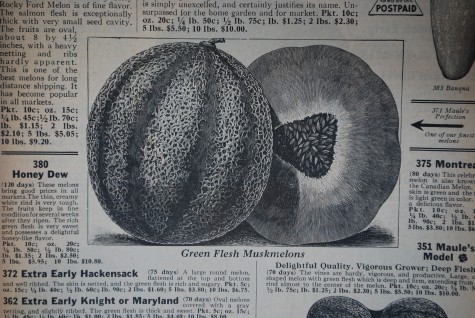
The stories of the lives of the people who worked at Marshalls is at least as interesting as their Green Flesh muskmelons, and the beautiful etching accompanying the description of the plant.  They were all gardeners-but for the head of the packing and shipping department.  It was noted however that he was the star pitcher of the Marshall’s baseball team.

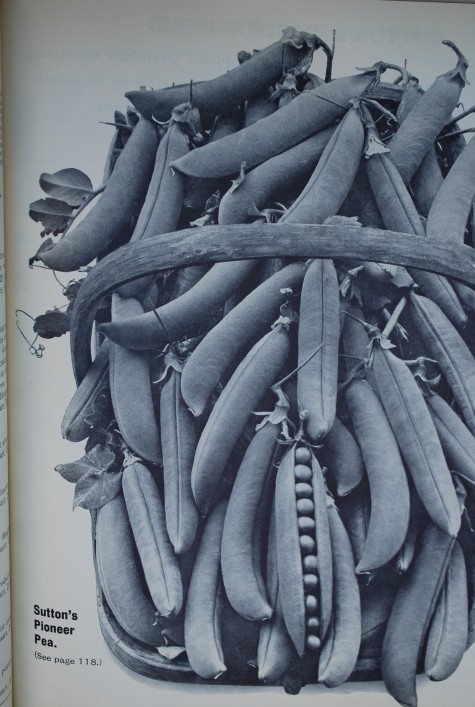
This fabulous black and white photograph of a trug loaded with peas had to have sold countless packages of Sutton’s Pioneer Pea seeds. I very well might have bought these seeds myself.  Not so much so I could eat the peas, though I do like peas.  What is so compelling here is how beautiful they are. And how beautifully arranged and photographed they are.


Customer service-Maule’s Seeds had that as well.  If you wished to pay for your seed over time, a specially color coded order blank was available, which stated “I am faithful in the settlement of my obligations, and give you my pledge that you may feel safe in trusting me as agreed.”  A credit system based on honor-much like a certain local produce stand I patronize. They are not always there-it takes lots of time for them to grow their vegetables..  I get my corn, and put the money in  the cigar box.  That I am able to do this, yet another raisonne d’etre for a gardening life.

Flow Blue

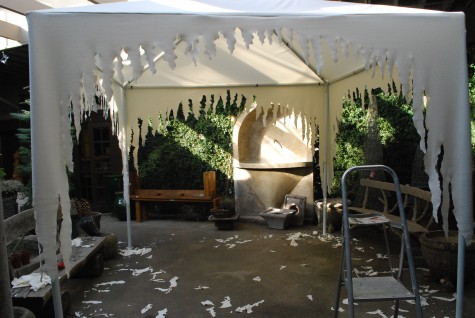
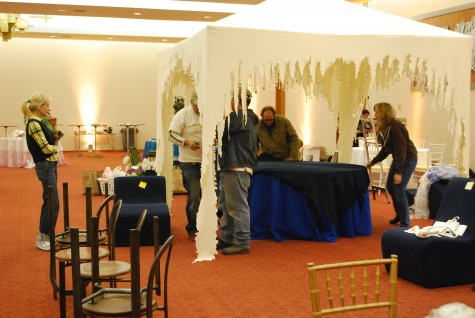
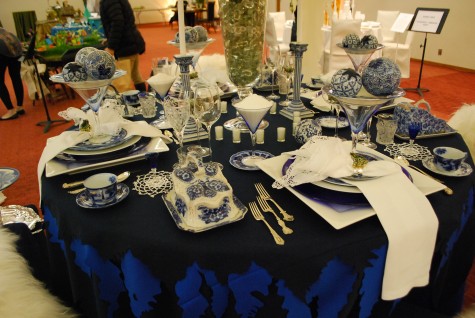
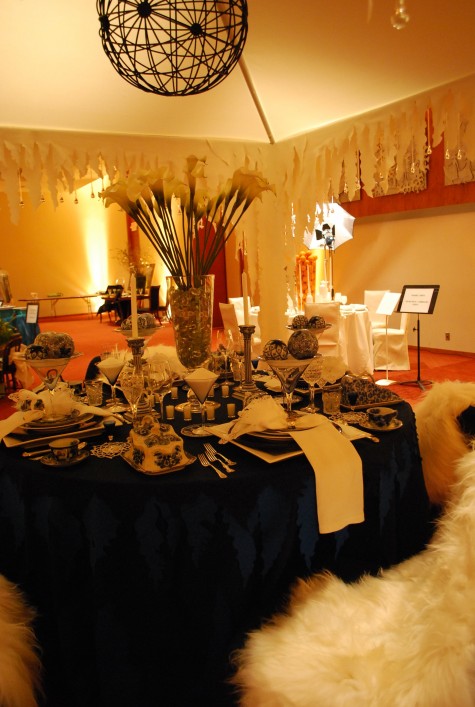
Occasionally there is an opportunity to help a client create a landscape for an event.  In this case, a fundraising event for Temple Bethel involved individual participants and groups setting their own distinctive versions of a Passover Seder table. My client knew three things.  She was interested in using a pavillion she ordinarily kept in her garden to create a room with a walls and a roof that would provide a framework for her table. She also wanted to set the table with her own collection of antique flow blue china.  And she wanted an overall look that would be unexpectedly contemporary.   I immediatey thought of billiard table felt as an appropriate material for the pavillion roof.  It comes in very wide widths, and drapes beautifully.  It would be striking in color, but warm and cozy in feeling-perfectly appropriate for an early March event.  Cutting a series of abstract stalagtite shapes into the edges of the vertical elements of the roof would be a considerable visual departure from a traditional garden awning.  We set the pavillion up in the shop-this made the cutting of the roof fabric much easier.          

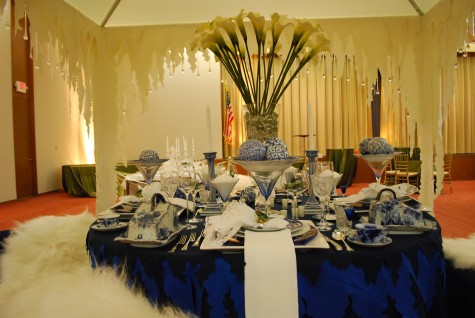
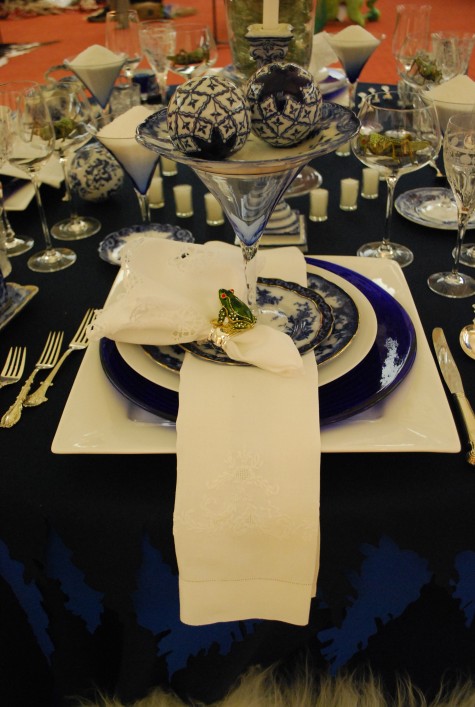
Flow blue china originated with Staffordshire potters in England in the 1820’s.  It is a white porcelain patterned transferware whose deep blue color actually comes from cobalt oxide.  Many of the patterns were Asian in origin.  The china is quite ornate, and delicate-but visually graphic.  We repeated that white and deep cobalt blue palette simply,  with the idea of creating a limited, and more contemporary look.    

We added white unsheared sheepskin throws to each piece of a suite of mid century modern foam chairs and a chaise covered in a navy blue wool.  These chairs belonged to my client, and clearly reflected her point of view.  The juxtaposition of the traditional elements of the Seder celebration in a decidedly contemporary context provides visual interest.  The table itself was covered in four cloths in two shades of blue, three of which had the same edge treatment as the roof.  

The interior rails of the tent were dressed with multiple pieces of cut felt.  A collection of my client’s glass drops echoed the crystal on the table, and provided a striking contrast to the light absorbing felt.  Once the pavillion was set up with its cover, my client set her table.   

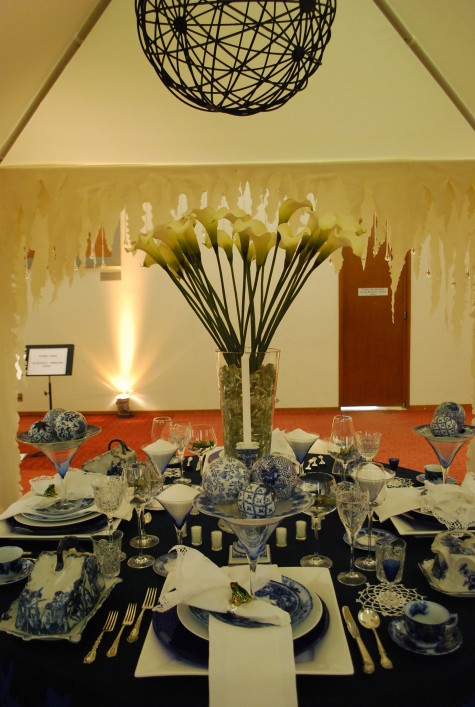
This is a very formal and very important occasion; the china, fine glassware, silver and linens reflects this.  The traditional elements required in a Passover Seder dinner are represented in a graphic way.  A contemporary glass vase of faux calla lilies anchored in glass ice provides some height.  The ruffled edges of the callas recall the cut edges of the roof.  Hung from the roof of the pavillion, a contemporary steel sphere representing the idea of a chandelier whose blue-black finish stands out against the white roof.    

The big gestures come from the hand and eye of my client.  The little and very personal touches- enamelled frog napkin rings, and a ring of elegantly narrow votive candles.   The round and regular shapes of the plates, glassware and flow blue spheres is in strong contrast to the roof fabric.   

People collect all sorts of things, depending on their interests.  What a treat to see a collection so beautifully displayed.  Better yet, a chance to work with a client whose thoughtful attention to detail, and committment to following through was considerable.  The pleasure was all mine. 


The event was to be lit softly; I am sure this added lots to the atmosphere.  Every table I saw was set with the same attention of design and detail-but they were all very different.  Anyone who went last night was in for a treat.  But I had great admiration for this particular space.  Not for what I helped with.  I did help, yes-ok and fine.  But she had an idea, and a committment to bringing her idea to life.  This I greatly admire.

A Bucket Shop

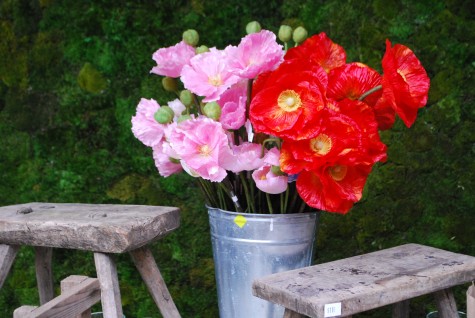
On my bucket list-a bucket shop all my own.  I have always wanted one.  The year I spent living in New York City in the mid eighties-my favorite part was the small markets, and beautiful bucket shops.  Every where you could find the and most breathtaking cut flowers, flowering stems and twigs imaginable, many of which were displayed on the street in buckets. My hands down favorite- oak branches studded with freshly set green acorns.  Those stems made the hair on the back of my neck stand up; I have never seen them available since.  What is available in cut flowers in New York City-the sky is the limit.  But I am happy with any bouquet of flowers; fresh flowers are irresistable.  Just about anything that grows is beautiful-can you think of a flower you just don’t like?  Living color-like no other color.  The idea of selecting and offering beautiful and striking cut flowers has been in the back of my mind for years.  I do flowers occasionally for parties and special events, but I am not a florist.  I am so sorry to say that Detroit Garden Works does not own a fresh flower cooler.     

I attended a national peony convention some 35 years ago.  I was very interested in how the exhibitors managed to bring so many cut stems of penies great distances to the show. Growers who exhibit their blooms in competition have this down pat.  A bud showing good color, and a marshmallow soft texture when squeezed, is good to cut.  Bag the buds in a baggie with the stems out, and store them dry, in the refrigerator. Bring them out 24 hours ahead of when you need them.  I was amazed that this works, but it does.  Years ago when I had hundreds of peonies, I would store stems in the fridge, just to extend my bloom season a little.  Some exhibitors brought hundreds and hundreds of buds packed in coolers-hoping that 1 or 3 or 7 would be perfect examples of a given cultivar, and win a ribbon.   

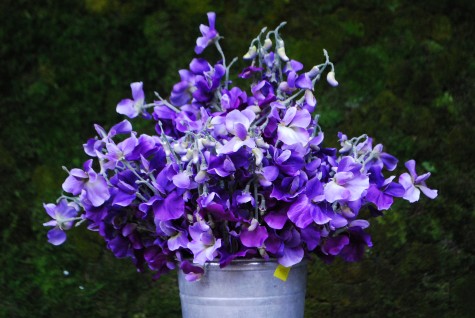
Fabulous cut flowers need not be from my zone.  Sweet peas-how I long to have them in my life.  It is doubtful I will ever grow a decent sweet pea, but they are available, at certain times of the year, as cut flowers.  Sweet they are.  And as if the color and shape wasn’t enough, the fragrance is divine.    

 A bucket shop-not so much in my future.  We are in a way out of the way location; the shop in its first life-a machine shop in an industrial location. My fresh cuts would languish, unclaimed.  I probably would have to take most of them home.  A bucket shop needs shoppers non stop.  The most successful florist in my town, and maybe nation wide-Kroger grocery store.  This makes perfect sense.  Everyone needs to shop for food regularly.  Weekly-maybe more often.  Selecting a bunch of fresh flowers for the grocery cart-easy.  The best part of the flowers at a very successful florist is that turnover means the flowers are more likely to be really fresh.  The downside?  It is less likely you will see the more unusual flowers.  Not that I hold one grudge against carnations and chrysanthemums- even the most ordinary species is still a fresh flower.  

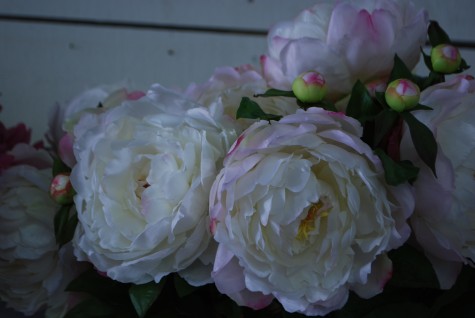
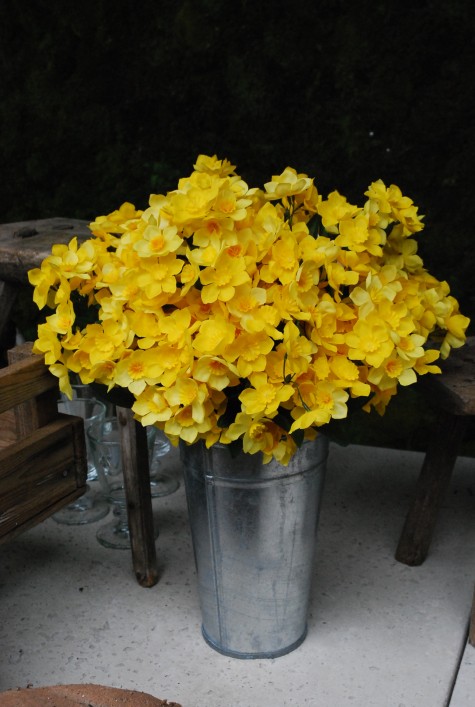
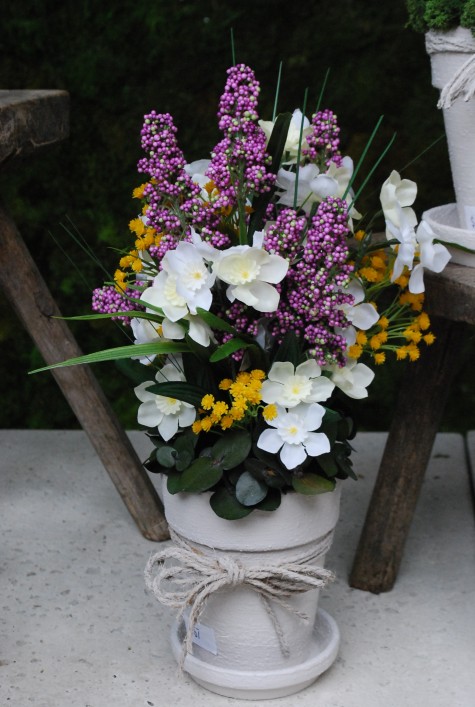
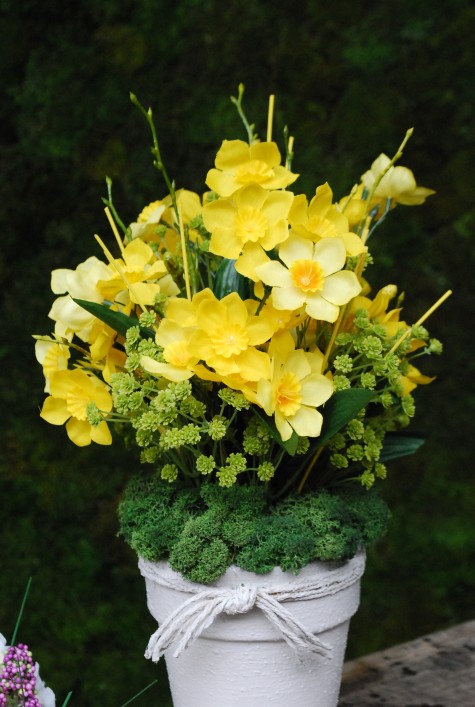
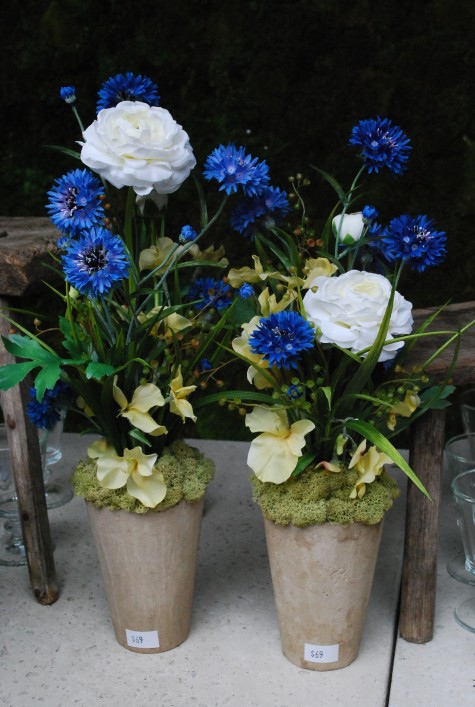
My idea of a bucket shop took a different turn.  In Atlanta this winter, I made it my business to source beautifully made faux flowers.  Every picture you have seen thus far and will see-fake.  Including these daffodil stems.  Are they not the best looking plastic and polyester flowers?  The peonies are amazingly realistic.  Are they a substitute for a real peony-of course not.  But fake flowers have their place. 

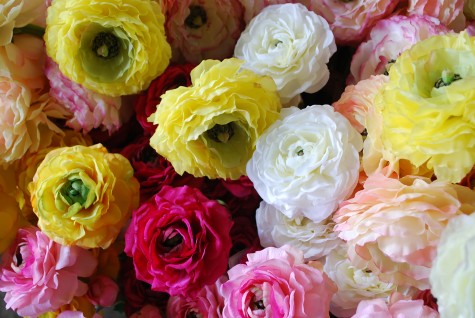
Though I have devoted a lifetime to raising flowers of all sorts, I wrote a check for bucket loads of faux flowers.  Why wouldn’t I?  There are lots of people who love flowers and gardens who are not gardeners.  There are some who cannot garden; there are times when no one can garden.  The shop umbrella ought to be big enough for all. Some faux flowers are better than others; the strong simple shape of ranunculus is easy to recreate in a permanent form.  Silk iris I would stay away from.        

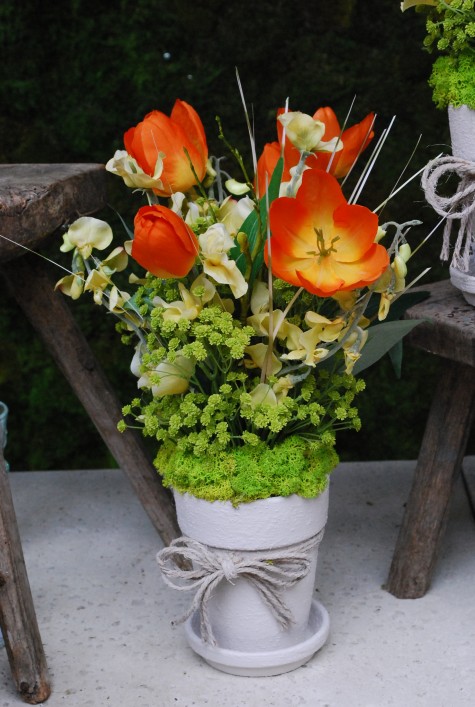
Pam made this small arrangement in a terra cotta pot painted white.  It is charming, cheery and spring like, to my eye.  It will be a month or 6 weeks before anything stirs in my garden, not to mention that the last leg of our winter is the toughest to take.  My faux flowers are primarily spring species.         

Would I take one of these home-absolutely.  I have plenty of dark places in my house that would be all the better for a little color.  I am a winter weary gardener who needs some reference to the garden.  Not to smell, or touch-just to look at.  For those days when I do not want to look at pictures of gardens, or books, or a documentary about the Chelsea flower show-just something bright to look at.  

 I do try to buy faux stems that can go outside.  Our spring season can be very short; many gardeners do not plant containers for spring for exactly this reason.  I do plant spring pots for clients; faux branches and grasses in the center of a container instantly creates some scale and presence.  A well done mix of faux and real flowers makes the fake elements very tough to spot. My observation?  People see what they believe as much as they believe what they see.           


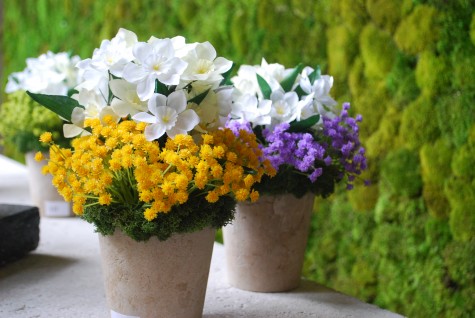
These mini pots, furnished with white daffodils, and  finished in dark green reindeer moss-I like them.