Treated To The Tulips

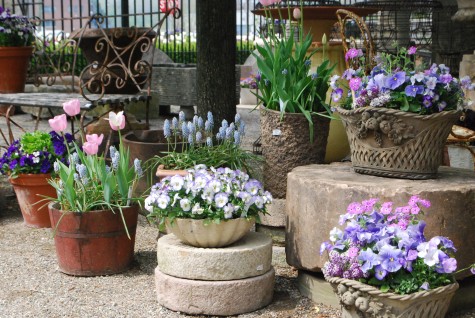
All of the cold tolerant spring flowers have their charms.  The pansies and violas come in every attitude from dainty and demure to bold and sassy.  The pale powder blue grape hyacinth pictured above, muscari Valerie Finnis, is a vigorous grower whose flowers last a long time.  Phlox intensia will last even longer; I have had it thrive an entire season.  But there is nothing quite like being treated to the tulips.  The pale pink variety pictured-Pink Diamond. 
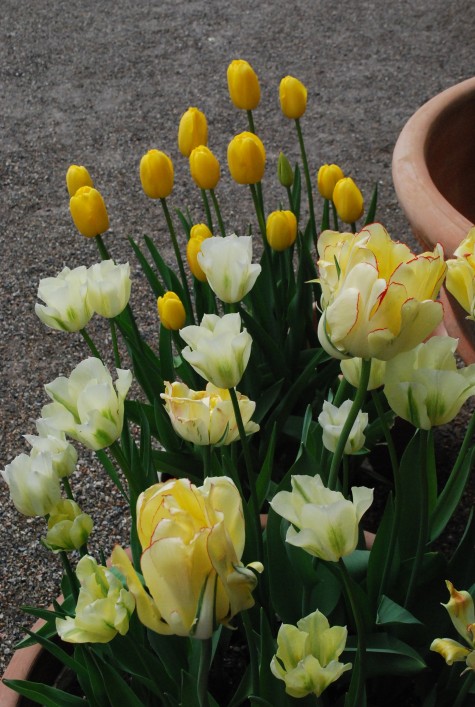
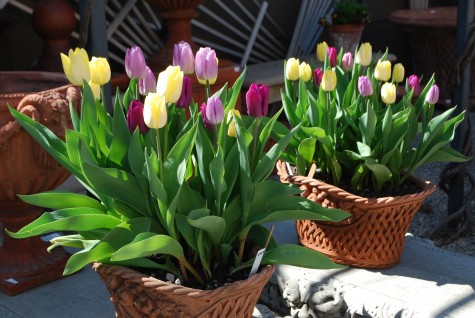
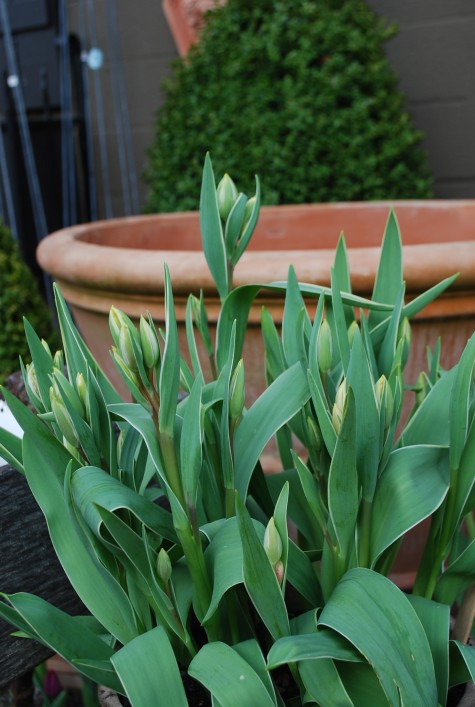
Their forms and colors are many.  Their big simple shapes can make a big visual statement from just a few bulbs.  Bulbs wintered in the garage in fiber pots make great centerpieces for spring containers.  From the moment that the leaves emerge from the soil, to bloom is about three weeks.  The thick strappy leaves are just about as beautiful as the flowers.  The formation of seed pods, and the dying back of the foliage takes another month.  The entire process is beautiful to watch.   Pictured above, the multi-petalled Darwin hybrid Akebono, Spring Green, and the butter yellow Roi du Midi. 
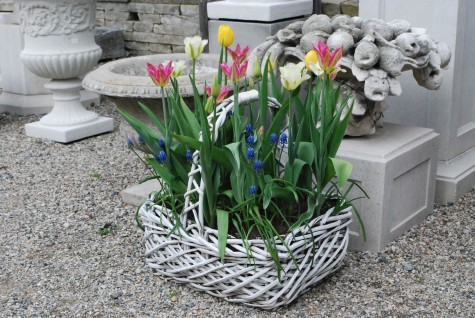
I do have a soft spot for viridiflora tulips.  The white petals of the variety Spring Green are streaked with green.   The pink and green variety in this basket is called Virichic. Green and pink chic, indeed.  They bloom fashionably late in the spring, and their spiky shape is striking.  
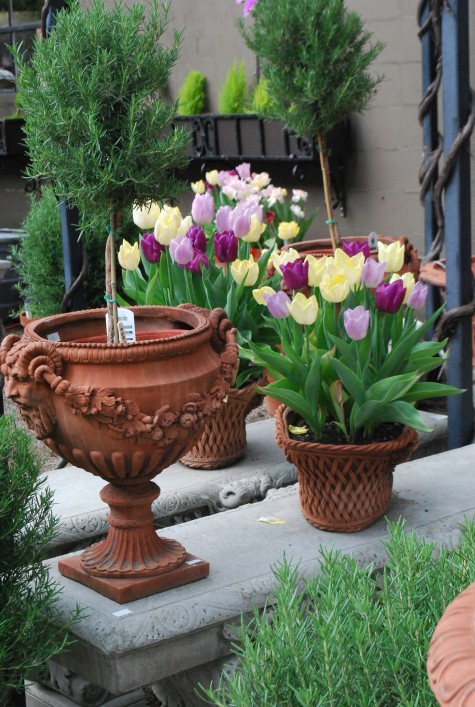
Though the color of Princely Mix is very sweet, their staying power is considerable.  These compact clumps have been in bloom for better than 3 weeks.  Their short height makes them perfect for small containers; they are also likely to weather the worst of the spring rain and wind without damage.    
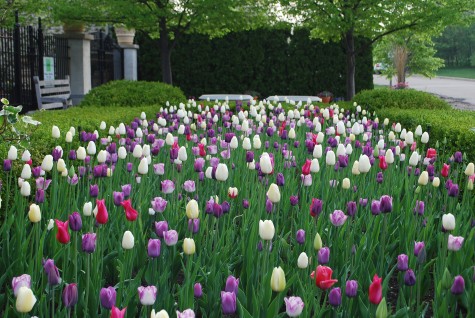
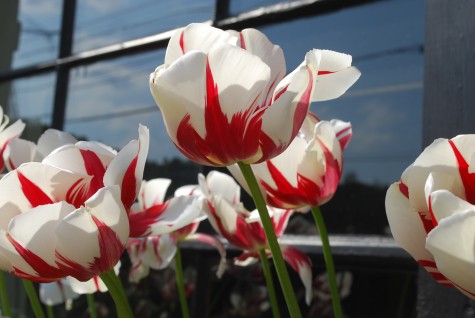
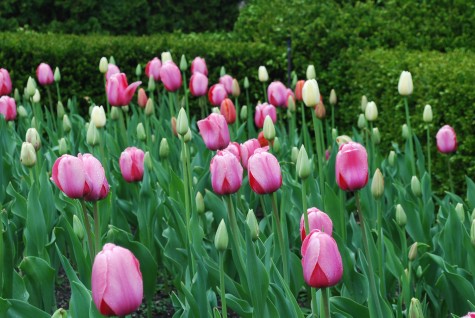
Choosing a mix of tulips for the big garden at the shop is great fun.  What I like the best about a mix is the possibility of great variation in height.  This gives you color at every level.  Violet Beauty-18″ tall.  The white tulip edged in violet is called Shirley; it grows 22″ tall.  The random hot pink lily flowered tulip Mariette also grows 22 inches tall, but its rarer appearance in the mix makes it seem different from all of the other tulips.  At 24″ tall, Cum Laude is the tallest of the purple tulips.  The white single late tulips Maureen grows to 28 inches.     
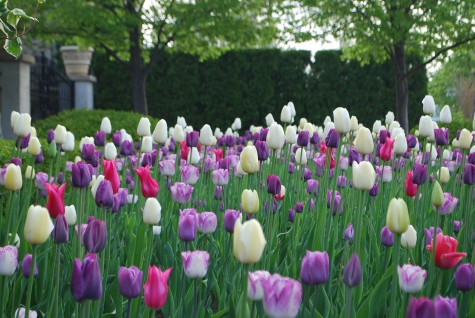
What would I do differently, if I had the chance?  That is a question I am always asking.  In this case, I would add a short white tulip.  Pale colors do a great job of highlighting darker ones.  So, 2 different heights of white tulips, 2 purples, one whte and purple bicolor,and the odd tulip out-a little hot pink seasoning here and there.  Most flowers are beautiful in their own right, but how they are arranged can make them look all the more lovely. The tulips fields in the Netherlands in bloom-show stopping in a different way.  Tulips being farmed have a much different appearance than tulips in a garden.
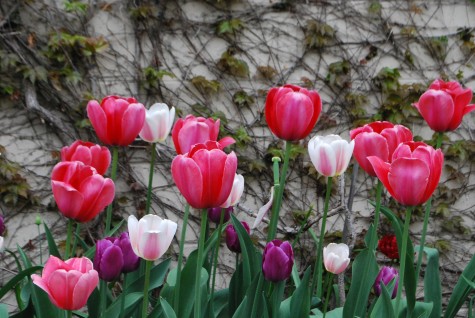
In this mix, flower size was equally as important as height.  Every plant has characteristics worth considering when a design is taking shape.  For example, it is easy to extend your tulip season greatly by choosing tulips from different classes.  The species tulips bloom a month earlier than the single late tulips.  I like the idea of  having a spring that goes on for three months, in one form or another.  
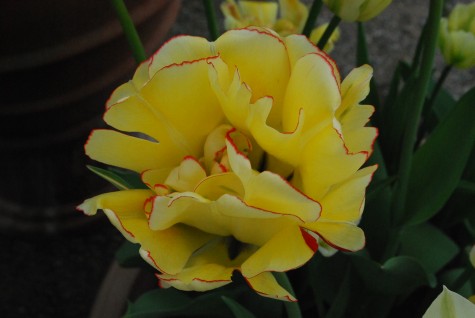

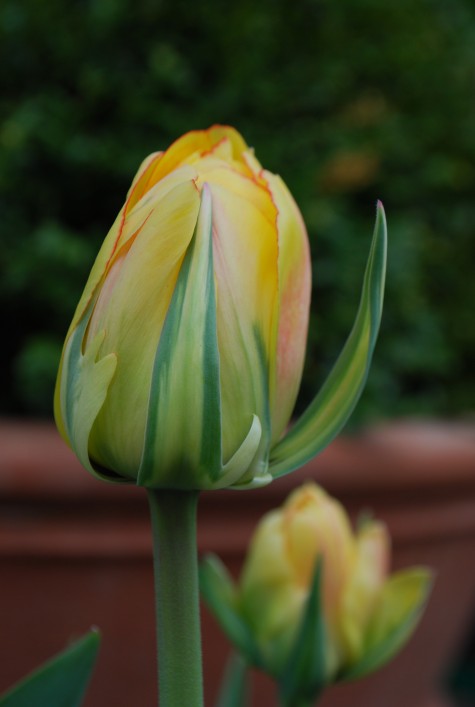
The Darwin hybrid tulip Akebono is a new one to me.  No doubt I will  have this again in bigger numbers.  I like to try a small amount of lots of bulbs-there is nothing better than seeing them bloom in person.  Choosing tulips can be tough.  They get planted as small papery brown spheres that give no hint as to what will come the following spring.  For that reason alone, I try to photograph all the tulips-so I have a record of what they can be.  Pictures of bulbs in catalogues can be notoriously misleading.   Photographic record keeping is an easy way to better inform your design.  This tulip with a  simply shaped, pale yellow firned and a spring green companion-that could be gorgeous.  Paired with red, orange, and hot pink tulips-visually electric. All by itself-just plain stunning.  If you are nearby, stop up for a look.  It is peak tulip treat week.
Green Schemes

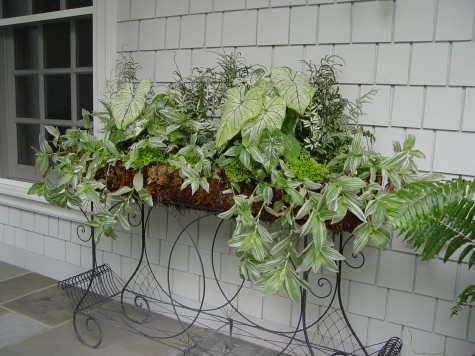
Containers planted with an all green color scheme can be very beautiful.  Eliminating color as an element in container design means that other elements, such as texture, mass, form, scale, and proportion, become very much more important.  The frosty white Victorian parlor ferns in this planter are a lacy contrast to the big leaves of the white caladiums.  The languid and lax habit of the tradescantia fl. Variegata contrasts to the tight soil skimming habit of the lime green club moss, known as selaginella.  Overall, the planting is loose, and airy-just like the container.  The container itself is such an important element of the overall composition. 

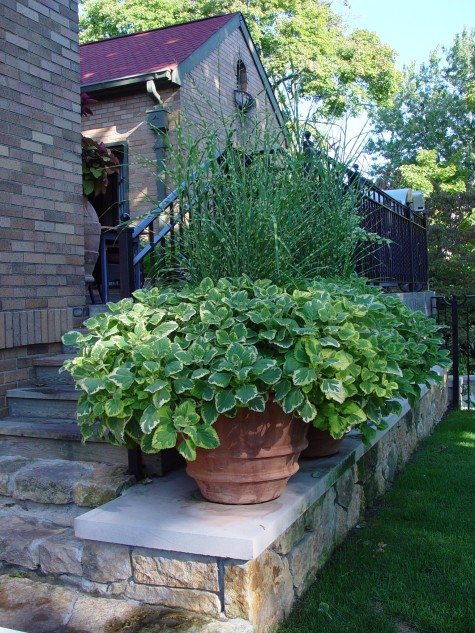
I planted this pair of Italian pots with 2 gallon size zebra grasses, and finished up all around with lime variegated plectranthus.  The colors in one plant mirror the colors of the other-so all of the visual interest is the contrast of the tall narrow grass blades, and the thick felted trailing leaves of the plectranthus.  I pinched the plectranthus, which is related to coleus, all summer long.  This made for an overall shape that was widely horizontal.  The tall grass, in contrast to the very wide plectranthus-a certain visual contrast that satisfied my eye.  The glimpse I still see of the pot at the bottom is just enough to complete the picture.  The planting does a good job of describing what the planter looks like, though you cannot see so much of it. This is a very simple planting which to my eye is very visually engaging.     

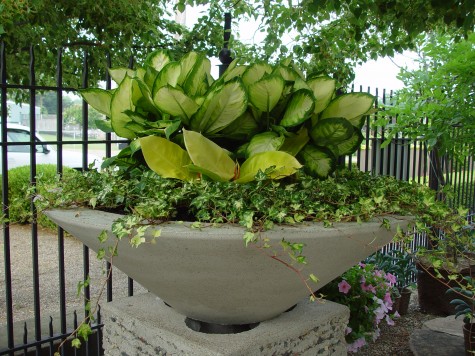
Big leaves-do you not love them? This severely contemporary v-shaped limestone  planter benefits from a planting of the paddle-leaved tropical plant dieffenbachia.  The pale yellow green leaves can dramatically lighten a very shady spot.  The yellow variegated ivy once established, I kept trimmed to the inside edge of the stone, as the container itself makes such a strong statement.  The overall shape of the planting seems pleasing to me.  This planting greatly complements the container.      

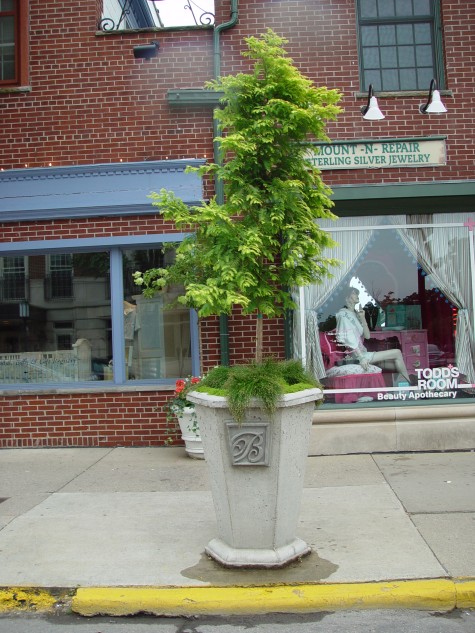
This planter located on a city street got planted with a lime green version of dawn redwood-a lime green version of Metasequoia.  Small trees can be great in containers; they can be planted in the ground at the end of the summer season.  The  fiber optic grass and Scotch moss are just about the same shade of green.  This planting is simply about texture, and plant habit.  The relationship of one plant to another is enough to keep me gardening.   

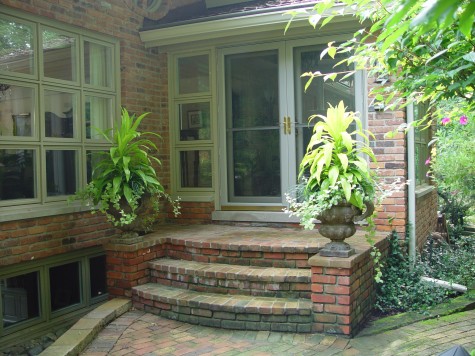
The lime green dracaena Jenny Craig is another great tropical plant suitable for containers in shady places. The strappy leaves cascade like water from a fountain.  The variegated licorice petticoat pictured above provides some width that helps to balance the composition.  The detail of the urns is still visible.  I spend a lot of time picking and choosing what of a container gets hidden by draping plants-and what stays exposed.   

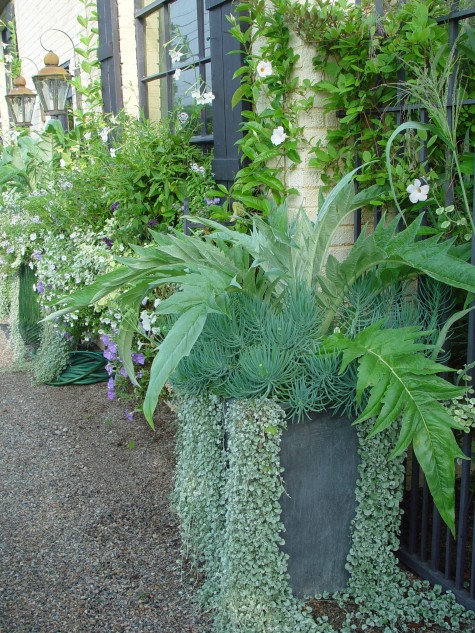
This cardoon is a very architecturally striking plant.  The leaves have a prehistoric, slightly menacing look about them. They have an aura which is so strong-they have the visual power to organize a space. The blue green succulent planted at its base-I have no idea what this is called-sorry.  My eyes and my instincts just told me they would work in this container.  These succulents do a great job of softening the look of the cardoon-even though the foliage is stiff, and needle-like. The silver falls dichondra drapes down the corners of this lead container, and puddles on the ground-a languid, and gorgeous contrast to those stiff cardoon leaves.  In general, it is easier to achieve a balanced compostion with three elements, as opposed to two. A container with one or two elements will need thoughtful work on the shaping as it grows, to keep the arrangement visually interesting.  A single well cared for topiary plant in a pot would be a good example of this kind of grooming.  

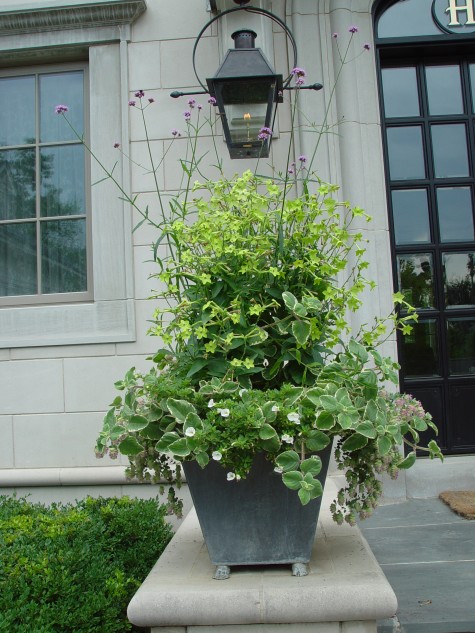
The lime green flowering nicotiana alata is one of my favorite flowers.  Green flowers-not so ordinary, but eminently satisfying.  The tuft of verbena bonariensis at the top loosens up the entire planting.  The wide outer border planting of white million bells, green and white plectranthus, and Kent Beauty showy oregano, softens the top edge of the container, and balances the height of the nicotiana and verbena.    

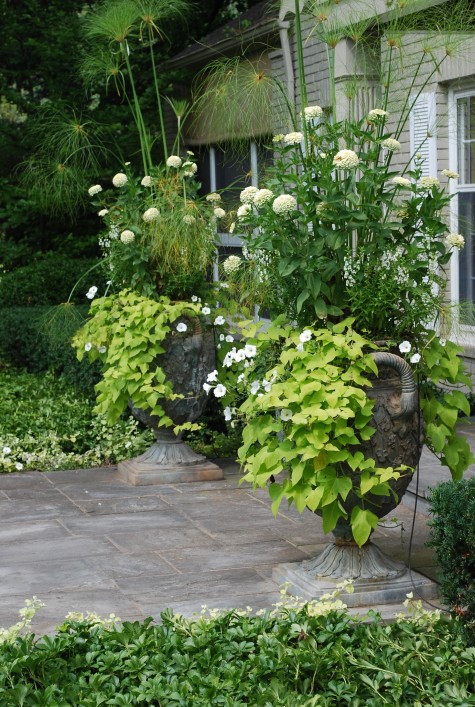
These bronze containers are very intricate, and beautiful.  Given that they flank a front door, I plant them tall.  The King Tut papyrus provide great height.  The tall white zinnias read mostly green.  The lime sweet potato vine- they speak strongly to lush. A planting of white mini petunias add some froth where some width is needed.    


Any predominately green composition gets attention from me on lots of  levels.  I cannot really explain this-except to say that great color enchants, and distracts me.  No doubt beautiful color gets my attention.  But when I design, I imagine every element in black and white.  Composing containers in green and white is like looking at the natural world in black and white.  Black and white-this teaches me plenty.

Lipstick


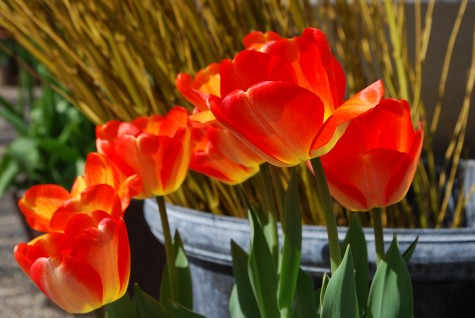
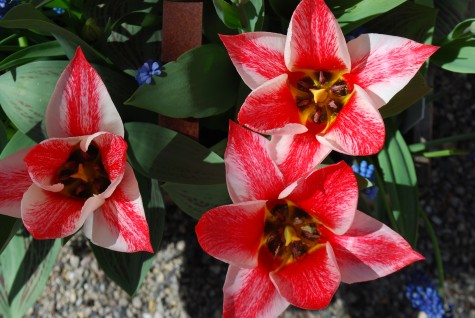
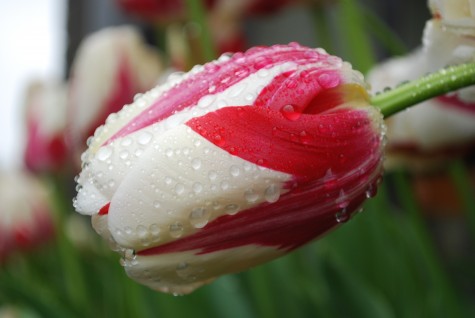
I am not much for getting dressed up, but some occasions call for that.  I oblige as best I can.  Some great vintage costume jewelry, and a little lipstick can do wonders when I need to go out after work.  Lipstick in the garden-the tulips take first prize.  Their large, goblet shaped and brilliantly colored blooms dress up a spring garden like a new lipstick.  Even the pastel colors glow.  Who knows what the real science is, but here is my theory.  The petals are very large, and thin.  This makes them transluscent.  Spring sun shines through the petals-they glow.  This tulip?  American Dream. 


A truly beautiful photograph of a flower or a garden is so dependent on a circumstance of light that endows a flat surface with four edges with depth, and great color saturation.  I understand nothing of the science of photography-I just take lots of pictures.  But I do know my favorite experience of the tulips is not only their gorgeous shapes and juicy leaves and stems- that saturated, glowing color relieves my winter headache in an instant. 

Glowing color is so welcome in my zone-after an interminable and invariably gray winter.  Michigan is known for its long run of sunless days.  By the time spring comes, I feel like I have lived my whole life in blah and white.  No flower comes with packed with more vitamin D than the tulip. 

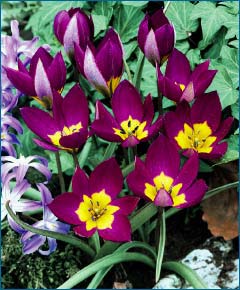
Tulips come in no end of species and hybrids.  Anna Pavord’s book on tulips-excellent and thorough.  My classification of tulips-much more simple.  There are those that are reliably perennial, and there are those that are half-heartedly perennial at best.  The species tulips, the early tulips-most of them are quite perennial.  They are modest in size, and exotic looking.  Why would they not be?  This species tulip-tulipa humilis hybrid is aptly named Persian Pearl.  I am sure the name refers to its native habitat.     

Tulips comprise a group of 109 species-native to Southern Europe, North Africa, Asia, Anatolia, and Iran.  These are exotic places, given that I live in Michigan.  They have that look-from another world.  The very early species can be crushed by late frosts, but they are stubborn about coming back.  Tulip Oratorio-a greigii tulip, is quite persistent and tolerates planting in a pot that winters in the garage quite well.  

The later blooming hybrid tulips- heart stopping.  I have had Temple of Beauty grow in excess of 40 inches tall.  I have had Blushing Beauty flowers fully seven inches across.  Some years for tulips are better than others-they like a long cool spring.  They hate being frozen through and through.  In very severely cold winters, if they are not planted deep enough, they freeze solid, and rot when the soil warms. 

It is no wonder the long stemmed so called French tulips are a spring staple for florists.  The flowers grow after they are cut, and age.  Extraordinary, this.  They are the devil to arrange-they have their own ideas about placement.   

Tulips are a bloody nuisance-the brown orb shaped bulbs want to be planted in the fall after the soil cools.  As committed a gardener as I am, I have an aversion to putting my hands in cold soil.  Warm soil is one of the great pleasures of gardening.  This is by way of saying it is fairly big work to have tulips to celebrate your spring. Not only do they ask for planting late in the year, they want you to wait many months before you can savor the fruits of your work.  Do not be so discouraged that you do not plant any.

Even one giant blob of tulips will will lift your winter weary spirits.  There are no end of tulips varieties and colors from which to choose from. 


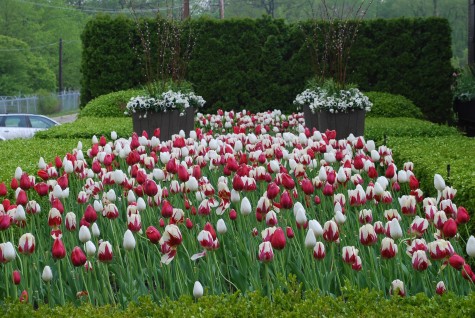
If you have no tulips coming on, stop by.  I planted 2300 tulips in the front garden at the shop last fall.  I am guessing they will begin to show color within a week, and be in full bloom shortly therafter.  I have a client who went for the spring tour at Keukenhof-can you hear me sighing?  My business precludes a spring trip anywhere except to the shop.  That’s exactly why I plant my own version of Keukenhof.  You are welcome to stop by to see this year’s shades of lipstick.

Back To The Future

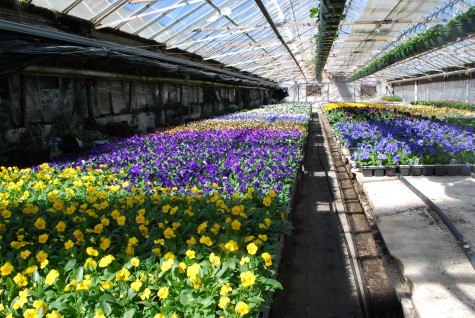
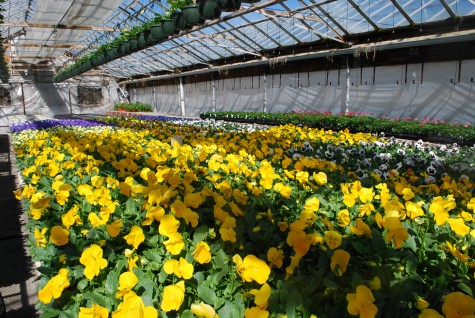
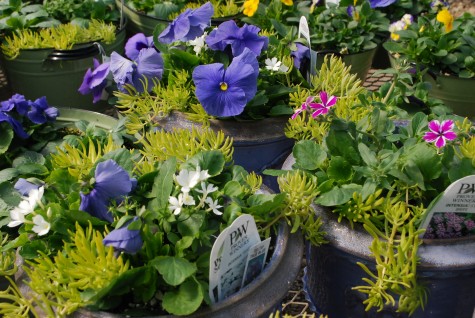
Our weather is being momumentally reluctant to shift into spring.  Yes, I still have snow and ice in my yard.  But  there are a few signs of spring afoot.  Bogie Lake Greenhouse transported me back to the future; the pansy house is bursting with spring color.  They are plenty big enough to go outside, pending some warmer night temperatures.  I do so associate pansies and violas with spring.  I do not mind violets in the lawn.  I like Johnny Jump Ups almost anywhere.  Plants that self sow can be a nuisance, but these plants are charming.  I know of no other flower which is commonly referred to as having a face. This refers to the prominent dark blotch on the petals of some varieties. This house is the closest thing I have to spring right now.  

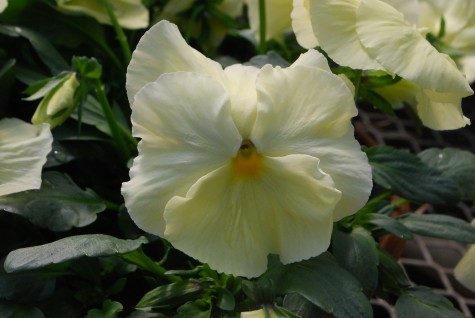
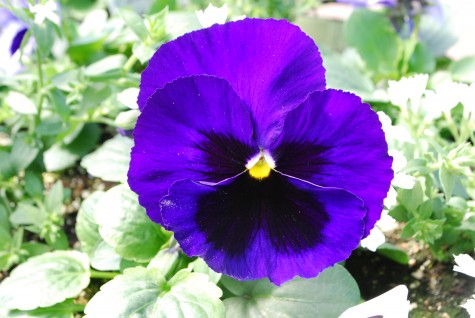
The clear sky series of pansies have no face, but I treasure them nonetheless.  They also are particularly hardy in my zone.  The tolerate a fall planting over tulips or other spring bulbs, and come back fairly reliably.  This faceless pansy does have a name-primrose.  Perfect. 

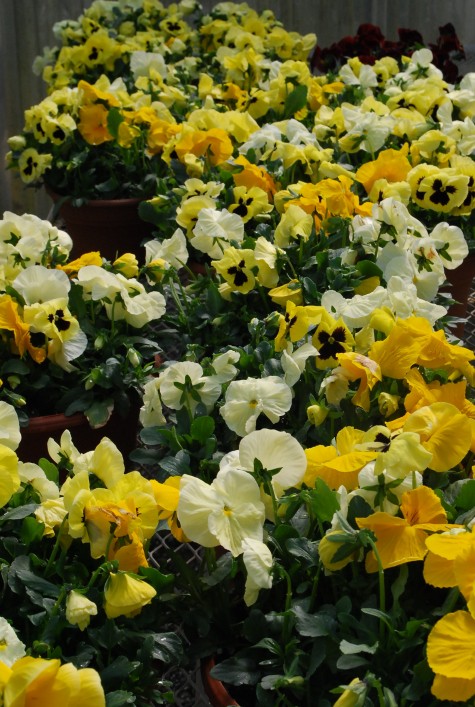
Clear sky yellow pansies are plainly visible from a long ways away.  This intense yellow makes it a perfect companion to other colors.  Yellow and primrose and dark purple make for a lively mix.  I like mixes for home plantings-they seem so much more personal.  In contemporary gardens, I like one idea, expressing confidently in a beautiful shape or sweep.  For a mix that reads evenly, use at least 3 colors.

This pansy is a member of a mix; the seed produces a range of colors that are related.  My knowledge of plant breeding is nothing to speak of, but I do understand the concept of selection.  Breeding for a specific characteristic means selecting those plants that most closely resemble the ideal, and breeding on.  I may select certain colors from a mix to further refine an idea or a look.   

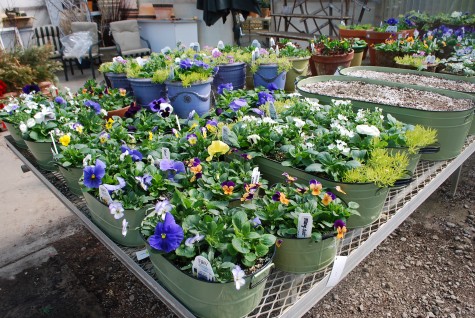
Mark kindly allocated some bench space to some spring pots of mine.  The selection of the plant material proved daunting, as nothing was in bloom.  I have firmly resolved to take notes on varieties and combintions I like when the plants are in bloom.  But a good deal of the fun of the planting-besides getting one’s hands in the dirt-is arranging for beautiful color.  However, planting containers with green plants has advantages.  A focus on the contrast of texture, mass and shape can make for spring containers all the more beautiful. 

All of the contrast here is about color.  The plants are all pansies that have the same habit of growth, the same leaves, and the same flower shape. 


There are plenty of plants that tolerate our cool spring.  One of my favorites is phlox intensia-annual phlox.  Pictured here is the white, and the pink bicolor.  There is a lovely lavender variety as well.  It has a lax habit of growth that can be supported by the stiff growth of parsley, angelina, or pansies.  It will still be growing strong later in the summer.  I am thinking I will start planting out this next Monday, April 4.  Bring on the lettuce, the parsley, the fennel, the pansies, violas and osteos-the list is long enough to keep me really busy.  Hopefully there will be every opportunity to do something new, break all the rules, and go out on a limb.  There usually is.