 Amazingly enough, it was my fifth grade science teacher that taught me the color basics. I remember that she covered individual panes of some of the classroom windows with sheets of red, yellow and blue acetate. Her explanation of the term “primary colors” was simple-these three colors come standard issue in nature-they cannot be made from any other colors. She had a stack of giant acetate rectangles every color imaginable, and we did spend a lot of time trying to overlay sheets in some form that would produce yellow. We never made any yellow, but we did make lots of other colors-the secondary colors. Secondary, meaning the result of the mix of any two primary colors. Then we made tertiary colors-any mix of three colors.
 This may have been science, but it was pure fun. Once we had green from mixing blue and yellow, and orange from yellow and red, and purple from blue and red, we pasted these combos on the windows. Over a period of days, every window in the room had a distinctly different color. In the center, the single sheets of the primary colors. At the edges, stacks of acetate sheets that looked like the color of mud. I remember how enchanted I was with all that color; to this day a set of pastels, markers, yarn samples,colored pencils, paints and the like interest me. I did not so much grasp the relationship of color to light, but I could see it. The quality of light greatly influences the appearance of color-anyone who has loved a paint chip at the store, and put it on a wall at home to disastrous effect understands this.
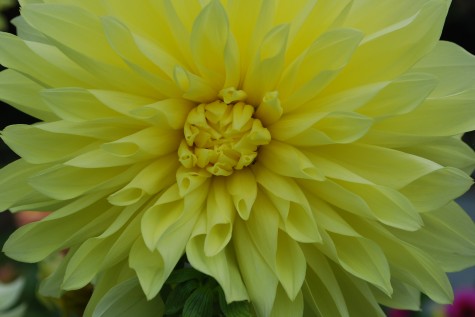 Color in the landscape functions the same way. The primary colors have an electricity that comes with the territory, but where and how color gets placed determines how it looks. Yellow reads brilliantly at a distance; use it in places far away from your eye, or to back up other darker or more subtle colors that would otherwise fade from view. The transparency of yellow makes it a perfect choice for areas in the landscape that are back lit-it will look like the lights are on. The edges of these dahlias petals have gone green; they are too thick to transmit light well. The dark behind the dahlia turns the yellow dirty yellow-green.
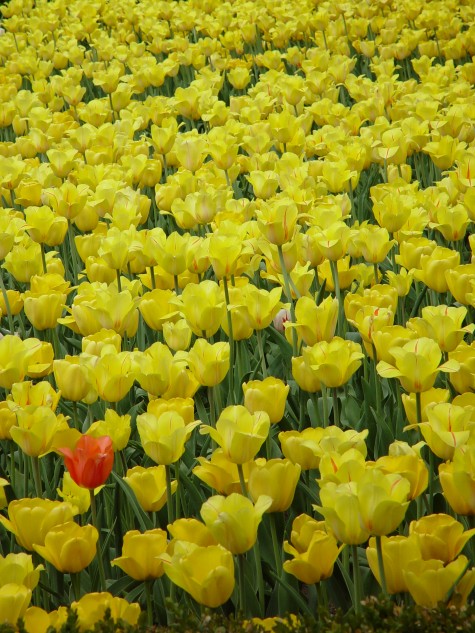
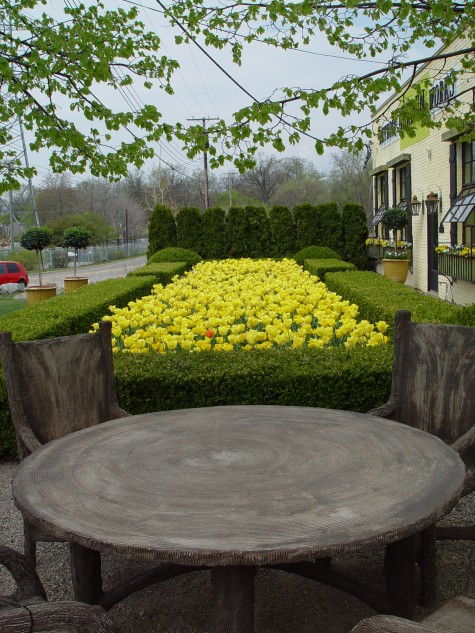 This composition is first and foremost about yellow. It draws your eye, and keeps your visual attention. It is secondarily about tulips, yews, boxwood, geometry-and so on. Notice how the color far away in this photo are subdued, muddy, and indistinct-but for the green of the emerging leaves. New leaf green has a lot of yellow in it-that yellow reads at a distance.
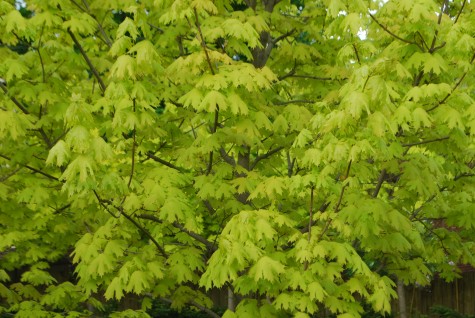 Princeton gold maple leaves are really yellow with a green cast when they first emerge.
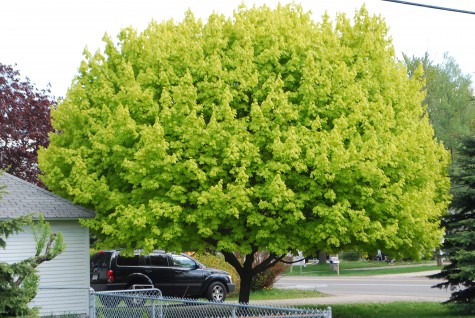 In a sunny spot, the leaves read yellow to the eye at the top, where they get the most light. As your eye looks at this tree from top to bottom, the color changes. The leaves with least exposure to light are the darkest. The change in value-or relative lightness or darkness-from the top of this tree to the bottom is considerable. The trunk of the tree looks black, given all the light behind it.
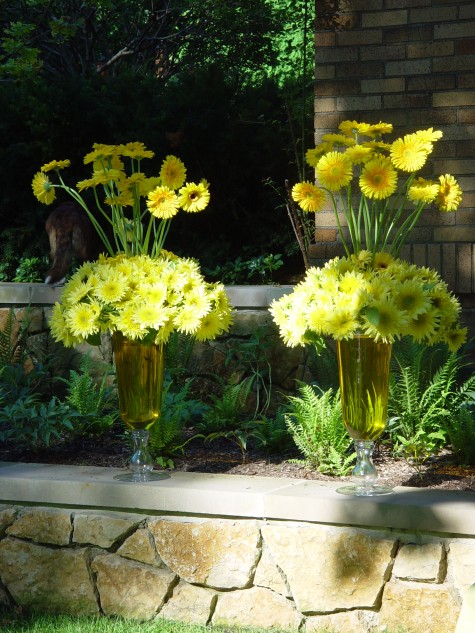 Yellow has the ability to light up a shady area. The gerberas at the top glow in front of the yews whose color almost appears black. Densely shady gardens can die visually if some effort is not made to introduce contrast. One landscape project involved a densely wooded area; cutting out the brush and sapling trees in a few selected areas created pools of light. The contrast of light and dark added visual interest, but also made it possible to see the more subtle colors of the plants in the ground.
 Likewise, painting the concrete floor of one room in the shop these grassy-shaped variations of chartreuse and yellow green made it easier to see everything that would be placed in the room. Milo’s coat color is known as “dark brindle”. All the individual colors present in his coat read much more clearly than they would should I have photographed him with a dark background.
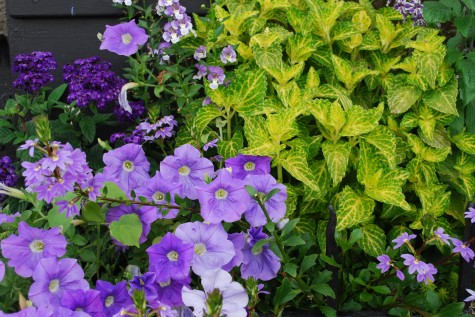
Yellow may or may not be a favorite color, but how it makes other colors look makes it useful. The color of these blue petunias, heliotrope and angelonia appears clear and striking, given the contrasting companionship of the yellow coleus. These same flowers, planted with brown sweet potato vine? fugue-like. How you use color helps insure that what you design reads just how you intended.
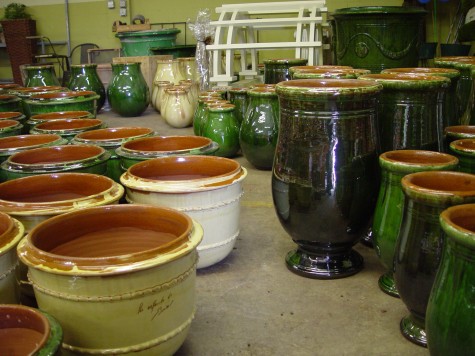 I reluctantly agreed to play ball with those dogs of mine yesterday-in spite of the 9 degree temperature. We were not outside for long, but long enough for me to see the color of my yews had gone so dark they almost looked black. This cold color could not be further from how those yews look dressed in their spring green foliage. This set me to thinking about color as a design element. The glazed terra cotta pots manufactured in France for hundreds of years make a big color statement. Their strong color has a very Mediterranean feeling to me; the color seems very much a product of the climate in which they are made. When I see a pink stucco house, I immediately think warm climate; no doubt I react to color with an entire set of pre-conceived notions hovering nearby.
 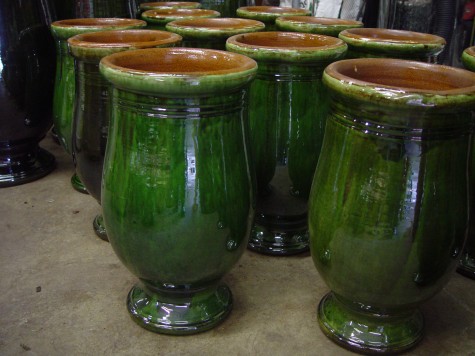 Though green is the dominant color of any landscape, this shiny green glaze is a color experience of a different kind. These pots have a much more formal appearance than a natural clay pot-whose natural and from the earth color is vastly more subdued than this. As glazed pots do not absorb water from the outside, the finish and color is as fresh in their tenth year as their first, provided none of the glaze has chipped. The vibrant color of these pots will strongly figure in how I would place and plant them.
 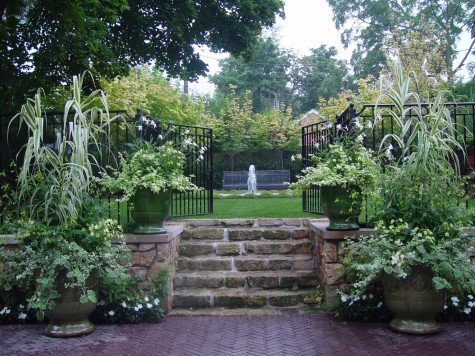 The color of these pots will always be a significant part of the planting composition. Unlike natural clay pots whose importance in the composition may be secondary or slight, the color of these pots attracts visual attention, and sets off the planting in a formal way. A green and white color scheme seems restrained and serene. Do these pots look out of their Mediterranean element? I think not. This leads me to think that before deciding a color won’t work, I should try it.
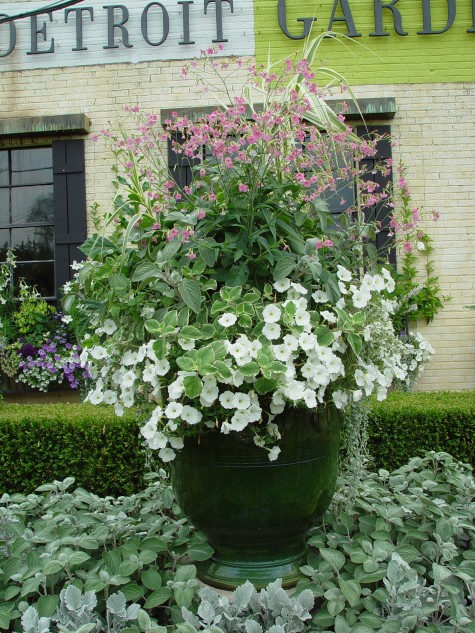 This color scheme branches out a bit into the pinks and greys. The pot is elevated on a concrete base, so the foot of the pot still reads even though the ground planting has grown in. The shiny green mass of the pot is a beautiful foil for the tiny naturally green leaves of the boxwood. Monochromatic, or one color schemes are quietly formal and restful in their simplicity.
 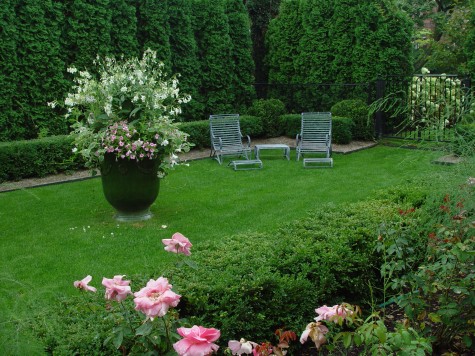 This pot is 12 years old. Mineral deposits from the water had dulled the shine of the glaze. It is remarkable how close the color is to the color of the existing evergreens and grass. This composition is more about texture, and mass, than color.
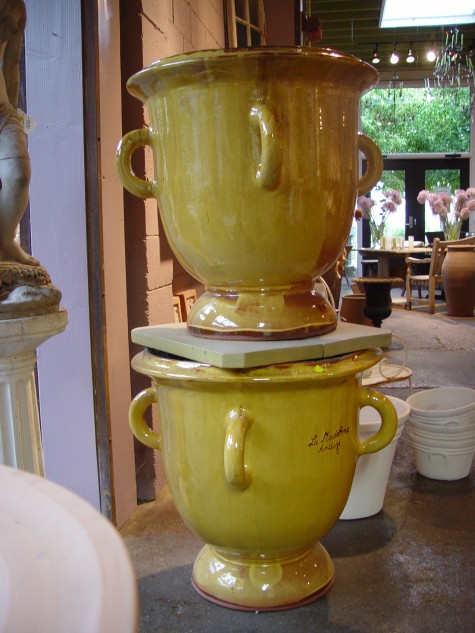 Yellow glazed French pots are perfect for places where any thing but neutral seems like a good idea. Shady gardens, or nondescript locations asking for a strong center of interest can get that from a splash of unexpected color.
 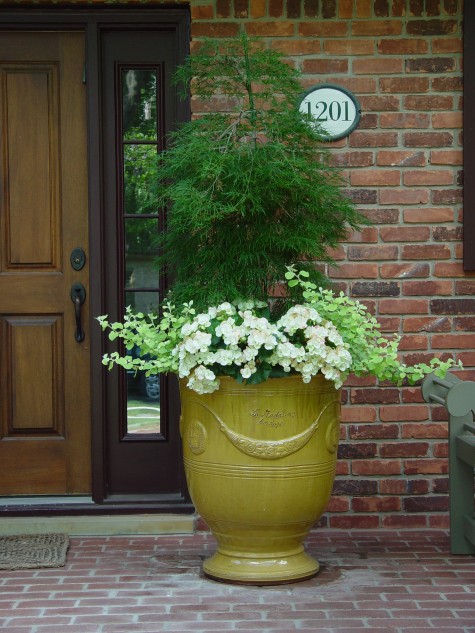 This pot is full of surprises; the yellow of the pot is just the beginning. A threadleaf Japanese maple makes an unusual centerpiece for the surrounding white begonias and lime licorice. The brick front porch, tough completely shaded by a second story balcony, has a fresh and striking appearance. Though delicate in color, these French pots are incredibly strong and durable. The clay of the large pots can be 3/8 of an inch thick or better, and they are high fired for extended periods of time.
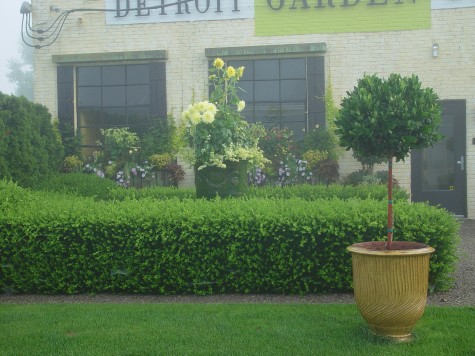 Some potteries have added more contemporary designs to their collections. This pot, known as a strie, refers to the striations formed from the pattern generated by the fingers of the potter; each pot is unique to the fingertips of the person who made it. The color of the pot helps to make it central to the entire composition of the garden. Simple color relationships read more clearly and strongly than mixed color compositions. Strong color relationships paired with more subtle color relationships is what creates rhythm in a composition.
 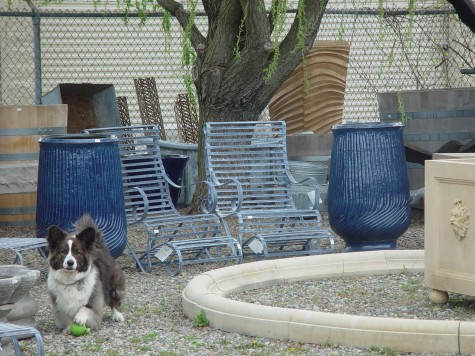 Blue glazed pots in the landscape can be tough to place. Though bluestone, acid washed steel, lead, water and sky all represent blue in one form or another, planting blue pots requires some thought. That glazed blue will be very influential in the look of the whole. Yellow flowers in a blue pot can look like a band uniform, or worse. Some shades of purple are deadly dull and irritating with this shade of blue; lavender and silver can be great.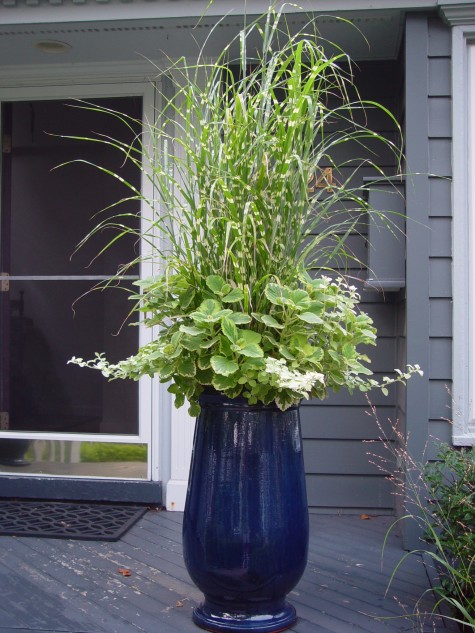
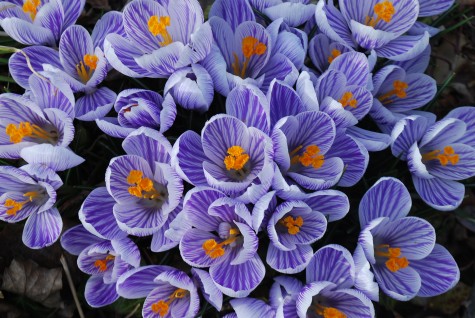 The year’s end always invites reflection on what worked and didn’t work, what I liked and didn’t like-what I might want to do differently next year. There’s time for that, over the winter. But other things come more immediately to mind, at year’s end. As I rarely see a plant or a garden that I don’t like, what sticks out in my mind are those great garden moments. I have had years when my March crocus are so blasted by below freezing temperatures they barely bloom. This year, they were glorious-and glorious for quite a while. The night temperatures were perfect; every day for 2 weeks they were an event well worth the price of the ticket.
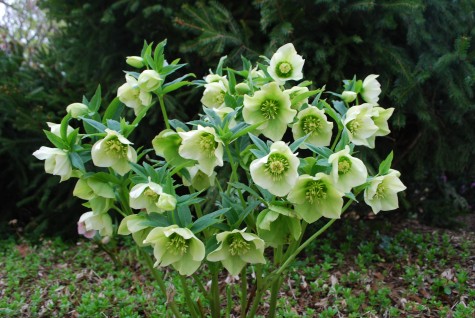 My hellebores were similarly spectacular this year. The evenly cool temperatures they liked. I was even so inspired to send away for more from Knott Hill Farms. The sweet woodriff coming on is a good companion for them. I have both of these planted in full sun, not far from the road. They not only perform better in this location than my shadier places, they take fewer years to make dreamboat sized clumps.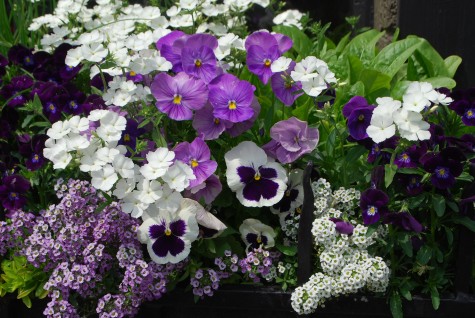
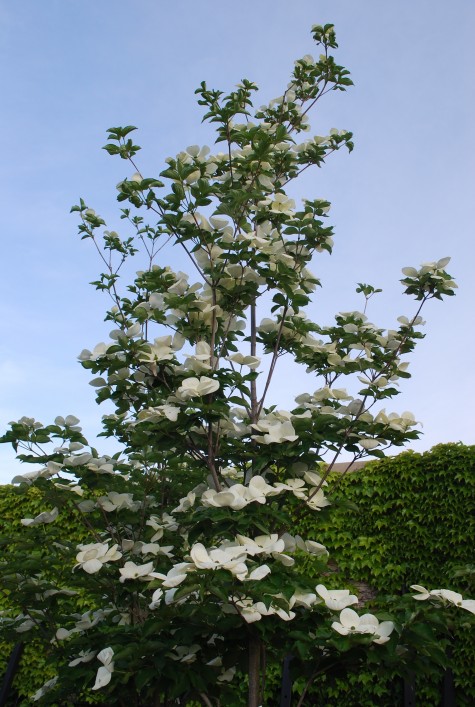 The blooming of the Venus dogwoods however was spectacular. They were in full bloom, loaded with these giant 7 inch diameter flowers, for over a month. I could not recommend this tree too highly. It is happy in full sun, and very hardy. It grows fast, but stays small. It is the first tree I have planted in my yard in a good many years. If I had the space, I would plant great drifts of them, and let the grass grow rough underneath them.
 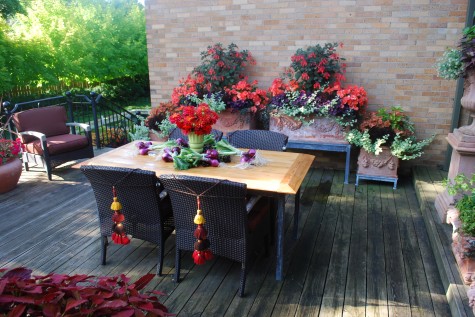 The morning of July 19 dawned cool and sunny, perfect weather for the garden tour we sponsored to benefit the Greening of Detroit. We had 325 people attend the tour, and 125 for bites and cocktails afterwards at the shop. In addition to all that fun, we raised a good amount for the Greening. It was a perfect garden day.
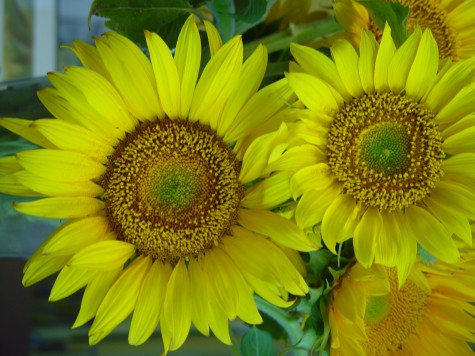
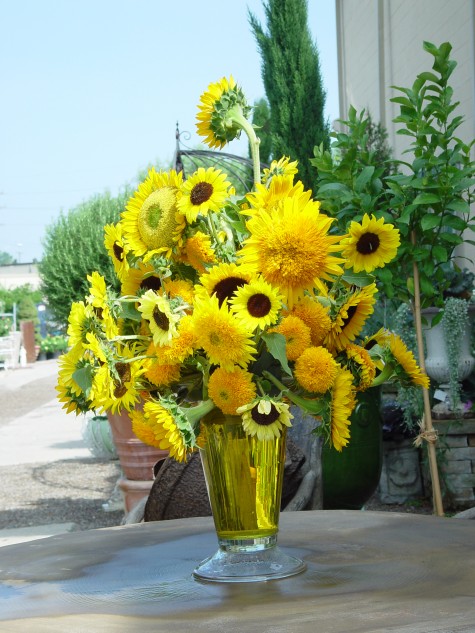 My favorite time at the farmer’s market begins with sunflower season. Everything is big about them-big size, big color, big heart-big delicious seeds, so loved by the goldfinches. Sunflowers-the name says it all. The summer harvest is well underway.
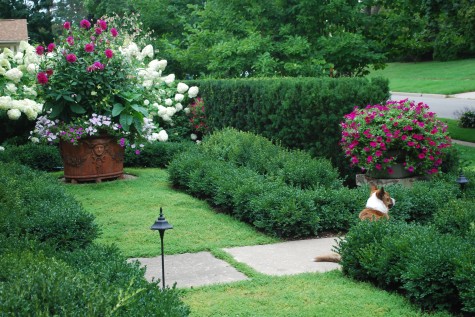 My summer annuals provide much pleasure to me. I like the planning, the planting, the caring for, the looking at, the deadheading, the watering-I like every aspect of this part of my garden. I do not have the luxury of lots of time to spend in my garden; I work a lot elsewhere. This part I have the time, energy and heart for, every day. Other parts of my landscape have their moments, but the annual flowers provide every day good moments.
 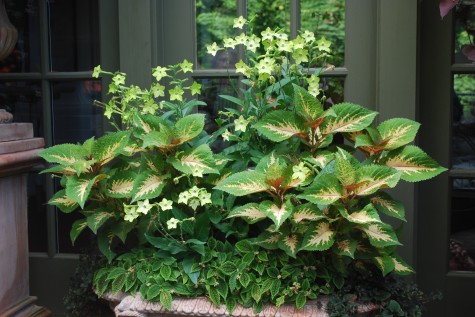 I always have one container that’s all green-I particularly enjoy matching and contrasting shapes, textures and volumes of green. Green-who could live without it?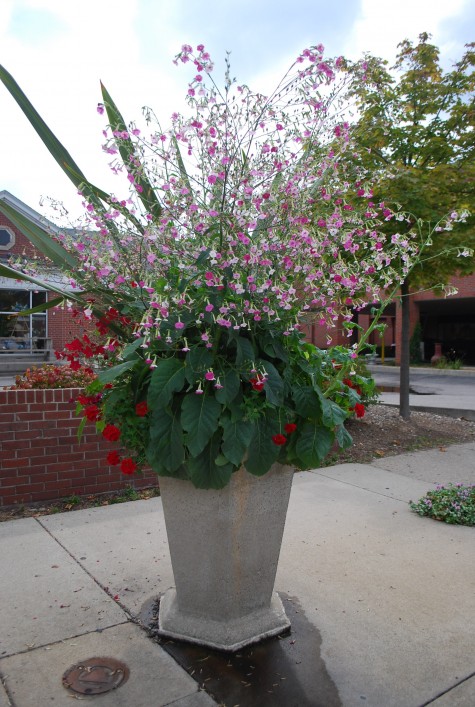
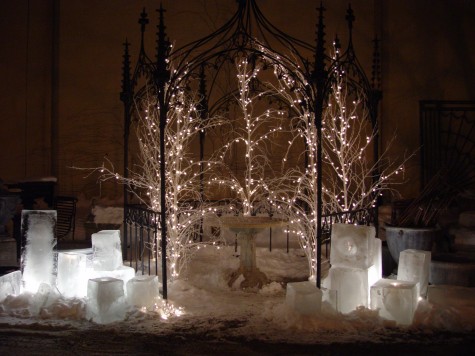
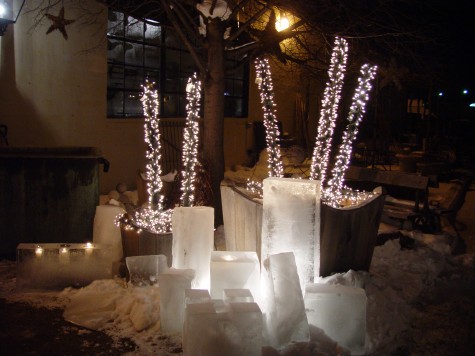
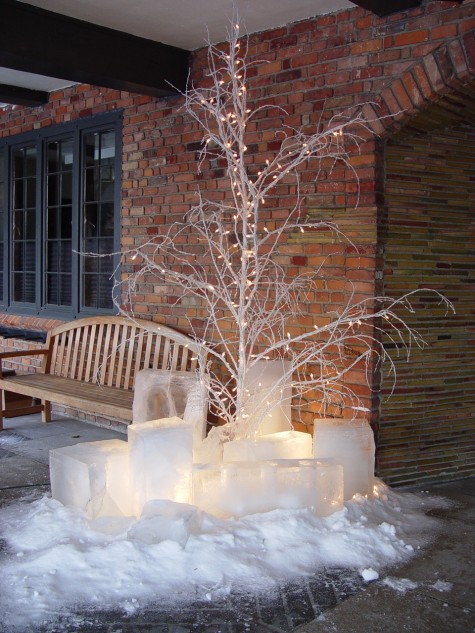
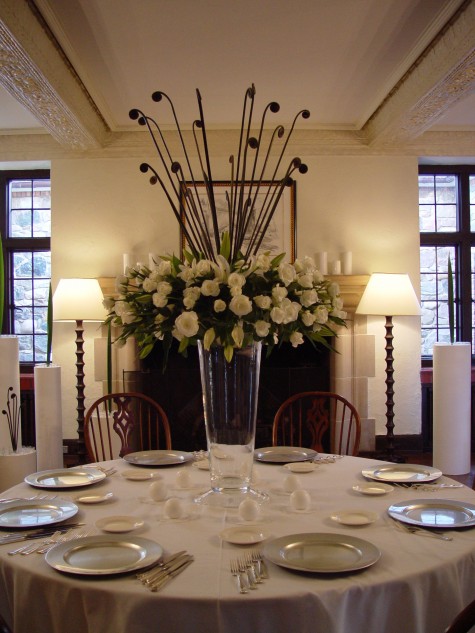 We carried this winter snow and ice idea from the outside, inside. We outfitted sonatubes used for forming concrete cylinders into giant candles. A platform set just below the rim was stuffed solid with 10 hour votives in individual glass holders. Single leaves wedged in the center created a flame shape. The guest of honor’s table was dressed in white roses and lilies, and fern curl flames. The overhead flowers make an immediate statement at eye level when guests arrived. This treatment also makes it easy for guests to talk across the table.
 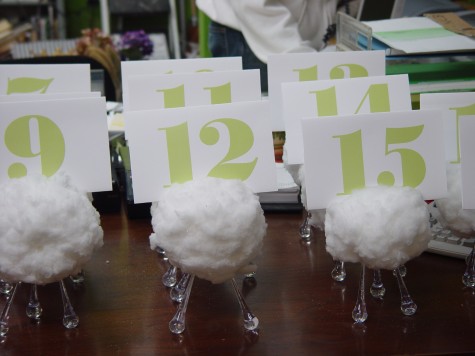 Some parties call for table numbers. We set cotton batting snowballs on tripods of glass drops; this makes an organizational element part of the fun. Formal occasions do not necessarily mean stuffy occasions.
 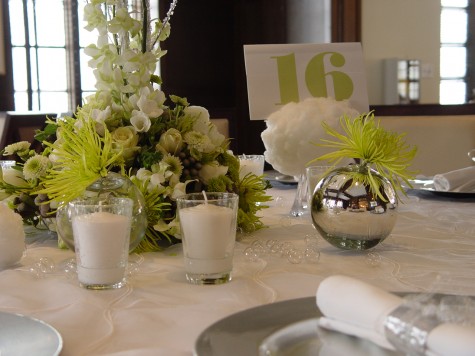 My client did want some color in evidence-chartreuse she liked. The quality of cut flowers in the winter can be hit and miss, so I stuck with varieties that are readily available, and tolerate winter travel well. Hollywood roses are my favorite white rose, but I need to order them well in advance to get them. White freesia and the white button mum “Green Peas” I can count on. White dendrobium orchids, and chartreuse spider mums are equally foolproof. White ranunculus can be good, and can be equally horrid; if I decide to use them, I order extra.
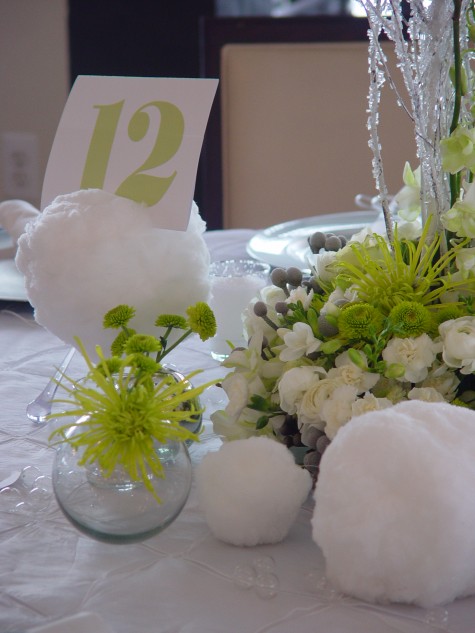 Glass bubbles in different sizes, shapes, and surfaces were spread on the tables, along with more snowballs. White twigs encrusted with plastic ice gave a little height, and lots of sparkle.
 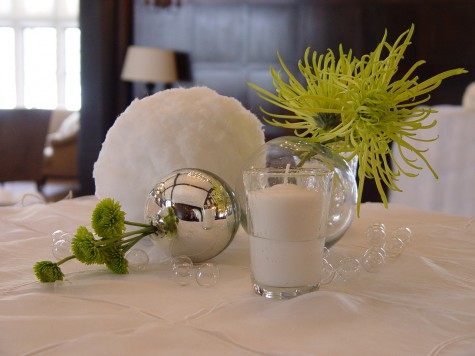 The chartreuse button pomp Yoko Ono is a cut flower workhorse. So much color from such a small flower. They can be used without water, if need be. The oversized votive candles have water in the bottom-this makes it easy to clean the wax out after the party, and re-use the glass holder.
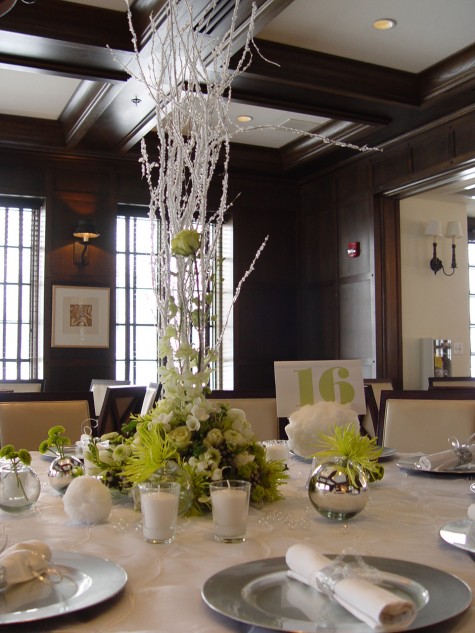 Silver chargers, and white napkins wrapped in silver ribbon complete the table decor.
  <
<