I met three new people yesterday. A couple with a sizeable property working with an architect on designing a large open conservatory space and terrace that would allow them to spend more time and entertain out doors, were equally as interested in addressing their landscape. I spent several hours with them, discussing the scope of their project. They were very interested that I understand why they had bought the house. He was very clear in comunicating that the house was relatively unimportant in their decision process; they bought on the strength of his keen interest in the property. It is large, has many mature trees, and a very interesting and varied topography. The house sits quite high; the view driving up almost suggests the house sits on a cliff. He discussed at some length how much the placement of the house suited him. Those of you familiar with Julie Messervy’s book, The Inward Garden, will recall her discussion of what she calls “archetypal gardens”. Each child’s physical experience of “place” later in life culminates in a psychological concept of the world. ( This is an unfairly condensed version of her ideas; If you are a gardener, I could not too highly recommend reading this book.) He feels a genuine connection to this particular place.
He went on to discuss the importance of his family, and his relationships with them. This in and of itself is not remarkable; many people value family above all else. What was interesting was his description of that life. His interaction with friends and family was very much intertwined with his interaction with the natural world. He wanted everyone in his immediate sphere to experience nature in some way. His children would be exposed to and learn about nature. As to benefits, many people talk about a need for peace and serenity at home. I can so well relate to that feeling. He was especially articulate, describing how wearing the demands of public life can be. He emphasized how important the landscape and garden was in restoring and maintaining his sense of well being. In conclusion, he told me that a house and home was no doubt a wonderful thing. But no matter how nice a house might be, in the end, it would always be a cave. He would be happiest, outdoors. His interest that the landscape be beautiful and well looked after is a personal and proprietary interest of his. He is interested that the landscape spaces flow such that he is able to entertain, teach his children, entertain and enjoy the beauty and excitement of every square inch of it. Though I do not expect to see him turning soil, this person is a gardener.
What interested me the most about meeting the two of them was how they had organized their first meeting with me. They had thought a lot about what the landscape meant to them, and felt that this discussion was the first order of business. They made a distinction between the big scheme of things, and and all else that came under the heading of details. I like when I see people thinking personally, abstractly, intelligently and passionately about the prospect of a garden. They genuinely represented themselves. I share with them an interest as a designer that the sculpture which is the landscape have an authenticity of place.
Though I only know enough to be dangerous discussing the idea known as “genius loci”, the words translate literally from the latin as the genius of place. I interpret this to mean that a landscape, authentic to the environment and culture from whence it comes, has a genuine and special beauty. In classical times, the actual meaning of the phrase meant not so much the place, but the guardian divinity of that place. Clearly nature is the guardian divinity of the property under discussion; they both made reference to this with as much delight as conviction. An idea much discussed in England in the 18th century, this distilled bit from Alexander Pope; “Consult the genius of the place in all…” The large landscape parks in England from this time period were designed with the idea that a truly successful landscape was a more civilized, less savage, and virtually indistinguishable version of what nature might herself create. Much later, Lawrence Durrell would say ” …you begin to realize that the important determinant of any culture is after all the spirit of place.” As much as I (The aforementioned came largely from an article on genius loci from The Journal of Urban Design written by Jiven and Larkham) am interested in philosophical underpinnings, I am much more tuned in and trusting of the judgments made by the eye. I think landscapes that don’t look or feel right, that are not seated in the environment in which they are made, that are disconnected, and lack a sense of authenticity, have that movie set aura about them to which I could never belong.
A sense of belonging is not so easy to come by, for anyone. However, I clearly belong to my garden, and the gardens I make for others. The third person I met at a dinner party last night. I was introduced to him by both name and profession; he spent a few minutes talking to me about his landscape. He said when he came home at night, and closed the car gates behind him, there was not a single visual clue anywhere on the property or in the landscape that would reveal that he lived in Michigan. He had a classically formal French garden, perfect in every detail. Every bit of this delighted him. I have not seen the garden, so I have no opinion about it. But were I ever asked to do any design work for him, I would want to understand what would provoke such an intense longing for another time, and another place, that he would find such a dislocation beautiful. I have designed plenty for people with a penchant for formal and edited French design. Or perennial borders with an English flavor. But none the less, these are American gardens, set in Michigan. I happen to think Michigan is a very beautiful place, as do the clients I just met. That we treasure our place is common ground.
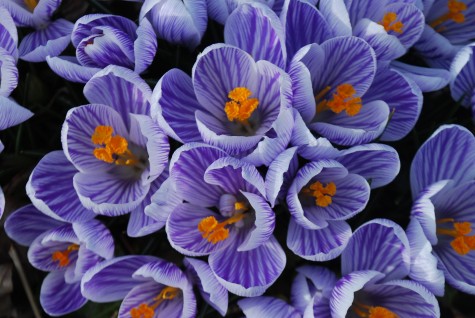 The first color I want to feast my eyes on when spring comes is purple. It could not be any further from the light, medium and dark drab I have been looking at for months. Purple flowers have a luminosity and depth that no purple paint could come close to-just try to paint a room crocus purple. Watercolor pigments, thoroughly suspended in water, and applied transparently over a white sheet of paper, come close to luminous. The gold yellow of these stamens are by direct contrast sure to attract pollinators as much as they attract me. But no one does luminous better than nature.
 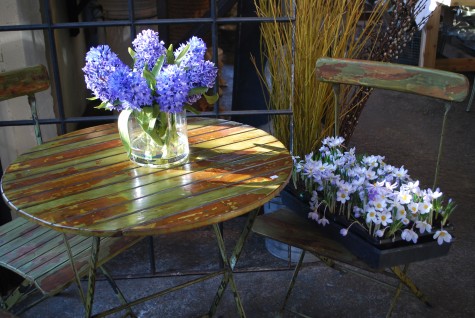 Though these lavender species crocus planted in a flat do not bloom for long, I pay my money, and go home happy. Sometimes I do the right thing, and plant tufts of them out in the garden. They rebound from the forcing amazingly well, and will take hold in the garden. The hyacinths are another story-these fabulous fakes fool the eye even up close. I have seen people touch them, to check if they are real. I think the fabric is dyed such that the color pools dark to light on each floret. The individual florets are thin enough to permit light to pass through-a more than decent try for luminosity.
 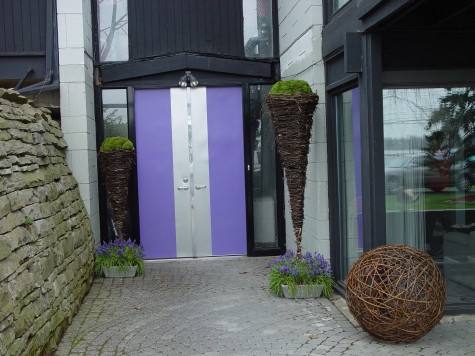 It is an unusual client who will commit to a purple door. I find this refreshing. The front door looks like a package ready to be opened, does it not? The grape hyacinths-who would not have them-all the species and every available hybrids-if they could?
 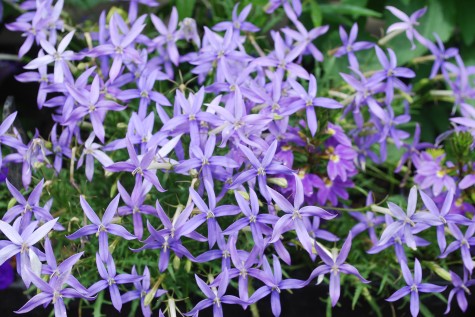 Laurentia is blue purple. Commonly known as heliotrope blue, the color startles me. In the smallest dose, it reads loud and clear. A small stand of this is as striking as an entire field of sunflowers, as it is so unexpected. An unexpected landscape element-what is yours?
 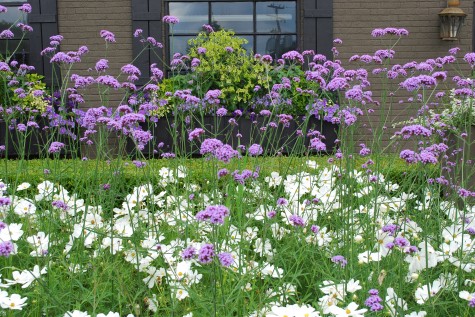 Verbena bonariensis is one of my favorite flowers. Endowed with all the airy grace of a meadow perennial, it is an annual in my zone. Drought tolerant, sturdily tall, a prolific seeder whose seedlings are easy to weed out-who could ask for more from a plant? These floating dots of red/lavender/purple are beautiful with just about every other color on the planet; this makes them friendly to just about any scheme you have in mind.
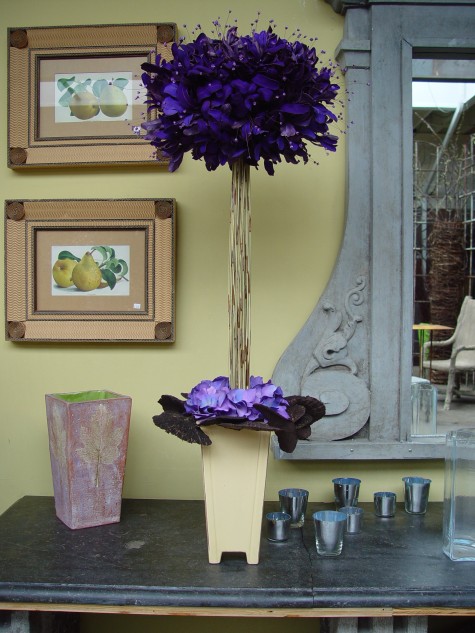 Integrifolia dyed purple is a rich royal purple. Placed in front of a pale greenish yellow wall, this complimentary color makes the purple glow. Though no light penetrates these leaves, pairing colors opposing each other on the color wheel is a reasonable approximation of luminosity.
 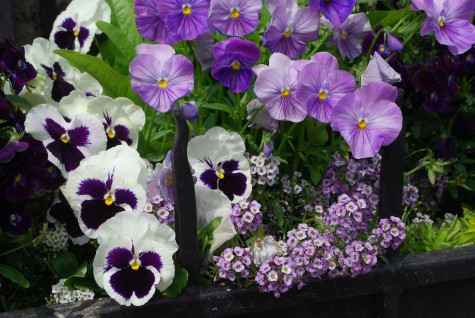 Pansy purple-everyone knows what that color is. I find it all the more precious as I have it in the spring and early summer-no other time. I call this alyssum the Easter mix-the mix of lavender and purple brings back memories of Easter Sunday hats. Those hats I only saw at Easter-never any other time of year. I am sure I had more than one Sunday dress in some variation of that purple.
 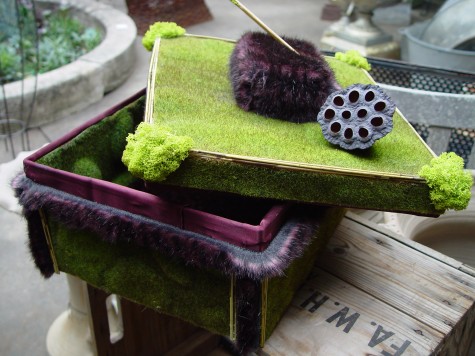 I call this a presentation boxes-don’t ask me what that means, exactly. Draw your own conclusions. This box I made from synthetic moss mats, lime green reindeer moss, natural reed, a particularly fine specimen of poppy pod-and purple fake fur. Purple and lime green-an inspired color combination.
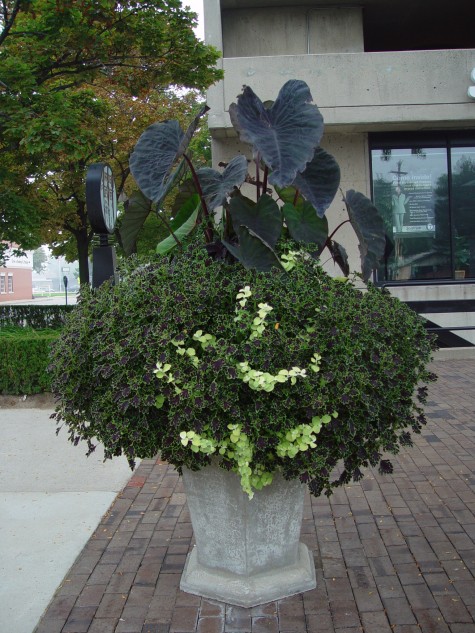
 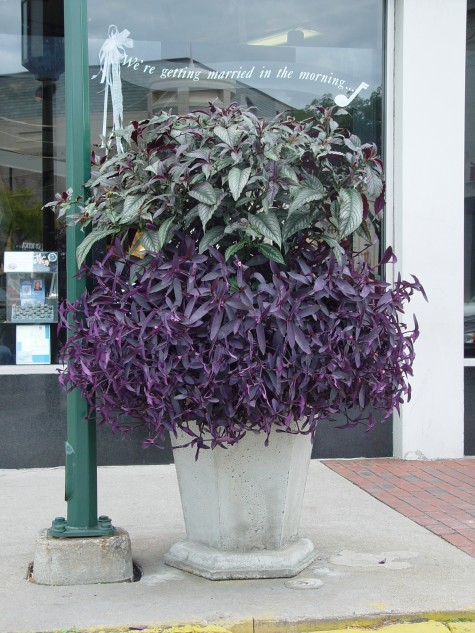 Purple can be moody, and fugue like. What I call Moses in the Cradle-this dark purple tradescantia, I plant liberally. It tolerates cold, heat, shade, sun and neglect. A new variety I tried this year has a white and cerise variegation; such a fancy outfit must be why it does not grow vigorously. But the ordinary Moses will make a stunning bouquet for you. Persian Shield is a moody mix of blue green and red violet in this more sunny location.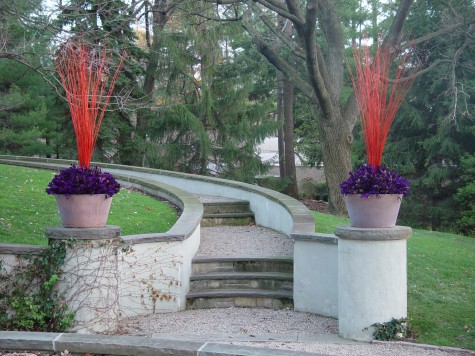
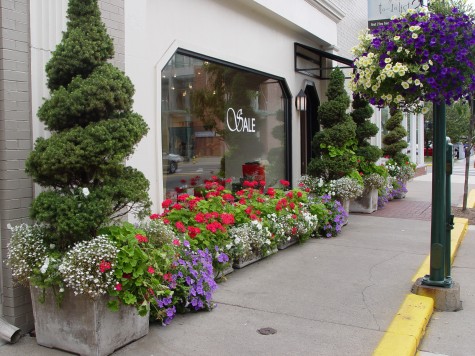
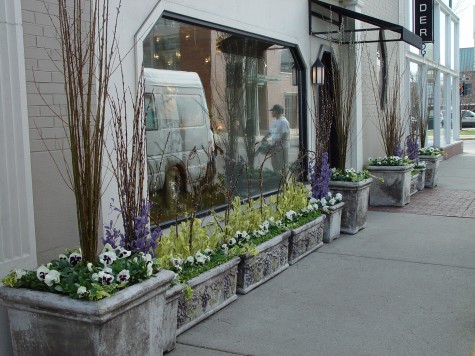 Tender is a very smart dress shop where they take their fashion seriously. As I take the landscape seriously, we relate just fine to one another. Commercial clients understand that the presentation of their business outdoors says a lot about what goes on inside. They want the outside of their store to look as fresh and newly conceived as what they carry inside. I am thinking about Tender today, as
 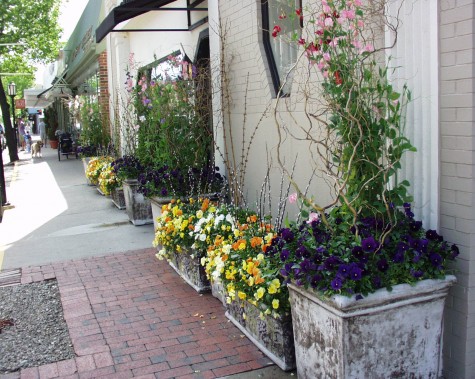 A container planting is a one-season committment. Unlike the landscape, the plants have to be replaced every year. The responsibility for a landscape can go on for many years. I sometimes don’t make changes that I should, out of sheer inertia. But my containers force change on me. I have no choice but to observe and learn how to do better, and redo them-or be stuck twiddling my thumbs from sheer boredom. A container planting is a miniature version of any landscape. I would much prefer growing up as a gardener over four square feet and some annuals, than 100 square feet and a truckload of shade perennials.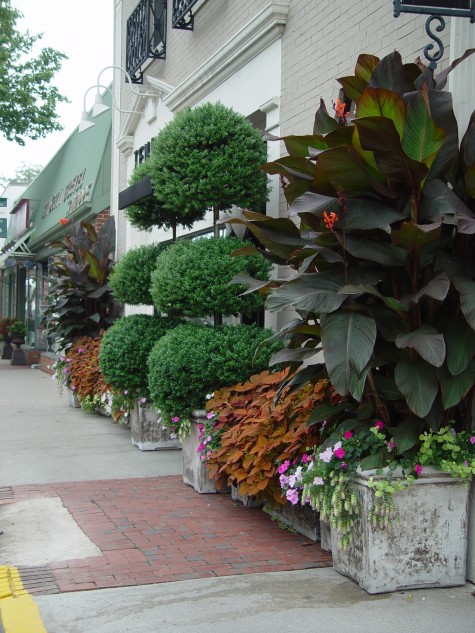
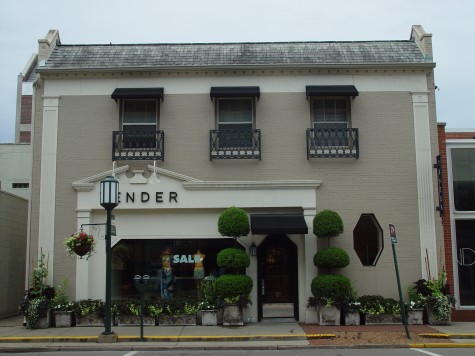
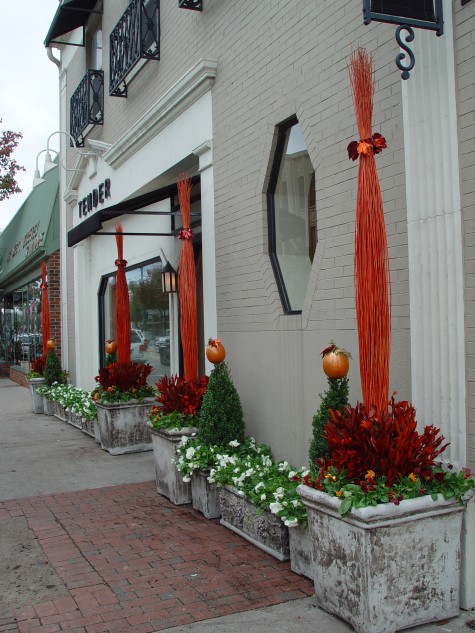 Pumpkin hats on the conical boxwood-this made me smile. The willow sticks dyed orange-I bought an entire container load of these some years ago from Spain- in lots of jewel like colors. Several hundred thousand sticks-no kidding. Getting a phytosanitary certificate sufficient to get them through customs was a headache that made me want to black out. Though looking at this picture makes me want them again in the worst way, I know something new is just ahead of me.
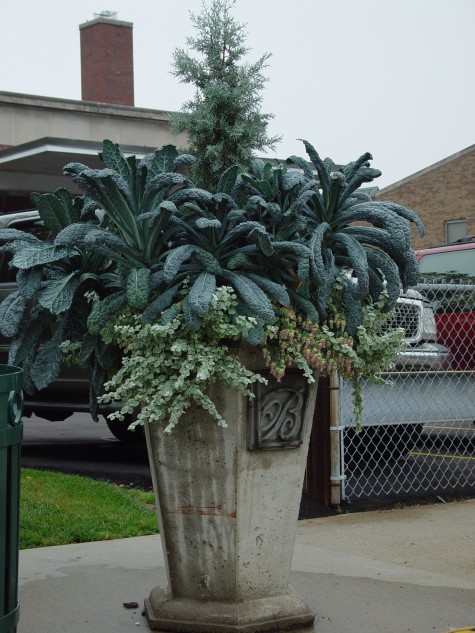
 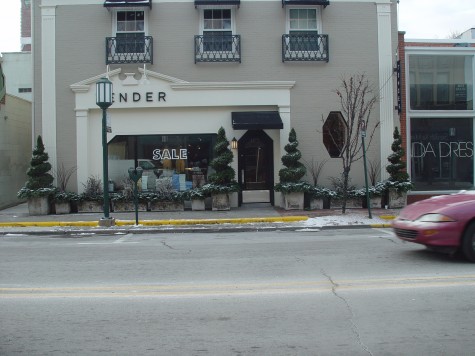 The winter is our quiet season. Our colors are subdued, but not our gardening spirit. But for these planters, with their Alberta spruce topiaries and their greens, this view would be more bleakly about concrete than need be.
 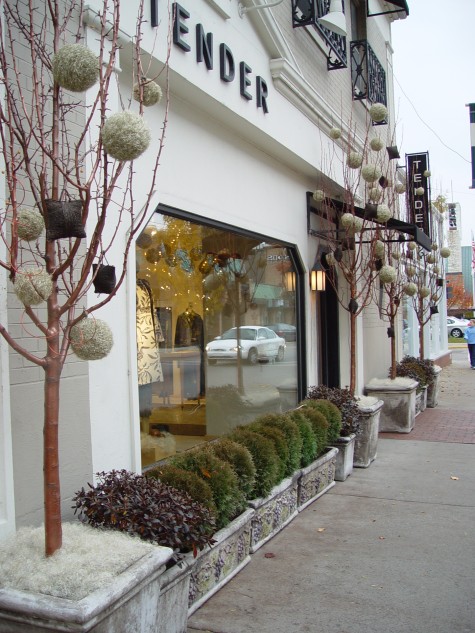 This year one gallon size PJM rhododendron and dwarf globe arborvitae filled the rectangular pots. I bought dead trees from my nursery supplier, and varnished the bark after dusting them with copper spray paint. Platinum ball ornaments and squares of tarred jute ornament the trees. Each tree had a bird’s nest of fine platinum colored wire at the base. A winter landscape.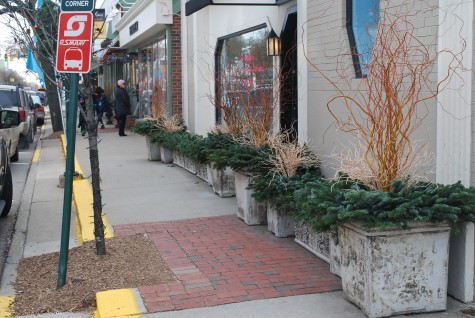
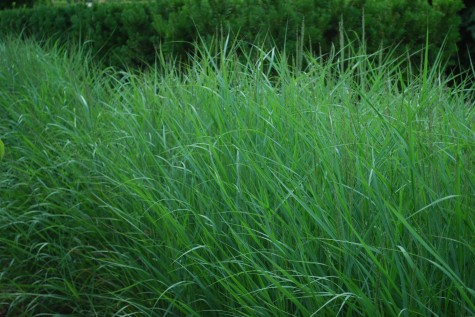
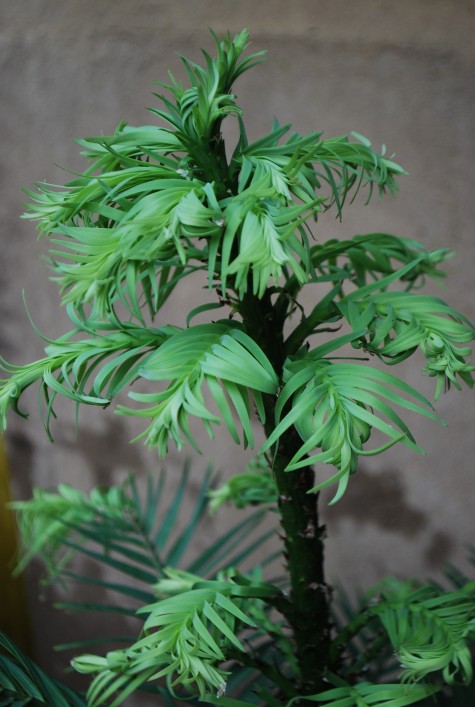
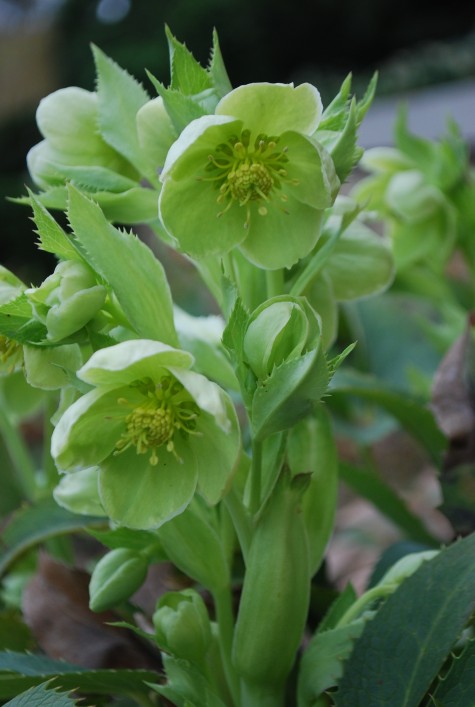
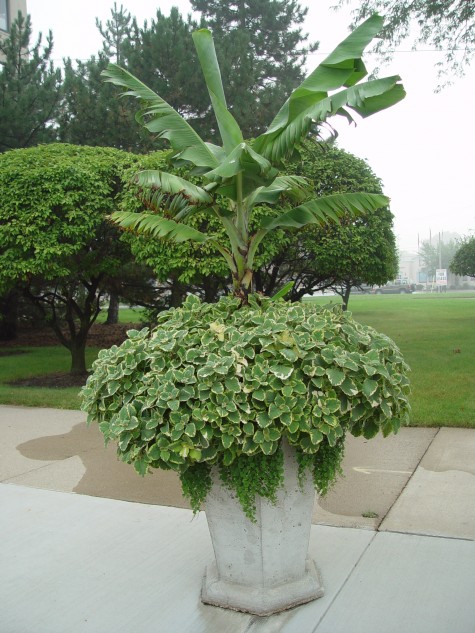
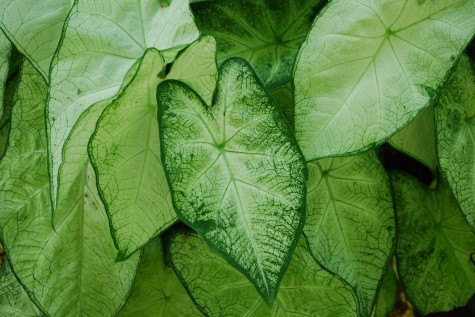
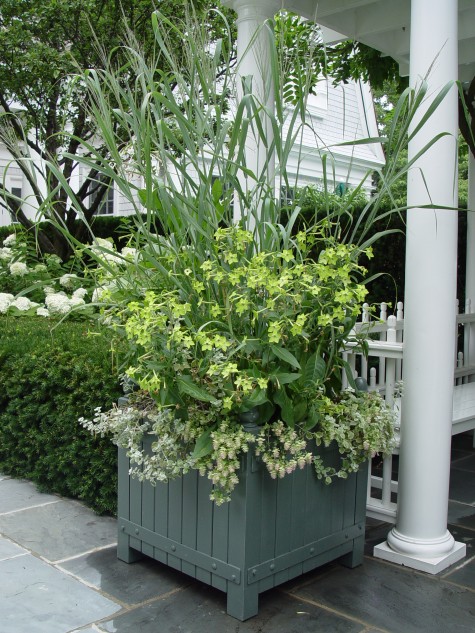
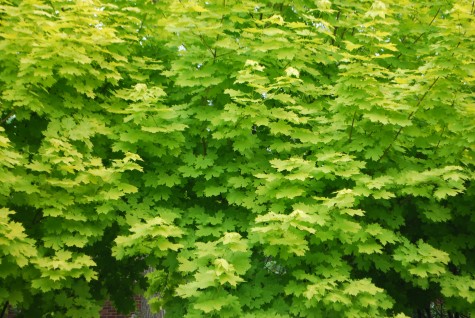
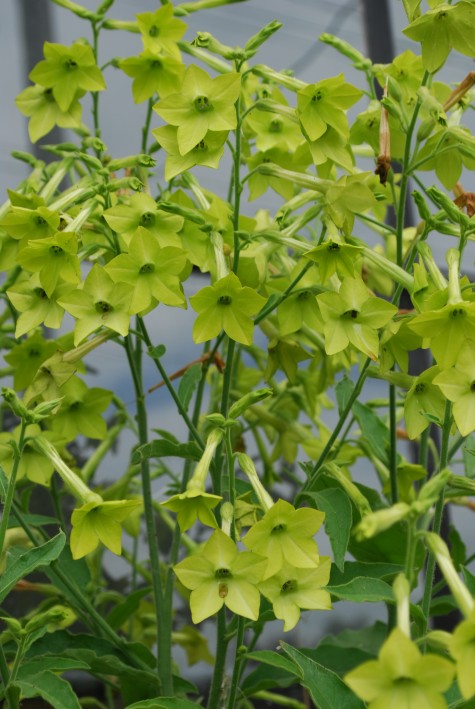
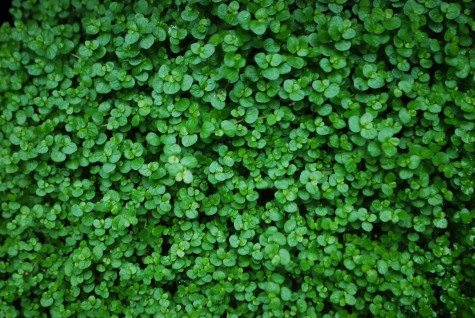 Judging from the numbers of people I try to help grow healthy yews who cannot spot that yellow/green yews indicate a water or drainage problem, I think green is so pervasive in a landscape, people stop seeing it. If you are not tuned in to green, you are missing a good portion of the pleasure and satisfaction of a landscape. Designing with green in mind-don’t miss this.