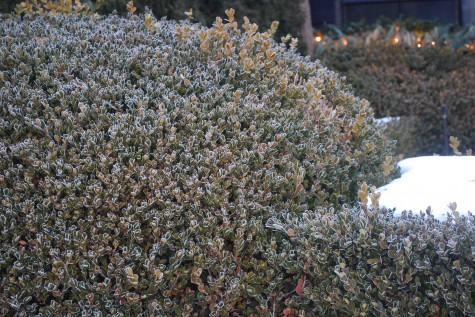
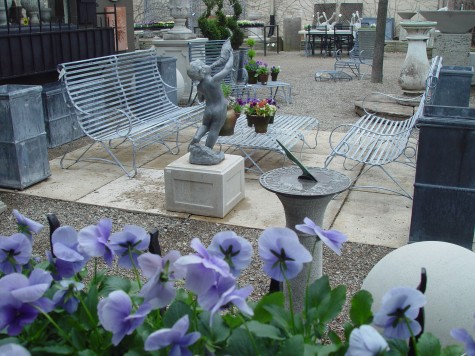
 I might be making things up. I am so ready for a view like this out my office window that my reporting may simply be wishful thinking. But I do believe I heard birds singing this morning. It was thrilling just to be outside and not shudder. The sun was shining, the temperature well above freezing. Though the best thing about February 19th is that I will not have to deal with it for another whole year, I could sense some little signs of spring.
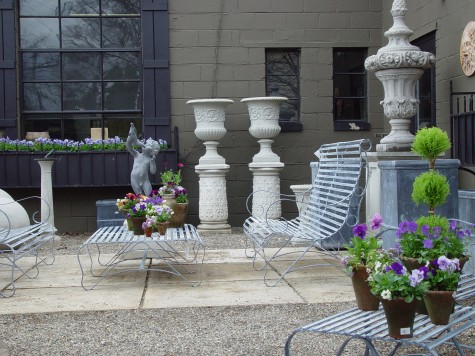 One definition of a Michigan spring is the day the snow is gone. It is gone from my roof, sidewalk and drive. My street was wet; the big piles of snow are a fraction of a bit smaller. The 39 degrees by 5 pm seemed like a heatwave. Perhaps more telling, the sun was still shining at 5pm; this is a sure sign that winter is loosening its grip. I am of course thinking already about planting. It will not be long before I have my hands back in the dirt.
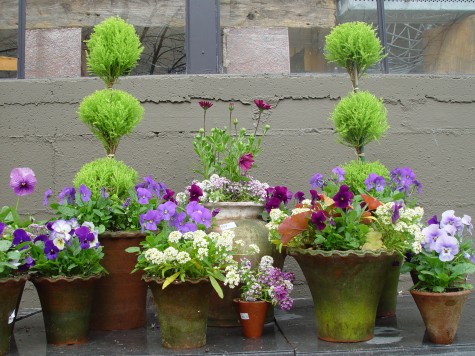
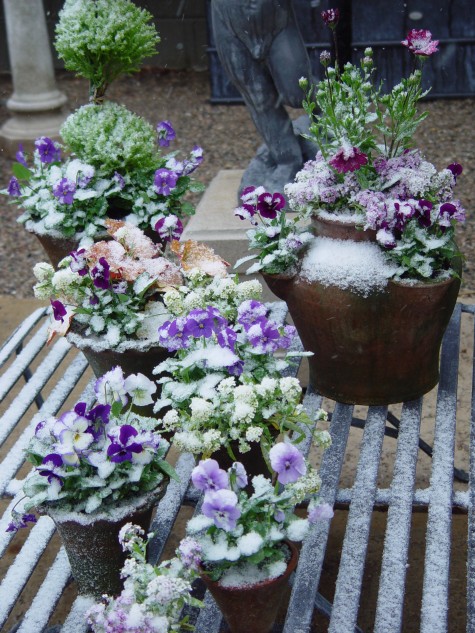
There are lots of plants quite tolerant of cold. These lime needled Italian cypress are not hardy in my zone, but they do not mind chilly weather. I have grown them 5 feet tall and better, depending on how good a job I do of wintering them in the garage. The pansies, violas, alyssum, and heuchera in these pots are much more cheerful about chilly days than I am.
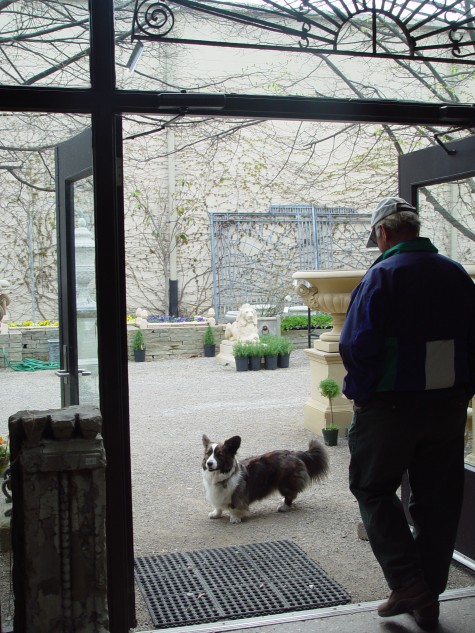
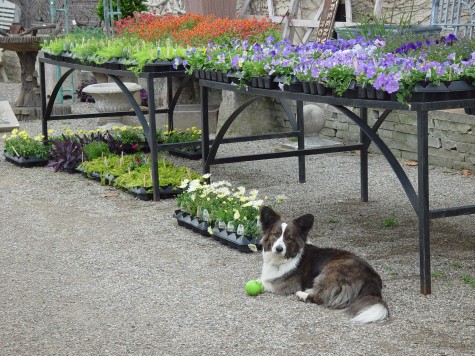 I have never seen Milo give any indication that he did not like any weather. He’s game, any day. But he seems more determined than ever to get out that door now. Once we reopen March 1, he will be outside as long as he can persuade someone to keep him company. I buy plants as I think they can tolerate the night temperatures. Diascia and angelina, osteospermum-even Moses in the Cradle- shake off the cold as well as the pansies.
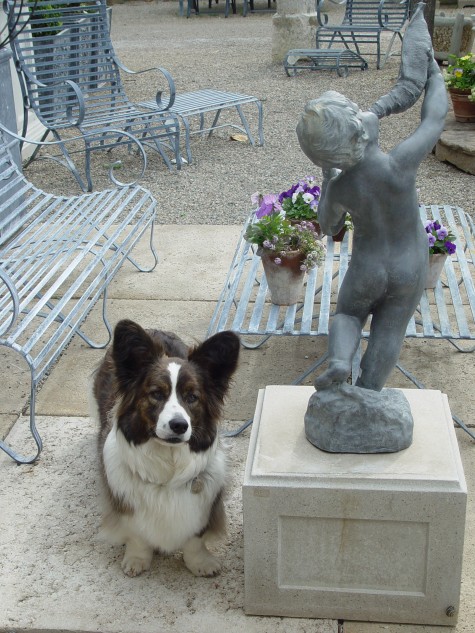
It will be a good while before perennials are available-more than likely the same while it will take the ground to be ready for working. I try to leave my in ground gardens alone until they truly wake up. As I greatly dislike anyone dogging me when I am half asleep, I keep quiet until I can see the lights are on and I can smell something brewing. Trees and shrubs are just coming in-depending on the weather. So I plant spring pots; Milo keeps me company looking after them.
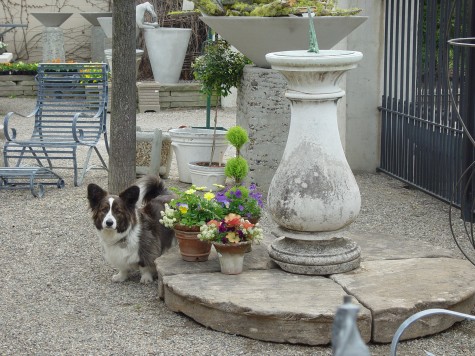 If the weather doesn’t break early in March, I will go to Bogie Lake and beg some greenhouse space to hold my spring pots. As tolerant as they are of cold, spring flowers only put on weight when there is heat. My spring pots get looking pretty good about June 1; some years, the spring pots last the entire summer. Every spring there are nights when everything has to be hauled in. Growing plants is such work-but there comes a time when I can’t do without them one more day.
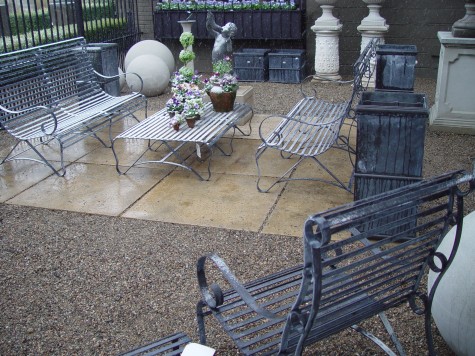 We will have snow on and off in March and April. I remember a whomping snowstorm some years ago on April 16; more than a few times have we had flurries on Mother’s Day. Late snow doesn’t bother me that much-it rarely stays. The snow we get in December I am still looking at now-that’s a big bother.
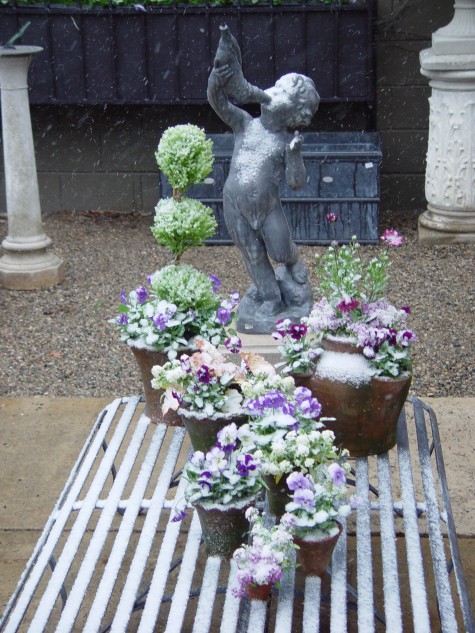 I do cringe seeing my beloved spring flowers disappear beneath the snow, but they seem not to be bothered, unless the temps go below 28 degrees. I have seen fierce frosts when the tulips were 4 inches out of the ground. It may damage the leaves, but the flowers come on fine. The species crocus are a favorite of mine; there are years when freezing weather reduces their fragile blooms to gray mush. But when they are good, they are spectacular.
 Our winter is all but gone. But March and April are neither winter nor spring. They are what I call the sprinter months. Move quickly towards spring, drop precipitously down and back into winter. We’ll have big wind soon-maybe ice. Our transition to spring can be a rocky one. It seems like we all are sprinting in one direction or another to keep up.
We’ll be fooled. We’ll be wringing our hands, and scrambling. But first and foremost, we’ll be ready to welcome the new season.
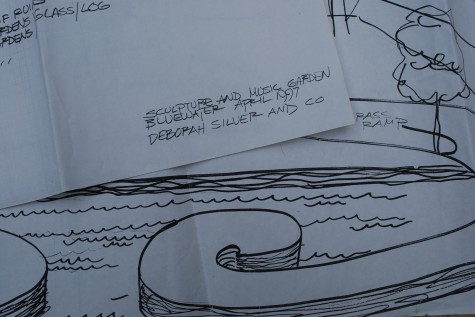 As my layout table has its first new coat of paint in 14 years, all the prints I’ve had stored there are piled up in my office. OK, I couldn’t resist taking a look before I put them back in storage. Some of them entertain me-I can see exactly what was influencing me at the time. The roll of drawings for the Bluewater project was just that-drawings. These unpolished sketches of landscape elements for a commercial project were highly conceptual-and certainly predate any computer programs that are now readily available to designers.
 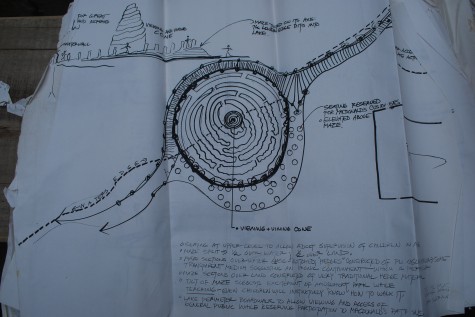 Land forms have always been of great interest to me. A big chunk of my library deals with mazes and labyrinths, land sculpture and earthworks. Robert Smithson’s 1970 sculpture “Spiral Jetty”, constructed in 6 days on a leased piece of the Great Salt Lake in Utah, is now completely landlocked as the lake is so low. The sculpture spent 20 years or better completely submerged. The sculpture has presented in many forms over the past 40 years. I have always admired it; no doubt this conceptual drawing of a maze half in and half out of some water was directly inspired by Smithson’s work.
 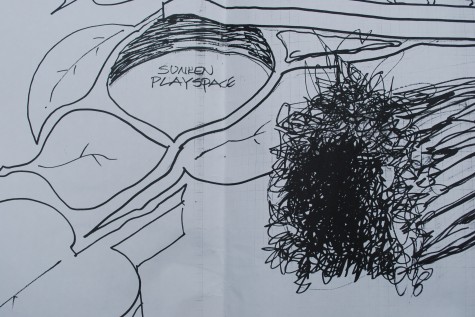 Another favorite-the land form drawings of Hans Dieter Schaal in his book “Landscape as Inspiration”. Inspired indeed. His sprawling and energetic drawings of natural forms exposed me to an entirely different way of thinking about dirt and nature. I had never seen landscape spaces rendered in this way before. I was equally taken with the beauty of the drawings. They are by no means scaled prints, they are gestural and interpretive marks on a page. This work inspired me to take up a marker and put it to a page, and see what happens. I refer to his book regularly.
 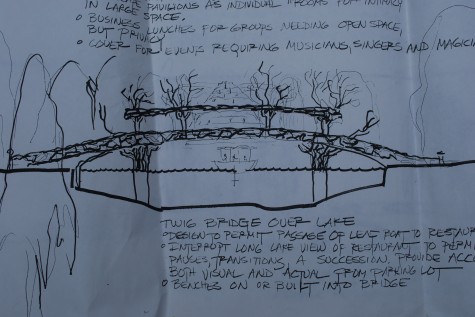 Any reference to natural forms intrigues me. A log twig bridge over Bluewater’s man-made lake seemed like just the right combination of architecture and natural materials. Buck shakes his finger at me when I design with no regard for construction, but I still think a little free spirited doodle drawing has its place. A sketch that seems to be going no where is easily discarded-provided you have not spent so much time with it that you have become attached. It is difficult to be objective about one’s own work-so I try to work fast at the conceptual stage. Anything I have invested a lot of time and work in can be hard to trash-even when trash it I should.
 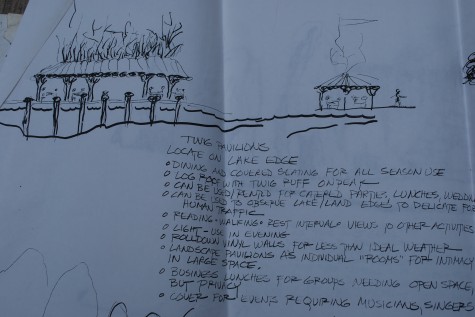 None of these drawings would convince a client to commit their time and money. But they might convince a client that there was a reservoir of ideas from which something of interest might emerge. If you don’t believe your designer is a person of interest, then a collaboration on your project is unlikely. If you are designing for yourself, drawings can bring ideas to the surface you didn’t know you had. Keeping a waste basket handy can be a comfort!
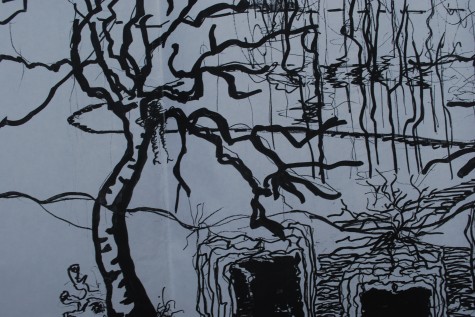 I am happy to have these drawings, not for their design, but for their energy. Being the fan of science that I am, I wholly subscribe to the notion that everything in motion tends to stay in motion-and what’s at rest tends to stay still. This applies as much to a design sensibility as it does to the physical world. Inertia being gravity that has gotten the upper hand, I make the effort to feed whatever energy I have regularly.
 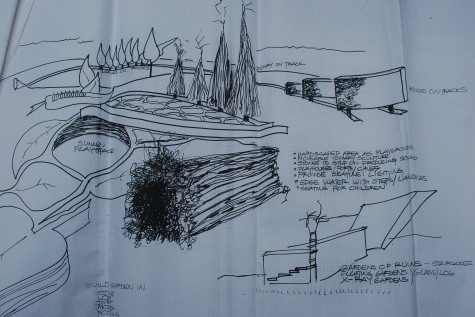 This drawing suggests at least 6 different ideas. They have similar elements, but are disconnected from each other. At the end of a series of drawings comes the integration phase. How visual and sculptural elements relate to each might be more important than any given piece. That relationship provides for good flow and rhythm. I see lots of landscapes that have good bits, but no flow. In the print, I plan for the transition between one space and another to have its own space.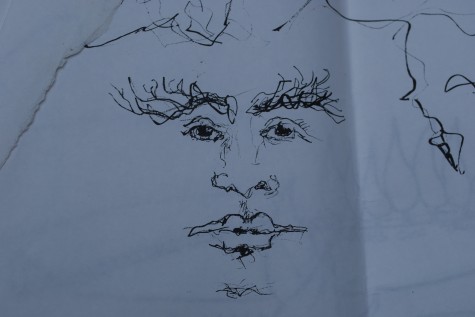
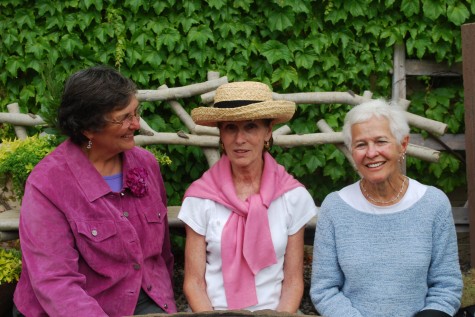 A discussion of space and flow in a garden is not just about one’s eye-it is also about providing clear passage and respite for people you like. How I move in, use, work and relax in my garden is easy for me-I live there. I know the shortcuts. It does not take so much to entertain me-sometimes flopping down on the grass works just fine. As much as I love the solitary aspect of my garden, friends visit. They need places to be, and be comfortable.
 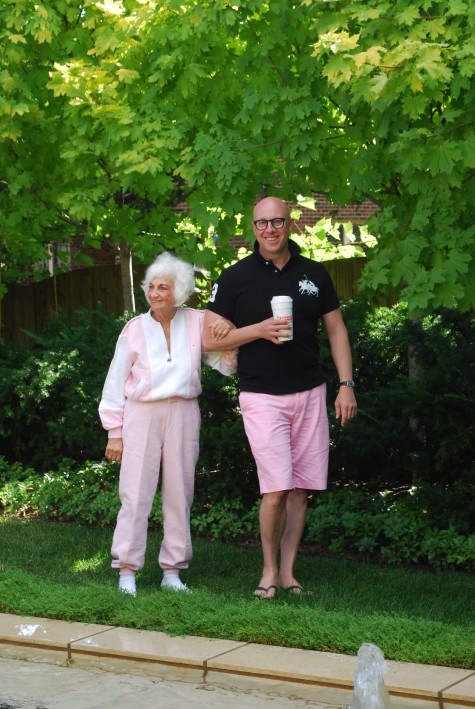 Should you have one friend, or many-should you have older relatives, and a slew of kids, the issues are the same. Should you be interested in company enjoying your garden, planning for them to be there comfortably is important.
 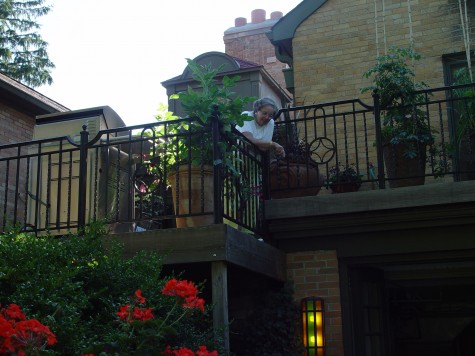 I invite my clients to visit their own home in disguise. Be a guest in your garden for an hour. Where do you park? Can you see the house number? Are you clearly directed to the door? Is the porch large enough for two of you to stand side by side? If there are stairs, are they easy to negotiate? Are the walks and stairs lit in the evening? Your questions will be better than mine-you live there.
 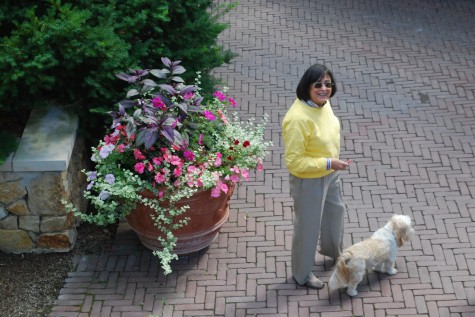 Hard flat surfaces are friendly to people. Slopes and uneven surfaces make people focus their attention on maintaining their balance, instead of enjoying your peonies in bloom. My car park doubles as a terrace when I have company-I put my car in the street.
 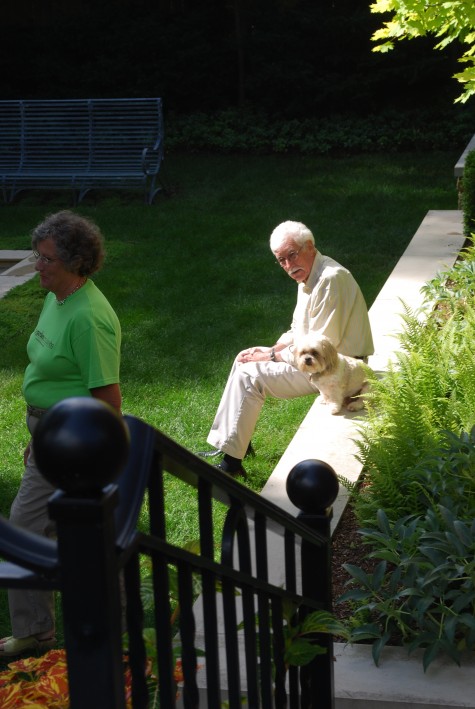 Though my fountain garden has a bench, it also has higher than chair height seat walls. It’s easy to sit down in a number of places; it is equally easy for a number of people to casually congregate as they see fit. Even the little dogs like this.
  My deck terrace is large enough for dining furniture, a few lounge chairs, the barbeque-and my pots. I bring the garden upstairs; some nights I am too tired go into the garden. Wherever people might be in my garden, there are places to sit, to talk, to linger.
  Thomas Church wrote a book entitled “Gardens are for People”. This idea has inspired many a beautiful walkway, bench, pool, terrace, pergola, dining table, croquet lawn-you get the idea. How your friend, or your party of 60 will enter your property, enjoy the garden, have a cocktail and sit down to dinner-this is worth planning for. Sharing a garden is one of the better reasons to own one.
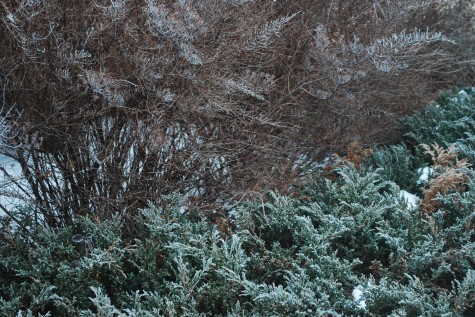
 Hoarfrost is simply frozen dew. Though this form has none of the romance of a dewy June morning, it is lovely. If we are going to get hoarfrost, it usually appears in January, after a rain. We have had intermittent rain for several days, with freezing temperatures overnight; this morning was 24 degrees. As a result, everything was coated in fine white ice crystals barely visible in the fog. This made for a beautiful January morning.
 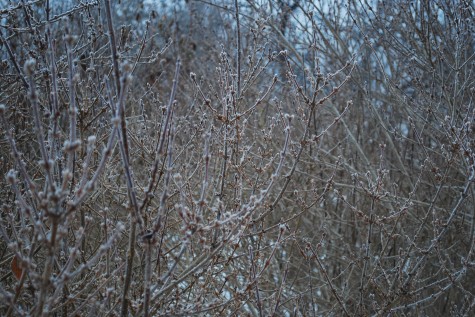 The frost on these forsythia branches was very subtle-just enough to greatly soften their appearance. Deciduous shrubs in winter have a quiet beauty all their own. The winter is one of the best times to evaluate shrubs for your garden; their winter appearance should be as important a factor in your selection as their summer dress. The frost in particular makes their shape and habit clear.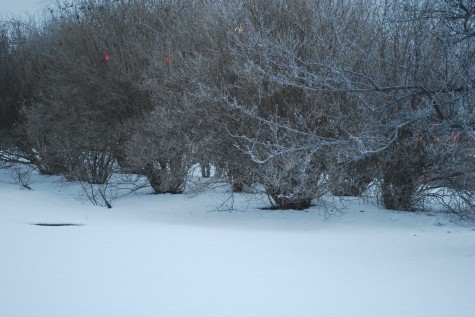
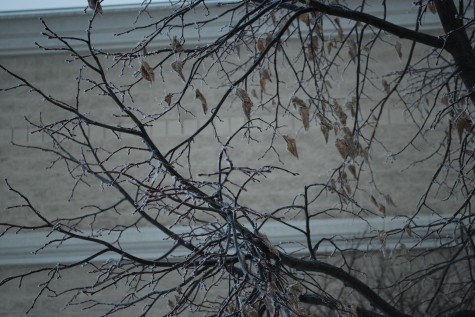 Trees can be a nuisance to prune, as most of the activity is a long way from the ground. But the winter silhouette will make clear where a branch could be cleaned up, or headed back, in a good and beautiful way. The stub pruned branch in the middle of this picture-I would take it all the back to the big branch. Whatever shape you are trying to encourage makes itself known now.
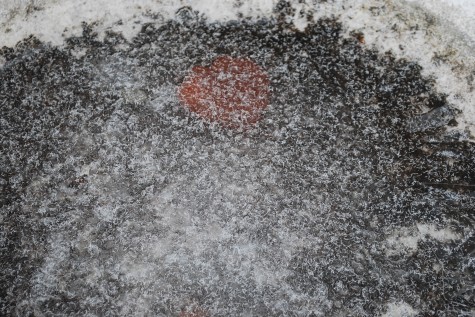 The hoarfrost sticks to ice as well as any other surface. A single fall leaf frozen in the ice may be a melancholy reminder of the dormant garden, but the colors, textures and shapes here are quite beautiful.
 Every bark has its own brown. The crabapples are grey and black, the forsythias a warm yellow brown. Choosing shrubs and trees for their bark has its winter rewards. Now is the perfect time to look at bark; is a dominant feature of the winter landscape. With every bit as much variation as leaves or flowers, there is actually a lot to see.
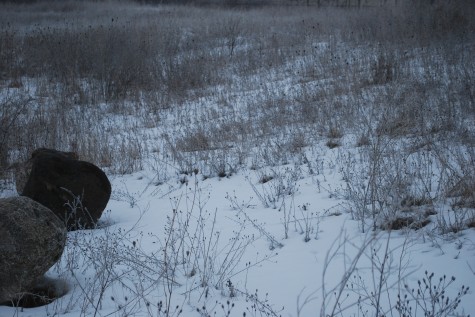 The field next door was breathtaking this morning. The white frost, the blue white snow, and the dark rock may lack the romance of May, but there is this alternate garden universe which is worth seeing. Though not in active grown, woody plants, and the remains of perennial plants have a lot to say, even in the winter.