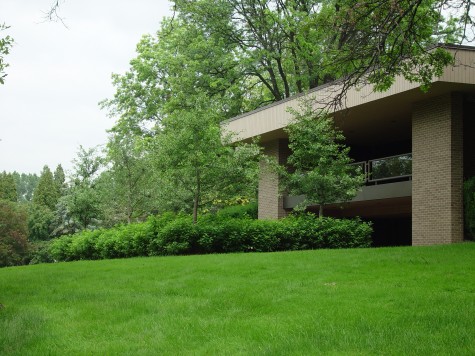
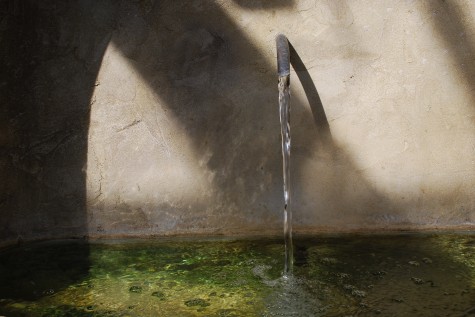
 Our weather has taken a decidedly balmy turn the past few days; we have temps in the fifties. I expect it will take a turn for the worse sooner or later, but today I am enjoying the sun. The cold, snow and ice of a Michigan winter is usually bearable, but the grey could make you black out. I am always ready for some sun. I was outside today with no coat, enjoying that sun. Even indoors, the light is brighter and stronger. The days are longer. I welcome the reappearance of the sun. The season is changing-delightful.
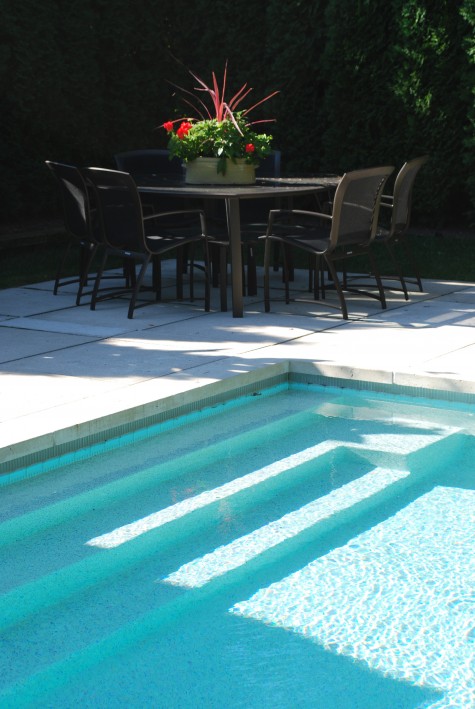
Sunlight is essential to living things. Books are written and lists made of those plants that tolerate shade. The unspoken implication here-nothing living loves the dark. When I was young, I killed many a shade tolerant perennial thinking it was shade loving. I am in discussion with a client now about a design for a pool, so there has been much talk about sun and games. Sunny and shady. Imagine your life long enough to see what, where, and how you want to live outdoors.
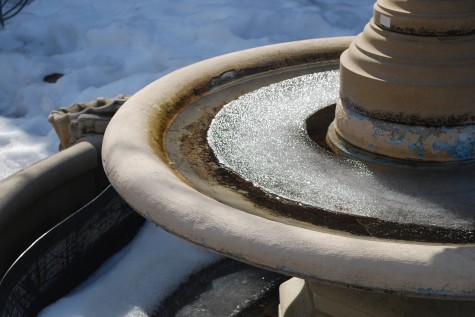 Water one observes can be sited in a number of places. Shadier locations will provide perfect conditions for mosses and other water loving plants to take hold. Shading 75% of the surface of a pond will not only provide refuge for fish, but it will make the job of balancing the pond ecologically much easier. For those that have an aversion to cleaning a pond mechanically, an understanding of the role of the sun is essential. Read up. A fountain burbling in the shade can be peacefully overrun with everything that blows in and takes up residence-beautiful. Sunny water-don’t you want to get in?
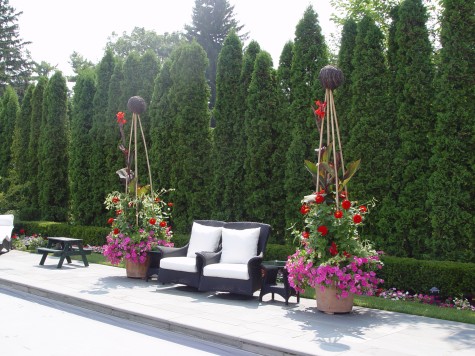
Pools for swimming are another topic altogether. The right siting for any activity outdoors-look to the sun. I want to swim in the sun-water is cold, even in midsummer. Enjoying a sunny July day at pool side-fine, for a while. Watching kids play in a pool, or having lunch outdoors-a shady spot is a good idea.
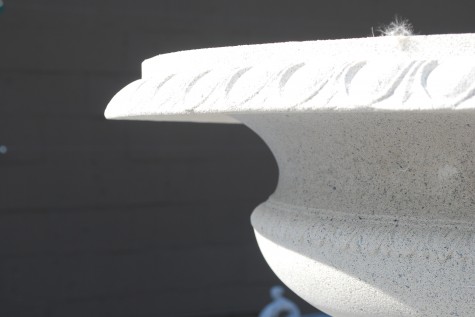 White or light surfaces poolside will reflect sunlight, and be cooler for bare feet. Reflected heat and light will dry you off in short order. Drying off in the sun-like being on vacation. If you are old enough to remember putting sheets on a bed that have been sun dried on a clothesline-this a simple and exquisite pleasure. Dark surfaces absorb the heat of the sun, and radiate that heat. A shady location sporting dark surfaces may be a late summer refuge. Hard surfaces take a long time to heat up, and a long time to give up their heat. Plan for some, if it is your idea to be outside, late fall.
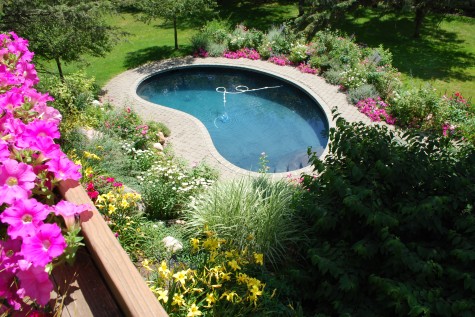
Pools with dark interior surfaces reflect light. A swimming pool that doubles as a reflecting pool has a long season of use. Dark surfaced pools absorb the energy from the sun-the water will be warm, but the bottom of the pool is usually obscured. Cathy’s pool is very unusual, as it can be seen from far above; she has a view of warm water in a dark surfaced pool, to the bottom. The interior color of her pool contrasts sharply with the surrounding garden. She gets as much from looking at her pool as being in it. The big idea here? Make moves that deliver at different times, in different seasons.
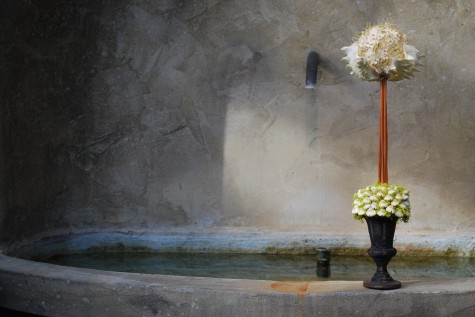
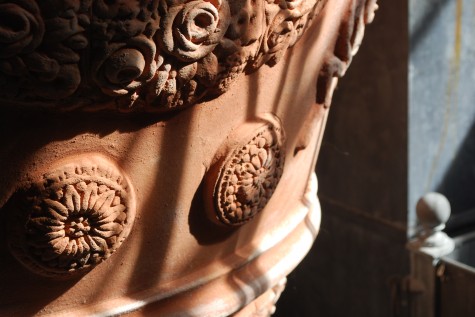 This handmade Italian pot is indoors until the weather reliably warms. Nevertheless, its detail is brought to life by the light of the spring sun streaming in the window. The surfaces closest to the light are white; the shadows are black. What goes on in between is a matter between you and your designer. Or between you and your gardening self.
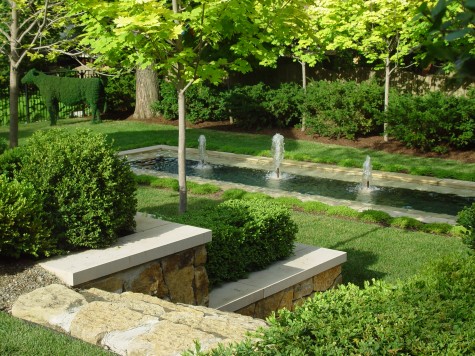
My fountain is 26 feet long-of course the conditions are different end to end, and they change, given the course of the day. Mostly sunny is the outlook for my home water-I am ready for it when I get home at the end of the day. On moody days, it is enough to just watch it. This post may seem to be a rambling late winter stream based on a lot of thoughts; you are right about that. I am waking up to lots of design work needing spring readiness. But this warm March day, I am also dreaming about a warm summer’s day, and some water.

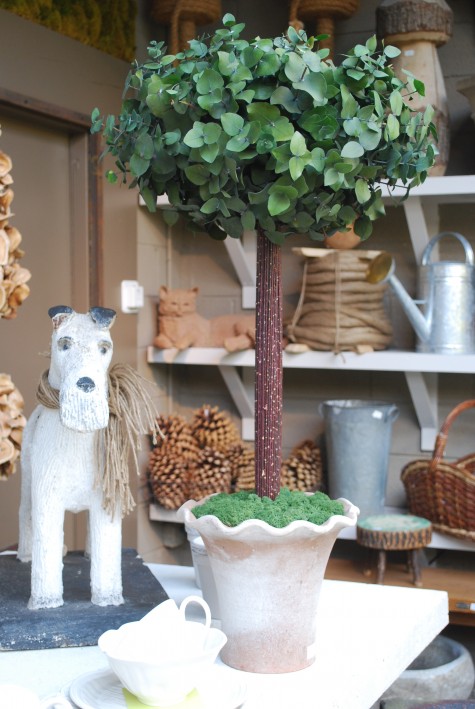 Eucalyptus is not native or hardy in Michigan, but its sturdy broad leaves remind me of boxwood- super sized, that is. Eucaylptus takes well to being preserved; the lush and lively look pictured above will last a very long time. The delicate cedar whip stems are arranged around a stout stick under a rubber band, and then glued. The trunk has interesting texture, does it not? Preserved reindeer moss covers the top of the clay pot. The moss is set low enough such that the terra cotta pie crust edge can still be seen.
 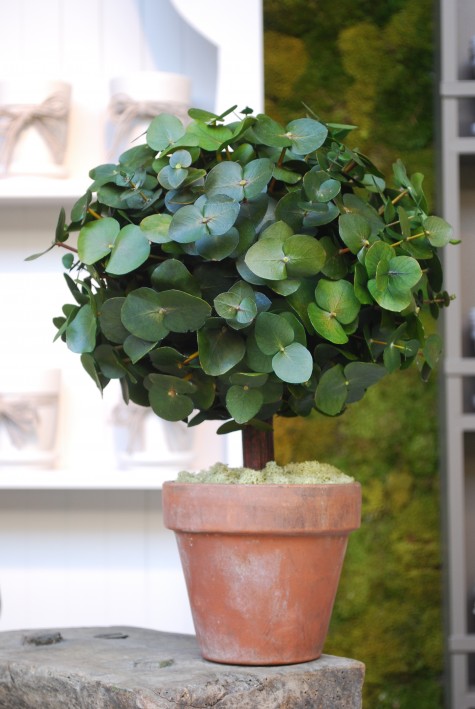 Making anything with one’s own hand is so satisfying. My friends Lauren, Buck, Marianna, Jane, Lynn, Julie and Janet-they cook. Fred’s twice a year chili extravanza-he runs a marathon for a solid two days over it; I have been a lucky recipient. Some sew, others compose. Gerhardt has not only resumed, but embraced his interrupted calling as an artist, after 30 years directing an Art Academy. At 70, he is just firing up. What and how all of them make things energizes me. Myself-I love what these small sculptures teach me about scale, proportion, texture, color, line, mass; what I put together stays with me, when I have a garden project to design.
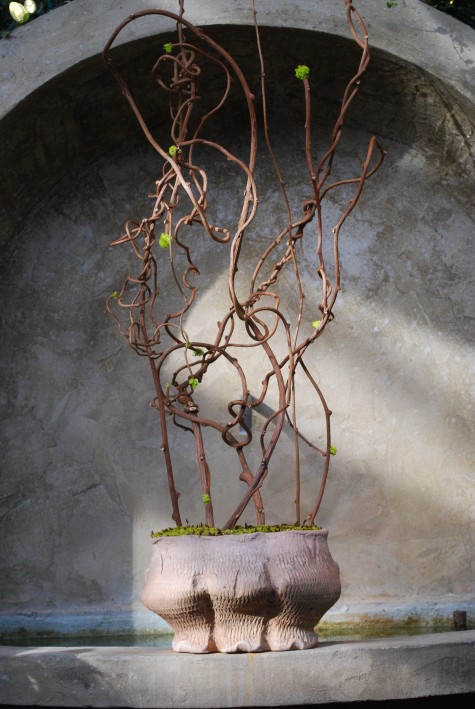
 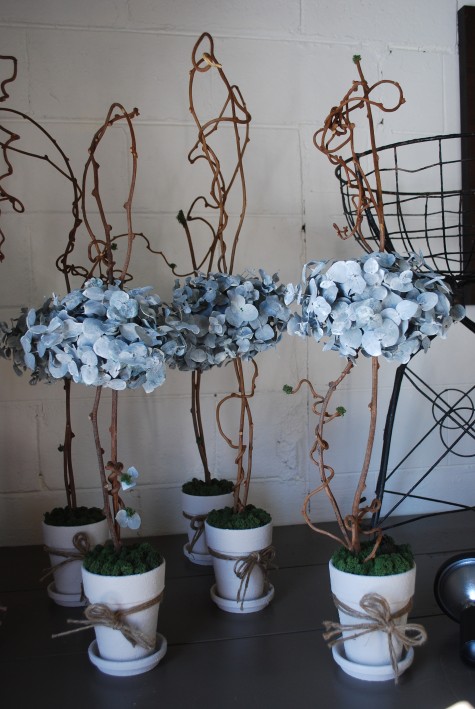 The hard wood of kiwi vine is extraordinarily beautiful. No two lengths are ever the same. Though I designed a number of these small sculptures with whitewashed eucalyptus and painted terra cotta pots, each one is different. As I compare them, I see the importance of line in a composition. I see that a signature, an arrangement of lines, is unique, and significant. Where I might apply this in my work-who knows. But I have seen this, and I will remember.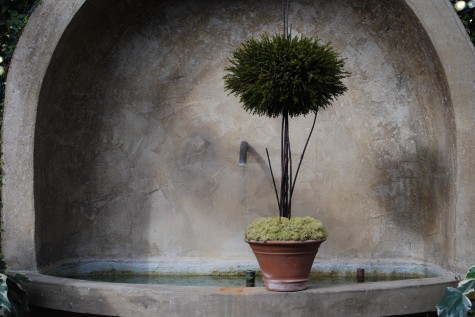
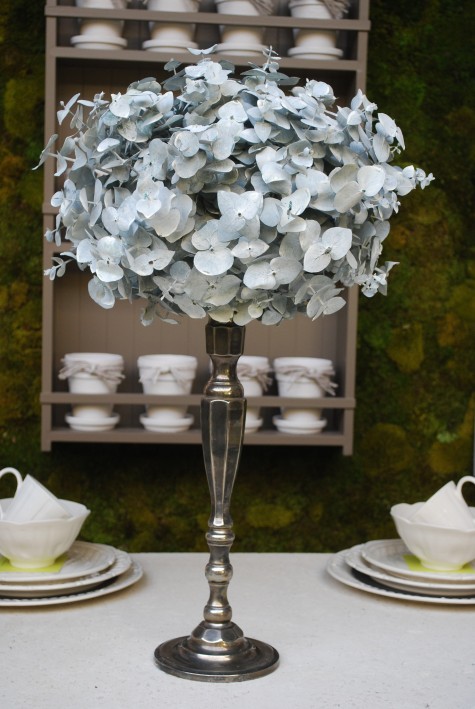 This lone silver plate candlestick I inherited-I do not remember why. For years it has been on a shelf, looking at me. The whitewashed eucalyptus unexpectedly looks good with this formal metal trunk. Every material needs the right spot to shine.
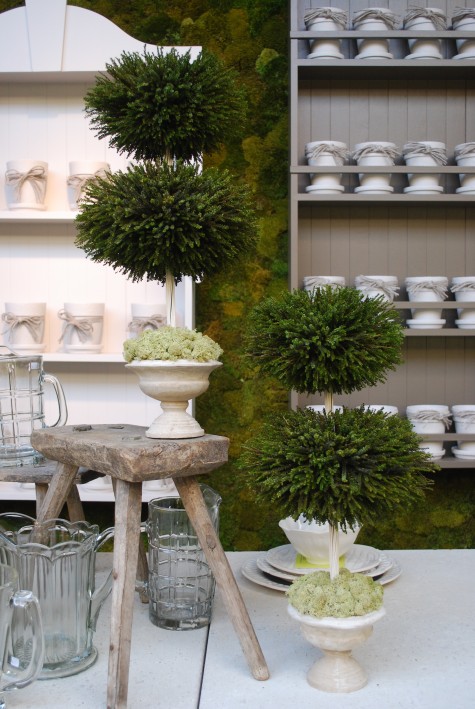 Rob will show up from a buying trip with pots in hand-these are actually densely fabricated paper mache. A wispy and dense natural material seemed like it might make a good companion. Though my first choice would be for a topiary plant firmly rooted in the ground, in a landscape, I don’t mind this slight and skillfully made interior bound reference. Making is much about doing justice to whatever greatly interests you.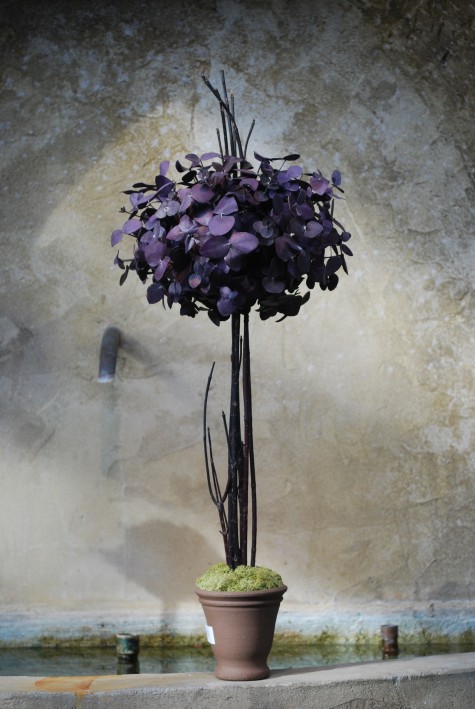
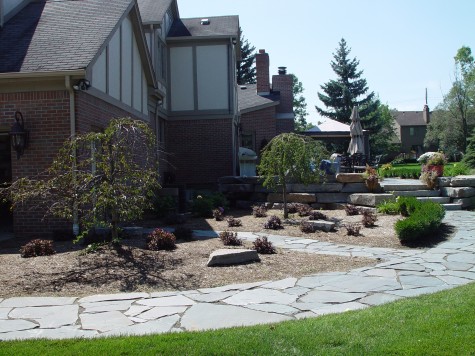 I would not hesitate for a second, recommending that new plantings be mulched with 2 to 3 inches of bark. Mulch conserves moisture in the soil, and it discourages the germination of weeds. Transplanting is a big shock; a little mulch can be calming. I do not, however, admire decorative mulch, mulch gardens, mulch landscapes, mulch over existing weeds, or mountains of mulch anywhere else beyond a landscape supply yard. Mulch should not be seen or heard from. Whomever designed the landscape pictured above should get a ticket, three points, and a hefty fine. Who would cut giant beds, dot in a few maroon-leaved weigela in no discernable pattern, and call it a landscape? This is a bark garden, just weeks after completion. In a year’s time, the mulch will be a dirty grey, blown about by rain, bikes and wind. All the while organisms in the soil are degrading said bark such that any weed seeds in the soil underneath will soon have optimal conditions to germinate and grow. I shuddered when I saw this, and shuddered again when I realized the clients had no idea the hand that had been dealt to them.
 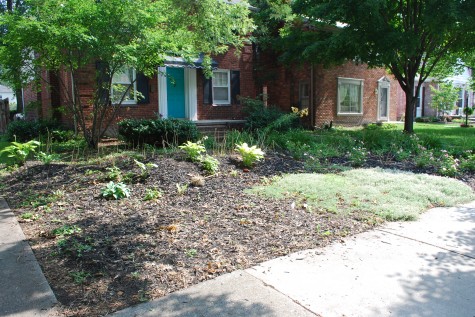 Suburban landscape/ gardens in front yards- in conspicuous lieu of grass-have become quite popular the last ten years or so. Occasionally the news tells the tale of neighbors up in arms over a non-conforming suburban yard whose messy assortment of perennials, vegetables and whatever else threatens to disturb the status quo. The debate about lawn versus garden is immaterial here-this yard is indeed a mess. What I find even more astonishing are the drifts of bark. As if bark over bare dirt,weeds, and some scraggly plants could improve the look here.
 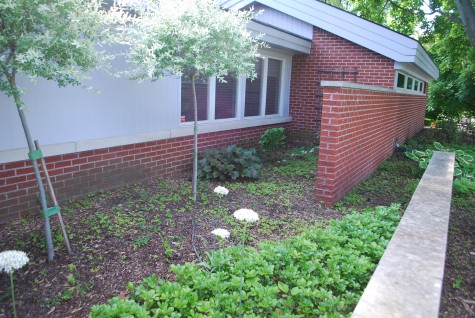 No kidding, nature abhors a vacuum. The above pictured bark is a testimonial to the fact that bare or barked dirt stays bare only a short time. Bark slows down weeds at first, but them helps them grow all the more robustly. A forest completely destroyed and buried in volcanic ash will reforest, given enough time. Some landscapes could get that fresh well-tended look if the bark were banished. It is not as if any removal is required. A landscape quick-fix? Plant more of what you already have in your bark beds.
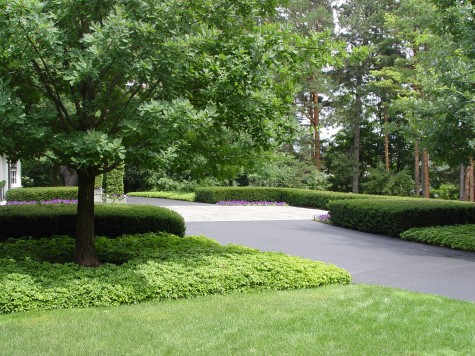 It is difficult to get plants to grow under trees; the shade and competition for water can be daunting. Planting a companion plant at the same time the tree goes in gives everyone involved a chance. I planted rooted cuttings of pachysandra with a weeding fork underneath these English oaks close to ten years ago. The groundcover has taken over the job of the bark. Though a planting of pachysandra is never going to make your heart pound, it is vastly better looking than the bark. The shape and density of growth is enough.
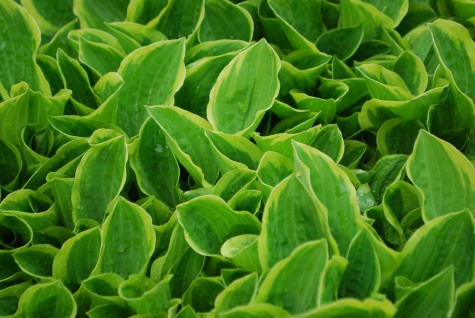 There are lots of groundcovers for both sun and shade. This dwarf hosta is a happy combination of bold texture and ground hugging scale. Not that a groundcover needs to be short, mind you. Groundcover is anything that covers the ground. For your planting trouble, you get a mass of green that conserves moisture in the soil, and discourages weeds. Does this not sound like a good idea?
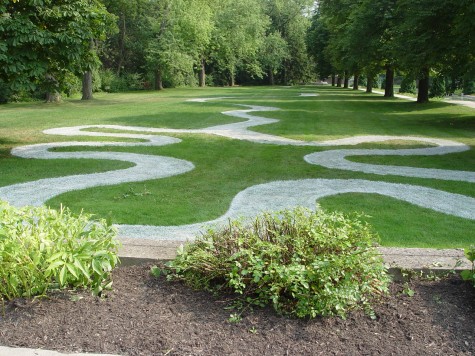
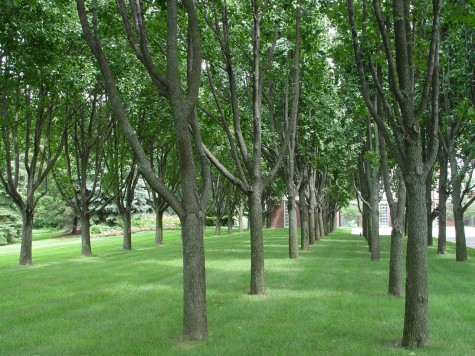 There is not one thing intrinsically wrong with grass. It is a vigorous groundcover, and it does need to be cut. It is doing amazingly well in the shade of these Bradford pears. It is as much landscape as some people can handle. A grass panel, or sculpture can be strikingly beautiful. Just because a zillion lawn care products exist is no sign you are obliged to use them. Just cut the grass. Even when my garden is weedy and falling over from neglect, I feel better when the grass is cut. I like that illusion of order.
 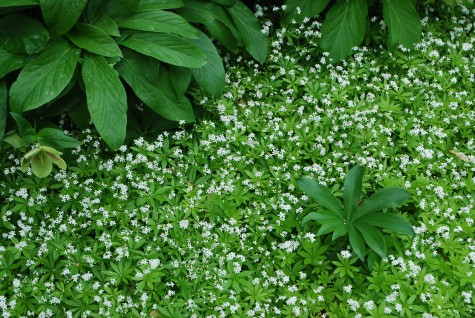 Sweet woodriff is a beautiful groundcover, but it must be sited properly. In too much shade, and in too wet a soil, fungus will prevail in late summer, leaving the garden with brown rotted leaves and bare patches. I am willing to put up with its problems, as it covers the ground under my hellebores so beautifully. My hellebores still seed here, though there is not a square inch of bare dirt to be seen.
 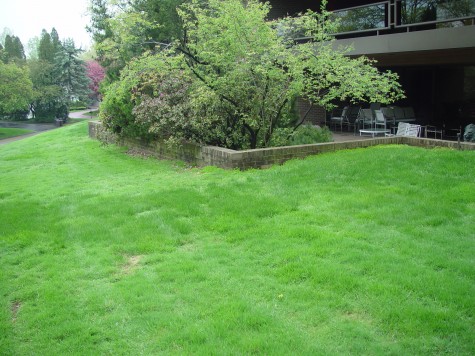 A client with a private garden carved into a hillside asked me to redo the space. The shrubs had become considerably overgrown, and a tree had died. The walled garden on the inside has been totally redone. But I was equally as interested in the street side presentation of the garden. The grass was tough to cut next to the brick wall; the grade was sloppily uneven. I stripped the grass five feet away from the wall, and added 20 yards of soil to level the ground.