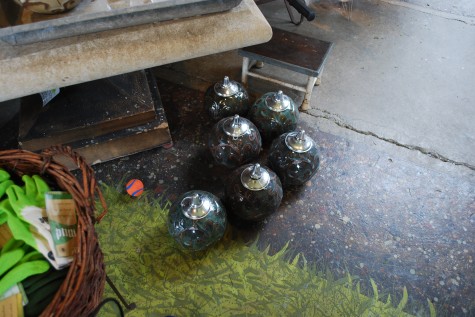
 Some landscapes appear and feel spacious for no more complicated a reason than they exist on large properties. The Chicago Botanic Garden has many beautiful long views, as it physically sits on 360 some odd acres. How I visually process space has to do with what is called perspective. If I walk in the Botanic garden, and Daffodil Island is in bloom, the daffodils appear to my eye like tiny yellow dots-and lots of them. Daffodils physically measure up at a fairly decent size, but they appear smaller and smaller, the further away they are from my eye. The position of the eye, relative to an object-perspective. The most dramatic illustration of perspective? Picture yourself 5 feet from the KLM 747 Anna Pavlova; the size is overwhelming. A city with wings. 230 feet long, and wings 200 feet wide-my entire property would hold a quarter of this plane. Only moments after that plane is aloft, it appears as a black speck streaking towards the horizon. Once a black speck, I know it is miles from my eye. These Anamese oil lamps pictured above are on the floor beneath me-I know this, as I am looking at their tops. They are also 10 feet away from my eye.
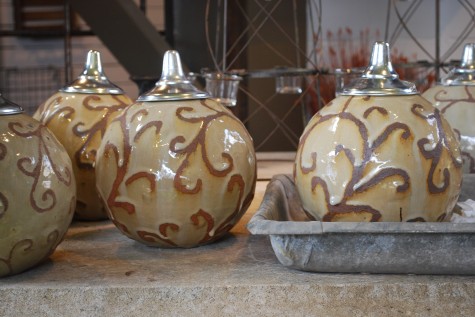
Then I move the globes to the surface of a table, and sit down to photograph them; they appear much larger than what they actually are. They are close enough to take up most of my field of vision-so they appear huge. My eyes are on the same horizontal plane as the lamps-I am seeing clearly the side view. Explaining the idea of perspective is difficult, but people instinctively understand and orient themselves to it-via the horizon line. Dense fog on a sunny day is disconcerting, as the horizon disappears. Sometimes at twilight on Lake Superior, the sky is the same silvery blue as the water-your eye cannot pick out the horizon. Where you are standing is not clear.
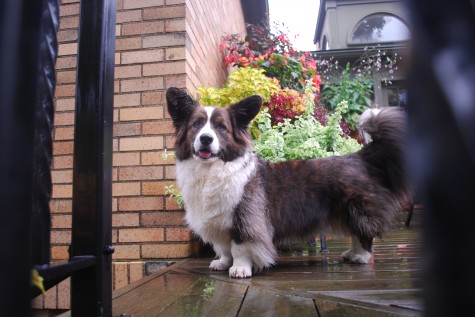
Milo is my little wide-body, billiard table shaped corgi. He acquired these nicknames, as I am usually looking down on him. His legs are about four inches long; his back some 13 inches off the floor. My eyes are 60 inches off the floor; I see Milo in plan view. Unless he in on the deck, and I am in the yard-is he not a very good looking dog from the side? Before you completely loose interest in this discussion, I will say that an awareness of how perspective works can help create views, and make the smallest urban garden appear spacious. Those gardens smaller yet can be designed with a strong spatial sense. If you are ever going to think about perspective in a landscape, now is the time. Who would want to address it in May? May is for moving a project along, yes?
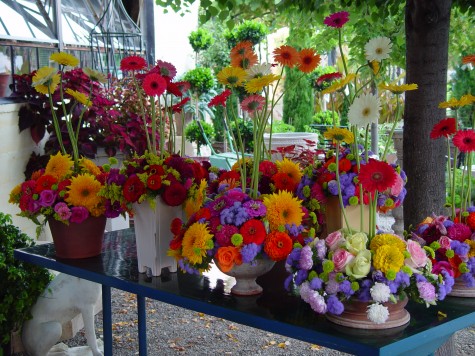
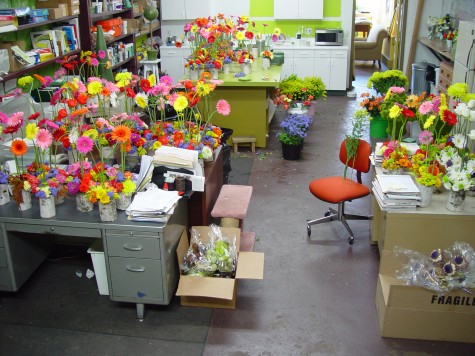
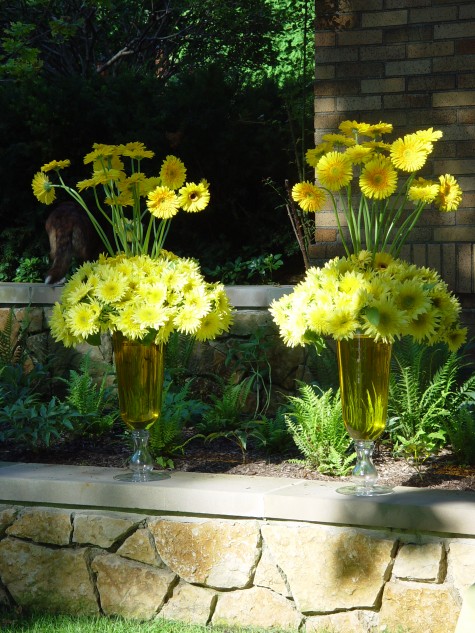
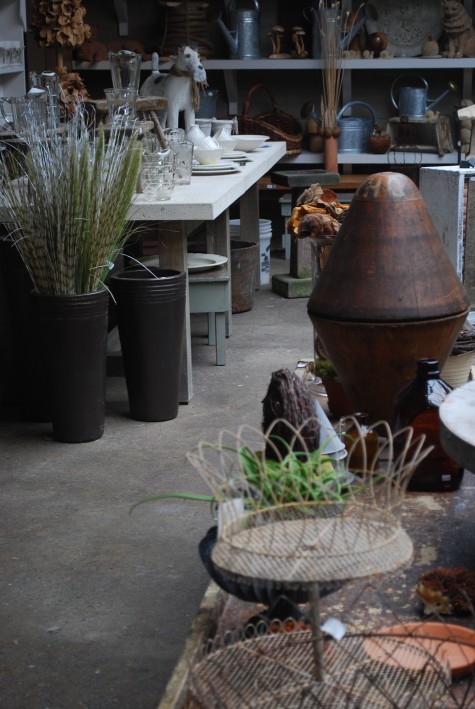
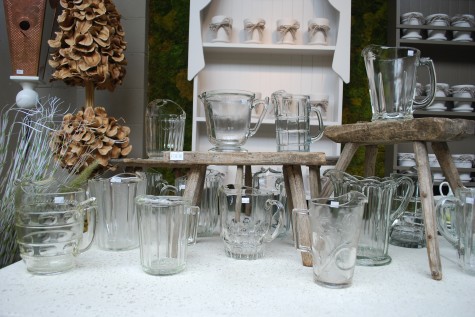 I am in the process of putting the shop back together, as we reopen for the 2010 season next week. The logistics of this has been a little daunting, as my on my feet time is somewhat limited yet. Luckily my four wheeler has a seat-so I can take a break. This puts my eye at dining table height. The table and pitchers loom large in the foreground space. The exaggeration of the size of the foreground elements moves the background even further back.
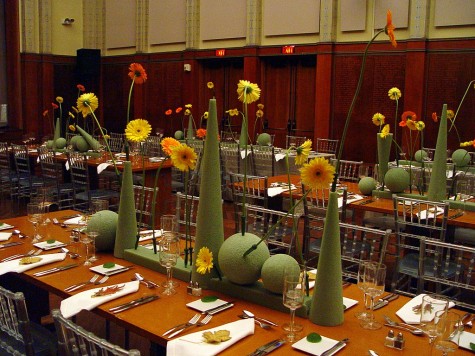
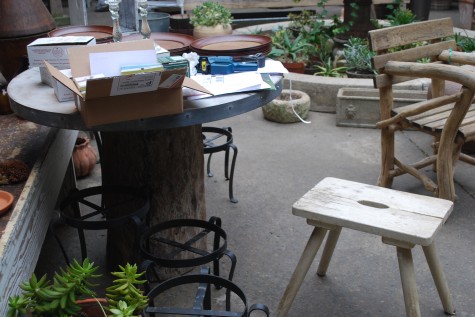 Varying the heights and sizes of the foreground elements helps to give the foreground itself dimension. The visual path your eye takes from one object to the next reveals that each object is in a different plane. A recognition of multiple planes makes for the illusion of space. This is after all, a flat object we call a photograph. But visual space is represented here.
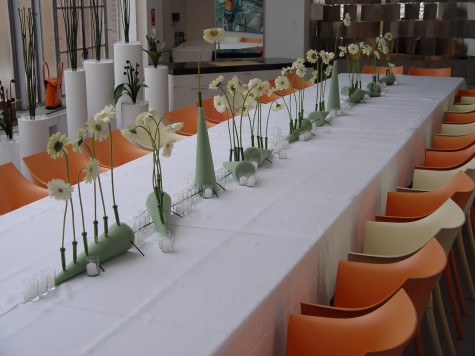
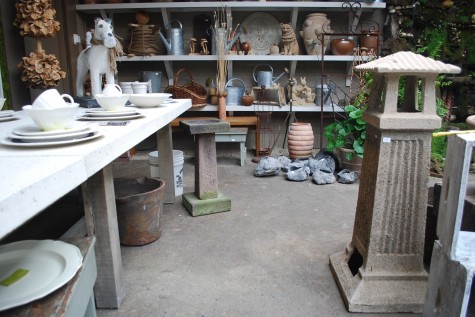 The position and direction of the concrete table in this composition moves the eye into the deep space of the photograph. The table is so wide in the foreground, it runs off the edge of the page. The table width appears much smaller, as the table appears to move back in space. The large masses of table, and lighthouse contrast with the objects on the back wall that appear so small.
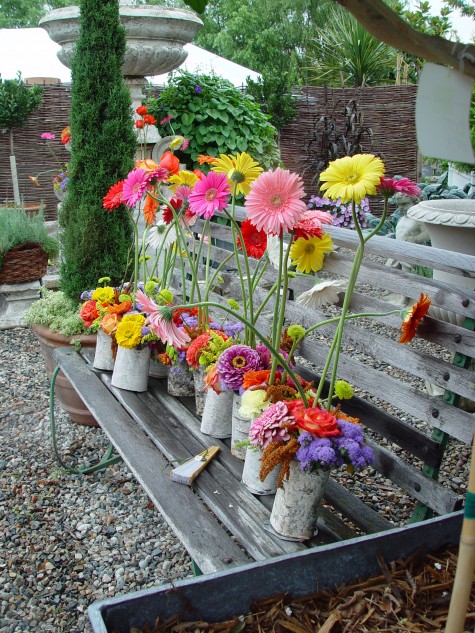
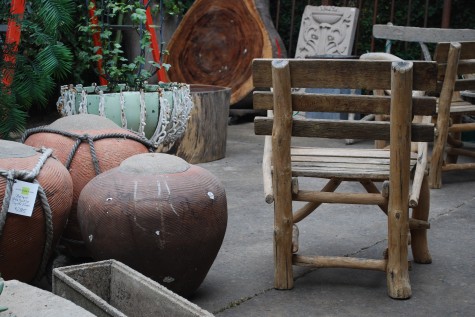 Not every bench in a landscape needs to be placed at the end of a garden. Placed at the beginning, with its back to your eye, the sense of space from front to back is exaggerated. The bench back is like a fence-enclosing the space beyond.
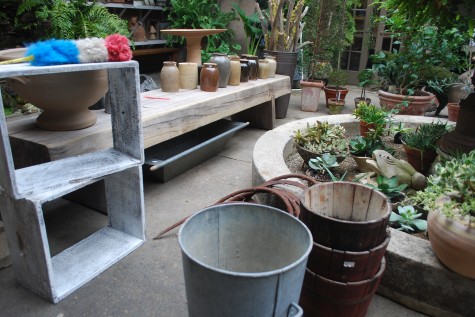 It is important in any composition to direct the eye of the viewer from the front to the back-and out again. The white wood rectangle in this picture frames a view of the foreground appearance of this bench. The frame invites the viewer to focus on what is within the frame. The bench then appears to go back in space-quickly. In the far background-a pair of doors suggesting another space beyond.
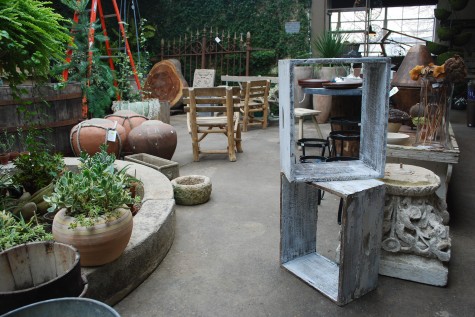
It is anything but magic to see like this. It only requires that you look long enough to provoke some speculation about how to see spatially. If no light comes on standing in a spot in your garden, take a picture. A picture is a flat object, with four edges-the camera will frame the view, and record your placement of plants and ornament dispassionately.
I read countless gardening books when I first started gardening. None of them gave me one clue about how to see spatially. I could count on most of them to tell me to plant the tall plants in the back, and the short plants in the front. Expecting plants to carry a composition is asking a lot. There are other, maybe more interesting ways of composing. Place some big things in some small spaces. Try some tall things in the foreground space, and some very small things way in the back. Tomato stakes are great for trying different placements. Should you look long enough, you will know where you stand.
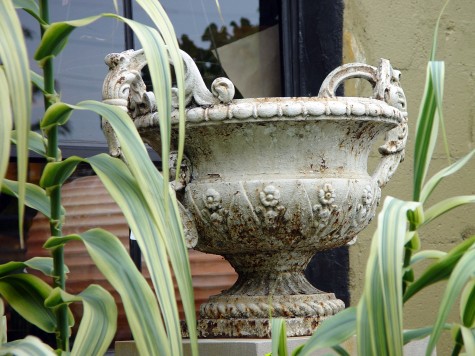 Gardeners make choices based on lots of issues, but most can figure out what appeals to them straight off. Some love old crusty, rusty and well worn antiques; others find that state of gentle disrepair lacks visual punch. Many antique urns have been painted at one time or another; white having been a very popular color. Worn white will either be just the thing, or seem jarring. For others, the prospect of a classical urn leaves them cold-old or new. But if the idea of an urn resonates with you, which you will choose depends on several things.
 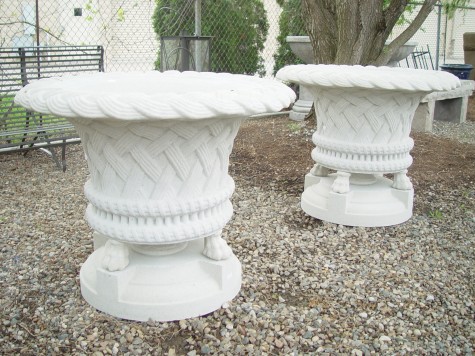 Dry cast limestone urns are usually based on classical handcarved limestone designs dating back hundreds of years. Many of those designs are European in origin. Dry cast limestone is a process by which limestone dust is mixed with a binder, and poured into molds. These reproductions are much more affordable than their antique counterparts. Some old designs would not be available at all, but for a reproduction. On occasion I find a piece I feel I must have, with no placement in mind. But a classical European urn may be very much out of place in front of a Cape Cod home. Now would these elaborately footed urns ring right against the backdrop of my own arts and crafts style home. However, they might be elegant and unexpectedly beautiful in a contemporary setting. The location you have in mind should influence your decision.
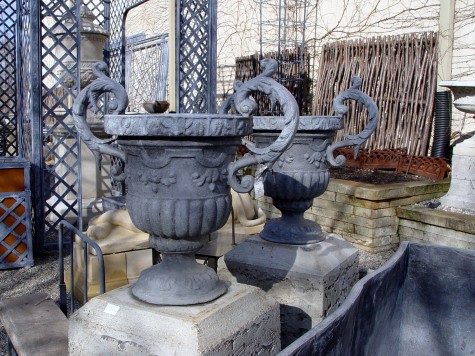 The scale of an urn is an important consideration. Very small urns may need pedestals to set them off properly. If the shape and decoration of an urn is a good bit of what you find appealing, then they need be placed where those things can be easily seen. Small urns have another significant disadvantage. From a small size follows a small planting area; you will need to edit your plant choices. Perhaps of more importance-how easily will you be able to water, and water again, when the weather gets hot? Small pots dry out faster than is easy to keep up with.
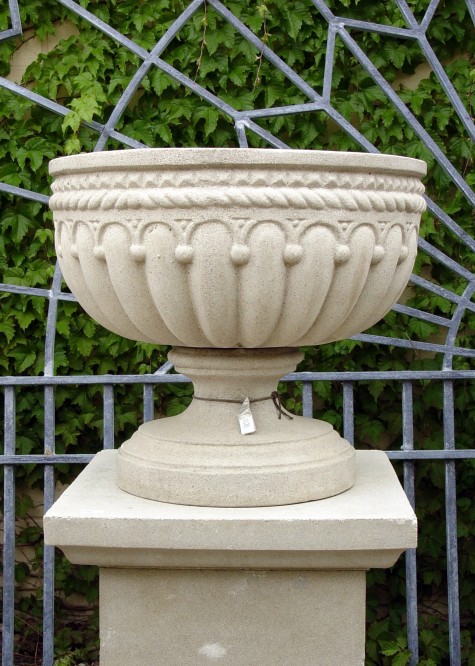 I like urns of a generous size. I have plenty of room to plant-either lots of one thing, or a collection. An urn planted such that in late summer it is a garden bouquet of good size is a pleasure. Watered properly, they retain moisture evenly, over a longer period of time. A container that can wait for me to get there with the hose- this I appreciate. Any urn I plant becomes part of the working garden. A gorgeous urn with a poor planting is a frustration no gardener needs.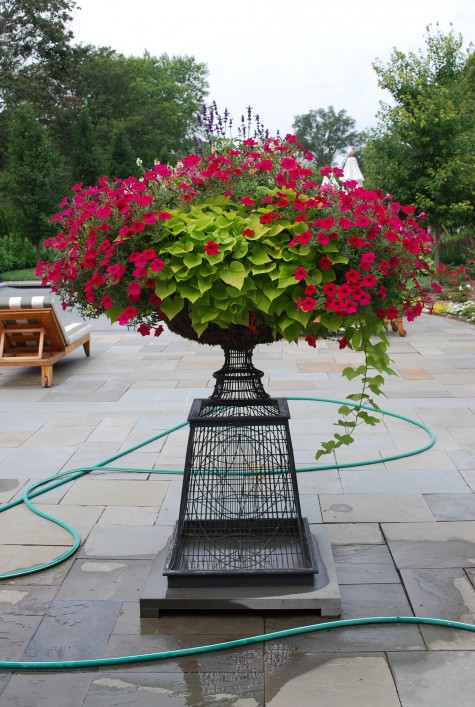
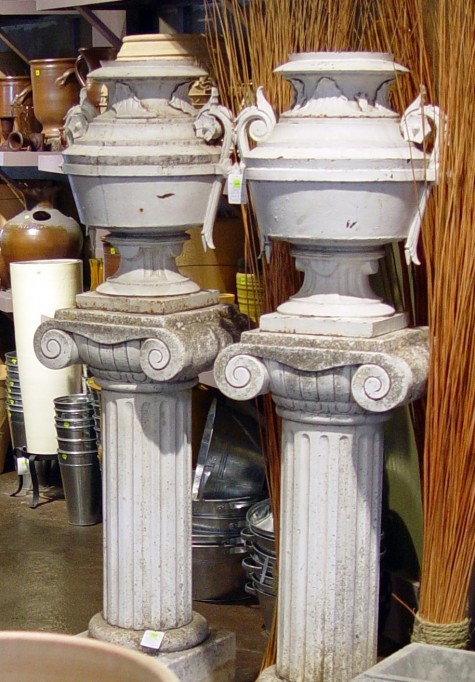 These French art deco style urns have such style and presence one might be inclined not to plant them. The Waterloo Urn I discussed in yesterday’s post is placed out in the open landscape. Unplanted, it could be placed anywhere calling for a sculpture-no need to have water conveniently nearby.
 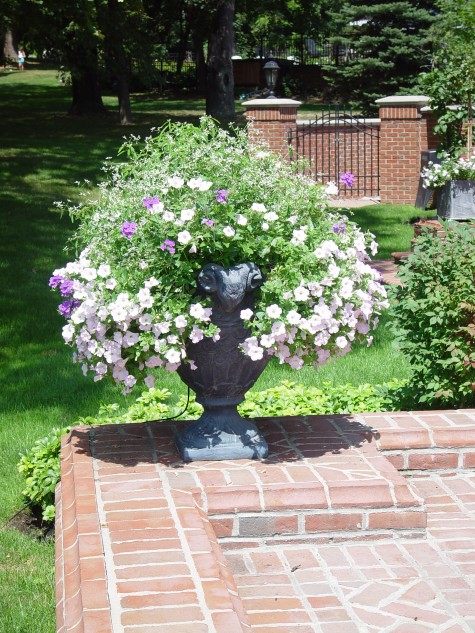 This lead urn is watered via a tube connected to the irrigation system in this yard. In much the same way as greenhouses tube their hanging baskets, or geraniums, these tubes buy a gardener a little time. They are not really a substitue for hand watering, as the coverage can be uneven, too long, or too short. If the tube runs on a nearby irrigation zone, that pot is at the water mercy of whatever else is being primarily watered. I am more than willing to look after my plantings; some automatic irrigation helps me to hedge this pledge. Those days that I come home really late will not need be a crisis. The level of your ability to maintain pot plantings is an important part of the selection process.
 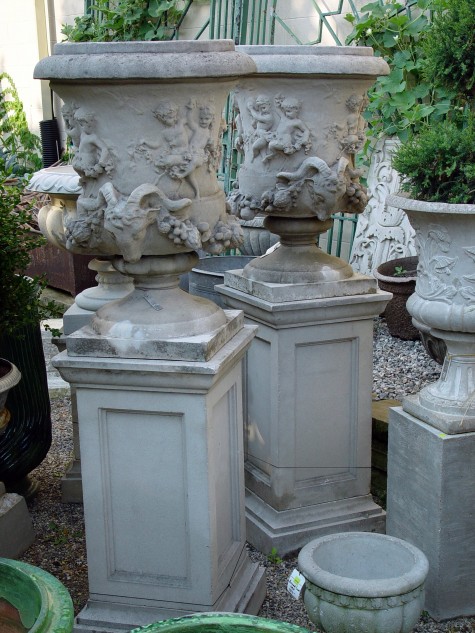 These concrete pots are English made reproductions, but they have that aged look. The surface is such that I would plant the tall, and vase shaped-nothing trailing. Ala some voluminously opulent Flemish flower painting. There is no choosing these pots if the decorative story being told does not greatly appeal-why cover up what so appealed to you in the first place? In this case, the urns and there plantings need to strike a balance, so they look great in relationship to one another.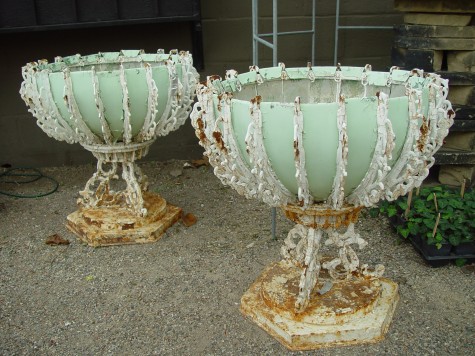
![1660164496_ce85d76e9b_o[1]](https://deborahsilver.com/wp-content/uploads/2010/02/1660164496_ce85d76e9b_o1.jpg "1660164496_ce85d76e9b_o[1]")
![15a1[1]](https://deborahsilver.com/wp-content/uploads/2010/02/15a11.jpg "15a1[1]") When I first got interested in dealing in garden antiques, it was tough going- educating myself about them. Outside of a few well known reference books, garden auction catalogues proved helpful. A garden urn, I learned, is a container with a foot, or pedestal. The small urn pictured above was manufactured by the Coalbrookdale Ironworks in England in the 19th century, and is a handsomely proportioned piece.
When I first got interested in dealing in garden antiques, it was tough going- educating myself about them. Outside of a few well known reference books, garden auction catalogues proved helpful. A garden urn, I learned, is a container with a foot, or pedestal. The small urn pictured above was manufactured by the Coalbrookdale Ironworks in England in the 19th century, and is a handsomely proportioned piece. ![C0671[1]](https://deborahsilver.com/wp-content/uploads/2010/02/C06711.jpg "C0671[1]")
![256[1]](https://deborahsilver.com/wp-content/uploads/2010/02/2561.jpg "256[1]")
![831[1]](https://deborahsilver.com/wp-content/uploads/2010/02/8311.jpg "831[1]") These American concrete urns on associated pedestals came from the Philadelphia area. They are among the most favorite garden urns that have ever come my way. The bell shape is decorated with what seems like thistles to me. I know little else about them. They are in very fragile condition; I bring them in for the winter. Their rims have been so worn by rain and exposure to the elements that I can see the aggregate in the concrete mix clearly. Stately and frail, they are.
These American concrete urns on associated pedestals came from the Philadelphia area. They are among the most favorite garden urns that have ever come my way. The bell shape is decorated with what seems like thistles to me. I know little else about them. They are in very fragile condition; I bring them in for the winter. Their rims have been so worn by rain and exposure to the elements that I can see the aggregate in the concrete mix clearly. Stately and frail, they are.![C1311[1]](https://deborahsilver.com/wp-content/uploads/2010/02/C13111.jpg "C1311[1]") These diminuitive concrete urns have a highly textured surface, just like my thistle urns. They are old-vintage-pieces, not antiques. The faded red color is unusual, and the shape is beautiful. I could easily see them indoors. Old garden urns are fine unplanted. They have an aura and a presence that needs nothing else, should the sculpture alone please you.
These diminuitive concrete urns have a highly textured surface, just like my thistle urns. They are old-vintage-pieces, not antiques. The faded red color is unusual, and the shape is beautiful. I could easily see them indoors. Old garden urns are fine unplanted. They have an aura and a presence that needs nothing else, should the sculpture alone please you.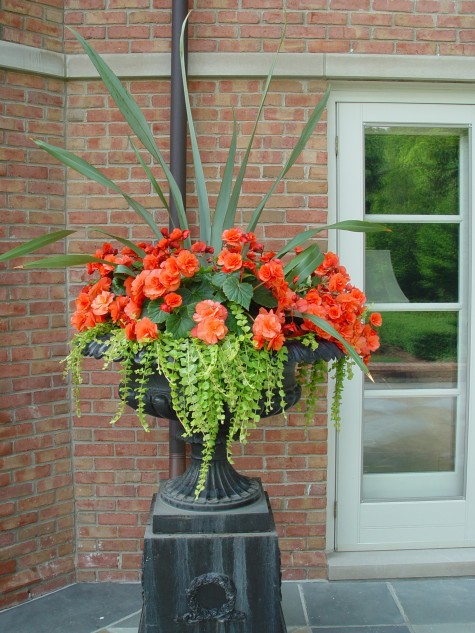
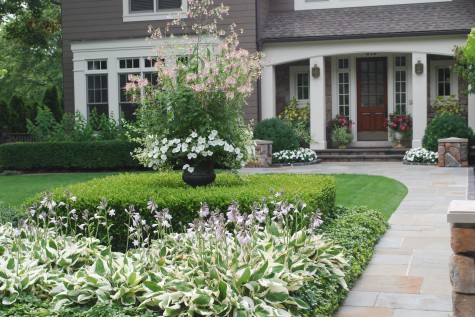
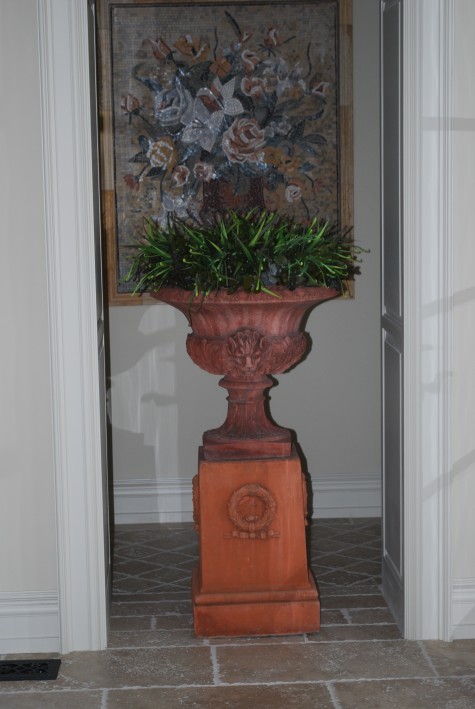
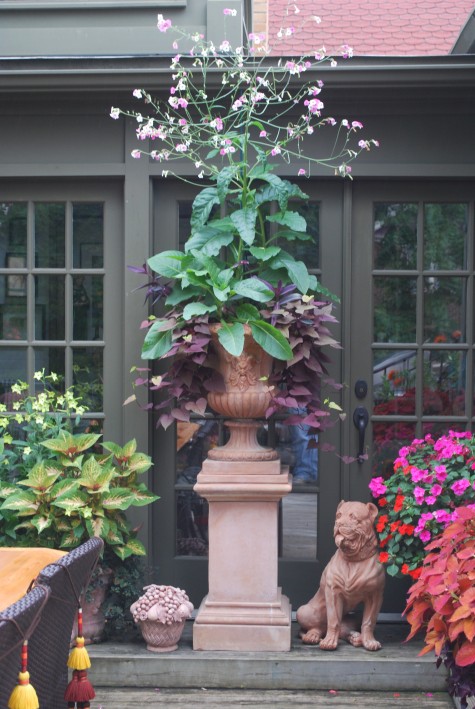 My own Italian terra cotta garden urns on plinths from Mital-I so love them. I trim what ever obscures their decoration. In the winter, I move them to my front porch, and plant them for the holidays. The rest of the winter they are empty, awaiting spring.
 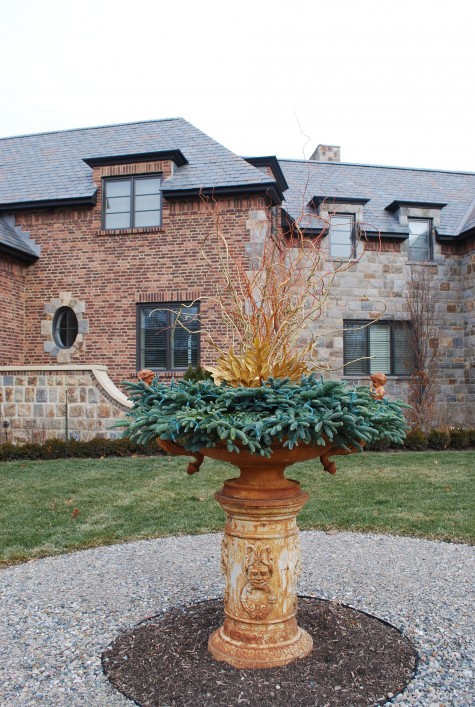 Antique urns take to a winter planting with ease. This client landscaped her yard to celebrate her fine antique footed pots. I completely understand this gesture.