Trimmed Up


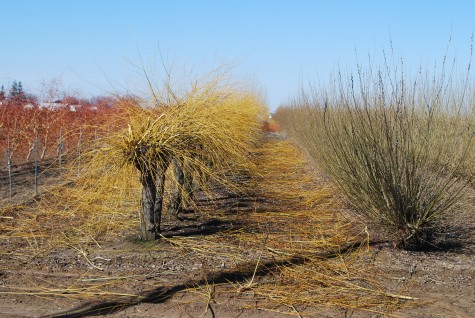
Last March, when I was thinking about taking on writing a daily blog for the first time, I had some ideas about it-not the least of which had to do with the seasons.  I wanted to write what I thought day to day-not especially about the past, and maybe a bit about the future.  The news of the day-in this I was most interested.  The winter is excruciatingly long in Michigan; making writing for day to day interest in the depths of my winter, for other gardeners stuck in a similar spot, a challenge.  In defense of the winter months, lots of design issues can be broached and discussed. I have done that, maybe in more detail than you like. The 2010 store collection and how it came to be looks great-but all of this is lacking a certain kind of life. No collection comes to life until the plants get here. All I have a mind to do right now is think and talk about plants.  Steve has been on a road trip, checking out nurseries from whom we have plants ordered and soon to be on the way.  Relevant to my Sunday post about pollarding, his photograph above is of a willow stock plant, being pollarded.  The branches will not be used for firewood, as they are frequently used in Europe-these rootless cuttings will be sent out to growers all over who wish to grow on this cultivar.  These trimmings will become trees someday.         
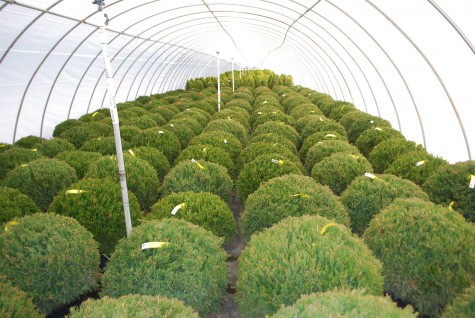
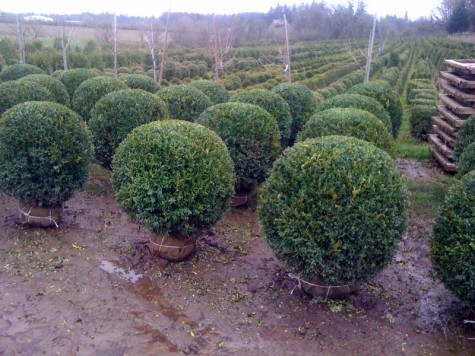
Some older boxwood specimens spend the winter in tunnel houses.  Winter snow loads can devastate what has taken many years to grow. A tiny boxwood you may purchase at a nursery most likely takes seven years to get to that 12″ size.  Bigger plants take many more years to grow.  Nursery people do what they can, to protect what has taken so much of their time and effort, to grow on. 
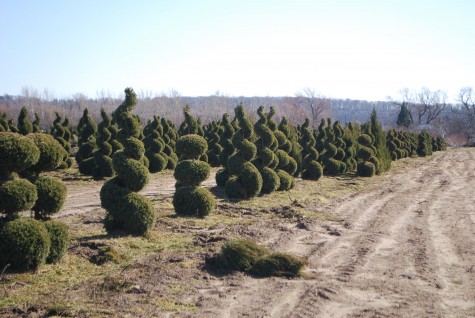
I so love this photograph of Steve’s.  The dirt road, impressed with dusty tractor tracks, is in stark contrast to these painstakingly grown and trimmed plants.  Wow-do you not think you are looking at an alternative planet?  Or at the very least an alternative idea about plants?  Like trimmed topiary plants or not, the energy, will and work cannot be denied.  Growers and gardeners-a relationship.
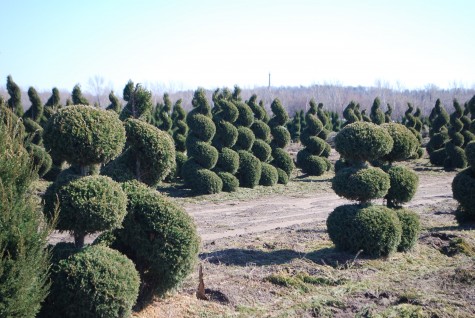
I spoke for a big group of these plants.  They are beautifully grown, and healthy.  But I mostly admire the hand in evidence that sculpted these plants.  Make no mistake-so many years, so much effort, so much passion-one has to pause and admire what made this field come to be.  Growers by and large have no prize in mind-they grow, and live to grow.  Their hands-I plan to celebrate them.  I am sure you do too.
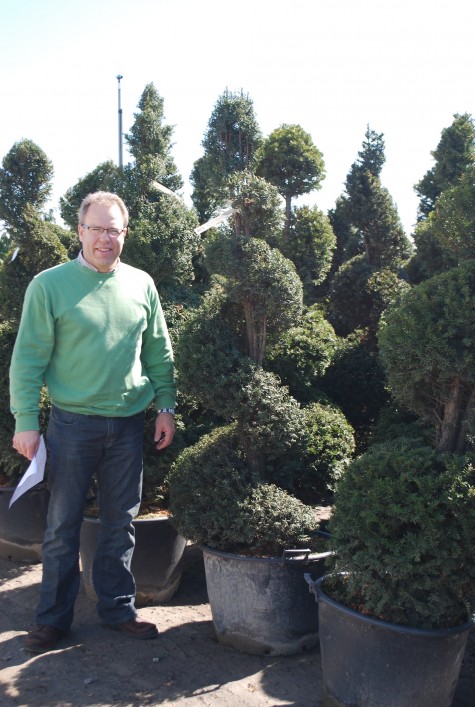
I see junipers grown and trimmed in this fashion regularly.  Yews grown like this-news to me. When I think old, gorgeous, and thoughtfully grown yews, I think England.  I am now seeing old and trained yews on my side of the pond-I will have some. Sensational topiary plants grown on this side of the ocean-I am clapping my hands. 
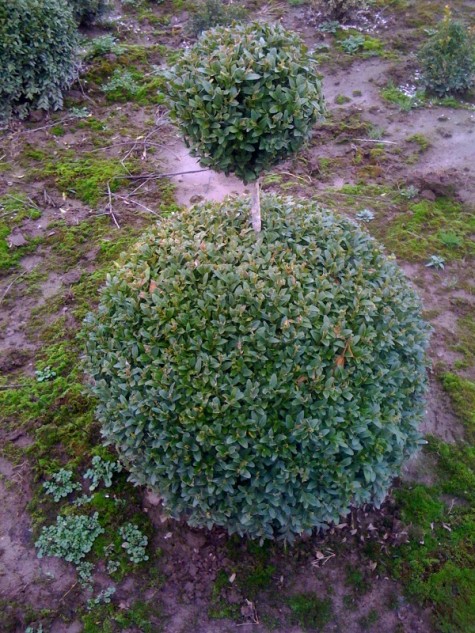

Buxus Sempervirens is not hardy in my zone.  I have avoided the plant like the plague-who wants to deal with a serious gardener’s grief when they loose a major plant?   I cannot plant this species of boxwood in the ground-all of us need to be committed to taking them into the garage for the winter. These topiary grown and trimmed boxwood would make my heart pound, planted in pots-a handtruck taking them to shelter for the winter is well worth the effort.    
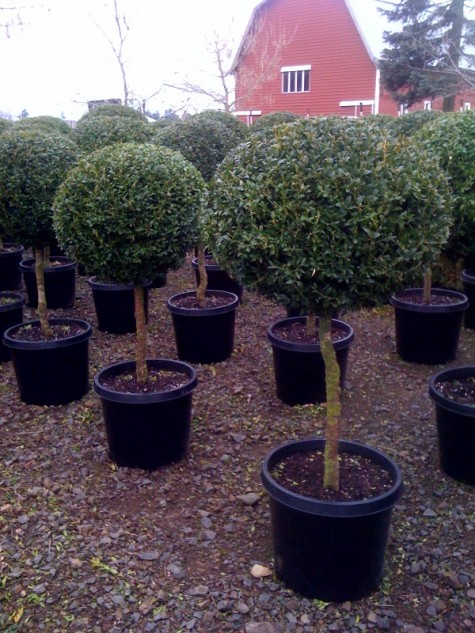
 My pots are standing, waiting for plant material of this caliber.  How they have been grown and trimmed up before they ever get to me-many thanks to those growers whose committment and investment stands largely behind the scenes.  The hands put to a living plant by any gardener-no matter personal or professional, no matter a home or a growing field-I so greatly value this.
 

Design Elements Matter


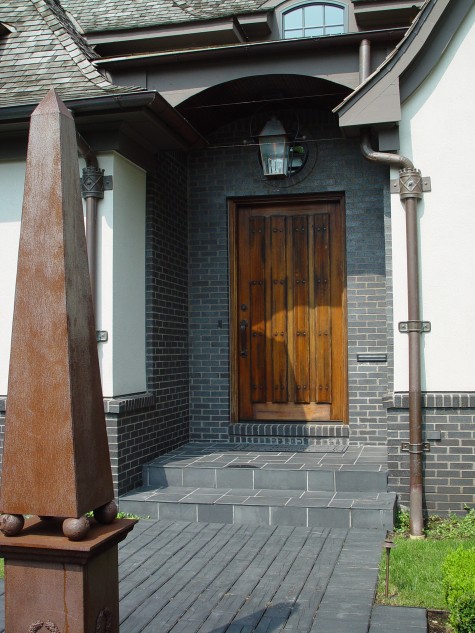
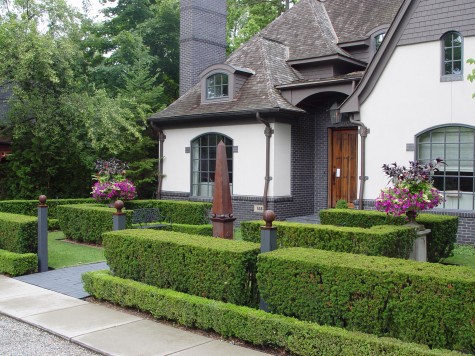
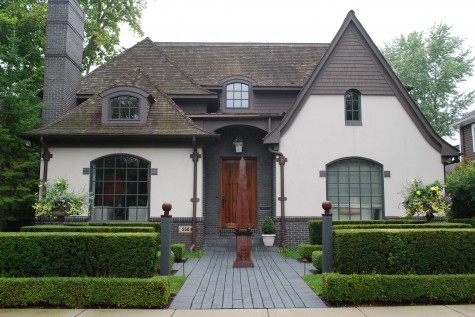
Those of you following this blog on garden design may be crossing your eyes and feeling like blacking out this past few weeks.  I have gone on about the elements of design-maybe too long. I try the best I can to illustrate, and not instruct.  My ability to peel off into a snow bank, or winter weary meadow, is a little compromised right now, so I have been photographing close to home and on solid ground.  When I am done apologizing, I am still left with the conviction that a clear understanding of the elements of design applies to any 4 square feet on your planet-your dining room, your kitchen, your garden, your driveway. No kidding.  I hope to illustrate and not instruct- via this very small property I landscaped some years ago.  Though the front door is massive, the property square footage is very small. No need to put the landscape under a microscope-the house came with an intensely small space. Every move counts.   

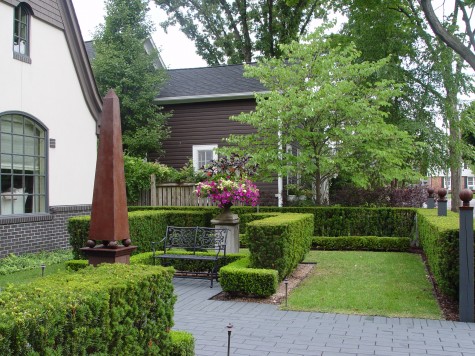
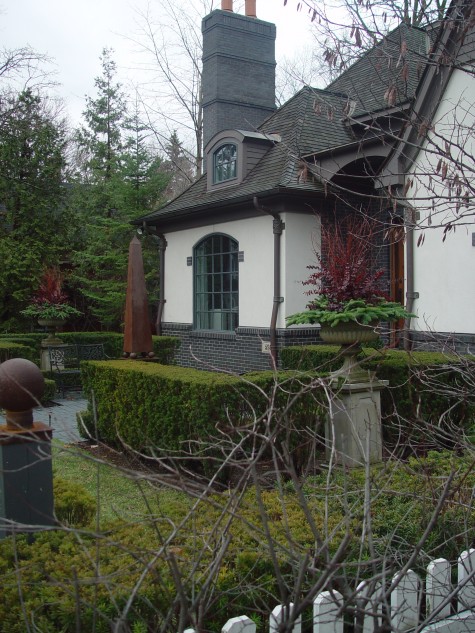
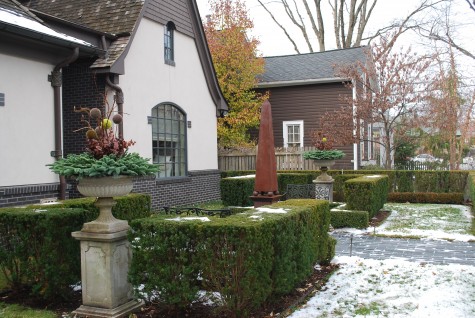
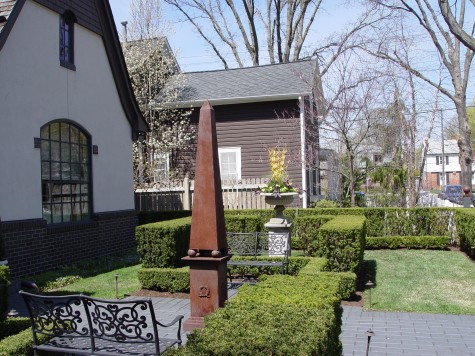
This landscape relies much on a configuration of evergreens that stand fast every month of the year. Whatever the weather. My original client sold this house some time ago-my new clients are grade A stewards-any beautiful old landscape is a direct result of the intensive care of the present, and not age-this idea via the essays of Henry Mitchell. The yew hedge fence, and its black stained posts and rusted finials, echo the rusted obelisk placed front and center.  A pair of pots on pedestals placed side to side, and planted for each season-who knew a pair of pots could rule a garden like these do.  


It cannot be 20 feet from the street to the front door.  I persuaded my clients to install a wood sidewalk-each length of pressure treated lumber was routed to resemble bricks-after one year of weathering, I stained them black.  There was a time when roads were made of wood-that history is not especially pertinent to this design. What is pertinent is what one sees.  A look needs to stand on its own, no matter any history or explanation.   A short walk needs a distinguising feature-a new thought.  Any gesture, no matter how short,  can illustrate a love of the out of doors without instructing. A wood sidewalk-different.  Still looking great after all these years-this I love. 

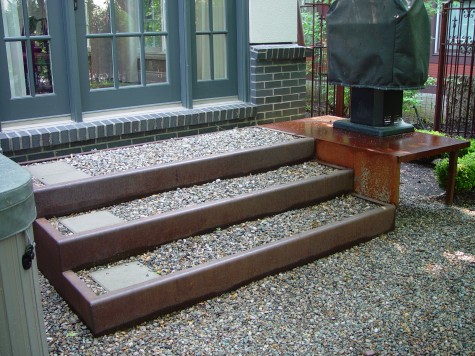
The rear yard-a patch of ground that would comfortably accomodate 12.  The simple solution-gravel the entire area.  Plant four lindens at the four corners, to provide some natural shade corner to corner.  The steps to the back door-I did not switch materials.  Simple in a small space means the repetition of one material amounts to the impact of many hands to the same end.  These corten steel risers retain the gravel surface steps.  On the floor, everywhere else, gravel.    

When winter comes, leaves are shed. Shrubs of great volume are but a shadow of their summer self.  The evergreens keep on going on- but what is remarkable here, given it is mid-January?  Those two pots on pedestals, stuffed with materials for the winter, carry the day.  The design elements in play here are many.  No need to know the words, if you can see.  

No matter the late lame snow, the design elements of this garden are strong; grown in. There is a living presence, and pattern, that pleases the eye.  Their garden ornament takes on a bigger role in the half year we know as winter.  I like my front garden and landscape to be eye-ready, no matter the season.    

Once spring comes, we change out those pots.  Their idea of spring brings the neighborhood to life -many houses on this street do much the same.  Designing thoughtfully to the betterment of all -what a great idea.  Those elements that make a difference-take some time to look, and make them work for you.    

Contrast

The contrast between Milo’s white fur, and the mud he’s been running through and spattering all over it is quite spectacular, is it not? I admit I could not take my eyes off of him. Contrast is all about those elements that are set in strong opposition to one another.  In his case, clean and pristine white versus mud-dirty black. Contrast can be expressed in many ways-big versus small, textured versus smooth, light and dark.  Relationships that emphasize differences are what creates contrast. In any case contrast is like a tuba in a brass band-oom pah pah.

Contrast creates interest and excitement.  The figures in this plaque were carved in such relief that they almost leap off the wall.  The physical depth from the back plate to the outstretched hand of the most forward cherub is great-and even more greatly exxagerated by the late day sun.  The slanting sun makes the darks very dark, and the lights almost white. There are not so many shades of grey.  Like a silhouette, black and white makes the ultimate statement about contrast.    

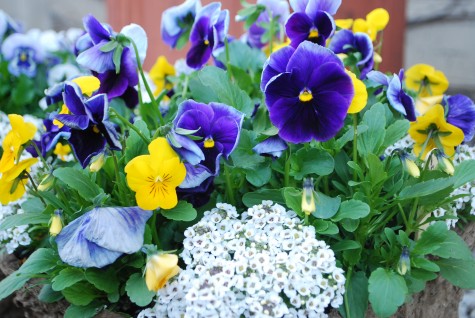
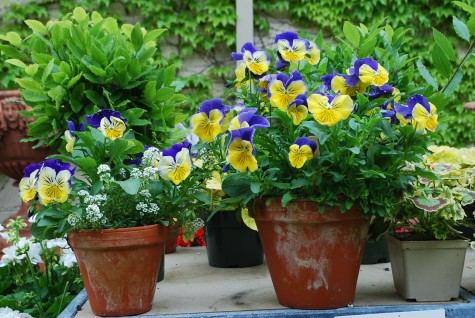
Color contrasts make for lively compositions.  Purple and yellow together is a loud conversation across the color wheel. The white alyssum is a contrast in texture with the smooth textures of the pansy petals and leaves; there is a second conversation going on here.  White contrasts dramatically with any intense color, and attracts attention from the eye at a distance.  Small compositions can have big impact given a dose of white.  This little eight inch pot has a lot going on for its size.

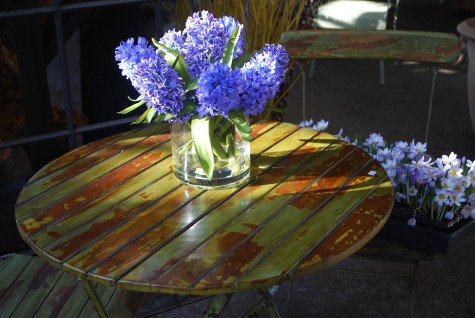
Metallic or shiny surfaces reflect light.  But in this case, the contrast is relatively low.  There are blacks, and shiny silver in this composition-but lots of grey tones in between.  The eye moves from white to black with a lot of steps in between. This picture is easy on the eye, as the contrast is low. 

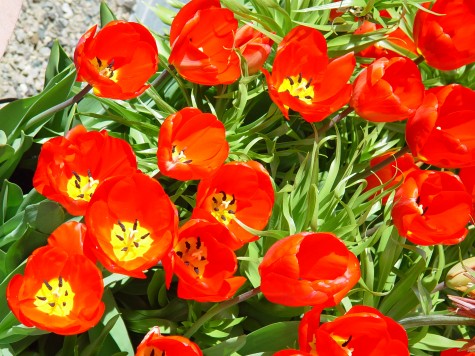
These electrically fiery red tulips set aginst their cooly green foliage is anything but calm and soothing.  This has the same impact as a thunderclap right outside your bedroom window in the middle of the night.  I wouldn’t anticipate anyone not following the contrast analysis here.  The important part is choosing great contrast where it will be effective in a garden, and making a conscious decision for quiet where the garden benefits from quiet. 

 Subtle contrasts are not always so easy to spot-or plan for.  Huge swaths of impatiens have cache from their mass, but they also may have that air of a shopping center planting.  A group of shade tolerant plants providing contrasting textures, sizes and colors can be vastly more interesting. It’s important to pay attention to the stems and foliage that come with a flower-they are better than 50% of the visual output of the plant.  Liriopes in pots-upright and grassy in texture, look great with green dichondra-that silvery round leaved trailer.  They contrast in every way except their color.  The fingered leaves of hellebores are all the better for a pairing with sweet woodriff.  Their overall shape is very similar; their size differential is dramatically contrasting.

Some contrasting elements are slight-but enough to make a big difference.  These V shaped steel pots are so much more striking for the steel bands that describe their shape. The banding catches the light, and solidly finishes the form. 


I have a particular fondness for a little color sass in the spring-for all the obvious reasons.  They make a brave face when it’s still very cold here.  I won’t want yellow and purple in my summer garden, but this kind of one-two punch is perfect for April. I’ve had temperatures in the 60’s the past two days-what a lovely contrast to my winter.

Sunday Opinion: Success

Though there is nothing revolutionary or even provocative about the idea, I have been thinking about it. That is, that nothing makes for enthusiasm quite like success.  A friend was asking about my very first garden-what exactly was that like?  In 1980, armed with 4000.00 in cash from the sale of my first house in Ferndale, and an 8000.00 loan from my grandmother, I was able to buy a house and 5 acres in Orchard Lake for $60,000.00.  How so?  Though Orchard Lake is a very nice community and five acres is a whomping lot of land, we were in the middle of a recession, and the house in question was a disaster in every way.  The furnace had been installed in a dirt hole under the house-a ladder was required to go take a look at it. The first spring I lived there, said hole flooded; I had no heat at all after April 1. Every other part of the house was on a par with this, or worse.  The house was so bad, I had to get homeowner’s insurance through a state pool of high risk properties. I was 30 years old-what did I know?  All I could see was the property-and the possibilities that property would afford me.  My Mom cried when she saw it-I remember being so annoyed with her.  I had enthusiasm-what else did I need?

I actually needed plenty, and couldn’t afford one thing, once the mortgage and that insurance was paid every month.  We knocked down the garage, whose roof was balanced on unmortared columns of concrete blocks, and disposed of it one truckload at a time.  The hand-excavation for the drive-in garage had left the foundation of the house exposed-an excavating guy said he would bring in 300 yards of sandy dirt, and rough grade it all for 2000.00.  Nana to the rescue, a second time.  I think she had more confidence that I could make this work than my Mom.  She decided up front that if I could not make a go of it, she would bail me out.  She never said so out loud, but I think from the start she insured me against disaster.

But back to my first garden.  I was left with a really roughly graded, unmowably steep slope of a giant size-now what? Most of the gardening I had done to that point was confined to reading and mooning over plant catalogues, and garden books from the library. I had a few beds around the house-a few great plants trying to survive the weedfest. Not having an unlimited budget, I wanted plants that would spread.  Ground covers for sun.  Many sunny groundcovers came under the heading of rock garden plants-so I decided I would have a rock garden.  A sympathetic neighbor with an ancient Ford tractor dragged huge rocks from the property up to the top of the slope, and  turned them loose. Gravity made half the placement decisions, the puffy new soil the other half.  My rocks sank like the stones they were- at least half way into the ground. My first success-each rock looked like it had been there long enough for the earth to come up around it like an opulent stole.

My second success-what dumb luck that the soil that came to me was very sandy, and well drained, as most of the property was intractably heavy clay.  I spent what seemed like a king’s ransom on little spreading plants-but the sheer square footage of the area swallowed them up.  Not having one clue about mulch or weed prevention, I weeded-for years and years- before it filled in. Then I moved into crown growing plants, for a little vertical interest. I had myself a rock garden.  Dianthus, saponaria, aethionema , thymes, species tulips, iris chrysographes, and forrestii-and my favorite-encrusted saxifrage.  I could not get over the fact that the saxifrage leaves were stone-limestone- encrusted. I still can’t. My plants grew, and that success fueled my enthusiasm for more.  When I sold the house fifteen years later, it was actually liveable.  But what I hated leaving behind the most were my gardens. The rock garden was my first on that property,  but not my one and only.

My success had mostly to do with fortuitous accident.  I would never have dug out 1000 square feet of sod for a garden all at one time-not then.  The sheer size of the area of bare dirt forced me to deal with the space as a whole.  I planned little plant villages and neighborhoods. I had an east coast, and a west coast.   I saw where the water ran downhill in a fierce rain, and gravelled those gullies. I planted accordingly. I had a country going on, and it was my job to govern the whole thing. The spots I could see coming up the front walk got my favorites.  On my own, I would have started small, and added on.  What is it about add on’s that they always look added on? The sandy gritty soil-I am sure my excavating person had some he wanted to get rid of, or perhaps it was on special that day. Wherever it came from, my rock plants loved where they lived. 

My best friend Margaret gave me Louise Beebe Wilder’s book “Pleasures and Problems of a Rock Garden” written in 1938;  she had inherited it from her gardener father.  I quote from her chapter “The Steadfast Sedum”:  “No stonecrop, we are given to understand, would have the heart to blast our budding enthusiasms by refusing to live; any soil will suit them, any situation, and they increase at a rate unknown to other rock plants.  Pin our faith to sedums, and avoid despair.”  I took her advice when ever possible.  She wrote about rock gardening with such great enthusiasm.  Phlox subulata, she writes, has “radiant color, rich fragrance, and almost universal amicability”.  Who would not want to grow that? I about wore that book out, as I read for the pleasure of her writing, and I read again for her instruction and encouragement.  I loved the sedums sight unseen-they were going to help me have a garden.

Some thirty years later, I am still interested in this idea of success and enthusiasm.  No one can be enthused about dead or near dead plants. Or a groundcover bed overrun with quack grass.  In some cases, I am unable to intervene; who knows what people do with their plants when I am not looking.  But anyone who wishes to grow a garden, or redo a landscape, or plant some pots, has the ability to help themselves.  Nurseries put tags in their pots of plants; more than likely someone works there who gardens at home.  My very first gardening job was at a place where I bought iris and daylillies by the trunkload. My ideas of a vacation is visiting a nursery.  I am possessed and obsessed by gardening.  Lacking this, trees come with planting instructions. There are books. There is the encyclopedia interneta. Every gardener knows these things; what can be much tougher is figuring out who you are. That will tell you what kind of gardener you might become, should you hope and plan to.  Plan for success, and work hard.  You’ll be a better gardener for it.