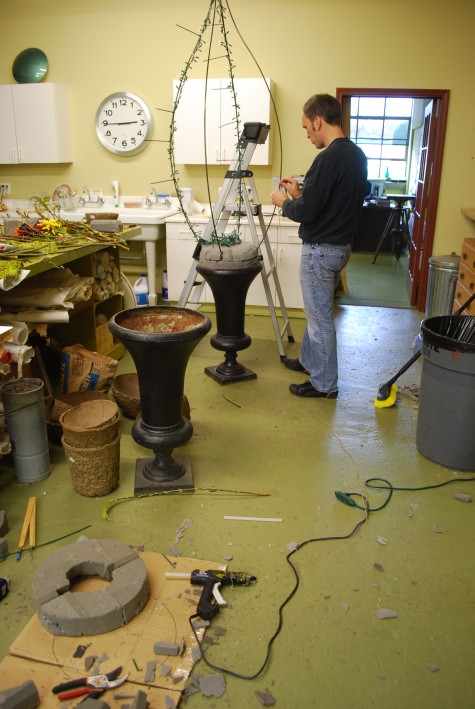
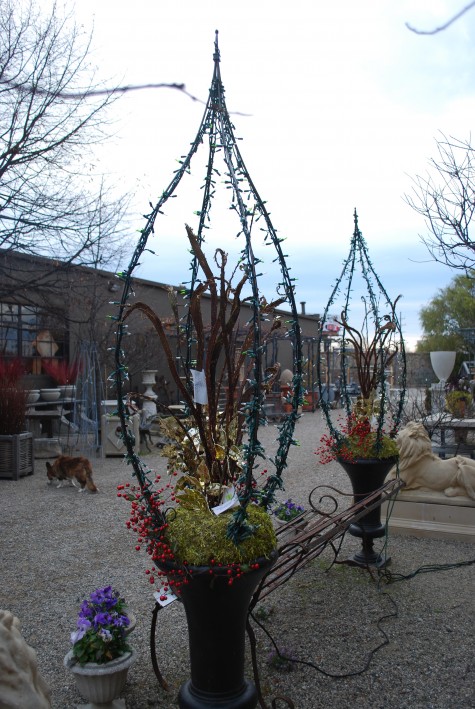
 Our entire method of sturdily constructing an arrangement for a winter pot is predicated on one concept-you have to create the roots, and the trunk. I rarely worry about my summer pots going out of kilter. The roots of the plant secure them to the soil; plants grow upwards, towards the sun. I do not have that luxury in the winter, and Michigan has more than its fair share of stormy winter weather. So the mechanics of fastening all the materials is really important to the longevity and beauty of the piece. Tall skinny pots like these get lots of gravel in the bottom; a large centerpiece can be a big sail in disguise, just waiting for a decent wind to get airborne. We then construct a form in which to secure all the materials-glued up with industrial strength hot melt glue-that sits tight in the container. A loosely fitting form is just asking for trouble. If you have ever tried standing up in a pair of ice skates that do not lace up tight over your ankles, you know exactly what I am talking about.
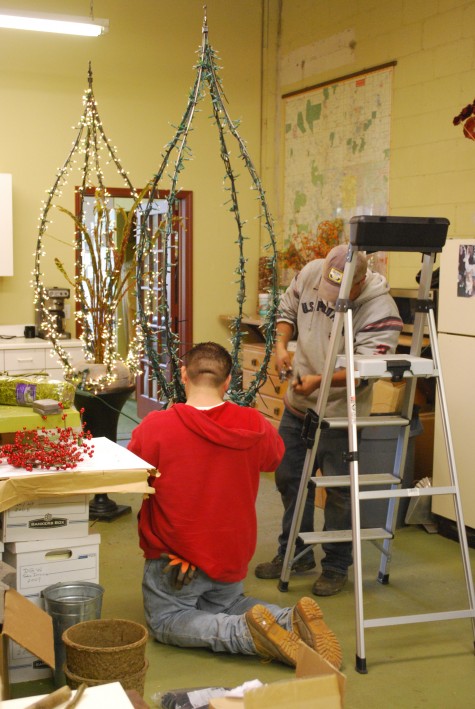 These pots will have lights in the vertical dimension; a steel form provides stability as light strings are heavy. They also make it possible to cleanly and crisply mimic a geometric form. As light strings shapes are governed by gravity, a rigid form insures they will be representing the form you choose for them today, next March.
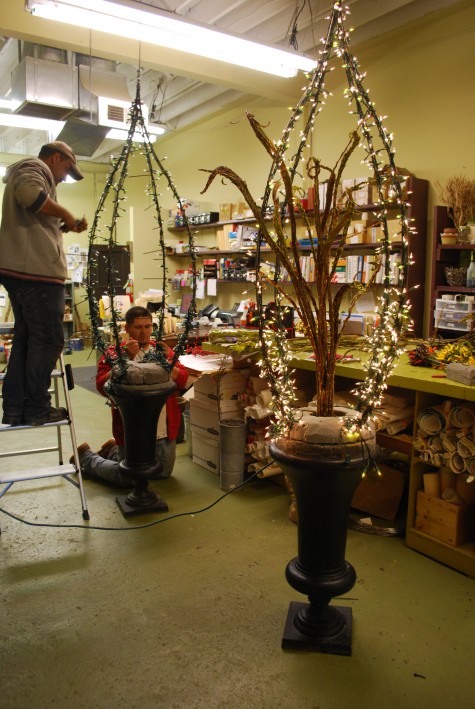 Winding the lights around a form is time consuming. It also makes the removal of the lights tedious. Zip ties make for an easy in and easy off. It’s also easy to spot in the above picture how close we space those zip ties; the closer, the better. Light string wires have strong kinks and curves when they come out of the package, but droop they will, given time. They do not hold a graceful curve on their own; we are generous with the fasteners. The centerpiece is set through a hole in the center of the form; a stout bamboo stake at the center of the arrangement goes far enough down into the pot to insure it stays vertical. There is something so wrenching about a listing centerpiece-who needs that in the winter?
 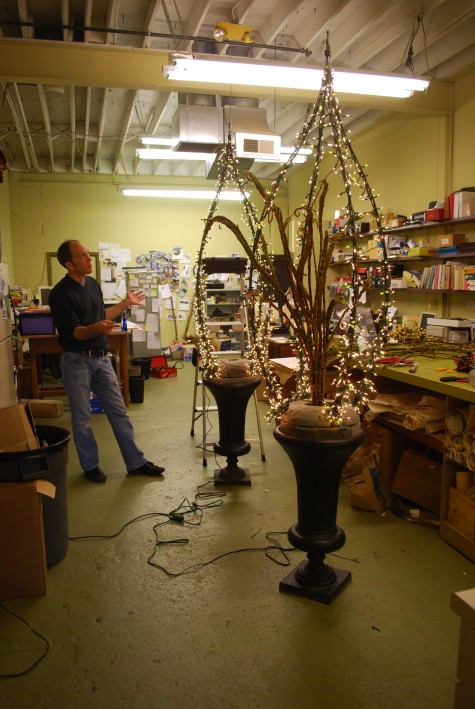 The fantail willow is set into the form based on a determination of the front elevation. When pots are placed such that they can be seen from all sides, we work in the round. As the form will be covered in a skin of lichen mat, the form is shaved into a rounded shape.
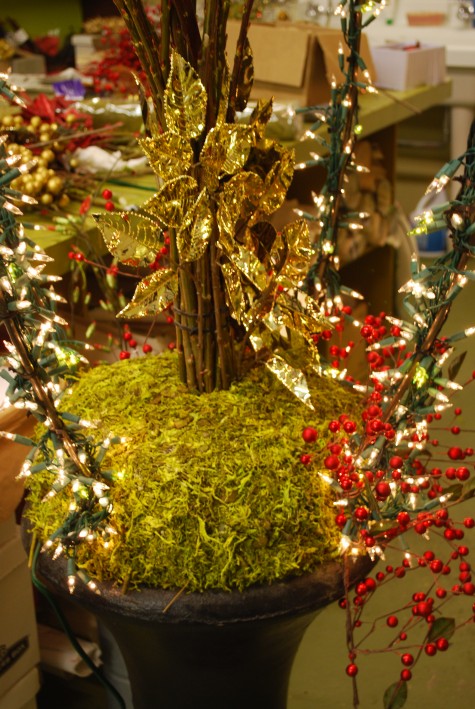 Once the form is covered in the lichen, we add a little icing to our lichen cake-just for the holidays. Gold leaves and a luminous red berry garland-yummy. These elements can be removed after the first of the year, so the pots look good throughout the winter. A client can use the lights in the winter-or not. The topiary form has a decidedly dressy look to it, with the added attraction of absolutely no maintenance. It will still look fine come next April, provided the construction is sound.
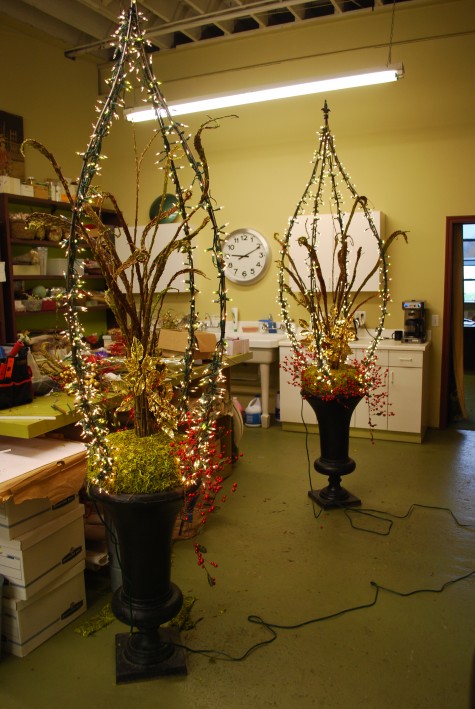 Getting the installation to match in a pair of pots is harder than you think. I try to work on pairs side by side. Some pairs of pots that demand a very formal arrangement, I make sure that one person does both. Everyone’s eye and hand is noticeably all their own. My rule of thumb-I work on the second pot, never taking my eyes off the first.
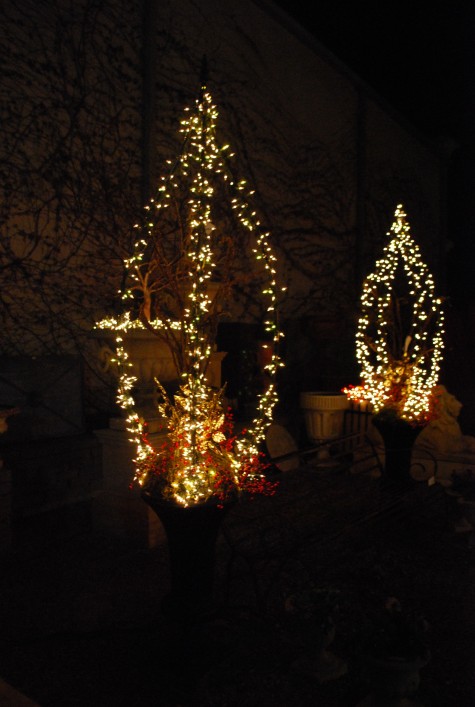
Day and night-never is that idea more evident than in a winter pot. In high summer here, daylight persists well past 9pm. Very shortly now, it will be dark at 4pm. Day length has everything to do with the onset of flowering in plants. How I design the winter pots respects this science, in a parallel way.
 Your winter pots are the best they will ever be, the first day they are done. Unlike a landscape that fills out, and blossoms with age, there is no growing involved. They need to be constructed tall, wide, and robust from the beginning. The winter is a season that can handle a little unedited excess, with a dash of over the top sparkly, with aplomb.
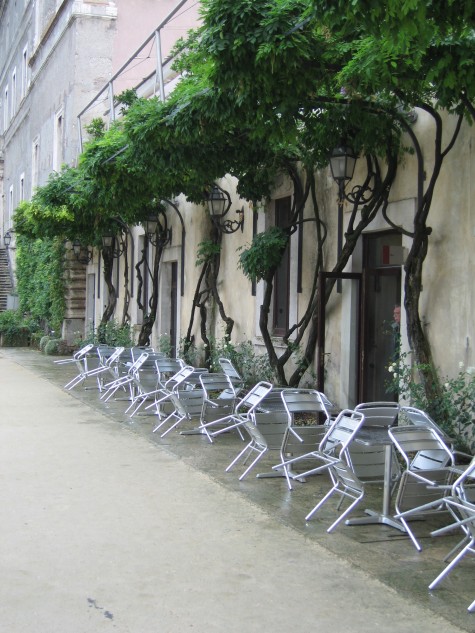 Vining plants have a very special charm. Provided they have secure support, they take up little to no room in a garden. Most of them are energetic growers; this I especially appreciate in a plant. Wisteria gives new meaning to the phrase “willing and able”, but with proper support and ruthless pruning, their sculptural effect in a garden will rival their long and languid racemes of flowers in June. I would only advise that any thought of planting wisteria should be undertaken in tandem with where the iron will come from. Iron support, and iron fisted supervision are must haves. Any other scenario risks waking up to it growing in your bedroom window.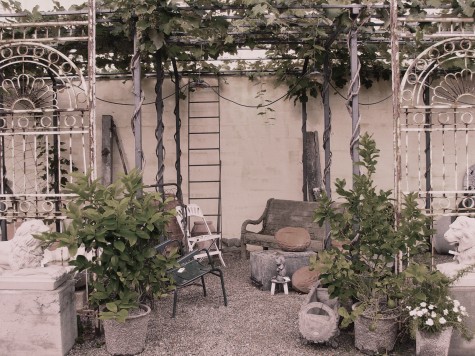
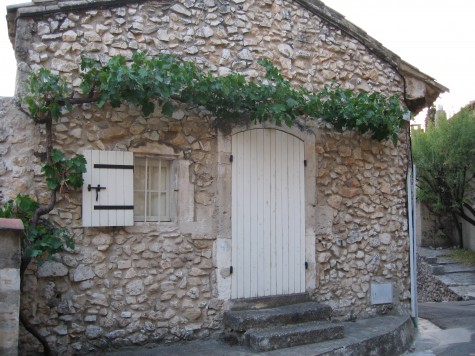 Grapes are like any other vine-lax in habit, and best grown within the confines of a well run dictatorship. They are sterling performers with a good gardener at the helm. But like the willows and dogwoods I discussed yesterday, their strong suit is about the harvest. I will never grow grapes for the table or for wine; I suspect the art and science behind that is considerably more than I imagine or could grasp. But I do value the look and feel of ornament made from materials from the garden.
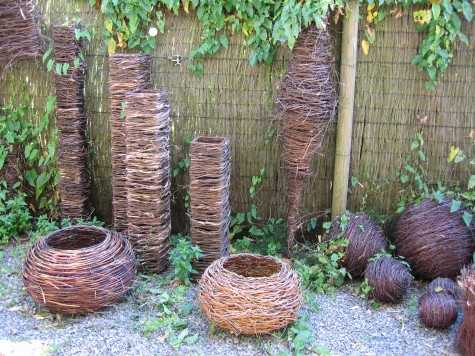 My shop has featured many garden ornaments made from vines and flexible twigs over the years. They never seem to loose their appeal. Those woven over a steel framework have an astonishing long life; they are as beautiful breaking down as they are brand new. Every year I pick up a large French basket from a client planted with a colony of medium sized agaves, amazed that it is still all of a piece. Enamoured as I am of Belgian design both inside and out, these airy, often hairy objects are a beautiful foil to brick, plaster, stone, concrete and iron.
 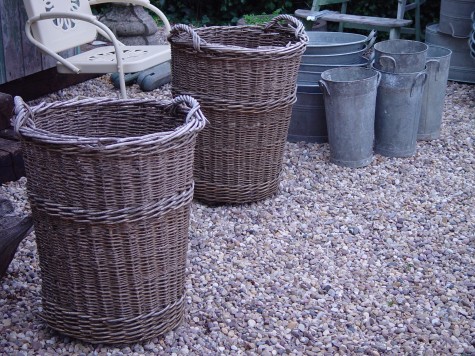 Only in England would you find a business named The English Hurdle and Basket Center. Despite sounding like remedial center for floundering collegians, it actually produces vessels and baskets of great artistry. The graceful shapes belie the skill and strength needed to form them. The artist Serena de la Hey, for whom I have the greatest respect, creates truly inspired sculpture for the garden. My very first purchase for my shop in 1995 was a order for one of her boar sculptures. She is well worth a look;
 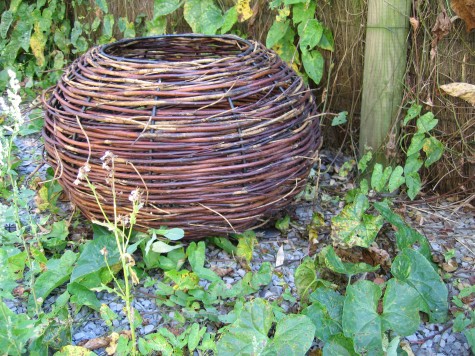 The framework that is visible here makes the object eminently renewable. Though the wood and bark of willow is remarkably resilient to weather, it will eventually deteriorate. I appreciate the chance to renew, redo, and rethink an object; this is a good part of the appeal of twig and branch sculpture.
 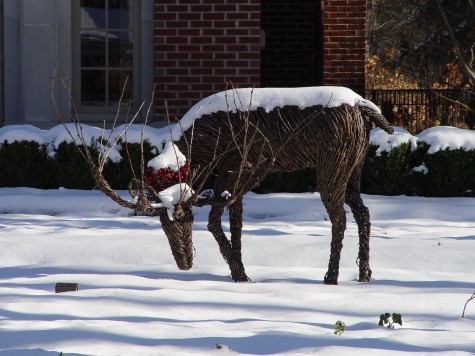 Though this stag looks perfectly at home in my client’s landscape, it is made in California. The metal frame will last a lifetime. The willow is painstakingly woven; the sculpture is heavy and sturdy. Carleen’s life size animal sculptures are enchanting. I have seen enough of them to recognize which of her artisans is responsible for a specific piece. This is grape vine, beautifully rendered.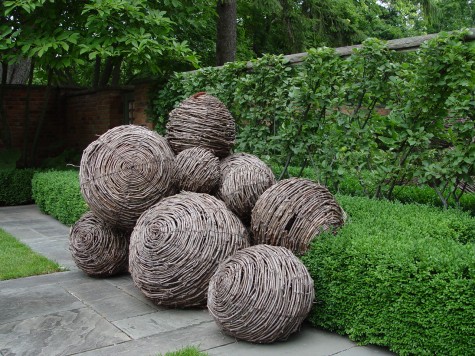
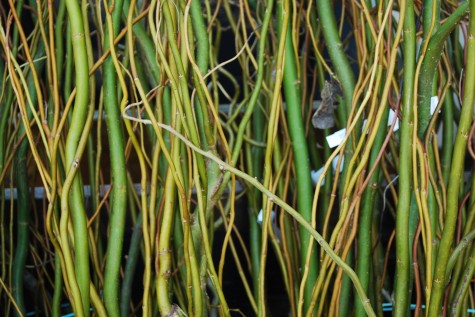
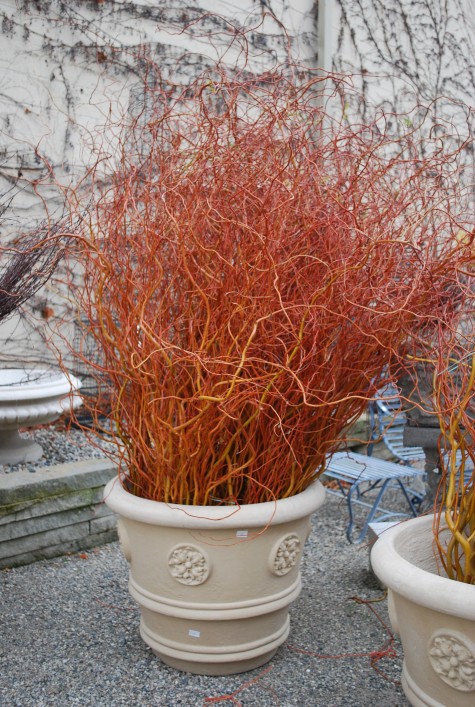
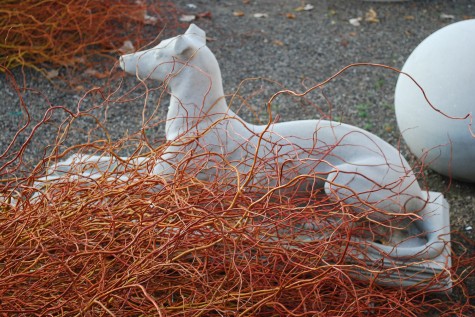 The golden coppery orange is a great foil for the landscape gone to black and white. The fresh branches are limber and pliable. The curly tops can be tied up in a good approximation of a pony tail, or twisted and tied into new shapes not necessarily natural, and perhaps more contemporary.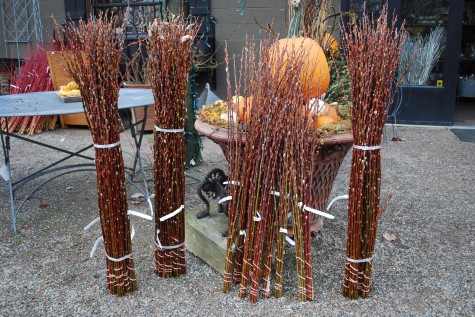
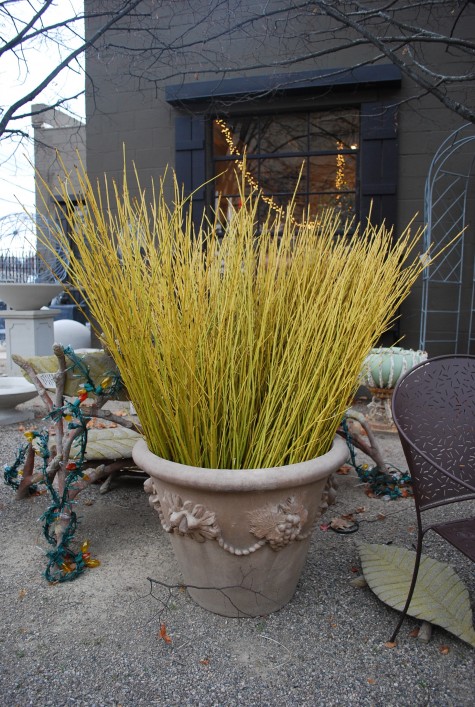 The shrubby dogwoods are every bit as useful as the willows. They also produce the best color on new wood. If you grow these dogwoods in your garden, be sure to prune them down regularly and hard. The old bark of shrubby dogwoods is dull, and invariably scarred by exposure to weather. I rarely see yellow twig dogwood planted any more-plants do go in and out of fashion. This cultivar was specifically bred for color superior to the species- and it delivers.
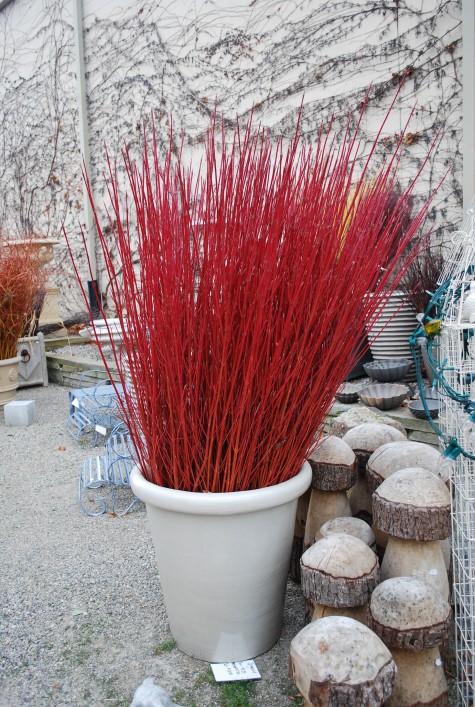
 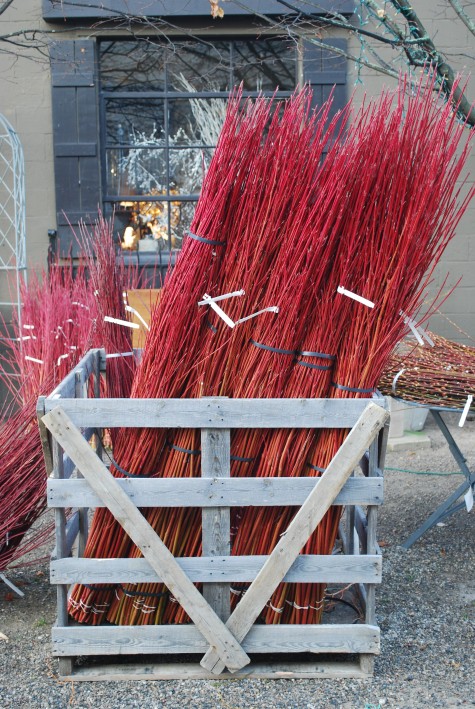 Many cultivars of red twig dogwood are available now. With bark ranging in color from pink-coral to coral, orange red, fire engine scarlet red, and maroon, these twigs make quick work of banishing the winter gardening blues. This cultivar, aptly named “Cardinal” is the brightest red bark I have ever seen. The 1500 stems in this crate makes me wish I could see the entire field from which they were cut-the day the leaves drop. I would bet that view is a perfect gardening moment.
  Whatever you might fancy, the dormant garden has plenty to recommend it. The gathering of materials, and the act of decorating for the cold season is an act of Mitchell-esque defiance I can get right behind.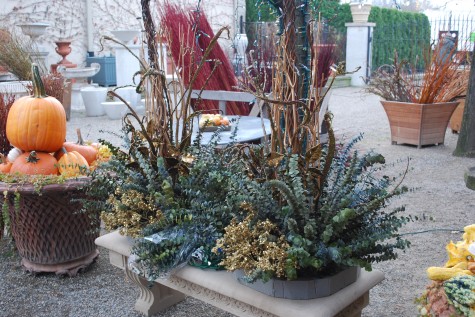
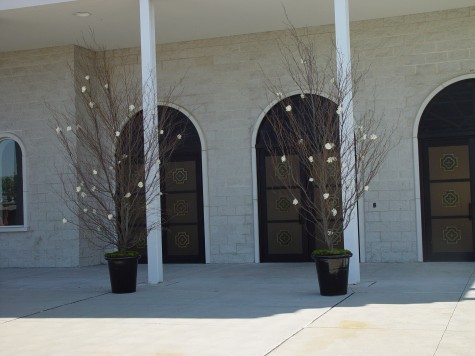
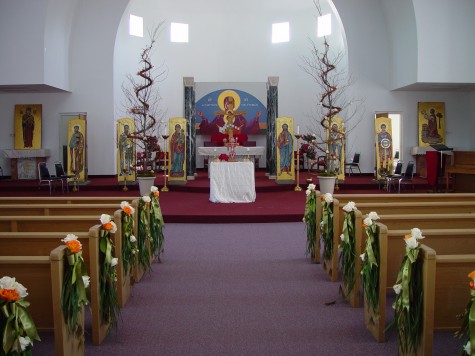 This gorgeous Melkite Catholic church needed little in the way of decoration; the beautifully vaulted white-walled interior was formally appointed with iconographic paintings of figures central to their faith. I found four 3″ beech that had not survived the season in my landscape supplier’s bone yard; they would be destined for another kind of life. Bare grapevine garland would be dressed up with bitterweet vine and the rose “Hollywood”. No other white rose opens so beautifully, and stays fresh longer, out of water. The pews we marked simply with sprays of grasses with seed heads intact, to which we added orange and white roses. The dressy olive green double faced satin formally acknowledged the space, and the occasion.
 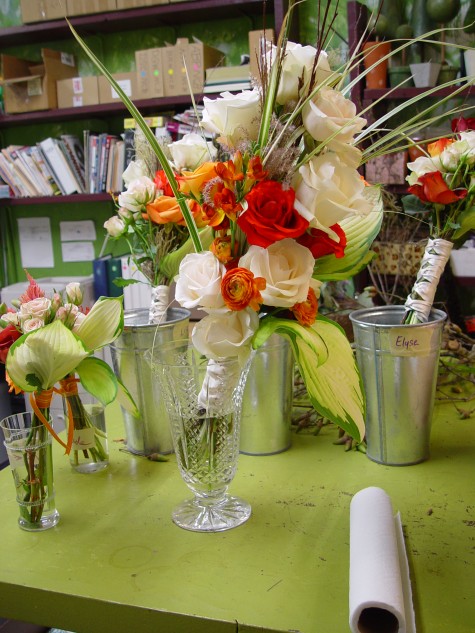 Even the bride’s bouquet included delicate birch branches. Variegated miscanthus grass and hosta complimented the orange freesia, ranunculus and roses. The bare stems were dressed in braided satin ribbon; the contrast in materials is particularly lovely.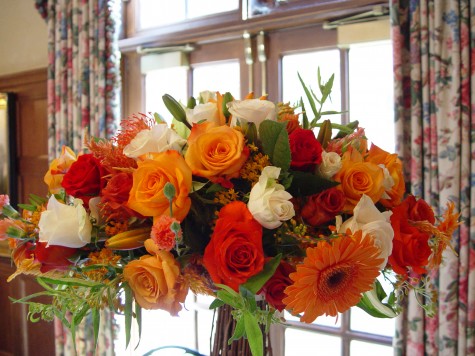
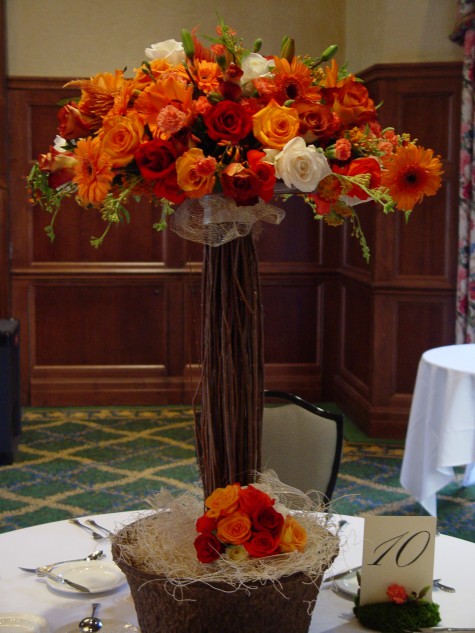 Stout bundles of willow sticks get my flowers in the air. The rustic fiber pots filled with hemp fiber make an unmistakable reference to the garden. The metal pole set in concrete not seen here is an apparatus which keeps the flowers aloft securely.
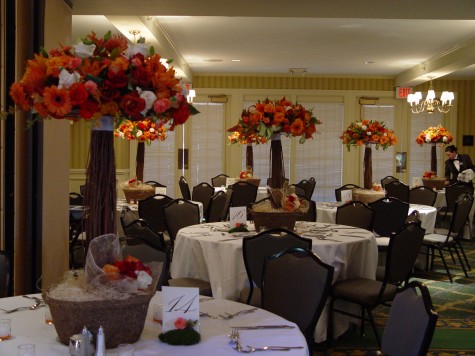 The generic quality of the room fades away; what is left is a celebration of saturated fall color, and a very important event involving family and friends. The tabletop level decor has interest and presence which will please the eye, but not obstruct anyone’s view.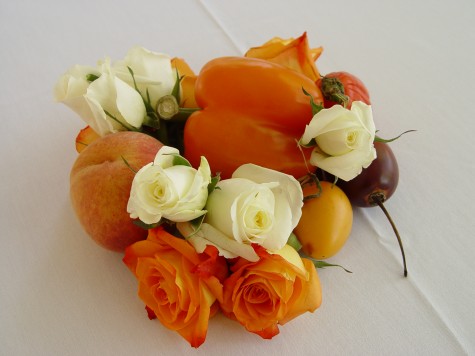
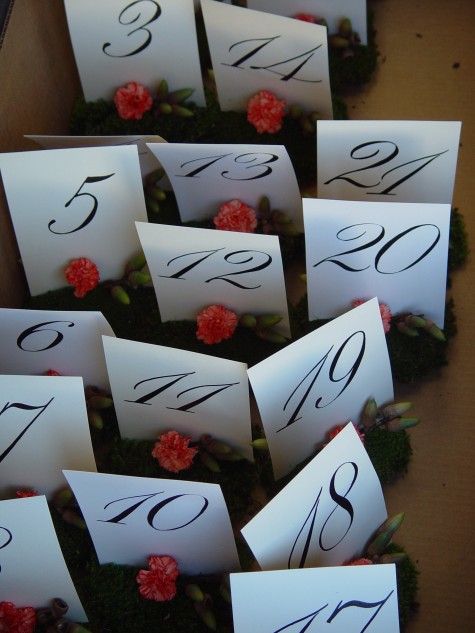 Celeste provided the table numbers, the calligraphy of her own hand. Large pieces of mood moss, when grooved, made naturally beautiful stands. The fresh green acorns-another nod to the season.
 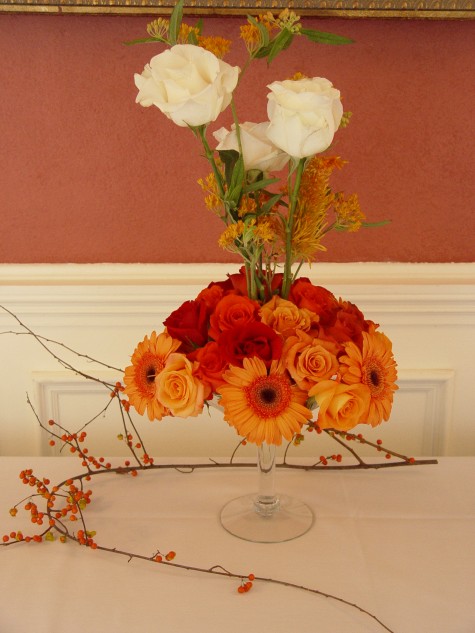 The effect of these flowers is so enhanced by the company of a length of bittersweet vine. The vine creates a visual context for the flowers. The creation of a visual world complete and believable is a daily challenge in the store; important events demand this too.